http://www.jscdss.com Vol.2 No.3 June 2015: 14-19 Article history:
Accepted 28 April 2015 Published online 28 April 2015
Journal of Soft Computing and Decision
Support Systems
Performance Evaluation of Turbo Code System under Jamming
Environment
Roya Tavakkoli a,*
a Universiti Teknologi Malaysia, Faculty of Electrical Engineering, Skudai, Johor Bahru, Malaysia, 81300
* Corresponding author email address: [email protected]
Abstract
This paper evaluates the effect of Frame- size, Code rate and Decoding iteration as efficient parameters on turbo code system performance. For this study, first a turbo code system was simulated by MATLAB software to study the effect of mentioned factors in different ranges of value on performance of turbo code system and then the performance of turbo code under the effect of jamming signal was evaluated to investigate the effect of jamming signal on bit error rate (BER) performance. The results show increasing the Frame- size, Code rate and decoding iteration, better BER performance of turbo code system is achieved and also it is deduced from the results that turbo code system can act as good anti-jamming code with acceptable code rate.
Keywords: Turbo code system, Jamming signal, Frame-size, Bit error rate, Decoding iteration, Code rate
1. Introduction
Channel coding is a technique which can protect the transmitting information against noise and interference that cause Bit Errors. Using error-correcting channel codes, the number of bit errors will be reduced and also it will allow Shannon limit which is maximum rate of transmitting Signal over a channel (Claude et al., 1993). According to the channel coding, redundant bits are added to information sequence due to assisting in detection and correction of bit Errors. Channel codes are divided in to two important groups, block codes and convolutional Code. Due to the importance of Shannon limit that has been achieved by Error – correcting channel codes with large length, the required power for decoding such large codes make this process impractical so new class of convolutional codes called turbo code which transmit information through the noisy channel with low bit error rate is introduced to overcome this problem by utilizing its recursive encoders and iterative decoders. Turbo code uses parallel concatenation of two recursive systematic convolutional codes fed by two information sequences which are separated by an interleaver. Decoding this class of codes is based on iteratively decoding process and passing the so-called extrinsic information to the next decoding stage (Sergio and Guido, 1996).
Jamming is one of the most important communication problems that prevents receiver from estimating many unknown parameters of signal. Jammer sends its power in to the same frequency band with signal
and causes signal becomes disrupted (Pierre and Ralf, 2005). Furthermore, for more accurate estimation of signal, receiver has to characterize jamming signal and distinguish between jammed and un-jammed symbols (Jang Wook et al., 2006). According to the direct relationship between BER performance of turbo code system and effective parameters of code rate, frame size and decoding iteration, turbo code system is a useful method to decrease bit error rate in the presence of jamming signal. In better word, turbo code can be used as a method to decrease the effect of jamming signal, so it can be a good anti-jammer with acceptable code rate. Although the effect of mentioned parameters on turbo code performance was considered, in this paper performance is evaluated for different ranges of code rate, frame size and decoding iteration which can be summarized as 1/2 and 1/3 for code rate, 500,1000,1200 and 1500 for frame size and 1 to 5 for decoding iteration. Besides, to show turbo code system acts as good anti – jammer different percentage of total bandwidth is jammed and amount of BER for 25%,50%,70% and 100% bandwidth jammed is compared and conclusion is made based on the results.
2. Components of an Anti-Jamming System Based on Turbo Code
Furthermore, for more accurate estimation of signal, receiver has to characterize jamming signal and distinguish between jammed and un-jammed symbols (Jang Wook et al., 2006). Considering jammer can produce for a communication system, it can be concluded that jamming is one of the most important communication obstacles that prevents receiver from estimating many unknown parameters of signal. In this work, noise jamming which is categorized into Partial-band Jamming and pulse jamming is considered as a main issue. Besides, Performance of turbo code system is evaluated under the effect of partial-band jamming which jammer concentrates its power over some parts of the total bandwidth so it will be more effective (Claude et al., 1993).in this study, turbo code system is utilized to investigate the probability of acting as a good anti-jamming against partial-band jamming. The components of a turbo code system which are considered in this work are as follows:
2.1. Turbo Code Encoder
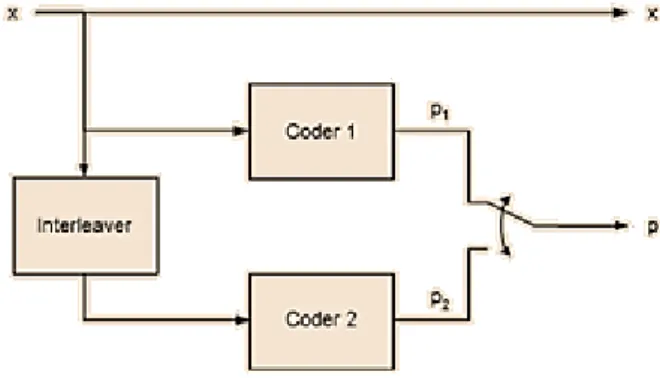
To perform better in low signal to noise ratio (SNR), turbo code uses parallel concatenation of two recursive systematic convolutional (RSC) codes that are separated by an interleaver (Claude et al., 1993). At the same time information is encoded by first encoder and then interleaved and encoded by second RSC. But only one of the systematic outputs of the encoders is used, because the systematic output from the second encoder is just a permuted version of the first encoder systematic output (Fu-hua, 1997).the output from the two components RSC codes will be then multiplexed and punctured. Since each input bit has one parity bit and one systematic bit output and two component RSC codes are half rate, 50% of the output bits from the two RSC encoders must be punctured to produce coding rate of one half but to prevent performance degradation the systematic bits should be rarely punctured than parity bits (Michael et al. ,2001).as a last stage, The encoded sequence will be generated by multiplexing the information bits and the punctured redundancy generated by the RSC encoders (Francis,2001). Fig. 1 shows fundamental turbo code encoder.
Fig. 1. Turbo Encoder Schematic.
2.2. Interleaver
The interleaver which is used between the two encoders in turbo codes is used to increase randomness of input sequence and weight of the code words. Codes with low weight have error performance, so one or both of the encoders should produce good weight codes. The design of interleaver has important effect on performance of code because the interleaver that is used for second encoder should compensate a low weight output from first encoder to improve BER of turbo code. In addition, the code weight of turbo code is combination of low-weight output of first encoder and high-weight output of second encoder (Matthew, 1996; Hamid et al., 2001). Interleavers are classified into six types which are Block Interleaver, Random (Pseudo- Random) Interleaver, Circular-Shifting Interleaver, Semi random Interleaver, Odd-Even Interleaver and Optimal (Near-Optimal) Interleaver. Since a fixed random permutation is used in random interleaver, in this study random interleaver is employed to map the input sequence by applying permutation order. Fig. 2 shows the random interleaver with L=8.
Fig. 2. Random interleaver with L =8.
2.3. Turbo Code Decoder
and Hussein,2009).in this study, MAP is selected as decoding algorithm.
2.4. Maximum A-Posteriori Algorithm
Bahl, Cocke, Jelinek and Raviv introduced Maximum A-Posteriori (MAP) algorithm, to estimate the a-posteriori probabilities of the states (Sam and Dariush, 1995). The mentioned algorithm has also called the BCJR algorithm, because of its inventor’s name. Unlike SOVA which minimizes the probability of non-survivor paths through the trellis, MAP minimizes decoded BER, thus in this study, MAP is selected as decoding strategy algorithm to improve BER of encoded bits. The MAP algorithm examines all survivor and non-survivor paths through the trellis to compute the a posteriori probabilities (APP) of each path and to choose the one with highest probability so it seems to be more complex in systems. In turbo decoding, the MAP finds the probabilities of an individual message bit which is either 1 or 0 and gives its noisy code sequence then puts them into log likelihood ratio (LLR) equation and this information will be arrived in decoding iteration circle until the last iteration (Mauro et al., 2003). To reduce the complexity of the MAP algorithm, the logarithmic domain of it is implemented so the MAP becomes Log-MAP which its performance has minimal degradation.
3. Computer Simulation
There are two main methods which can be used to analyze the performance of turbo code systems; analytical method and computer simulation. Due to the structure of coding scheme, analytical method is so difficult. Furthermore, in this study, performance of turbo code is evaluated under the effect of AWGN in presence and non-presence of noise jamming by computer simulation. MATLAB is used to construct the computer code of turbo code system. The simulation results are divided into two main parts. First part relates to performance evaluation of turbo code in non-presence of noise jamming and it considers the effect of increasing code rate, decoding iteration and frame size on BER performance. Second part includes the effect of noise jamming on BER performance of turbo code system and shows turbo code can act as a good anti-jamming code. The simulation setup includes three parts of encoder, channel and decoder. The simulated encoder consists of two RSC components encoders which are separated by a random interleaver. A random interleaver is a random permutation of order of bit in a bit stream.in addition; the simulated decoder includes two iterative soft decoders with Log- MAP decoding strategy. The simulated channel is the Gaussian channel (Gaussian noise) model because it can be constructed from the basic Gaussian distribution with zero mean and standard deviation of one and it is suitable for different transmission mediums. The MATLAB code includes some sub-routines that each of them describes fundamental parts of a turbo code system. Sub-routines consists of Log- MAP algorithm, Trellis diagram, RSC encoder, DE multiplexer which gets the code word of each encoder, Interleaver and Multiplexer that combine codes of first encoder with
second encoder codes. To run the MATLAB code, the code rate which is either 1/2 or 1/3, frame size that has amount range between 400 and 2000 bit/frame, number of iteration for each frame which is from1 to 5 and number of frame errors to terminate the trellis that has default amount of 15 should be entered to get the simulation results.
4. Results and Discussion
4.1. The Effect of Increasing Code Rate on Turbo Code Performance
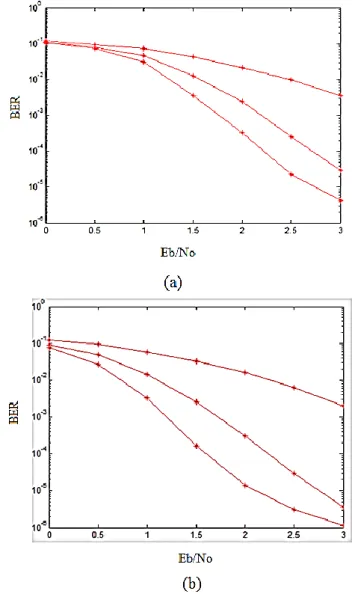
As it is shown in Fig. 3, the BER of 1/3 code rate turbo code Fig. 3b is much better than 1/2 code rate turbo code system Fig. 3a. The results show that by increasing the code rate, the performance of the code increases and BER decreases which is the characteristic of turbo code system. The effect of puncturing which clearly is shown in Fig. 3 confirms when code rate decreases bandwidth also decreases and the probability of losing some information increases that leads to BER increase.
4.2. The Effect of Increasing Frame Size on Turbo Code Performance
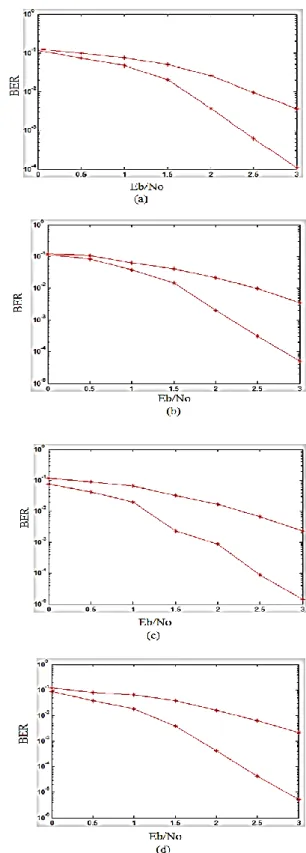
Fig.4a and Fig.4b shows the performance of 1/2 code rate turbo code system for 500 and 1000 frame sizes in two iteration whereas Fig. 4c and Fig. 4d present the performance of 1/3 code rate turbo code system for frame sizes of 500 and 1000 in two iteration. By comparing the amount of BER between 1000 and 500 bit/frames it is obvious that the performance of 1000 bit/frames is better than the performance of 500 bit/frames because when Frame size decreases bandwidth also decreases and the probability of losing some information increases that leads to BER increase. Therefore by using greater frame size the performance of turbo code can get improved.
4.3. The Effect of increasing decoding iteration on Turbo Code Performance
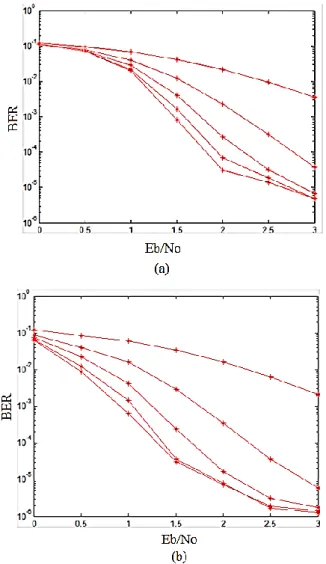
Fig. 5a and Fig. 5b show the effect of increasing decoding iteration on turbo code system performance. As it is obvious from the Figures, the effect of decoding iteration on BER performance in low signal to noise ratio (SNR) is negligible; however, it is remarkable in high signal to noise ratio. Based on the results, it can be deducted that increasing the iteration leads to significant decrease on BER because for long range transmission conditions, in each decoding iteration error correction codes can decrease the error rate so by increasing the iteration this error correction will get improved which leads to low total BER.
4.4. The Effect of Noise Jamming Signal on Turbo Code Performance
In this part the effect of noise jamming on the performance of 1/2 and 1/3 code rate turbo code is evaluated. Since partial noise jamming is considered in this work, the evaluation is based on partial bandwidth jamming which includes 25%, 50%, 70% and 100% of bandwidth jammed.it has been deducted from the BER performance results of Fig. 6 and Fig. 7 that the performance of 1/3 code rate turbo code under the effect of noise jamming is better than the performance of 1/2 code rate turbo code so for improving the BER performance increasing the decoding iteration, code rate, frame size and Eb/No is applied.
In addition it is obvious from the Figures that extending the jammer power over wide range of bandwidth lead to more bit error rate (BER). Figs. 6a, 6b, 6c and 6d show the performance of 1/2 code rate turbo code system under the effect of noise jamming for 25%, 50%, 70% and 100% of bandwidth jammed and also the performance evaluation of 1/3 code rate turbo code system for 25%, 50%, 70% and 100% of bandwidth jammed is presented in Figs. 7a, 7b, 7c and 7d.
Based on the results from the Fig. 6 and Fig. 7, it can be deducted that concentrating jammer power on wide range of bandwidth increases the bit error rate. Therefore when the bandwidth is 25% jammed the BER has lowest amount for both 1/2 and 1/3 code rate turbo code and also its highest amount is for 100% of bandwidth jammed.
Comparing the BER performance of 1/3 and 1/2 code rate turbo code in non-presence of jamming with BER performance of turbo code in presence of jamming for 25% and 50% of bandwidth jammed leads to classify turbo code system as good anti jamming code with acceptable bit error rate which can be used widely in wireless communication systems.
Fig. 5. BER performance of (a) 1/2 code rate turbo code within five decoding iteration, (b) BER performance of 1/3 code rate turbo code for five decoding iteration
5. Conclusion
In this paper, the performance of turbo code system in presence and non-presence of noise jamming is evaluated through computer simulation. The BER performance of turbo code is evaluated for many cases and the simulation results show how the changes in amount of code rates, frame size and decoding iteration influence the turbo code performance. Besides, the performance is evaluated in presence and non-presence of noise jamming to show turbo code is a good anti-jamming code. Turbo code BER performance of three decoding iteration with fixed frame size, but different code rates is evaluated to consider the effect of increasing code rates on turbo code performance. The results show that by increasing the code rate, performance of turbo code improves and BER decreases. The effect of puncturing on BER performance of turbo code shows that when code rate decreases bandwidth also decreases which leads to increase bit error rate so, it can be deduced that higher code rate has lower BER. In order to consider the effect of increasing frame size on performance of turbo code some simulations were done for turbo code with two decoding iteration and fixed code rate, but
different frame size. It can be deduced from the results that for a fixed code rate, when frame size increases the performance of turbo code improves and BER decreases. Therefore, turbo code system with higher frame size has lower bit error rate. Another important evaluation of turbo code performance is to investigate about the effect of increasing decoding iteration on BER performance.
Improvement of BER performance between one decoding iteration to five decoding iteration for turbo code with different code rates but fixed frame size confirms that increasing decoding iteration causes improvement of turbo code performance and BER reduction so, more decoding iteration leads to substantial decoding gain. Besides, Turbo code BER performance of two decoding iteration with fixed frame size but different code rates and different jammed bandwidth is evaluated to consider the effect of noise jamming on turbo code performance. It can be found from the results, BER Performance of 1/3 code rate turbo code system under the effect of jamming signal is much better than the BER performance of 1/2 code rate turbo code system so, for getting better BER performance the Eb/No or decoding iteration must be increased. For fixed code rate and frame size, concentration of jammer power on wide range of bandwidth increases the bit error rate. Therefore, when the bandwidth is 25% jammed the BER has lowest amount for both 1/2 and 1/3 code rate turbo code and also its highest amount is for 100% of bandwidth jammed. It can be deduced from the results that turbo code system may be a good anti jamming code with acceptable bit error rate.
References
Benedetto, S. and Montorsi, G. (1996). Design of Parallel Concatenated Convolutional Codes.in communications, IEEE transactions, 44(5), pp. 591- 600.
Benedix, M., Ertel, J. and Kallio, S. (2001). Performance and Implementation Aspects of Channel Coding Issues, IST-1999-10025, WIND-FLEX, 31.
Berrou, C., Adde, P., Angui,E. and Faudeil, S.(1993). A low complexity soft-output Viterbi decoder architecture. . in Communications, 1993. ICC '93 Geneva. Technical Program, Conference Record, IEEE International Conference . Geneva,Switzerland.
Berrou, C., Glavieux, A. and Thitimajshima, P. (1993). Near Shannon Limit Error-Correcting Coding and Decoding: Turbo-Codes. in ICC 1993. May 1993. Geneva, Switzerland.
Dolinar, S. and Divsalar, D. (1995). Weight Distributions for Turbo Codes Using Random and Nonrandom Permutations. Progress report, communication system and research section.
Sadjadpour, H.R., Sloane, N.J.A.,Salehi, M. and Nebe , G.(2001). . Interleaver Design for Turbo Codes. IEEE Journal on Selected Areas in Communication, 19(5), pp. 831-837.
Hanzo, L., Liew, T.H., Yeap, B.L.,Tee, R.Y.S.and Soon Xin Ng.( 2011). Turbo Coding, Turbo Equalisation and Space-Time Coding.USA: JohnWiley & sons.
Huang, F. (1997). Evaluation of Soft Output Decoding for Turbo Codes. M.Sc. Thesis, Electrical Engineering ,Virginia Polytechnic Institute and State University. Ahmed, E. S., & Hussein, A. A. (2009, January). Turbo
Code Performance in the Presence of Jamming Signals. In The 11th Scientific Conference of the University of Babylon, April 29-30.
Lattuada, M., Posega, R., Marco, M. and Mlinek, D. (2003). Turbo Coded OFDM system for Video Terrestrial Broadcasting. LTS3-ITS-STI EPFL Ecublens, 1015, Switzerland.
Moon, J.W., Wong,T.F. and Shea,J.M.(2006). Pilot-Assisted and Blind Joint Data Detection and Channel Estimation in Partial-Time Jamming. In Communications, IEEE Transactions , 54(11),pp. 2092-2102.
Moulin, P. and Koetter,R.(2005). Data-Hiding Codes. Proceedings of the IEEE, 93(12), pp. 2083-2126. Syrns, F. (2001). Adaptive Turbo-Bit-Interleaved Coded
Modulation for Wireless Channels. M.Sc Thesis, Department of Electrical and Computer Engineering University of Toronto.
Valenti, MC. (1996). Iterative Detection on Decoding for Wireless Communication. PhD. Dissertation, Virginia polytechnic Institute and State University.
Biography