
UR Undergraduate BS Earth and Environmental Sciences Program
Learning Objectives and Assessment Plan
Students will:
1. Demonstrate understanding of and ability to use the core foundations of geological sciences in problem solving including …..
a) Demonstrate comprehension of terms, concepts and models involving the foundations of geological sciences.
b) Demonstrate comprehension of underlying chemistry and physics that apply to geologic issues.
c) Be able to use knowledge of how geological scientists build models to take a realistic system and simplify it to essential physical properties.
d) Analyze and solve problems on homework and tests by being able to draw on geological science knowledge.
e) Analyze results of lab experiments by being able to use geological science knowledge to draw valid conclusions.
f) Critically evaluate conclusions in research articles which are based on geological science knowledge.
2. Understand mathematics and computation fundamentals used in the modeling of geologic systems and solving geological science problems.
a) Use calculus and ordinary differential equations in analysis and solution of geologic problems.
b) Demonstrate competence in use of basic computer tools including graphical applications, and software used for geologic analysis.
3. Understand the scientific method, including formulation of hypotheses, experimental design, and analysis and interpretation of results.
a) Demonstrate comprehension of the terms and concepts for scientific method, hypothesis formulation, experimental design, and analysis and interpretation of results.
b) Be able to formulate an original hypothesis and design an experiment to test the hypothesis.
c) Be able to analyze and interpret the results of an experiment using basic statistical methods.
d) Be able to critically evaluate a research paper’s hypothesis, experimental design, analysis and conclusions.
4. Develop basic, practical experimental skills used in geological science field and lab research, including field and lab procedures.
a) Be able to identify the range of research questions and types of data produced by each of the experimental methods commonly used in the investigation of geological
science phenomena.
b) Can identify and classify basic geologic materials, structures, and landforms as well as their physical, chemical, and biological characteristics.
c) Can collect and describe samples of geologic materials in support of field investigations.
d) Can create basic geologic maps.
e) Can perform basic types of geologic analyses including lithostratigraphic correlation, map construction, geophysical studies, and/or cross section construction.
f) Be able to analyze and interpret experimental results arising from each of the experimental methods commonly used in the investigation of geologic phenomena. 5. Read and comprehend original scientific literature.
a) Be able to summarize a research paper including its theoretical approach, hypothesis, experimental design, and interpretation of results.
b) Be able to use science literature databases to effectively search for pertinent articles related to a research lab or project.
6. The ability to effectively communicate scientific knowledge, experimental results, and analyses in both oral and written formats.
a) Be able to write a lab report that clearly presents hypothesis, methods, experimental results, and conclusions.
b) Be able to write a research paper that clearly presents ideas in prose, tabular, and graphical formats, and correctly uses geological science terminology.
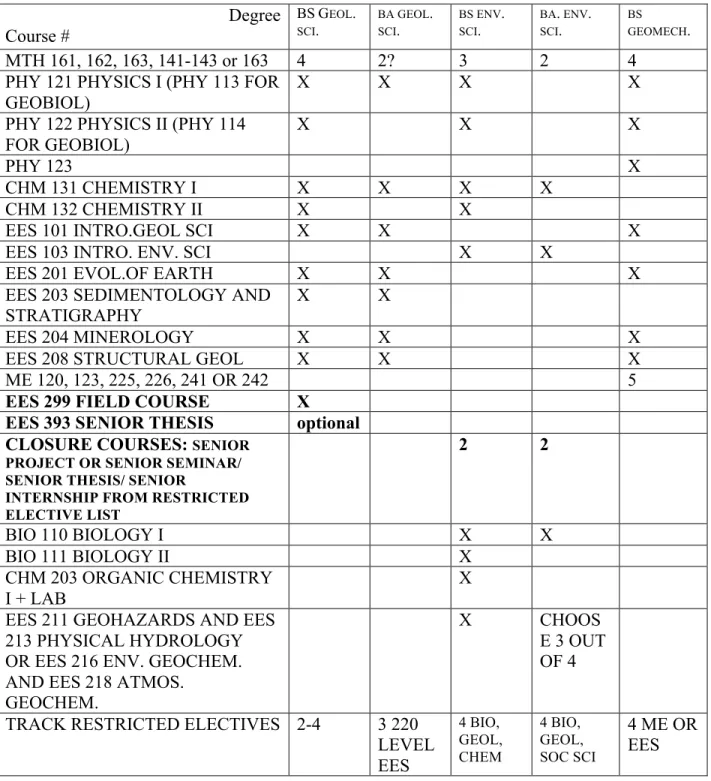
A. UR EES Core and Restricted Elective Courses by UG Degree Table 1. EES Department BS and BA Degrees: Courses
Degree Course #
BSGEOL.
SCI.
BA GEOL.
SCI.
BS ENV.
SCI.
BA. ENV.
SCI.
BS GEOMECH. MTH 161, 162, 163, 141-143 or 163 4 2? 3 2 4
PHY 121 PHYSICS I (PHY 113 FOR GEOBIOL)
X X X X
PHY 122 PHYSICS II (PHY 114
FOR GEOBIOL) X X X
PHY 123 X
CHM 131 CHEMISTRY I X X X X
CHM 132 CHEMISTRY II X X
EES 101 INTRO.GEOL SCI X X X
EES 103 INTRO. ENV. SCI X X
EES 201 EVOL.OF EARTH X X X
EES 203 SEDIMENTOLOGY AND
STRATIGRAPHY X X
EES 204 MINEROLOGY X X X
EES 208 STRUCTURAL GEOL X X X
ME 120, 123, 225, 226, 241 OR 242 5
EES 299 FIELD COURSE X
EES 393 SENIOR THESIS optional CLOSURE COURSES: SENIOR
PROJECT OR SENIOR SEMINAR/ SENIOR THESIS/ SENIOR
INTERNSHIP FROM RESTRICTED ELECTIVE LIST
2 2
BIO 110 BIOLOGY I X X
BIO 111 BIOLOGY II X
CHM 203 ORGANIC CHEMISTRY I + LAB
X EES 211 GEOHAZARDS AND EES
213 PHYSICAL HYDROLOGY OR EES 216 ENV. GEOCHEM. AND EES 218 ATMOS.
GEOCHEM.
X CHOOS
E 3 OUT OF 4 TRACK RESTRICTED ELECTIVES 2-4 3 220
LEVEL EES
4 BIO, GEOL, CHEM
4 BIO, GEOL, SOC SCI
4 ME OR EES
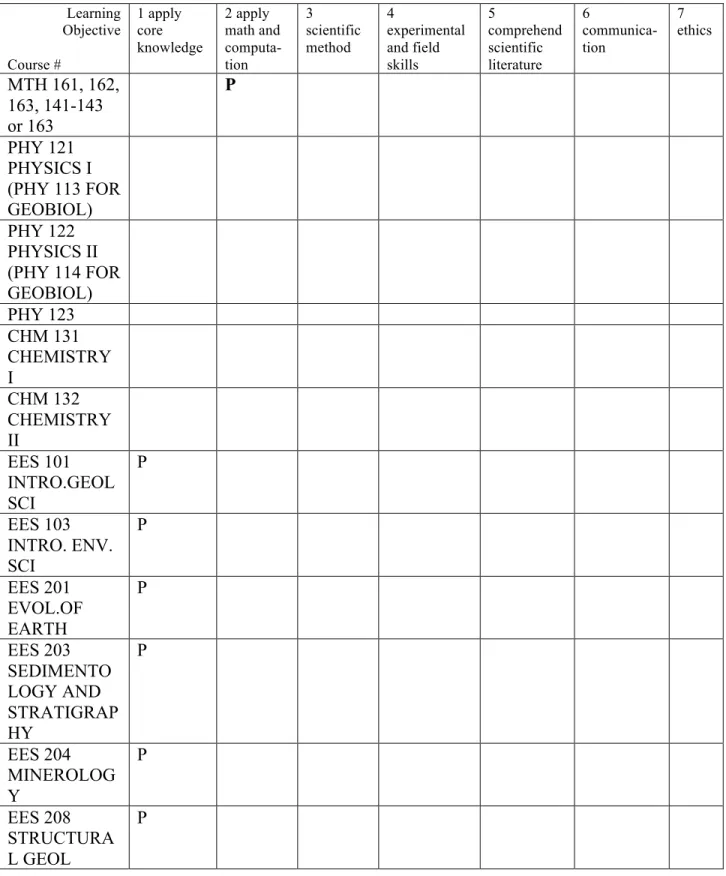
B. Alignment of Program Learning Objectives and Core Course Curriculum Table 2. EES Degrees: Program Learning Objectives (LO) Addressed in Each Course (P=LO is a primary focus of student assessments in course)
Learning Objective Course # 1 apply core knowledge 2 apply math and computa-tion 3 scientific method 4 experimental and field skills 5 comprehend scientific literature 6 communica-tion 7 ethics MTH 161, 162,
163, 141-143 or 163
P PHY 121
PHYSICS I (PHY 113 FOR GEOBIOL) PHY 122 PHYSICS II (PHY 114 FOR GEOBIOL) PHY 123 CHM 131 CHEMISTRY I CHM 132 CHEMISTRY II EES 101 INTRO.GEOL SCI P EES 103 INTRO. ENV. SCI P EES 201 EVOL.OF EARTH P EES 203 SEDIMENTO LOGY AND STRATIGRAP HY P EES 204 MINEROLOG Y P EES 208 STRUCTURA L GEOL P
ME 120, 123, 225, 226, 241 OR 242
P EES 299
FIELD COURSE
P
P
P
P
P
P
P
EES 393 SENIOR THESIS
P
P
P
P
P
P
P
CLOSURE COURSES: SENIOR PROJECT OR SENIOR SEMINAR/ SENIOR THESIS/ SENIOR INTERNSHIP FROM
RESTRICTED ELECTIVE LIST
P
P
P
P
P
P
P
BIO 110 BIOLOGY I BIO 111 BIOLOGY II CHM 203 ORGANIC CHEMISTRY I + LAB EES 211 GEOHAZARD S AND EES 213
PHYSICAL HYDROLOG Y
OR EES 216 ENV.
GEOCHEM. AND EES 218 ATMOS. GEOCHEM. TRACK RESTRICTED ELECTIVES
C. EES Program Assessment Plan Direct methods
- Each term, 4 courses will be chosen by the Department Chair and Undergraduate Program Director from the list of permitted degree requirements and faculty will complete a course reflective memo. In the memo, faculty review student assessments related to performance for selected course learning objectives. Course reflective memos will be sent to the undergraduate committee for review and action.
- Post-graduation placement in graduate school, or employment as reported in senior survey (percentage accepted, quality of the programs) (annual)
- Awards and Scholarships received by students (annual) Indirect methods
- High level of satisfaction with overall program, advising, and teaching quality ratings in senior survey (annual)
- High level of ability self-assessment for program learning outcomes in senior survey (annual) and alumni surveys (every 5 years)
- Senior focus group review of program quality and learning processes (suggested assessment method, to be implemented every 3 years)
UR Undergraduate BA Earth and Environmental Sciences
Program Learning Objectives and Assessment Plan
Students will:7. Demonstrate understanding of and ability to use the core foundations of geological sciences in problem solving including …..
a) Demonstrate comprehension of terms, concepts and models involving the foundations of geological sciences.
b) Demonstrate comprehension of underlying chemistry and physics that apply to geologic issues.
c) Be able to use knowledge of how geological scientists build models to take a realistic system and simplify it to essential physical properties.
d) Analyze and solve problems on homework and tests by being able to draw on geological science knowledge.
e) Analyze results of lab experiments by being able to use geological science knowledge to draw valid conclusions.
f) Critically evaluate conclusions in research articles which are based on geological science knowledge.
8. Understand mathematics and computation fundamentals used in the modeling of geologic systems and solving geological science problems.
a) Use calculus in analysis and solution of geologic problems.
b) Demonstrate competence in use of basic computer tools including graphical applications, and software used for geologic analysis.
9. Understand the scientific method, including formulation of hypotheses, experimental design, and analysis and interpretation of results.
e) Demonstrate comprehension of the terms and concepts for scientific method, hypothesis formulation, experimental design, and analysis and interpretation of results.
f) Be able to formulate an original hypothesis and design an experiment to test the hypothesis.
g) Be able to critically evaluate a research paper’s hypothesis, experimental design, analysis and conclusions.
10.Develop basic, practical experimental skills used in geological science field and lab research, including field and lab procedures.
a) Be able to identify the range of research questions and types of data produced by each of the experimental methods commonly used in the investigation of geological
science phenomena.
b) Can identify and classify basic geologic materials, structures, and landforms as well as their physical, chemical, and biological characteristics.
c) Can create basic geologic maps.
d) Can perform basic types of geologic analyses including lithostratigraphic correlation, map construction, geophysical studies, and/or cross section construction.
e) Be able to analyze and interpret experimental results arising from each of the experimental methods commonly used in the investigation of geologic phenomena. 11.Read and comprehend original scientific literature.
a) Be able to summarize a research paper including its theoretical approach, hypothesis, experimental design, and interpretation of results.
b) Be able to use science literature databases to effectively search for pertinent articles related to a research lab or project.
12. The ability to effectively communicate scientific knowledge, experimental results, and analyses in both oral and written formats.
a) Be able to write a lab report that clearly presents hypothesis, methods, experimental results, and conclusions.
b) Be able to write a research paper that clearly presents ideas in prose, tabular, and graphical formats, and correctly uses geological science terminology.
D. UR EES Core and Restricted Elective Courses by UG Degree Table 1. EES Department BA Degrees: Courses
Degree Course #
BSGEOL.
SCI.
BA GEOL.
SCI.
BS ENV.
SCI.
BA. ENV.
SCI.
BS GEOMECH. MTH 161, 162, 163, 141-143 or 163 4 2? 3 2 4
PHY 121 PHYSICS I (PHY 113 FOR GEOBIOL)
X X X X
PHY 122 PHYSICS II (PHY 114
FOR GEOBIOL) X X X
PHY 123 X
CHM 131 CHEMISTRY I X X X X
CHM 132 CHEMISTRY II X X
EES 101 INTRO.GEOL SCI X X X
EES 103 INTRO. ENV. SCI X X
EES 201 EVOL.OF EARTH X X X
EES 203 SEDIMENTOLOGY AND
STRATIGRAPHY X X
EES 204 MINEROLOGY X X X
EES 208 STRUCTURAL GEOL X X X
ME 120, 123, 225, 226, 241 OR 242 5
EES 299 FIELD COURSE X
EES 393 SENIOR THESIS optional CLOSURE COURSES: SENIOR
PROJECT OR SENIOR SEMINAR/ SENIOR THESIS/ SENIOR
INTERNSHIP FROM RESTRICTED ELECTIVE LIST
2 2
BIO 110 BIOLOGY I X X
BIO 111 BIOLOGY II X
CHM 203 ORGANIC CHEMISTRY I + LAB
X EES 211 GEOHAZARDS AND EES
213 PHYSICAL HYDROLOGY OR EES 216 ENV. GEOCHEM. AND EES 218 ATMOS.
GEOCHEM.
X CHOOS
E 3 OUT OF 4 TRACK RESTRICTED ELECTIVES 2-4 3 220
LEVEL EES
4 BIO, GEOL, CHEM
4 BIO, GEOL, SOC SCI
4 ME OR EES
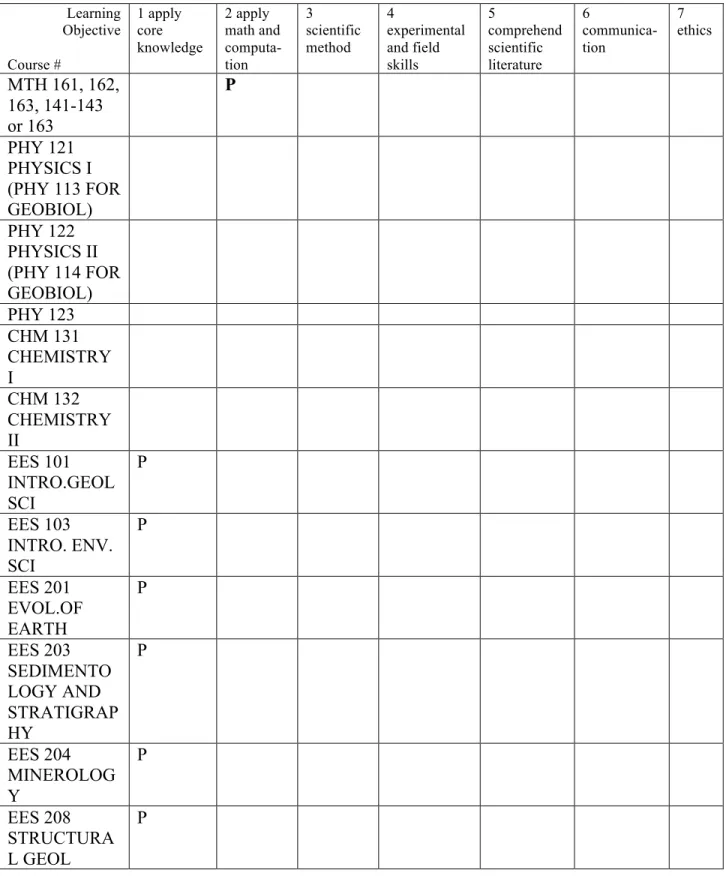
E. Alignment of Program Learning Objectives and Core Course Curriculum Table 2. EES Degrees: Program Learning Objectives (LO) Addressed in Each Course (P=LO is a primary focus of student assessments in course)
Learning Objective Course # 1 apply core knowledge 2 apply math and computa-tion 3 scientific method 4 experimental and field skills 5 comprehend scientific literature 6 communica-tion 7 ethics MTH 161, 162,
163, 141-143 or 163
P PHY 121
PHYSICS I (PHY 113 FOR GEOBIOL) PHY 122 PHYSICS II (PHY 114 FOR GEOBIOL) PHY 123 CHM 131 CHEMISTRY I CHM 132 CHEMISTRY II EES 101 INTRO.GEOL SCI P EES 103 INTRO. ENV. SCI P EES 201 EVOL.OF EARTH P EES 203 SEDIMENTO LOGY AND STRATIGRAP HY P EES 204 MINEROLOG Y P EES 208 STRUCTURA L GEOL P
ME 120, 123, 225, 226, 241 OR 242
P EES 299
FIELD COURSE
P
P
P
P
P
P
P
EES 393 SENIOR THESIS
P
P
P
P
P
P
P
CLOSURE COURSES: SENIOR PROJECT OR SENIOR SEMINAR/ SENIOR THESIS/ SENIOR INTERNSHIP FROM
RESTRICTED ELECTIVE LIST
P
P
P
P
P
P
P
BIO 110 BIOLOGY I BIO 111 BIOLOGY II CHM 203 ORGANIC CHEMISTRY I + LAB EES 211 GEOHAZARD S AND EES 213
PHYSICAL HYDROLOG Y
OR EES 216 ENV.
GEOCHEM. AND EES 218 ATMOS. GEOCHEM. TRACK RESTRICTED ELECTIVES
F. EES Program Assessment Plan Direct methods
- Each term, 4 courses will be chosen by the Department Chair and Undergraduate Program Director from the list of permitted degree requirements and faculty will complete a course reflective memo. In the memo, faculty review student assessments related to performance for selected course learning objectives. Course reflective memos will be sent to the undergraduate committee for review and action.
- Post-graduation placement in graduate school, or employment as reported in senior survey (percentage accepted, quality of the programs) (annual)
- Awards and Scholarships received by students (annual) Indirect methods
- High level of ability self-assessment for program learning outcomes in senior survey (annual) and alumni surveys (every 5 years)

![[−2]proPSA versus ultrasensitive PSA fluctuations over time in the first year from radical prostatectomy, in an high-risk prostate cancer population: A first report](data:image/gif;base64,R0lGODlhAQABAIAAAP///wAAACH5BAEAAAAALAAAAAABAAEAAAICRAEAOw==)