Open Access
Research
Real-time intelligent pattern recognition algorithm for surface EMG
signals
Mahdi Khezri*
†and Mehran Jahed
†Address: Sharif University of Technology, Electrical Engineering Department, Biomedical Engineering Group, Tehran, Iran Email: Mahdi Khezri* - [email protected]; Mehran Jahed - [email protected]
* Corresponding author †Equal contributors
Abstract
Background: Electromyography (EMG) is the study of muscle function through the inquiry of electrical signals that the muscles emanate. EMG signals collected from the surface of the skin (Surface Electromyogram: sEMG) can be used in different applications such as recognizing musculoskeletal neural based patterns intercepted for hand prosthesis movements. Current systems designed for controlling the prosthetic hands either have limited functions or can only be used to perform simple movements or use excessive amount of electrodes in order to achieve acceptable results. In an attempt to overcome these problems we have proposed an intelligent system to recognize hand movements and have provided a user assessment routine to evaluate the correctness of executed movements.
Methods: We propose to use an intelligent approach based on adaptive neuro-fuzzy inference system (ANFIS) integrated with a real-time learning scheme to identify hand motion commands. For this purpose and to consider the effect of user evaluation on recognizing hand movements, vision feedback is applied to increase the capability of our system. By using this scheme the user may assess the correctness of the performed hand movement. In this work a hybrid method for training fuzzy system, consisting of back-propagation (BP) and least mean square (LMS) is utilized. Also in order to optimize the number of fuzzy rules, a subtractive clustering algorithm has been developed. To design an effective system, we consider a conventional scheme of EMG pattern recognition system. To design this system we propose to use two different sets of EMG features, namely time domain (TD) and time-frequency representation (TFR). Also in order to decrease the undesirable effects of the dimension of these feature sets, principle component analysis (PCA) is utilized.
Results: In this study, the myoelectric signals considered for classification consists of six unique hand movements. Features chosen for EMG signal are time and time-frequency domain. In this work we demonstrate the capability of an EMG pattern recognition system using ANFIS as classifier with a real-time learning method. Our results reveal that the utilized real-time ANFIS approach along with the user evaluation provides a 96.7% average accuracy. This rate is superior to the previously reported result utilizing artificial neural networks (ANN) real-time method [1].
Conclusion: This study shows that ANFIS real-time learning method coupled with mixed time and time-frequency features as EMG features can provide acceptable results for designing sEMG pattern recognition system suitable for hand prosthesis control.
Published: 3 December 2007
BioMedical Engineering OnLine 2007, 6:45 doi:10.1186/1475-925X-6-45
Received: 20 April 2007 Accepted: 3 December 2007
This article is available from: http://www.biomedical-engineering-online.com/content/6/1/45
© 2007 Khezri and Jahed; licensee BioMed Central Ltd.
Background
The EMG signal provides us with information about the neuromuscular activity from which it originates. This has been fundamental to its use in clinical diagnosis, and as a source for control of assistive devices. It has been pro-posed that the EMG signals from upper limb musculature can be used to identify motion commands for the control of an externally powered prosthesis hand. Electromyo-gram signal is a simple way for obtaining necessary infor-mation on what the disabled user would like to do with his/her hands. It is possible to control a prosthetic device only with pair of surface mounted differential electrodes placed on residual limbs. [2]
EMG is a complicated signal influenced by various factors such as physiological and anatomical properties and char-acteristics of instrumentation. It differs from one person to another. In earlier studies, the recognition system learned the characteristics of EMG signal in an offline manner. The offline approach was incapable of adjusting its inner states to correspond to real-time operator's varia-tions of hand movements [3-5]. To decrease these effects on EMG pattern recognition system and to eliminate its dependence on individual subjects, real-time training methods were introduced [1].
Current prosthesis hands, such as Otto Bock [6] commer-cial hand are unable to provide human-like grasping func-tionality or deliver motor sensory feedback to the users. Moreover they require a great deal of training and adjust-ing processes. Also duradjust-ing recent years, several robotic and anthropomorphic hands have been developed such as Utah/MIT hand [7], the Stanford/JPL hand [8], the DLR hand [9], and the Robonaut hand [10]. All of these hands
have a high number of degree of freedom and flexibility with non-distinctive hand movements. Moreover they can not truly operate as prosthesis hands due to their heavy and bulky structure and crude gripping functionality. A recent remedy to overcome these shortcomings has been to reduce the degree of freedom [11,12].
Accurate feature extraction from EMG signals is the main kernel of classification system in both real-time and offline systems and is essential to the motion command identification. The non-stationary nature of sEMG signal makes it difficult to precisely extract feature parameters with such block processing stationary models like autore-gressive (AR) model [13]. Previous works have shown that time-frequency features present better results in EMG pat-tern recognition applications [5]. This is due to the effect of combining time domain and frequency analyses which yields a potentially more revealing picture of the temporal localization of a signal's spectral characteristics. However it is very difficult to utilize only one feature set to ade-quately reflect the unique feature of the measured sEMG signals to a motion command. Therefore in order to increase the recognition rate of this system, we propose to use the feature set based on combined features. Once the feature set is constructed, it is fed to a classifier to discrim-inate between our proposed six hand motions.
The real-time scheme of EMG pattern recognition system used in this work is shown in Figure 1. The five major components are, EMG pre-processing and conditioning, feature extraction, Dimensionality-reduction, classifier (pattern recognizer) and trainer units. The goal of pre-processing step is to prepare and amplify the signal for the subsequent steps and to reduce noise artifacts. This work
Real-Time Scheme for hand prosthesis control Figure 1
consists of a feature extraction step followed by a dimen-sionality reduction technique, namely PCA to simplify the task of the classifier. The role of dimensionality reduction is to retain information that is important for class discrim-ination and discard irrelevant information. Next a real-time intelligent classifier approach, namely ANFIS is introduced. Finally a novel trainer unit is utilized to relate actual EMG patterns with generated control commands and furthermore to adapt to the operator's characteristics.
sEMG pattern recognition using adaptive neuro- fuzzy inference system
Fuzzy inference system was developed in 1965 by profes-sor lotfizadeh [14,15]. Fuzzy logic systems can emulate human decision-making more closely than many other classifiers, because of the possibility of introducing the knowledge of an expert system in the fuzzy rules of the form IF-THEN [16-19]. The non-stationary nature of sEMG signal like other biological signal makes the task of classification more difficult. But the characteristics of fuzzy inference system make it a viable tool for pattern recognition applications [20]. The fuzzy system, initially fuzzifies inputs to values at interval [0, 1] using a set of membership functions (MF). Next it is inferred by fuzzy logic through rules in the form of IF-THEN. The basic part of fuzzy system is the fuzzy inference engine that can be used for creating fuzzy rules. The example of fuzzy rules is:
where Rj (i = 1,2, .., l) denotes the ith fuzzy rules, x
j (j = 1,2,
.., n) is the jth input and zi is the output of jth fuzzy rule, and
are fuzzy membership function of antecedents
and consequents for ith rules.
In this work we applied a neuro-fuzzy scheme to recog-nize sEMG patterns. Neuro-fuzzy computing enables us to build a more robust intelligent based decision making sys-tems by combining the advantage of artificial neural net-work with the fuzzy modeling of Imprecise and qualitative knowledge. Figure 2 depicts the ANFIS struc-ture with n inputs and one output. The output of this sys-tem can be described by the following function:
where MF is the membership function. In this work we chose the generalized bell function as membership func-tion. This function depends on three parameters namely a, b, c as given by:
The basic problem of fuzzy system is, adjusting member-ship function parameters, output of each fuzzy rule and estimating number of rules that should be minimum and precise enough. Adaptive neuro-fuzzy inference system
Rj:if is x1 MF1i and/or x2 is MF2i and/or...xj is MFji thenn ziis MFoi (1)
MF MFoji, i
y
MFji x j j
n
z i
MFji x j j
n
i L
= =
∏ ⎛
⎝ ⎜ ⎜
⎞
⎠ ⎟ ⎟
( )
= ∏ ⎛
⎝ ⎜ ⎜
⎞
⎠ ⎟ ⎟ =
∑ ⎧
⎨ ⎪
⎪ ( ) .
( ) 1
1 1 ⎪⎪
⎩ ⎪ ⎪ ⎪
⎫
⎬ ⎪ ⎪⎪
⎭ ⎪ ⎪ ⎪ =
∑
iL1 (2)MF x
x c a
b ( )=
+ − 1
1
2 (3)
Network representing ANFIS structure Figure 2
adapts the parameters of Sugeno type inference system using the neural networks [21]. For Sugeno type systems, output is a crisp number computed by multiplying each input by a constant and then adding up the results. The
resultant output is in the form of .
For training fuzzy system, ANFIS employs BP scheme for the parameters associated with the input membership functions, and LMS estimation for the parameters associ-ated with the output membership functions.
In order to optimize the fuzzy system and increase its abil-ity for sEMG pattern recognition problem, subtractive clustering was employed to optimize fuzzy rules specifica-tion. This method partitions the data into groups called clusters, and generates a Fuzzy Inference System (FIS) with the minimum number of rules required to distin-guish the fuzzy qualities associated with each of the clus-ters. In the next section we introduce these methods and describe their application in implementing neuro-fuzzy system.
Hybrid method (BP and LMS)
The ANFIS structure can be used for training fuzzy infer-ence system. One of the most useful algorithms that can be used for this purpose is back-propagation. BP adjusts membership function parameters. For neuro-fuzzy system usually the bell function is applied as membership func-tion. In this function a, b and c are considered variables and must be adjusted. The BP algorithm may be used to train these parameters. Suppose that we are given an input-output pair (x, y), x = [x1, x2, ... xn], our goal is, to minimize the cost function (where ydes is desired output):
The output of each rule ziis defined by:
where kz is a step size. To adjust a, b, and c parameters, we
start with Sugeno's system. Here, we can specify the out-put as follows:
Derivative of equation (4) based on equation (6) is given by:
Then for output of each rule we can define the following equations:
Similarly, for jth membership function of ith fuzzy rule the
parameters are calculated as:
In order to specify the number of rules in fuzzy system we utilize subtractive clustering approach. This method is introduced bellow.
Subtractive clustering
Subtractive clustering is based on a measure of the density of data points in the feature space. The idea behind this approach is to find regions in the feature space with high densities of data points. The point with the highest number of neighbours is selected as the center for a clus-ter. The data points within a prespecified fuzzy radius are then removed (subtracted), and the algorithm looks for a new point with the highest number of neighbours. This continues until all data points are examined. Consider a collection of K data points specified by m-dimensional vectors uk, k = 1, 2..., K. Since each data point is a candi-date for a cluster center, a density measure at data point uk
is defined as:
where ra is a positive constant. Hence, a data point will have a high density value if it has many neighbouring data z1=s01+s x11 1+ +... s x1j j
e=
[
ydes−y]
12
2
(4)
z t z t k e
z i i i z ( + =) ( )− ∂ ∂ 1 (5)
w MF y
wiz i i L wi i L i j j n = = = ∑ = ∑ =
∏
1 11 , (6) ∂ ∂ = ∂∂ ⋅ ∂∂ ∂ ∂ = = ∑ ∂ ∂ = − e z i e y y z i y z i wi wi i L e
y ydes y
, ( )
1
and
(7)
z t z t k wi
wi i
L y y
i i z des ( + =) ( )− ( )( ) = ∑ − 1 1 (8)
a t a t k e
a ji j i j i a ( + =) ( )− ∂ ∂ 1 (9)
b t b t k e
b ji j i j i b ( + =) ( )− ∂ ∂ 1 (10)
c t c t k e
c ji j i j i b ( + =) ( )− ∂ ∂ 1 (11)
D uk u j
ra k j K = ⎛− − ⎝ ⎜ ⎜ ⎞ ⎠ ⎟ ⎟ =
∑
exp( 2 2)
1
points. Only the fuzzy neighborhood within the radius of ra contributes to the density measure. After calculating the density measure for each data point, the point with the highest density is selected as the first cluster center. Let uc1 be the point selected and Dc1 its density measure. Next, the density measure for each data point uk is revised by the for-mula:
where rb is a positive constant. Therefore, the data points near the first cluster center uc1 will have significantly reduced density measures, thereby making the points unlikely to be selected as the next cluster center. The con-stant rb defines a neighborhood to be reduced in density measure and it is normally larger than ra to prevent closely spaced cluster centers, where typically rb = 1.5 × ra. After the density measure for each point is revised, the next cluster center uc2 is selected and all the density measures are revised again. The process is repeated until a sufficient number of cluster centers are generated. When applying subtractive clustering to a set of input-output data, each of the cluster centers represents a rule. To generate rules, the cluster centers are used as the centers for the premise sets in a singleton type of rule base (or the radial basis func-tions in a radial basis function neural network).
Methods
EMG acquisition and pre-processing
The EMG signal is the electrical manifestation of the neu-romuscular activation associated with a contracting mus-cle. A good acquisition of the sEMG signal is a prerequisite for good signal processing. Since hand motions result from contraction of the muscles in the forearm section, we used surface electrodes for measuring sEMG signal from the extensor digitorum, the extensor carpi radialis, the pal-maris longus and the flexor carpi ulnaris. In this work we use two channels of differential surface electrodes for col-lecting sEMG signal.
This Signal is easily affected by undesired signal that come from different sources such as 50/60 Hz electromagnetic interference from power lines. In addition, for surface electrode instrumentation, complicating issues may arise due to its coupling with skin. Concerns such as impedance of the skin, its superficial oil content and the density of its dead cell layer are to name a few. We placed differential electrodes on the forearm under the elbow and placed ref-erence electrode on the wrist. After the acquisition, sEMG signal was filtered using a band-pass filter consisting of a high-pass filter with 500 Hz cut off frequency to reduce motion artifacts and a low pass filter of 20 Hz cut-off fre-quency to reduce noise. The signal was next amplified
with a high common mode rejection ratio (CMRR) ampli-fier [22]. Also we exerted a notch filter at 50 Hz to elimi-nate power line noise. Finally the signal was sampled at 1 KHz and transferred to an IBM based personal computer (PC) for further analysis.
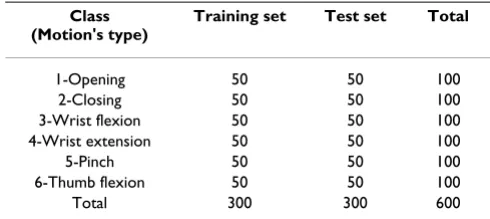
A roster of four healthy subjects participated for collecting sEMG signals. Six hand movements were considered and sEMG signal for each was extracted. These movements depicted in Figure 3, were Hand opening and closing, pinch, thumb flexion, wrist flexion and extension. For each class of movement, 100 signals were collected. We divided the acquired signals into two categories. First cat-egory was utilized as a training set data and the second was employed as a test set, in the manner that each of them included 50 signals. To increase the ability of our system to recognize hand movements, we utilized several signals in each class of movement as a validation set and therefore the test set actually incorporated both the test and validation sets. In this work training and test data sets were formed by 300 samples, or 50 samples for each class. Table 1 presents the class distribution of the samples in the training and validation data sets.
Features selection
Time domain features extracts time structures in the EMG signal. The EMG signal has a number of irregular struc-tures in the temporal waveform due to its deterministic components but it also exhibits a great deal of intraclass variability due to existence of random component. In our analysis various features of the signal were considered. Sampled waveform for sEMG pattern classification will result in the undesirable loss of temporal structure of the signal. Moreover, in this case, due to high variability of features and high dimension of feature space, a further poor classification performance will occur.
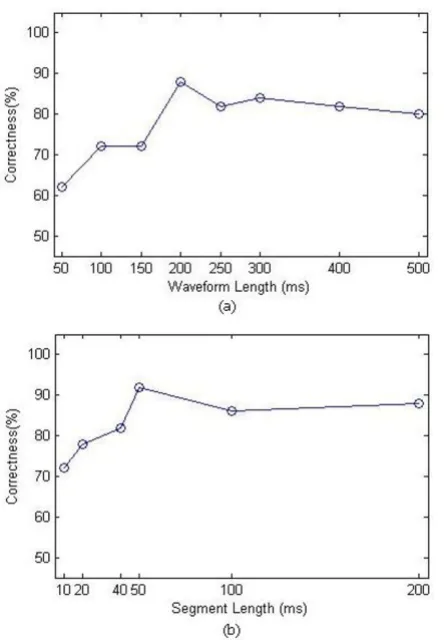
To overcome the loss of temporal information of the sig-nal and poor classification performance, we segmented sEMG signal and extracted desirable features from each segment. In this work, we used a time domain window of 500 (ms) for collecting sEMG signal. For classification problem, appropriate length of sEMG signal should be considered. Hudgins experimented with different seg-ment lengths in an attempt to reduce classification error. He decided on a scheme of five 40 (ms) segment plus an extra segment [3].
In this work, 200 (ms) segmented signal was found to be most appropriate for the classification problem. We decided on four 50 ms sub-segment for better accuracy. Figure 4 shows the selected wavelength signal and seg-ment length for the task of sEMG pattern recognition. EMG features must be calculated over all four segments. In this study we used, mean absolute value (MAV), slope
D D D uk uc
rb
k k c
’
exp
( )
= − ⎛− −
⎝ ⎜ ⎜⎜
⎞
⎠ ⎟ ⎟⎟
1 1
2 2
sign changes (SSC) and AR model coefficients as time fea-tures of the signal.
As noted earlier, in order to increase the recognition rate of the system, we incorporated the time-frequency fea-tures. The major incentive for using these representations as a feature for the application of sEMG pattern recogni-tion is the need for more signal informarecogni-tion to better dis-criminate amongst various hand movements. Discrete wavelet transform (DWT) is a well-known type of time-frequency representation. Wavelet coefficients can be very effective however there is a fundamental drawback namely, lack of shift invariance. If the signal to be ana-lyzed is shifted, the coefficients of wavelet transform vary in a complex manner. This matter presents a significant problem in the task of pattern recognition. To overcome
this problem, we can use shift invariant features of DWT such as zero crossing (ZC) and local maxima [23].
For constructing feature set with DWT, we needed to determine the parameters that most effectively influenced it. For this reason we considered candidate parameters and compared their accuracy in the sEMG pattern recogni-tion system. For DWT two parameters were considered, namely choice of mother wavelet and depth of decompo-sition. The best mother wavelet for sEMG pattern recogni-tion was determined empirically. Basically, the selecrecogni-tion of mother wavelet must be based on best correlation with the EMG signal.
The DWT decomposition can be terminated prior to a full decomposition. If the signal has a length of N samples,
then the maximum depth of decomposition is .
The sEMG signals in this work had 512 samples thus the maximum depth of decomposition was chosen to be nine. For choosing the best mother wavelet, different mother wavelet types such as Haar, Daubechies, Symlet, Coiflet and Biorthogonal were applied and their perform-ance was accordingly evaluated. These results were obtained by initially selecting the mother wavelet type and using 9 level of decomposition for sEMG signal. Eng-lehart et al [5] showed that high level of decomposition provided best performance of EMG pattern recognition J=logN2
The six classes of movements used in this work Figure 3
The six classes of movements used in this work.
Table 1: Class distribution of the sample in training and test set data
Class (Motion's type)
Training set Test set Total
1-Opening 50 50 100
2-Closing 50 50 100
3-Wrist flexion 50 50 100 4-Wrist extension 50 50 100
5-Pinch 50 50 100
6-Thumb flexion 50 50 100
system. This was followed by selecting the best depth of sEMG decomposition based on the selected wavelets from the pervious step. In this stage in accordance with Engle-hart's work, at high level of decomposition, the best accu-racy of the system was obtained.
The results indicate that biorthogonal3.5 as a mother wavelet with 9 level of decomposition, presents the best performance to recognize sEMG patterns. Figure 5 depicts the process of DWT parameters selection.
Role of trainer unit in real-time pattern recognition
For implementation of a real-time learning scheme in pat-tern recognition applications, operator's evaluation of sys-tem performance is required. In the case of offline methods previously mentioned, there is no need for con-sidering the time as a cost function.
The real-time method must be able to evaluate the accu-racy of system in recognizing hand movement that is per-formed by operator. The trainer unit constructs the
training data which contains a teacher reference signal from the operator and reduced features from dimension-ality reduction unit. Next, this training data is fed to the pattern recognition unit. When the trainer unit receives the teacher reference signal from the operator, it creates the teaching vector as,
where T is a desired hand movement and {T = 1, 2, ..., n} for n total hand motions. The trainer unit creates the reduced feature set (p) with teaching data (t) in the form of Γ(p,t) and sends this teaching vector to pattern recogni-tion unit. The trainer unit updates the state of pattern rec-ognition unit in the interval that demanded control command from EMG signal is generated. This process is continued until the root mean square (RMS) comparison is within the acceptable range and in this case, the thresh-old was set at 0.1.
t t t t t if i T
otherwise
n i
= =⎧⎨ =
⎩ ( , ,..., ), ,
,
1 2
1
0 (14)
Selection of DWT parameters to construct sEMG feature set Figure 5
Selection of DWT parameters to construct sEMG feature set.
Selection of sEMG waveform length and segment number to construct time domain feature set
Figure 4
Designing the neuro-fuzzy system structure
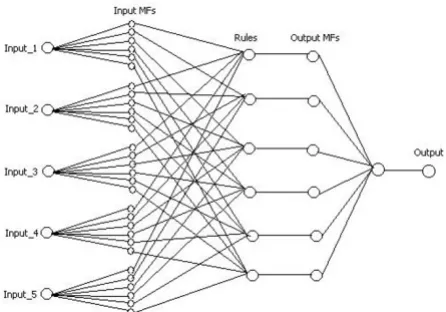
As noted before, five features of sEMG signal for the appli-cation of pattern recognition in this study, namely MAV, SSC, and AR model are applied as time domain features and number of ZC and local maxima of wavelet coeffi-cients are employed as time-frequency features. Therefore our proposed system has five inputs.
In this work a subtractive clustering method is employed to determine the number of fuzzy system rules, while BP and LMS algorithm are utilized for membership function parameters and rule outputs, respectively. For the recogni-tion system that is designed with compound features, six fuzzy rules are employed. As shown before this system is of Sugeno-type of order five and the output for each rule is determined by LMS method. Consider Zi in the form of:
Zi = αi1(in1) + αi2(in2) + αi3(in3) + αi4 (in4) + αi5 (in5) +
αi6 (16)
where in1 represents the first input and so on. Figure 6 depicts the structure of this fuzzy system. Our proposed system has five inputs, one output and six fuzzy rules. The characteristic of this system is summarized in Table 2. To design this system, we use "prod" as an AND method, "probor" as an OR method, and "weigh average" as a def-fuzification operator.
In our study to determine the fuzzy rules, membership functions are represented by linguistic expressions. For
this purpose we introduce these expressions from lower to upper range of inputs, as low, middle-low, average-low, average-high, middle-high and high, respectively. The output of each rule is represented as Zi, (for i = 1, 2, 3, 4, 5, 6) and each output is obtained by combining all inputs.
Results
Experimental results
To implement the real-time EMG recognition system, we used a PC with a Pentium4 processor. The proposed feed-back system was implemented by MATLAB software. Firstly a key on the keyboard was pressed to initiate the teacher signal to the trainer unit. A computer graphic (C.G) algorithm simulated the working of a prosthesis hand. The subject watched the monitor and sent the motion command by pressing the corresponding keys. Next, he sent new motion command when he judged that the controller has learned the previous command motion completely. Therefore he watched the monitor and also re-sent a teacher signal for the past motion if it was not performed correctly. Figure 7 shows the scheme of this process. After training the system for different trials of each movement, the accuracy of ANFIS based system was evaluated.
Table 3 depicts the results of implemented EMG pattern recognition system using six hand movements previously RMS
n t O
i n
=
(
−)
≤=
∑
1
0 1
1
2
. (15)
An experimental setup for a real-time EMG pattern recogni-tion system
Figure 7
An experimental setup for a real-time EMG pattern recogni-tion system.
Structure of fuzzy system with five inputs and one output Figure 6
Structure of fuzzy system with five inputs and one output.
Table 2: Characteristic of designed neuro-fuzzy system
Number of inputs
Number of outputs
Number of Fuzzy Rules
Number of input parameters
(MF parameters)
Number of output parameters
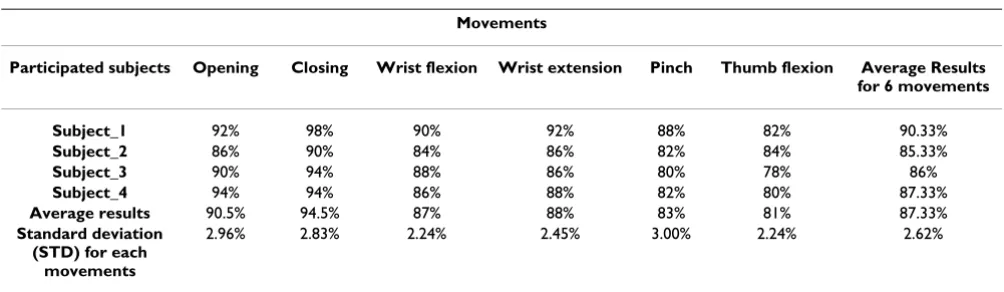
noted. It presents the acquired results for each subject and the average accuracy of the system for different hand movements. The training process for this system utilized different time durations (response delays) for each indi-vidual movement. It varied from three minutes for the hand closing to eleven minutes for the thumb move-ments.
The results indicated that the ANFIS system exhibits a superior performance as compared to ANN noted in pre-vious studies [1]. Also the real-time scheme for learning sEMG pattern recognition system with the user evaluation inclusion provided better results. Hence by using the ANFIS real-time learning method, we were able to success-fully discriminate among six descriptive and distinct hand movements. To compare the proposed ANFIS method and the simple feed forward ANN approach, the acquired results are presented in Tables 3 and 4, respectively. Based on these results, the average recognition rate for ANFIS and ANN are 96.7% (STD 1.2) and 87.3% (STD 2.6), respectively. These results depict a marked improvement in recognition rate associated to the proposed ANFIS algo-rithm.
Confusion matrix, recognized as one of the most useful methods in the study of pattern recognition applications, was utilized for discriminating among various hand movements for all subjects. One benefit of a confusion matrix is that it is easy to verify if the system is confusing two classes (i.e. commonly mislabelling one as another). Table 5 depicts our results for this study. Each column of the matrix represents the instances in an actual class, while each row represents the instances in a predicted class. Results show a minimum class based recognition rate of 94% while a maximum error rate of 5% depicting class confusion was recorded.
Table 6 depicts two offline and one online based studies for comparison with our findings. As number of hand movements differs in these studies, we defined a criterion which is based on the error percentage per number of movements. Based on the results presented in this table, the best per movement error percentage belongs to our proposed ANFIS algorithm as referenced to our accumu-lated results in Table 3.
Furthermore to evaluate the performance of the proposed ANFIS algorithm, we determined the specificity and sensi-tivity of each class by using the results depicted in the
con-Table 4: Statistical overview of rate of success of the real-time ANN system for sEMG pattern discrimination system
Movements
Participated subjects Opening Closing Wrist flexion Wrist extension Pinch Thumb flexion Average Results for 6 movements
Subject_1 92% 98% 90% 92% 88% 82% 90.33%
Subject_2 86% 90% 84% 86% 82% 84% 85.33%
Subject_3 90% 94% 88% 86% 80% 78% 86%
Subject_4 94% 94% 86% 88% 82% 80% 87.33%
Average results 90.5% 94.5% 87% 88% 83% 81% 87.33%
Standard deviation (STD) for each
movements
2.96% 2.83% 2.24% 2.45% 3.00% 2.24% 2.62%
Table 3: Statistical overview of rate of success of the real-time neuro-fuzzy system for sEMG pattern discrimination system
Movements
Participated subjects Opening Closing Wrist flexion Wrist extension Pinch Thumb flexion Average Results for 6 movements
Subject_1 98% 100% 94% 94% 96% 92% 95.67%
Subject_2 98% 100% 100% 96% 98% 94% 97.67%
Subject_3 96% 100% 88% 98% 98% 92% 95.33%
Subject_4 100% 100% 94% 96% 100% 98% 98%
Average results 98% 100% 94% 96% 98% 94% 96.67%
Standard deviation (STD) for each
movements
fusion matrix (Table 5), where the sensitivity and specificity may be defined as number of correct classifica-tion of multi-labeled movements per total number of con-fused cross-class movements, and number of correct classification per number of total hand movements, respectively [24]. Table 7 presents the results for both parameters.
Discussions
sEMG signals provide an extremely useful non-invasive measure of ongoing muscle activity. They are potentially suitable as reference signals for prosthetic hands. Most commercially available hand prostheses have limited range of hand motions. The most natural way to control prosthesis hand would be through a neural based control scheme mediated by the nerves intended for the ampu-tated hand or arm. In this work, we proposed a novel real-time method suitable for hand prosthesis control.
In this non-invasive system, two channel surface mounted electrodes were utilized. The system presented in this work was based on a new intelligent approach, namely a neuro-fuzzy classifier. To train this system, a hybrid method approach consisting of BP and LMS was intro-duced. Furthermore we employed a subtractive clustering scheme to specify fuzzy system rules.
Also in order to increase recognition rate of this system, two types of features which were time domain and time-frequency representations were used. In time domain we used three major features of sEMG signal namely, MAV, SSC and AR model coefficients and in time-frequency domain, ZC and local maxima of wavelet transform were
employed. Once a feature set was constructed, they were fed to a classifier for discriminating amongst six motion commands of selected hand motions. In this study by using a real time learning method, we considered the effect of user evaluation. The training process of the sys-tem was continued until its recognition accuracy based on the RMS criterion was satisfied.
After implementing the sEMG pattern recognition system, we acquired classification rate of the proposed system. Our results demonstrated that the utilized real-time based ANFIS approach was superior to the previously intro-duced ANN scheme as it allowed for a versatile multi motion recognition machine.
Conclusion
In this work, we introduced a new approach for recogniz-ing sEMG pattern based on real-time neuro-fuzzy system with high degree of correctness. Two types of sEMG fea-tures were used, namely time and time-frequency feafea-tures. Also in order to consider the effect of real-time learning on recognizing six distinct hand movements, an operator based vision feedback approach was utilized. This study demonstrated that ANFIS real-time based learning method is a viable contender in the sEMG pattern recog-nition system in extending the acceptable range of hand motions intended for hand prosthesis systems.
Abbreviations
EMG Electromyogram Signal
sEMG Surface Electromyogram Signal
Table 6: Comparing the acquired results in this work with previous offline and online EMG pattern recognition system
Selected Study Number of Hand Movements Used
Percentage of Error Range
System type Percentage of Error per Movement
B. Hudgins 4 2–30% Off-line 0.5 – 7.5%
K. Englehart 4 6–13% Off-line 1.5 – 3.25%
Nishikawa 10 5.6–9.3% On-line 0.56 – 0.93%
This work 6 2 – 4.67% On-line 0.33 – 0.78%
Table 5: Confusion matrix for identified hand movements for all subject by using ANFIS
Identified movements Real movements
Opening Closing Wrist flexion Wrist extension Pinch Thumb flexion
Opening 98% 2% - - -
-Closing - 100% - - -
-Wrist flexion - 2% 94% 4% -
-Wrist extension - - 4% 96% -
-Pinch - 2% - - 98%
ANFIS Adaptive Neuro-Fuzzy Inference System
BP Back Propagation
LMS Least Mean Square
ANN Artificial Neural Network
AR Autoregressive
MAV Mean Absolute Value
SSC Slope Sign Changes
ZC Zero Crossing
PCA Principle Component Analysis
CMRR Common Mode Rejection Ratio
MF Membership Function
TD Time Domain (features)
TFR Time-Frequency Representations
FIS Fuzzy Inference System
DWT Discrete Wavelet Transform
RMS Root Mean Square
PC Personal Computer
C.G Computer Graphics
Competing interests
The author(s) declare that they have no competing inter-ests.
Authors' contributions
MK conceived, designed and implemented the computer model, and drafted the manuscript. MJ supervised the project, contributed to the discussion and interpretation of the results, and participated in manuscript revisions. All authors read and approved the final manuscript.
References
1. Nishikawa D, YU W, Yokoi H, Kakazu Y: EMG Prosthetic Hand Controller Discriminating Ten Motions using Real-Time Learning Method. Proceeding of the 1999 IEEE/RS International con-ference on Intelligent Robots and Systems .
2. Zecca M, Micera S, Carrozza MC, Dario P: Control of Multifunc-tional Prosthetic Hands by Processing the Electromyo-graphic Signal. Critical Reviews™ in Biomedical Engineering 2002, 30(4–6):459-485.
3. Hudgins B, Parker P, Scott RN: A new strategy for multifunction myoelectric control. IEEE Tran Biomed Eng 1993, 40(1):82-94. 4. Englehart K, Hudgins B: A robust, real-time control scheme for
multifunction myoelectric control. IEEE Trans Biomed Eng 2003, 50(7):848-854.
5. Englehart K, Hudgins B, Parker PA: A wavelet-based continuous classification scheme for multifunction myoelectric control.
IEEE Trans Biomed Eng 2001, 48(3):302-311.
6. Otto Bock HealthCare GmbH 2002 [http://www.ottob
ock.com]. Duderstadt (DE)
7. Speeter TH: Primitive based control of the Utah/MIT dex-trous hand. Intl Conf on Robotics and Automation (ICRA), Sacra-mento, California:866-877. April 9–11 1991
8. Mason M, Salisbury J: Robot Hands and the Mechanics of Manip-ulation. Cambridge, Massachusetts: MIT Press; 1985.
9. Butterfa J, Grebenstein M, Liu H, Hirzinger G: DLR-hand II: "next generation of a dextrous robot hand. Intl Conf on Robotics and Automation (ICRA), Seoul:109-114. May 21–26 2001
10. Lovchik CS, Diftler MA: e robonaut hand: a dexterous robot hand for space. IEEE Intl Conf on Robotics and Automation (ICRA), Detroit, Michigan:907-912. May 10–15 1999
11. Massa B, Roccella S, Carrozza MC, Dario P: Design and develop-ment of an underactuated prosthetic hand. Intl Conf on Robotics and Automation (ICRA) 2002, Washington DC:3374-3379. IEEE, 2002, May 11–15 2002
12. Fujii S, Nishikawa D, Yoko H: Development of a Prosthetic Hand Using Adaptable Control Method for Human Characteris-tics. Volume 5. Amsterdam: IOS Press; 1998:360-376.
13. Graupe D, Salahi J, Kohn KH: Multifunction prosthesis and orthosis control via micro-computer identification of tempo-ral pattern differences in single-site myoelectric signals. J Biomed Eng 1982, 4:17-22.
14. Zadeh LA: Fuzzy sets. Inf Control 1965, 8:338-353.
15. Zadeh LA: Outline of a new approach to analysis of complex systems and decision processes. IEEE Trans Syst Man Cybern
1973, SMC3:28-44.
16. Hussein SE, Granat MH: Intention detection using a neurofuzzy EMG classifier. IEEE Eng Med Biol Mag 2002, 21:123-9.
17. Chan FHY, Yang YS, Lam FK, Zhang YT, Parker PA: Fuzzy EMG classification for prosthesis control. IEEE Trans Rehabil Eng 2000, 8(3):305-311.
18. Ajiboye AB, ff. Weir RF: A heuristic fuzzy logic approach to EMG pattern recognition for multifunctional prosthesis con-trol. IEEE Trans Neural sys and Rehabil Eng 2005, 13(3):280-291. 19. Petroff N, Reisinger KD, Mason PAC: Fuzzy-control of a hand
orthosis for restoring tip pinch, lateral pinch, and cylindrical prehensions to patients with elbow flexion intact. IEEE Trans Neural Syst Rehabil Eng 2001, 9(2):225-231.
20. Bezdek J: Pattern Recognition with Fuzzy Objective Function Algorithms. New York: Plenum; 1981.
21. Karlik B, Tokhi MO, Alci M: A fuzzy clustering neural network architecture for multifunction upper-limb prosthesis. IEEE Trans Biomed Eng 2003, 50(11):1255-1261.
22. Deluca CJ: Surface electromyography: detection and record-ing. 2003 [http://www.delsys.com/library/papers/sEMGintro.pdf]. Table 7: The statistical characteristics of designed neuro-fuzzy system for recognizing hand movements
Classifier Specificity Sensitivity
ANFIS 96.67% 97.14%
Publish with BioMed Central and every scientist can read your work free of charge
"BioMed Central will be the most significant development for disseminating the results of biomedical researc h in our lifetime."
Sir Paul Nurse, Cancer Research UK
Your research papers will be:
available free of charge to the entire biomedical community
peer reviewed and published immediately upon acceptance
cited in PubMed and archived on PubMed Central
yours — you keep the copyright
Submit your manuscript here:
http://www.biomedcentral.com/info/publishing_adv.asp
BioMedcentral
23. Karlsson S, Yu J, Akay M: Enhancement of spectral analysis of myoelectric signalsduring static contractions using wavelet methods. IEEE Trans Biomed Eng 1999, 46:670-684.
24. Subasi A: Application of adaptive neuro-fuzzy inference sys-tem for epileptic seizure detection using feature extraction.