ISSN 2319-7625 (Online) www.chemistry-journal.org
Electrophoretic Study of Fe(III) and Mn(II) Complexes
with Medicinally Important Ligand
Arvind Singh, Ram Rudra Patel and O.P. Rai
Department of Chemistry,
Govt. (Autonomous) P. G. College, Satna, M. P., INDIA.
(Received on: January 20, 2015)
ABSTRACT
The complexation of Fe(III) and Mn(II) with medicinally important ligand ephedrine in solution were studied by paper electrophoretic technique. Stability constants of investigated binary chelates were determined at 25°C and 0.1M (HClO4) ionic strength. The stability constant data revealed that ephedrine may be used as chelating agent.
Keywords: Paper electrophoresis, Binary complexes, Fe(III), Mn(II), ephedrine,
Chelation, Stability constants.
INTRODUCTION
30 Arvind Singh, et al., J. Chem. & Cheml. Sci. Vol.5 (1), 29-35 (2015)
January, 2015 | Journal of Chemistry and Chemical Sciences | www.chemistry-journal.org
Iron and manganese are essential for normal biological and physiological functions in human beings. The amount of these metals can be varying in human body through intake of diet and different environmental factors. They may either contribute towards the health of the human body or cause toxicity8. The effective coordination of metal ions with ligands may have significance in biological implication9. The chelation therapy for intoxication of metals depends upon the chelating agent being able to reach the intercellular site where the metals are firmly bound. For a pretty long time, varieties of ligand have been used as chelating agent to combat metal poisoning. In present study ephedrine has been used as ligand. Which is a sympathomimetic ammine commonly used as a stimulant, appetite suppressant, concentration aid, decongestant and treat hypotension associated with anaesthesia. Literature survey10-15 reveals that no work has been done using ephedrine as a ligand. Therefore we decided to study the stability constant of binary complexes of ephedrine with Fe(III) and Mn(II) in solution using paper electrophoretic technique.
EXPERIMENTAL
Instrument
A Systronic (Naroda, India) Model 610 electrophoresis system was used. The apparatus consisted of a PVC molded double tank vessel. It has a built-in power supply (a.c.– d.c.) that is fed directly to a paper electrophoresis tank. In our laboratory significant change in the instrument has been made. Two hollow rectangular metallic plates coated with thin polyethylene sheets on the outer surface have been used through which thermo stated water is run for controlling the temperature (25°C). The tanks were closed with a transparent PVC molded lid. The whole assembly is tight which prevent moisture changes, which may upset the equilibria in a paper strip. The assembly design keeps to a minimum the disturbing effects of evaporation from the unwanted liquid flow in the paper. Each electrolyte tank contains a separate electrode chamber in which the anode and cathode are placed, respectively. The pH measurements were made with an Elico (Hyderabad, India) Model L1–10 pH meter using a glass and calomel electrodes assembly, working on 220 V/50 Hz established a.c. mains.
Chemicals
Filter Paper Strips
Strips of Whatman No. 1 filter paper for chromatography (30×1) cm² were used and the potential gradient was 6.6 V/cm.
Electro–osmotic indicator
5.0 × 10⁻³ M glucose (BDH A. R. grade) was prepared in water and used as an electro–osmotic indicator for the correction due to electro–osmosis.
Detecting reagent for metal ions
Ammonium thiocyanate for Fe(III) and 0.1% (W/V) solution of 1–(2-pyridylazo)–2-naphthol (PAN) in ethanol for Mn(II) was used.
Indicator for glucose
A saturated aqueous solution (0.9 ml) of silver nitrate was diluted with acetone to 20 ml. Glucose was detected by spraying with this solution, and then with 2% ethanolic hydroxide when a black spot was formed.
Background electrolyte
Stock solution of (5.0 M) was prepared by suitable dilution of 70% perchloric acid (SDS A. R. grade). 2.0 M sodium hydroxide (A. R. grade) and 0.5 M stock solutions of the complexing reagent ephedrine (A. R. grade) solutions were prepared. All chemicals were used without further purifications. Each solution was standardized using the appropriate method. The background electrolyte used in the study of binary complexes was 0.1M perchloric acid and 0.01M ephedrine. The system was maintained at various pH by the addition of sodium hydroxide.
PROCEDURE
32 Arvind Singh, et al., J. Chem. & Cheml. Sci. Vol.5 (1), 29-35 (2015)
January, 2015 | Journal of Chemistry and Chemical Sciences | www.chemistry-journal.org
wetting of paper strips. Subsequently, a direct 200 volts was applied between the electrodes. Eletrophoresis was carried out for 30 minutes after which these strips were removed from the tank and dried. The metal ions and glucose spots were detected by specific reagents. The leading and tailing edges were measured from the mid-point and the mean were taken. The distance moved by glucose spot was subtracted (in case of migration towards anode) to obtain the correct path length. Migration towards anode and cathode were designated by negative and positive signs, respectively.
Electrophoretic observations on metal ion spots were recorded at various pH values of the background electrolyte obtained by adding sodium hydroxide solution, the ionic strength being maintained at 0.1M. The observed mobility of the migrant was calculated by using the formula.
.
After applying the correction factor, the observed mobility is given as
.
Where U = mobility of metal ion/complex ion, d = mean of duplicate distances travelled by metal ion/complex ion, dG = mean of duplicate distances travelled by glucose spots, x = field strength and t = time for electrophoresis.
The electrophoresis was carried out for 30 minutes as for metal ions. The mobility of the metal ion spots on the strips were reported along with pH values. The individual mobility of the duplicate spots was fairly equal and the variation was always less than 0.5 cm.
RESULT AND DISCUSSION
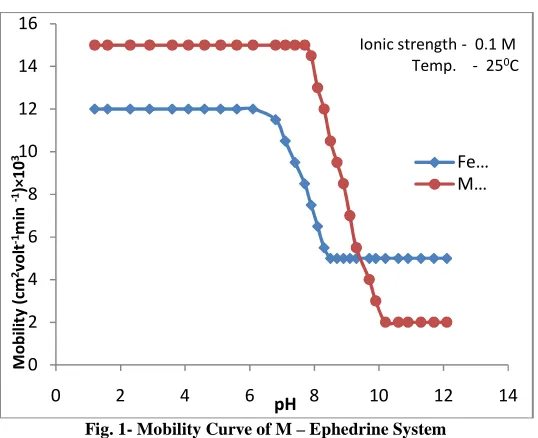
Fig. 1- Mobility Curve of M – Ephedrine System 0
2 4 6 8 10 12 14 16
0 2 4 6 8 10 12 14
M
o
b
il
it
y
(
cm
2v
o
lt
-1m
in
-1)×
10
3
pH
Ionic strength - 0.1 M Temp. - 250C
The electrophoretic mobility of metal ion spot against pH gives number of plateaus shown in figure 1. A plateau is obviously show pH range where mobility is practically constant. In the region of first platea
where concerned of highly protonated species of ligand is obviously maximum, hence it is concluded that this protonated species of ligand is not complexing. Beyond this pH range metal ion spot has progressively decreasing mobility.
complex of metal ion with ligand. A point is reached beyond which mobility of the metal ion species remain constant. This is the second plateau which corresponds to a pH region in which 1:1 cationic complex is formed. One ligand anion combines with each metal ion to form [Fe(L)]++ and [Mn(L)]
further increase of pH beyond the second plateau there is no further decrease in mobility of metal ion indicates no further complexation takes place. It is significant that these studies give clear evidence of the binary complex formation of 1:1 composition. The complexation of metal ions with ligand anion [L
Where M3+ = Fe3+ and M
[L-] = ephedrine anion, K = stability constants
The spot is moving under the influence of electric field, if non
protonated species are considered, the overall mobility can be given by expression as:
u0.0β0.0 + u u1.1 β1.1
u2.1 β2.1
U = β0.0 .β1.0 . [L] +
+ β1.2 .[H2L] +
Where u0.0 is the speed of uncomplexed metal ion, u
by the combination of one unprotonated anionic ligand with the metal ion and u speed of the metal complex formed by the combination of x ani
each. β’s are the overall stability constants of the different metal complexes formed in the interaction. On taking into consideration different equlibria above equation transformed into following useful form:
M3+ + L- M2+ + L-
The electrophoretic mobility of metal ion spot against pH gives number of plateaus shown in figure 1. A plateau is obviously show pH range where mobility is practically constant. In the region of first plateau metal ions are uncomplexed. It lies in low pH region where concerned of highly protonated species of ligand is obviously maximum, hence it is concluded that this protonated species of ligand is not complexing. Beyond this pH range ressively decreasing mobility. This decrease shows formation of complex of metal ion with ligand. A point is reached beyond which mobility of the metal ion species remain constant. This is the second plateau which corresponds to a pH region in tionic complex is formed. One ligand anion combines with each metal ion to and [Mn(L)]+, cationic complexes with Fe(III) and Mn(II) respectively. On further increase of pH beyond the second plateau there is no further decrease in mobility of metal ion indicates no further complexation takes place. It is significant that these studies give clear evidence of the binary complex formation of 1:1 composition. The complexation of metal ions with ligand anion [L-] can be represented as
and M2+ = Mn2+ metal ion, ] = ephedrine anion,
= stability constants
The spot is moving under the influence of electric field, if non
species are considered, the overall mobility can be given by expression as:
+ u1.0 .[L] + u2.0 β2.0 [L] 2
+…. + 1.1 .[HL] + u2.1 .[HL]2 +…..………….
2.1 .[H2L] + u2.2 β2.2 [H2L] 2
+…... U =
. [L] + β2.0 .[L] 2
+β1.1 .[HL] + β2.1 .[HL] 2
L] + β2.2 .[H2L]2+
is the speed of uncomplexed metal ion, u1.0 is that of the complex formed by the combination of one unprotonated anionic ligand with the metal ion and u
speed of the metal complex formed by the combination of x anions containing p protons ’s are the overall stability constants of the different metal complexes formed in the interaction. On taking into consideration different equlibria above equation transformed into
K
ML2+ K
ML+
The electrophoretic mobility of metal ion spot against pH gives number of plateaus shown in figure 1. A plateau is obviously show pH range where mobility is practically u metal ions are uncomplexed. It lies in low pH region where concerned of highly protonated species of ligand is obviously maximum, hence it is concluded that this protonated species of ligand is not complexing. Beyond this pH range
This decrease shows formation of complex of metal ion with ligand. A point is reached beyond which mobility of the metal ion species remain constant. This is the second plateau which corresponds to a pH region in tionic complex is formed. One ligand anion combines with each metal ion to , cationic complexes with Fe(III) and Mn(II) respectively. On further increase of pH beyond the second plateau there is no further decrease in mobility of metal ion indicates no further complexation takes place. It is significant that these studies give clear evidence of the binary complex formation of 1:1 composition. The complexation
(1)
(2)
The spot is moving under the influence of electric field, if non-protonated and species are considered, the overall mobility can be given by expression as:
(3)
34 Arvind Singh, et al., J. Chem. & Cheml. Sci. Vol.5 (1), 29-35 (2015)
January, 2015 | Journal of Chemistry and Chemical Sciences | www.chemistry-journal.org
U
(4)
Where u0 and u1 are the ionic mobilities of uncomplexed metal ions and 1:1 metal complexes, respectively. For calculating stability constant K, the region between first and second plateau is pertinent. The system contains using the principle of average mobility. Stability constant can be calculated with the help of mobility of first plateau and second plateau the system contains overwhelmingly a mixture of free metal ion and 1:1 complex. Using the principle of average mobility
U
(5)
Provided
K
Accordingly the pH corresponding to the average value of u0 and u1 is found from the figures and with the knowledge of dissociation constant of ligands, the concentration of ionic ligands at this pH is calculated. Its reciprocal gives the stability constant K of the 1:1 complex. The concentration of chelating ligands anion [L-] is determined as:
L
(6)
Where [Lt] = total concentration of the ligand ephedrine k = dissociation constant of ephedrine
With the help of dissociation constant of ephedrine (pka = 9.958). The concentration of ephedrine anion is determined for the pH, from which the stability constant (K) is calculated. The calculated stability constants value for 1:1 binary complexes are given in table 1 which follows the Irving William’s16 order for stability constants of transition metals of the first transition series and no comparison can be made with the literature value due to its unavailability.
TABLE – 1: STABILITY CONSTANT OF M - EPHEDRINE BINARY COMPLEXES
Temperature - 250C Ionic Strength - 0.1M
Metal ions
Stability Constants
Calculated Values logK Literature values logK
Fe (III) 4.2601 -
CONCLUSION
Fe(III) and Mn(II) are present in many structural and functional part in the human body and essential for normal physiological processes, but they are toxic if present in excess. Metal toxicity is a major problem for human and other living beings. Chelating agents and stability constant are important parameter for formation of metal complexes. The chelating agents are substances that have a strong ability to grab onto toxic metals and dislodge from the tissues. Ephedrine used in this work is very good chelating agents which interacted with metal ions to form various metal chelates. It can be concluded from the present study that ephedrine may be used to reduce the level of Fe(III) and Mn(II) in biological system and paper electrophoretic technique is very useful for determination of stability constant of metal complexes in solution.
REFERENCES
1. Jokl, V. J., Chromatography, 14, 74 (1964). 2. Biernet, J., Rocz. Chem., 38, 343 (1964).
3. Alimarin, I. P. and Sheleskaya, V. I., Pure Appl. Chem., 21, 461 (1970).
4. Beck, M. T., The determination of complex equilibria. Chapter 8, Van Nostrand, New York (1969).
5. Janes, D. L. and Margerum,W. M., Inorg. Chem., 5, 1135 (1966).
6. Diaj, G. M., Alanso, R. P. and Esparza, R. M., J. Inorg. Biochem., 64, 207 (1996). 7. Obaleya, J. A., Nde-aga, J. B. and Balogun, E.A., Afr. J. Sci., 1, 10-12 (1997). 8. Yambe, S. and Koho, J. P., Chem. Abs., 111, 219307z (1989).
9. A.O. Ajibola, Essential Medicinal Chemistry, 2nd Edn., Shaneson Jeresey, 2b (1999). 10. Tewari, B. B., Journal of Chromatography A, 962, 233-237 (2002).
11. Tewari, B. B., J. Mex. Chem. Soc., 52(3), 219-223 (2008). 12. Tewari B. B., Revista Bolivina De Quimica., 25(1), 4-9 (2008). 13. Sachan, S. et al., Croat. Chem. Acta, 84(4), 461-464 (2011).