Introduction
Panacea is a term used for a material that can be used as a cure for all or universal remedy. Calcium hydroxide had held its position as the panacea in dentistry for many decades owing to its multiple applications be it as an intracanal medicament or a pulp capping agent.[1] Calcium hydroxide is the material of choice for apical barrier formation and healing. But along with its many advantages, the disadvantages can be summarized as follows: 1 length of time for induction of coronal or apical hard tissue barriers. This typically ranges from 2 to 3 months in the case of pulp capping[2] and 6–18 months in the case of apexification procedures[3-5] with an average of 9 months for the latter.[6] The zones represent the contact area between calcium hydroxide and vital pulp tissue; they may become infected at a later time through microleakage under restorations, leading to pulpitis and subsequent pulp necrosis.[7] This may lead to infiltration of bacteria through vascular tunnels.[8,9] These changes are related to the loss of inorganic and organic components of the dentin.[10-18] These changes lead frequently to cervical root fractures.[5,19,20] In 1993, a new endodontic material, mineral trioxide aggregate (MTA) was developed by Torabinejad and coworkers, primarily for the purpose of
ABSTRACT
The aim of this questionnaire survey was to study the level of awareness among the dentists in Chennai, the current status of knowledge and opinion toward mineral trioxide aggregate (MTA) as a panacea in dentistry. A total of 200 dentists and specialists (endodontist) were included in this survey. The first part contained questions regarding the profile of the respondents including gender, age group, field of practice, and years of experience. The second part contained 16 questions regarding the knowledge and opinion toward the use of MTA proving to be a panaceain dentistry. The results of this questionnaire survey showed that dental practitioners agree to the fact that MTA has successfully replaced calcium hydroxide as the new panacea in dentistry. The dental residents and endodontist in Chennai were much aware of the uses and advantages of MTA. Due to its superior clinical performance, it is concluded that MTA is a panacea in dentistry.
Keywords: Panacea, survey, mineral trioxide aggregate, calcium hydroxide
Is mineral trioxide aggregate, a panacea in dentistry?
A questionnaire survey
Surendar Sugumaran, M. S. Nivedhitha
Department of Conservative Dentistry and Endodontics, Saveetha Dental College, Saveetha University, Chennai, Tamil Nadu, India
Correspondence: M. S. Nivedhitha, Department of Conservative Dentistry and Endodontics, Saveetha Dental College, Saveetha University, No. 162, Poonamallee High Road, Chennai – 600 077, Tamil Nadu, India. Phone: +91-9840912367. E-mail: [email protected]
making a bacteria-tight and biocompatible material to seal accidental perforations of the root canal apart from its other applications.[21] This material was proved to be ideal as root-end filling material and material for use in pulp capping and pulpotomy cases.[22-27] Later, MTA found its way into the treatment of traumatized immature teeth with pulp necrosis (apexification), as some of the shortcomings of calcium hydroxide seemed to be overcome with the use of MTA.[28]
In recent times, MTA has been successfully used as a pulp capping material, in apexification procedures, as a sealer, etc.[29] Hence, can we say that MTA has replaced calcium hydroxide successfully as the panacea in modern dentistry.
This questionnaire survey aims to assess the level of awareness among the dentists in Chennai, the current status of knowledge and opinion toward MTA as a panacea in dentistry.
Materials and Methods
A total of 200 dentists and specialists (endodontist) were included in this survey. The first part contained questions regarding the profile of the respondents including gender, age group, field of practice, and years of experience Figure 1. The second part contained 16 questions regarding the knowledge and opinion toward the use of MTA proving to be a panaceain dentistry. All the questionnaires were completely filled and submitted. The results were tabulated.
Questionnaire
Is MTA a remedy for all difficulties in dentistry? A questionnaire survey.
Access this article online
Website: www.japer.in E-ISSN: 2249-3379
1. Gender: male ()
female ()
2. Age group (in years): 20 - 30 ()
31 - 40 ()
41 - 50 ()
>50 ()
3. Field of practice: post graduate (endo) ()
general dentist ()
endodontist ()
interns ()
4. years of experience: 0 - 5 ()
6- 10 ()
11 - 15 ()
>15 ()
5. Rate the biocompatibility of dental materials listed below ?. Rank answers from 1 to 4
1 - most compatible 4 - least compatible
• Calcium hydroxide { 1 / 2 / 3 / 4 } • Mta { 1 / 2 / 3 / 4 } • Gic { 1 / 2 / 3 / 4 } • Amalgam { 1 / 2 / 3 / 4 }
6. Which material do you think could prevent infection-related root resorption?.
strongly
agree agree uncertain disagree stronglydisagree a. Mta
b. Calcium hydroxide c. Biodentine
7. Materials used for apexification procedures?
strongly
agree agree uncertain disagree stronglydisagree a. Mta
b. Calcium hydroxide c. Biodentine
d. Calcium phosphate ceramics & hydroxyapetite e. Bone morphogenetic proteins
8. Rate the materials for superior performance as direct pulp capping agent?.
1 - most superior 4 - least superior
• Calcium hydroxide { 1 / 2 / 3 / 4 } • Mta { 1 / 2 / 3 / 4 }
• Bioaggregate { 1 / 2 / 3 / 4 }
• Tri-calcium phosphate { 1 / 2 / 3 / 4 } • Biodentine { 1 / 2 / 3 / 4 }
9. Rate the materials for superior performance as a base for indirect pulp capping ?.
1 - most superior 4 -least superior
• Calcium hydroxide { 1 / 2 / 3 / 4 } • Mta { 1 / 2 / 3 / 4 }
• Bioaggregate { 1 / 2 / 3 / 4 }
• Tri-calcium phosphate { 1 / 2 / 3 / 4 } • Biodentine { 1 / 2 / 3 / 4 }
10. Which material do you think showed higher clinical and radiographic success as pulpotomy agent in immature permanent teeth?
strongly
agree agree uncertain disagree stronglydisagree a. Mta
b. Calcium hydroxide c. Formocresol
d. Biodentine
11. Rate the materials for root canal sealers? 1 - most 4 -least
• Zinc oxide-eugenol { 1 / 2 / 3 / 4 } • Mta { 1 / 2 / 3 / 4 }
• Ah plus { 1 / 2 / 3 / 4 } • Endoseal { 1 / 2 / 3 / 4 }
12. Which material shows better results for leakage and bio-compatibility for apicoectomy procedure ?.
strongly
agree agree uncertain disagree stronglydisagree a. Mta
b. Gic c. Amalgam
13. Do you think mta is the material of choice for root and furcation perforation repair material?
14. Which obturation material do you think shows higher resistance to fracture?
a. Mta b. Gutta-percha c. Both a&b
15. What do you consider to be the optimal treatment for management of open apex?
A. calcium hydroxide apexification
B. calcium hydroxide application followed by mta apical plug and backfilling with obturation material C. Mta apical plug and backfill with obturation material D. triantibiotic paste and pulpal regeneration
E. multiple option
16. Materials used for apical transportation repair ?. strongly
agree agree uncertain disagree stronglydisagree a. Mta
b. Bioceramics
17. Advantages of mta
yes no uncertain
a- less number of visits
b- good apical seal
c- patient compliance
18. Advantages of mta over calcium hydroxide?. strongly
agree agree uncertain disagree stronglydisagree a. Lesser time
period b. Single visit
c. Safety
19. Mta is an appropriate alternative to calcium hydroxide with predictable results?.
a. Yes b. No c. uncertain
20. Panacea- cure-all. Is mta panacea in dentistry?
a. Myth b. Real
Please write any comments you wish to make related to the kap survey.
________________________________________________ ________________________________________________ ________________
Results
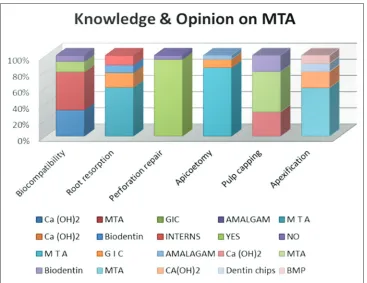
The results of this questionnaire survey showed that dental practitioners agree to the fact that MTA has successfully replaced calcium hydroxide as the new panacea in dentistry [Figure 2].
Discussion
The various studies conducted earlier consider whether the time has come to replace CH with MTA in certain dental trauma situations such as pulp capping, pulpotomy, and apexification. Before reaching a conclusion in that regard, it is necessary to look at the amount of clinical data related to the long-term outcomes of the two methods. In the case of CH, a number of long-term studies have demonstrated a healing rate of 95% for pulpotomy and 95% for apexification. With respect to MTA, there are only a few clinical studies with relatively few subjects for either pulpotomy or apexification.[30] This points out that clinical result of MTA should be compared with CH with more randomized clinical trials. Until then, we should use MTA as a new material which may not have a long-term usage. This is most important with respect to its use in teeth with root fractures and coronal pulp necrosis and in teeth with external root resorption. The technical difficulties and other disadvantages of using MTA should be noticed. One concern has to do with whether or not MTA exerts the same weakening effect on dentin as CH.
There have been two in vitro studies that seem to indicate risks of MTA that is maintain a high pH level in the root canal for many months, and the structural strength of dentin appeared to be weakened.[12,17] On the other hand, Hatibovic-Kofman et al.[16] showed that the use of MTA did not seem to weaken dentin over a 3-month to 1-year period. More in vitro and in vivo studies need to be carried out to assess the severity of this issue. Another problem has been an apparent staining effect of MTA when used for pulp capping, pulpotomy, and apexification in anterior teeth. We need to look into this matter more seriously as MTA is very commonly used as a material for pulpotomy in anterior teeth as well. The frequency and severity of this effect are presently unknown. It may be concluded from this review that MTA appears to be a promising successor to CH for a variety of pulpal and periodontal healing complications after trauma. More randomized clinical trials need to be carried out to compare CH and MTA in the treatment of pulp and periodontal healing complications post-trauma.
This questionnaire survey showed that dental practitioners agree to the fact that MTA has successfully replaced calcium hydroxide as the new panacea in dentistry.
Conclusion
The dental residents and endodontist in Chennai were much aware of the uses and advantages of MTA. About 96.5% of the dentist from this survey agrees MTA is an appropriate alternative to Ca (OH)2 with predictable results. Due to its superior clinical performance, it is concluded that MTA is a panacea in dentistry.
References
1. Cvek M. Endodontic management and the use of calcium hydroxide in traumatized permanent teeth. In: Andreasen JO, Andreasen FM, Andersson L, editors. Textbook and Color Atlas of Traumatic Injuries to the Teeth. 4th ed.
Oxford: Blackwell; 2007. p. 598-657.
2. Olsson H, Petersson K, Rohlin M. Formation of a hard tissue barrier after pulp cappings in humans. A systematic review. Int Endod J 2006;39:429-42. 3. Mackie IC, Bentley EM, Worthington HV. The closure of open apices in
non-vital immature incisor teeth. Br Dent J 1988;165:169-73.
4. Yates JA. Barrier formation time in non-vital teeth with open apices. Int Endod J 1988;21:313-9.
5. Cvek M. Prognosis of luxated non-vital maxillary incisors treated with calcium hydroxide and filled with gutta-percha. A retrospective clinical study. Endod Dent Traumatol 1992;8:45-55.
6. Kinirons MJ, Srinivasan V, Welbury RR, Finucane D. A study in two centres of variations in the time of apical barrier detection and barrier position in nonvital immature permanent incisors. Int J Paediatr Dent 2001;11:447-51.
7. Schröder U, Granath LE. Early reaction of intact human teeth to calcium hydroxide following experimental pulpotomy and its significance to the development of hard tissue barrier. Odontol Revy 1971;22:379-95.
8. Cox CF, Sübay RK, Ostro E, Suzuki S, Suzuki SH. Tunnel defects in dentin bridges: Their formation following direct pulp capping. Oper Dent 1996;21:4-11.
9. Nair PN, Duncan HF, Ford TR, Luder HU. Histological, ultrastructural and quantitative investigations on the response of healthy human pulps to experimental capping with mineral trioxide aggregate: A randomized controlled trial. Int Endod J 2008;41:128-50.
10. Grigoratos D, Knowles J, Ng YL, Gulabivala K. Effect of exposing dentine to sodium hypochlorite and calcium hydroxide on its flexural strength and elastic modulus. Int Endod J 2001;34:113-9.
11. Andreasen JO, Farik B, Munksgaard EC. Long-term calcium hydroxide as a root canal dressing may increase risk of root fracture. Dent Traumatol 2002;18:134-7.
12. White JD, Lacefield WR, Chavers LS, Eleazer PD. The effect of three commonly used endodontic materials on the strength and hardness of root dentin. J Endod 2002;28:828-30.
13. Doyon GE, Dumsha T, von Fraunhofer JA. Fracture resistance of human root dentin exposed to intracanal calcium hydroxide. J Endod 2005;31:895-7. 14. Yoldas O, Dogan C, Seydaoglu G. The effect of two different calcium hydroxide
combinations on root dentine microhardness. Int Endod J 2004;37:828-31. 15. Rosenberg B, Murray PE, Namerow K. The effect of calcium hydroxide root
filling on dentin fracture strength. Dent Traumatol 2007;23:26-9.
16. Hatibovic-Kofman S, Raimundo L, Zheng L, Chong L, Friedman M,
Andreasen JO. Fracture resistance and histological findings of immature teeth treated with mineral trioxide aggregate. Dent Traumatol 2008;24:272-6. 17. Twati WA, Wood DJ, Liskiewicz TW, Willmott NS, Duggal MS. An evaluation
of the effect of non-setting calcium hydroxide on human dentine: A pilot study. Eur Arch Paediatr Dent 2009;10:104-9.
18. Sahebi S, Moazami F, Abbott P. The effects of short-term calcium hydroxide application on the strength of dentine. Dent Traumatol 2010;26:43-6. 19. Rmer KS, Jacobsen I, Attramadal A. Hvor Funkjonsdyktige Bliver Rottfylte
Unge Permanente Incisiver? Nordisk Forening for Pedodonti. Bergen, Norway: Aarsm Te; 1988.
20. Al-Jundi SH. Type of treatment, prognosis, and estimation of time spent to manage dental trauma in late presentation cases at a dental teaching hospital: A longitudinal and retrospective study. Dent Traumatol 2004;20:1-5.
21. Camilleri J, Montesin FE, Di Silvio L, Pitt Ford TR. The chemical constitution and biocompatibility of accelerated Portland cement for endodontic use. Int Endod J 2005;38:834-42.
22. Camilleri J. Characterization of hydration products of mineral trioxide aggregate. Int Endod J 2008;41:408-17.
23. Ferk Luketic S, Malcic A, Jukic S, Anic I, Segovic S, Kalenic S. Coronal micro leakage of two root-end filling materials using a polymicrobial marker. J Endod 2008;34:201-3.
24. Tselnik M, Baumgartner JC, Marshall JG. Bacterial leakage with mineral trioxide aggregate or a resin-modified glass ionomer used as a coronal barrier. J Endod 2004;30:782-4.
25. John AD, Webb TD, Imamura G, Goodell GG. Fluid flow evaluation of Fuji triage and gray and white ProRoot mineral trioxide aggregate intraorifice barriers. J Endod 2008;34:830-2.
26. Iwamoto CE, Adachi E, Pameijer CH, Barnes D, Romberg EE, Jefferies S. Clinical and histological evaluation of white ProRoot MTA in direct pulp capping. Am J Dent 2006;19:85-90.
27. Fridland M, Rosado R. MTA solubility: A long term study. J Endod 2005;31:376-9.
28. Faraco IM Jr, Holland R. Response of the pulp of dogs to capping with mineral trioxide aggregate or a calcium hydroxide cement. Dent Traumatol 2001;17:163-6.
29. Parirokh M, Torabinejad M. Mineral trioxide aggregate: A comprehensive literature review - Part I: Chemical, physical, and antibacterial properties. J Endod 2010;36:16-27.
30. Accorinte Mde L, Holland R, Reis A, Bortoluzzi MC, Murata SS, Dezan E Jr, et al.
Evaluation of mineral trioxide aggregate and calcium hydroxide cement as pulp-capping agents in human teeth. J Endod 2008;34:1-6.