A Widely Applicable Bayesian Information Criterion
Sumio Watanabe [email protected]
Department of Computational Intelligence and Systems Science Tokyo Institute of Technology
Mailbox G5-19, 4259 Nagatsuta, Midori-ku Yokohama, Japan 226-8502
Editor:Manfred Opper
Abstract
A statistical model or a learning machine is called regular if the map taking a parameter to a prob-ability distribution is one-to-one and if its Fisher information matrix is always positive definite. If otherwise, it is called singular. In regular statistical models, the Bayes free energy, which is defined by the minus logarithm of Bayes marginal likelihood, can be asymptotically approximated by the Schwarz Bayes information criterion (BIC), whereas in singular models such approximation does not hold.
Recently, it was proved that the Bayes free energy of a singular model is asymptotically given by a generalized formula using a birational invariant, the real log canonical threshold (RLCT), instead of half the number of parameters in BIC. Theoretical values of RLCTs in several statistical models are now being discovered based on algebraic geometrical methodology. However, it has been difficult to estimate the Bayes free energy using only training samples, because an RLCT depends on an unknown true distribution.
In the present paper, we define a widely applicable Bayesian information criterion (WBIC) by the average log likelihood function over the posterior distribution with the inverse temperature 1/logn, where n is the number of training samples. We mathematically prove that WBIC has the same asymptotic expansion as the Bayes free energy, even if a statistical model is singular for or unrealizable by a statistical model. Since WBIC can be numerically calculated without any information about a true distribution, it is a generalized version of BIC onto singular statistical models.
Keywords: Bayes marginal likelihood, widely applicable Bayes information criterion
1. Introduction
in statistical model evaluation. Hence constructing singular learning theory is an important issue in both statistics and learning theory.
A statistical model or a learning machine is represented by a probability density functionp(x|w)
ofx∈RNfor a given parameterw∈W⊂Rd, whereWis a set of all parameters. A prior probability density function is denoted byϕ(w)onW. Assume that training samplesX1,X2, ...,Xnare
indepen-dently subject to a probability density functionq(x), which is called a true distribution. The log loss function or the minus log likelihood function is defined by
Ln(w) =−
1 n
n
∑
i=1
logp(Xi|w). (1)
Also the Bayes free energy
F
is defined byF
=−logZ n
∏
i=1
p(Xi|w)ϕ(w)dw. (2)
This value
F
can be understood as the minus logarithm of marginal likelihood of a model and a prior, hence it plays an important role in statistical model evaluation. In fact, a model or a prior is often optimized by maximization of the Bayes marginal likelihood (Good, 1965), which is equiva-lent to minimization of the Bayes free energy.If a statistical model is regular, then the posterior distribution can be asymptotically approxi-mated by a normal distribution, resulting that
F
=nLn(wˆ) +d2logn+Op(1), (3) where ˆwis the maximum likelihood estimator,d is the dimension of the parameter space, andnis the number of training samples. The right hand side of Equation (3) is the well-known Schwarz Bayesian information criterion (BIC) (Schwarz, 1978).
If a statistical model is singular, then the posterior distribution is different from any normal distribution, hence the Bayes free energy cannot be approximated by BIC in general. Recently, it was proved that, even if a statistical model is singular,
F
=nLn(w0) +λlogn+Op(log logn),wherew0 is the parameter that minimizes the Kullback-Leibler distance from a true distribution to a statistical model, andλ>0 is a rational number called the real log canonical threshold (RLCT) (Watanabe, 1999, 2001a, 2009, 2010a) .
The birational invariant RLCT, which was firstly found by a research of singular Schwartz dis-tribution (Gelfand and Shilov, 1964), plays an important role in algebraic geometry and algebraic analysis (Bernstein, 1972; Sato and Shintani, 1974; Kashiwara, 1976; Varchenko, 1976; Koll´ar, 1997; Saito, 2007). In algebraic geometry, it represents a relative property of singularities of a pair of algebraic varieties. In statistical learning theory, it shows the asymptotic behaviors of the Bayes free energy and the generalization loss, which are determined by a pair of an optimal parameter set and a parameter setW.
fact, RLCTs for several statistical models and learning machines are being discovered. For exam-ple, RLCTs have been studied in artificial neural networks (Watanabe, 2001b; Aoyagi and Nagata, 2012), normal mixtures (Yamazaki and Watanabe, 2003), reduced rank regressions (Aoyagi and Watanabe, 2005), Bayes networks with hidden variables (Rusakov and Geiger, 2005; Zwiernik, 2010, 2011), binomial mixtures, Boltzmann machines (Yamazaki and Watanabe, 2005), and hidden Markov models. To study singular statistical models, new algebraic geometrical theory is con-structed (Watanabe, 2009; Drton et al., 2009; Lin, 2011; Kir´aly et al., 2012).
Based on such researches, the theoretical behavior of the Bayes free energy is clarified. These results are very important because they indicate the quantitative difference of singular models from regular ones. However, in general, an RLCT depends on an unknown true distribution. In practical applications, we do not know a true distribution, hence we cannot directly apply the theoretical results to statistical model evaluation.
In the present paper, in order to estimate the Bayes free energy without any information about a true distribution, we propose a widely applicable Bayesian information criterion (WBIC) by the following definition:
WBIC=Eβw[nLn(w)], β=
1
logn, (4)
whereEβw[ ]shows the expectation value over the posterior distribution onWthat is defined by, for an arbitrary integrable functionG(w),
Eβw[G(w)] =
Z
G(w) n
∏
i=1
p(Xi|w)βϕ(w)dw
Z n
∏
i=1
p(Xi|w)βϕ(w)dw
. (5)
In this definition,β>0 is called the inverse temperature. Then the main purpose of this paper is to show
F
=WBIC+Op( plogn).
To establish mathematical support of WBIC, we prove three theorems. Firstly, in Theorem 3 we show that there exists a unique inverse temperatureβ∗which satisfies
F
=Eβw∗[nLn(w)].The optimal inverse temperatureβ∗is a random variable which satisfies the convergence in proba-bility,β∗logn→1 asn→∞. Secondly, in Theorem 4 we prove that, even if a statistical model is singular,
WBIC=nLn(w0) +λlogn+Op( p
logn).
In other words, WBIC has the same asymptotic behavior as the Bayes free energy even if a statistical model is singular. And lastly, in Theorem 5 we prove that, if a statistical model is regular, then
WBIC=nLn(wˆ) +
d
2logn+Op(1),
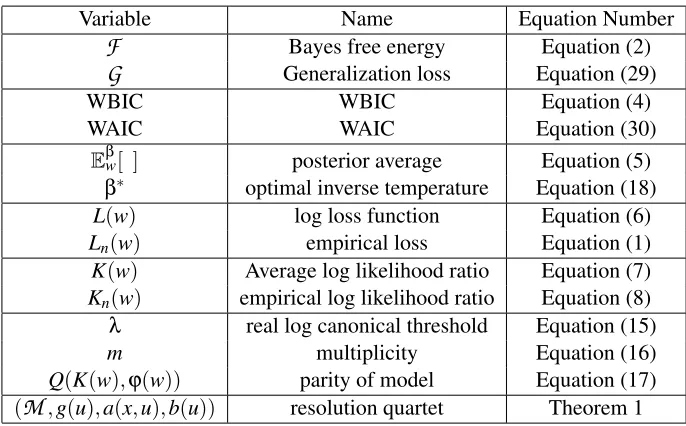
Variable Name Equation Number
F
Bayes free energy Equation (2)G
Generalization loss Equation (29)WBIC WBIC Equation (4)
WAIC WAIC Equation (30)
Eβw[ ] posterior average Equation (5)
β∗ optimal inverse temperature Equation (18) L(w) log loss function Equation (6) Ln(w) empirical loss Equation (1) K(w) Average log likelihood ratio Equation (7) Kn(w) empirical log likelihood ratio Equation (8)
λ real log canonical threshold Equation (15) m multiplicity Equation (16) Q(K(w),ϕ(w)) parity of model Equation (17)
(
M
,g(u),a(x,u),b(u)) resolution quartet Theorem 1Table 1: Variable, Name, and Equation Number
energy. These results show that WBIC is a generalized version of BIC onto singular statistical models and that RLCTs can be estimated even if a true distribution is unknown.
This paper consists of eight sections. In Section 2, we summarize several notations. In Section 3, singular learning theory and the standard representation theorem are introduced. The main theorems and corollaries of this paper are explained in Section 4, which are mathematically proved in Section 5. As the purpose of the present paper is to prove the mathematical support of WBIC, Sections 4 and 5 are the main sections. In section 6, a method how to use WBIC in statistical model evaluation is illustrated using an experimental result. In section 7 and 8, we discuss and conclude the present paper.
2. Statistical Models and Notations
In this section, we summarize several notations. Table 1 shows variables, names, and equation numbers in this paper. The average log loss functionL(w)and the entropy of the true distributionS are respectively defined by
L(w) = −
Z
q(x)logp(x|w)dx, (6)
S = −
Z
q(x)logq(x)dx.
ThenL(w) =S+D(q||pw), whereD(q||pw)is the Kullback-Leibler distance defined by
D(q||pw) =
Z
q(x)log q(x) p(x|w)dx.
In this paper, we assume that there exists a parameterw0 in the interior ofW which minimizes L(w),
L(w0) =min
w∈WL(w),
where the interior of a setSis the defined by the largest open set that is contained inS. Note that such w0 is not unique in general, because the mapw7→ p(x|w)is not one-to-one in general in singular statistical models. We also assume that, for an arbitraryw that satisfiesL(w) =L(w0), p(x|w) is the same probability density function. Let p0(x)be such a unique probability density function. In general, the set
W0={w∈W;p(x|w) =p0(x)}
is not a set of single element but an analytic set or an algebraic set with singularities. Let us define a log density ratio function,
f(x,w) =log p0(x) p(x|w),
which is equivalent to
p(x|w) =p0(x)exp(−f(x,w)). Two functionsK(w)andKn(w)are respectively defined by
K(w) =
Z
q(x)f(x,w)dx, (7)
Kn(w) =
1 n
n
∑
i=1
f(Xi,w). (8)
Then it immediately follows that
L(w) = L(w0) +K(w), Ln(w) = Ln(w0) +Kn(w).
The expectation value over all sets of training samplesX1,X2, ...,Xnis denoted byE[ ]. For example,
E[Ln(w)] =L(w)andE[Kn(w)] =K(w). The problem of statistical learning is characterized by the
log density ratio function f(x,w). In fact,
Eβw[nLn(w)] = nLn(w0) +Eβw[nKn(w)], (9)
Eβw[nKn(w)] =
R
nKRn(w)exp(−nβKn(w))ϕ(w)dw
exp(−nβKn(w))ϕ(w)dw
. (10)
The main purpose of the present paper is to prove
F
=nLn(w0) +Ewβ[nKn(w)] +Op( plogn)
forβ=1/logn. Definition.
(1) If q(x) = p0(x), then q(x) is said to be realizable by p(x|w). If otherwise, it is said to be unrealizable.
(2) If the setW0consists of a single elementw0and if the Hessian matrix Ji j(w) =
∂2L ∂wi∂wj
atw=w0 is strictly positive definite, thenq(x)is said to beregularfor p(x|w). If otherwise, it is said to besingularfor p(x|w).
Note that the matrix J(w) is equal to the Hessian matrix ofK(w) and thatJ(w0) is equal to the Fisher information matrix if the true distribution is realizable by a statistical model. Also note that, ifq(x)is realizable by p(x|w), thenK(w)is Kullback-Leibler divergence ofq(x)andp(x|w). However, ifq(x)is not realizable byp(x|w), then it is not.
3. Singular Learning Theory
In this section we summarize singular learning theory. In the present paper, we assume the following conditions.
Fundamental Conditions.
(1) The set of parametersWis a compact set inRdwhose interior is not the empty set. Its boundary is defined by several analytic functionsπ1(w),π2(w), ...,πk(w), in other words,
W={w∈Rd;π1(w)≥0,π2(w)≥0, ...,πk(w)≥0}.
(2) The prior distribution satisfiesϕ(w) =ϕ1(w)ϕ2(w), whereϕ1(w)≥0 is an analytic function and ϕ2(w)>0 is aC∞-class function.
(3) Lets≥6 and
Ls(q) ={f(x);kfks≡
Z
|f(x)|sq(x)dx
1/s
<∞}
be a Banach space. There exists an open setW′⊃W such that the mapW′∋w7→ f(x,w)is an Ls(q)-valued analytic function.
(4) The setWεis defined by
Wε={w∈W;K(w)≤ε}. It is assumed that there exist constantsε,c>0 such that
(∀w∈Wε) EX[f(X,w)]≥cEX[f(X,w)2]. (12)
Remark.(1) These conditions allow that the set of optimal parameters
W0={w∈W; p(x|w) =p(x|w0)}={w∈W; K(w) =0}
may contain singularities, and that the Hessian matrixJ(w)atw∈W0is not positive definite. There-foreK(w)can not be approximated by any quadratic form in general.
(2) The condition Equation (12) is satisfied if a true distribution is realizable by or regular for a statistical model (Watanabe, 2010a). If a true distribution is unrealizable by and singular for a sta-tistical model, there is an example which does not satisfy this condition. In the present paper, we study the case when Equation (12) is satisfied.
Lemma 1 Assume Fundamental Conditions (1)-(4). Let β= β0
whereβ0>0is a constant and let0≤r<1/2. Then, as n→∞,
Z
K(w)≥1/nrexp(−nβKn(w))ϕ(w)dw=op(exp(−
√
n)), (13)
Z
K(w)≥1/nrnKn(w)exp(−nβKn(w))ϕ(w)dw=op(exp(−
√
n)). (14)
The proof of Lemma 1 is given in Section 5.
Letε>0 be a sufficiently small constant. Lemma 1 shows that integrals outside of the regionWε do not affect the expectation valueEβw[nKn(w)]asymptotically, because in the following theorems,
we prove that integral in the regionWε have larger orders than the integral outside ofWε. To study integrals in the regionWε, we need algebraic geometrical method, because the set{w;K(w) =0} contains singularities in general. There are quite many kinds of singularities, however, the following theorem makes any singularities be a same standard form.
Theorem 1 (Standard Representation) Assume Fundamental Conditions (1)-(4). Letε>0 be a sufficiently small constant. Then there exists an quartet(
M
,g(u),a(x,u),b(u)), where(1)
M
is a d-dimensional real analytic manifold,(2) g is a proper analytic function g:
M
→Wε′, where Wε′ is the set that is defined by the largest open set contained in Wεand g:{u∈M
;K(g(u))6=0} → {w∈Wε′;K(w)6=0}is a bijective map, (3) a(x,u)is an Ls(q)-valued analytic function,(4) and b(u)is an infinitely many times differentiable function which satisfies b(u)>0, such that the following equations are satisfied in each local coordinate of
M
:K(g(u)) = u2k, f(x,g(u)) = uka(x,u),
ϕ(w)dw = ϕ(g(u))|g′(u)|du=b(u)|uh|du,
where k= (k1,k2, ...,kd)and h= (h1,h2, ...,hd)are multi-indices made of nonnegative integers. At least one of kjis not equal to zero.
Remark. (1) In this theorem, for u= (u1,u2,···,ud)∈Rd, notations u2k and |uh| respectively
represent
u2k = u2k1
1 u 2k2
2 ···u 2kd
d , |uh| = |uh1
1 u
h2
2 ···u
hd
d |.
The singularityu=0 inu2k=0 is said to be normal crossing. Theorem 1 shows that any singularities can be made normal crossing by using an analytic functionw=g(u).
(2) A mapw=g(u)is said to be proper if, for an arbitrary compact setC,g−1(C)is also compact. (3) The proof of Theorem 1 is given in Theorem 6.1 of a book (Watanabe, 2009, 2010a). In order to prove this theorem, we need the Hironaka resolution of singularities (Hironaka, 1964; Atiyah, 1970) that is the fundamental theorem in algebraic geometry. The functionw=g(u) is often referred to as a resolution map.
map w=g(u). However, even for a fixed K(w), a resolution map is not unique, resulting that a quartet(
M
,g(u),a(x,u),b(u))is not unique.Definition. (Real Log Canonical Threshold) Let{
U
α;α∈A
}be a system of local coordinates of a manifoldM
,M
= [α∈A
U
α.The real log canonical threshold (RLCT) is defined by
λ=min α∈A
d
min
j=1
hj+1
2kj
, (15)
where we define 1/kj=∞ifkj=0. The multiplicitymis defined by
m=max α∈A#
n
j;hj+1 2kj
=λo, (16)
where #Sshows the number of elements of a setS.
The concept of RLCT is well known in algebraic geometry and statistical learning theory. In the following definition we introduce a parity of a statistical model.
Definition. (Parity of Statistical Model) The support ofϕ(g(u))is defined by suppϕ(g(u)) ={u∈
M
;g(u)∈Wε, ϕ(g(u))>0},whereSshows the closure of a setS. A local coordinate
U
αis said to be an essential local coordinate if both equationsλ = mind
j=1
hj+1
2kj
,
m = #{j;(hj+1)/(2kj) =λ},
hold in its local coordinate. The set of all essential local coordinates is denoted by{
U
α;α∈A
∗}. If, for an arbitrary essential local coordinate, there exist bothδ>0 and a natural number jin the set{j;(hj+1)/(2kj) =λ}such that
(1)kj is an odd number,
(2){(0,0, ..,0,uj,0,0, ..,0);|uj|<δ} ⊂suppϕ(g(u)),
then we defineQ(K(g(u)),ϕ(g(u))) =1. If otherwise,Q(K(g(u)),ϕ(g(u))) =0. If there exists a resolution mapw=g(u)such thatQ(K(g(u)),ϕ(g(u))) =1, then we define
Q(K(w),ϕ(w)) =1. (17)
If otherwiseQ(K(w),ϕ(w)) =0. IfQ(K(w),ϕ(w)) =1, then the parity of a statistical model is said to be odd, otherwise even.
It was proved in Theorem 2.4 of a book (Watanabe, 2009) that, for a given set(q,p,ϕ),λandm are independent of a choice of a resolution map. Such a value is called a birational invariant. The RLCT is a birational invariant.
Proof of this lemma is shown in Section 5. Lemma 2 indicates that, if a true distribution is real-izable by a statistical model, thenQ(K(g(u)),ϕ(g(u)))is a birational invariant. The present paper proposes a conjecture that Q(K(g(u)),ϕ(g(u)))is a birational invariant in general. By Lemma 2, this conjecture is proved if we can show the proposition that, for an arbitrary nonnegative analytic functionK(w), there exist q(x) and p(x|w) such thatK(w) is the Kullback-Leibler distance from q(x)top(x|w).
Example.Letw= (a,b,c)∈R3and
K(w) = (ab+c)2+a2b4,
which is the Kullback-Leibler distance of a neural network model in Example 1.6 of a book (Watan-abe, 2009), where a true distribution is realizable by a statistical model. The priorϕ(w)is defined by some nonzero function on a sufficiently large compact set. In a singular statistical model, com-pactness of the prior is necessary in general, because, if the parameter set is not compact, then it is not easy to mathematically treat the integration on the neighborhood among the infinite point.
Let a system of local coordinates be
U
i={(ai,bi,ci)∈R3} (i=1,2,3,4).A resolution mapg:
U
1∪U
2∪U
3∪U
4→R3in each local coordinate is defined by a=a1c1, b=b1, c=c1,a=a2, b=b2c2, c=a2(1−b2)c2, a=a3, b=b3, c=a3b3(b3c3−1), a=a4, b=b4c4, c=a4b4c4(c4−1).
This mapgis made of recursive blowing-ups whose centers are smooth manifolds, hence it is one-to-one as a mapg:{u;K(g(u))>0} → {w;K(w)>0}. Then
K(a,b,c) = c21{(a1b1+1)2+a21b41}=a22c22(1+b22c22)
= a23b43(c23+1) =a24b24c44(1+b24).
Therefore integration overW can be calculated using integration over the manifold. The Jacobian determinant|g′(u)|is
|g′(u)| = |c1|=|a2c2|
= |a3b23|=|a4b4c4|2. In other words, in each local coordinate,
(k1,k2,k3) = (0,0,1),(1,0,1),(1,2,0),(1,1,2),
(h1,h2,h3) = (0,0,1),(1,0,1),(1,2,0),(2,2,2). Therefore
h1+1
2k1
,h2+1 2k2
,h2+1 2k2
= (∞,∞,1),(1,0,1),(1,3 4,∞),(
3 2,
3 2,
3 4).
The smallest value among them is 3/4 which is equal toλand the multiplicty ism=1. The essential local coordinates are
U
3andU
4. InU
3andU
4, the sets{uj;(hj+1)/(2kj) =3/4}are respectively {u2}and{u3}, where 2kj=4 in both cases. Consequently, bothkjare even, thus the parity is givenLemma 3 Assume that the Fundamental Conditions (1)-(4) are satisfied and that a true distribution q(x)is regular for a statistical model p(x|w). If w0is contained in the interior of W and ifϕ(w0)>0, then
λ=d
2, m=1, and
Q(K(w),ϕ(w)) =1. Proof of this lemma is shown in Section 5.
Theorem 2 Assume that the Fundamental Conditions (1)-(4) are satisfied. Then the following holds.
F
=nLn(w0) +λlogn−(m−1)log logn+Rn,whereλis a real log canonical threshold, m is its multiplicity, and{Rn}is a sequence of random variables which converges to a random variable in law, when n→∞.
Theorem 2 was proved in the previous papers. In the case whenq(x)is realizable by and singular for p(x|w), the expectation value of
F
is given by algebraic analysis (Watanabe, 2001a). The asymptotic behavior ofF
as a random variable was shown in a book (Watanabe, 2009). These results were generalized (Watanabe, 2010a) for the case thatq(x)is unrealizable.Remark. In practical applications, we do not know the true distribution, henceλandm are un-known. Therefore, we can not directly apply Theorem 2 to such cases. The main purpose of the present paper is to make a new method how to estimate
F
even if the true distribution is unknown.4. Main Results
In this section, we introduce the main results of the present paper.
Theorem 3 (Unique Existence of the Optimal Parameter) Assume that Ln(w) is not a constant function of w. Then the followings hold.
(1) The valueEβw[nLn(w)]is a decreasing function ofβ.
(2) There exists a uniqueβ∗(0<β∗<1)which satisfies
F
=Eβw∗[nLn(w)]. (18)Note that the functionLn(w)is not a constant function in an ordinary statistical model with prob-ability one. The Proof of Theorem 3 is given in Section 5. Based on this theorem, we define the optimal inverse temperature.
Definition. The unique parameterβ∗ that satisfies Equation (18) is called the optimal inverse tem-perature.
In general, the optimal inverse temperature β∗depends on a true distributionq(x), a statistical modelp(x|w), a priorϕ(w), and training samples. Thereforeβ∗is a random variable. In the present paper, we study its probabilistic behavior. Theorem 4 is a mathematical base for such a purpose.
Theorem 4 (Main Theorem)Assume Fundamental Conditions (1)-(4) and that β= β0
whereβ0is a constant. Then there exists a random variable Unsuch that
Eβw[nLn(w)] =nLn(w0) + λlogn
β0
+Un s
λlogn 2β0
+Op(1),
where λ is the real log canonical threshold and {Un} is a sequence of random variables, which satisfiesE[Un] =0,converges to a Gaussian random variable in law as n→∞. Moreover, if a true
distribution q(x)is realizable by a statistical model p(x|w), thenE[(Un)2]<1. The proof of Theorem 4 is given in Section 5. Theorem 4 withβ0=1 shows that
WBIC=nLn(w0) +λlogn+Un r
λlogn
2 +Op(1),
whose first two main terms are equal to those of
F
in Theorem 2. From Theorem 4 and its proof, three important corollaries are derived.Corollary 1 If the parity of a statistical model is odd, Q(K(w),ϕ(w)) =1, then Un=0.
Corollary 2 Letβ∗be the optimal inverse temperature. Then β∗= 1
logn
1+p Un
2λlogn+op
1
√
logn
.
Corollary 3 Letβ1=β01/logn andβ2=β02/logn, whereβ01andβ02are positive constants. Then the convergence in probability
Eβ1
w[nLn(w)]−Ewβ2[nLn(w)]
1/β1−1/β2 →
λ (19)
holds as n→∞, whereλis the real log canonical threshold.
Proofs of these corollaries are given in Section 5. Note that, if the expectation value Eβ1
w[ ] is
calculated by some numerical method, thenEβ2
w[ ]can be estimated usingEβw1[ ]by using
Eβ2
w[nLn(w)] = E
β1
w[nLn(w)exp(−(β2−β1)nLn(w))]
Eβ1
w[exp(−(β2−β1)nLn(w))]
. (20)
Therefore RLCT can be estimated by the same computational cost as WBIC. In Bayes estimation, the posterior distribution is often approximated by some numerical method. If we know theoret-ical values of RLCTs, then we can confirm the approximated posterior distribution by comparing theoretical values with estimated ones.
The well-known Schwarz BIC is defined by
BIC=nLn(wˆ) +d
2logn,
Theorem 5 If a true distribution q(x)is regular for a statistical model p(x|w), then WBIC=nLn(wˆ) +d
2logn+op(1).
Proof of Theorem 5 is given in Section 5. This theorem shows that the difference of WBIC and BIC is smaller than a constant order term, if a true distribution is regular for a statistical model. This theorem holds even if a true distributionq(x)is unrealizable by p(x|w).
Remark. Since the set of parametersW was assumed to be compact, it is proved in Main The-orem 6.4 of a book (Watanabe, 2009) that nLn(w0)−nLn(wˆ) is a constant order random variable in general. If a true distribution is regular for and realizable by a statistical model, its average is asymptotically equal tod/2, whered is the dimension of parameter. If a true distribution is singu-lar for a statistical model, then it is sometimes much singu-larger thand/2, because it is asymptotically equal to the maximum value of the Gaussian process. Whether replacement ofnLn(w0)bynL(wˆ)is appropriate or not depends on the statistical model and its singularities (Drton, 2009).
5. Proofs of Main Results
In this section, we prove the main theorems and corollaries.
5.1 Proof of Lemma 1
Let us define an empirical process,
ηn(w) =
1
√
n
n
∑
i=1
(K(w)−f(Xi,w)).
It was proved in Theorem 5.9 and 5.10 of a book (Watanabe, 2009) thatηn(w)converges to a random process in law and
kηnk ≡ sup
w∈W|
ηn(w)|
also converges to a random variable in law. IfK(w)≥1/nr, then
nKn(w) = nK(w)− √
nηn(w) ≥ n1−r−√nkηnk.
By the condition 1−r>1/2 andβ=β0/logn, exp(√n)
Z
K(w)≥1/nrexp(−nβKn(w))ϕ(w)dw
≤exp(−n1−rβ+√n+√nβkηnk),
which converges to zero in probability, which shows Equation (13). Then, let us prove Equa-tion (14). Since the set of parameterW is compact,kKk ≡supwK(w)<∞. Therefore,
Hence
exp(√n)
Z
K(w)≥1/nr|nKn(w)|exp(−nβKn(w))ϕ(w)dw
≤(kKk+kηnk/√n)
×exp(−n1−rβ+√n+√nβkηnk+logn),
which converges to zero in probability. (Q.E.D.)
5.2 Proof of Lemma 3
Without loss of generality, we can assumew0=0. Sinceq(x)is regular forp(x|w), there existsw∗ such that
K(w) =1
2w·J(w ∗)w,
whereJ(w)is given in Equation (11). SinceJ(w0)is a strictly positive definite matrix, there exists ε>0 such that, if K(w) ≤ε, then J(w∗) is positive definite. Let ℓ1 and ℓ2 be respectively the minimum and maximum eigen values of{J(w∗);K(w)≤ε}. Then
1 4ℓ1
d
∑
j=1 w2j ≤1
2w·J(w
∗)w≤ℓ 2
d
∑
j=1 w2j.
By using a blow-up g:
U
1∪ ··· ∪U
d→W which is represented on each local coordinateU
i= (ui1,ui2, ...,uid),wi = uii,
wj = uiiui j (j6=i),
it follows that
ℓ1u2ii
4 (1+
∑
j6
=i
u2i j)≤u
2
ii
2(uˆ,J(w
∗)uˆ)≤ℓ
2u2ii(1+
∑
j6=iu2i j),
where ˆui j=ui j(j6=i)and ˆuii=1. These inequalities show thatki=1 in
U
i, thereforeQ(K(w),ϕ(w)) =1. The Jacobian determinant of the blow-up is
|g′(u)|=|uii|d−1,
henceλ=d/2 andm=1. (Q.E.D.)
5.3 Proof of Theorem 3
Let us define a functionFn(β)ofβ>0 by
Fn(β) =−log
Z n
∏
i=1
p(Xi|w)βϕ(w)dw.
Then, by the definition,
F
=Fn(1)andFn′(β) = Eβw[nLn(w)],
By the Cauchy-Schwarz inequality and the assumption thatLn(w)is not a constant function,
Fn′′(β)<0,
which shows (1). SinceFn(0) =0,
F
=Fn(1) =Z 1 0 F
′
n(β)dβ.
By using the mean value theorem, there existsβ∗(0<β∗<1) such that
F
=Fn′(β∗) =Eβw∗[nLn(w)].HereFn′(β)is a decreasing function,β∗is unique, which completes Theorem 3. (Q.E.D.)
5.4 First Preparation for Proof of Theorem 4
In this subsection, we prepare the proof of Theorem 4. By using Equation (9) and Equation (10), the proof of Theorem 4 results in evaluatingEw[βnKn(w)]. By Lemma 1,
Ewβ[nKn(w)] = Bn+op(exp(− √n))
An+op(exp(−√n))
, (21)
whereAnandBnare respectively defined by
An =
Z
K(w)<εexp(−nβKn(w))ϕ(w)dw, (22) Bn =
Z
K(w)<εnKn(w)exp(−nβKn(w))ϕ(w)dw. (23) By Theorem 1, an integral over {w∈W;K(w)<ε} is equal to that over
M
. For a given set of local coordinates{U
α}ofM
, there exists a set ofC∞class functions{ϕα(g(u))}such that, for an arbitraryu∈M
,∑
α∈Aϕα(g(u)) =ϕ(g(u)).
By using this fact, for an arbitrary integrable functionG(w),
Z
K(w)<εG(w)ϕ(w)dw=α
∑
∈AZ
Uα
G(g(u))ϕα(g(u))|g′(u)|du.
Without loss of generality, we can assume that
U
α∩suppϕ(g(u))is isomorphic to[−1,1]d. More-over, by Theorem 1, there exists a functionbα(u)>0 such thatϕα(g(u))|g′(u)|=|uh|bα(u),
in each local coordinate. Consequently,
Z
K(w)<εG(w)ϕ(w)dw=α
∑
∈AZ
[−1,1]ddu G(g(u))|u
h
In each local coordinate,
K(g(u)) =u2k. We define a functionξn(u)by
ξn(u) =√1
n
n
∑
i=1
{uk−a(Xi,u)}.
Then
Kn(g(u)) =u2k−
1
√
nu
kξ n(u).
Note that
uk=
Z
a(x,u)q(x)dx
holds, because
u2k=K(g(u)) =
Z
f(x,g(u))q(x)dx=uk
Z
a(x,u)q(x)dx.
Therefore, for an arbitraryu,
E[ξn(u)] =0.
The function ξn(u) can be understood as a random process on
M
. On Fundamental Conditions(1)-(4), it is proved in Theorem 6.1, Theorem 6.2, and Theorem 6.3 of a book (Watanabe, 2009) that (1)ξn(u)converges to a Gaussian random processξ(u)in law and
E[sup
u
ξn(u)2]→E[sup u
ξ(u)2].
(2) Ifq(x)is realizable by p(x|w), and ifu2k=0, then
E[ξn(u)2] =EX[a(X,u)2] =2. (24)
By using the random process ξn(u), the two random variables An and Bn can be represented by
integrals over
M
,An =
∑
α∈A
Z
[−1,1]ddu exp(−nβu
2k+√nβukξ
n(u))|uh|bα(u),
Bn =
∑
α∈A
Z
[−1,1]ddu(nu 2k
−√nukξn(u))
×exp(−nβu2k+√nβukξn(u))|uh|bα(u) To prove Theorem 4, we study asymptotics of these two random variables.
5.5 Second Preparation for Proof of Theorem 4
To evaluate two integrals An andBn asn→∞, we have to study the asymptotic behavior of the
following Schwartz distribution,
fort→0. Without loss of generality, we can assume that, in each essential local coordinate,
λ= h1+1
2k1
=h2+1
2k2
=···= hm+1
2km
<hj+1 2kj
,
for an arbitrary jsuch thatm< j≤d. A variableu∈Rd is denoted by
u= (ua,ub)∈Rm×Rd−m.
We define a measuredu∗by
du∗= (
m
∏
j=1
δ(uj)) ( d
∏
j=m+1
(uj)µj)du
2m(m−1)!(∏m j=1kj)
, (25)
whereδ( )is the Dirac delta function, andµ= (µm+1,µ2, ...,µd)is a multi-index defined by
µj=−2λkj+hj (m+1≤ j≤d).
Thenµj>−1, hence Equation (25) defines a measure on
M
. The support ofdu∗is{u= (ua,ub);ua=0}.
Definition. Letσbe ad-dimensional variable made of±1. We use the notation, σ= (σ1,σ2, ...,σd)∈Rd
whereσj=±1. The set of all such variables is denoted byS(d).
S(d) ={σ;σj=±1(1≤ j≤d)}.
Also we use the notation
σu= (σ1u1,σ2u2, ...,σdud)∈Rd.
Then(σu)k=σkukand(σu)2k=u2k. By using this notation, we can derive the asymptotic behavior
ofδ(t−u2k)|uh|fort→0.
Lemma 4 Let G(u2k,uk,u)be a real-valued C1-class function of(u2k,uk,u)(u∈Rd). The following asymptotic expansion holds as t→+0,
Z
[−1,1]dduδ(t−u 2k)
|u|hG(u2k,uk,u) =tλ−1(−logt)m−1
∑
σ∈S(d)
Z
[0,1]ddu
∗G(t,σk√t,u)
+Otλ−1(−logt)m−2, (26)
(Proof of Lemma 4) LetY(t)be the left hand side of Equation (26). Then
Y(t) =
∑
σ∈S(d)
Z
[0,1]dδ(t−(σu) 2k)
|σu|hG((σu)2k,(σu)k,σu)d(σu)
=
∑
σ∈S(d)
Z
[0,1]dδ(t−u 2k)
|u|hG(t,σk√t,u)du.
By using Theorem 4.6 of a book (Watanabe, 2009), ifu∈[0,1]d, then
δ(t−u2k)|u|hdu = tλ−1(−logt)m−1du∗
+O(tλ−1(−logt)m−2). By applying this relation toY(t), we obtain Lemma 4. (Q.E.D.)
5.6 Proof of Lemma 2
LetΦ(w)>0 be an arbitraryC∞class function onWε. LetY(t,Φ)(t>0) be a function defined by
Y(t,Φ)≡
Z
K(w)<ε
δ(t−K(w))f(x,w)Φ(w)ϕ(w)dw,
whose value is independent of a choice of a resolution map. By using a resolution mapw=g(u),
Y(t,Φ) =
∑
α∈Aσ∈
∑
S(d)Z
[−1,1]dduδ(t−u 2k)uk
|u|ha(x,u)Φ(g(u))bα(u)du.
By Lemma 4, andσ= (σa,σb),
Y(t,Φ) = tλ−1/2(logt)m−1
∑
α∈A∗σa∈
∑
S(m)(σa)k
∑
σb∈S(d−m)
(σb)k
×
Z
[0,1]ddu
∗a(x,σu)Φ(g(σu))b α(σu)
+O(tλ−1/2(logt)m−2).
By the assumption that a true distribution is realizable by a statistical model, Equation (24) shows that there existsxsuch thata(x,u)=6 0 foru2k=0. On the support ofdu∗,
σu= (σaua,σbub) = (0,σbub),
consequently the main order term ofY(t,Φ)is determined byΦ(0,ub).
In order to prove Lemma, it is sufficient to prove thatQ(K(g(u)),ϕ(g(u))) =1 is equivalent to the proposition that, for an arbitraryΦ, the main term ofY(t,Φ)is equal to zero.
First, assume thatQ(K(g(u)),ϕ(g(u))) =1. Then at least onekj (1≤ j≤m)is odd,σka takes
both values±1, hence
∑
σa∈S(m)σk a=0,
which shows that the coefficient of the main order term inY(t,Φ) (t→+0)is zero for an arbitrary Φ(w). Second, assume thatQ(K(g(u)),ϕ(g(u))) =0. Then allkj (1≤ j≤m)are even, hence
∑
σa∈S(m)σka=
∑
σa∈S(m) 16=0.
5.7 Proof of Theorem 4
In this subsection, we prove Theorem 4 using the foregoing preparations. We need to studyAnand
Bnin Equation (22) and Equation (23). Firstly, we studyAn.
An =
∑
α∈A
Z
[−1,1]dduexp(−nβu
2k+β√nukξn(u))
|u|hbα(u)
=
∑
α∈A
Z
[−1,1]ddu
Z ∞
0
dtδ(t−u2k)|u|hbα(u)
×exp(−nβu2k+β√nukξn(u)).
By substitutiont:=t/(nβ)anddt:=dt/(nβ),
An =
∑
α∈A
Z
[−1,1]dbα(u)du
Z ∞
0 dt nβδ
t
nβ−u 2k|u|h ×exp(−nβu2k+β√nukξn(u)).
For simple notations, we use
Z
M du
∗ ≡
∑
α∈A∗σ∈
∑
S(d)Z
[0,1]dbα(u)du ∗,
ξ∗n(u) ≡ σkξn(u),
where{
U
α;α∈A
∗}is the set of all essential local coordinates. Then by using Lemma 4,δ(t/nβ− u2k)can be asymptotically expanded fornβ→0, henceAn =
Z
M du
∗Z ∞ 0
dt nβ
t
nβ
λ−1
−log( t
nβ)
m−1
×exp(−t+pβtξn∗(u)) +Op((log(nβ)) m−2
(nβ)λ )
= (log(nβ)) m−1
(nβ)λ
Z
Mdu
∗Z ∞ 0
dt tλ−1exp(−t) exp(pβtξ∗n(u)) +Op((log(nβ))
m−2
(nβ)λ ).
Sinceβ=β0/logn→0,
exp(pβtξ∗n(u)) =1+pβtξ∗n(u) +Op(β).
By using the gamma function,
Γ(λ) =
Z ∞
0
tλ−1 exp(−t)dt, it follows that
An =
(log(nβ))m−1
(nβ)λ
n
Γ(λ)
Z
Mdu
∗+p
βΓ(λ+1
2)
Z
Mdu
∗ξ∗
n(u) o
+Op(
(log(nβ))m−2
Secondly,Bncan be calculated by the same way,
Bn =
∑
α∈A
Z
[−1,1]ddu
Z ∞
0
dtδ(t−u2k)|u|hbα(u)
×(nu2k−√nukξn(u))exp(−nβu2k+β√nukξn(u)).
By substitutiont:=t/(nβ)anddt:=dt/(nβ)and Lemma 4,
Bn =
Z
Mdu
∗Z ∞ 0
dt nβ
t
nβ
λ−1
−log( t
nβ)
m−1
×1β(t−pβtξ∗n(u))exp(−t+pβtξ∗n(u)) +Op(
(log(nβ))m−2 β(nβ)λ )
= (log(nβ)) m−1 β(nβ)λ
Z
M du
∗Z ∞ 0
tλ−1(t−pβtξ∗n(u))exp(−t) ×exp(pβtξ∗n(u)) +Op((log(nβ))
m−2 β(nβ)λ ).
Therefore,
Bn =
(log(nβ))m−1 β(nβ)λ
n
Γ(λ+1)
Z
M du
∗+p
β Γ(λ+3
2)
Z
Mdu
∗ξ∗
n(u)
−pβ Γ(λ+1
2)
Z
Mdu
∗ξ∗
n(u) o
+Op((log(nβ)) m−2 β(nβ)λ ).
Let us define a random variableΘby
Θ=
R
MRdu∗ξ∗n(u)
M du∗
. (27)
By applying results ofAnandBnto Equation (21),
Eβw[nKn(w)] =
1 β×
Γ(λ+1) +pβ Θ{Γ(λ+3/2)−Γ(λ+1/2)}
Γ(λ) +pβ ΘΓ(λ+1/2) +Op(1).
Note that, ifa,b,c,d are constants andβ→0,
c+pβd a+p
βb = c a+
p
βad−bc a2
+O(β).
Then by using an identity,
Γ(λ)(Γ(λ+3/2)−Γ(λ+1/2))−Γ(λ+1)Γ(λ+1/2)
Γ(λ)2 =−
Γ(λ+1/2)
2Γ(λ) ,
we obtain
Eβw[nKn(w)] =
1 β
Γ(λ+1)
Γ(λ) −
Θ
p
β
Γ(λ+1/2)
A random variableUnis defined by
Un=−
ΘΓ(λ+1/2) √
2λΓ(λ) . (28)
Then it follows that
Eβw[nKn(w)] =
λ β+Un
s
λ
2β+Op(1).
By the definition ofξn(u),E[Θ] =0,henceE[Un] =0. By using Cauchy-Schwarz inequality,
Θ2
≤
R
MRdu∗ξ∗n(u)2
Mdu∗
.
Lastly let us study the case that q(x)is realizable by p(x|w). The support of du∗ is contained in u2k=0, hence we can apply Equation (24) toΘ,
E[Θ2]≤
R
M duR∗E[ξ∗n(u)2]
Mdu∗
=2.
The gamma function satisfies
Γ(λ+1/2)
Γ(λ) < √
λ (λ>0).
Hence we obtain
E[(Un)2]≤E [Θ2] 2λ
Γ(λ+1/2)
Γ(λ) 2
<1,
which completes Theorem 4. (Q.E.D.)
5.8 Proof of Corollary 1
By definition Equation (27) and Equation (28), it is sufficient to proveΘ=0, where
Θ=
∑
α∈A∗σ∈∑
S(d)Z
[0,1]dbα(u)du ∗σkξ
n(u)
∑
α∈A∗σ∈∑
S(d)Z
[0,1]dbα(u)du ∗ .
The support of the measure du∗ is contained in the set {u= (0,ub)}. We use a notation σ= (σa,σb)∈Rm×Rd−m. If Q(q,p,ϕ) =1 then there exists a resolution map w=g(u) such that
σk
atakes values both+1 and−1 in arbitrary local coordinate, hence
∑
σa∈S(m)σk a=0.
It follows that
∑
σ∈S(d)σkξ
n(0,ub) =
∑
σb∈S(d−m) σk
bξn(0,ub)
∑
σa∈S(m) σk
a=0,
5.9 Proof Corollary 2
By using the optimal inverse temperatureβ∗, we define T =1/(β∗logn). By the definition,
F
=Eβw∗[nLn(w)]. By using Theorem 2 and Theorem 4,
λlogn=Tλlogn+Un p
Tλlogn/2+Vn=0,
where
Vn=Op(log logn).
It follows that
T+ Un √
T
p
2λlogn−1+ Vn
logn =0. Therefore,
√
T=−p Un
8λlogn+
s
1+ (Un)2
8λlogn− Vn
logn. SinceUn=Op(1),
√
T=1−p Un
8λlogn+op( 1
p
λlogn),
resulting that
β∗logn=1+p Un
2λlogn+op( 1
p
λlogn), which completes Corollary 2. (Q.E.D.)
5.10 Proof of Corollary 3 By using Theorem 4,
Eβ1
w[nLn(w)] = nLn(w0) + λ β1
+Op( p
logn),
Eβ2
w[nLn(w)] = nLn(w0) + λ β2
+Op( p
logn).
Since(1/β1−1/β2) =Op(logn),
λ=E
β1
w[nLn(w)]−Ewβ2[nLn(w)]
1/β1−1/β2
+Op(1/ p
logn),
which shows Corollary 3. (Q.E.D.)
5.11 Proof Theorem 5
By using Equation (9) and Equation (10),
the proof of Theorem 5 results in evaluatingEβw[nKn(w)]. By Lemma 1 for the caser=1/4,
Eβw[nKn(w)] =
Dn+op(exp(−√n))
Cn+op(exp(−√n))
,
whereCnandDnare respectively defined by
Cn =
Z
K<1/n1/4exp(−nβKn(w))ϕ(w)dw,
Dn =
Z
K<1/n1/4
nKn(w)exp(−nβKn(w))ϕ(w)dw.
If a statistical model is regular, the maximum likelihood estimator ˆwconverges tow0in probability. LetJn(w)bed×dmatrices defined by
(Jn)i j(w) = ∂
2K
n
∂wi∂wj (w).
There exists a parameterw∗such that
Kn(w) = Kn(wˆ) +
1
2(w−wˆ)·Jn(w
∗)(w−wˆ).
Since ˆw→w0in probability andK(w)<1/n1/4,w∗→w0in probability. Then
kJn(w∗)−J(w0)k ≤ kJn(w∗)−Jn(w0)k+kJn(w0)−J(w0)k
≤ kw∗−w0k sup
K(w)<1/n1/4
∂Jn(w)
∂w
+kJn(w0)−J(w0)k,
which converges to zero in probability asn→∞. Therefore,
Jn(w∗) =J(w0) +op(1).
Since the model is regular,J(w0)is a positive definite matrix. Now we define Cn = exp(−nβKn(wˆ))
×
Z
K(w)<n1/4exp(−
nβ
2 (w−wˆ)·(J(w0) +op(1))(w−wˆ))ϕ(w)dw. By substituting
u=pnβ(w−wˆ), it follows that
Cn = exp(−nβKn(wˆ))(nβ)−d/2 ×
Z
exp(−1
2u·(J(w0) +op(1))u)ϕ(wˆ+ u
p
nβ)du
= (2π)
d/2exp(−nβK
n(wˆ))(ϕ(wˆ) +op(1)) (nβ)d/2det(J(w
0) +op(1))1/2
H 1 2 3 4 5 6 WBIC1Ave. 17899.82 3088.90 71.11 78.21 83.23 87.58
WBIC1Std. 1081.30 226.94 3.67 3.78 3.97 4.09 WBIC2Ave. 17899.77 3089.03 71.18 75.43 82.54 86.83
WBIC2Std. 1081.30 226.97 3.54 3.89 4.03 4.08 BIC Ave. 17899.77 3089.03 71.18 83.47 91.86 94.87
BIC Std. 1081.30 226.97 3.54 3.89 4.03 4.08
Table 2: WBIC and BIC in Model Selection
In the same way,
Dn = exp(−nβKn(wˆ)) ×
Z
K(w)<1/n1/4
nKn(wˆ) +
n
2(w−wˆ)·(J(w0) +op(1))(w−wˆ)
×exp−nβ
2 (w−wˆ)·(J(w0) +op(1))(w−wˆ)
ϕ(w)dw
= (2π)
d/2exp(−nβK
n(wˆ))(ϕ(wˆ) +op(1)) (nβ)d/2det(J(w
0) +op(1))1/2
nKn(wˆ) + d
2β+op(1)
.
HerenKn(wˆ) =Op(1), because the true distribution is regular for a statistical model. Therefore,
Eβw[nLn(w)] =nLn(w0) +nKn(wˆ) + d
2β+op(1), which completes Theorem 5. (Q.E.D.)
6. A Method How to Use WBIC
In this section we show a method how to use WBIC in statistical model evaluation. The main theorems have already been mathematically proved, hence WBIC has a theoretical support. The following experiment was conducted not for proving theorems but for illustrating a method how to use it.
6.1 Statistical Model Selection
Firstly, we study model selection by using WBIC.
Letx∈RM,y∈RN, andw= (A,B), whereAis anH×Mmatrix andBis anN×H matrix. A reduced rank regression model is defined by
p(x,y|w) = r(x) (2πσ2)N/2exp
−2σ12ky−BAxk 2,
wherer(x)is a probability density function ofxandσ2is the variance of an output. Let
N
M(0,Σ)
denote theM-dimensional normal distribution with the average zero and the covariance matrixΣ. In an experiment, we setσ=0.1,r(x) =
N
M(0,32I), whereIis the identity matrix, andϕ(w) =thatA0andB0were respectively anH0×Mmatrix and anM×H0matrix. Note that, in reduced rank regression models, RLCTs and multiplicities were clarified by a research (Aoyagi and Watanabe, 2005) andQ(K(w),ϕ(w)) =1 for arbitraryq(x), p(x|w), andϕ(w). In the experiment,M=N=6 and the true rank was set asH0=3. Each element of A0andB0 was taken from
N
1(0,0.22)and fixed. From the true distributionp(x,y|w0), 100 sets ofn=500 training samples were generated.The Metropolis method was employed for sampling from the posterior distribution,
p(w|X1,X2, ...,Xn)∝exp(−βnLn(w) +logϕ(w)),
whereβ=1/logn. Every Metropolis trial was generated from a normal distribution
N
d(0,(0.0012)2I),by which the acceptance probability was 0.1-0.9. First 50000 Metropolis trails were not used. After 50000 trails,R=2000 parameters{wr;r=1,2, ...,R}were obtained in every 100 Metropolis steps.
The expectation value of a functionG(w)over the posterior distribution was approximated by
Eβw[G(w)] =
1 R
R
∑
r=1 G(wr).
The six statistical modelsH=1,2,3,4,5,6 were compared by the criterion,
WBIC=Eβw[nLn(w)], (β=1/logn).
To compare these values among several models, we show both WBIC1, WBIC2, and BIC in Table 2. In the table, the average and the standard deviation of WBIC1defined by
WBIC1=WBIC−nSn,
for 100 independent sets of training samples are shown, where the empirical entropy of the true distribution
Sn=−
1 n
n
∑
i=1
logq(Xi)
does not depend on a statistical model. AlthoughnSndoes not affect the model selection, its standard
deviation is in proportion to√n. In order to estimate the standard deviation of the essential part of WBIC, the effect ofnSnwas removed. In 100 independent sets of training samples, the true model
H=3 was chosen 100 times in this experiment, which demonstrates a typical application method of WBIC.
Also WBIC2in Table 2 shows the average and the standard deviation of
WBIC2=nLn(wˆ) +λlogn−(m−1)log logn−nSn,
where ˆwis the maximum likelihood estimator, λis the real log canonical threshold, and mis the multiplicity. The maximum likelihood estimator ˆw= (Aˆ,Bˆ) is given in reduced rank regression (Anderson, 1951),
ˆ
BAˆ=VVtY Xt(X Xt)−1,
wheretshows the transposed matrix andX,Y, andV are matrices defined as follows. (1)Xi jis thei-th coefficient ofxj
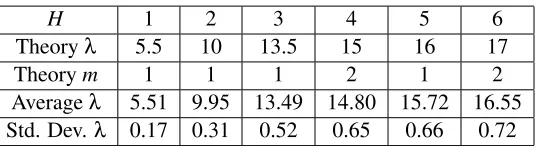
H 1 2 3 4 5 6 Theoryλ 5.5 10 13.5 15 16 17
Theorym 1 1 1 2 1 2
Averageλ 5.51 9.95 13.49 14.80 15.72 16.55 Std. Dev.λ 0.17 0.31 0.52 0.65 0.66 0.72
Table 3: RLCTs for the caseH0=3
(3) The matrix V is made of eigen vectors with respect to the maximumH eigen values of the matrix,
Y Xt(X Xt)−1XYt.
If we know the model that is equal to the true distribution, and if we have theoretical real log canonical threshold and multiplicity, then we can calculate WBIC2.
The value BIC in Table 2 shows the average and the standard deviation of Shwarz BIC,
BIC=nLn(wˆ) +d
2logn−nSn,
wheredis the essential dimension of the parameter space of the reduced rank regression, d=H(M+N−H).
We used this dimension because the number of parameters in reduced rank regression isH(M+N)
and it has free dimensionH2. These results show that WBIC is a better approximator of the Bayes free energy than BIC.
6.2 Estimating RLCT
Secondly, we study a method how to estimate an RLCT. By using the same experiment as the foregoing subsection, we estimated RLCTs of reduced rank regression models by using Corollary 3. Based on Equation (19), the estimated RLCT is given by
ˆ λ=E
β1
w[nLn(w)]−Ewβ2[nLn(w)]
1/β1−1/β2
,
whereβ1=1/lognandβ2=1.5/lognand we used Equation (20) in the calculation ofEβ2
w[ ].
The-oryλin Table 3 shows the theoretical values of RLCTs of reduced rank regression. For the cases when true distributions are unrealizable by statistical models, RLCTs are given by half the dimen-sion of the parameter space,λ=H(M+N−H)/2.In Table 3, averages and standard deviations of λshows estimated RLCTs. The theoretical RLCTs were well estimated. The difference between theory and experimental results was caused by the effect of the smaller order terms than logn. In the case the multiplicitym=2, the term log lognalso affected the results.
7. Discussion
7.1 WAIC and WBIC
Firstly, let us study the difference between the free energy and the generalization error. In the present paper, we study the Bayes free energy
F
as the statistical model selection criterion. Its expectation value is given byE[
F
] =nS+Z
q(xn)logq(x
n)
p(xn)dx n,
whereSis the entropy of the true distribution,
q(xn) = n
∏
i=1 q(xi),
p(xn) =
Z n
∏
i=1
p(xi|w)ϕ(w)dw,
anddxn=dx1dx2···dxn. Hence minimization ofE[
F
]is equivalent to minimization of theKullback-Leibler distance from theq(xn)top(xn).
There is a different model evaluation criterion, which is the generalization loss defined by
G
=−Z
q(x)logp∗(x)dx, (29)
where p∗(x)is the Bayes predictive distribution defined by p∗(x) =Eβw[p(x|w)],withβ=1. The expectation value of
G
satisfiesE[
G
] =S+E hZq(x)log q(x) p∗(x)dx
i
.
Hence minimization ofE[
G
]is equivalent to minimization of the Kullback-Leibler distance from q(x)to p∗(x). Both ofF
andG
are important in statistics and learning theory, however, they are different criteria.The well-known model selection criteria AIC and BIC are respectively defined by
AIC = Ln(wˆ) +
d
n, (30)
BIC = nLn(wˆ) +
d 2logn.
If a true distribution is realizable by and regular for a statistical model, then
E[AIC] = E[
G
] +o(1n),
E[BIC] = E[
F
] +O(1).These relations can be generalized onto singular statistical models. We define WAIC and WBIC by
WAIC = Tn+Vn/n,
where
Tn = −
1 n
n
∑
i=1
logp∗(Xi|w),
Vn = n
∑
i=1
n
Ew[(logp(Xi|w))2]−Ew[logp(Xi|w)]2 o
.
Then, even if a statistical model is unrealizable by and singular for a statistical model,
E[WAIC] = E[
G
] +O(1n2), (31)
E[WBIC] = E[
F
] +O(log logn), (32)where Equation (31) was proved in a book (Watanabe, 2009, 2010b), whereas Equation (32) has been proved in the present paper. In fact, the difference between the average leave-one-out cross validation and the average generalization error is in proportion to 1/n2and the difference between the leave-one-out cross validation and WAIC is also in proportion to 1/n2. The difference between E[WBIC]andE[
F
]is caused by the multiplicitym. If a statistical model is realizable by and regular for a statistical model, WAIC and WBIC respectively coincide with AIC and BIC,WAIC = AIC+op(1
n), WBIC = BIC+op(1).
Theoretical comparison of WAIC and WBIC in singular model selection is an important problem for future study.
7.2 Other Methods How to Evaluate Free Energy
Secondly, we discuss several methods how to numerically evaluate the Bayes free energy. There are three methods other than WBIC.
Firstly, let{βj;j=0,1,2, ...,J}be a sequence which satisfies
0=β0<β1<···<βJ=1.
Then the Bayes free energy satisfies
F
=− J∑
j=1
logEβwj−1[exp(−n(βj−βj−1)Ln(w))].
This method can be used without asymptotic theory. We can estimate
F
, if the numberJ is suf-ficiently large and if all expectation values over the posterior distributions{Eβwj−1[ ]}are preciselycalculated. The disadvantage of this method is its huge computational costs for accurate calculation. In the present paper, this method is referred to as ‘all temperatures method’.
Secondly, the importance sampling method is often used. Let H(w) be a function which ap-proximatesnLn(w). Then, for an arbitrary function G(w), we define an expectation value ˆEw[ ]
by
ˆ
Ew[G(w)] =
R
G(w)exp(−H(w))ϕ(w)dw
R
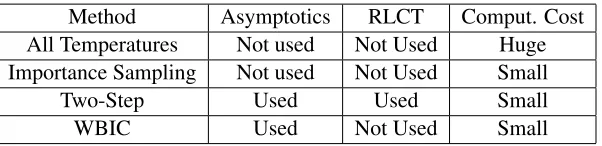
Method Asymptotics RLCT Comput. Cost All Temperatures Not used Not Used Huge Importance Sampling Not used Not Used Small
Two-Step Used Used Small
WBIC Used Not Used Small
Table 4: Comparison of Several Methods
Then
F
= −log ˆEw[exp(−nLn(w) +H(w))] −logZ
exp(−H(w))ϕ(w)dw,
where the last term is the free energy ofH(w). Hence if we findH(w)whose free energy is analyti-cally calculated and if it is easy to generate random samples from ˆEw[ ], then
F
can be numericallyevaluated. The accuracy of this method strongly depends on the choice ofH(w).
Thirdly, a two-step method was proposed (Drton, 2010). Assume that we have theoretical values about RLCTs for all cases about true distribution and statistical models. Then, in the first step, a null hypothesis model is chosen by using BIC. In the second step, the optimal model is chosen by using RLCTs with the assumption that the null hypothesis model is a true distribution. If the selected model is different from the null hypothesis model, then the same procedure is recursively applied until the null hypothesis model becomes the optimal model. In this method, asymptotic theory is necessary but RLCTs do not contain fluctuations because they are theoretical values.
Compared with these methods, WBIC needs asymptotic theory but it does not theoretical results about RLCT. The theoretical comparison of these methods is summarized in Table 4.
The effectiveness of a model selection method strongly depends on a statistical condition which is determined by a true distribution, a statistical model, a prior distribution, and a set of training samples. Under some condition, one method may be more effective, however, under the other con-dition, another may be. The proposed method WBIC gives a new approach in numerical calculation of the Bayes free energy which is more useful with cooperation with the conventional method. It is a future study to clarify which method is recommended in what statistical conditions.
Remark. It is one of the most important problems in Bayes statistics how to make accurate Markov Chain Monte Carlo (MCMC) process. There are several MCMC methods, for example, the Metropolis method, the Gibbs sampler method, the Hybrid Monte Carlo method, and the ex-change Monte Carlo method. Numerical calculation of WBIC depends on the accuracy of MCMC process.
7.3 Algebraic Geometry and Statistics
by
(a2+b2)1/2=a1
q
1+b21=b2
q
a22+1,
which takes both positive and negative values. On the other hand,(a4+b4)1/2takes only nonnega-tive value. The parity indicates such difference.
Secondly, the parity has a relation to statistical model with a restricted parameter set. For exam-ple, a statistical model
p(x|a) =√1
2πexp(−
(x−a)2 2 )
whose parameter set is given by{a≥0}is equivalent to a statistical modelp(x|b2)and{b∈R}. In other words, a statistical model which has restricted parameter set is statistically equivalent to an-other even model which has unrestricted parameter set. We have a conjecture that an even statistical model has some relation to a model with a restricted parameter model.
And lastly, the parity has a relation to the difference ofK(w)andKn(w). As is proven (Watanabe,
2001a), the relation
−log
Z
exp(−nKn(w))ϕ(w)dw=−log
Z
exp(−nK(w))ϕ(w)dw+Op(1)
holds independent of the parity of a statistical model. On the other hand, ifβ=1/logn, then
Eβw[nKn(w)] =
R
nK(w)exp(−nβK(w))ϕ(w)dw
R
exp(−nβK(w))ϕ(w) +Un
p
logn+Op(1).
If the parity is odd, thenUn=0, otherwiseUnis not equal to zero in general. This fact shows that
the parity shows difference in a fluctuation of the likelihood function.
8. Conclusion
We proposed a widely applicable Bayesian information criterion (WBIC) which can be used even if a true distribution is unrealizable by and singular for a statistical model and proved that WBIC has the same asymptotic expansion as the Bayes free energy. Also we developed a method how to estimate real log canonical thresholds even if a true distribution is unknown.
Acknowledgments
This research was partially supported by the Ministry of Education, Science, Sports and Culture in Japan, Grant-in-Aid for Scientific Research 23500172.
References
T. W. Anderson. Estimating linear restrictions on regression coefficients for multivariate normal distributions. Annals of Mathematical Statistics, 22:327–351, 1951.
M. Aoyagi and S. Watanabe. Stochastic complexities of reduced rank regression in Bayesian esti-mation. Neural Networks, 18(7):924–933, 2005.
M. F. Atiyah. Resolution of singularities and division of distributions.Communications of Pure and Applied Mathematics, 13:145–150, 1970.
I. N. J. Bernstein. Analytic continuation of distributions with respect to a parameter. Functional Analysis and its Applications, 6(4):26–40, 1972.
M. Drton. Likelihood ratio tests and singularities. The Annals of Statistics, 37:979–1012, 2009. M. Drton. Reduced rank regression. InWorkshop on Singular Learning Theory. American Institute
of Mathematics, 2010.
M. Drton, B. Sturmfels, and S. Sullivant.Lecures on Algebraic Statistics. Birkh¨auser, Berlin, 2009. I. M. Gelfand and G. E. Shilov. Generalized Functions. Volume I: Properties and Operations.
Academic Press, San Diego, 1964.
I. J. Good. The Estimation of Probabilities: An Essay on Modern Bayesian Methods. MIT Press, Cambridge, 1965.
H. Hironaka. Resolution of singularities of an algebraic variety over a field of characteristic zero. Annals of Mathematics, 79:109–326, 1964.
M. Kashiwara. B-functions and holonomic systems.Inventiones Mathematicae, 38:33–53, 1976. F. J. Kir´aly, P. B¨uuau, F. C. Meinecke, D. A. J. Blythe, and K-R M¨uller. Algebraic geometric
comparison of probability distributions. Journal of Machine Learning Research, 13:855–903, 2012.
J. Koll´ar. Singularities of pairs. InAlgebraic Geometry, Santa Cruz 1995, Proceedings of Symposia in Pure Mathematics, volume 62, pages 221–286. American Mathematical Society, 1997.
S. Lin. Algebraic Methods for Evaluating Integrals in Bayesian Statistics. PhD thesis, Ph.D. dis-sertation, University of California, Berkeley, 2011.
D. Rusakov and D. Geiger. Asymptotic model selection for naive Bayesian network. Journal of Machine Learning Research, 6:1–35, 2005.
M. Saito. On real log canonical thresholds. arXiv:0707.2308v1, 2007.
M. Sato and T. Shintani. On zeta functions associated with prehomogeneous vector space. Annals of Mathematics, 100:131–170, 1974.
G. Schwarz. Estimating the dimension of a model.The Annals of Statistics, 6(2):461–464, 1978. A. Varchenko. Newton polyhedrons and estimates of oscillatory integrals.Functional Analysis and
its Applications, 10(3):13–38, 1976.
S. Watanabe. Algebraic analysis for nonidentifiable learning machines. Neural Computation, 13 (4):899–933, 2001a.
S. Watanabe. Algebraic geometrical methods for hierarchical learning machines. Neural Networks, 14(8):1049–1060, 2001b.
S. Watanabe. Algebraic geometry and statistical learning theory. Cambridge University Press, Cambridge, UK, 2009.
S. Watanabe. Asymptotic learning curve and renormalizable condition in statistical learning the-ory. Journal of Physics Coneference Series, 233(1), 2010a. 012014. doi: 10.1088/1742-6596/233/1/012014.
S. Watanabe. Asymptotic equivalence of Bayes cross validation and widely applicable information criterion in singular learning theory. Journal of Machine Learning Research, 11:3571–3591, 2010b.
K. Yamazaki and S. Watanabe. Singularities in mixture models and upper bounds of stochastic complexity. Neural Networks, 16(7):1029–1038, 2003.
K. Yamazaki and S. Watanabe. Singularities in complete bipartite graph-type boltzmann machines and upper bounds of stochastic complexities. IEEE Transactions on Neural Networks, 16(2): 312–324, 2005.
P. Zwiernik. Asymptotic model selection and identifiability of directed tree models with hidden variables. CRiSM report, 2010.