Organized by G. V. S. E. T., Jaipur. Available Online at www.ijpret.com70
INTERNATIONAL JOURNAL OF PURE AND
APPLIED RESEARCH IN ENGINEERING AND
TECHNOLOGY
A PATH FOR HORIZING YOUR INNOVATIVE WORK
OPTIMIZATION OF WELD BEAD GEOMETRY IN GMAW PROCESS USING RSM BY
BOX-BEHNKEN DESIGN
DHARMENDRA KUMAR 1, DR. NEERAJ KUMAR1, RAVINDRA KUMAR JAIN1, ARVIND
KUMAR SINGH2
1.Department of Mechanical Engineering, Suresh Gyan Vihar University, Rajasthan, Jaipur, 302017, India. 2.Department of Mechanical Engineering, JNU Jaipur
Accepted Date: 19/03/2018; Published Date: 01/04/2018
Abstract: Now a day’s use of the automatic & robotic system of welding leads a vital role for the fabrication industries in terms of maintaining their quality and productivity. And also helps them to come out from the problems such as lack of skilled welders, health & safety needs. To make more use of these type of system. This is essential to choose the correct method and parameters which would satisfy the required nature of the weld bead. To get a high quality of welding all the various variables should be balanced in a corrective way, so in this paper, we have focused on the high quality of welding all the various variables should be balanced in a corrective way.
Keywords: Weld Bead Geometry, Robotic System
Corresponding Author: DHARMENDRA KUMAR
Access Online On:
www.ijpret.com
How to Cite This Article:
Dharmendra Kumar, IJPRET, 2018; Volume 6 (8): 70-84
PAPER-QR CODE
SPECIAL ISSUE FOR
NATIONAL LEVEL CONFERENCE
Organized by G. V. S. E. T., Jaipur. Available Online at www.ijpret.com71
INTRODUCTION
Current modern items which have given to the thriving of humankind, owe their expansion and productive execution to welding, which is presently the all-around acknowledged strategy for forever joining metals and making solid structures proficiently and monetarily. Weld rising is logically attempting to enhance the life and to decrease the cost of designing part. Gas metals arc welding (GMAW) covering is lengthily utilized in its reflex mode to get the victor quality stainless steel cladding. Steels by far off are the most widely utilized and welded assets, principally, because of the trueness that they can be mass-created moderately monetarily in gigantic adds up to correct necessity and have an encompassing scope of mechanized properties.
MIG WELDING
MIG welding is for the most part utilized for welding Aluminum and Stainless Steels through inert gas welding. In 2this strategy, the welding is being
Formed between an electrode and the base metal. Where electrode deeds a straightforward wire of minor breadth, which offers the mortar metal and consequently no additional field, is essential. Shielding argon, helium, carbon dioxide, and oxygen are being castoff for close-by the arc to safeguard the dissolved metal from air contaminations like dust, dirt, metal oxides, and so on. These gasses can be castoff both as a lone gas and in a blend of different gasses. At the point when CO2 just is castoff as the protective gas, the system is called CO2 welding. Once in the past, argon and helium were utilized as shielding gasses. By and by CO2 is utilized Panoptic, and oxygen and CO2 are oft various with inert gasses.
CLADDING TECHNIQUE
Organized by G. V. S. E. T., Jaipur. Available Online at www.ijpret.com72
Extrusion: This procedure is utilized for making tubing.
Continuous brazing: In this procedure, the brazing composite flowed between strips is immersed, as the strips are unendingly warmed and rolled.
Casting: This procedure contains metal being cast by another through the centrifugal process.
Welding: In this procedure, one material is dropped over the other through welding.
Explosive Bonding: Here the blasting activity of a leaf of unstable drives the source metal and covering metal messily and blows them. This procedure was gotten a handle on useable titanium, Nickel stainless clad steel in large plates.
CLAD METAL APPLICATION-
Copper: stainless steel is utilized as a base metal. It is utilized to advance thermal properties of heater and heat exchangers.
Aluminum: Wrought Aluminum (Al-clad) is utilized as source metal. Their utilization includes reflectors, cooking utility, substance hardware, marine application.
Stainless steel: Carbon and alloy steel, aluminum is utilized as the base metal. It is covered for better-quality corrosion resistance of pressing and blending tanks. Its utilization incorporates cooking utensil, auto trim, and chemic method watercraft.
Titanium: Steel is utilized as a soluble base metal. It is utilized as a part of chemic process mechanical assembly.
Silver: There is a various source metal on which silver is covered. It is for the most part utilized for electrical conduction.
MIG VARIABLES
Organized by G. V. S. E. T., Jaipur. Available Online at www.ijpret.com73
Welding Voltage
It ought to be evidently recognized that the arc length is directly controlled by the voltage setting and in addition, it will a beyond any doubt run is needed to hold the welding soundness at any predetermined current level of welding.
Nozzle to plate distance
NPD mains are an enthusiastic part of proceeding with the bead shape and quality. At the point when the NPD is being to smaller then it will harm the gas nozzle. However, when the NPD is too long, the capability of the shielding gas is affected including with the chances of arc stability. Commonly NPD of the inward distance across approx. 1 to 1.5mm.
Welding speed
The welding rate can be characterized as the direct rate what the welding moves alongside the workpiece. These parameters are in effect essentially expressed in inches or meters per min. Two articulations are being influenced with respect to the welding speed.
If there is any expansion in the thickness of the material, the welding speed must be dropped down.
Higher welding travel speed is being accomplished by utilizing the forehand strategy for welding.
Electrode Stick Out
The separation from bringing down the tip of the contact tube to the tip of the electrode wire is known as electrode stand out. It is an essential parameter for controlling the disintegration rate and bead geometry. They stand out is essentially kept between 5 to 15 mm for the short circuiting transformer and 16 to 25 mm for another sort of metal exchange.
PRESENT WORK
The cladding properties have been essentially impacted by weakening turns out. In this way, control of weakening assumes an essential part in surfacing at whatever point a frail weakening is very required. The in conclusion store organization comes nearer to that of filling material When weakening is very low, and consequently it enhances the erosion safe properties of the cladding .
Reseweldinghers have endeavored to improve weakening of stainless steel cladding utilizing the GMAW procedure. At the same time, it was discovered that the ideal weakening conditions are accomplished, accordingly diminishing the efficiency of this procedure in the event that it is to be utilized for surfacing operations.
Organized by G. V. S. E. T., Jaipur. Available Online at www.ijpret.com74
METHODOLOGY
To finish the following targets RSM has been assigned (Response Surface Methodology) strategy that it request the smaller amount of experimentations to be appeared and furthermore it can handle uncompromising variables incorporated in the plan of experimentations. Essential strides for finishing the want destinations are:
Data Collection
Rendering to outline framework established on RSM plan grid. The experimentations will be coordinated on mellow steel plate devouring 304 stainless steel electrodes.
Empirical Modelling
Design of the new observational model (relationship among GMAW reactions and the GMAW parameters) utilizing relapse investigation.
Test for sufficiency of creating a show
Inspection of prototypical centrality, demonstrate terms suggestion utilizing ANOVA investigation. This exact model will oblige in an ideal combination of GMAW parameters.
OPTIMIZATION OF GMAW PARAMETERS
Plan of analyses approach, by utilizing of RSM procedure was found to the best fitting optimization method for contemporary work as placated by the writing overview. I have taken four numeric factors, for example, nozzle to plate distance, open circuit voltage, welding speed and wire feed rate being distinguished for my present work. Plan of trials approach, by utilizing of RSM strategy was found to the best appropriate enhancement method for introducing function as fulfilled by the writing study.
In view of the issue communicated or talked about over the accompanying goals were surrounded
Define the Parametric enhancement of bead geometry parameters, 1. Bead Height
2. Bead Penetration of dot geometry. 3. Bead Width
DESIGN OF EXPERIMENTS
Materials and hardware's utilized
Base material
Organized by G. V. S. E. T., Jaipur. Available Online at www.ijpret.com75
Filler wire
The austenitic stainless steel strong wire of the kind 304 of the distance across 1.2 mm is being utilized as a part of the contemporaneous work. The physical and concoction belonging to the ASS sort 304 are as per the following:
Table 1
Mtrl C Mn S P Si Cu Ni
% 0.0194 1.7152 0.00085 0.0283 0.2883 0.1732 9.1356
Ti Cr Mb V Tu Al Fe
0.0041 19.2702 0.0777 0.1188 0.037 0.0061 68.922
The composition of base metal plate M.S being used (wt %) Table 2
Mtrl(MS) C Si Mn P S Ni Cr Al Fe
% 0.134 0.161 0.59 0.025 0.022 0.021 0.044 0.028 Balance
Shielding gas
Organized by G. V. S. E. T., Jaipur. Available Online at www.ijpret.com76
Experimental Details
To pick up an entire information about dependability of austenitic stainless and steel cladded plates this will be discovered basic to research the accompanying conditions.
Identification, determination, and foundation of scopes of parameters.
To discover ideal welding conditions for welding current, weld globule geometry, weakening, testimony rate and cladding file utilizing RSM strategy.
Evaluation of properties of claddings through smaller scale hardness testing and twist test.
Process parameters varied at three levels
Table 3
Input Parameters Units Low(-) Intermediate High(+) NPD(Nozzle to
plate distance
Mm 6 10 14
OCV(Open circuit Voltage)
Volts 15 21 27
WS(Welding Speed)
Cm/Min 20 30 40
WFR(Wire Feed Rate)
M/Min 4 8 12
EXPERIMENTAL WORK
Organized by G. V. S. E. T., Jaipur. Available Online at www.ijpret.com77
required idea of the weld globule. To get a high caliber of welding all the different factors ought to be adjusted remedially.
Design of tests
Input factors Wire feed rate (F), Open circuit voltage (V), Welding speed (S)
Nozzle to plate distance (N)
Response parameters
The depth of Penetration(DOP) Bead Height (BH)
Bead Width(BW)
BOX-BEHNKEN DESIGN
Box– Behnken Designs are experimental designs, designed by George E. P. Box and Donald Behnken in 1960 for response surface methodology.
Table 4
StdOrder RunOrder PtType Blocks NPD OCV WS WFR
12 1 2 1 1 0 0 0
1 2 2 1 -1 -1 0 0
10 3 2 1 1 1 0 -1
24 4 2 1 0 1 0 1
19 5 2 1 -1 0 1 0
3 6 2 1 -1 1 0 0
21 7 2 1 0 -1 0 -1
20 8 2 1 1 0 1 0
22 9 2 1 0 1 0 -1
5 10 2 1 0 0 -1 -1
18 11 2 1 1 0 -1 0
2 12 2 1 1 -1 0 0
16 13 2 1 0 1 1 0
27 14 0 1 0 0 0 0
6 15 2 1 0 0 1 -1
17 16 2 1 -1 0 -1 -1
9 17 2 1 -1 0 0 -1
Organized by G. V. S. E. T., Jaipur. Available Online at www.ijpret.com78
14 19 2 1 0 1 -1 0
11 20 2 1 -1 0 0 1
25 21 0 1 0 0 0 0
8 22 2 1 0 0 1 1
4 23 2 1 1 1 0 0
26 24 0 1 0 0 0 0
23 25 2 1 0 -1 0 1
15 26 2 1 0 -1 1 0
7 27 2 1 0 0 -1 1
MEASUREMENT OF WELD BEAD GEOMETRY
Optical profile projector is used for studied of the bead height and depth of penetration. Model METZ-801A of optical profile projector was used for bead penetration measuring.
OPTIMIZATION
Organized by G. V. S. E. T., Jaipur. Available Online at www.ijpret.com79
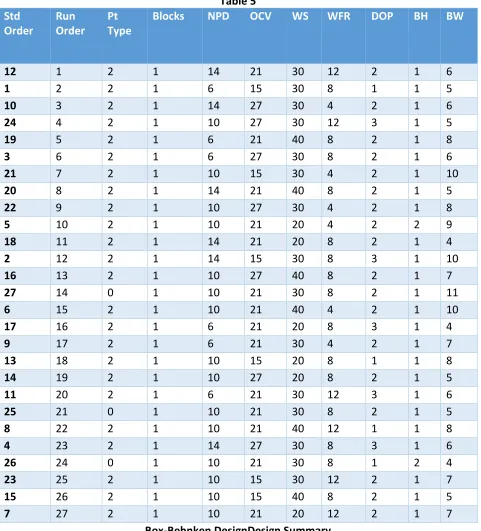
BOX-BEHNKEN DESIGN SUMMARY
Table 5
Std Order
Run Order
Pt Type
Blocks NPD OCV WS WFR DOP BH BW
12 1 2 1 14 21 30 12 2 1 6
1 2 2 1 6 15 30 8 1 1 5
10 3 2 1 14 27 30 4 2 1 6
24 4 2 1 10 27 30 12 3 1 5
19 5 2 1 6 21 40 8 2 1 8
3 6 2 1 6 27 30 8 2 1 6
21 7 2 1 10 15 30 4 2 1 10
20 8 2 1 14 21 40 8 2 1 5
22 9 2 1 10 27 30 4 2 1 8
5 10 2 1 10 21 20 4 2 2 9
18 11 2 1 14 21 20 8 2 1 4
2 12 2 1 14 15 30 8 3 1 10
16 13 2 1 10 27 40 8 2 1 7
27 14 0 1 10 21 30 8 2 1 11
6 15 2 1 10 21 40 4 2 1 10
17 16 2 1 6 21 20 8 3 1 4
9 17 2 1 6 21 30 4 2 1 7
13 18 2 1 10 15 20 8 1 1 8
14 19 2 1 10 27 20 8 2 1 5
11 20 2 1 6 21 30 12 3 1 6
25 21 0 1 10 21 30 8 2 1 5
8 22 2 1 10 21 40 12 1 1 8
4 23 2 1 14 27 30 8 3 1 6
26 24 0 1 10 21 30 8 1 2 4
23 25 2 1 10 15 30 12 2 1 7
15 26 2 1 10 15 40 8 2 1 5
7 27 2 1 10 21 20 12 2 1 7
Organized by G. V. S. E. T., Jaipur. Available Online at www.ijpret.com80
Factors: 4 Replicates: 1
Base runs: 27 Total runs: 27
Base blocks: 1 Total blocks: 1
Organized by G. V. S. E. T., Jaipur. Available Online at www.ijpret.com81
Organized by G. V. S. E. T., Jaipur. Available Online at www.ijpret.com82
Response Goal Lower Target Upper Weight Importance
BW Minimum 3.93 11.10 1 1
BH Minimum 1.00 2.15 1 1
DOP Maximum 1.2 2.90 1 1
Solution
Solution A B C D BW Fit
BH Fit
DOP Fit
Composite Desirability 1 6 27 20 12 3.64376 0.680760 3.53542 1
Multiple Response Prediction
Variable Setting
A 6
B 27
C 20
D 12
Response Fit SE Fit 95% CI 95% PI
BW 3.64 3.14 (-3.20, 10.49) (-4.51, 11.80)
Organized by G. V. S. E. T., Jaipur. Available Online at www.ijpret.com83
CONCLUSION
The following conclusions are as follows:
With the increase in wire feed rate, depth of penetration will increase.
When wire feed rate increases, its weld bead rate also increases. In open circuit voltage and nozzle to plate distance but decreases in welding speed.
A three level four-factor full factorial project matrix based on the Box-Behnken Design method can be used for the development of a mathematical model to design of Experiment.
After designing the experiment and performing on this design for optimization of surface response, I found that observation no. 1(where NPD=6, OCV=27, WS=20, and WFR=12) is the best suitable for the Welding of Mild Steel by the use of austenitic stainless steel wire of the kind 304.
Out of the four process variables considered wire feed rate was the most significant and influential factor having the positive effect,
REFERENCES
1. Benyounis KY, Olabi AG, "optimization of different welding processes using statistical and numerical approaches -A Reference guide " department of industrial engineering ,Garyounis university, AIES 39(2008)483-496
2. Gautam, D.K. &Breazu, M. 1988, “Some aspects of MIG stainless steel cladding”, Int. conference on welding technology, University of Roorkee, India, PP1‐ 145toI‐151.
3. Puja, M.G., Dayal, R.K., Gill, T.P.S., Gnanamoorthy J.B. 1988, “Corrosion of thermally aged Type 316 stainless steel weld metals in an acidic chloride medium”, Int.conference on welding technology, University of Roorkee, PP India,II‐33toII‐38.
4. Ei‐Hebeary, M.R. Rittinger, J. 1988, “Factors affecting toughness of austenitic clad layers”, Int. conference on welding technology, University of Roorkee, India, PPII‐87toII‐92.
5. Mallya, U.D. and Srinivas, H.S.1993, “.Effects of magnetic steering of the arc on clad quality in the submerged arc strip cladding”, Welding Journal, PP 289 to 293s.
6. Avery, R.E. & Parsons, D. 1995, “Welding stainless and 9% Nickel steel cryogenic vessels”, Welding Journal, PP 45to49.
7. Kotecki, D. 1996, “Dilution control in single wire stainless submerged arc cladding”, welding journal, PP45to49.
8. Murugan N, Parmar RS. Effects of MIG process parameters on the geometry of the bead in the automatic surfacing of stainless steel. J Mater Process Technol 1994; 41:381–98.
Organized by G. V. S. E. T., Jaipur. Available Online at www.ijpret.com84
10. Starling CMD, Marques PV, Modenesi PJ. Statistical modelling of narrow-gap GTA welding with magnetic arc oscillation. J Mater Process Technol 1995; 51:37–49.
11. Kim IS, Son JS, Kim IG, Kim OS. A study on relationship between process variable and bead penetration for robotic CO2 arc welding. J Mater Process Tech 2003; 136:139–45.
12. Kim IS, Jeong YJ, Son KJ, Kim KJ, Kim JY, Kim IK, Yaragada PKDV. Sensitivity analysis for process parameters influencing weld quality in robotic GMA welding processes J. mater Process Technol 2003, 140: 676 – 681.
13. Kim IS, Son KJ, Yang YS, Yaragada PKDV. Sensitivity analysis is for process parameters in GMA welding processes using a factorial design method. Int J Mach Tools Manuf2003; 43: 763– 769.
14. Murugan N, Parmar RS. Effect of welding conditions on microstructure and properties of type 316L stainless steel submerged arc welding cladding. Weld J, AWS 1997; 76(5):210-s–20-s, May.
15. Gunaraj V, Murugan N. Application of response surface methodology for predicting weld bead quality in submerged arc welding of pipes. J Mater Process Technol 1999; 88:266–75. 16. Gunaraj V, Murugan N. Prediction and comparison of the area of the heat-affected zone for the bead-on-plates and bead-on-joint in submerged arc welding of pipes. J Mater Process Technol 1999; 95: 246–61.
17. Koleva E. Statistical modeling and computer programs for optimization of the electron beam welding of stainless steel. J Vacuum 2001; 62:151–7.
18. Gunarai V, Murugan N. Prediction and optimization of weld bead volume for the submerged arc process – part 1. Weld J, AWS 2000(October):286-s–94-s.
19. Gunarai V, Murugan N. Prediction and optimization of weld bead volume for the submerged arc process – part 2. Weld J, AWS 2000(November):33-s–8-s.
20. Gunaraj, Murugan. Prediction of heat-affected zone characteristics in submerged arc welding of structural steel pipes. Weld J, AWS 2002(January):94-s–8-s.