Vol.7 (2017) No. 5
ISSN: 2088-5334
Scattered Mosaic Rendering Using Unit Images
Sanghyun Seo
#, Sungdae Hong
*#
Div. of Mediasoftware, Sungkyul University, 53 Sungkyuldaehak-ro, Manan-gu, Anyang, 14097, Rep. of Korea E-mail: [email protected]
*
Dep. of Film & Digital Media, Seokyeong University, 124 Seogyeong-ro Seongbuk-gu, Seoul, 02173, Rep. of Korea E-mail: [email protected]
Abstract—An image mosaic method that can be used when creating advertisements or posters is proposed in this study. Mosaic is a
method that expresses an entire image using an arbitrary number of cells. Photomosaic generates new images using a combination of photos. In this paper, we propose a new mosaic algorithm that generates an abstract artistic mosaic image by filling a region that is divided by a boundary using a unit image, which is an image that only has a shape and no allocated color. A unit image can be changed diversely through rotation or shifting, and the corresponding region is filled by using the gradient direction and edge information of the input image. For this, we extract and use information from input image such as color, edge and gradient. In result we can generate various abstractive images which can be used in advertisement and multimedia contents market.
Keywords—computer graphics; mosaic rendering; non-photorealistic rendering; photomosaic
I. INTRODUCTION
Non-photorealistic rendering (NPR) in the computer graphics field is a rendering method that expresses traditional artistic forms such as watercolor, pen sketch, impressionist, and mosaic methods, instead of obtaining realistic images such as photos [1]. Thus, NPR focuses on creating a smooth rendering style that is similar to work created by designers, or drawn and manipulated by artists. The images that are created using this method have enhanced visibility and artistry, compared to those that are created using earlier realistic rendering methods. It can be said that this artistry and visibility is suitable for advertisements whose purpose is to attract consumers’ attention to form consumer awareness on products or services, promote additional purchases to existing users, and make carve images to consumers. The method used in broadcasting and paper advertisements is represented in this study using existing image processing technology and NPR. Fig. 1 shows an image that was used in an actual advertisement.
As seen in Fig. 1, the content of the advertisement was created by scattering a unit image, which does not have a defined color, in a region that has a particular shape. This representation method is similar to the mosaic method that expresses a combination of small pieces, referred to as tiles, as a large object.
An algorithm that represents a mosaic method that is similar to that used in Fig. 1 is proposed in this study.
This paper proposes an algorithm that generates an abstract artistic mosaic image by filling a particular region that is divided by a boundary using a unit image, which is an image that only has a shape, and no allocated color. A meta-image that has a specific pattern can change diversely through rotation or shifting, and the relevant region is filled using the gradient direction and edge information of the input image. For this purpose, the optimal position is determined by converting the meta-image without exceeding the edge. By composing a system that can divide the regions using an image segmentation method on the input image, and attaching the shapes of different tiles to each region, a diversely abstract mosaic can be generated. In addition, the color of the input image, an arbitrary color, or a color table can be used as the color of the drawn unit image. Using this process, the system was employed to generate a mosaic image whose shape is similar to that of the desired input image, or that only has a shape.
Silver at al. [2] proposed the photomosaic method firstly. Photomosaic is a picture that has been divided into tiled sections, each of which is replaced with another photograph that matches the target photo. It searches a database for the image that most closely matches each tile section, and replaces the original blocks with proper image. There are many photomosaic generation algorithms [5] and their basic functionality is based on this.
Fig. 1 Mosaic images used in actual advertisement
Especially, Kim at al. [4] proposed an extension version of the original photomosaic method. In their method, instead of using regularly tiled sections, they use arbitrarily shaped tiles for generating the photomosaic. In order to pack arbitrarily shaped tiles, they proposed an energy function based on optimization method.
Kang at al. [9] introduced stackable mosaic rendering which is a variant of the photomosaic. They represent target image by placing a few tile layers and implemented the algorithm in the mobile devices. This is similar to the photomosaic that make an image by composing several unit images in small image database. However each layered tile mosaic places arbitrary shaped images which are rotated by different angles.
In addition, Li et al. [6] developed a GPU-based photomosaic framework. Hansner [3] crowded rectangular tiles to simulate decorative mosaic.
Kang et al. [7] also extended Hansner’s method to generate the animation using video. They used the motion information in between frames. Recently, Kim at al. [8] proposed a method that automatically generates animations in the style of colored paper mosaics. Seo at al. [10] proposed an interesting photomosaic method that acquires the images from the albums of Social Network Service (SNS) considering the relation and annotation
II.
M
ATERIAL ANDM
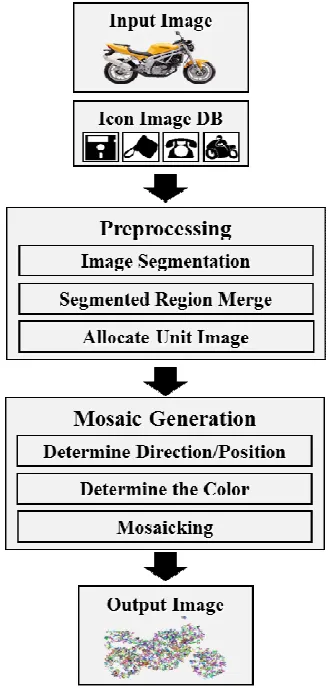
ETHODThe system flow of the proposed scattered image mosaic rendering is shown in Fig. 2. First, the image to be converted is received as the input. This image undergoes region segmentation and merging according to a user’s intention. The unit images that fill the merged segmented regions are allocated from a DB, and the allocated unit images fill the scattered regions in each segmented region. The image segmentation and merging processes are described in section A and the algorithm of scattering actual unit images is described in detail in section B.
A. Pre-processing
The scattered image mosaic rendering proposed in this study is an algorithm that is used to fill specific regions with unit images. The input image must be divided by boundaries for this representation. Region segmentation and merging algorithm was used to represent the boundaries in this study. Region segmentation is a method that combines regions with similar colors into one region. For this purpose, a mean-shift [11] segmentation algorithm was used. Mean-shift region segmentation allows for various expressions of the size of equivalent segmented regions based on the input variable.
Other segmentation methods can be used; however, this method was selected because it is convenient to adjust the segmented regions according to the input variable.
Fig. 2 System flow of scattered image mosaic rendering
In addition, merging between regions is required in these segmented regions to divide the regions, or to generate the shape intended by the user. The merging of these regions is processed using the user’s input.
Fig. 3 shows the input image that the user intends to represent, initial segmentation of the image, and merging by the user interventions. In this study, the background area was not considered as a separate segmented region and was processed as white because the beauty of space is important for the visibility of the proposed mosaic method.
Fig. 3-(a) shows the input image for scattering image mosaic and Fig. 3-(b) shows the segmented image by mean-shift segmentation method. The segmented regions can be merged diversely according to the user’s intention shown in Fig. 3-(c) and (d). These merged regions are arbitrarily allocated with unit images to perform the proposed mosaic rendering. The unit image of each segmented region is selected by the user. The allocation and rendering parameters of unit images such as position, color, direction and density of unity image are described in section B.
(a) Input image (b) Segmented image
(c) One region (d) Three regions
Fig. 3 Region segmentation and merging of input image
B. Determination Rendering Parameters
After the pre-processing procedure of image segmentation and merging of the input image is complete, the desired unit images at each segmented region must be mosaicked. For this purpose, the position is determined, and the direction and color are set at this position for the unit image to be drawn.
1) Unit Image DB
The unit image is converted into a basic unit (tile) that fills the region that does not have an allocated color. Unit images with two types of colors (black and white) are used in this study. The black parts can be changed into arbitrary colors and the white parts are processed as transparent. Fig. 4 shows examples of the unit images used in this study. The unit images can be expanded.
Fig. 4 Unit image samples
2) Density of Mosaic
The density of the subject that is intended to be represented in mosaic using the user’s input must be selected. Density can be considered as the number and size of the unit images that are intended to be drawn. This is processed using the user’s input.
First, the total number of unit images(C) to be scattered and the size of the unit image that is intended to be dawn in each region, where n is the number of segmented regions, are received as inputs. Here, the total number of unit images are proportional to the area of the segmented regions, and are each allocated (Cn) in Eq. 1. This is done to modify the total density using the user’s input.
n
C C
C
C = + +...+
2 1
(1)
Fig. 5 shows the distribution of points based on the area of each region (C1, C2), when the number of unit images to be drawn is 15.
Fig. 5 Density of distributed points in each region
3) Position and Direction of Unit Image
The number of unit images to be scattered in each segmented region was determined in the previous step. Next, the determined number of unit images is scattered on each region. The position is arbitrarily selected in this study. Then, the rotating direction of the unit image rotates using the vertical vector of the gradient at the corresponding position of the input image. This arbitrarily determines the direction because the gradient value is constant when the input image looks like a cartoon or has a single color. When the position and direction are set inside the regions, and the images are scattered, the boundary of the regions may not fit owing to the size of unit image.
As seen in Fig. 6, only Case 3 among Case 1, Case 2, and Case 3 is drawn within the image. The unit images deviates from the region in Case 1 and Case 2. Detailed consideration is needed for Case 2 because it can be selected depending on the intention of the actual required representation. Therefore, a standard is required to determine the selection.
Fig. 6 Selection of unit image scattered on region
A user input value (R) is defined in this study for the reference of selection. Rendering is determined depending on the amount of color of the unit image that occupies the corresponding segmented region (level of musical note included in the region of Fig. 6). The reference has a value of 0.0~1.0, where a value of 0 implies that the image is drawn when the center of the corresponding unit image is included in the related region, and a value of 1 implies that the image is drawn when the intended unit image is
completely included in the region (Case 3). Here, cases 1 and 2 may be selected depending on the reference value.
4) Color of Unit Image
After the position and direction of the unit image are determined, its color must be selected. Regarding this selection, a color limited by the user’s definition, an arbitrary color, and the color of the input image are used in this study. Pros and cons exist in each case and the color is limited to an arbitrary color to represent the advertisement image that was referred to in this paper. We also can choose color from color palette which has information color theme and color emotion.
III.RESULTS AND DISCUSSION
Various results can be generated using the proposed rendering method. Fig. 7 shows the resulting images according to the size of the unit image scattered in the region. Various effects can be observed, which depend on the size of unit image.
(a) Results of preprocessing
(b) Size of unit image: 15
(c) Size of unit image: 20
(d) Size of unit image: 40
Fig. 7 Rendering image according to size of unit image (boundary maintenance level: 1)
Fig. 8 shows the results of the scattered unit images according to the boundary maintenance level. The input image is the same as that used in Fig. 7. As seen in Fig. 8-(a), the image is not drawn if the boundary deviates even slightly. In this case, a few parts of the intended image boundary cannot be represented. Fig. 8-(c) shows the case of severe deviation of the boundary. The image can be adjusted diversely according to the user’s intention.
Fig. 9 and Fig. 10 show the cases of modifying the number of segmented regions in the merging process. Various images can be represented by allocating different unit images and sizes in each segmented region
(a) Boundary maintenance level: 1
(b) Boundary maintenance level: 0.5
(a) Boundary maintenance level: 0.0
Fig. 8 Rendering image according to boundary maintenance level (size of unit image: 30)
Fig. 9 Rendering image with 2 segmented regions (size of unit image: 30)
Fig. 10 Rendering image with 2 segmented regions (Size of unit image: Region 1=15, Region 2= 20, Region 3= 30)
IV.CONCLUSION
Various results can be generated using the proposed An algorithm that represents mosaic images that are used in broadcasting and paper advertisements using existing image processing technology and NPR is proposed in this study. The input image is region segmented using the mean-shift method and the segmented regions are merged according to the user’s intention. Desired symbolic images are allocated to these segmented regions to fill the corresponding regions. An abstract mosaic image is created using this method. User input, which can modify the number, direction, color, and position of the unit images that fill the regions for various mosaic representations, is used in this study to allow for various representations.
A convenient user interface and expansion of the unit image DB that is suitable for use in actual advertisements or non-photorealistic content production are required in the future. In addition, if color appearance [12] is considered for artistic expression when we determine the color of unit image, we will get the more impressive result. The results of this study also can be applied to various content fields such as education using the gamification [13, 14] if it provides an intuitive and easy interfaces for tutoring.
ACKNOWLEDGMENT
This research was supported by Basic Science Research Program through the National Research Foundation of Korea (NRF) funded by the Ministry of Education (No. 2016R1D1A1B03935378). Direct questions and comments about this article to corresponding author; Sungdae Hong, Seokyeong University, [email protected].
REFERENCES
[1] B. Gooch and A. Gooch, Non-Photorealistic Rendering, A. K. Peters, Ltd., Natick, MA, USA, 2001
[2] R. Silver and M. Hawley, Photomosaics, New York: Henry Holt, 1997
[3] A. Hausner, “Simulating decorative mosaics,” in Proc. the 28th annual conference on Computer graphics and interactive techniques, ACM, pp.573-580, 2001.
[4] J. Kim and F. Pellacini, “Jigsaw image mosaics,” ACM Transactions
on Graphics, vol.21 no.3, pp.657-664. 2002
[5] G. Di Blasi and G. Gallo, “Artificial mosaics,” The Visual Computer, vol.21(6), pp.373-383, 2005
[6] P. Li and H. Sun, “Density‐enhanced perceptual mosaic on GPU,”
Computer Animation and Virtual Worlds, vol.27, no.3-4, pp.241-249,
2016
[7] D. Kang, Y. Ohn, M. Han and K. Yoon “Generation of coherent mosaic animations: enhancement and evaluation of temporal coherence,” Computer Animation and Virtual Worlds, vol.23, no.3-4, pp.191–202, 2012
[8] S. Kim, D. Kang and K. Yoon, “Human-friendly stylization of video content using simulated colored paper mosaics,” New Review of
Hypermedia and Multimedia, vol.22, no.3, pp.270-285, 2016
[9] D. Kang, S. Seo, S. Ryoo and K. Yoon, “A study on stackable mosaic generation for mobile devices,” Multimedia Tools
Applications, vol.63, no.1, pp.145–159, 2013
[10] S. Seo and D. Kang, “A photomosaic image generation method using photo annotation in a social network environment”. Multimedia Tools
and Applications, vol.75, no.20, pp.12831-12841, 2016
[11] D. Comaniciu and P. Meer, “Mean shift: A robust approach toward feature space analysis. IEEE Transactions on pattern analysis and
machine intelligence, vol.24, no.5, pp.603-619, 2002.
[12] A. Othman, T. S. M. T. Wook and S. M. Arif, “Quantization Selection of Colour Histogram Bins to Categorize the Colour Appearance of Landscape Paintings for Image Retrieval,”
International Journal on Advanced Science, Engineering and Information Technology, vol.6, no.6, pp.930-936. 2016
[13] Applying an online game-based formative assessment in a flowchart-based intelligent tutoring system for improving problem-solving skills. Computers & Education, vol. 94, pp.18-36, 2016.
[14] A flowchart-based intelligent tutoring system for improving problem-solving skills of novice programmers. Journal of Computer Assisted
Learning, vol.31,no.4, pp.345-361, 2015