RESEARCH ARTICLE
The relationship between working memory capacity and
temporal and dichotic auditory processing in teachers
Saeideh Mehrkian1, Zahra Mozaffari1*, Enayatollah Bakhshi2
1- Department of Audiology, University of Social Welfare and Rehabilitation Sciences, Tehran, Iran 2
- Department of Biostatistics, University of Social Welfare and Rehabilitation Sciences, Tehran, Iran
Received: 14 Sep 2018, Revised: 16 Oct 2018, Accepted: 20 Oct 2018, Published: 15 Apr 2019
Abstract
Background and Aim: Because speech percep-tion is disturbed in people who are exposed to noise, this study aimed to investigate the effect of work environment noise on working memory capacity, temporal, and dichotic auditory proce-ssing and relationship between them in elemen-tary school teachers.
Methods: Fifty-six female aged 30−50 years were enrolled in our study case and control groups. A total of 28 teachers with normal hearing and poor speech perception in noise were in the case group, and 28 women were controls with normal hearing and good scores in speech perception in noise who did not work in a noisy environment. Working memory tests, dichotic digit test (DDT) and gap-detection test (GDT) were performed for both groups. The mean score of each test was obtained from the two groups and the results were analyzed.
Results: Comparison of means between the two groups in DDT, GDT, and working memory capacity test showed that the scores of the case group were significantly lower than those in the control group (p < 0.05). There was no correla-tion between working memory capacity test, DDT, and GDT scores. (p > 0.05, r < 0.1).
Conclusion: Noise exposure in the work envi-ronment causes weakness in temporal and dich-otic auditory processing, and working memory capacity. But there was no correlation between working memory capacity and auditory proce-ssing. The findings of this study show the eff-ects of noise exposure on speech perception and the need to protect hearing from noise.
Keywords: Noise; working memory; auditory processing; gap-detection; dichotic hearing
Citation: Mehrkian S, Mozaffari Z, Bakhshi E. The Relationship between working memory capacity and temporal and dichotic auditory processing in teachers. Aud Vestib Res. 2019;28(2):100-105.
Introduction
Today noise avoidance is impossible. Most peo-ple are exposed to noise in their working place. Classrooms, especially at elementary schools, are among noisy places. Teachers, who are wor-king at schools for years, are susceptible to adv-erse effects of noise. Noise has extensive effects on subjects’ health, including pathophysiologic problems and hearing loss [1,2]. Occasionally in spite of normal hearing threshold, noise invo-lves supra threshold functions, especially tem-poral processing and dichotic listening which lead to speech perception and recognition dis-orders [3].
* Corresponding author: Department of Audiology,
Normal speech processing and perception, espe-cially in a noisy environment, are based on audi-tory (temporal, dichotic) and cognitive proce-ssing (working memory and attention) [4]. Dichotic listening is a scale for evaluation of brain hemisphere asymmetry and based on this asymmetry other issues such as attention, spee-ch perception, memory, and learning are inves-tigated [5]. For speech perception, fine temporal processing is vital, too. For quick speech proce-ssing, temporal processing is more important than spectral processing so that temporal proce-ssing deficit, even as small as of 10 ms, is obs-erved in many linguistic disorders [6].
Working memory is a brain function for temp-orary storage of data in order to perform com-plex cognitive activities such as speech perce-ption, learning, and reasoning. This memory is composed of four components; central executive systems, phonological loop, visual-spatial sket-chpad, and episodic buffer [7,8]. Working mem-ory has a major role in language understanding and word recognition [9]. Working memory has contributions in five areas of language proces-sing; word acquisition, speech production, spe-ech perception, reading progress, and fluent rea-ding. These roles are made possible via phono-logical loop for processing and retaining verbal materials and executive centers for general data processing [10]. As speech perception needs following, retaining, and integrating auditory data flow, working memory probably has a key role in speech perception [11]. Working mem-ory has limited capacity. Target speech in the presence of irrelevant auditory signals will res-ult in speech perception difficres-ulty. The exis-tence of noise along with the stimuli which must be stored in and recalled from working memory make the process difficult [12]. Subjects with limited memory span are in more need of a quieter place (less noise) for speech perception. Subjects with expanded working memory do not experience such difficulty [13]. Those with ext-ended working memory display better perfor-mance in segregating target signals in complex conditions [14].
As both auditory processing (temporal and dich-otic) and working memory are involved in
speech perception, the present study aimed at studying auditory processing (temporal and dichotic) and cognitive processing in teachers who work in noisy environments and finding the relationship between these two processes.
Methods
OB822 (Madsen; Denmark) and TDH39 head-phone at octave frequencies from 250−8000 Hz. Then the DPOAE test was conducted by Otometrics (Denmark). DPOAE was present in all cases, indicating outer hair cell integrity. Then Q-SIN test [16] was performed by Asus x450c (China) with Sennheiser HD 200 Pro (Germany) headphone which was calibrated by using a one third octave sound level meter type 2250-L (Bruel & Kjaer; Denmark). Forward digit span, backward digit span, n-back test, dichotic digit test (DDT) and gap-detection (GDT) were used. Forward digit span included 7 digit series and each series had 2 exercises. The number of digits in each exercise was from 3 to 9. The digits were presented in 1-s inter-vals. The longest string of digits that examinee could recall was considered forward digit span [17,18]. The backward digit span had 7 digit series. The number of digits was from 2 to 8. The digits were presented in 1-s intervals. The examinee had to repeat digits from the end to the beginning. The longest string of digits that examinee could recall in this manner was con-sidered backward digit span [17,18]. In the n-back test, a set of stimuli (digits) were presented and the examinee was asked to repeat n stimuli before the end stimulus. The number n can be 1, 2 or 3 [19]. GDT is one of the best methods for evaluation of temporal resolution. In this study, the time interval between two similar tones were 0, 2, 5, 10, 15, 20, 25, 30 and 40 ms. This test was conducted at a comfortable level (60 dB SPL). Then the subject would be asked to tell if he had heard one or two consecutive tones. The smallest gap that was recognizable (hearing two separate tones) was the GDT result [20]. In DDT, digits from 1 to 10 (except 4 which is a two-syllables word in Persian) were presented binaurally. Each test item was composed of 4 digits (two digits for each ear) to 6 digits (three digits for each ear). The examinee had to repeat all presented digits. The score was calculated for each ear [21]. After recording the mean scores for both groups in all mentioned tests, comparisons were made between mean scores and auditory processing and memory span rela-tionship was studied by using SPSS 22.
Shapiro-Wilk and Mann-Whitney non-paramet-ric tests were used for comparing means in wor-king memory capacity tests and GDT in 500, 1000 and 2000 Hz. The t-test was used for comparing right and left ear results for DDT and GDT in 4000 Hz and the Spearman test was used for data analysis. At the present study, all ethical considerations recommended by Univer-sity of Social Welfare and Rehabilitation Scien-ces Ethical Committee were taken into account (Ethical Code IR.USWR.REC.1396.260). All participants completed a written informed con-sent.
Results
This study was conducted on 56 adults in the age range of 30−50 years old, including 28 tea-chers with speech perception difficulty in noise as the case group with a mean (SD) age of 42 (±6) years and 28 normal subjects with the mean (SD) age of 38 (±5) years. Q-SIN was perfor-med in both groups and mean errors in the case group was 2 and in the control group was 1. SNR 50 in the case group was 0.28±1.2 and in the control group was -1.32±0.57.
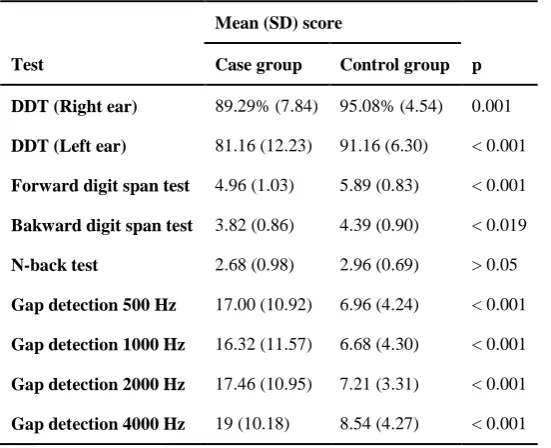
The results of comparing means between the two groups are summarized in Table 1. As it is shown, there was a significant difference bet-ween two groups in DDT (right and left ear), GDT in 500, 1000, 2000, and 4000 Hz and forward and backward digit span (p < 0.05). There was not any significant relationship bet-ween working memory capacity in forward, backward digit span and n-back test with temporal and dichotic processing in the case group based on the Spearman correlation test (p > 0.05).
Discussion
In the present study, there were two primary goals: first to compare the mean score of wor-king memory span and temporal and dichotic processing in two groups. Second, the rela-tionship between auditory processing (temporal and dichotic) and cognitive processing (working memory) in teachers with speech perception difficulty in noise were investigated.
revealed that the performance of the case group was significantly weaker than the control group in temporal processing. In both groups, GDT for 4000 Hz was significantly weaker than that in 500, 1000 and 2000 Hz. This finding is in agreement with Kumar et al. [1] and Paul et al. [22] findings. They investigated the temporal processing in normal hearing subjects who wor-ked in noisy environments. It seems that after noise exposure, even with normal outer hair cell function (based on DPOAE), the impaired syn-apses between hair cells and afferent fibers pro-duce a permanent deficit in temporal encoding. In the present study, the performance of the case group was lower than the control group in dic-hotic processing which is in agreement with Liberman et al. [23] and Kraus and White-Schwoch [24] results. They studied adverse effects of noise on auditory nerve and synapses between hair cells and afferent fibers.
In the present study, working memory span in teachers was tested by three tests; forward and backward digit span and n-back tests. The mean of forward and backward digit span tests showed that the case group had significantly
lower performance than the control group but n-back showed no difference. It seems that diffi-culty of n-back test, in relation to forward and backward digit span tests reduce its sensitivity and efficacy to differentiate the performance of these two groups. Coway et al. [14] and Salvi et al. [25] studied working memory and showed the same results in the presence of noise. They reported that when noise and digit span test materials were presented simultaneously, mem-ory capacity reduced.
In the present study, the relationship between working memory capacity and temporal and dichotic processing was investigated that sho-wed no significant correlation. For interpre-tation of the auditory processing test results, we need to consider the effects of cognitive factors, too. Many studies have shown that cognitive processing can affect auditory processing signi-ficantly and there is a significant correlation bet-ween them. Maerlender et al. showed a strong relationship between working memory capacity and dichotic processing and used working memory capacity test as an index for recog-nizing auditory processing disorder [26]. In this Table 1. Mean (standard deviation) scores of the dichotic
digit test in right and left ear, forward digit span test, bakward digit span test , n-back test, gap detection test in 500, 1000, 2000 and 4000 Hz in both groups
Mean (SD) score
Test Case group Control group p
DDT (Right ear) 89.29% (7.84) 95.08% (4.54) 0.001
DDT (Left ear) 81.16 (12.23) 91.16 (6.30) < 0.001
Forward digit span test 4.96 (1.03) 5.89 (0.83) < 0.001
Bakward digit span test 3.82 (0.86) 4.39 (0.90) < 0.019
N-back test 2.68 (0.98) 2.96 (0.69) > 0.05
Gap detection 500 Hz 17.00 (10.92) 6.96 (4.24) < 0.001
Gap detection 1000 Hz 16.32 (11.57) 6.68 (4.30) < 0.001
Gap detection 2000 Hz 17.46 (10.95) 7.21 (3.31) < 0.001
Gap detection 4000 Hz 19 (10.18) 8.54 (4.27) < 0.001
manner, the present study is different from Maerlender et al. study. Murphy et al. [27] maintained that the difficulty level of auditory processing tests can affect degree and type of correlation between auditory and cognitive processing. According to the place of processing inside the brain, there might be a different corr-elation between auditory and cognitive proce-ssing. It must be considered that cognitive pro-cessing is a top-down process but the temporal and dichotic process is a bottom-up one. The-refore it is recommended that we use both audi-tory and cognitive processing for predicting subjects’ performance [28]. Some working memory tests do not have any correlation with auditory processing [29]. Also in some studies, the subjects with lower cognitive performance had weaker auditory performance but there was not a clear correlation [28]. It seems that the difficulty level of tests and sample size in the present study has led to this result. Maybe by using tests with different difficulty levels and choosing tests that evaluate different levels of the central auditory system, the results might be different.
Conclusion
Based on the temporal and dichotic processing and working memory tests in teachers and con-trol groups, the adverse effects of noise is clear and prevention from noise exposure is recom-mended. These tests can help the early identi-fication of noise adverse effects. The study sho-wed that noise before developing a hearing loss has irreversible effects on memory and central auditory processing.
Acknowledgments
This paper was extracted from Z. Mozaffari’s MSc. thesis with the same title and was con-ducted at the University of Social Welfare and Rehabilitation Sciences. The authors would like to thank Deputy of Physical Education and Health Ministry of Education, Mr. Mehrzad Hamidi, for cooperation and issuing permits to enter schools and we also would like to thank school principals and teachers for their parti-cipation.
Conflict of interest
The authors declared no conflicts of interest.
References
1. Kumar UA, Ameenudin S, Sangamanatha AV. Tem-poral and speech processing skills in normal hearing individuals exposed to occupational noise. Noise Health. 2012;14(58):100-5. doi: 10.4103/1463-1741.97252
2. Omari S, De-Veer A, Amfo-Otu R. The silent killer: an assessment of level of industrial noise and associated health effects on workers. International Journal of Basic and Applied Sciences. 2013;2(2):165-9. doi:
10.14419/ijbas.v2i2.657
3. Zeng FG. Uncovering hidden hearing loss. Hear J. 2015;68(1):6. doi: 10.1097/01.HJ.0000459741.56134.79
4. Kraus N, Banai K. Auditory-processing malleability focus on language and music. Curr Dir Psychol Sci. 2007;16(2):105-10. doi: 10.1111/j.1467-8721.2007.00485.x
5. Hugdahl K. Dichotic listening: probing temporal lobe functional integrity. In: Davidson RJ, Hugdahl K, editos. Brain asymmetry. 1st ed. Cambridge: MIT Press; 1995. p. 123-56.
6. Zatorre RJ, Belin P. Spectral and temporal processing in human auditory cortex. Cereb Cortex. 2001;11(10):946-53. doi:10.1093/cercor/11.10.946
7. Baddeley A. Working memory: theories, models, and controversies. Annu Rev Psychol. 2012;63:1-29. doi:
10.1146/annurev-psych-120710-100422
8. Willis S, Goldbart J, Stansfield J. The strengths and weaknesses in verbal short-term memory and visual working memory in children with hearing impairment and additional language learning difficulties. Int J Pediatr Otorhinolaryngol. 2014;78(7):1107-14. doi:
10.1016/j.ijporl.2014.04.025
9. Pisoni DB. Cognitive factors and cochlear implants: some thoughts on perception, learning, and memory in speech perception. Ear Hear. 2000;21(1):70-8.
10. Gathercole SE, Baddeley AD. Working memory and language. 1st ed. New York: Psychology Press; 1993. 11. Baddeley A. Working memory: looking back and
look-ing forward. Nat Rev Neurosci. 2003;4(10):829-39. doi:
10.1038/nrn1201
12. Bays PM. Spikes not slots: noise in neural populations limits working memory. Trends Cogn Sci. 2015;19(8): 431-8. doi: 10.1016/j.tics.2015.06.004
13. Neher T, Grimm G, Hohmann V. Perceptual consequ-ences of different signal changes due to binaural noise reduction: do hearing loss and working memory capacity play a role? Ear Hear. 2014;35(5):e213-27. doi:
10.1097/AUD.0000000000000054
14. Conway AR, Cowan N, Bunting MF. The cocktail party phenomenon revisited: the importance of working mem-ory capacity. Psychon Bull Rev. 2001;8(2):331-5. doi:
10.3758/BF03196169
15. Jafari Z, Karimi H, Sazmand A, Malayeri S. [Comparing the prevalence of handedness between normal and congenitally deaf students in age intervals of 12 to 18 years in Tehran]. Archives of Rehabilitation. 2007;8(1):25-34. Persian.
speech in noise test in Persian speaking 18-25 years old normal adults. Journal of Rehabilitation Sciences and Research. 2016;3(3):51-6.
17. Geers AE, Pisoni DB, Brenner C. Complex working memory span in cochlear implanted and normal hearing teenagers. Otol Neurotol. 2013;34(3):396-401. doi:
10.1097/MAO.0b013e318277a0cb
18. Shahim S. [Wechsler's revised intelligence scale for children/conformation and normalizing]. Shiraz: Shiraz University; 2004. Persian.
19. Au J, Sheehan E, Tsai N, Duncan GJ, Buschkuehl M, Jaeggi SM. Improving fluid intelligence with training on working memory: a meta-analysis. Psychon Bull Rev. 2015;22(2):366-77. doi: 10.3758/s13423-014-0699-x
20. Muluk NB, Yalçinkaya F, Keith RW. Random gap detection test and random gap detection test-expanded: Results in children with previous language delay in early childhood. Auris Nasus Larynx. 2011;38(1):6-13. doi:
10.1016/j.anl.2010.05.007
21. Mahdavi ME, Aghazadeh J, Tahaei SAA, Heiran F, Akbarzadeh Baghban A. [Persian randomized dichotic digits test: development and dichotic listening perfor-mance in young adults]. Audiol. 2015;23(6):99-113. Persian.
22. Paul BT, Bruce IC, Roberts LE. Evidence that hidden hearing loss underlies amplitude modulation encoding deficits in individuals with and without tinnitus. Hear Res. 2017;344:170-82. doi:
10.1016/j.heares.2016.11.010
23. Liberman MC, Epstein MJ, Cleveland SS, Wang H,
Maison SF. Toward a differential diagnosis of hidden hearing loss in humans. PLoS One. 2016;11(9):e0162726. doi:
10.1371/journal.pone.0162726
24. Kraus N, White-Schwoch T. Not-so-hidden hearing loss. Hear J. 2016;69(5):38-40. doi:
10.1097/01.HJ.0000483269.59643.1a
25. Salvi RJ, Lockwood AH, Frisina RD, Coad ML, Wack DS, Frisina DR. PET imaging of the normal human auditory system: responses to speech in quiet and in background noise. Hear Res. 2002;170(1-2):96-106. doi:
10.1016/S0378-5955(02)00386-6
26. Maerlender AC, Wallis DJ, Isquith PK. Psychometric and behavioral measures of central auditory function: the relationship between dichotic listening and digit span tasks. Child Neuropsychol. 2004;10(4):318-27. doi:
10.1080/09297040490909314
27. Murphy CF, La Torre R, Schochat E. Association between top-down skills and auditory processing tests. Braz J Otorhinolaryngol. 2013;79(6):753-9. doi:
10.5935/1808-8694.20130137
28. Tomlin D, Dillon H, Sharma M, Rance G. The impact of auditory processing and cognitive abilities in children. Ear Hear. 2015;36(5):527-42. doi:
10.1097/AUD.0000000000000172
29. Gordon-Salant S, Cole SS. Effects of age and working memory capacity on speech recognition performance in noise among listeners with normal hearing. Ear Hear. 2016;37(5):593-602. doi: