Tanaffos (2003) 2(6), 31-37
2003 NRITLD, National Research Institute of Tuberculosis and Lung Disease, Iran
Practice of Deep Vein Thrombosis Prophylaxis in
Teaching Hospitals of Tabriz
Hassan Heidarnezhad1, Nasrin Zendehdel2, Susan Kolahi2, Aydin Pirzeh3, Shabnam Eslampanah3
1 Department of Pulmonary Medicine, NRITLD, Shaheed Beheshti University of Medical Sciences and Health Services, 2 Department of Internal Medicine, 3 Research Center for Tuberculosis and Lung Diseases, Tabriz University of Medical Sciences and Health Services TABRIZ-IRAN
ABSTRACT
Background: Deep Vein Thrombosis (DVT) and Pulmonary Thromboembolism (PTE) are one of the frequently missed and lethal complications in admitted patients. Unfortunately, in spite of the presence of consensus about prevention of DVT, these guidelines are not applied in most hospitals. Death rates from DVT and PTE are more than those of road accidents and breast cancer. Our study aimed to analyze the situation of DVT/PTE prevention in hospitals of Tabriz.
Materials and Methods: Based on 75000/ year admission, we studied the records of 17 teaching wards in 7 hospitals systematically. At least 50 records from each ward were reviewed. Records with insufficient data; admissions of less than 3 days; heparin treated cases; uremic and cirrhotic patients; those with bleeding tendencies, and ENT, ophthalmology, pediatric wards were excluded. 1557 records were collected, and risk of DVT (low-moderate-high-very high) along with appropriate prevention method was stratified according to ACCP 1998 guideline for surgical ward. For stratification of risk factors in medical wards, comparable rate of prevalence of DVT/PTE was used for every medical condition.
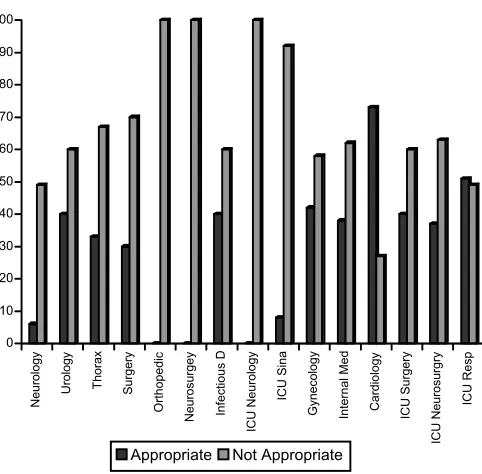
Results: Highest rate of DVT prevention was related to cardiology unit (63.4%) and lowest rate to thoracic surgery unit(2.7%). Appropriate prevention methods were related to cardiology (73.1%), pulmonary ICU (51.4%), and gynecology (42.3%). Inappropriate methods were related to neurology ICU, neurosurgery, and orthopedic wards (0%).
Conclusion: This study shows that in spite of the presence of guidelines for prevention of DVT, and the importance of this in decreasing costs and mortalities, application of appropriate method in most wards is far from reality, and continuous learning of physicians about prevention of DVT and regular control of medical records by medicare is strongly recommended in order to reach a good endpoint. (Tanaffos 2003; 2(6): 31-37)
Key Words: Deep vein thrombosis, Pulmonary thromboembolism, Prevention, Teaching hospitals, Tabriz
INTRODUCTION
Venous thromboembolism is a major national health problem, especially among elderly and hospitalised
Correspondence to: Heidarnezhad H Tel.: +98-21-2803550
E-mail address: [email protected]
markedly with increasing age for both sexes, with pulmonary embolism accounting for most of the increase. The incidence of PTE was approximately 45% lower during the last 15 years of the study for both sexes and all age strata, while the incidence of DVT remained constant for males in all age groups, decreased for females younger than 55 years old and increased for women older than 60 years old (6). In another study, annual incidences for DVT/PTE were 1.8/1000 and 1.3/1000 at age 65-69 years which steadily rise to 3.1 and 2.8/1000 by age 85-89 years. Pulmonary embolism occurred in 1.7% of patients with DVT within one year of hospital discharge for initial treatment. The one year recurrence rate for PTE was 8%. The hospital mortality associated with PTE and DVT was 21% and 3%, and one-year mortality was 39% and 21% respectively (7). More than 50% of DVTs are without any clinical signs and symptoms, and about 50% of patients with clinical findings suggesting DVT are without disease in further investigations. (4,8-10). Up to 70% of PTEs had not been diagnosed, and these were associated with 30% mortality (1-4). In some series in various disease entities, the frequency of DVT/PTE has been reported up to 60% (11). Due to these diagnostic problems and also efficiency of various prophylactic methods in prevention of DVT/PTE (12-16), international and national consensus has been developed for prevention of DVT/PTE for decreasing the health costs and morbidity / mortality, and it has been established that prevention is cost-benefit than diagnosing and treating DVT/PTE. The risk of DVT/PTE is different in various wards and illnesses, so guidelines have developed according to risk stratification to very high, high, moderate, and low risk groups (17,18). Unfortunately, practice of physicians regarding prevention of DVT/PTE were unsatisfactory in most studies. In this study, we have
evaluated the practice of 17 teaching wards of Tabriz hospitals in prevention of DVT/PTE.
MATERIALS AND METHODS
According to approximate 75000 hospital admissions/ year in Tabriz teaching hospitals and estimated 20% prevention, 2% error and 98% confidence interval, and with formula n=z2pq/E2, study population calculated 1550 including standard error. With simple systematic sampling, records of 17 teaching wards in 7 hospitals were reviewed. For each ward at least 50 records was allocated. Demographic data and factors regarding risk stratification, and method(s) used for prevention and appropriateness of method for gravity of risk factor have been collected from records and processed by SPSS software. For stratification of risk factors and appropriate prevention method, we used ACCP 1998 guideline about prevention of DVT/PTE for surgical wards (16). For medical wards, we applied comparable incidence of DVT/PTE in special medical condition(s) for surgical risk groups and guideline of Cohen et al. (18). Due to the absence of some information about risk stratification like hypercoagulability, we considered the least available data with optimistic view. Exclusion criteria were, admissions<3 days, age groups< 12yr, ENT, ophthalmology and obstetric wards, patients receiving anticoagulants, cirrhotics, thrombocytopenic and other bleeding disorders, and chronic renal failure. For reaching sufficient number of records with sufficient data, about 8000 records were reviewed.
RESULTS
were allocated for study (Figure 1). Fifty-five percent of patients were male, distribution in study population was matched, except in some wards with predominance of males (orthopedics, urology, trauma wards) or absolutely female (gynecology). After grading of risk factors, the ratio for low, moderate, high, and very high risk groups were 8%, 28%, 40%, and 24% respectively (Figure 2). The performance of DVT prevention in various wards and appropriateness of prevention methods for the specific risk groups are depicted in Figure 3 and Figure 4 respectively.
Figure 1. Distribution of studied records in different wards of 7 hospital
Figure 2. Risk stratification of studied records
Figure 3. Condition of DVT/PTE prophylaxis in different wards
Figure 4.Appropriateness of DVT prevention route in various wards
DISCUSSION
Our study in teaching wards of Tabriz University is in favour of the under-use of prophylaxis against DVT and unfamiliarity of most wards in applying 0
50 100 150 200 250 300 350
Urology Thorax Surgery
Orthopedic
Neurosurgery Infectious D ICU Neurology ICU General Gynecology Internal Med Cardiology ICU Surgery
ICU Neurosugery
Neurology
0 100 200 300 400 500 600
Low Risk Moderate
Risk
High Risk Very High Risk
0 10 20 30 40 50 60 70 80 90 100
Neurology Urology Thorax Surgery
Orthopedic
Neurosurgey Infectious D
ICU Neurology
ICU Sina
Gynecology Internal Med Cardiology ICU Surgery
ICU Neurosurgry
ICU Resp
Appropriate Not Appropriate 0
50 100 150 200 250 300
Neurology Urology Thorax Surgery
Orthopedic
Neurosurgery Infectious D ICU Neurology
ICU Sina
Gynecology Internal Med Cardiology ICU Surgery
ICU Neurosgery
ICU Resp
appropriate method for gravity of risk factors. Inattention to DVT prevention is a common medical problem in most places. In 1980, a study on 725 orthopedics and 663 surgeons of UK showed that there was a large gap between knowledge and practice of DVT prevention, and appropriate method has not been applied for each risk groups. The results of this study suggested that provision of prophylaxis against DVT/PTE is inversely related to the frequency with which it occurs. The proportion of surgeons offering no prophylaxis or ambulation and physiotherapy was only 72% for hip fractures, 52% for hip replacement and 38% for general surgery (19). In another survey, low-dose heparin and elastic stockings were the most prevalent prevention methods used by American surgeons. These methods were used even in very high risk population. In this survey, responders were unfamiliar with risk stratification, limitation of low dose heparin and elastic stocking. Also, there was knowledge or a practice gap for more effective routes of DVT prophylaxis with warfarin, dextran, IPC (20,21). In study of Paiement et al. (22), it has been recognized that most surgeons used pharmacology prevention of IPC in hip arthroplasty (84.4%) and hip fracture (74%). Only 50% of orthopedics and surgeons used warfarin, but because of bleeding risks stopped its use. In this study, aspirin was the most prevalent used drug for prevention, but more than 25% of physicians enrolled in survey have denoted that at least one of their patients with hip arthroplasty had deid due to pulmonary embolism in last 5 years (22). Anderson in study of 16 hospitals in Massachusetts of USA has found that only 39% of high risk surgery patients have been prevented from DVT, so CME programs have been applied for increasing practice for DVT prevention since 1986. In another study in 1996, it was recognized that orthopedics had good compliance with consensus guidelines for DVT prevention and approximately all patients undergoing
hip replacement were prevented with one or more prophylactic methods (23). In study of 1991 in USA about prevention of DVT in teaching and non-teaching hospitals, it was elucidated that, there was large difference between hospitals in applying prophylaxis (9% to 56%), and it was more common in teaching hospitals compared to non-teaching ones (44% vs. 19%). In this survey, most physicians have used LDUH (78%), IPC (13%), warfarin (12%), and IVC filter (3%). (24) These authors after application of CME program have showed that prophylaxis of DVT increased from 29% in 1986 to 52% in 1989. Increase in prophylaxis use at that time was significantly greater among patients cared for in those hospitals whose physicians participated in a formal CME program (an increase of 28%) than in control hospitals (an increase of 11%) (25). Caprini et al. showed that most surgeons are aware of problems of DVT /PTE and their attitude has changed in the last 10 years. Application of mechanical devices for prophylaxis like elastic stockings and IPC has increased. Ninety percent of surgeons use routine prevention methods e.g. IPC, Heparin, and elastic stockings in order of frequency. Only 25% of surgeons have used combined pharmacologic and mechanical routes, and 50% have applied pharmacologic prevention before surgery (26). In a more recent survey performed in Europe, on 202 patients, it has been showed that only 43% of patients admitted to medical wards have been prevented for DVT, while another 50% of patients have been prevented for DVT/PTE without indication (27).
20%-30% in gynecology, neurology ICU, and general surgery wards. In remaining wards the rate was even lower and less than 20%.
In further analysis, the condition becomes worse if we consider the appropriateness of prevention methods. Overall, cardiology wards, and respiratory ICU have applied appropriate methods in 73% and 51% respectively; but most unfavorable condition is noticed in orthopedic, neurosurgery, neurology, neurology ICU, medical ICU (rate between 11%-0%), which has both the highest rate of DVT/PTE, and highest number of high-risk groups according to world-published data. The rate in other wards was between 30% and 40%. To our knowledge, the problem in some of these high risk wards is due to unavailability of mechanical devices . Low molecular weight heparin (LMWH) has been available recently and its use may help to diminish the gravity of the problem.
Although reliance on CME program has increased prophylaxis application in some parts, but even in these studies, the outcome is not realistic and is far from good end-point (23-25). Other measures, like routine record control by managed care staff, associated with CME program with published consensus guidelines, and availability of mechanical methods and new drugs may increase the knowledge and practice of DVT/PTE prevention and these modalities should be tested in future for reaching to good end-point.
REFERENCES
1. Dalen JE, Alpert JS. Natural history of pulmonary embolism. Prog Cardiovasc Dis 1975; 17(4): 259-70. 2. Dismuke SE, Wagner EH. Pulmonary embolism as a cause
of death. The changing mortality in hospitalized patients.
JAMA 1986; 255(15): 2039-42.
3. Bergqvist D, Lindblad B. A 30-year survey of pulmonary embolism verified at autopsy: an analysis of 1274 surgical patients. Br J Surg 1985; 72(2): 105-8.
4. Goldhaber SZ, Hennekens CH, Evans DA, Newton EC, Godleski JJ. Factors associated with correct antemortem diagnosis of major pulmonary embolism. Am J Med 1982; 73(6): 822-6.
5. Anderson FA Jr, Wheeler HB, Goldberg RJ, Hosmer DW, Forcier A. The prevalence of risk factors for venous thromboembolism among hospital patients. Arch Intern Med 1992; 152(8):1660-4.
6. Silverstein MD, Heit JA, Mohr DN, Petterson TM, O’Fallon WM, Melton LJ3rd. Trends in the incidence of deep vein thrombosis and pulmonary embolism: a 25-year population-based study. Arch Intern Med 1998; 158(6): 585-93. 7. Kniffin WD Jr, Baron JA, Barrett J, Birkmeyer JD,
Anderson FA,Jr. The epidemiology of diagnosed pulmonary embolism and deep venous thrombosis in the elderly. Arch Intern Med 1994; 154(8): 861-6.
8. Cranley JJ, Canos AJ, Sull WJ. The diagnosis of deep venous thrombosis. Fallibility of clinical symptoms and signs. Arch Surg 1976; 111(1): 34-6.
9. Haeger K. Problems of acute deep venous thrombosis. I. The interpretation of signs and symptoms. Angiology 1969; 20(4): 219-23.
10. Wheeler HB, Hirsh J, Wells P, Anderson FA Jr. Diagnostic tests for deep vein thrombosis. Clinical usefulness depends on probability of disease. Arch Intern Med 1994; 154(17): 1921-8.
11. Coon WW. Epidemiology of venous thromboembolism.
Ann Surg 1977; 186(2): 149-64.
12. Clagett GP, Reisch JS. Prevention of venous thromboembolism in general surgical patients. Results of a meta-analysis. Ann Surg 1988; 208(2): 227-40.
13. Collins R, Scrimgeour A, Yusuf S, Peto R. Reduction in fatal pulmonary embolism and venous thrombosis by perioperative administration of subcutaneous heparin. Overview of results of randomized trials in general, orthopedic, and urologic surgery. N Engl J Med 1988; 318(18): 1162-73.
15. Pezzuouli G, Neri Serneri GG, Settembirini P, Coggi G, Olivari N, Buzzetti G, et al. Prophylaxis of fatal pulmonary embolism in general surgery using low-molecular weight heparin Cy216; a multicentre, double-blind, randomized, controlled, clinical trial versus placebo (STEP). STEP-Study Group. Int Surg 1989; 74(4): 205-10.
16. Colditz GA, Tuden RL, Oster G. Rates of venous thrombosis after general surgery: combined results of randomised clinical trials. Lancet 1986; 2(8499): 143-6. 17. Clagett GP, Anderson FA, Geerts W, Heit JA, Knudson M,
Lieberman JR, et al. Prevention of venous thromboembolism. Chest 1998; 114(5 Suppl): 531s-560s. 18. Cohen AT, Alikhan R. Prophylaxis of venous
thromboembolism in medical patients. Curr Opin Pulm Med 2001; 7(5): 332-7.
19. Morris GK. Prevention of venous thromboembolism. A survey of methods used by orthopaedic and general surgeons. Lancet 1980; 2(8194): 572-4.
20. Conti S. Deep vein thrombosis prophylaxis in the surgical patient. A regional survey. Vasc Surg 1980; 14: 382-389. 21. Conti S, Daschbuch M. Venous thromboembolism
prophylaxis: a survey of its use in United States. Arch Surg
1982; 117(8): 1036-40.
22. Paiement GD, Wessinger SJ, Harris WH. Survey of prophylaxis against venous thromboembolism in adults undergoing hip surgery. Clin Orthop 1987; 223: 188-93. 23. Anderson FA Jr, Audet AM. Physician practices in the
prevention of deep vein thrombosis; the MassPRO DVT study. Orthopedics1996; 19 (suppl): 9-11.
24. Anderson FA Jr, Wheeler HB, Goldberg RJ, Hosmer DW, Forcier A, Patwardhan NA. Physician practices in the prevention of venous thromboembolism. Ann Intern Med
1991; 115(8): 591-5.
25. Anderson FA Jr, Wheeler HB, Goldberg RJ, Hosmer DW, Forcier A,Patwardhan NA. Changing clinical practice. Prospective study of the impact of continuing medical education and quality assurance programs on use of prophylaxis for venous thromboembolism. Arch Intern Med 1994; 154(6): 669-77.
26. Caprini JA, Arcelus JI, Hoffman K, Mattern T, Laubach M, Size GP, et al. Prevention of venous thromboembolism in North America: results of a survey among general surgeons.
J Vasc Surg 1994; 20(5): 751-8.