World Maritime University
The Maritime Commons: Digital Repository of the
World Maritime University
World Maritime University Dissertations Dissertations
2000
Comparative study on port privatisation : two ports
under Port Authority of Thailand : Bangkok port
and Laem Chabang port : case study
Noppadol Angkanupong WMU
Follow this and additional works at: https://commons.wmu.se/all_dissertations
Recommended Citation
Angkanupong, Noppadol, "Comparative study on port privatisation : two ports under Port Authority of Thailand : Bangkok port and Laem Chabang port : case study" (2000). World Maritime University Dissertations. 1097.
https://commons.wmu.se/all_dissertations/1097
WORLD MARITIME UNIVERSITY
Malmö, Sweden
COMPARATIVE STUDY ON PORT
PRIVATISATION: TWO PORTS UNDER PORT
AUTHORITY OF THAILAND: BANGKOK PORT
AND LAEM CHABANG PORT CASE STUDY
By
Noppadol Angkanupong
Thailand
A dissertation submitted to the World Maritime University in partial fulfillment of the requirements for the award of the degree of
MASTER OF SCIENCE
in
PORT MANAGEMENT
2000
DECLARATION
I certify that all material in this dissertation that is not my own work has been identified, and that no material is included for which a degree has previously been conferred on me.
The contents of this dissertation reflect my own personal views, and are not necessarily endorsed by the University.
………
15 August 2000
Supervised by :
Name: Professor Shuo Ma
Office: Course Professor, Port and Shipping Management World Maritime University
Assessor:
Name: Professor Bernard Francou
Office: Associate Professor, Port Management World Maritime University
Co-assessor:
Name : Professor Jean-Michel Mancion Former Resident Professor, Port Management
ACKNOWLEDGMENTS
First of all, I wish to express my sincere thanks and gratitude to my organization, the Port Authority of Thailand, for allowing me to participate in the 17-month Port Management Course, at World Maritime University, Malmö, Sweden.
Then, my gratitude goes to the Global Foundation for Research and Scholarship of Japan (GFRS) for sponsoring me to study at the university.
My deep gratitude to Professor Shuo Ma, my course professor and dissertation supervisor, for his untiring effort to go through my dissertation and provide me the necessary assistance; Professor Dr. Bernard Francou, my assessor, for taking his time to read and evaluate my dissertation which has no doubt facilitated its successful completion. Similarly, to Professor Jean-Michel Mancion, my Co-assessor, I very much appreciate his acceptance to carry out the task of further assessing the dissertation.
I would like to express my thanks to Professor Partick Donner, Professor Toshio Hikima, Captain Jan Horck, Lecturer Rejendra Prasad and all university professors and also visiting lecturers who gave me the required training.
Not forgetting various organizations I visited during my field trip study. Ports: Le Havre (France), Valetta and Malta Free Port (Malta), Rotterdam Municipal Port, Copenhagen and Arhus ports (Denmark), Malmö and Cotheborg (Sweden) among other firms visited in continental Europe.
My thanks is extended to all the staff of the library, David Moulder, Susan Wangeci Eklöw and Cecelia Denne for their assistance in acquiring materials from the library.
Also special thanks to my fiancée, Ms. Pranee Lertheerasuppakul, who worked hard on providing me with all the information I needed during my studies at World Maritime University.
Abstract
Title of Dissertation : COMPARATIVE STUDY ON PORT PRIVATISATION: TWO PORTS UNDER PORT AUTHORITY OF THAILAND: BANGKOK PORT AND LAEM CHABANG PORT CASE STUDY
Degree MSc
Due to the financial situation and advice from IMF and the World Bank, the Thai government has to review its role on economy and seek a suitable way for state enterprises. Privatisation is one of the ways to be used. The privatisation plan of the Port Authority of Thailand began several years ago, with the aim to set up a holding company in 2000. So far, there are many problems: efficiency, finance return, government policy, legal matters, land ownership, labour relations and supervision.
The paper is composed of five main chapters, excluding the introduction and the conclusion. Chapter two describes the background of Bangkok Port to give a general idea of the port. Chapter three gives an overview of the performance and productivity of BKP and LCP. Chapter four deals with the cause of privatisation of Thai ports. Chapter five offers the alternative to BKP and LCP to privatisation. Finally, chapter six indicates a suitable solution.
The question concerning the government is which is the most suitable method applicable to port privatisation in BKP and LCP. The author attempts to give an overview of various methods of approaching the problem with suggestions on the most suitable method to BKP and LCP.
Keyword: Privatisation, Corporatisation, Bangkok Port, Laem Chabang Port, and
TABLE OF CONTENT
Declaration ii
Acknowledgement iii
Abstract v
Table of Contents vii
List of Tables xi
List of Figures xiv
List of Abbreviations xv
I Introduction 1
1.1 Methodology 2
1.2 Objective 2
1.3 Limitation 3
II. Background of Bangkok Port 4
2.1 Physical 4
2.2 Economics 6
2.3 Disadvantages of BKP 12
2.4 PAT management and operation 15
III Performance and Productivity of PAT and
LCP
18
3.1 Container vessel 20
3.1.1 Turnaround time 20
3.1.2 Berth occupancy 21
3.2 General cargo vessel 22
3.2.1 Turnaround time 22
3.2.2 Berth occupancy 22
3.3 Handling productivity 22
3.4 The efficiency of handling
3.5 Expense of operation 25
3.6 Tugboat productivity 25
3.7 Vessel through channel and berth 27
3.8 General condition 29
3.8.1 Finance 29
3.8.2 Resource management 29
3.8.3 Administration 30
3.8.4 Fringe benefit 30
IV The privatisation of Thai ports 31
4.1 The various reasons 32
4.1.1 Government stability 32
4.1.2 Efficiency 33
4.1.3 Securities exchange of Thailand 35
4.1.4 International loan agencies 36
4.1.5 Government’s burden 37
4.1.6 Employment 38
4.1.7 Concept of port 39
4.1.8 Management skills 40
4.1.9 Modern technology 40
4.1.10 Collapse of communism countries 41
V Alternative to BKP and LCP 42
5.1 The basic port privatisation alternative 42 5.2 The exist of port privatisation in
Thailand
43
5.3 The basic alternative applied to PAT 47
5.3.1 The continued and extended leasing alternative
47
5.3.2 An alternative to sell cargo handling equipment, dredging equipment and tugboats
49
5.3.3 Corporatisation 50
5.3.4 Outright sale of PAT asset and business 51
5.3.4.1 General 51
5.3.4.2 Problems related 52
5.4 Advantages and disadvantages of the
different alternatives 55
5.5 The choice between alternatives 55
5.5.1 First alternative 55
5.5.3 Third alternative 59
5.5.4 Fourth alternative 61
5.5.5 Fifth alternative 63
VI The suitable solution 66
6.1 Alternative selection 66
6.2 The rationale of this alternative 67
6.3 Future role of PAT and role of its subsidiaries
69
6.3.1 The future role of PAT 69
6.3.2 The role of the subsidiaries 70
6.3.2.1 LCP company 70
6.3.2.2 BKP company 71
6.3.2.3 Dredging company 71
6.3.2.4 Tugboat services company 72
6.4 Major concerns of alternative 3 72
6.4.1 Main legal concerns 72
6.4.1.1 Authority to establish Subsidiaries
72
6.4.1.2Land ownership and transfer 73
6.4.1.3 Control subsidiaries 73 6.4.1.4 Legal status of subsidiaries 74 6.4.1.5 Privileges and immunities
under the PAT Act
74
6.4.1.6Public service obligation 74
6.4.1.7Competition and sectional policy
75
6.4.2 Enactment of a corportisation Bill 75
6.4.2.1 Land ownership 76
6.4.2.2 Land transferred to the
government 76
6.4.2.3 Revocation of PAT Act 76 6.4.2.4 Regulatory power transfer 77
VII Conclusion and Recommendation 78
7.1 Conclusion 78
7.2 Recommendation 79
Bibliography 84
Appendix 1 Map of Chaopraya river 88
Appendix 2 Map of Bangkok Port 89
Appendix 3 Map of Laem Chabang Port 90
List of tables
Table1 Facilities in BKP 5
Table2 The call of vessel following to type of vessel at BKP 1986-1997 6
Table3 Statistics of Import goods through BKP in 1990-1997 8
Table4 Statistics of export goods through BKP in 1990-1997 10
Table5 Operational system in BKP 16
Table6 Port performance 19
Table7 Handling productivity 23
Table8 Efficiency of handling equipment use 24
Table 9 Expense of operation/Ton 25
Table10 Comparison of tugboat operations 26
Table 11 Income and expense of tugboats 26
Table12 Statistics of vessels through channel and berth 27
Table13 The performance of the Marine Department 28
Table14 Number and position of PAT employees 38
concession period at LCP
Table16 Cleaning and car leasing by private
company in PAT 45
Table 17 PATs land lessee 45
Table 18 Private berth along Chaopraya river 46
Table 19 Private berth around LCP 46
Table 20 Map Ta phut port facilities 47
Table 21 Songkhla and Phuket capacity 47
Table 22 The advantage and disadvantage of alternative 1 56
Table 23 The advantage and disadvantage of alternative 2 58
Table 24 The advantage and disadvantage of alternative 3 60
Table 25 The advantage and disadvantage of alternative 4 62
Table 26 The advantage and disadvantage of alternative 5 64
Table 27 Board of Commissioner and their position 69
Table 28 Compensation for early retirement both BKP and LCP 75
Table 29 Detail of 1st phase at LCP 94
Table 31 Details in 2nd phase at LCP 97
Table 32 Statistics of containers through LCP
in 1991-1997 101
Table 33 Import and export goods through
LCP in 1991-1997 103
List of figures
Figure1 Vessel service 7
Figure2 Import goods through BKP 9
Figure3 Export goods through BKP 11
Figure4 Container through LCP 102
List of Abbreviations
BKP Bangkok Port
BOT Build Operator Transfer
BSAA Bangkok Shipowners and Agents
Association
CCC Civil and Commercial code
EDI Electronic Data Interchange
GRT Gross Registered Tonnage
IMF International Monetary Fund
JICA Japan International Co-operation Agency
LCP Laem Chabang Port
MEBO Management Employee Buy Out
MOF Ministry of Finance
MOTC Ministry of Transports and
Communication
NEDECO Netherlands Engineering Consultants
NESDB National Economic and Social
Development board
OECF Overseas Economics Co-operation Fund
OMPC Office of Maritime Promotion
Commission
PSA Port of Singapore Authority
PTT Petroleum Authority of Thailand
TEU Twenty foot equivalent
UNCTAD United Nations Conference on Trade and
Chapter 1
Introduction
The Port Authority of Thailand (PAT) is a public utility state enterprise under the general supervision of the Ministry of Transport and Communications. It was established by the Port Authority of Thailand Act B.E.2494 with the objective of conducting the business pertaining to the port for the interest of the state and the public. At present, PAT is responsible for two main ports namely Bangkok Port as river port and Laem Chabang port as deep sea port.
For many years, different characteristics and processes of privatisation in Thailand were complicated to achieve the government’s goal. The financial crisis and economic downturn in 1997-1998 including the pressure from external organisations such as the World Bank and IMF forced the Thai government to restructure and stabilise the economy. In 1998, the government issued a master privatisation plan following the agreement with IMF.
According to the plan, privatisation should be used to stimulate economic growth. Foreign and domestic investments and know-how should be attracted at the same time as the efficiency in state enterprises should be improved. The objectives of privatisation to state enterprises are as follow:
1) Free public resources to be allocated more efficiently to high priority government objectives such as improving health and education
2) Increasing competition in order to provide better value to state enterprise customers through improved services and price
4) Reducing public debt and budgetary burdens
5) Preparing for globalisation of trade in services.(Priebjrivat, 1999)
Following the government policy, PAT as one of the state enterprises will also be privatised. However, there are many alternatives to privatisation: management buy out, deregulation, licensing, leasing, concession, build operate transfer, build own operate transfer, and build own operate. The question in mind is which alternative is suitable and flexible for PAT. The details will be discussed later.
1.2. Methodology
The author has used the following methodology: gathering, organising, analysing, diagnosing, and summarising the information and given possible solutions based on the advantages and disadvantages of each solution. The information includes a) Primary sources of data collected from PAT and related offices in Thailand b) Secondary sources from permanent and quest lecturers, field trip study,
UNCTAD, magazines, periodical and information through internet.
1.3. Objective
1. To study policy on privatisation of ports under the Port Authority of Thailand 2. To study procedure on privatisation of ports under the Port Authority of Thailand 3. To compare privatisation in Bangkok Port and Laem Chabang Port
1.4 Limitation
Chapter 2
Background of Bangkok Port (BKP
)2.1Physical
Following to the Ministry of Transports and Communication (1994), it stated that
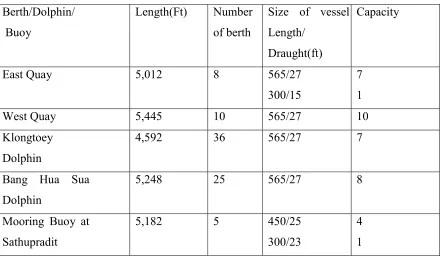
Bangkok Port has played an important role as the main gateway of the international trade of Thailand. BKP is located on the left side of Chao Phraya River about 28 km. from its estuary, and consists of the West Quay with 8 berths and the East Quay with 10 berths. BKP has 87 wharves in total on both sides of the river. The main wharves located on the left side of a distance of 26 to 29 kilometers from the mouth of the river are operated by the Port Authority of Thailand (PAT). (See Appendix1,2)
Table 1: Facilities at BKP
Berth/Dolphin/ Buoy
Length(Ft) Number
of berth
Size of vessel Length/
Draught(ft)
Capacity
East Quay 5,012 8 565/27
300/15
7 1
West Quay 5,445 10 565/27 10
Klongtoey Dolphin
4,592 36 565/27 7
Bang Hua Sua Dolphin
5,248 25 565/27 8
Mooring Buoy at Sathupradit
5,182 5 450/25
300/23
4 1
Source: Port Authority of Thailand
There are 2 sides with berths in Bangkok Port: East Quay with 8 berths and West Quay with 10 berth. The area for cargo storage in Customs fence is about 415,912 sq.m. whereas that outside customs fence is about 63,012 sq.m. The total area for cargo storage is about 478,924 sq.m. The maximum capacity of Bangkok Port in 1992 was 1,285,009 TEU. Following the government policy, container traffic through BKP. is limited to 1,000,000 TEU.
Seaports play a vital role for the continued growth of the economy. The type of
transportation has changed to containers and the size of vessels is bigger. BKP is
article on Port Conditions in Lloyd’s List (1995), it stated “One hundred and five vessels in port and 25 vessels waiting at outer anchorage with berthing delay
expected.” Traffic congestion in Bangkok Metropolitan area is another reason for
creating the necessity to have further ports in the Eastern Seaboard area. Laem Chabang Port is designed to act as a catalyst for the development in Eastern Seaboard area and to lessen the congestion in BKP and the Bangkok Urban area.
2.2Economics
a) Vessel service
Table 2 The call of vessel following to type of vessel at BKP 1986-1997
Unit: Calls Fiscal
year
General cargo vessel
General cargo vessel & Container
Container vessel
Total Growth %
1986 556 349 814 1,719
-1987 529 387 891 1,807 5,1193
1988 585 312 1,175 2,072 14,6652
1989 545 227 1,431 2,203 6,3224
1990 608 230 1,480 2,318 5,2202
1991 713 219 1,463 2,395 3,3218
1992 699 204 1,614 2,517 5,0939
1993 587 175 1,720 2,482 -1,3905
1994 579 152 1,818 2,549 2,6994
1995 744 185 1,650 2,579 1,1769
1996 679 122 1,540 2,341 -9,2284
1997 677 123 1,615 2,415 3,1610
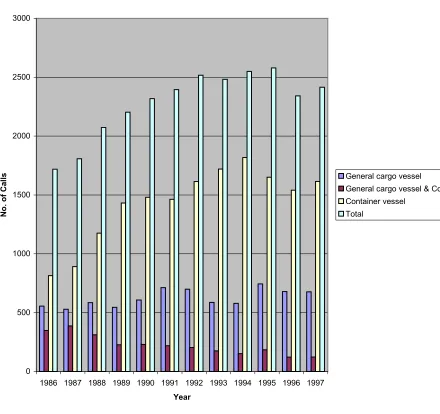
Figure 1 Vessel service
Following the performance to serve vessels at BKP, it showed that calls of vessels to BKP have increased every year. Especially in 1988 the growth rate of calls of vessels to BKP was about 14%. According to table 2 calls of vessels from 1986-1997, it showed that the growth rate of calls of vessels to BKP decreased
Vessel Services
0 500 1000 1500 2000 2500 3000
1986 1987 1988 1989 1990 1991 1992 1993 1994 1995 1996 1997 Year
N
o
. of
C
alls General cargo vessel
General cargo vessel & Container Container vessel
with negative percentage in 1992 because of the inauguration of Laem Chabang Port (LCP) in 1991 (See Appendix 3,4) including limitation of containers through BKP following the government policy. Simultaneously, more incentives for port users to use LCP have been taken; therefore, calls of vessels to BKP have decreased.
b) Goods service
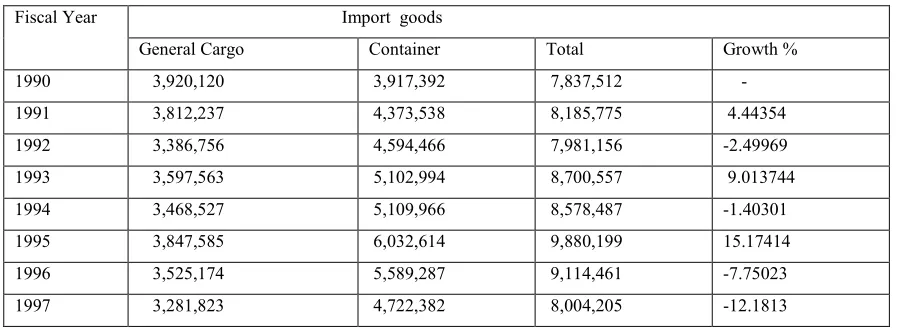
Table 3. Statistics of import goods through BKP in 1990-1997
Unit: Tons
Import goods Fiscal Year
General Cargo Container Total Growth % 1990 3,920,120 3,917,392 7,837,512 -1991 3,812,237 4,373,538 8,185,775 4.44354 1992 3,386,756 4,594,466 7,981,156 -2.49969 1993 3,597,563 5,102,994 8,700,557 9.013744 1994 3,468,527 5,109,966 8,578,487 -1.40301 1995 3,847,585 6,032,614 9,880,199 15.17414 1996 3,525,174 5,589,287 9,114,461 -7.75023 1997 3,281,823 4,722,382 8,004,205 -12.1813
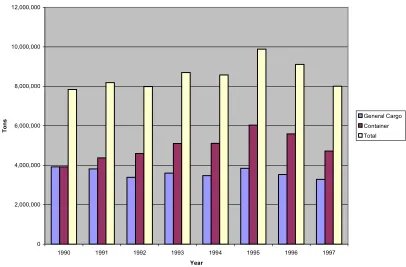
Figure 2 Import goods through BKP
Import Goods
0 2,000,000 4,000,000 6,000,000 8,000,000 10,000,000 12,000,000
1990 1991 1992 1993 1994 1995 1996 1997
Year
Tons
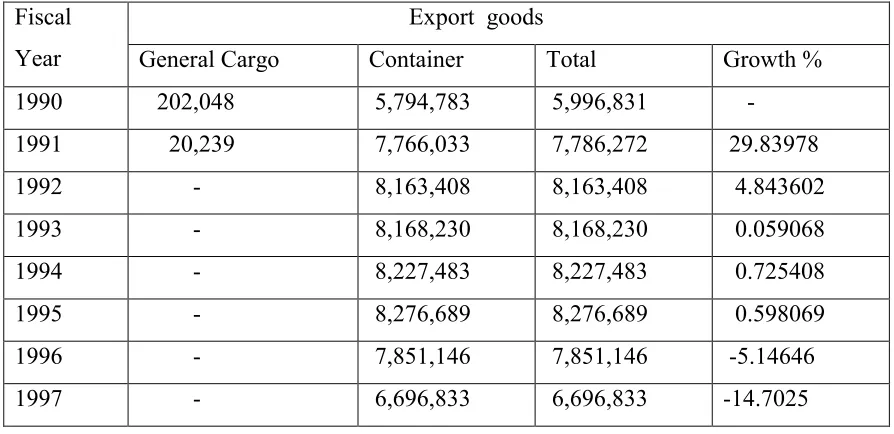
Table 4 Statistics of export goods through BKP in 1990-1997
Export goods Fiscal
Year General Cargo Container Total Growth %
1990 202,048 5,794,783 5,996,831
-1991 20,239 7,766,033 7,786,272 29.83978
1992 - 8,163,408 8,163,408 4.843602
1993 - 8,168,230 8,168,230 0.059068
1994 - 8,227,483 8,227,483 0.725408
1995 - 8,276,689 8,276,689 0.598069
1996 - 7,851,146 7,851,146 -5.14646
1997 - 6,696,833 6,696,833 -14.7025
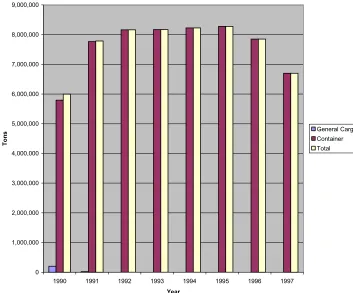
Figure 3 Export goods through BKP
Export Goods
0 1,000,000 2,000,000 3,000,000 4,000,000 5,000,000 6,000,000 7,000,000 8,000,000 9,000,000
1990 1991 1992 1993 1994 1995 1996 1997
Year
Tons
Following table3 and 4, the quantity of goods through BKP in 1990-1997 increased continuously but decreased from 1996-1997. Simultaneously, the growth of import and export cargoes through BKP outstandingly decreased in 1996-1997. The quantity of import and export cargoes decreased about 12.8% and 14.7% respectively. This showed that the government has managed the effects of limitation of containers through BKP so as to promote LCP.
BKP plays an important role in international sea trade in Thailand. Table 3 shows the annual throughput of BKP wharves during 1990-1997. Both export and import goods increased rapidly. The rapid increase of container cargo in the past led to severe congestion at BKP. PAT implemented the policies to reduce the BKP congestion by controlling the container volume passing through BKP not more than 1,000,000 TEU per year from 1994 and encouraging more traffic at Laem Chabang port (LCP).
2.3 Disadvantage of BKP
BKP was the main port of Thailand for more than 50 years and has developed along with national economics and social development. The location of BKP is on Chaophraya river where there is a draught limitation for vessel over 12,000 GRT. and 172 meters in length. BKP situated in the capital city serves port and provides anchorage and dolphin services. The problems of BKP are as follows:
1. The major factor that contributes to the port inefficiency is the stuffing and
factories which are located near the port area and users consider port as if port
was their own backyard.”
2. The lack of a closing time for exports box. Some goods were sent to the port
area when the vessel was going to arrive or the vessel had already arrived. This led to traffic jam in the port area.
3. The process of EDI installation at Bangkok Port has made very little progress
since there is on line connection with the Customs Department.
4. BKP remains government controlled with a staff of over 5,000 employees.
An article ,PAT Solution, in Port Development International (1995) stated the following
Payoongkich Chivamit, Managing Director of Bangkok Port, walks past one of a long row of desks in the Port Authority of Thailand’s hectic office in Bangkok. Sitting at it is a port employee reading a copy of Cosmopolitan magazine, with nothing else on his desk. Chivamit passes without commenting, but he is well aware of the company’s massive overstaffing problems. The days of the PAT as an enormous employment-creating benefactor have to draw to a close if it is to be competitive
In addition, 22 out of 34 people who drive cargo handling equipment are about
45-58 years old which led to decreased efficiency.
5. Face- to -face contact between port employees and port users lead to
tea money (corruption). According to the article, Kick Back Bid Fails, in Port Development International (1999) it stated that
(BSAA) said that we can’t risk our cargo which is worth several hundred thousand baht for just a few hundred baht.
6. The area of BKP is limited; therefore, it can not expand to cope with the
increasing demand of port users. In addition, the area in BKP has been allocated for more than 60 offices of shipping company and port offices led to congestion in BKP. According to an article, Thai Up and Move, in Port Development International (1996) it stated
Now the Port Authority of Thailand itself has been forced out of the area as it plans a new office building outside of the port gates. A storey, 493million baht (approximately USD 20 million) building is the PAT’s solution to its space problems.
7. BKP is located in the capital city. The more port users there are, the
more traffic jams around port area in rush hours. Lorries will not be allowed to run in rush hours (7-9am and 4-7pm)
8. The growth rate of international trade has increased continuously, but this
does not get along with the limited area in BKP and the capacity of BKP for cargo transportation is not compatible.
9. Red tape of the bureaucratic system. For example, the checking procedure
before taking goods out of port area by customs has been taken more time and faced many difficulties.
10. The container berths are not sufficiently deep and the shallow channel to Klong Toey wharves limit the navigation of large size container ship. 11. The location of Bangkok Port does not fit big vessels. An article, Bangkok Seeks new Solution to Port Congestion, in Lloyd’s list (1993), it stated
Being a river port BKK cannot accommodate large container ships and had to rely on transshipment through the ports of neighbor countries with the consequent cost disadvantage. This in turn has reduced the
2.4 PAT Management and Operation
Although PAT has created financial profit for a long time, this profit can not be used as a good indicator of efficiency because BKP has enjoyed a monopoly. The following conclusion of performance is based on the analysis of the actual management and operation system of PAT in the Effective Port Management and
Operation System (EPMOS) study’s Final Report. According to Japan
International Co-operation Agency (JICA) study (1988) it stated
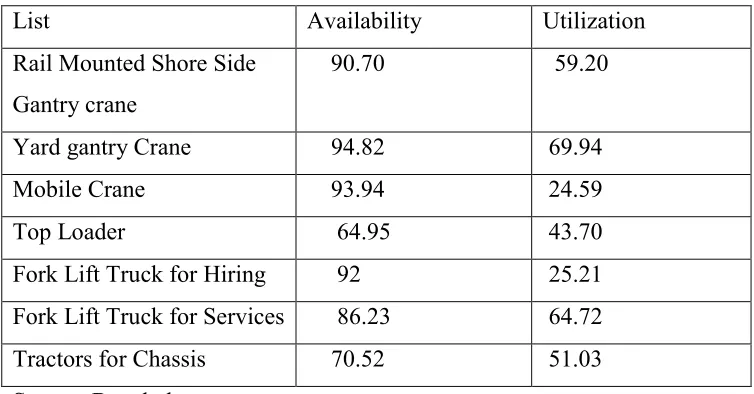
Considering the operation of container handling at Klong Toey wharves, the total throughput in the past, as table 3, shows a considerable success of operations. However, when the actual operational performance was examined, there are many problems. Efficiency of cargo handling equipment use does not maximize. The availability of equipment is about 70-90% whereas the utilization of equipment is about 25-60%.”
The operational system in BKP was summarized in table 5 to show that each body actually conducts each operation. The major problems of container handling in BKP are the lack of a total control system of vehicle traffic flow within the port area, including the shortage of equipment and skilled workers for container handling.
Table 5. Operational system in BKP.
Job Mark Remark
Ship Assignment ,permission and confirmation of using berth facilities
Pilotage /navigation control Tug boat
D B
Harbor Department
Arrange of shipping company
Rope boat Stevedoring
B C
By order of pilot
Private sector, subject to registration with PAT. Cargo Conventional Long-shoring Shed operator Tally /Delivery Lighter A A A C
Direct operation by PAT labor and equipment
Acknowledged by PAT and permitted by Customs
Container Marshalling
Stacking
Stuffing for export Unstuffing for import
Allocation of CY
B/C
B/C B/C A
A
Obliged to use PAT labor and equipment. Private sector widely acting in case of shortage
Conducted by PAT and Inspected by Customs On application of shipping company
Common Storage of Cargo
Road traffic Gate check Custom inspection Quarantine/Immigration Carry-in/out A/C A A D D C/D
On request of consignee except CY watched by shipping company
Insufficient controlled With customs officials
Abbreviation in Table 5
A: Management/Operation by PAT directly
B: PAT’s services but executed by groups other than PAT C: Private sector’s service allowed by PAT actually D: Service by other public agencies
Chapter 3
Performance and Productivity of PAT and LCP
Port performance indicators are useful because they will help to measure port performance, identify the problems and seek for suitable solutions. To compare the actual port performance with the target of the port is important of port performance. In addition, port performance will show the trend of the port that is related to its performance. Professor Francou (2000) stated the following:
In spite of the fact that more and more ports all over the world have engaged a process of privatization, the port authority is still involved in the control of the efficiency because the survival of the port in a competitive market or the economy of the country in case of monopoly, are determined by the efficiency.
According to Professor Shuo Ma (2000)
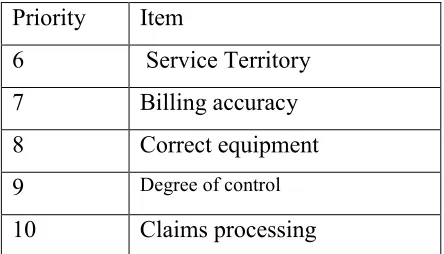
Efficiency often means speed and reliability of port services. From a survey made by a big intermodal transport operator/shipping line APC of its shippers, as shown in a table, one can observe that transport efficiency described as “on line delivery” is the first concern of shippers, who are at
the same time directly or indirectly port users.
Priority Item
1 On-time delivery
2 Overall responsiveness
3 Price
4 On-time pickup
Priority Item
6 Service Territory
7 Billing accuracy
8 Correct equipment
9 Degree of control
10 Claims processing
To measure the efficiency of the port, the performance indicators such as turnaround time, berth occupancy, handling productivity, efficiency of handling equipment, expense of operations, tugboat productivity and channel use should be analyzed to show the problem of PAT.
Table 6 Port Performance
Performance
List Unit 1996 1997 1998
Berth at BKP 1. Container vessel
a. Waiting time Hour/call 4.43 4.74 2.62
b. Turnaround time Hour/call 32.24 24.90 22.16
c. Working time Hour/call 22.81 19.26 17.83
d. Berth occupancy % 73.91 63.53 60.06
2. General cargo vessel
a)waiting time Hour/call 6.71 2.46 0.97
b)Turnaround time Hour/call 77.26 66.64 63.50
c)Working time Hour/call 49.46 36.88 42.65
d)Berth occupancy % 75.28 63.07 44.16
3.1 Container vessel
3.1.1 Turnaround time
Ship turnaround time is one of the basic measurements of port performance whether a port will survive or not is up to the customers’ satisfaction namely ship-owner. The shorter ship turnaround time is, the more benefits the ship owners get. “According to several studies, it is admitted 2/3 of the total maximum cost take place in the ports, mainly wharfage, handling and storage operation.” (Francou, 1999) In addition, ship turnaround time will be calculated by shipping companies or ship-owners to see the port efficiency and sail schedule for the vessel. “Ship Turnaround time gives an excellent indication of the speed of service being provided to ship operators; it is a very important element in determining maritime transport cost.” (The United Nations Conference on Trade and Development, 1992). Professor Francou (2000) stated
In deed, the comparison of the waiting time with the service time gives a good information about what is acceptable by ship-owners; they usually accept a 10% rate; beyond this rate, they consider the port as a low quality one.
goods about 1,113,756 T.E.U., therefore the average was 639 containers per call. The performance of turnaround time at LCP operated by PAT was 16.44 hours/calls of container vessels and the average was 538 containers per call. The performance of turnaround time at LCP operated by private companies was 18-20 hours/calls of container vessels and the average was 540 containers per call. Following the evaluation of the Ministry of Finance, the average time per container at LCP should be about 3 minutes.
The different containers between BKP and LCP were about 100 containers and times by 3; therefore, it was about 5 hours. In summary, the time operated by PAT and private companies at LCP was about 21.44 and 23-25 hours respectively. When the turnaround time of BKP, LCP operated by PAT and private companies was compared, they were quite the same. However, the weak point of BKP is that it is a river port therefore the tide is an important factor.
3.1.2 Berth occupancy
Berth occupancy is one of the indicators to show port performance. It not only gives the actual intensity of berth use but also indicates the level of demand of service. In theory, berth occupancy rate with several berths is calculated with 60% so that waiting time will be minimized and cargo handling will be proper without congestion traffic and spare capacity for traffic peaks will be guaranteed. In case of special conditions (competition, schedule etc) the berth occupancy rate should be between 40-50%. “High berth occupancy does not indicate an efficiently run berth. Low berth occupancy indicates under use of resources.” (The United Nations Conference on Trade and Development, 1992)
container vessels berthed at BKP therefore the berth will be not maximizing used.
3.2General cargo vessel
3.2.1 Turnaround time. The expected turnaround time by PAT was about 66
hours/call whereas the performance was 63.50 hours/call. This decreased because the economic crisis occurred in Asia and transportation changed from conventional cargo to container. This showed it was better than expected.
3.2.2 Berth occupancy. The expected berth occupancy by PAT was about 65%
whereas the performance was about 64.16%. This showed it was lower than expected because few vessels berthed at BKP and the transportation was changed from conventional cargo to container; therefore, the berth will be not be used to a maximum. The berth occupancy was 44.16%. It showed the vessels would berth 13 days and the berth will be empty for 18 days monthly.
The vessels stayed for a long time at the port unnecessarily when compared with efficient ports in the world such as Le Havre in France, and the Port of Rotterdam, the Netherlands where the minimum turnaround time of vessel was 6 hours. Although most efficient ports are in the developed countries, PAT should try to increase the efficiency in the era of the globalization. In view of the berth occupancy, the most efficient ports are from 40-50%, which is contrary to PAT.
3.3 Handling productivity
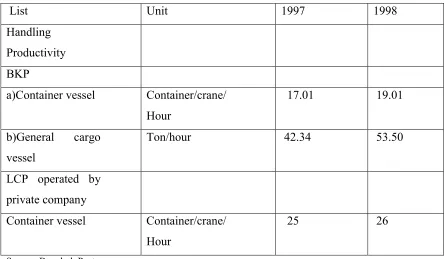
Table 7 Handling Productivity
List Unit 1997 1998
Handling Productivity BKP
a)Container vessel Container/crane/
Hour
17.01 19.01
b)General cargo vessel
Ton/hour 42.34 53.50
LCP operated by private company
Container vessel Container/crane/
Hour
25 26
Source: Bangkok Port
Following Table 7, the efficiency in cargo handling at BKP was quite low; however, the improvement of the handling efficiency of containers was from 17 to 19 containers/crane/hour in 1998, whereas that of the efficiency of general cargo was from 42 to 53 tons in 1998. On the other hand, the handling productivity of LCP operated by private companies was from 25 to 26 containers/crane/hour. This was the weak point of BKP in competition. Besides, unskilled and old workers including traffic conditions are also an obstacle in the handling productivity.
3.4 The efficiency of Handling Equipment
show poor utilization of the equipment. High availability but low utilization shows under use of equipment. Horck (2000) stated
An overall utilisation value for all machines of a particular type and capacity would be a more practice measure. The advantage is that it gives an idea of the overall level of demand for a specific class of equipment. Equipment availability is a measure of the proportion of time individual machines or classes of machines are accessible to berth operators.
Table 8 Efficiency of handling equipment use
List Availability Utilization
Rail Mounted Shore Side Gantry crane
90.70 59.20
Yard gantry Crane 94.82 69.94
Mobile Crane 93.94 24.59
Top Loader 64.95 43.70
Fork Lift Truck for Hiring 92 25.21
Fork Lift Truck for Services 86.23 64.72
Tractors for Chassis 70.52 51.03
Source: Bangkok port
3.5 The expense of operation
The expense of port operations is very important because it reflects the cost of production. If the expense of port operation is high, it is difficult to go on doing business in the highly competitive market.
Table 9 Expense of operation/Ton
List BKP LCP
Operation expense(baht) 2,799,246 1,719,188
Amount of cargo(ton) 13,365,736 13,889,933
Operation expense/ Amount of cargo
209.434 123.815
Source: BKP and LCP
Table 9 shows the expense of operations including vessels, cargo, service and administration expenses per ton at BKP was about 209 baht/ton whereas that at LCP was about 123 baht/ton. The expense at LCP is lower than that at BKP about 1 time because the expense for dredging in BKP as a river port is very high. The high operation expense/ton at BKP led to the high cost of production and the disadvantage of competition.
3.6 Tugboat productivity
Tugboats push, pull and move ships to shore where the quay or dock is shallow or small. Tugboats are one of the services that PAT provides to vessels.
Table 10 Comparison of tugboats operations
List 1995 1996 1997 1998
Number of Tugboat
13 13 13 11
Utilize 13 13 13 11
Total
Working hour
29,931 18,127 16,084 13,061
Average
of working hour/ tugboat/month
191 116 103 99
Compare % With 1995
100% 60% 54% 52%
Source: Harbor Department, PAT
Table 11 Income and expense of tugboat
Unit: Million baht
Income/expense 1996 1997 1998
Tugboat income To BKP
(container vessel)
23.25 24.32 30.24
To BKP (General cargo vessel)
28.15 29.89 20.73
To Private berth 70.99 26.29 14.32
Total income 122.40 80.51 65.31
Tugboat expense
Profit(loss) (1.27) (82.67) (81.20) Source: Comptroller Department, PAT
Following Table 10, the utilization of 11 tugboats at BKP was only 50% in 1997-1998 because BKP’s tugboats were replaced by private tugboats at the private berths following the government policy. In addition, the income from tugboats continuously decreased from 1996-1998 from 122.4, 80.5 to 65.3 million baht respectively. This led to a continuous loss in 1996-1998 from 1.27, 82.67 to 81.2 million baht. Furthermore, the cargo through BKP decreased and the income from tugboats to serve private berths also decreased in 1996-1998 from 71.0, 26.3 to 14.3 million baht respectively. This decrease was about 80% within 2-3 years. (See table 11) On the contrary, tugboat expenses such as salary, depreciation and maintenance still increased.
3.7 Vessel through channel and berth
One of the PAT duties is “to conduct dredging operation and maintenance of the bar channels, installing navigation aids and other related facilities.” (PAT, 1998) The number of vessels through the channel affected the income.
Table 12 Statistics of Vessels through channel and berth
1996 1997 1998
Vessel Calls % Calls % Calls %
Bunker 11,559 60 11,543 55 9,873 54
Berth at BKP
3,047 21 3,099 25 2,858 25
Berth at Private berth
2,875 19 2,371 20 2,331 21
Source: Bangkok Port
Table 13 The performance of the Marine Department
Unit: million baht
Income/expense 1996 1997 1998
Income -Port dues -other income Total Income 294.9 2.5 297.4 368.9 13.6 382.5 340.3 0.4 340.7 Expense -Operation -Administration Total expense 319.2 43.5 362.7 321 42 363 304.2 41 345.2
Profit(loss) (65.3) 19.5 (4.5)
Unit cost of dredging 96.5 110 92.6
Source: Comptroller Department, PAT
decreasing number of vessels through the channel. (See table 12) The income from port dues decreased to about 28.6 million baht or about 7.8% whereas the profit decreased about 15 million baht or about 77%.
3.8 General condition 3.8.1 Finance
Some permanent assets such as land which were distributed by the landowner to PAT as a state enterprise were used for the performance to bring about the income. However, these assets were not calculated for depreciation as the expense in the balance sheet. In addition, the delayed performance following the project will affect state enterprises because the loan from foreign bank has to pay the fee and interest. A lot of money from the PAT income was deposited in the current account in the bank but did not bring about much interest as should have been the case. In addition, some port workers were paid overtime which was more than the monthly salary even though they did not work after office hours. The comptroller department (1998) stated “ One of the monthly high expenses for PAT is overtime paid to port workers.”
3.8.2 Resource management
3.8.3 Administration
The National Economic and Social Development Board (1984) stated
The inefficiencies of state enterprises to their lack of operating flexibility and slow decision on investment and expenditure resulting from too much supervision by too many government agencies, including the Ministry of Finance, the Budget Bureau, and the National Economic and Social Development Board.
In addition, the executives and managers of many state enterprises were political appointees or government bureaucrats with little experience in business. The boards of directors were filled with retired military leaders, high-ranking bureaucrats, and politicians who used their positions to obtain jobs for relatives and friends. Employees of smaller and less efficient state enterprises demanded salaries equal to the wages of workers in larger and more productive state enterprises. Political intervention resulted in overstaffing and high costs.
3.8.4 Fringe benefit
Chapter 4
The Privatisation of Thai Ports
Privatisation is to increase the role of the private sector in the activities that the government used to manage so as to decrease the role of the government in the economic activities. In addition, privatisation is to deregulate the regulations that are obstacles for the initiation so that a good climate for competition will be promoted. This will lead producers to develop the products and services continuously so as to respond to customers’ needs.
Royal Thai Government (1998) stated
The government defined privatisation as any measures that increases private sector participation in sectors where government enterprises presently operate, including divestiture of the state enterprises or assets (ownership transfer), concession arrangement, joint ventures, management contracts, leasing, outsourcing, contracting services, deregulation which increases competition, creation of needed regulatory bodies, and introduction of new competition.
Professor Ma (2000) stated
approach of discussing such complex problem is probably to explain the general principles and then go through various real case studies to let the students themselves to seize an inspiration from the cases. Non-programmable management can only be ‘learnt’ indirectly. By discussing the experience of success or failure cases, one’s own experience could be enriched, which becomes the source of his artistic quality.
Like other countries, the government of Thailand aims to improve the economic and social well-being of the country and its people and in its drive to attain this objective, numerous state enterprises have started to occupy important positions and to play a vital role in the development of the Thai economy. It is imperative, therefore, that the objective of raising living standard be achieved if the efficiency of state enterprises is improved. To fail to do so would mean that state enterprises would drain the valuable economic resources of the country. To raise the efficiency, the Thai government is convinced that privatisation is an important policy instrument. PAT, like other state enterprises, is under the infrastructure of the privatisation program.
4.1 The various reasons for PAT privatisation are as follows:
4.1.1 Government Stability
The Thai Government commissioned the Netherlands Engineering Consultants (NEDECO) to conduct a feasibility study on developing a new deep sea port. The project’s feasibility study was reviewed and updated from time to time according to the change in circumstances. In 1982, the Government decided that this port should be developed and opened for operation by 1990. A loan from the Overseas Economics Co-operation Fund (OECF) of Japan was granted in 1983 to support this project (70% from OECF, 30% from local currency). The construction of the port started in December 1967.
This led to the accumulation of external debt. Ingavatana (1989) stated “In 1980, for example, the proportion of state enterprise investment financed from internally generated funds dropped to as low as 17 per cent although this was improved to 29 per cent during 1982-1983.” During the latter period, the proportion of investment of state enterprises financed from budgetary allocations dropped from 10 to 15 percent. This drop in the proportion on investment finances from internally generated savings and budgetary allocations consequently led to increasing reliance debt financing especially foreign borrowing. Ingavatana (1989) stated “By early 1985, the total outstanding foreign debt of all state enterprises was about USD 5 billion, which amount to about half of Thailand’s public sector foreign debt.”
4.1.2 Efficiency
To increase the efficiency of state enterprises like PAT in Thailand is the second major reason. Royal Thai Government (1998) stated the following:
Although some of Thailand’s 59 state enterprises returned surplus to the
quasi-monopoly powers, require substantial capital investments or operating subsidies and due to their dominance in each sector, inhibit open and free competition.
Although state enterprises like PAT made a profit, this financial profitability could not be taken as a good indicator of efficiency. This is because the above financial profitability had been due to a monopolistic market structure in which some of the state enterprises operated and discriminated in favor of state enterprises when it comes to the award of contract. This can be seen in the case of PAT circumstances. In the past, state enterprises had been given the preference over others when it came to competitive bidding for contract by the state even when their prices were higher than their competitors. These practices hardly encouraged efficiency, especially when they were less competitive. The government realized this and took steps to improve efficiency by exposing state enterprises to real market competition without any favors given to them, to co-operate with the private sector managers to help in running state enterprise following the corporate culture so that these state enterprises will be more responsive to market signals and to lessen political interference in the management of state enterprises. The efficiency at the port was already analyzed in chapter two. Bert Kruk, Director of TEMPO, Port of Rotterdam (2000) stated
4.1.3 Securities Exchange of Thailand
Privatisation is to be engaged with a view of deepening and strengthening the Securities Exchange of Thailand. Privatisation can raise the funds for the economic regeneration and attract both national and international capital into the country. This will be collection of capital from the private sector. However, the value of shares and the interest of private to invest in the port are up to the port performance. If the performance of the port is good, many people will be interested in investment and money will be used for other projects. On the other hand, if the performance of the port is not good, few people will be interested in investment; therefore, it is difficult for the port to run another project. In addition, it will promote a good climate for investment. Priebjrivat (1999) stated
State Enterprise such as Port Authority of Thailand (PAT) would transform themselves into holding companies, setting up subsidiaries to run the operation under the control and to float their shares on the stock exchange. PAT privatised part of their operations by giving concessions to private organisations to manage their facilities or to provide services. PAT provided a 25-year concession to a private company to run its operations at Laem Chabang Port.
4.1.4 International Loan Agency
The pressure from the international loan agencies such as the World Bank may also influence the Thai government to embark upon privatisation and deregulation. World Bank (1997) stated
The World Bank emphasises that privatising state enterprises and allowing the private sector to participate more freely in sectors of the economy controlled or dominated by the state can free up public resources for higher priority activities, make it possible for services to be delivered better and at lower cost, and create new opportunities for private sector development.
In the period of the Asian crisis, the government sought a 17.2 billion USD loan from the IMF through the privatisation plan to address growing constraints in its ability to subsidise state enterprises, reduce its debt burden, and restore investors’ confidence in the Thai economy. A loan of USD 4 billion through a stand-by arrangement for the macro economic adjustment was provided by IMF. Following an article on PAT: Long and winning road to Privatisation in Port and Harbour (1998) stated “ Parliamentary committee is a considering privatisation of state enterprise to improve efficiency and tackle with the country’s economic crisis.” Priebjrivat (1999) stated “ The IMF contends that privatisation can improve the long-run growth rate or output level of the economy, generate public revenues to reduce public debt and government deficits, and enhance the value of
enterprise assets.” Priebjrivat (1999) stated “The Royal Thai Government issued
Under continuing pressure from the International Monetary Fund and the World Bank, the Thai government announced a new privatisation strategy in the fourth IMF letter of intent in May 1998.
The above strategies are as follows:
a) Free public resources to be allocated more efficiently to high priority
government objectives such as improving health and education.
b) Increasing competition in order to provide better value to state enterprise
customers through improved services and prices
c) Promoting higher productivity and labor welfare
d) Reducing public debt and budgetary burdens
e) Preparing for globalization of trade in services.
These strategies were managed quickly following the condition and time of IMF. Therefore, some points such as consumer protection may not be considered carefully and clearly.
4.1.5 Government’s Burden
The losses of state enterprises seemed to be government’s burden for a long time. The deterioration of government reserves, growing expenditure budgets, the decrease of international reserves, the growing public debt and others brought in the concept of privatisation. NESDB (1981) stated
many sectors hindered the introduction of new products and services and the expansion of services coverage. Low overall rates of return made state enterprise unreliable instruments for price stabilisation or public revenue generation.
The subsidy from the government to state enterprises came from the income tax; therefore, it may say that the losses of state enterprises are the burden of people who paid taxes.
4.1.6 Employment
Table 14 Number and Position of employees in PAT
Position Number
Director General 1
Deputy Director General 4
Assistant Director General 3
Director of Department 14
Deputy Director of Department 23
Director of Division 86
Deputy Director of Division 96
Chief of Section 300
Assistant chief of Section 242
Chief of Unit 531
General Administrative officer 1,391
Clerk 3,446
Assistant to mechanic officer 267
General worker 331
Following the table 14, it shows that a number of employees in PAT are clerk and also shows the imbalance between number of worker and work. This is the overstaff problem. Following the study by Japan International Cooperation Agency (JICA), the number of suitable employees should be 3000. With regard to employment, privatisation will reduce the public labor force on administration, and operation, reduce or eliminate the restrictive labor practices or labor union as it used to be. Lloyd’s List (1995) stated “ Port workers have been blocking the main entrance to Bangkok Port since about 1800 local time, only the entrance to East Quay is presently accessible. The strike is causing congestion in the port.” The article on Developing Ports in Lloyd’s list (1998) stated
Even though the new company will not employ all the same staff, we think privatisation will be good for our employees, said Mr. Payoongkich, because they will have increased income. And with our new port improvement in place, we feel we are in a good position to adjust easily when a new company is formed under the terms of privatisation.
It may say that privatisation will increase the private sector employment whereas the ‘hire’ and ‘fire’ by performance will be introduced.
4.1.7 Concept of Port
efficiency and adaptation of port play an important role on the ability of the country to compete.
4.1.8 Management skills
Professional management skills and techniques by the new partners from both local and abroad will be introduced through privatisation. The motivation and incentive to improve the performance including risk taking in the business will be provided to the management and staff. Port workers should know the philosophy of business management and change the way of work. The former pattern of port work did not get along with the present situation. Management techniques from privatisation will help to improve the port performance so as to survive and compete with other ports.
4.1.9 Modern Technology
designed to serve the logistics requirement of more narrowly defined groups of shippers. The efficiency of port cargo handling and inland transportation services has also increased so greatly that the geographical monopoly power once enjoyed by ports has been eroded greatly. The routeing alternatives for the majority of shippers have increased over time. In the port industry, developments along with the provision of more specialised facilities have had the somewhat preserves corollary of increasing the effectiveness of competition in the industry.
4.1.10 Collapse of communism countries
Chapter 5
Alternatives to BKP and LCP
The methods in privatising state enterprises to be used by the government can range from liberalisation, commercialisation, corporatisation, sales of assets, public share offers, joint ventures, concession, auction, build operator transfer (BOT) to management employee buyout (MEBO). One type of privatisation may be successful to apply in one country but it could be a disaster in another country as Professor Shuo Ma of World Maritime University advised. Therefore, some methods to be chosen to apply by the government are up to the type of state enterprise. In addition, the most suitable method should also be adaptable to the environment.
5.1 The basic port privatisation alternatives
The possibilities of basic port privatisation can be summarised as follows
:
( Pintadit,1997, p.55)
a) The state or local government of port organisation will lease its facilities and/or enters into Build, Operate and Transfer (BOT) contracts for private enterprise management and operations of terminals or larger ports units as well as land areas. Thus it becomes a landlord.
b) In addition to the above a
,
the state or local government of port organisation mayc) The corporation of the state or local government of port organisation may continue function as the port operator or may contract for terminal operations and other services the same as in b. This becomes mainly a landlord. To begin this is that the government will be the sole shareholder. The corporation may sell shares to public. This is considered as an opportunity for the government to reduce its share holding to less than 50%.
d) The state or local government of port organisation sells terminals or entire port to private operators such as in England.
5.2The existing port privatisation in Thailand
Port privatisation has been practised for a decade whereas major privatisation undertaken was as follows:
Table 15 Terminal leased by company and concession period at LCP
Terminal Company Concession period
A2 Thai Laem Chabang
Terminal Co., Ltd.
1996-2026 (30years)
A4 Aawthai Warhouse Co.,
Ltd.
1993-2018 (25 years) A5 Banpu Terminal Co., Ltd. 1996-2021 (25 years)
B1 Thai Laem Chabang
Terminal Co., Ltd.
1995-2022 (27 years)
B2 Evergreen Container
Terminal (Thailand) Co., Ltd.
1993-2020 (27 years)
B3 Eastern Sea Laem Chabang
Terminal Co., Ltd.
1990-2017 (27 years)
B4 TIPS Co.,Ltd. 1990-2017
(27 years)
B5 Laem Chabang
International Terminal Co., Ltd.
1996-2026 (30 years)
Source: Laem Chabang Port
Table 16 Cleaning and car leasing by private company in PAT
Topic Company
Cleaning Siam Ratchathani Co., Ltd.
To clean port area and building
Car Leasing - Air-conditioned buses about 20 different lines from different companies to pick up and see off PAT employee.
This will replace PAT bus. - Car for senior management
Private company will provide a car with car driver to PAT whereas PAT will pay 10,000 baht a car monthly.
Source: Port Authority of Thailand
c) The lands of BKP are leased to other government agencies, private companies and individuals. (See Table 17)
Table 17 PAT’s land lessee
Land lessee Usage Petroleum Authority of Thailand Oil storage Bangkok Mass Transportation Authority Parking place
Housing Authority Housing for poor people Bangkok Metropolitan Park for public
Private Commercial building
Individual Market
Total area 340 acres
d) The larger and small private terminals for dry bulk , general cargo and containers along the Chao-Pra-ya river and along the coast north of LCP were established. (See Table 18,19)
Table 18 Private berths along Chao Phra ya river
Private berth Length of berth Vessel
Thai Property Terminal Co., Ltd. 150 m. 1 Bangkok Modern Terminal Co., Ltd. 315 m. 2 United Thai Shipping Co., Ltd. 200 m. 1 Siam Land and Sea Service Co., Ltd. 270 m. 1 BDS Terminal Co., Ltd. 150 m. 1 Total capacity 640,000 Teus / year
Source: Bangkok Port
Table 19 Private berth around LCP
Private berth For
NPC Berth Chemical goods
TPI berth Liquid goods
Siam Seaport General cargo
Sriracha Harbour General cargo
Source: Laem Chabang Port
1992, IEAT awarded a contract to the Thai Prosperity Terminal company to operate the multi-purpose terminal to serve the shipment of bulk cargo and commodities.
Table 20 Map Ta Phut port facilities Terminal Facilities
Quay length 330 m.
Quay depth 10.5 m
Berthing depth 10.0 m
Source :Board of Investment
f) SongKhla and Phuket ports under the Harbour Department have been managed and operated by Chaopraya Terminal International Co.,Ltd. (CTIC) since 1988.
Table 21 Songkhla and Phuket capacity
Songkhla Port Phuket Port Capacity (Tons/year) 3 million 3 million Largest ship (tons) 20,000 20,000 Containers (TEUs) 128,000 32,000
Source: Board of investment
5.3The Basic alternatives applied to PAT
5.3.1 The continued and extended leasing alternative
equipment in BKP should be improved. PAT owned cargo handling equipment in LCP whereby the private terminal operators will maintain them. Privatisation alternatives such as terminals in BKP should continue the same as previously practised in LCP.
For LCP, Phase 2 facilities will be leased when the construction has been completed. The share of private investment for Phase 2 facilities such as quay structure and some reclamation will be increased when compared with the existing facilities. The lease or BOT in LCP contract should be continued for the existing and extended facilities. The terms and conditions of contract should focus on yielding the desirable return on the government investment in each terminal and in the reasonable share of the facilities for all terminals such as breakwater, access channel, basin, navigation aids. Besides, all maintenance cost which terminal contractors have not to be responsible should be included. The investment designated in Thai Baht should be adjusted for the appreciation and depreciation of the foreign currency loans which covered a part of financing. (Babtie, 1997, p.86)
For BKP, it is necessary to attract private operators to lease the container and general cargo facilities whereas existing facilities should be leased for several terminals. The financial terms of the contract should aim at yielding the desirable return on the asset value of each terminal and of the reasonable share of maintenance costs for all facilities such as bar channel, depth and navigation aids. The leasing of terminal in BKP will lead to serious human resource problems since there are more than 1,450 staff working in the Cargo Operation Department and two Mechanical Handling Equipment Divisions.
If the above suggestions are implemented, PAT will become a landlord and will need considerable restructuring for this function. However, problems related to leasing of terminals in BKP may cause PAT to remain the operator of all or some parts of BKP.
5.3.2 An alternative to selling Cargo Handling Equipment, Dredging Equipment and Tug Boats
In view of cargo handling equipment included in a terminal lease contract, non-replacement of worn-out or obsolete equipment owned by PAT such as container quay cranes should be negotiable. This will create the one organisation with full responsibility for ownership, operation and maintenance of all cargo handling equipment in one terminal.
in the Harbour Service Division may find employment with the company. This alternative will make PAT’s landlord function more declared and therefore need further restructuring. Major redundancy problems will be limited to dredging, tug boats and related staff if PAT remains the BKP operator.
Restructuring of PAT will involve the reduction of staff over a period of several years. Retirement over a number of years should be accomplished whereas rehiring should be done for essential positions only. Some of the PAT staff working at container terminals, general cargo division, dredging and tug boat division may find employment from private terminal operators if terms and conditions would be agreed. The remaining redundancy of staff should be taken care of by early retirement plans or training for other jobs; however, this will be a considerable cost for PAT. (PAT, 1997,2)
5.3.3 Corporatisation
The government will initially own all the shares and remain a majority shareholder or become a minority shareholder later. When the government considers it is suitable time, the corporatisation will be listed on the stock exchange and some shares will be sold to the public. According to the absorptive capacity of the equity market and desire to optimise revenues, the sale of share should be spread over a long period of time.
The Port of Singapore Authority (PSA) is being privatised under the name of PSA corporation at the same time as the law requirement is passed. After the corporation has been established, the government will consider the appropriate time to list it on the stock exchange and some shares will be sold. However, it has not intended to lease or sell terminals or other facilities to private enterprises.
5.3.4 Outright sale of PAT assets and businesses
5.3.4.1 General
5.3.4.2 Problems is related to sales or long term leasing of the PAT terminal and land and the change from lease or BOT contract to sale
5.3.4.2.1 General
According to the laws, PAT cannot sell the land or fixed facilities. In addition, some parts of land of PAT were expropriated from private owners so as to be used by PAT as the public port. The government is unlikely to consider sales of land and fixed facilities as a politically acceptable alternative. Long term leasing about 99 years is considered to be equivalent to sale but is not possible without legislation.
A number of terminal facilities at LCP as well as that at BKP are leased to private enterprises. Many leases are long term and will expire in the distant future. The problems related to possible sale of assets under the lease or BOT contract are discussed.
Existing lease and BOT contracts for container Terminals at LCP
PAT has leased terminals to private operators since December 1990. The first two leases for Terminal B3 and B4 were originally for 12 years but the bidding was scrapped because the proposal that a lessee should give PAT additional profit if the actual cargo volume surpassed the minimum volume expected was not attractive. PAT again called for a bid and leases were extended in November 1996 to 2020. A BOT contract for Terminal B5 was made for 30 years in April 1996. Thus, it will expire in 2026. The operator has financed the quay structure, completion of reclamation, pavements, building, utilities as well as cargo handling equipment. (LCP, 1996, p.2)
The first contract for a shipyard facility was made in December 1990 and will expire in 2020. A BOT contract for a bulk sugar and molasses terminal, A4, was entered into in March 1993 and will expire in 2028. A lease contract for a coal terminal, A5, was entered into in April 1996 and will expire in 2021. A BOT contract for a multi purpose terminal, A2, was entered into in September 1996 and will expire in 2026.
(LCP, 1996, p.3)
Existing lease contracts for land between the Customs fence and port boundary at BKP
Land areas are leased to other government agencies for 1-3 years except that 8 rai were leased to Bangkok Metropolitan Authority for 20 years and will expire in the 2013, 140 rai were leased to the National Housing Authority for 20-30 years and will expire in the years 2005, 2006 and 2010 respectively. However, most land areas are used by the Petroleum Authority of Thailand (PTT), the Customs Department, Ministry of Industry without the limitation of time. Of all these, only PTT pays a lease fee to PAT. (PAT’s Annual Report,1996, p.56)
The lease to significant private companies is that the Fuel Pipeline Co., Ltd., leased 6 rai of land for 30 years and will expire in 2022 and a lease of 14 rai of land for the building for 20 years which will expire in 2012.
compensation to terminate the lease from PAT rather than to take risks of ownership. Sale of facilities which is larger than the terminals to a third party or the present operator will be complicated and time consuming because this will involve two or more operators who disagree with the terms and conditions.
Sale of terminals in BKP
Terminals in BKP for containers and general cargo should be sold separately. However, the same problems as the sale of terminals in LCP will happen. In addition, the serious problems for the third party are the limitation of container throughput about 1 million TEUs through BKP led to the decline of throughput and the diversion of container and general cargo to LCP. A private terminal along the river near BKP and that along the coast north of LCP to handle container or general cargo, dry or liquid bulk will be a better alternative for private enterprise. The license issued by the Office of Maritime Promotion Commission (OMPC) is valid for 15 years and it can be renewable. This is a significant advantage when compared with a longer period of mandatory terminal operations.
Sales of Land outside the Customs Fence in BKP