World Maritime University
The Maritime Commons: Digital Repository of the World
Maritime University
World Maritime University Dissertations Dissertations
2000
Piracy in Southeast Asia : examining the present
and revisiting the problems of definition,
prevention, response and prosecution
Leopoldo V. Laroya World Maritime University
Follow this and additional works at:http://commons.wmu.se/all_dissertations
This Dissertation is brought to you courtesy of Maritime Commons. Open Access items may be downloaded for non-commercial, fair use academic Recommended Citation
Laroya, Leopoldo V., "Piracy in Southeast Asia : examining the present and revisiting the problems of definition, prevention, response and prosecution" (2000).World Maritime University Dissertations. 263.
WORLD MARITIME UNIVERSITY
Malmö, SwedenPIRACY IN SOUTHEAST ASIA:
EXAMINING THE PRESENT AND REVISITING THE
PROBLEMS OF DEFINITION, PREVENTION,
RESPONSE AND PROSECUTION
By
LEOPOLDO V. LAROYA
Philippines
A dissertation submitted to the World Maritime University in partial fulfilment of the requirements for the award of the degree of
MASTER OF SCIENCE
In
MARITIME SAFETY AND ENVIRONMENTAL PROTECTION (Nautical)
2000
DECLARATION
I certify that all the material in this dissertation that is not my own work has been identified, and that no material is included for which a degree has previously been conferred on me.
The contents of this dissertation reflect my own personal views, and are not necessarily endorsed by the University.
LEOPOLDO V. LAROYA 18 August 2000
Supervised by:
Lt. Cdr. Maximo Q. Mejia, Jr., PCG
Lecturer, Maritime Administration, Safety and Environmental Protection World Maritime University
Internal Assessor:
Dr. Proshanto K. Mukherjee, Ph.D.
Course Professor, Maritime Administration, Safety and Environmental Protection
World Maritime University
External Assessor:
Capt. Jayant Abhyankar
ACKNOWLEDGEMENT
I would like to acknowledge all those who in one way or the other have helped me all throughout the completion of this dissertation. This work would not have reached its final stages if it were not for those small and big helpful things that have mattered much to make this dissertation a worthwhile handiwork.
Particular heartfelt gratitude goes to:
• Mrs. Cecilia Denne who has gone out of her way as WMU library assistant to assist me in the gathering of important materials for this dissertation. I salute her! She may not know it, but her help has significantly made this dissertation possible;
• Lecturer Maximo M. Mejia, Jr. for his unwavering assistance in the supervision of this dissertation;
• Captain Abhyankar who has provided me we some valuable insights that has become part of my analysis in this dissertation;
• The International Transport Workers Federation who, without their sponsorship, I would not have made it here at WMU.
DEDICATION
To my wife Weng and my wonderful son Zach, who have remained brave and supportive in spite of my seventeen months of absence,
to my brothers Joel and Nouls who have filled in the gap of my absence by offering their assistance to my wife and kid
during those difficult and lonely moments,
and finally, to those who believed in my capabilities, never faltering to be at my side and
offer their humble assistance,
ABSTRACT
Title of Dissertation: Piracy in Southeast Asia: Examining the Present Situation and Revisiting the Problems of Definition, Prevention, Response and Prosecution
Degree: Master of Science in Maritime Safety and Environmental Protection (Nautical Stream)
This dissertation is an analysis of piracy, focusing on the present situation of piracy, problems related to definition, prevention, response and prosecution. The objective of this dissertation is to present a backgrounder on piracy, both historical and present-day, and to analyze the problems associated with piracy being witnessed today.
Piracy has existed for many a century. It has evolved from different modes and concepts and was, in some point in time, a legal and authorized activity. It is through history that international law on piracy was based. Modern day piracy differs quite much from historical piracy. This is one of the reasons why the international law on piracy failed to be in line with what modern day piracy is all about.
The problem of piracy also involves an analysis and investigation of the different phases of a piracy act. The root cause of piracy shall be discussed, enabling to determine what can be done to stop piracy syndicates. There has been much publication offering recommendations to aid the ship crew in the event of piracy as well as aid the government in the actions to take against piracy. This dissertation examines some of those important recommendations as well as problems that hinders the enforcement of anti-piracy, problems related to jurisdiction, investigation and prosecution of pirates.
After analyzing all aspects of the problem related to modern day piracy, solutions and recommendations will be offered, foremost of which involves international, not just regional, cooperation in coming up with a uniformed guideline in the definition in international law, enforcement, jurisdiction, investigation and prosecution.
KEYWORDS:
Piracy Pirate
Armed Robbery Maritime Security Maritime Safety Terrorism
TABLE OF CONTENTS
Declaration ii
Dedication iii
Acknowledgements iv
Abstract v
Table of Contents vii
List of Tables x
List of Figures xi
List of Abbreviations xii
Chapter 1 INTRODUCTION 1
Chapter 2 PIRACY THROUGHOUT THE CENTURIES
2.1 Historical Background and Terminologies Used 5 2.1.1 Privateering 6 2.1.2 Buccaneers 8
2.1.3 Corsairs 8
2.1.4 Piracy in the 18th and 19th Centuries 9 2.2 Piracy in the 20th Century 10
2.2.1 Data Collection on Piracy Incidents 10 2.2.2 World Situation 11
Chapter 3 PIRACY IN SOUTHEAST ASIA
3.1 Background 16
3.2 Malacca Straits 18 3.3 South China Sea and the Rest of Southeast Asia 21
3.3.1 Hong Kong-Luzon-Hainan Triangle and
3.3.2 Gulf of Thailand 23 3.3.3 Southern Philippines 25
Chapter 4 CODIFICATION OF THE LAW ON PIRACY
4.1 Piracy Under International Law 28 4.1.1 The 1958 Geneva Convention 29 4.1.2 The 1982 UNCLOS 30 4.1.3 Piracy in International Customary Law 30 4.2 International Maritime Organization 32 4.3 The SUA Convention 38
Chapter 5 CONTENTIOUS ISSUES AND POSSIBLE SOLUTIONS
5.1 Conceptual Definition of Piracy 42 5.1.1 “any illegal acts of violence or detention,
or any act of depredation” 43 5.1.2 “committed for private ends” 45 5.1.3 “by the crew or the passengers of a private
ship or a private aircraft, and directed … against another ship or aircraft, or against persons or property on board such ship
or aircraft” 49 5.1.4 “on the high seas” or “in a place outside
5.3.3 Hiring Commercial Anti-Piracy Services 62 5.3.4 Tracking Devices 64 5.4 Problems of Enforcement 65 5.4.1 Pursuit of Pirates 65 5.4.2 Resource Constraint 66 5.4.3 Regional or International Cooperation 67 5.5 Investigation, Prosecution and Punishment 70 5.5.1 Article 105 of UNCLOS 70 5.5.2 Legislation 71 5.5.3 Code for Piracy Investigation 72
Chapter 6 CONCLUSION AND RECOMMENDATIONS 73
Bibliography 81
Appendices
Appendix A ICC-IMB Annual Report on Piracy and Armed Robbery
LIST OF TABLES
LIST OF FIGURES
Figure 2.1 Piracy Incidents 1991 – 1999 12
Figure 2.2 Actual / Attempted Attacks 1999 13
Figure 3.1 Piracy Attacks in Southeast Asia 17
LIST OF ABBREVIATIONS
APEC Asia Pacific Economic Cooperation ASEAN Association of Southeast Asian Nations BIMCO The Baltic and International Maritime Council DSC Digital Selective Calling
EEZ Exclusive Economic Zone
ICC International Chamber of Commerce ICS International Chamber of Shipping ILC International Law Commission IMB International Maritime Bureau IMO International Maritime Organization Inmarsat International Mobile Satellite Organization ITU International Telecommunication Union MILF Moro Islamic Liberation Front
MNLF Moro National Liberation Front
MSC Maritime Safety Committee
PCG Philippine Coast Guard
PLF Palestine Liberation Front
PLO Palestine Liberation Organization
PRC Piracy Reporting Center
SAR Search and Rescue
SUA Rome Convention for the Suppression of Unlawful Acts Against the Safety of Maritime Navigation of 1988
UN United Nations
UNCLOS United Nations Convention on the Law of the Sea of 1982 UNHCR United Nations High Commissioner for Refugees
CHAPTER 1
INTRODUCTION
“Piracy, one of the traditional scourges of the sea, seemed to have been eradicated a hundred years ago, but most of the other criminal activities that have appeared recently are new. They serve to make life even more difficult for the seafarers who have become accustomed to the normal perils of the sea but could now find themselves being threatened by criminals - and possibly being murdered.”
-IMO Background Paper on World Maritime Day 1999
In November 1999, World Maritime Day was celebrated with the theme “IMO and the New Millennium”. An IMO Resolution was adopted during the Assembly meeting which specifies the “Objectives of the Organization in the 2000s”. One of the main objectives of the IMO in the new millenium is “to promote the intensification by Governments and industry of efforts to prevent and suppress unlawful acts which threaten the security of ships, the safety of those onboard and the environment.” One such unlawful act that IMO considers as a significant issue is piracy. Indeed, piracy is now a major problem in many parts of the world.
prevent and suppress piracy. For years, the International Maritime Organization has been coordinating the efforts to minimize, if not eradicate piracy, with the help of other concerned organizations such as the International Maritime Bureau and its Regional Piracy Center in Malaysia. But the efforts seemed inadequate, as statistics will show that there is an increasing incidence of piracy in the area.
There are so many issues that come to mind in discussing piracy, foremost are the following:
• Efforts in eradicating piracy may not be sufficient.
• There must be something wrong with the policies and guidelines in place.
• Shipping companies, more precisely, the seafarers may or may not know what to do in the event of piracy aboardship.
• International law seems vague on the issue of piracy vis-à-vis armed robbery aboard ships. Does that distinction really help in the prevention of piracy or should we treat both cases as a clear act of piracy regardless of definition?
• When pirates are apprehended, the international community does not have the same perception and harmonized procedures in handling piracy prosecution cases.
The above issues raised are but some of the problems related to piracy that this author aims to examine and answer. This dissertation hopes to explain and offer solutions on issues that has hampered the fight against piracy by providing a clear picture of the piracy situation, particularly in Southeast Asia and by providing a critical analysis of problem areas in piracy.
priority in international and national policy to protect maritime interest and instituting the necessary changes that this dissertation intends to recommend.
This dissertation will cover the historical background of piracy as it relates to modern day piracy. In the analysis of the problem, aspects of definition of piracy in international law will be analyzed to consider its relevance to today’s piracy problem. Relevant codifications on piracy will be mentioned in order to make this dissertation a one-stop reference guide to all relevant international regulations and resolutions on piracy.
Piracy in Southeast Asia will be analyzed. The reason for the limitation of the analysis of piracy incidents to one specific region is because the great majority of piracy incidents occur in Southeast Asia and that maritime traffic in the region has remained the nucleus of maritime trade.
Problems on piracy shall be discussed, with emphasis on definition in international law, root cause of piracy, preventive measures and countermeasures for ships, enforcement measures for government agencies and problems related to investigation, prosecution and punishment.
CHAPTER 2
PIRACY THROUGHOUT THE CENTURIES
“His name originally, it seems was Edward Drummond, and he began his career as an honest seaman,
sailing out of his home port of Bristol, England. He is seldom known by that name, for after he became a pirate he began calling himself Edward Teach, sometimes spelled in the records as Thatch, Tache, or even Tatch. Yet it was as Blackbeard that he was, and still is , known, and it was under this name that the people of his generation knew him, 'a swaggering, merciless brute.”
-- Hugh F. Rankin
Historical piracy dates back to time immemorial. During those times, piracy was synonymous to different terms used, depending on the location and activity of the pirates. While pirates have been synonymous to outlawed plunderers for whom violence is a necessary and inhumane action, there was a time in history when piracy was in fact a legitimate activity sponsored by States in times of war.
2.1 Historical Background and Terminologies Used
Piracy comes from the Greek word “peiran” which means attack (Henriksson, 1996). It is an age-old practice which dates back as early as 1200 BC during the time of the Phoenicians. In 1100 BC, Chinese and Japanese pirates operated in the South China Sea and along the coastline from Korea to the Strait of Malacca (Asiaweek, 1992). In 700 BC, the coastline from Oman to Qatar in the Persian Gulf was known as the Pirate Coast where Assyrian merchant vessels were attacked by Arabian and African pirates.
Turkey. In 78 BC, Julius Caesar was captured by pirates and held for more than six weeks until his family purchased his liberty. The Romans according to the words of Cicero called these pirates “hostes humani generis” which means “enemies of the human race.” After the fall of Rome in 5 AD, Turkish power became predominant in the East and pirates coming from the Barbary States of North Africa (Morocco, Algeria, Tunisia and Libya) replaced the Turkish pirates. From the fifteenth century and during the start of the Holy War, pirates were employed by rulers of both sides of the Christian-Moslem conflict. Moslem pirates and privateers operated mainly out of the Barbary States while their Christian counterparts had their headquarters on Rhodes and Malta (Peterson, 1989).
Pirates were also predominant along the European Atlantic Coast and the North Sea during the medieval era. In 700 AD, Scandinavian Vikings plundered from both land and sea from the Baltic Sea to the Strait of Gibraltar. The word “Viking” meant sea rover or pirate in Old Norse (Peterson, 1989). After the Viking Age, pirates of French, Scot, English, Welsh and Irish origin operated in British waters, albeit sporadic ally, because of the firm naval policies of Henrik III, Edward I and Edward II (Sherry, 1986).
By early sixteenth century, piracy once again became a widespread practice in Europe. Scilly Isles and Cinque Ports in England’s southeast coast became a well-known lair of pirate syndicates who operated in the English Channel and the Thames. Although piracy at that time was already considered a grave offence punishable by death, the British monarchy tolerated them since they constituted a good protection against their enemies. However, by 1690, piracy in European waters became less, becoming more common instead in the Americas where pirates were known as privateers, buccaneers and corsairs.
2.1.1 Privateering
While piracy per se was considered an illegal activity, privateering was considered a legal act sanctioned by states during wartime. Privateering became rampant in the sixteenth century up to the late eighteenth century, used by states in Europe as well as those in the eastern Indian coast, Arabian Peninsula and Southeast Asia. In order to support the war when government finances were insufficient and the navy was small, governments recruited privately owned vessels to capture and plunder the enemy’s merchant vessels to disrupt trade and finances of the nation with whom they were at war (Peterson M.J., 1989). The English government resorted to privateering and sometimes financially supported pirates (buccaneers) and privateers to attack Spanish and French ships, especially in the Caribbean where Spanish galleons loaded with gold, silver, cacao and rum, were on their way from Spanish colonies in America to Europe. This period in history was referred to as “the golden age of piracy.”
As opposed to piracy, privateering was a legal activity because the captain of a privateer ship help a license called “letter of marque and reprisal” which gave him the authority to attack enemy ships. Because they were legal, privateers were not liable to punishment and were able to sell their loot openly and legally. Lack of supervision and control, however, led to privateers succumbing to greed and starting to attack vessels of friendly or neutral countries.
In 1689, privateering in the Caribbean came to an abrupt end when England made peace with Spain and went into the League of Augsburg against France (Henriksson, 1996). Thus, privateers lost their “legal” authority and became just plain pirates (buccaneers and corsairs), widening their area of operation to the North American colonies along the Atlantic coast. Cities like New York, Charleston and Boston became popular markets for pirate loots.
The rampant activities of the now defunct privateers who are now just common pirates resulted in the increase in piracy incidence, which led to the changing attitude of governments in the 1800s calling for the abolition of privateering. Also, navies grew larger, sufficient to counter enemies during wartime. In 1856, the Declaration of Paris formally abolished the practice of privateering. This was again reiterated in the Second Hague Conference of 1907.
2.1.2 Buccaneers
In the sixteenth and seventeenth century, as opposed to the legal activity of privateering, pirates other than privateers were called “buccaneers” which was a label given to English pirates. Buccaneers means “smokers of meat” because aside from raiding Spanish vessels, they also slaughtered cattles and smoked them on wooden frames called “boucan” to sell to passing ships. The buccaneers were employed by the English and French empires to deter against Spain’s quest for domination over the New World. Primarily, the buccaneers raided Spanish galleons in the vicinity of the Caribbean islands with the blessings and encouragement of Queen Elizabeth I (Spence, 1995). This does not mean, however, that the activities of the buccaneers were considered legal. In fact, their plunderous activity was still illegal but motivated discreetly by the English monarchy.
2.1.3 Corsairs
2.1.4 Piracy in the Eighteenth and Nineteenth Centuries
With the increase in international trade, governments started to regard piracy as a threat to maritime commerce and tried to solve the problem of piracy. The British government conducted an extensive anti-piracy campaign in the Caribbean and western Atlantic where they replaced corrupt colonial officials and adopted stricter measures in ports. The British Royal Navy chased pirates along the West African Coast and in the Red Sea as well. The elimination of piracy by the British Royal Navy in Southeast Asia proved difficult because of local wars and European diplomatic rivalries in the area concerned(Peterson, 1989).
In 1822, the United States, Spain and England carried out a similar anti-piracy campaign in the Caribbean. The American Congress voted for the establishment of an anti-piracy force which would clear out the Caribbean and other surrounding waters of pirates. This proved successful, resulting in the capture and sentencing of pirates to death or imprisonment by English, Spanish and American courts. By 1830s, organized piracy disappeared in the Caribbean.
2.2 Piracy in the 20th Century
From historical piracy to modern day piracy, incidents of piracy have continued to rise to alarming levels. While there was a declining trend in historical piracy as a result of actions taken to outlaw privateering as discussed in the latter section, piracy in the 20th century has steadily increased. This section will discuss the incidents of modern day piracy and its relation to present day international law on piracy.
2.2.1 Data Collection on Piracy Incidents
Established in 1981, the International Maritime Bureau (IMB) of the International Chamber of Commerce (ICC) is perhaps the only organization that collates a comprehensive set of data on piracy incidents. ICC-IMB is a non-governmental non-profit-making organization that is charged with the investigation and prevention of maritime fraud and piracy. It functions as a focal point for information concerning maritime fraud and piracy for maritime companies and governments involved in international maritime trade. It is for this reason that this author has based his analysis of piracy incidents from the data collated by IMB through its Piracy Reporting Center (PRC) in Kuala Lumpur, Malaysia which was established in 1993. The PRC is a twenty-four hour information center whose function is to receive reports of piracy incidents, alert ships and government agencies, issue regular status reports, collate/analyze all information received and issue consolidated reports to interested bodies/organizations.
It should be pointed out that according to numerous scholars, the existing statistical data on piracy is by no means a true indicator of the actual number of incidents that takes place. Some say that piracy incidents reported represent only one half of the actual incidents. Others even believe that the actual number of incidents might even be ten times more that what is reported. There are a number of reasons for failure to report an actual piracy attack or an attempted attack. For one, shipowners fear that their vessel will be delayed in port pending an investigation that will disrupt the vessel’s schedule. It costs around $25,000 a day to keep a vessel in port. Add to that, the delay in the delivery of goods and services to the intended owner of the cargo. Another reason is that a successful piracy attack would mean that the vessel lacks or failed to institute security measures to deter a piracy attack and would reflect on the master’s competence. The ensuing unfavorable media coverage of a shipowners vessel might discourage future cargo owners from using the same vessel or vessels of the shipowner. Further, insurance premiums might increase and seamen’s unions might demand for high risks payments. States might downplay piracy reporting for fear of being branded as apathetic to the piracy problem, loss of tourism, as well as commercial and national security reasons.
It is for these reasons that statistical data on piracy, while providing a good scenario on piracy worldwide, does not render the clear and accurate picture of the actual piracy situation. Under-reporting also hampers the repression of piracy because government agencies cannot react when an incident is not reported and shipowners might be misled into thinking that a particular area is free of pirates because the data presented does not show any incident in that area.
2.2.2 World Situation
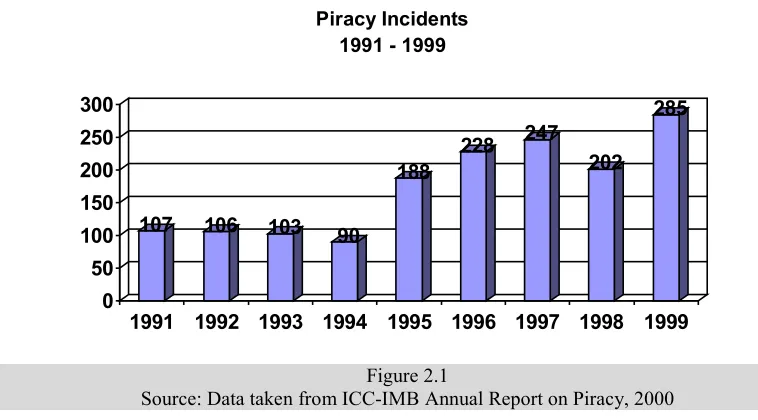
of incidents in 1991. Appendix A provides the IMB data and tables used on both actual and attempted attacks from 1991 to 1999 as well as other tables in providing an analysis of piracy incidents. The graph below gives a graphical representation of the number of piracy incidents from 1991 to 1999 for better appreciation.
Figure 2.1
Source: Data taken from ICC-IMB Annual Report on Piracy, 2000
IMB also attempts to distinguish between actual and attempted piracy attacks as well as the status of the vessel during the time of the incident, i.e. berthed, anchored or steaming (Appendix A).
As mentioned earlier, the IMB definition of piracy differs from the codified definition of piracy in that IMB defines piracy as:
“An act of boarding any ship with the intent to commit theft or any other crime and with the intent or capability to use force in the furtherance of that act.”
A more detailed discussion on issues related to the different definitions of piracy is reserved for a later chapter. For purposes of this section, however, it should suffice to point out that the IMB definition includes incidents occurring while anchored or berthed. From the codified definition of piracy (international law), piracy can only be committed on the high seas. For the purpose of this dissertation since no data is available on piracy incidents occurring in the high seas, the table below provides an analysis of the IMB data (Appendix A), with the assumption that
107 106 103 90
188
228 247 202
285
0 50 100 150 200 250 300
1991 1992 1993 1994 1995 1996 1997 1998 1999
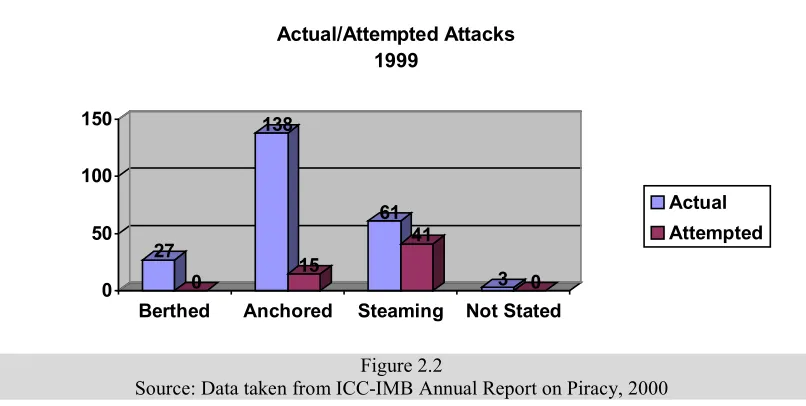
the IMB data on “steaming” will be presumed as incidents occurring in the high seas. With such assumption, it can be surmised that out of a total of 229 actual attacks in 1999, 61 or 27% of the incidents happened while the vessel was steaming and presumed by this author to be in the high seas while 138 or 60% of the actual attacks happened while the ship was anchored. As for 56 recorded incidents of attempted attacks, 41 or 73% occurred while the vessel was steaming (and presumed on the high seas) while only 15 or 27% occurred while the vessel was anchored. This analysis is just to provide for a realistic number of piracy incidents occurring in the high seas. While this author came up with the presumption that 27% of incidents occur in the high seas because they were recorded by IMB as ships attacked while steaming, it is widely accepted that this presumption is too high because most ships attacked en route are within territorial waters of a State. Some authors claim that there is as little as 20% of ships attacked in the high seas, while 80% of the attacks occur in waters other than the high seas (Wood, 2000).
Figure 2.2
Source: Data taken from ICC-IMB Annual Report on Piracy, 2000
The IMB data reveals that for actual attacks, only 27% (61 incidents) happened while the vessel was steaming and thus can be presumed as happening on the high seas. This means that a good majority (63%) of actual attacks, based on this authors presumption, while other authors claim 80% of actual attacks, cannot be considered as piracy according to the Geneva Convention and UNCLOS definition of piracy.
27 0
138
15
61 41
3 0
0 50 100 150
Berthed Anchored Steaming Not Stated
Actual/Attempted Attacks 1999
It can be surmised as well that while most of the actual attacks happen when the ship is anchored, it is the other way around for attempted attacks where 73% of attempted attacks happened while the ship was steaming.
In totality, counting both actual and attempted attacks, only 102 incidents or 35% out of a total number of 285 incidents in 1999 can be presumed as occurring in the high seas. As mentioned earlier, this is just for presumption purposes since no available data shows if the 102 incidents mentioned did indeed occur in the high seas. There is a great possibility that these 102 steaming incidents might have occurred in territorial waters or in the EEZ which excludes them as piracy incidents according to the codified definition of piracy. Once again, some authors claim that 80% of the attacks occur in waters other than the high seas. What can be surely deduced is that more incidents of attacks happen in areas not included in the codified definition of piracy and therefore becomes less significant in the eyes of the international community for reasons that such incidents are under the jurisdiction of national laws. A master of a vessel, however, does not care much about definition and legal interpretation, on whether the attack on his vessel happened in the high seas or in territorial waters. What he cares about is the safety of his ship. It is therefore apparent that there is a problem on the definition of piracy and how it affects actions to be taken by governments, whether governments treat incidents that happened in territorial waters and in the high seas with equality. This problem will be further discussed in the succeeding chapters.
The IMB report also reveals that besides the increasing number of piracy incidents, there is an indication that the level of violence has as well increased substantially. In 1999, the number of incidents where pirates boarded with guns increased as compared to 1998. Incidents where pirates were armed with knives doubled as compared to 1998. Extreme violence, i.e., death, however, declined (Appendix A).
CHAPTER 3
PIRACY IN SOUTHEAST ASIA
3.1 Background
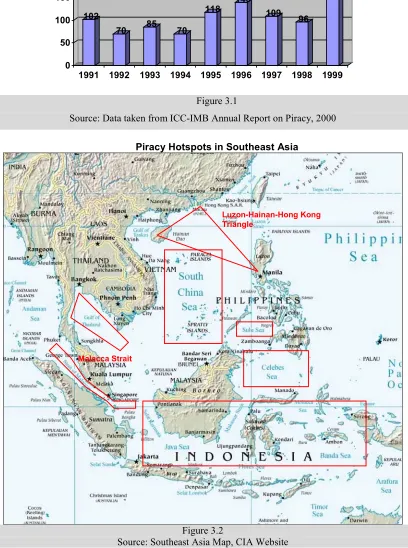
Figure 3.1
Source: Data taken from ICC-IMB Annual Report on Piracy, 2000
Piracy Hotspots in Southeast Asia
Figure 3.2
Source: Southeast Asia Map, CIA Website 102
70 85 70
118 140 109 96
165
0 50 100 150 200
1991 1992 1993 1994 1995 1996 1997 1998 1999
Piracy Attacks in Southeast Asia
Luzon-Hainan-Hong Kong Triangle
3.2 Malacca Straits
Malacca Strait is the longest strait in the world and is the main seaway connecting the Indian Ocean and the China Sea. It is under the jurisdiction of three coastal states, namely Malaysia, Indonesia and Singapore. Thus, incidents in the area do not constitute as piracy under international law but rather as piracy per se, depending on national laws if the countries concerned indicate that such attacks within their territorial waters can be considered as piracy. Because of the increasing maritime traffic in the Malacca Strait, over 600 vessels transit the strait on a given day, the area concerned is considered notorious for piracy attacks, particularly in the Phillip Channel close to Singapore. What makes the Malacca Strait even more important is the fact that all tankers destined for Asia from the Persian Gulf pass through the Strait of Malacca, oil being a major commodity imported by countries such as Japan. States who rely on oil imports have perceived that a significant threat to the carriage of this product could be interpreted as a direct threat to a State’s national security.
captain’s cabin and ransack the ship’s safe. When time permits, they also ransack crew’s cabins for cash and personal belongings. Pirates will try to avoid confrontation but in some reports, crewmembers who offer resistance are tied up.
Frequent cases of piracy in this area are perpetrated by amateur pirates, i.e. fishermen, who are driven by poverty (Asiaweek, 1992). More alarming are sporadic incidents perpetrated by criminal syndicates who are professional pirates acting with precision and using sophisticated equipment and automatic weapons. Their motives include selling the cargo, and the vessel. The vessel is usually re-flagged and sold. One recent example is the piracy attack and hijacking of MV Alondra Rainbow on October 22, 1999. The vessel was loaded with 7,000 metric tonnes of aluminum ingots and sailed from Kuala Tanjung, Indonesia to Miike, Japan. Shortly after departure, the vessel was attacked and hijacked by pirates armed with guns and swords. The crew were transferred to an old ship and set adrift off the west coast of Thailand. Ten days after, they were rescued by a Thai fishing boat. The IMB Piracy Reporting Center in Malaysia alerted all vessels and government agencies in the region.
On November 14, a master of a ship reported sighting a ship with the same
description as Alondra Rainbow in the Arabian Sea. The Indian Coast Guard
is stolen cargo. Discovery of credit cards, thousands of dollars in various currencies and the fact that two of the pirates had featured in earlier cases of hijackings suggest that the pirates are part of a larger syndicate.
It is said that professional pirates such as the example above are members of criminal syndicates. Some say that such syndicates are operating out of Singapore but the international shipping community suspects that the Indonesian navy, marine police or customs agents are involved in this unlawful business. This is somewhat plausible since the skill and discipline of the pirates indicate that they are well trained in combat. According to a senior Singapore shipping company official, Indonesian customs vessels were until 1985 extracting bribes from every ship plying between Singapore and Indonesia. Otherwise, it was alleged, the ships had to stay for two or three days while customs were checking their entry permit. However, the permits were abolished in late 1985, and after that pirate attacks in Indonesian waters increased dramatically. This has given rise to the suspicion that the piracy has replaced the bribes as the customs officers’ source of extra income (Asiaweek, 1988). This assumption, however, cannot be supported by evidence and the Indonesian government denied such accusations (Asiaweek, 1992).
While Indonesia and Malaysia deny the existence of widespread piracy in the Malacca Strait and claim that the situation is highly exaggerated, Singapore has taken measures against piracy within its territorial waters. The Singaporean authorities, for example, have a special VHF radio frequency for reporting incidents. They also advice ships on measures to be taken to prevent boarding and recommend that transit within the Strait be done at night.
Chew Chang Kiat alias Mr. Wong for six years for masterminding a series of piratical attacks. Mr. Chew is a Singaporean national. He was said to be responsible for the hijacking of tankers in the Malacca and Singapore straits. Apparently, the head of Mr. Wong’s syndicate is stationed in China. The hijacked tankers converted to phantom ships, and their cargoes are sold in China. According to IMB, Mr. Wong’s international network operated from China, Hong Kong, Philippines and Malaysia (IMB, 2000).
Malaysia has also started to contribute in the anti-piracy campaign. It was reported that police authorities in Malaysia will conduct air patrols to protect local fishermen who are frequent targets of pirates (IMB, 2000).
There have been attempts to solve the piracy problem in the Malacca Strait through regional cooperation. In 1992, Indonesia made agreements with Singapore and Malaysia on coordinated sea patrols, a common radio frequency, exchange of information and mutual assistance in hot pursuit of pirates. Indonesia also created a special anti-piracy team called “Sampata” (Time, 1992).
The main problem with regards to piracy in the Malacca Strait is that the attacks take place in territorial waters which renders the international law of piracy and the universal jurisdiction inapplicable. This shall be explained in succeeding chapters.
3.3 South China Sea and the Rest of Southeast Asia
3.3.1 Hong Kong-Luzon-Hainan Triangle and China/Hong Kong/Macao Area
compared to piracy incident in the Malacca Straits. These include cargo ships, tankers, fishing vessels, small ferries and Vietnamese boat refugees.
In the Hong Kong – Luzon – Hainan Triangle, the peak of piracy incidents occurred in 1993 where 27 incidents where reported. From the IMB report, the number of piracy incidents in the area seems to be declining over the years with zero reported incidents in 1998 and 1999. Incidents of piracy in the Triangle are comparable to incidents of piracy in the China/Hong Kong/Macao area which had, according to the IMB report, 31 incidents of piracy in 1995.
Some incidents of piracy in both areas were reported to have been perpetrated by groups of fifteen to twenty pirates in Chinese military uniforms using 20-meter speedboats which resemble a Chinese navy or police vessel and armed with heavier weapons. The Chinese government has been accused of being behind some of these piracy acts. It seems that Chinese anti-smuggling units established in 1992 were conducting patrols not only in Chinese territorial waters but also in international waters where China has said time and again that the South China Sea forms part of China’s territorial claim and jurisdiction. These Chinese anti-smuggling units were said to have exceeded their powers and seized ships indiscriminately, motivated by their right to a share of the supposed “smuggled” cargo carried by ships. For instance, on January 6, 1993, the Danish freighter MV Arktis Star was attacked by six men in Chinese military uniforms who approached the vessel in a speedboat and fired at her with rocket-propelled grenades (Telegraph Magazine, 1993). On March 20, 1994, the Honduran cargo ship MV Tequila was hijacked while lying at anchor in Hong Kong waters. The Hong Kong marine police observed the attacking ship disappear off the radar screen among a group of islands controlled by the Chinese navy (The Economist, 1994). The Chinese government denied all allegations. Recently, however, the Chinese authorities had declared their cooperation in the anti-piracy campaign. China has recently sentenced to death and later executed in December 1999, 13 pirates in connection with the murder of 23 Chinese seamen
onboard MV Cheung son which was hijacked on November 16, 1998. The 13 death
and illegal possession of guns and ammunition. Nineteen pirates were given prison sentences and fines. One of those sentenced to death was Huang Daming whose ship was used as the mother ship from where the pirates were able to launch its pirate attacks. It is interesting to note that the same ship owned by Huang Daming was previously used for customs border patrols.
China’s Ministry of Public Security, in response to official acknowledgements of the piracy problem, had decreed the creation of specialized marine departments to handle piracy. The Chinese government, during the 71st Session of the Maritime Safety Committee of the International Maritime Organization (IMO) held in May 1999, affirmed their stance to suppress piracy and armed robbery against ships and appealed for international cooperation in combating transnational piracy (IMB, 2000).
3.3.2 Gulf of Thailand
Although piracy in the Gulf of Thailand where the victims are Vietnamese boat refugees has been in the decline because of the improving political situation in Vietnam, it is worth examining how international efforts have contributed to its decline. The Gulf of Thailand was before considered as a piracy prone area, particularly during the time of the exodus of Vietnamese boat refugees in the early to late 1980s. Vietnamese boat refugees who travel to Thailand and Malaysia are robbed of their life savings and often murdered, raped, mutilated and finally thrown into the sea in the course of a piracy attack (Henriksson, 1996). Sometimes, girls and women are abducted and brought to the prostitution networks in Bangkok and the Island of Koh Kra, where they are sold to brothels (Kasemsri, 1989).
bilaterally by a donation of $2 million to Thailand from the United States. The program continued until 1981 when it ceased because the US and Thailand could not agree on how the programme should be financed. The UNHCR referred the situation to the Secretary General of the United Nations and to the International Maritime Organization resulting in the introduction of the second Anti-Piracy Programme which started on July 1982. This program was supported by UNHCR and funded by twelve donor countries, namely, Australia, Canada, Denmark, France, Federal Republic of Germany, Italy, Japan, Netherlands, Norway, Switzerland, United Kingdom and the United States. It involved the Royal Thai Navy, the marine police, the land police and the Harbour Department. The UNHCR functioned as the coordinator and the point of review and consultation between the donor countries and the Thai government.
3.3.3 Southern Philippines
evident, the Philippines has no agreement with Malaysia and Indonesia concerning the suppression of piracy in the area concerned.
The Philippine Sea as well as other inland waters in the Philippines are also frequented by criminal gangs including fishermen motivated by poverty and unemployment. Other areas prone to piracy include Tawi-Tawi, Jolo, Zamboanga, Basilan, along the Mindanao coast, in Manila Bay and other parts of the coast between Santa Cruz and Batangas in the Philippines. Disguised as fishermen or passengers, they attack fishing vessels, commuter ferries, cargo boats and boat refugees in order to get money or valuable personal items and the incidents often involve acts of violence. Some incidents, however, are perpetrated by well organized syndicates who forge registration papers and established connections to sell pirated ships and their cargo. An example is the hijacking in 1991 of MT Tabangao, an oil tanker servicing the domestic trade. She was renamed three times and was trading in Singapore before Indonesian Customs police apprehended the vessel. Philippine authorities apprehended five suspects including a Singaporean national. Those apprehended were apparently involved in at least four other hijacking incidents. The
MT Tabangao incident is an example of what problems a government encounters, especially on problems of jurisdiction because it involves other countries (in this example, Singapore and Indonesia). The MT Tabangao incident is also an example of a piracy incident not included in the definition of piracy in international law (Geneva Convention and 1982 UNCLOS) but treated as piracy in Philippine laws. The problem is exacerbated when such treatment of incident in Philippine laws differs from how Singapore and Indonesia should treat such incident. This shall be explained in detail in the succeeding chapters.
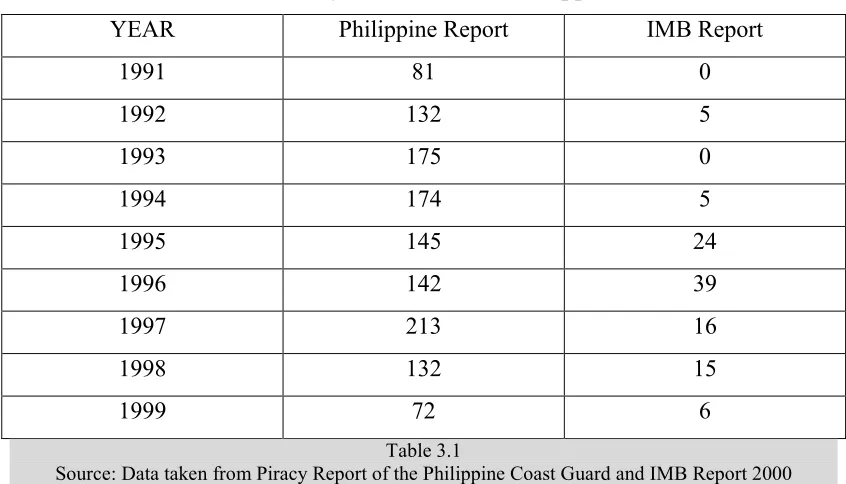
1999, the Philippine government reported 72 incidents compared to 6 incidents reported by IMB. Below is a table comparing the number of piracy incidents recorded by IMB as compared to incidents recorded by the Philippine Coast Guard (PCG). Appendix B provides the Philippine Coast Guard Report on Piracy. The report also includes a situationer on piracy in the Philippines as well as actions taken by the Philippine government in the anti-piracy campaign.
Piracy Incidents in the Philippines
YEAR Philippine Report IMB Report
1991 81 0
1992 132 5
1993 175 0
1994 174 5
1995 145 24
1996 142 39
1997 213 16
1998 132 15
1999 72 6
Table 3.1
Source: Data taken from Piracy Report of the Philippine Coast Guard and IMB Report 2000
CHAPTER 4
CODIFICATION OF THE LAW ON PIRACY
The purpose of this chapter is to provide the relevant regulations on piracy based on international law in order to better understand the problem of piracy. Besides relevant codifications on piracy, this author also intends to discuss non-mandatory documentations such as international organization’s recommendations in combating piracy. This chapter will not include national codifications on piracy because of the diversity and different notions applied by different coastal states. Piracy under municipal or national laws are diverse because many coastal states differ in their treatment of piracy in their territorial waters including punishment for the offence of piracy. Further, coastal states believe that crimes committed within territorial waters constitute crimes against the state and not against the international community. Thus, a problem exists when piracy incidents occur in territorial waters and international law does not recognize such incident as piracy (i.e. IMO categorizes such incidents as armed robbery). This problem shall be discussed in the next chapter.
4.1 Piracy Under International Law (Piracy Iure Gentium)
seize and punish pirates on the high seas (Henriksson, 1996). This principle was based on two reasons, namely, that pirates attacked the ships of all states indiscriminately and were thus a threat to all states, and that pirates were not subject to the authority of any state and therefore no state could be held responsible for their actions (Halberstam, 1988). The universality principle formed the basis of the international concept of piracy.
The codification of piracy in international law was started in 1926 when the League of Nations tasked a sub-committee of the Committee of Experts for the Progressive Codification of International Law to compile a report on piracy. The Assembly of the League of Nations decided to select piracy as a topic for its Codification Conference and the Harvard Law School undertook the task to prepare a draft convention. The draft convention was published in 1932 but was never adopted in any multilateral treaty. However, it was the first attempt to analyze piracy and problems that surround the subject (Dubner, 1980).
4.1.1 The 1958 Geneva Convention
It was during the first session of the International Law Commission (ILC) in 1949 when the ILC planned on creating a regime for the high seas that the subject of piracy was considered. The ILC used the Harvard draft convention as a working basis but the ILC’s final report submitted to the General Assembly in 1956 was more restrictive than the Harvard draft convention. The Harvard draft convention allowed for the seizure of a pirate ship within the territorial jurisdiction of another state under certain conditions, which was not included in the ILC’s report. Further, the Harvard draft convention included in its acts of piracy the possibility of a ship preparing to make attacks in territorial waters or on land from the high seas while the ILC report was restricted to piracy acts in the high seas only (Dubner, 1980).
Articles 14 to 21 of the 1958 Geneva Convention on the High Seas which entered into force on September 30, 1962.
Article 14 of the Geneva Convention provides for the general principle that “all States shall cooperate to the fullest possible extent in the repression of piracy on the high seas or in any other place outside the jurisdiction of any State.” All signatories to the Geneva Convention are therefore only obliged to provide the necessary support and cooperation to piracy incidents only in areas other than territorial waters of another coastal state. Present day piracy, however, knows no borders. Jurisdiction, enforcement and prosecution of piracy acts have been hampered by the restrictive codification of piracy in international law. Chapter 5 will further discuss the problem of definition.
4.1.2 The 1982 United Nations Convention on the Law of the Sea (UNCLOS)
The United Nations Third Conference on the Law of the Sea from 1973 to 1982 was convened for the purpose of producing a single treaty on the international law of the sea. The Conference resulted in the adoption of the United Nations Convention on the Law of the Sea on 30 April 1982 (UNCLOS) which entered into force on 16 November 1994. UNCLOS contains eight articles on piracy, Articles 100 to 107. These articles in UNCLOS are more or less the exact replicas of the articles in the 1958 Geneva Convention (Appendix C).
4.1.3 Piracy in International Customary Law
piracy up to this day is considered a “crime against humanity.” Piracy is one of two offences (the other is slave trade) which fall under the principle of universal jurisdiction or the universality principle. This means that any state may apprehend a pirate on the high seas or in any other place outside the jurisdiction of any state and try him before its municipal courts (Henriksson, 1996).
The concept of piracy under international customary law, however, is a vague concept. Under international customary law, piracy was just defined as an unauthorised act of violence committed by a private vessel on the open sea against another vessel with an intent to rob or plunder (Halberstam, 1988). Such vague description of piracy produced different interpretations. For example, it was argued whether an intent to rob should be a necessary element to constitute piracy. There are instances when destruction of goods on board a vessel should be treated as piracy despite the absence of an intent to rob. There was also the question on whether the crew who commits mutiny aboard the vessel and converted the vessel and its cargo for their own use should be considered an act of piracy. These issues were left unanswered in the original definition of piracy under international customary law. It is for these reasons that popular clamor suggested a codification of piracy in international law where all states signatory to such codification will treat piracy based on a unified definition.
4.2 International Maritime Organization (IMO)
The International Maritime Organization (IMO) is a specialized agency of the United Nations established in March 1958 which deals with all matters relating to the safety of international shipping, and the promotion of maritime standards and efficiency. The IMO is an advisory body that has no formal powers of enforcement which is left to the responsibility of the member states (Villar, 1985). It is for this reason that IMO has acted on the problem of piracy only on a consultative manner by issuing recommendations in the form of resolutions and disseminating information on piracy. It differs from conventions in that conventions are mandatory to all signatory states while resolutions are non-mandatory, leaving it up to the Administrations to implement such recommendations to their own satisfaction.
seamen. Such actions cannot be considered as piracy as no violence has taken place. It can be deduced, however, that IMO’s activities in the field of piracy started at this time since there are similarities in the suppression of maritime fraud to the suppression of piracy.
It was in 1983 when IMO devoted its attention solely on piracy. At that time, the government of Sweden submitted a report to the IMO’s Maritime Safety Committee (MSC) following a piracy attack on the Swedish vessel Tarn. The report contained a proposal to formulate a resolution relating to the crime of piracy where governments should provide information on acts of piracy and should take all steps necessary to prevent the occurrence of such acts within or outside their waters. The MSC also received a report from the IMB containing the nature of piracy attacks and measure taken by governments. The MSC prepared a draft text which was used as the basis for Resolution A.545(13) on “Measures to Prevent Acts of Piracy and Armed Robbery Against Ships” adopted by the IMO Assembly in November 1983. This Resolution can be considered as the first action of IMO solely for the fight against piracy. Among others, the resolution contained four main points, namely:
a. It notes with great concern the increasing number of incidents involving piracy and armed robber and recognizes the grave danger to life and the grave navigational and environmental risks to which such incidents can give rise.
b. It “urges Governments concerned to take, as a matter of highest priority, all measures necessary to prevent and suppress acts of piracy and armed robbery from ships in or adjacent to their waters, including strengthening of security measures.”
d. It requests the IMO Council to keep the matter under review and take such further action as it may consider necessary in the light of developments.
The fourth point paved the way for other resolutions on piracy as time progressed. Because of this, the MSC in 1984 decided to establish a separate and fixed agenda item in its work programme entitled “Piracy and Armed Robbery Against Ships.” The MSC started to receive reports on piracy submitted by member states and international organizations which were later disseminated starting 1986 to coastal States concerned for comments and advice on the actions taken with regard to the incidents reported.
recommendations concerning the establishment of a port facility security plan and a ship security plan that shall provide for measures to prevent the occurrence of weapons on board ships and unauthorized access to the passenger terminal, to the ship and to restricted areas on board. The document also provides for the appointment of a port facility security officer who is responsible for the preparation of the plans and their implementation.
Realizing that there is an alarming increase in the number of piracy incidents and that many incidents of piracy have not been reported or have not been brought to the attention of IMO, the IMO Assembly adopted Resolution A.683(17) in 1991 entitled “Prevention and Suppression of Acts of Piracy and Armed Robbery Against Ships” which urged member States to report to IMO all incidents of piracy and armed robbery against ships under their flags and invited coastal States to increase their efforts to prevent and suppress such acts committed in their waters.
In 1992, the MSC issued MSC/Circ. 597 which recommends the use of search and rescue (SAR) services and mobilization of maritime authorities so that action could be taken to provide assistance to ships under attack or to pursue the pirates with the minimum of delay (Henriksson, 1996).
Also in 1992, the IMO Secretary General Mr. William A. O’Neil established a Working Group composed of ten IMO member countries to prepare a report outlining the problem in the Strait of Malacca and providing recommendations on safety precautions and enforcement arrangements appropriate for crews, shipowners, flag States, coastal States and port States for dealing with piracy and armed robbery against ships. The report of the Working Group was considered by the MSC and in 1993, two circulars were issued, namely:
a. MSC/Circ. 622 on Recommendations to Governments for Preventing and Suppressing Piracy and Armed Robbery Against Ships
In the same year, the IMO Assembly adopted Resolution A.738(18) on “Measures to Prevent and Suppress Piracy and Armed Robbery Against Ships” which contained additional measures to prevent and suppress piracy and armed robbery against ships. The Resolution contained two main points, namely:
a. Recommendation for masters of ships to immediately report attacks or threats of attack to the nearest rescue and coordination center and request such coordination centers to immediately warn shipping in the immediate vicinity of the attack, as well as inform promptly the local security forces to implement any contingency plans they have for dealing with such incidents. b. A request to the MSC to adopt a special signal for use by ships under attack
or threat of attack.
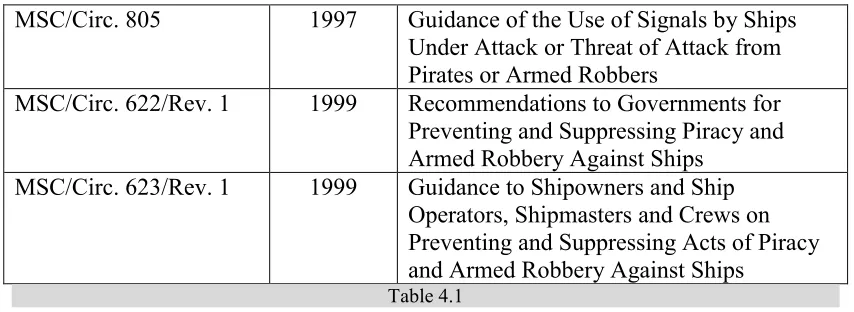
The IMO together with the International Telecommunication Union (ITU) and the International Mobile Satellite Organization (Inmarsat) has included “piracy/armed robbery attack” as a category of distress message which ships can transmit through either Digital Selective Calling (DSC) or Inmarsat equipment by pressing a button. The message can be received automatically by shore stations and ships in the vicinity. The MSC circulated MSC/Circ. 805 dated 06 June 1997 entitled “Guidance on the Use of Signals by Ships Under Attack or Threat of Attack from Pirates or Armed Robbers” to all member States inviting and recommending the use of such communication facilities in reporting a piracy attack.
In May 1999, the MSC discussed the outcome of the two missions to Southeast Asia and South America and as a result incorporated corresponding revisions to MSC/Circ. 622 and MSC/Circ. 623 with the issuance of MSC/Circ. 622/Rev. 1 and MSC/Circ. 623/Rev. 1 respectively (IMO, 2000).
The table below provides a summary of all IMO resolutions and circulars pertaining to piracy:
IMO Resolutions and Circulars Document Number Year Title
Res. A.461(XI) 1979 Barratry and Unlawful Seizure of Ships and their Cargoes
Res. A.504(XII) 1981 Barratry, Unlawful Seizure of Ships and Their Cargoes and Other Forms of Maritime Fraud
Res. A.545(13) 1983 Measures to Prevent Acts of Piracy and Armed Robbery Against Ships
Res. A.584(14) 1985 Measures to Prevent Unlawful Acts Which Threaten the Safety of Ships and the Security of their Passengers and Crews MSC/Circ. 443 1986 Measures to Prevent Unlawful Acts Against
Passengers and Crew on Board Ships Res. A.683(17) 1991 Prevention and Suppression of Acts of
Piracy and Armed Robbery Against Ships
MSC/Circ. 597 1992 the use of search and rescue (SAR) services and mobilization of maritime authorities so that action could be taken to provide
assistance to ships under attack or to pursue the pirates with the minimum of delay
MSC/Circ. 622 1993 Recommendations to Governments for Preventing and Suppressing Piracy and Armed Robbery Against Ships
MSC/Circ. 623 1993 Guidance to Shipowners and Ship Operators, Shipmasters and Crews on Preventing and Suppressing Acts of Piracy and Armed Robbery Against Ships
MSC/Circ. 805 1997 Guidance of the Use of Signals by Ships Under Attack or Threat of Attack from Pirates or Armed Robbers
MSC/Circ. 622/Rev. 1 1999 Recommendations to Governments for Preventing and Suppressing Piracy and Armed Robbery Against Ships
MSC/Circ. 623/Rev. 1 1999 Guidance to Shipowners and Ship Operators, Shipmasters and Crews on Preventing and Suppressing Acts of Piracy and Armed Robbery Against Ships
Table 4.1
4.3 The Convention for the Suppression of Unlawful Acts Against the Safety of Maritime Navigation (SUA Convention)
On October 7, 1985, Achille Lauro, a cruise liner of Italian registry was hijacked by four armed men in international waters thirty miles from Port Said, Egypt. This incident differed from piracy under international law (piracy iure gentium) for two reasons. First, piracy could not have been committed since it did not fulfill the requirement on piracy that the attack should have been directed from one vessel to the other. This two-vessel principle did not exist in the Achille Lauro
incident because the attackers were passengers of the vessel. Second, piracy was not committed because the intent of the attackers was not “for private ends”. The attacker’s motives were strictly political when they demanded the release of fifty Palestinians in Israeli prisons.
the Suppression of Unlawful Acts against the Safety of Maritime Navigation whose task was to prepare a draft convention based on the one submitted by the three governments. After a series of meetings, the agreed Draft Convention was forwarded for consideration in a diplomatic conference held in Rome on March 10, 1988. The Convention for the Suppression of Unlawful Acts Against the Safety of Maritime Navigation, otherwise known as the SUA Convention, was adopted and signed by 23 states. As of November 1994, 27 states had ratified the Convention.
There is a significance of the SUA Convention with regards to piracy. To this very day, piracy remains to be a broad concept. Although piracy in international law such as the 1958 Geneva Convention and the 1982 UNCLOS provides for the legal basis for dealing with piracy while IMO Resolutions and Circulars provides for recommendations and guidelines in the treatment and suppression of piracy, there remains a loophole in the whole international spectrum of piracy in that incidents that do not satisfy the two-ship requirement and “for private ends” requirement are not considered as piracy and that no legal provision exists for the groundwork on prosecution. Take the case of the Achille Lauro incident. Some States have national laws that will provide for the prosecution of the perpetrators of the Achille Lauro
incident in the ambit of committing the act of piracy. The US requested the extradition of the perpetrators because of the death of an American aboardship and charged the perpetrators for committing an act of piracy under Federal Laws.
Further, although piracy has been well defined in international law, the fact remains that piracy and armed robbery are dealt with as a single entity, i.e. contained in a single report. This author has not encountered any report that separates piracy, armed robbery and maritime terrorism. The fact remains that the international community distinguishes piracy from armed robbery and maritime terrorism, but considers the latter two as actions that should be punishable in the same level as piracy, meaning, as a “crime against humanity”.
international law are therefore not included and that jurisdiction is limited to the state of nationality of the offender, the flag state, and the state within whose territorial sea the offence was committed. As opposed to piracy whereby any State can have jurisdiction over piracy committed in the high seas.
Perhaps the most important part of the SUA Convention is the “extradite or prosecute” clause contained in Article 10, as follows:
“The State Party in the territory of which the offender or the alleged offender is found shall … if it does not extradite him, be obliged without exception whatsoever and whether or not the offence was committed in its territory, to submit the case without delay to its competent authorities for the purpose of prosecution, through proceedings in accordance with the laws of that State.”
States are therefore obliged to prosecute an offender, if it decides not to extradite the offender, under its national laws and shall treat the offence as a grave nature under the law of that State.
There have been instances mentioned in Chapter 3 where the problem of jurisdiction and prosecution hampered the apprehension of piracy offenders, such as the case of the MT Tabangao where three countries are involved, namely, the Philippines where the vessel is registered, Singapore where the vessel was found to be trading after being hijacked, and Indonesia where the vessel was apprehended.
This is perhaps the reason why even IMO recommends and urges Governments to ratify the 1988 Rome Convention for the Suppression of Unlawful Acts Against the Safety of Maritime Navigation. Although the SUA Convention is limited to maritime terrorism, some provisions of the SUA Convention will make it easier for States to deal with piracy particularly when other countries are involved in the apprehension and prosecution of pirates. Further, for incidents not falling under the ambit of piracy can be dealt with in the SUA Convention.
before its own courts. In contrast, piracy under the 1958 Geneva Convention and the 1982 UNCLOS do not obligate any state to try pirates or to extradite them to another state. This means that in the treatment of piracy, a loophole exists on the prosecution process.
CHAPTER 5
CONTENTIOUS ISSUES AND POSSIBLE SOLUTIONS
This author could not have said it better when the IMO report “Piracy and Armed Robbery at Sea” mentioned that “one problem that has emerged in recent years is that uncertainties about the law have meant that persons suspected of piracy have often been released without charge” (IMO, 2000).
This chapter will discuss the problems and obstacles hampering the anti-piracy campaign, particularly on the conceptual definition of piracy, the root cause of piracy, dilemma on preventive measures and countermeasures by ships, and difficulty in enforcement and prosecution by states. Possible solutions in overcoming these obstacles will also be discussed.
5.1 Conceptual Definition of Piracy
Article 101 of the 1982 UNCLOS defines piracy as:
(a) any illegal acts of violence or detention, or any act of depredation, committed for private ends by the crew or the passengers of a private ship or a private aircraft, and directed:
(i) on the high seas, against another ship or aircraft, or against persons or property on board such ship or aircraft
(ii) against a ship, aircraft, persons or property in a place outside the jurisdiction of any State
(c) any act of inciting or of intentionally facilitating an act described in subparagraph (a) or (b).
There is a substantial difference between piracy today compared to piracy in the olden days. Besides, historical piracy that existed in the past was directed mostly against merchant vessels. Today, because of increasing world trade and increase of merchant shipping as well as reliability in water transport as a primary mode of transportation of goods and passengers for various reasons primary of which is less cost, piracy today is directed to more types of vessels, with varying reasons from the most common robbery to the most sophisticated syndicate activity. Thus, we need to analyze whether the definition of piracy is applicable today as it was when the codification of piracy in international law was created.
The problem of the conceptual definition of piracy in international law (piracy
iure gentium) can be best approached by explaining some key words or phrases in the definition as provided by the 1982 UNCLOS that proves to be vague or needing of further explanation.
5.1.1 “any illegal acts of violence or detention, or any act of depredation”
as piracy. If it was, this means that if national law regulates that piracy should be meted the punishment of reclusion perpetua or even death, the simple act of theft such as the one described above might be considered as a crime of piracy as the illegal act itself satisfies all the other requirements of piracy. This author believes not. We should draw the line when you compare acts of theft in terms of magnitude, especially when no violence or threat to life is committed. For example, one should compare the stealing of cans of paint or mooring lines with the stealing of the ship’s safe containing huge amounts of the crew’s salary without the knowledge of the master and the crew. There is, therefore, a vague notion existent in the phrase “any illegal acts of violence or detention, or any act of depredation” because it does not provide for the magnitude of such illegal action.
Another flaw is the distinction between robbery and piracy. IMO which follows the definition of piracy based on the 1982 UNCLOS deems it fit to limit piracy as acts committed in the high seas and classifies those committed in territorial waters or waters other than the high seas as armed robbery. A person other than a passenger or crew of the same vessel, for example, who robs the master’s ship safe, be it with intent to commit violence or with threat and intimidation, may be considered as piracy rather than armed robbery. This author believes that there is a flaw in the definition because such actions in criminal law are considered as robbery and not piracy. I believe that there is a necessary element in the definition of piracy that should be included. There should be an act to take control of the vessel as one of the elements to distinguish robbery from piracy. Again, the gravity of an offence is of primary importance in distinguishing piracy from armed robbery. To take control or attempt to control a vessel by a person other than the master of a vessel should be a necessary element in the determination of piracy.
act to commit fraud, i.e. when the crew connives with the master to carry out the illegal act. However, when a crew or passenger takes control of a vessel from the master through either violence, detention or depredation, such act should be considered piracy. The element of a two-ship requirement shall be discussed later in this chapter.
The phrase “any illegal acts of violence or detention, or any act of depredation” should include an act to control the vessel as a mandatory element in the definition of piracy. Further, the act of depredation should be limited by listing down such act of depredation in terms of gravity for it to be a requirement in the definition of piracy.
5.1.2 “committed for private ends”
The “for private ends” criterion was adopted by the 1958 Convention from the Harvard draft convention. The reason why the Harvard group excluded political acts in the definition of policy was not because of the intention of limiting the piracy definition but because the group encountered problems at that time in determining the status of insurgents (Henriksson, 1996). Apparently, there did not exist in international law any principles to distinguish them from belligerents where the law of war is used and what treatment should be given to insurgents. It was apparent that the Harvard group faced a blank wall in considering if insurgents should be treated, in the purview of piracy, as committing the act of piracy or a lawful act of war if they were treated as belligerents. To resolve the issue, the Harvard group decided to limit the piracy criterion to “for private ends”. Accordingly, it would seem that the “for private ends” criterion was done in haste rather than careful analysis because the group did not solve the issue but rather went around the issue by limiting the piracy criterion to “for private ends”.