Volume 5, Issue 1, 2018, pp. 284-290 Available online at www.jallr.com ISSN: 2376-760X
* Correspondence: Omid Ostad, Email: omidostad007 gmail.com © 2018 Journal of Applied Linguistics and Language Research
The Impact of L2 Learning on Working Memory: A Case of
Iranian Intermediate EFL Learners
Mohammad Tarang University of Guilan, Rasht, Iran
Omid Ostad *
Allameh Tabatabai University, Tehran, Iran
Hamed Abbasi Mojdehi Islamic Azad University, Rasht Branch, Iran
Abstract
The impact, effect and agreement of working memory on second language learning has received some attention in L2 research. However, there seems to be a massive gap regarding the reverse, i.e. the effect of second language learning on working memory. Cognitive advantages of learning a second language are presumed to derive from the requirement to continuously control the activation of lexical representations from the non-target language in a way that they have no interference with the ongoing language processing (Green, 1998). The present study draws on one of the most prominent models for working memory put forward by Baddeley and Hitch (1974). This study attempts to assess the impact of learning a second language on the aforementioned components of the participants' short term memory. For the sake of the study, 48 participants (aged14-16 at the beginning of the study) were selected out of which 24 had just started attending English language classes in Zabansara Language Institute and the other half had been studying English in the same institute for 3 years in Astaneh, Guilan. The instruments employed were the Non-word test, the digit span test, the questionnaire based on Wechsler Adult Intelligence Scale; WAIS (1930) and Corsi Block Tapping –Test (1970) to assess the short term memory of the participants with different language learning backgrounds. The statistical analyses of the results provide evidence in support of the effect of background of learning English as a second language on the improvement of short term memory.
Keywords: foreign language learning, working memory, Iranian EFL learners
INTRODUCTION
Journal of Applied Linguistics and Language Research, 2018, 5(1) 285 success in life, with language learning being one of them. Extensive amount of research has been done on the effect of working memory on second language learning, while there has been little research about the reverse, i.e. the effect of second language learning on working memory. In order to investigate this relationship, we need to know more about working memory, its components and related notions.
Working memory (WM) has been an important construct which is said likely to have a critical role in language learning (both first and second language). There are mainly two points of view toward the concept of WM. The first group (Dornyei & Skehan, 2003; Robinson, 2005; Wen, 2012) believe that it is an innate predisposition and as a result, categorize it into the ‘individual differences’ field. The second group (Eysenck, 2012; Klinberg, 2010; Turley-Ames & Whitfield, 2003), on the other hand, suggest that WM can be modified and even with training, can improve.
Different studies, such as MacDonald and Christiansen (2002) confirm that it is possible to alter WM. Traditionally, working memory has been conceptualised as an active memory system that is responsible for the temporary maintenance and simultaneous processing of information (Bayliss, Jarrold, Baddeley, Gunn, & Leigh, 2005). Alternatively, working memory has been defined as the use of temporarily stored information in the performance of more complex cognitive tasks (Hulme & Mackenzie, 1992), or as a mental workspace for manipulating activated long-term memory representations (Stoltzfus, Hasher, & Zacks, 1996 ). Overall, working memory is viewed as a comprehensive system that unites various short- and long-term memory subsystems and functions (Baddeley, 1986).
REVIEW OF THE LITERATURE
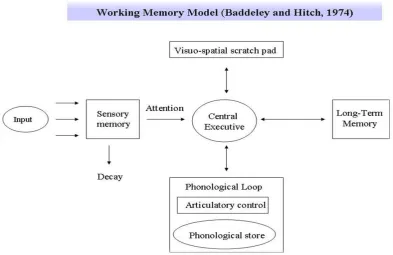
The present study draws on one of the most notable models for working memory that has been put forward by Baddeley and Hitch (1974). This model consists of three parts: a ‘phonological loop’ holding information in a speech-based form which transforms other modes of information into the phonological mode and then stores them in the working memory, a ‘visuo-spatial sketchpad’ for the coding of visual and spatial information that transforms other modes of information into images, and finally ‘the central executive’ which is related to attention and controls the other two.
Figure 1. Baddeley and Hitch’s Model
After defining the concept of WM, and introducing the framework model for the study, it seems necessary to mention some of the systems for measuring them. The most popular tests for measuring components of working memory are ‘star counting test (SCT)’, ‘digit span test’, ‘Corsi-Block tapping test’, and ‘non-words test’.
‘Digit span test’ was first used as a device for measuring intelligence, until Miller (1956) argued against it and said it had nothing to do with intelligence and that digit span test is simply a test for working memory. The most famous digit span test is the Wechsler Adult Intelligence Scale (WAIS) which was first used in 1997. In this test numbers are presented orally, and the testee is required to repeat the numbers in two orders, forwards and backwards.
Journal of Applied Linguistics and Language Research, 2018, 5(1) 287 There is yet another method of investigating verbal working memory and that is by remembering the last word of each sentence. This method, which is known by the name of ‘reading span test’ too, seems to be more congruent with different aspects of words. Some researchers tried to find relationships between components of WM and learning a foreign language. For instance, Papagno and Vallar (1995) compared Italian polyglots with monolinguals in terms of working memory and their subcomponents. The findings confirmed that there is in fact a “close relationship between the capacity of phonological memory and the acquisition of foreign languages” (abstract).
In a more recent research, French and O’Brien (2008) tested Arabic and English non-word repetition before and after French-speaking children took part in an Intensive English as a Second Language (ESL) program. The results showed that while performance on the English non-words improved, no difference was observed for Arabic non-words repetition.
THE STUDY
For this study we can only think of one thing and that is different languages have different phonological and alphabetic features, and working memory only applies for a familiar system of course.
In the present study, the following research question is going to be investigated:
Does learning second language have significant effects on improving the learners’ working memory capacity?
METHOD
Participants
The research was done on two classes in Shokouh Language Institute in Gilan, Iran. There were 48 boys in both classes, 24 of them were learning English for more than 3 years, while the others had just started learning English. All the participants were male and all of them were 14 or 15 years old. The only difference between these two classes was the number of years they had spent studying English.
Instruments
The instruments used for this study could be classified into three groups. There were two texts: one in the target language and the other in first language. The researchers tried to choose a text which was suitable for both groups. The other one was six to eight figures which are going to be presented orally. There was another paper with iconic pictures on it. These questionnaires were devised based on Wechsler Adult Intelligence Scale (WAIS) and corsi Block Tapping -Test.
The numbers were presented orally to the participants, then a distraction task like multiplying two digits were presented to them and after solving the problem they were asked to repeat the numbers in a forward and backwards manner. After this stage two texts in Persian and English were given to students and they were asked to remember the last word of each sentence. At last, a paper with eight pictures on it was presented to the participants and they are asked to remember the pictures and their places. All these stages were done three times with different instruments and this is because of the reliability of the test within different administrations and the students’ highest performance will be taken into account.
RESULTS AND DISCUSSION
Table 1 displays the digit span recall where some statistically significant difference was observed.
Table 1. Recall of digit span
Years Studying English recall span Mean &SD Attempt Mean and SD
1 4.18(1.63) 3.92
3 4.97(1.84) 4.59
The result of the Persian vocabulary span was the same and there was a little difference between the two groups, as displayed in Table 2. Interestingly, visuo-spatial results were the same again. However, digit span test results were different between these two groups and participants who were learning for a longer time had performed better, as shown in Table 3. The most interesting point is the difference in the performance of English vocabulary span test. It seems that those who were learning English for a longer time had better memory for the target language vocabulary but their Memory for the native language remained the same.
Table2. Persian vocabulary recall.
The next table, Table 3 displays the vocabulary (non-word) recall where the mean of the second group was significantly higher.
Table3. English vocabulary recall.
Years Studying English Vocab. recall span Mean &SD Attempt mean
1 2.3(1.29) 3.7
3 3.62(1.97) 4.2
Considering these figures, SPSS software was used to compare the results and it turned out that the only significant difference was in the digit span test and English vocabulary
Years learning English mean(SD Forward span mean(SD) Backwards Span mean(SD) Forward attempts Mean(SD) B.A Mean (SD) F. errors
Mean(SD) mean(SD) B. errors
1 5.2(1.39) 5.1(1.1) 4.80(1.74) 5.40(1.34) 9.6(1.3) 11.2(3.9)
Journal of Applied Linguistics and Language Research, 2018, 5(1) 289 recall. Also, the result of Persian word recall and visuo-spatial test did not show any significant difference.
Table4. Visuo-spatial recall.
Years Studying English Span mean Attempt mean
1 4.37 7.23
3 4.52 7.63
CONCLUSION
Obviously, working memory is composed of different components and it was shown that they are not homogeneous; it seems that learning a second language can enhance some components of working memory. Alphabetic system appears to have a lot of impression on the non-word and word recall tests. Previous research seems to ignore this point but the main controversial point is that some parts of working memory seems to work on according to the basic knowledge about the language. It is the point which is not mentioned in the previous researches in this regard.
Considering the unwanted variables in this research, we can argue that concentration, anxiety, and attention are the variables that are hard to control and they may affect the results of this research other than that this research was only conducted on male students and applying it to female learners was not possible. Of course it is good to have the same tests conducted on female students and that needs another research. Previous research has shown that there is an important relationship between age and working memory so conducting these tests on different age groups can be fruitful too.
REFERENCES
Alloway, T.P., Gathercole, S.E., Adams, A.M., & Willis, C. (2003). Working memory and other cognitive skills as predictors of progress towards early learning goals at School entry. Manuscript under review.
Archibald, L.M.D., & Gathercole, S.E. (2003). Working memory in children with Specific Language Impairment. Manuscript undergoing revision.
Axelrod, B. N. (2008). Cognitive and Emotional Differences among Veterans with Good and Poor Effort. Paper presented at the Annual Meeting of the National Academy of Neuropsychology, New York, NY.
Baddeley, A.D. (1993) Short-term phonological memory and long-term learning: A single case study. European Journal of Cognitive Psychology, 5, 129–148.
Baddeley, A.D. (2000). The episodic buffer: a new component of working memory? Trends in Cognitive Sciences, 4, 417-423.
Baddeley, A.D., Gathercole, S.E., & Papagno, C. (1998). The phonological loop as a language learning device. Psychological Review, 105, 158-173.
Cavanagh JP: Relationship between the immediate memory span and the memory search rate. Psychol Rev 1972, 79(6):525–530.
French, L., & O’Brien (2008). Phonological memory and children’s second language grammar learning. Applied Psycholinguistics, 29, 463-487.
Papagno, C. & Vallar, G. (1995). Short-term memory and vocabulary learning in polyglots.
Quarterly Journal of Experimental Psychology, 48A, 98-107
Service, E. (1992). Phonology, working memory, and foreign- language learning.
Quarterly Journal of Experimental Psychology, 45A, 21–50.