Original Article Published online: 20 September 2018.
Reza Mobashshernia
1*, Sharareh Mashadi Aghazadeh
1* Correspondence:
[email protected] 1 Department of Literature and Foreign
Languages, Chalous Branch, Islamic
Azad University, Chalous, Iran
Received: 23 February 2018
Accepted: 14 April 2018
Published online: 20 September 2018
Abstract
The present study aimed at investigating the relationship between interpersonal intelligence of Iranian bilingual and multilingual EFL learners and their reading comprehension achievement. To do so, 60 intermediate EFL students were selected from a group of 80 based on their Oxford Placement Test (OPT) scores. They were non-randomly divided into two experimental groups. Data collection took place during the summer semester 2017. Once the interpersonal intelligence questionnaire and the reading comprehension test scores had successfully been collected, the results of Pearson product correlation coefficient analyses showed that there was a significant relationship between Iranian bilingual and multilingual EFL learners’ interpersonal intelligence and their reading comprehension achievement: higher interpersonal intelligence was associated with higher levels of reading comprehension achievement and higher statistical significance among bilingual learners. Therefore, it was suggested that Multiple Intelligence Theories could still serve as determining factors in planning programs to teach reading in spite of the theoretical, conceptual, and empirical criticisms of the idea.
Keywords: bilingual, interpersonal intelligence, multilingual, reading comprehension
1. Introduction
Cognitive merits in bilingualism have been mostly discussed in studies conducted after the 1960s, especially over the past thirty years. Regarding the results of comparative research, bilingual samples outperformed their monolingual counterparts considering constructs of intelligence and nonverbal tests. The bilingual participants were superior in performance on cognitive capabilities such as advanced concept formation, classification, attentional tasks, divergent thinking, problem solving, and different verbal skills (Andreou & Karapetsas, 2004; Cummins, 1979, 1991; Diaz, 1983; Hakuta, Ferdman, & Diaz, 1987; Peal & Lambert, 1962; Wodniecka, Craik, Lou, & Bialystok, 2010).
It is worth noting that a lot of studies done in the first half of the 20th century were not perfect in that they did not have sound methodologies and, therefore, many researchers claimed that the results of the earlier studies on bilingualism were not usually reliable (Cummins, 1976). In their research, Peal and Lambert (1962) investigated the earlier researches and tried to shed light on the reasons why the researches before 1960 were not well-designed. In order to challenge their validity, Peal and Lambert (1962) contended that these studies suffered from some complex constructs influencing the results of the studies which the researchers were unable to control.
The major pitfalls in this field were associated with their methodologies: bilingual and monolingual subjects belonged to different socioeconomic and ethnic backgrounds, i.e., in most cases, bilingual participants were from low-income families and were new immigrants to the United States. Furthermore, the same intelligence quotient (IQ) tests that were developed and intended for mainstream monolingual participants were also utilized with minority bilingual participants. Peal and Lambert (1962) argued that the participants were not truly “balanced bilinguals” but possibly belonged to “pseudo-bilinguals” with little proficiency in their second language. In this regard, Diaz (1983) mentioned that the degree of bilingualism was determined by “foreignness of parents” (p. 26), and family names or even residency were so unstable and inaccurate variables that they could not be accounted for in scientific research.
In their comparative mono-bilingual study of kids, Peal and Lambert (1962) stated that, in contrast to previous researches on bilingualism, bilinguals outranked monolinguals on both verbal and non-verbal exams of intelligence. The logic behind this difference associated with the attention which was paid in the way the previous studies were conducted (Hamers & Blanc, 2000). Peal and Lambert (1962) tried to compare balanced bilinguals with monolinguals and to monitor the socioeconomic status, parental education, years of schooling, and other related variables which they believed could confound the outcomes (Hakuta, Ferdman, & Diaz, 1987). Since Peal and Lambert’s (1962) study, a variety of studies have considered the effects of bilingualism on the intellectual constructs confirming the cognitive merit in several cognitive abilities among bilinguals in comparison to monolinguals.
Multiple intelligences seem to be a good solution to reading problems since bilingual and multilingual people have different characteristics and for each person based on their special talent and aptitude, there should be a method or strategy to improve reading skill. Therefore, investigating the relationship between interpersonal intelligence and reading comprehension should be considered an important issue in addressing the problems pertaining to the skill of reading. Thus, this study aimed at answering the following research question:
RQ: Is there any relationship between the interpersonal intelligence of Iranian bilingual and multilingual EFL learners and their reading comprehension achievement?
2. Review of the Related Literature
2.1 Multiple Intelligences
General intelligence ‘g’ or general factor which was formerly recognized to be stabled at birth was known for many years by the term “IQ.” After the Second World War, efforts were made to develop the scales employed in assessing the general intelligence that were operationally defined as the capability to respond to questions on an IQ test. Such definition does not answer some questions particularly in school contexts. Accordingly, Gardner’s multiple intelligences (MI) theory (1983) was adopted as a choice with the merit of considering individual needs.
Via the MI theory, Gardner (1983) stated that each individual has a different degree of intelligence and therefore, has a unique cognitive state. He also mentioned that the intelligences were completely independent of each other. He states that everyone has the capability and capacity to improve all the nine intelligences to a reasonably high level of performance. He further declared that intelligences could be trained or improved via schooling and learning and they required to be nurtured with suitable encouragement, enrichment, and instruction.
Gardner (1983) did not agree with the old models of intelligence as they insisted on verbal-linguistic and logical-mathematical intelligence and condoned other capabilities. Gardner considered intelligence as “the capacity to solve problems or to fashion products that are valued in one or more cultural settings” (Gardner & Hatch, 1989). Suggesting the theory of MI, he developed a list of seven intelligences. Then, he could add two more to the list. The nine intelligences include verbal-linguistic, musical-rhythmic, logical-mathematical, visual-spatial, bodily-kinesthetic, interpersonal, intrapersonal, naturalist, and existential.
2.2 Interpersonal Intelligence
Gardner proposed his theory of multiple intelligences in 1983 as an alternative viewpoint to g factor to indicate that here is not just one way to learn, and not just one way to be categorized as “intelligent” (Klein, 1997). Gardner realized intelligence goes beyond being able to learn and retain information. That was why he added interpersonal and intrapersonal intelligences to his original seven intelligences (Gardner, 2002). According to Gardner, “Interpersonal intelligence is concerned with the capacity to understand the intentions, motivations, and desires of other people. It allows people to work effectively with others” (Smith, 2008, p. 7).
Interpersonal intelligence is salient in daily life. It is necessary for relating with family members at home, with classmates and teachers at school, and with others in a person’s career (Kanazawa, 2010). Having the ability of associating with other people and effectively communicating with them is needed, inside and outside of school. Interpersonal intelligence is a life skill, and many educators specifically teach this skill to their students (Klein, 1997). It is noteworthy that some researchers have questioned interpersonal intelligence despite its significance. Behjat (2012) put the importance and role of interpersonal intelligence in language learning to question. Her research results illustrated that there was a relationship between interpersonal intelligence and language learning. Nemat Tabrizi's (2016) research, on the contrary, tried to underscore the role of interpersonal intelligence on learners’ reading comprehension abilities. His results showed that all types of the learners’ MI profile had significant relationship with the reading comprehension scores.
In the classroom, teachers can augment students’ interpersonal intelligence via problem-based learning. This, however, is not the only form of interpersonal intelligence educators can use in class. Assisting students to develop interpersonal intelligence can occur via the use of plays, debates, small and whole class discussions, or, a video with a small group. These are just a few ways to include other elements of interpersonal intelligence in class.
3. Method
3.1. Design of the Study
The present study enjoys a quasi-experimental design because it specifically lacked the element of random assignment to treatment or control groups.
3.2 Participants
The participants of this study were selected based on availability (convenience) sampling and language proficiency from among bilingual and multilingual EFL learners with age range of 19-22 learning English in Shokoh Language Institute in Tehran, Enghelab Branch, Iran. The native language of the most of the multilingual learners was Azari and that of bilingual learners was Persian. The population comprised 80 EFL students in intermediate classes. After administering Oxford Placement Test (OPT), 60 male/female students whose proficiency level was intermediate based on their OPT scores were selected for the study. Then they were divided into two groups: bilingual group (experimental group 1) and multilingual group (experimental group 2). Considering their languages, 30 (50%) of the students were Azeri speakers and were multilingual, and 30 (50%) were Persian speakers and were bilingual.
3.3 Instruments
In order to have homogeneous groups and real-intermediate level students, the first part of the OPT containing 40 questions was administered to the participants. The test helped the researchers to make sure if all of the participants were at the intermediate level of proficiency. The interpersonal inventory extracted from MI Inventory and validated and modified for the Iranian respondents by Hajhashemi and Wong (2010) was employed in this study. It consisted of 10 five-point Likert-type statements designed to assess the interpersonal intelligence of students. The standardized reading comprehension tests from modified paper-based TOEFL® were selected. The tests consisted of five short passages, each followed by 9 to 11 multiple-choice questions and 50 in total. It was piloted to 20 EFL students who
were the same as the main participants of the study. The result of the pilot study showed a reliability of 0.89 (split-half).
3.4 Data Collection
Data collection took place during the summer semester 2017. At the initial phase, the researchers contacted Shokoh Institute for approval and the selection of classes in Tehran. To ensure an unbiased data collection, the classes were selected randomly. Meetings with the manager of the selected institute were held in order to gain the permission for their students’ participation. This completed the administrative procedure and a letter of consent was obtained. The process of data collection was then done in two sessions. In the first session, the interpersonal questionnaire was administered and the students were asked to complete it within 30 minutes. In the following week, the reading comprehension test was given to the students, which was completed in about 75 minutes.
3.5. Data Analysis
The collected data were fed into SPSS v.24 for the analysis. Regarding the nature of tests and the hypotheses of the research, Pearson product correlation coefficient was applied to calculate the correlation between interpersonal intelligence questionnaire results and reading comprehension scores. “Pearson product-moment coefficient is designed for interval level (continuous) variables. It can also be used if you have one continuous one dichotomous variable” (Pallant, 2005, p. 121).
4. Results
4.1 Results of the OPT
As stated earlier, the OPT was used to homogenize the initial participants. Table 1 presents the results of the homogeneity test.
Table 1. Descriptive statistics of the homogeneity test
N Minimum Maximum Mean Std. Deviation
80 17.00 33.00 22.72 4.72
The mean value and standard deviation of the OPT were 22.72 and 4.72, respectively. Therefore, those participants whose scores were one standard deviation below and above the mean were retained as the final participants of the study (18 ≤ s ≤ 27.54).
4.2 Normality of the research data
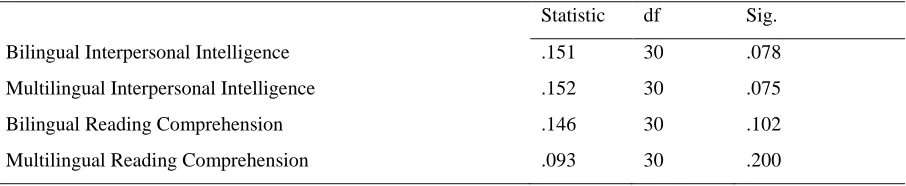
Like any other quantitative research, the first step in data analysis was to check the normality assumption. To determine the normality of distribution, the Kolmogorov-Smirnov test of normality was run on the intelligence scores and reading comprehension score, the results of which are presented in Table 2.
Table 2. Kolmogorov-Smirnov test of normality for the interpersonal intelligence as well as reading comprehension scores
Statistic df Sig.
Bilingual Interpersonal Intelligence .151 30 .078
Multilingual Interpersonal Intelligence .152 30 .075
Bilingual Reading Comprehension .146 30 .102
Multilingual Reading Comprehension .093 30 .200
As displayed in Table 2, the scores were normally distributed, p > 0.05.
4.3 Testing H1
The research hypothesis assumed that there is a significant relationship between the interpersonal intelligence of Iranian bilingual and multilingual EFL learners and their reading comprehension achievement. In order to test the hypothesis, the Pearson correlation coefficient was calculated, since the distribution of the data for all the scores was normal and running a parametric test was allowed. Tables 3 to 6 represent the results of descriptive and inferential statistics for testing the research hypothesis.
Table 3. Descriptive statistics of the bilingual participants’ scores on the interpersonal intelligence and reading comprehension tests
Bilingual Interpersonal Intelligence Bilingual Reading Comprehension
Mean 66.66 32.26
Std. Deviation 15.61 5.53
Minimum 40.00 24.00
Maximum 90.00 41.00
As Table 3 represents, the mean value and standard deviation of the bilingual participants on the interpersonal intelligence inventory were 66.66 and 15.61, respectively. The minimum and maximum scores on the interpersonal intelligence inventory were 40 and 90, respectively. In addition, their performance on the reading comprehension test was reported to have a mean value of 32.26 with a standard deviation of 5.53. The minimum and maximum scores on the reading comprehension test were 24 and 41, respectively.
Table 4. Correlation coefficients between the interpersonal intelligence and reading comprehension for the bilingual participants
Reading Comprehension of Bilinguals
Interpersonal Intelligence of Bilinguals
Pearson Correlation .549** Sig. (2-tailed) .002
N 30
**. Correlation is significant at the 0.01 level (2-tailed).
As seen in Table 4, there was a significant, positive correlation between the bilingual EFL learners’ interpersonal intelligence and their reading comprehension achievement, r =.549, N = 30, p < 0.001. Thus, the hypothesis is confirmed, and there is a significant relationship between bilingual EFL learners’ interpersonal intelligence and their reading comprehension achievement, i.e., higher interpersonal intelligence is associated with higher levels of reading comprehension achievement among bilingual EFL learners.
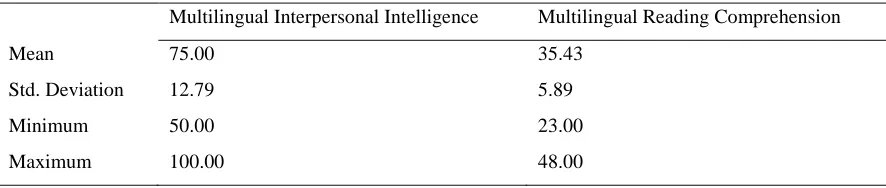
Table 5. Descriptive statistics of the multilingual participants’ scores on the interpersonal intelligence and reading comprehension tests
Multilingual Interpersonal Intelligence Multilingual Reading Comprehension
Mean 75.00 35.43
Std. Deviation 12.79 5.89
Minimum 50.00 23.00
Maximum 100.00 48.00
As Table 5 represents, the mean value and standard deviation of the multilingual participants on the interpersonal intelligence inventory were 75.00 and 12.79, respectively. The minimum and maximum scores on the interpersonal intelligence inventory were 50 and 100, respectively. In addition, their performance on the reading comprehension test was reported to have a mean value of 35.43 with a standard deviation of 5.89. The minimum and maximum scores on the reading comprehension test were 23 and 48, respectively.
Table 6. Correlation coefficients between the interpersonal intelligence and reading comprehension for the multilingual participants
Reading Comprehension of Multilinguals
Interpersonal Intelligence of Multilinguals
Pearson Correlation .363* Sig. (2-tailed) .048
N 30
*. Correlation is significant at the 0.05 level (2-tailed).
As seen in Table 6, the relationship between multilingualEFL learners’ interpersonal intelligence and their reading comprehension achievement was investigated using Pearson product-moment correlation coefficient. There was a positive correlation between the two variables, r =.363, N = 30, p < .05. Thus, the hypothesis was confirmed and there was a significant relationship between multilingual EFL learners’ interpersonal intelligence and their reading comprehension achievement, i.e., higher interpersonal intelligence was associated with higher levels of reading comprehension performance among multilingual EFL learners.
5. Discussion
Research works completed concerning the relationship between intelligence and learning during the past few decades has relatively consistently shown that learning is closely related to a higher IQ level and positive cognitive achievements (Sadighi, Yamini, & Mobashshernia, 2011). Following the same line of research, the present study revealed that there was a positive correlation between the interpersonal intelligence of both bilingual and multilingual learners and their achievement in the reading comprehension test.
This finding supports Richards and Rodgers’s (2001) arguments that “language learning and use are obviously closely linked with what MI theorists label Linguistic Intelligence” (p. 117). This finding is indirectly consistent with what Ahmadian and Hosseini (2012), Marefat (2007), Naseri and Nejad Ansari (2013), and Yeganehfar (2005) who found significant correlations between linguistic intelligence and writing tasks, writing strategies, and so forth. Further, in general, the finding is consistent with Marefat (2007) who concluded that interpersonal intelligence could also contribute to the prediction of the language-related issues. He concluded that kinesthetic, existential, and interpersonal intelligences made the biggest contribution to predicting the writing scores.
Again, in general, this finding is in partial consistency with a number of previous studies (Looi Lin & Ghazali, 2010; Naoe, 2010; Nolen, 2003; Saricaoglu & Arikan, 2009), which confirmed the existence of relationships between different types of intelligence as predictors of language-related variables in general and writing in particular. However, the results are contrary to some other studies (Razmjoo, 2008; Smith, 2001) which found that MI types could not predict language variables. Nevertheless, to the best knowledge of the present researchers, no specific study was found to show the relationship between the interpersonal intelligence and reading comprehension achievement.
6. Conclusion
The relationship between the interpersonal intelligence and reading comprehension achievement of Iranian bilingual and multilingual EFL learners can be accounted for via several explanations. A widely-known explanation belongs to Peal and Lambert (1962) who attribute higher intelligence scores of bi/multilingual speakers to greater mental flexibility and a greater facility in concept formation. They further believe that this can also be attributed to the bi/multilinguals’ ability in manipulation of two or more symbolic systems and simultaneous analysis of the underlying semantic features in greater details.
Intelligence is flexible and prone to improvement or decline. Human beings are born with an established set of genetically predisposed intelligences, which could be developed later in life, conditional on familial, social, cultural, and educational practices and experiences (Stanciu, Orban, & Bocos, 2011). Hence, the teaching-learning process plays a substantial role in developing, cultivating, and optimizing EFL learners’ MI profiles. Every single learner is capable of displaying all the intelligences with different levels, and “the challenge in education is for teachers to create learning environments that foster the development of all the intelligences” (Haley, 2004, p. 163). Actually, on the one hand, the findings of this study could discrepantly contribute to the current body of literature on the MI theory and reading, and on the other hand, it could bold the interrelationships of MI, as psychological constructs, and EFL education. Approaching EFL instruction with MI deliberations paves the way for more fruitful education.
References
Adams, M. J. (1990). Beginning to read: Thinking and learning about print. Cambridge, MA: MIT Press.
Afflerbach, P. (2002). Teaching reading self-assessment strategies. In C. Block & M. Pressley (Eds.), Comprehension
instruction: Research-based best practices (pp. 96-111). New York: Guilford Press.
Anderson, N. (1999). Exploring second language reading: Issues and strategies. Boston, MA: Heinle and Heinle publisher. Chamot, A., & O’Malley, M. (1996). The academic cognitive language learning approach: A model for linguistically
diverse classrooms. The Elementary School Journal, 96(3), 259-273. https://doi.org/10.1086/461827 Chiramanee, T., & Thangyon, P. (2011). The effects of pre-reading activities on reading comprehension ability.
Retrieved March 1, 2013, from http:// sv.libarts.psu.ac.th/conference5/proceedings/Proceedings3/.../003 Clandfield, L., & Foord, D. (2006). Teaching English overseas: Using newspapers in the classroom.
http://www.transitionsabroad.com/publications/magazine/0601/teaching_english_oerseas_using_newspapers_ classroom.shtm
Davies, F. (1995). Introducing Reading. England: Penguin Book.
Dreyer, C., & Nel, C. (2003). Teaching reading strategies and reading comprehension within a technology-enhanced
learning environment. System, 31(30), 349-365. https://doi.org/10.1016/S0346-251X(03)00047-2 Emery, E. (1968). Introduction to mass communication. New York: Dodd, Mead and Company, Inc.
Fairclough, N. (2001). Critical discourse analysis as method in social scientific research. In R. Wodak, & M. Meyer (Eds.), Methods of critical discourse analysis (pp. 121-129). London: SAGE.
Fenholt, J. (1985). The newspaper: Your key to better living. Using the newspaper in adult education classes. American Newspaper Publishers Association (ANPA) Foundation, Washington, DC.
Garner, R. (1994). Metacognition and executive control. In R. Ruddell, M. Ruddell, & H. Singer (Eds.), Theoretical
models and processes of reading (4th ed.; pp. 715-732). Newark, DE: International Reading Association.
Goodman, K. S. (1967). Reading a psycholinguistic. Journal of the Real Specialist, 6(4), 126-135.
https://doi.org/10.1080/19388076709556976
Grabe, W. (1991). Current developments in second language reading research. TESOL Quarterly, 25(3), 375-406. doi: 10.2307/3586977 http://www.jstor.org/stable/3586977
Grabe, W. (1997). Discourse analysis and reading instruction. In T. Miller (Ed), Functional approaches to written
text: Classroom applications (pp. 2-15). Washington, DC: United States Information Agency. Retrieved from:
eric.ed.gov/?id=ED417422.
Hedge, T. (2003). Teaching & learning in the language classroom. UK: OUP.
Hess, N. (1987). Newspapers in the English classroom: Stressing sociolinguistic communicative competence in an authentic framework. English Teachers Journal, 35, 70-71.
Howden, G. (1990). Workplace literacy. Paper presented at the ANPA Foundation Literacy Conference. [ED 323 364].
Janzen, J., & Stoller, F. (1998). Integrating strategic reading in L2 instruction. Reading in a Foreign Language, 12(1), 251-269. https://eric.ed.gov/?id=EJ583987
Jimenez, R. T., Garcia, G. E., & Pearson, D. P. (1996). The reading strategies of bilingual Latino students who are successful English readers: Opportunities and obstacles. Reading Research Quarterly, 31(1), 90-112.
https://doi.org/10.1598/RRQ.31.1.5
Kintsch, W. (1998). Comprehension: A paradigm for cognition. New York: CPU.
Kitao, K. (1995). Teaching English through newspapers. English Literary Society of Doshisha University.
Mokhtari, K., & Reichard, C. (2002). Assessing students’ metacognitive awareness of reading strategies. Journal of
Educational Psychology, 94(2), 249-259. https://eric.ed.gov/?id=EJ648499
Mokhtari, K., & Reichard, C. (2004). Investigating the strategic reading processes of first and second language readers
in two different cultural contexts. System, 32(3), 379-394. https://doi.org/10.1016/j.system.2004.04.005 Monda, L. E., Vail, C. O., & Koorland, M. A. (1988). Newspapers and LD students. Journal of Reading, 31(7),
678-679.
Moorman, K., & Ram, A. (1994). Integrating creativity and reading: A functional approach. Proceedings of the Sixteenth Annual Conference of the Cognitive Science Society: Cognitive Science Program. Georgia Institute
of Technology. Hillsdale, NJ: Lawrence Erlbaum Associates. National Reading Panel. (2000). Report of the National Reading Panel: Teaching children to read. Washington, DC:
U.S. Department of Health and Human Services. Palincsar, A. S., & Brown, A. L. (1984). Reciprocal teaching of comprehension fostering and
comprehension-monitoring activities. Cognition and Instruction, 1(2), 117-175. https://doi.org/10.1207/s1532690xci0102_1 Panah, E. (2009). Strategies for learning and Remembering of Vocabulary Items by Learners. A Thesis Submitted in
Partial Fulfilment of the Requirement Iranian EFL for M.A Degree. Pressley, G. M. (2002). Reading instruction that works: The case for balanced teaching (2nd ed.). New York: The
Guildford Press. Salas-Isnardi, F. (n.d.). Some ideas for the use of a newspaper in the E.L.A.P. class. Unpublished manuscript. Salinger, T. (2003). Helping older, struggling readers. Previewing School Failure, 47(2), 79-87.
https://doi.org/10.1080/10459880309604434
Sanderson, P. (2002). Using newspapers in the classroom. CUP.
https://www.developingteachers.com/books/review_unitc.htm.
Stahl, K. A. D. (2004). Proof, practice, and promise: Comprehension strategy instruction in the primary grades. The
Reading Teacher, 57(7), 598-609. https://steinhardt.nyu.edu/scmsAdmin/uploads/006/713/StahlpppRT.pdf
Tafani, V. (2009). Teaching English through mass media. Acta Didactica Napocensia, 2(1), 81-95.
https://eric.ed.gov/?id=EJ1052325
Toben, M. (1987). Using the newspaper in the classroom: A check list for intermediate and advanced classes. English
Teachers Journal, 35, 79-82.
Varzegar, M. (1995). The discoursal aspects of reading comprehension. Pazhuhesh, 11, 109–120. Wallace, C. (1992). Reading. Oxford: Oxford University Press.
Williams, E. (1996). Reading in the language classroom. UK: Hert Fortshire Phoenix, elt