Page 43
Fall 2018, Vol. 7, No. 2, Page 43-68 thejsms.org
Exploring the potential of social media platforms as
data collection methods for accessing and
understanding experiences of youth with disabilities:
a narrative review
Meaghan Walker1, Dr. Gillian King1,2, and Dr. Laura Hartman1,
1Bloorview Research Institute, Holland Bloorview Kids Rehabilitation Hospital, Toronto, ON
2 Department of Occupational Science and Occupational Therapy, University of Toronto, Toronto, ON
Social media (social media) is a critical component of youth culture, and may provide a useful platform for exploring young people’s authentic voices. This narrative review considers how researchers are exploring the experiences of youth with disabilities using social media. Five health and social science databases were searched using terms related to ‘social media’ and ‘data collection’. Articles were reviewed for relevancy. Narrative analysis was undertaken. Searches returned 1524 results, of which 15 articles were included. Social media -based data collection methods fell into three categories: 1) observational; 2) interactive; and 3) combined online/offline, each offering unique advantages to
data collection. Literature suggests that social media can be used to effectively explore self-care, coping and social experiences of youth with health conditions, however youth with disabilities were notably absent from all three categories. As a prominent component of youth culture, researchers have turned to social media -based data collection methods to understand youths’ real-world experiences. It is imperative, however, that the voices of youth with varied abilities and backgrounds be included in the conversation. Keywords: Social Media, data collection, youth, social engagement
oung people, regardless of dis/abilities, increasingly turn to social media as their primary mode of social communication and
expression (Park & Calamaro, 2013). Social media refers to any number of virtual interactive spaces that permit individuals to connect and interact (Cheung, Chiu, & Lee, 2011). Social media has become increasingly prevalent in the lives of adolescents (11-21) and young adults (18-25) in Western culture, together representing the largest group of social media users (Park & Calamaro, 2013). Social media, in fact, has become so rooted in the daily activity of young people that an estimated 75% of youth in the continental Unites States access social media sites daily (Park & Calamaro, 2013; Pew Research
Understanding Experiences of Youth with Disabilities
44 | Fall 2018 thejsms.org
Center, 2011). Social media communications are demonstrated to influence
individual and cultural interactions, as well as how personal information is shared (Alshaikh, Ramzan, Rawaf, & Majeed, 2014; Kosinski, Matz, Gosling, Popov, & Stillwell, 2015).
Just as young people have found in social media a platform to contribute to global discussions and have their voices heard, social scientists have found in social
media an avenue for accessing young people’s voices (McGarry, 2016). Through
social media platforms, social scientists have indeed begun to incorporate the voices of young people into the academic discussion of their own lives, and gain more
authentic understandings of young people’s lived experiences (McGarry, 2016). Such
increased ability and effort to incorporate youth voices into research via social media platforms aligns with the call within social science research to involve youth more actively in research about their own lives (Elden, 2012). Social media
represents a natural platform for including the voices and experiences of a broad representation of North American youth, as it has become a platform of authentic daily social and interactive experiences of youth (Park & Calamaro, 2013). It is through the push for increased inclusion of youth participants in research, and the increasingly prominent role of social media in the lives of those youth, that
researchers have begun to explore the utility of social media in the social research process.
The Journal of Social Media in Society, Vol. 7, No. 2
researchers, most prominently in the health care field, have begun incorporating the use of social media at various stages of the research process, including
participant recruitment, data collection and analysis, and knowledge dissemination (Lafferty & Manca, 2015). In fact, Shapka, Domene, Khan and Yang (2016) propose that online data collection methods may be among the most effective methods for collecting data on adoelscents and young adults (13-24 years old), further arguing that social media -based data collection may be more ecologically valid for certain demographics, such as vulnerable populations, or geographically isolated youth. Alshaik et al. (2014) additionally describe social media as a ‘powerful tool’ that can offer researchers copious amounts of information, and has the potential to obtain contextually situated and rich data.
While social media platforms are gaining footing as environments and tools for data collection with young people in general, they have been slow to be
incorporated into one particular subset of the youth population, namely, youth with disabilities (Raghavendra, Wood, Newman, & Lawry, 2012). The World Health Organization defines disability as an “umbrella term for impairments, activity limitations and participation restrictions, referring to the negative aspects of the interaction between an individual (with a health condition) and that individual’s
contextual factors (environmental and personal factors)” (World Health
Organization, 2011). This definition aligns with the conceptualization of disability in the current review. In the past twenty years, research methods in the areas of health and disability studies have evolved from relying almost exclusively on biomedically-oriented methods that capture quantifiably measurable, objective outcomes, to the inclusion and valuing of methodologies that capture the
experiential, lived understandings of young people with disabilities (McGarry, 2016). Research on the lives and experiences of youth with disabilities has progressed from focusing on the impairing condition evident in the child (derived from the biomedical model) to a more holistic and contextual approach that
Understanding Experiences of Youth with Disabilities
46 | Fall 2018 thejsms.org
factors (representing a more biopsychosocial approach) (Hubbard, 2004; King, Imms, Stewart, Freeman, & Nguyen, 2017; Wickenden & Kembhavi-Tam, 2014).
In order to understand youth with disabilities as social, emotional, and agentic persons living in particular contexts, we must reconsider how we access their social experiences as young people with disabilities, rather than focusing on disability in young people. To accomplish this conceptual shift from viewing and studying disabled young people to understanding experiences of young people with disabilities, we must reconsider the ability of the types of questions that we ask and the research methods that we employ to appropriately capture their holistic and contextualized lived experiences. As our field of inquiry evolves to incorporate broader understandings of childhood disability and its impacts, so too must the ways in which research is conducted. In diversifying the type of information we seek, as rooted in the types of questions we ask, we create opportunities to understand young people with disabilities in a manner that more authentically captures their experiences in various facets of life.
Social media has emerged as a novel context for data collection with general youth populations, allowing researchers unique access to their social interactions and evolving youth culture in the environment of the new millennium (Alshaikh et al., 2014; Kosinski et al., 2015; Lafferty & Manca, 2015). In the current review, we consider youth experiences that include: the actions, reactions, and rationales of
presenting oneself and one’s experiences on a platform meant to be viewed by and
interacted with by others, whether directly or indirectly. For our purposes, the platforms for expressions are social media websites, however the ways that young people act, react and interact with each site varies. Online interactions included original items such as posts or direct messages, reaction items such as comments, and interaction items such as conversation threads. Due to the evolving nature of
social media platforms, we considered the each study’s social media platform in the
The Journal of Social Media in Society, Vol. 7, No. 2
In order to understand how data collection methods incorporating social media can be used to explore the social experiences of youth with disabilities, we undertook a review of the literature on how social media platforms have been used in social participation research for such youth. Due to the limited number of articles returned during our searches for this particular population, we expanded our focus to include all youth in the hopes that our findings would drive future research with youth with disabilities and other populations. As such, the current paper explores social media as a tool for conducting research on general youth populations, with our discussion more explicitly considering research methods with youth with
disabilities.. Through the current narrative synthesis, we explore how social media has been used as a data collection tool for exploring the social experiences of youth with varied levels of ability in order to further understand how it can be used to access authentic experiences of youth and young adults with disabilities, and the unique ethical considerations that accompany these methodological innovations.
METHODS
A narrative literature review (Greenhalgh, Wong, Westhorp, & Pawson, 2011) was conducted in May to July of 2016, to explore the use of social media as a method of data collection for examining the social experiences of young people. The two objectives were to: (1) determine the nature of social media -based methods of data collection; and (2) explore the ethical considerations of such research
undertakings. Preliminary explorations of the literature were conducted in
conjunction with a health science librarian to construct a search strategy for social media -based research with youth with disabilities, which returned no available studies. As such, our team along with the librarian re-constructed the search without terms related to disability, as described below.
Article inclusion criteria consisted of: (1) data collection methods using social media or social networks as defined as a virtual community which allows people to connect and interact (Cheung et al., 2011); (2) adolescent or young adult
Understanding Experiences of Youth with Disabilities
48 | Fall 2018 thejsms.org
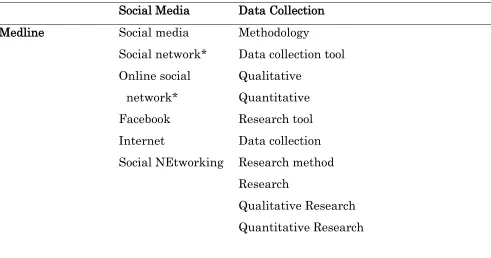
(4) available through our institutional or affiliated databases; and (5) published in peer reviewed resources (journals, conference proceedings, theses). Articles were excluded if they: (1) did not present the methods or ways in which the researchers used social media for data collection purposes; (2) were grey literature or non-academic resources; (3) defined social media in a way that did not meet the criteria as defined above. Five medical, allied health, and social science electronic databases (PsycInfo, Medline, Social Work Abstracts, Cumulative Index of Nursing and Allied Health Literature (CINAHL), and Social Science Abstracts) were searched using terms related to ‘social media’ and ‘datacollection’ (see Table 1). Search terms across databases were similar, but varied slightly based on database restrictions. Results were limited adolescent (13-18 years old) and young adult (18-24 years old) participants.
Table 1
Key Words/Search Terms used on Medline, as an example Social Media Data Collection
Medline Social media
Social network* Online social
network* Facebook Internet
Social NEtworking
Methodology
Data collection tool Qualitative
Quantitative Research tool Data collection Research method Research
Qualitative Research Quantitative Research
The Journal of Social Media in Society, Vol. 7, No. 2
discrepancies regarding article inclusion were settled by discussion with the third author (GK). The first author extracted and charted relevant information from all included articles, and a random subset of 20% was charted by the supervising author to ensure accuracy. Charted data included bibliographic information (e.g. title, author, publication year, country of origin, researcher background),
methodological information (e.g. research question, population, methods, analysis) and results (e.g. type of social media used, key findings) (Bae, 2014). Once the data were charted, articles were analyzed according to methods used for data collection, which will be further outlined in the results section.
RESULTS
Our search returned a total of 1021 unique titles. After the titles were reviewed for fit with inclusion criteria, 90 remained for further examination (see Figure 1). Two reviewers (MW, LH) independently examined the 90 abstracts,
which resulted in 33 articles retained for full review. After reading 33 articles in full guided by our inclusion criteria, 15 articles met inclusion criteria and were included in the final sample.
The majority of the articles originated from the United States (n=8), followed by the UK (n=4), New Zealand (n=2), and Canada (n=1). When examining the articles by year of publication the number of articles available on this topic was found to increase chronologically beginning in 2010 (n=1), followed by 2013 (n=3), 2014 (n=3), 2015 (n=6) and 2016 (n=2). While the articles increased chronologically, there was a decrease in 2016, which may be attributed to the articles being collected in May of that year. When considered by discipline of the authors, presented studies were most often conducted by multi-disciplinary research teams with
representation from nursing/health fields (n=11), followed by media studies (n=5), disability studies (n=1), geography and bioethics (n=1). Due to the multidisciplinary nature of this type of work, papers are listed under the multiple disciplines to
Understanding Experiences of Youth with Disabilities
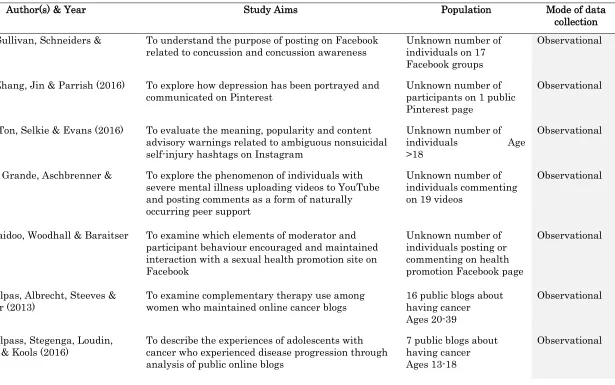
50 | Fall 2018 thejsms.org Table 2
Summary of Included Articles
Author(s) & Year Study Aims Population Mode of data
collection Ahmed, Sullivan, Schneiders &
McCrory (2010)
To understand the purpose of posting on Facebook
related to concussion and concussion awareness Unknown number of individuals on 17 Facebook groups
Observational
Guidry, Zhang, Jin & Parrish (2016) To explore how depression has been portrayed and
communicated on Pinterest Unknown number of participants on 1 public Pinterest page
Observational
Moreno, Ton, Selkie & Evans (2016) To evaluate the meaning, popularity and content advisory warnings related to ambiguous nonsuicidal self-injury hashtags on Instagram
Unknown number of individuals Age >18
Observational
Naslund, Grande, Aschbrenner &
Elwyn (2014)
To explore the phenomenon of individuals with severe mental illness uploading videos to YouTube and posting comments as a form of naturally occurring peer support
Unknown number of individuals commenting on 19 videos
Observational
Syred, Naidoo, Woodhall & Baraitser
(2014) To examine which elements of moderator and participant behaviour encouraged and maintained interaction with a sexual health promotion site on Facebook
Unknown number of individuals posting or commenting on health promotion Facebook page
Observational
Keim-Malpas, Albrecht, Steeves &
Danhauer (2013) To examine complementary therapy use among women who maintained online cancer blogs 16 public blogs about having cancer Ages 20-39
Observational
Keim-Malpass, Stegenga, Loudin,
Kennedy & Kools (2016) To describe the experiences of adolescents with cancer who experienced disease progression through analysis of public online blogs
7 public blogs about
having cancer Ages 13-18
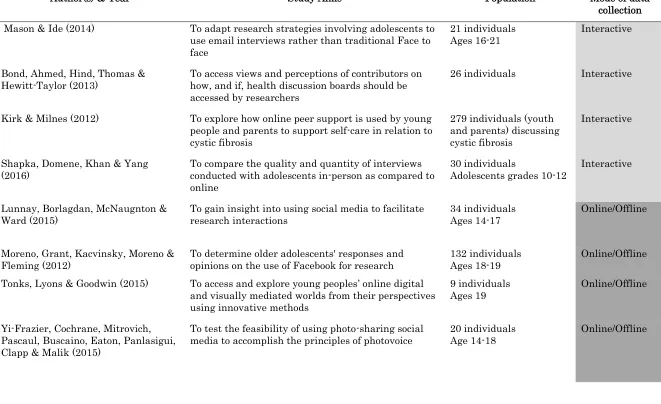
The Journal of Social Media in Society, Vol. 7, No. 2 Table 2
Summary of Included Articles
Author(s) & Year Study Aims Population Mode of data
collection Mason & Ide (2014) To adapt research strategies involving adolescents to
use email interviews rather than traditional Face to face
21 individuals Ages 16-21 Interactive
Bond, Ahmed, Hind, Thomas &
Hewitt-Taylor (2013) To access views and perceptions of contributors on how, and if, health discussion boards should be accessed by researchers
26 individuals Interactive
Kirk & Milnes (2012) To explore how online peer support is used by young people and parents to support self-care in relation to cystic fibrosis
279 individuals (youth and parents) discussing cystic fibrosis
Interactive
Shapka, Domene, Khan & Yang
(2016) To compare the quality and quantity of interviews conducted with adolescents in-person as compared to online
30 individuals Adolescents grades 10-12 Interactive
Lunnay, Borlagdan, McNaugnton &
Ward (2015) To gain insight into using social media to facilitate research interactions 34 individuals Ages 14-17 Online/Offline
Moreno, Grant, Kacvinsky, Moreno &
Fleming (2012) To determine older adolescents' responses and opinions on the use of Facebook for research 132 individuals Ages 18-19 Online/Offline Tonks, Lyons & Goodwin (2015) To access and explore young peoples’ online digital
and visually mediated worlds from their perspectives using innovative methods
9 individuals
Ages 19 Online/Offline
Yi-Frazier, Cochrane, Mitrovich, Pascaul, Buscaino, Eaton, Panlasigui, Clapp & Malik (2015)
To test the feasibility of using photo-sharing social
Understanding Experiences of Youth with Disabilities
Page 52
The Journal of Social Media in Society Fall 2018, Vol. 7, No. 2, Page 43-68 thejsms.org
Three overarching categories of data collection involving young people’s social participation as they perceive and/or enact it via social media platforms emerged from our included sample, which aligned with Lafferty and Manca’s (2015) categorization of social media data collection methods, and can be found in Figure 2. The first two methods for using social media as a data collection tool, suggested by Lafferty and Manca, (2015) include observational and interactive methods. Observational data collection methods refer to using real-time or retrospective online content which is publically available, such as open content on open social media sites, or open personal profiles on various sites (Lafferty & Manca, 2015). Observational methods do not require participant consent or even knowledge of the data collection process. Interactive data collection methods, refer to methods requiring some degree of participant consent and knowledge of researchers’
intent to access their online content for the purposes of research, and may also include other forms of participant-researcher interaction such as online interviews (Lafferty & Manca, 2015). There is also the recent emergence of a combined online/offline data
collection method, which combines either online observational or interactive methods with supplementary or complementary offline elicitation methods (e.g. interviews, focus groups, surveys) to obtain perceptions of online experiences. Online components mirror the
observational and interactive approaches outlined above, and the offline components provide insight into and reflection on the context of social media engagement and
participation. The combined online/offline approach allows for the exploration of the ways in which young people participate (act and interact) in social media contexts, as well as their reflections on what such participation choices mean for their connections,
The Journal of Social Media in Society, Vol. 7, No. 2
Figure 1. Methods of social media -based data collection
Observational social media-based data collection methods
Seven of the included articles utilized an observational approach to data collection (Ahmed, Sullivan, Schneiders, & McCrory, 2010; Guidry, Zhang, Jin, & Parrish, 2016; Keim-Malpass, Albrecht, Steeves, & Danhauer, 2013; Keim-Malpass, Stegenga, Loudin, Kennedy, & Kools, 2016; Moreno, Ton, Selkie, & Evans, 2016; Naslund, Grande,
Aschbrenner, & Elwyn, 2014; Syred, Naidoo, Woodhall, & Baraitser, 2014). All of these articles were conducted by researchers in the health field seeking information about public perception of youth, health promotion for youth, or personal experiences of youth with particular health conditions, but this sample did not include youth with physical disabilites.
Observational data collection refers to research practices in which publicly available postings are accessed to explore online social interactions and patterns, and the
permission of people who post on social media platforms) is not explicitly sought by the researchers (Lafferty & Manca, 2015). It is important to note that people who post in public forums are presumed to do so with the knowledge that the information that they
Combined Online/Offline
Includes components of observational and/or interactive methods, with an offline (in-person) component Examples of offline components include navigation of
social media realms with participants and interviews Offline components provide insight into the context of social media engagement, participation, and performance
Interactive
May include observation of online actions as well At least minimal participant interaction required to gain
consent required
May include communication and interaction with participants via social media platform
Observational Observing public online actions
Understanding Experiences of Youth with Disabilities
54 | Fall 2018 thejsms.org
share will be available to the public for multiple viewers. Therefore, what is observable to researchers and others online is a context-specific performance, just as there would be in any sphere of interaction. Researcher observation of such activity would theoretically not impose on the ways that they share or post. There are, however, ethical implications in assuming that those who post possess an informed understanding that their
communications may be used for purposes such as research, which will be addressed in the Ethical Considerations section below. The goals of observing the naturalistic
interactions as they occur online is to analyze, understand, and interpret how youth construct their identities online, present themselves, and (inter)act in online social environments. This information can then be compared to data on the same constructs in other social settings regarding how young people can, and choose to, construct and
perform their identities and drive social interactions. With this information, we can begin to identify the possibilities and challenges of interacting in 21st century online
environments, and how such social practices and identities compare to, and may impact, participation and engagement in offline environments.
Keim-Malpass et al. (2013; 2016) proposed observational data collection on social media platforms as a novel way of capturing authentic narratives of participants. The literature suggests the utility of multiple approaches to observational data collection using social media . One approach includes observing and collecting data from publically
The Journal of Social Media in Society, Vol. 7, No. 2
the authors to understand how particpants storied and performed their experiences of a particular condition for their online audiences without impacting participants’
presentation of the expeirneces or imposing researcher bias (Keim-Malpass et al., 2016). Similarly, Keim-Malpass et al. (2013) took an observational approach to explore women’s experiences of having cancer between the ages of 20-39. The authors wanted to explore the use of complementary therapies, and the overall experiences, of women undergoing cancer treatment and turned to online blogs to gather such information. This appraoch allowed the researchers insight into the personal accounts of their desired population without imposing researcher bias or influencing how the participants chose to share their experiences.
Another common observational data collection method is analysis of online interaction and/or reaction in the forms of comments and posts on popular social media sites (Ahmed et al., 2010; Guidry, Carlyle, Messner, & Jin, 2015; Guidry et al., 2016; Moreno et al., 2016; Naslund et al., 2014; Syred et al., 2014). Observation of online interactions permits researchers to observe conversations and behaviours without
researcher influence, interferance, or even permission (Lafferty & Manca, 2015)). Naslund et al. (Naslund et al., 2014) suggest that one common limitation of face-to-face research is perceived researcher influence in people’s typical interaction or their comfort in
Understanding Experiences of Youth with Disabilities
56 | Fall 2018 thejsms.org
participants focusing on negative events in their lives. While there are potential benefits of avoiding risks of potential traumatic thoughts, and the information is technically within the public domain, researchers must be mindful that the information they are gathering was not originally posted for the purpose of research, and through the research may be shared with audiences that were not original targets. Because of this, maintaining the confidentiality of posters must be a priority. Using direct quotes or personal demographic information disclosed in posts or blogs puts researchers at risk for compromising the confidentiality of contributors (Lafferty & Manca, 2015). Researchers must ensure they avoid using any information that risks breaching confidentiality of the posters, espeically because consent was not granted by posters for researchers to use such information.
Naslund et al. (2014) proposed that social media is frequently a place where youth share their stories and experiences while trying to relate to others experiencing similar situations. Exploring interactions on social media platforms may provide researchers with insight into the lives of these youth that is inaccessible through traditional data collection methods. Naslund et al. (2014) suggested that observational data collection using social media platforms allows researchers to access “real world data” with less researcher interference than ever before. Keim-Malpass et al.’s (2016) work, discussed above, provides an example of online observation in which researchers’ questions or mere
presence in youths’ environments did not influence participants’ chosen expression of their experiences.
Interactive social media -based data collection methods
The Journal of Social Media in Society, Vol. 7, No. 2
The most commonly used method of interactive data collection was online
participant interviews (Bond et al., 2013; Mason & Ide, 2014; Shapka et al., 2016). Such interviews occurred over instant messaging hosted on a social media website (Shapka et al., 2016) or over e-mail (Bond et al., 2013; Mason & Ide, 2014). Participants in Shapka et al.’s study (2016) reported that they enjoyed the process more when interviewed online than in person, were more comfortable sharing information with interviewers online, and built a stronger rapport with researchers online. In Mason and Ide’s (2014) study, youth reported that online interviews decreased their perceptions of a power differential between themselves and the researcher, while promoting their empowerment and a greater sense of control over what they could and should share. Further, Mason and Ide (2014) reported that the online interview process may decrease the influence of parents or
gatekeepers on participants’ ability or decision to participate in an online interview.
Participants shared that they appreciated the ability to answer questions on their own time and have opportunities to consider their responses rather than feeling pressure to respond immediately to a question that was posed to them, as they may feel in a face-to-face interview (Mason & Ide, 2014).
Such online methods have further been found to maintain, equally to traditional methods, confidentiality while providing participants the opportunity to participate in a natural, comfortable enviornment (Mason & Ide, 2014). To understand the differences both in data received and in participant perception of in-person versus online interviews, Shapka et al., (2016) conducted online interviews and in person interviews to compare the processes and results. They found that while the two interview formats were structurally different, the number and content of themes that emerged from both were almost equal (Shapka et al., 2016).
Another form of interactive online data collection present in our sample mirrors the observational data collection practices discussed above, with the important difference of gaining permission of individuals or forums prior to collecting the observational-style data. In this way, researchers were able to collect the desired and more ‘natural’ online
interactions taking place on discussion boards, forums, profiles and social media site
groups without directly or interacting with the environment’s participants for prolonged
Understanding Experiences of Youth with Disabilities
58 | Fall 2018 thejsms.org
ethical concerns (Bond et al., 2013; Kirk & Milnes, 2016). Kirk and Milnes (2016), for example, explored the support provided and received on an online Facebook group for parents and youth with cystic fibrosis. They found that online enviornments provided participating families who were geographically disconnected with a means to connect, interact, and share experiences with others facing similar situations. The participants were not directed to post anything in particular, nor were they asked specific questions. Rather, the intent was for researchers to observe the online conversations that occurred within the Facebook environment (Kirk & Milnes, 2016). This approach was beneficial as researchers had access to online behaviours and interactions that may not have been publically avaliable, and were able to target a specific population while observing their online conversations and interactions. However, while gaining access to partipants’ online profiles provides researchers with an abundance of information and insight into the
virtual reality, social participation, and performed self of the participant it is imperative that the researcher is clear when explaining to participants the types of information they will access, and subsequently adheres to such boundaries.
Combined Online/Offline social media -based data collection
The third set of methods for social media -based data collection that we have
identified is a combination of the online (observational or interactive) and offline methods. Offline data collection methods can include surveys, interviews, observations, or other forms of data collection which are used to complement or supplement the online data collection. Topics of the offline data collection can include additional information about the online platform on which the participants are interacting, or additional information
The Journal of Social Media in Society, Vol. 7, No. 2
online/offline approach. The combined approach provided a means of obtaining online social media data, on which participants interact and perform as their online selves, while allowing a space for participants to subjectively explain the reasons and rationales behind their online social behaviours and actions.
Combining both online and offline methods was considered by reserachers to provide them with a more holistic understanding of the intent, meaning, and behaviour patterns of the participants’ online activities (Tonks et al., 2015). An example of such combined methods is presented by Yi-Frazier et al. (2015), who examined how youth share about their experiences of having Type 1 Diabetes. The youth were asked to post
photographs related to their illness on Instagram, for both the researchers and whomever else the participants choose to allow access to their account to view, at least three times per week for three weeks before being interviewed about their chosen photographs and captions. Such a combined online/offline approach provided the researchers with insight into the young people’s opinions and thoughts about their illness, while having them subjectively interpreted by the young person for the intent of the post and expanded explanations (Yi-Frazier et al., 2015). Tonks et al. (2015) similarly saw the benefit of incorporating both social media -based and offline methods of data collection, and had participants navigate their personal Facebook profiles throughout an interview to provide a memory aid and prompt for participants in addition to hearing their interpretations of online activity. Lunnay et al. (2015) also used Facebook in conjunction with in-person interviews to explore the social influences of consuming alcohol among underage females. Lunnay et al.’s (2015) study offered an opportunity for participants to feel empowered and in control by allowing them to direct the conversation and guide the researcher in their virtual world by using pictures to help tell their stories and share their experiences.
Understanding Experiences of Youth with Disabilities
60 | Fall 2018 thejsms.org
share any entity of the social medium that is available to them with the researcher, yet researchers must remain responsible to not include information from or about non-participants.
Online media allow for access to an abundance of information, however, Tonks et al. (2015) advise that such information should be interpreted in context, with consideration of
the participants’ original intent, requiring participant voice beyond the mere writing of the
original online comment. Through combined online/offline methodologies, researchers do not treat online content (pictures, text) as objective data; rather, for the most accurate understanding of a young person’s online profile researchers interact with the youth to access their subjective interpretations of their online actions. To best understand
participants’ experiences on and via social media, the participant’s interpretation and
explanation not only strengthens the online content but also enriches the data with additional interpretations of their personal understandings of their alternative, online worlds (Tonks et al., 2015).
DISCUSSION
Recently there has been a push for developing and exploring innovative
methodologies that will provide access to the natural voices of young people (Elden, 2012). Researchers must adapt their methods of data collection in order to meet our participants in the forums and environments where they naturally and comfortably express
themselves. Social media has gained popularity in the last two decades and become an essential component to youth culture for communication, identity and expression (Alshaikh et al., 2014; Kosinski et al., 2015). Following from its cultural and social ubiquity in the lives of Western young people, social media has emerged as a relevant platform for data collection in social and health science research, which aligns with its emergence as an integral platform for socialization in this population (Kosinski et al., 2015). The three methods of data collection outlined in the results represent ways in which researchers are using social media in the data collection process as a way of accessing the natural and authentic 21st century experiences of youth. These three methods offer
The Journal of Social Media in Society, Vol. 7, No. 2
suited to answer certain types of questions, and is associated with unique benefits. Thus, it is important that researchers consider which approach will best help them reach their target participant population, and answer their research question.
Youth with disabilities are seemingly frequently excluded from research exploring youth more generally. We posit that this is related to the types of questions asked, and further exacerbated by the accessibility of the research methods used to connect with participants. Thus, it is imperative that methodologies are formulated to include young people with disabilities in ways that emphasize their participation in their larger youth-culture (Raghavendra et al., 2012) that consider the accessibility of the methods. As
demonstrated through the current review, social media has shown to be a valuable tool for accessing youth voice. It may be more valuable, however, for accessing the voices of youth with disabilities for numerous reasons. Primarily, it offers additional options to voice experiences and opinions to youth who do not communicate verbally. For example, an online forum for communicating with peers and researchers may allow insight into the thoughts and experiences of young people who do not communicate in traditional verbal ways (Hemsley & Murray, 2015). Social media may provide a more equitable space for communication, arguably “leveling the playing field” for youth with communication difficulties (Hemsley & Murray, 2015). Moreover using social media, particularly
interactive data collection, for youth with communication challenges may be beneficial as it allows the young person more time to formulate their answer without the in-person pressure.
Many youth with disabilities use social media as one of their main form of
communication and socialization, due to the many challenges that can be associated with face-to-face communication and socialization (Shpigelman & Gill, 2014). Accessibility of interviews (both environmental and communicative) may be a challenge for some
participants with disabilities and social media data collection could pose a solution to this. Some young people with disabilities face accessibility challenges, and social media
Understanding Experiences of Youth with Disabilities
62 | Fall 2018 thejsms.org
observation of youth with disabilities in online forums would therefore be an authentic way to understand their social and cultural patterns and engagement. Further to
observation, for the reasons discussed above, interaction with youth with disabilities in an online forum increases the options for them to communicate and physically access
research opportunities. For example, if a participant has the option to be involved with research online, they may be more willing or able to participate as it elevates some of the physical environmental accessibility and transportation concerns. Such forums would also allow for both written and verbal communication options that would expand the
population able to participate in studies and provide their voice to research and resulting programs or services. These forums would also provide the option for youth to consider their answers and reply out-of-sync, which was helpful for other youth participants, and would align with the needs of youth with cognitive delay to consider their answers rather
than feeling put ‘on the spot’ to answer complex social and/or emotionally-based research
questions. It is imperative that we hone in on these new technologies and utilize them as ways of accessing the voices of youth with disabilities.
We do note, however, that alongside the use of technology required to access online platforms come costs. The costs of equipment, internet access, and training for online use may present barriers to participation. This may further marginalize subsets of youth with disabilities, namely those with lower income and those in rural/remote areas with limited internet access options. Additionally, some youth with more involved communication devices and systems may require additional adaptation regarding programming and engineering, as well as subsequent training, to access online platforms through their communication systems. These challenges are not easily met, and should not
automatically deter researchers from using online platforms, but should be a consideration.
Additional unique and important concerns have been associated with undertaking research in the online realm. Ethical considerations beyond those of face-to-face research practices must be taken into account when including social media data collection methods. Indeed, there is a flourishing body of literature devoted directly to the ethical
The Journal of Social Media in Society, Vol. 7, No. 2
ensure privacy and confidentiality of participant posters (Luh Sin, 2015), particulalrly in light of increased ease of online search engines and techniques and archiving of social media sites (Lafferty & Manca, 2015). Such protection is particularly important when researchers access publicly available data (observational) for which research was not the initial purpose of the posting and informed consent was not obtained. Researchers must recognize a legal and moral obligation in research to maintain our ethical research standards and thus maintain confidentiality of participants.
Another ethical concern that has arisen in the literature is the blurring lines between the participants’ and researchers’ private and public spheres (Lunnay et al., 2015). Particularly, it is the researcher’s obligations ensure that participants are
adequately informed of the scope of what the researcher will consider (and access) as ‘data’ when participants provide the researcher with access to an online profile (Luh Sin, 2015; Monks et al., 2015; Moreno, Goniu, Moreno, & Diekema, 2013), as well as what this may mean for the participant’s personal privacy and confidentiality. Such implications for fully informed consent may also extend to researchers ensuring that participants are made aware of their privacy options and how to adjust any necessary settings on their profiles (Lunnay et al., 2015; Monks et al., 2015) to limit the information to which researchers have access.
Future Directions
While social media is prominent in youth culture, research using social media -based data collection methods is relatively novel. Future research should continue to study the effectiveness, ethical considerations and specific methods of incorporating social media as a data collection tool. Additionally, future consideration should be given to the ways in which social media has been used in fields outside of the social sciences.
For the purpose of our specific question and population, research should also
Understanding Experiences of Youth with Disabilities
64 | Fall 2018 thejsms.org
we value the voices and contributions of youth with disabilities and find a space where they feel comfortable and able to share and participate. Novel research exploring youth with disabilities’ experiences with online social media and social communications suggests there are numerous benefits to the advancements in technology and online
communications for youth with disabilities. Future research should further explore this to determine the feasibility of using online data collection as a way of involving youth with disabilities in research.
Social media is a very promising tool for research in the social sciences, however, as with any emerging methodology, future research is necessary to ensure rigor, validity and reliability. social media-based data collection methods hold great promise, specifically in the health field (Park & Calamaro, 2013), however requires more research to explore the extent to which social media can be used as a tool in research specifically with youth with disabilites.
Limitations
The current review contains limitations in the review procedure, as well as
limitations of the literature reviewed. Our search and review were limited to articles that were written or available in English. Thus, articles related to our research question may be excluded due to our restricting language credentials. Further, as social media
represents a rapidly evolving field and environment, making it challenging for research to keep up with the evolution and changes in social media platforms. Thus, some articles may have outlined ethical considerations or methods appropriate for social media platforms of which are outdated.
The Journal of Social Media in Society, Vol. 7, No. 2
CONCLUSION
Social media is rapidly increasing and evolving as a platform for communication and expression, specifically in youth populations of varied abilities. As social media platforms represent a burgeoning environment for youth interaction and expression, we
would be remiss were we not to explore youth’s social and interactive experiences with the
goal of understanding their social participation in such contexts. As online and social media-based research programs emerge, our exploration of the literature has indicated three ways of incorporating social media as a data collection tool for social and health-based research. These three methods provide researchers with a variety of options to make informed decisions when choosing the data collection and analysis methods that will allow them to answer their research questions. Each of the three methods described in this paper offers unique benefits and answers specific types of questions. While they are all beneficial and effective methods, researchers must consider the question they are asking and the population they are seeking when choosing the method best suited for their
research. Due to the prevalence of social media in youth culture, it is crucial that research keeps up with current trends of communication and expression to ensure we are reaching participants on platforms where they are natural and comfortable.
References
Ahmed, O. H., Sullivan, S., Schneiders, A. G., & McCrory, P. (2010). iSupport: Do social networking sites have a role to play in concussion awareness? Disability and Rehabilitation: An International, Multidisciplinary Journal, 32(22), 1877-1883. Alshaikh, F., Ramzan, F., Rawaf, S., & Majeed, A. (2014). Social network sites as a mode
to collect health data: A systematic review. Journal of Medical Internet Research, 16(7), 1-13.
Bae, J. M. (2014). Narrative reviews. Epidemiology and Health, 36, 1-8.
Bond, C. S., Ahmed, O. H., Hind, M., Thomas, B., & Hewitt-Taylor, J. (2013). The
conceptual and practical ethical dilemmas of using health discussion board posts as research data. J Med Internet Res, 15(6), 246-255.
Cheung, C. M. K., Chiu, P.-Y., & Lee, M. K. O. (2011). Online social networks: Why do students use facebook? Computers in Human Behavior, 27(4), 1337-1343. doi: 10.1016/j.chb.2010.07.028
Understanding Experiences of Youth with Disabilities
66 | Fall 2018 thejsms.org
Greenhalgh, T., Wong, G., Westhorp, G., & Pawson, R. (2011). Protocol - Realist and meta-narrative evidence synthesis: evolving standards (RAMSES). BMC Medical
Research Methodology, 11(115), 10. doi: 10.1186/1471-2288-11-115
Guidry, J. P., Carlyle, K., Messner, M., & Jin, Y. (2015). On pins and needles: how vaccines are portrayed on Pinterest. Vaccine, 33(39), 5051-5056. doi:
10.1016/j.vaccine.2015.08.064
Guidry, J. P., Zhang, Y., Jin, Y., & Parrish, C. (2016). Portrayals of depression on Pinterest and why public relations practitioners should care. Public Relations Review, 42(1), 232-236. doi: 10.1016/j.pubrev.2015.09.002
Hemsley, B., & Murray, J. (2015). Distance and proximity: research on social media connections in the field of communication disability. Disabil Rehabil, 37(17), 1509-1510. doi: 10.3109/09638288.2015.1057031
Hubbard, S. (2004). Disability studies and health care curriculum: The great divide. Journal of Allied Health, 33(3), 184-188.
Keim-Malpass, J., Albrecht, T. A., Steeves, R. H., & Danhauer, S. C. (2013). Young women's experiences with complementary therapies during cancer described through illness blogs. West J Nurs Res, 35(10), 1309-1324. doi:
10.1177/0193945913492897
Keim-Malpass, J., Stegenga, K., Loudin, B., Kennedy, C., & Kools, S. (2016). "It's Back! My Remission Is Over": Online Communication of Disease Progression Among Adolescents With Cancer. J Pediatr Oncol Nurs, 33(3), 209-217. doi:
10.1177/1043454215600424
King, G., Imms, C., Stewart, D., Freeman, M., & Nguyen, T. (2017). A transactional framework for pediatric rehabilitation: shifting the focus to situated contexts, transactional processes, and adaptive developmental outcomes. Disability and Rehabilitation, 1-13. doi: 10.1080/09638288.2017.1309583
Kirk, S., & Milnes, L. (2016). An exploration of how young people and parents use online support in the context of living with cystic fibrosis. Health Expectations: An
International Journal of Public Participation in Health Care & Health Policy, 19(2), 309-321.
Kosinski, M., Matz, S. C., Gosling, S. D., Popov, V., & Stillwell, D. (2015). Facebook as a research tool for the social sciences: Opportunities, challenges, ethical
considerations, and practical guidelines. Am Psychol, 70(6), 543-556. doi: 10.1037/a0039210
Lafferty, N. T., & Manca, A. (2015). Perspectives on social media in and as research: A synthetic review. Int Rev Psychiatry, 27(2), 85-96. doi:
10.3109/09540261.2015.1009419
Luh Sin, H. (2015). “You're Not Doing Work, You're on Facebook!”: Ethics of Encountering the Field Through Social Media. Professional Geographer, 67(4), 676-685. doi: 10.1080/00330124.2015.1062706
Lunnay, B., Borlagdan, J., McNaughton, D., & Ward, P. (2015). Ethical use of social media to facilitate qualitative research. Qual Health Res, 25(1), 99-109. doi:
10.1177/1049732314549031
The Journal of Social Media in Society, Vol. 7, No. 2
McGarry, O. (2016). Repositioning the research encounter: exploring power dynamics and positionality in youth research. International Journal of Social Research
Methodology, 19(3), 339-354. doi: 10.1080/13645579.2015.1011821
Monks, H., Cardoso, P., Papageorgiou, A., Carolan, C., Costello, L., & Thomas, L. (2015). Young people's views regarding participation in mental health and wellbeing
research through social media . The International Journal of Emotional Education, 7(1), 4-19.
Moreno, M. A., Goniu, N., Moreno, P. S., & Diekema, D. (2013). Ethics of social media research: common concerns and practical considerations. Cyberpsychol Behav Soc Netw, 16(9), 708-713. doi: 10.1089/cyber.2012.0334
Moreno, M. A., Grant, A., Kacvinsky, L., Moreno, P., & Fleming, M. (2012). Older adolescents' views regarding participation in Facebook research. Journal of Adolescent Health, 51(5), 439-444.
Moreno, M. A., Ton, A., Selkie, E., & Evans, Y. (2016). Secret society 123: Understanding the language of self-harm on Instagram. Journal of Adolescent Health, 58(1), 78-84. Naslund, J. A., Grande, S. W., Aschbrenner, K. A., & Elwyn, G. (2014). Naturally
occurring peer support through social media : the experiences of individuals with severe mental illness using YouTube. PLoS ONE [Electronic Resource], 9(10), e110171.
Organization, W. H. (2011). World Report on Disability. Geneva.
Park, B. K., & Calamaro, C. (2013). A systematic review of social networking sites: Innovative platforms for health research targeting adolescents and young adults. Journal of Nursing Scholarship, 45(3), 256-264.
Pew Research Center. (2011). Teens, kindness and cruelty on social networking sites: Pew Research Center.
Raghavendra, P., Wood, D., Newman, L., & Lawry, J. (2012). Why aren't you on
Facebook?: Patterns and experiences of using the Internet among young people with physical disabilities. Technology & Disability, 24(2), 149-162 114p.
Shapka, J. D., Domene, J. F., Khan, S., & Yang, L. M. (2016). Online versus in-person interviews with adolescents: An exploration of data equivalence. Computers in Human Behavior, 58, 361-367.
Shpigelman, C.-N., & Gill, C. J. (2014). Facebook use by persons with disabilities. Journal of Computer-Mediated Communication, 19(3), 610-624.
Syred, J., Naidoo, C., Woodhall, S. C., & Baraitser, P. (2014). Would you tell everyone this? Facebook conversations as health promotion interventions. J Med Internet Res, 16(4), 1-9.
Tonks, A., Lyons, A. C., & Goodwin, I. (2015). Researching online visual displays on social networking sites: Methodologies and meanings. Qualitative Research in Psychology, 12(3), 326-339.
Wickenden, M., & Kembhavi-Tam, G. (2014). Ask us too! Doing participatory research with disabled children in the global south. Childhood, 21(3), 400-417.
Understanding Experiences of Youth with Disabilities
68 | Fall 2018 thejsms.org
Acknowledgements: The authors thank Pui Ying Wong for assistance with the search strategy. The authors acknowledge the Ward family for partial funding of Meaghan Walker.