94
Copyright © 2018. IJEMR. All Rights Reserved.
Volume-8, Issue-1 February 2018
International Journal of Engineering and Management Research
Page Number: 94-104
A Framework for Offshore Service Providers’ Capability Maturity
Dr. Santanu Mukherjee
Professor of IT and Supply Chain Management, School of Business, The Assam Kaziranaga University, Jorhat, INDIA
Corresponding Author: [email protected]
ABSTRACT
Massive growth in offshore IT service delivery in last two decades triggered voluminous amount of research activities in this domain. However, even today research study on offshore providers’ capability maturity appears to be sketchy and limited to the concepts of building technology and solution architecting skills. This research study attempts to develop a generic capability maturity framework for offshore IT service providers based on their capabilities pertaining to business processes, service operations, relationship management, and business organization maturity. The research process involves a select group of experts and thought leaders from a global IT service firm in India to capture the ground level experience about the firm’s evolution path since its inception. In addition, these experts ascertain various stages of firms’ service maturity with the help of a questionnaire based survey followed by theme based interviews. Subsequently, in a group decision making situation, respondents identify the pertinent service capabilities that the firm acquired at various stages of the maturity during its journey of evolution. Successive discussions and review sessions with the experts reveal the significance of identified service capabilities in creating business value at each stage of service maturity. The learnings from these interviews and group sessions helped conceptualize a generic capability maturity framework, which eventually vindicates offshore IT service providers’ evolution through a service maturity value chain.
Keywords-- Capability, Framework, Maturity, Offshore, Orbit, Service Provider
I.
INTRODUCTION
Providing diverse service categories from offshore has become a significant phenomenon due to globalization in an ever changing global business environment. Moreover, overwhelming success of global service delivery became possible due to continuous
innovations in information and communication
technology, which helped change the market dynamics with lesser communication cost and enhanced quality of
offshore service delivery. Offshore IT service
outsourcing (ITO) in one of such business models, which involves transferring IT assets and resources and related services to a third party located overseas. Over the period, increased global collaboration and continuous improvement in delivery capabilities helped global ITO increasingly feasible and financially viable to a greater number of outsourcing firms (Hirschheim and Lacity, 2006).
Existing researchers (e.g., Lee, 2008) postulates that the key attributes of offshore ITO service maturity include the creation of a complementary service mechanism at offshore for a synergic contractual relationship, which energizes the providers‟ capability to
help accomplish the strategic, economic, and
technological goals of the buyer organizations. Similar researches (e.g., Levina and Ross, 2003; Ethiraj et al., 2005; Guopeng and Bo 2008) observe that the core capabilities of the offshore IT service providers are the collection of its operational capabilities that are essential for providing efficient service delivery.
In light of above observations, the literature study in this research reveals a list of capabilities that an offshore IT service provider may wish to develop to fulfill the varied needs of a global customer in an ever changing market scenarios. A few existing researches on offshore provider selection strategies (i.e. Mukherjee and Mukherjee 2015) recognize similar capabilities as the basic ingredients that buyer organizations seek during their due diligence phase of provider selection process. It can therefore be argued that foundation of any offshore IT service capability maturity framework may be built upon these capabilities as its bricks and mortars. This is an explorative research and its objective is to address the following research questions:
1. What are the various stages of IT service providers‟ service value chain?
2. How the service capability maturity framework for
offshore IT service providers may look like in light of real life experiences of the experts from service provider organization?
95
Copyright © 2018. IJEMR. All Rights Reserved.
maturity and identifies various essential capabilities thatoffshore service providers should acquire at each stage of the maturity. Consequently, this framework may help discover capability gaps in the offshore provider‟s existing service delivery mechanism and encourage them to initiate necessary steps in their endeavor to move up in the service maturity value chain. Moreover, buyer organizations may use this framework as a handy tool for the selection of offshore service providers.
The proposed framework stands apart from similar works primarily because of following reasons: 1. This research study conceptualizes a capability
maturity framework, which is comprehensive and is based upon providers‟ all-round skills related to business processes, service operations, relationship management, and business organization maturity etc.
2. This study incorporates real life experiences of a group of industry veterans, selected from a global IT service provider organization, who have seen the offshore IT service industry evolve, and mature since its inception. Moreover, the experts from provider organization vindicate the concept of using aforesaid capabilities as the bricks and mortars of the proposed framework.
II.
LITERATURE STUDY AND
ANALYSIS
Some of the existing research article propose staged models to assess the maturity of a buyer organization‟s capability to strategize IT outsourcing initiatives. One of such well cited research articles (Carmel and Agarwal, 2002) propose sourcing of IT work offshore (SITO) model based on maturity of buyer‟s sourcing processes and its sophistication in managing offshore ITO activities. The SITO model illustrates four maturity stages of sourcing offshore IT services based on a set of strategic imperatives and internal firm dynamics. Stages are defined as
„Bystanders‟, where buyer organizations have
minimal/no exposure to offshore ITO; „Experimenters‟, where buyer organizations started experimenting with offshore ITO; „Proactive Cost Focus‟, when buyer organizations recognize the benefits of offshore ITO, in terms of cost effectiveness; and finally „Proactive Strategic Focus‟, when buyer organizations embrace the concept and practice of offshore ITO for strategic advantages. In a similar study authors (e.g., McCarthy et al., 2003), propose an adopted version of the SITO model, where four stages are „Bystanders‟, when organizations have either just started to consider offshore ITO or have done nothing; „Experimenters‟, where the organizations acquired some offshore ITO experience though offshore not being their overall IT strategy or spending plans; „Committed‟, where organizations have invested in sophisticated governance mechanisms for the success of offshore ITO; and finally, „Full Exploiters‟, where organizations have made committed effort to take all the benefits of offshore ITO.
However, there are only a very few models that conceptualize the offshore providers‟ IT service capability maturity. One of such four-stage maturity models (e.g., Gannon and Wilson, 2007), propose four categories of offshore providers such as „Domestic Provider‟, which is a small systems integrator /consulting firm with no offshore capability; „Tactical
Offshore Provider‟, which is a systems
integrator/consulting firm having some ad-hoc offshore service delivery experiences; „Niche Offshore Provider‟, who can be described as a comparatively large systems integrators consultants with well-defined geographic or industry specialization, and have established onshore and offshore capabilities; and finally, „Multi-shore Provider‟, which is a well-established and large offshore player providing IT/BPO service delivery through its distributed delivery system. In a related research work, authors (Khan et al., 2003) capture various strategies adopted by Indian IT service providers to create superior value in competitive offshore outsourcing space. The outcome of this research work portrays the classification of evolving service maturity scenarios, where service providers in India move up into the service value chain from simple body-shopping organizations to complex design and production
development organizations. The evolution of
outsourcing strategies depicted in the research work are Level-1: Body shopping; Level-2: Offshore development and project executions; Level-3: Establishing standards; Level-4: Consultancy and designing the IT architecture and Level-5: Design and product development. Evolution of these offshore providers from lower level to higher levels helped them create superior values for their customers.
In addition, research studies (e.g., Mäkiö et al., 2010) observe that the providers use the process models to assess their service delivery maturity and enhance their competitive edge in the global market. Depending on the intended purpose, these process maturity models focus on varied aspects of IT service business processes including development, implementation of software and the requisite support processes (Mäkiö et al., 2010). Following paragraphs provide the gist of the commonly used existing process maturity models.
P-CMM (People Capability Maturity Model)
P-CMM helps organizations successfully
address critical people issues. The P-CMM is conceptualized in line with Capability Maturity Model for Software as a foundation for a model of best practices for managing and developing an organization‟s workforce (Curtis et al., 2009).
DMM (Documentation Maturity Model)
DMM helps in assessment of quality of software system documentation that helps understanding the software code (Pierce and Tilley, 2002).
MMAST (Maturity Model for Automated Software Testing)
96
Copyright © 2018. IJEMR. All Rights Reserved.
of testing. Therefore, organizations seeking software tobe built according to the demands of their clients should follow an automation approach to regressing testing (Furtado et al., 2014). For example, when an organization chooses to build and host a Web application, automated regression testing becomes a necessity for success.
IDEAL (Initiating – Diagnosing – Establishing – Acting – Leveraging)
IDEAL model is an integrated software process improvement approach and includes five phases of process improvement cycle. These phases are repetitive and help in improving the processes on continuous basis (O'Regan, 2002).
SE-CMM (Systems Engineering Capability Maturity Model)
The SE-CMM defined the essential elements of an organization's systems engineering process to ensure the existence of a good systems engineering. It doesn‟t deal with a particular process or sequence. In addition, the SE-CMM provides a reference for comparing actual systems engineering practices against these essential systems (CMU/SEI, 1995).
SA-CMM (Software Acquisition Capability Model)
The SA-CMM describes the buyer‟s
(acquirer‟s) role in the acquisition process. The model identifies key process areas for four of its five levels of maturity and expects that the key process goals must be met to a required degree of maturity (Cooper and Fisher, 2002).
CMMI (Capability Maturity Model Integration) Capability Maturity Model Integration (CMMI) is a process improvement approach that provides organizations with the essential elements of effective processes. CMMI for Development Version 1.2 consists of 22 process areas with Capability or Maturity levels. A company is appraised at a certain level of CMMI. The goal of the CMMI project is to improve usability of maturity models for software engineering and other disciplines, by integrating many different models into one framework. It was created by members of industry, government and the SEI (CMMI/SEI, 2002).
CMMI –DEV (Capability Maturity Model Integration for Development)
CMMI for Development (CMMI-DEV)
provides a comprehensive integrated solution for development and maintenance activities applied to products and services. CMMI for development version 1.2 is a continuation and update of CMMI version 1.1 and has been facilitated by the concept of CMMI “constellations” wherein a set of core components can be augmented by additional material to provide application-specific models with highly common content. CMMI-DEV is the first of such constellations and represents the
development area of interest (CMMI Product Team, 2010).
CMMI-ACQ (Capability Maturity Model Integration for Acquisition)
The CMMI-ACQ model provides guidance for applying CMMI best practices in an acquiring organization. Best practices in the model focus on activities for initiating and managing the acquisition of products and services to meet the needs of customers and end users. Although providers can provide artifacts useful to the processes addressed in CMMI-ACQ, the focus of the model is on the processes of the acquirer (CMMI Product Team, 2010).
The aforesaid process models help elevate providers‟ IT service delivery capability and uplift them thorough an evolutionary path from a state of chaotic processes to a state of matured and disciplined software processes (Herbsleb et al., 1997).
In similar terms, offshore IT services travelled a long journey from „staff augmentation‟ to managing IT functions from a business perspective. Over the period, not only has the offshore IT service delivery model matured but the provider organizations become much more aligned to the customized needs of the individual customers. Incremental and transparent approach towards offshore ITO helped offshore service providers move up in the value chain (Jalona and Chandrakar, 2011).
Existing research articles (i.e. Mukherjee and Mukherjee, 2015) observe that offshore outsourcing of IT services help considerably in improving overall business performance of the buyer organizations. Based on the above observations, it can be argued that the efficiency and business performance of the buyer organization depends to a great extent on the service capabilities of its offshore partner. Therefore, it is imperative that the outsourcing organization should carefully evaluate and asses the service capabilities of its offshore partner before getting into any contractual relationship (Khan et al., 2003). Offshore partner selection involves assessment of provider‟s service maturity based on a set of essential capabilities depending on the quality of IT service sought by the buyer firm. The process of provider selection not only helps the buyer organizations identify right IT service partner but also helps provider organizations understand its service gaps so that they can enhance their level of service maturity for the future assessments (Mukherjee and Mukherjee, 2015).
Table-1 and table-2 provide the gist of providers‟ capabilities, which is the outcome of an extensive literature study of the related research articles published over the past two decades.
Table-1: Offshore Service Providers ‘Capabilities
Capability Description
Quality Process Maturity (QPM)
97
Copyright © 2018. IJEMR. All Rights Reserved.
certification refers to higher level of quality process maturity (Rottman and Lacity, 2006).
Innovation Process Maturity
(IPM)
Investment in new technology, processes and human resources for continuous improvement of service delivery and business efficiencies. Innovative processes help assimilate new knowledge, create new IPs and display robust knowledge management system (Chang et al., 2012).
Disaster Recovery &
Business Continuity Maturity (DBM)
Disaster Recovery processes help restore a business back on track when business operations get interrupted partially or completely by some unnatural events such as flood, hurricane or fire etc. (Slater, 2012). Business Continuity entails mechanisms to minimize business interruptions and restoration of interrupted business processes in a quickest possible time (Scalet, 2011).
Delivery Process Maturity (DPM)
Providers' ability to respond to client‟s IT service w.r.t. service level agreements (Krym N, 2012; Feeny et al., 2005). The competency of a provider gets reflected through its capability to handle complexity in ITO scope and its track record to fulfill requirements with respect to cost, quality and change management (Khan et al., 2011; Ho et al., 2010; Feeny et al., 2005).
Program Management Maturity (PMM)
Program management involves prioritizing, coordinating, mobilizing and promoting a series of interrelated projects (Feeny et al., 2005) within an offshore engagement. Important aspects of program management include continuous monitoring of key performance related metrics (Rottman and Lacity, 2006), scope creeps, operational issues, knowledge management, dealing with local vendors, risk management and governance (neoIT, 2003).
HR Process Maturity (HPM)
Providers‟ capability to identify, acquire, develop and deploy the human resources with requisite expertise and skills for the success of the offshore engagement (Ranganathan and Balaji, 2007). A good and authentic HR practice ensures lower attrition rate and higher productivity (Willcocks et al., 2007; Feeny et al., 2005).
Technology Capability Maturity (TCM)
Refers to technology selection, analysis, architecture, design, development, integration, and maintenance support (Power et al., 2006). Success of an offshore ITO engagement depends on providers‟ maturity to acquire required technical skills quickly (Khan et al., 2011). The technically capable provider can quickly exploit, effectively deploy, and scale up new technology skills and infrastructure (Willcocks et al., 2007) to support critical service improvement targets (Feeny et al., 2005).
Domain Capability Maturity (DCM)
Refers to provider‟s ability to understand, relate and apply clients‟ core business knowledge for high value IT service delivery (Willcocks et al., 2007; Power et al., 2006; Feeny et al., 2005) at a lesser cost (Herath and Kishore 2009).
IT Infrastructure Maturity (IIM)
Refers to computer hardware and software, network and telecommunication infrastructure including high end servers, data transfer facility through stable and high bandwidth
network etc. in order to ensure smooth execution of large system integration projects within an offshore environment (Khan et al., 2011)
Communication Process Maturity
(CPM)
Key challenges in offshore ITO include handling complex communication and
coordination problems due to geographical distance, time-zone differences and cultural barriers (Holmstrom et al., 2006; Damian et al., 2007; Khan et al., 2011). The success of the offshore ITO engagement largely depends on the maturity communication and coordination processes to handle timeliness, adequacy, effectiveness and quality of the information exchange between partners (Blumenberg et al., 2008; Mao et al., 2008).
Corporate Relationship Maturity (CRM)
Providers‟ ability to align with the values, cultures, goals and needs of the customer throughout an ITO engagement (Willcocks et al., 2007) for the success of an engagement (Palvia et al., 2010; Ang and Inkpen 2008). A bureaucratic organization inculcate delay in decision making process thereby could mess up relationship with the clients‟ top
management
Table-2: Offshore Service Providers ‘Capabilities
Capability Description
Trust & Commitment
(TNC
Trust refers to the general belief that the offshore outsourcing partner is capable of providing services as defined in the contract (Blumenberg et al., 2008), whereas providers‟ commitment refers to an implicit or explicit pledge for continuity in a relationship in order to fulfill contractual obligations (Blumenberg et al., 2008). Mutual TNC enhances seamless knowledge transfer, facilitates collaboration, communication, and teamwork.
Degree of Strategic Fit
98
Copyright © 2018. IJEMR. All Rights Reserved.
(DSF) 2008; Krym, 2012). A strategic relationship demands well-defined structure to ensure
transparency in goals and motivations of the engagement across relationship structure (Mukherjee et al., 2013; Larsen et al., 2012). Similar norms, common values and beliefs ensure client organizations‟ better control over their partners (Mao et al., 2008) and thus help the engagement enhance the probability of desirable outcomes (Mao et al., 2008; Krym, 2012).
Global Foot Print (GFP)
GFP refers to provider‟s physical presence closer to its global clients (Dhar and Balakrishnan 2006) in order to respond to the clients‟ pressing needs within minimum possible time. Global presence ensures better grasp on local language and culture, which help providers‟ understand the customers‟ needs better. In addition, global presence enables providers to relocate offshore work to another country quickly in the event of offshore business disruption due to unforeseen situations.
Corporate Governance Maturity (CGM)
Refers to the rules, processes, or regulations that are used to operate and control a business entity. It can refer to internal regulations defined by the stakeholders or constitution of a corporation as well as to external forces such as consumer groups, clients, and government regulations (Rouse, 2008). The importance of corporate governance has started receiving increased attention due to incidence of high profile financial fraud involving misuse of corporate power and, alleged criminal activity by corporate officers (Rouse, 2008).
Corporate Financial Stability (CFS)
A Provider‟s financial stability refers to its consistent financial accomplishment with respect to its earnings, profitability, compound annual growth, and the size of cash reserves over a period (Krym, 2012). Financially unstable and smaller size provider organizations may not be in a position to make investments to meet the engagement needs and therefore could be unreliable for a large offshore ITO engagement (Cheraghi et al., 2004).
Global Brand Image (GBI)
Global branding is considered as valuable strategic asset and provides the basis upon which customers can identify and bond with a product or service or a group of products or services (Ghodeswar, 2008). The brand identity encompasses the firm‟s business strategy and its intention for investment in the programs that can live up to the promise made to its customers (Ghodeswar, 2008). The global brand of an IT service provider entails its reputation in dollar terms, image and intellectual property.
Data Security & Privacy (DSP)
DSP refers to offshore providers' capability to handle and safeguard clients‟ IP and sensitive data throughout the ITO engagement (Khan et al., 2011). While data security assures that the clients‟ IP and data are protected from going to the wrong hands during and after outsourcing period, data privacy refers to evolving relationship between technology and legal rights to/expectation of privacy in collecting, storing, managing and sharing of data (Jericho forum, 2007).
Authentic Referral Customers
(ARC)
Referral customers provide insights on providers‟ management style and track record of managing similar engagements with respect to planning, execution, monitoring and control (Power et al., 2006). Referral visits to providers‟ existing client locations and/or talking to them provide opportunities to a buyer to see and hear about the abilities of a prospective provider (Brown and Willson, 2005) in fulfilling budget and schedule commitments for offshore ITO projects (Power et al., 2006).
III.
RESEARCH METHODOLOGY
The research methodology in this study is qualitative and exploratory and consists of two phases. The respondents of the study belong to an Indian IT service providing organization, which started its journey about 30 years ago and progressively moved up in the IT service value chain from a staff augmentation firm to a strategic offshore partner to its customers. All the respondents, who participated in the research study have seen the growth of the organization since its inception. Notion of conducting this study with the respondents of one single organization deemed suitable as opposed to respondents from multiple organizations. The reason behind the above decision can be justified by the fact that the organizations belonging to same industry may often have different capability value chain as their business strategies significantly differ in terms of service
delivery mechanism, policies, contracts, and post-sale service (Khan et al., 2003).
Phase-1
99
Copyright © 2018. IJEMR. All Rights Reserved.
an existing research (Khan et al., 2003). The theme ofthe interview and discussion sessions are summarized to the respondents at the beginning as depicted in Fig 1. In light of this theme, respondents portrayed how strategies at various stages helped the firm fulfill the evolving business needs and create value for its overseas customers.
At the end of phase-1, participants agreed to classify the IT service evolution path of the organization
into five distinct stages such as „Discrete Offshore
Player‟, „Technology-focused Offshore Player‟,
„Process-focused Offshore Player‟, „Customer-focused Offshore Player‟ and „Strategic Offshore Player‟. Section 4.0 provides the detail analysis of each stage of the proposed maturity framework, which is the outcome
of group analysis and discussion sessions.
Fig 1: Value Creation through Offshore Strategy (Khan et al., 2003)
Phase-2 –Delphi Study
The basic objectives of this phase is to find out the service capabilities that the aforesaid organization assimilated at various stages of its evolution path in its endeavor to create higher business value for its customers. The reason behind choosing Delphi technique is its suitability in consensus building among the respondents (Dalkey and Helmer, 1963; Hsu and Standford, 2007; Mukherjee, 2017). Delphi technique, as opposed to other consensus building techniques, consists of multiple iterations and encourage respondents to reassess their initial judgments based on decisions made by other group members (Mukherjee, 2017). The major advantages of the technique is its ability to maintain anonymity of respondents in a collective
decision-making situation (Hsu and Standford, 2007; Mukherjee, 2017).
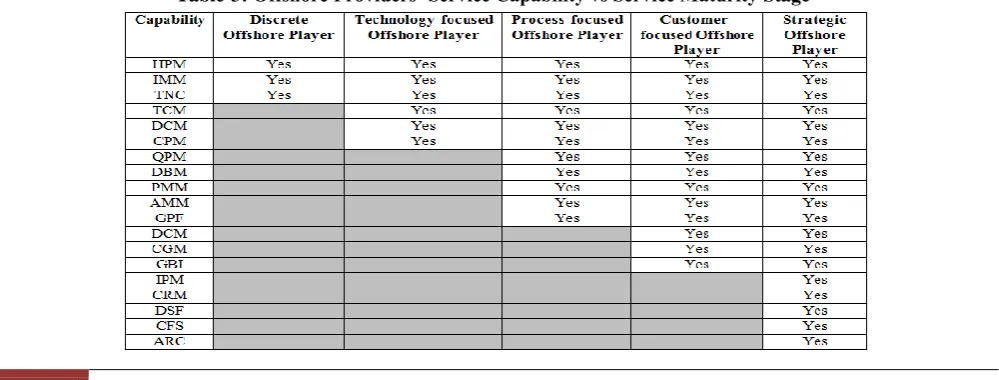
In this phase, the same group of experts identify the capabilities that an offshore provider need to acquire at each stage of capability maturity framework. Respondents are provided with an initial list service capabilities pertaining to business processes, service operations, relationship management, and business organization maturity (As provided in the table-1 and table-2). Respondents are asked to fill-up the „service capability‟ vs. „service maturity‟ matrix. At the end of three iterations, respondents could come to a reasonable consensus. Table-3 shows the outcome of this phase, which is a matrix showing service capabilities that may be required for a provider to qualify for a specify service maturity stage.
100
Copyright © 2018. IJEMR. All Rights Reserved.
IV.
PROPOSED CAPABILITY
MATURITY FRAMEWORK
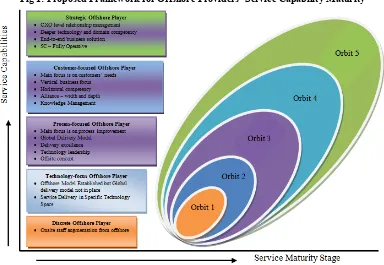
The primary notion of the proposed capability maturity model is to highlight the width and depth of an offshore ITO provider‟s capability at various stages (Orbits) of the service maturity in terms of their ability of value creation. „Value‟ in this context may be defined as the provider‟s ability to create some differentiators in the business operations that help the provider deliver superior quality service to its customers. These are nothing but some unique building blocks by which they can create service delivery which is much more valuable to their customers (Porter, 1985). In the proposed framework, building blocks are depicted as „Orbits‟. The capability requirements for each „Orbit‟ are the outcome of the Delphi study as shown in the table-II. Eventually, a framework is conceptualized based on the various inputs provided by the experts of the Indian offshore provider organization. Fig 2 depicts the proposed framework.
Orbit-1 (Discrete Offshore Player)
In this orbit, capability maturity of an offshore provider is at the elementary stage, where the offshore
activities are limited to IT staff augmentation service and delivering basic IT support service activities. Staff augmentation refers to a scenario, wherein a buyer organization contracts out the recruiting service of the IT workers to the offshore providers. Typically, these services contracts are agreed on a time-and-expense basis, where labor or hourly rate is the key element of the contract. However, the responsibility of managing the effort, risk and deliverables generally rests with the client (Iyengar et al., 2006). The concept of staff augmentation from offshore was originated during 1993-1999, when there was huge demand for Mainframe, COBOL and related technology skills at client sites to maintain the existing legacy systems support services. Moreover, Orbit-1 players provide low end IT service
delivery support, i.e. software bug fixing or
augmentation, from offshore. In order to fulfill staff augmentation and discrete IT service needs Orbit-1 players should possess capabilities including a) access to global talent pool b) overseas office for client coordination c) HR process maturity d) maturity in IT and communication infrastructure e) trustworthy and committed player.
Fig 1: Proposed Framework for Offshore Providers’ Service Capability Maturity
Orbit-2 (Technology-focused Offshore Player)
The Orbit-2 offshore service providers are the systems integrators or consulting firms that have delivered limited offshore IT service delivery projects, and primarily fulfill the cost-reduction effort of the client organizations. Orbit-2 players provide IT service from offshore, which is rendered for a specified scope of work, and is executed within a finite time frame (Iyengar et al., 2006). The primary focus of these consulting firms is to build varied technology skills that may be required
101
Copyright © 2018. IJEMR. All Rights Reserved.
Apart of possessing the Orbit-1 skills, atechnology-focused offshore player must display higher
maturity in service delivery processes, client
communication, trust, and commitment. However, Orbit-2 players doesn‟t possess proven global service delivery
processes, methodologies, and quality assurance
capabilities.
Orbit-3 (Process-focused Offshore Player)
A Process-focused offshore ITO provider recognizes the dynamic global business needs and therefore adopt a global service delivery model, which can be defined by the capabilities including stable &
efficient offshore processes, proven end-to-end
methodologies, established quality procedures, and higher level technology competency. A global service delivery model facilitates Orbit-3 players enhance the quality of their technology solutions and helps them reduce the overall cost of service delivery by reducing the turnaround time of the project deliverables (Iyengar et al., 2006). Offshore global IT service delivery model encompasses a focus on the technical skills, process rigor, tools, methodologies, overall structure and strategies for seamless delivery of IT services from offshore locations.
A process-focused offshore provider‟s model implies certain value propositions to its overseas client and can be defined through following terms:
a. Primary value proposition remains to be the cost reduction based on global service delivery needs;
b. Responding to the client‟s changing needs
effectively through its global delivery mechanism; c. The global presence helps it to have access to a
large pool of resources of varying costs thus allows it to optimize its delivery cost;
d. A global delivery model enables it to render round the clock ('follow the sun' model) service to its overseas customers, whereby it can hand off work from one location to another at the end of the 'day shift‟ and thus enhance the productivity of the delivery team to a great extent;
e. Global delivery model can bring down the cultural disparities between the contractual organizations considerably.
A Process-focused offshore player (Orbit-3 Player) is successfully assessed at higher level of quality system maturity in terms of CMMI certification. In addition, it achieves the technology leadership through its width and depth of expertise on varied technology. Orbit-3 offshore providers are expected to have a significant presence in one or more low-cost offshore locations, and also in one or more of the developed western markets in Europe or USA.
Orbit-4 (Customer-focused Offshore Player)
Orbit-4 offshore player offers
customer-focused, high-quality, and performance-driven
outsourcing services from offshore. Offshore service providers in this orbit aims to radically reshape the face of service delivery through their capability in customer relationship management and business objectives alignment with the clients‟ overall outsourcing mission.
Consistency and commitment are the watchwords while catering to the offshore outsourcing needs in a wide variety of fields including offshore call center and technical support outsourcing based services.
Orbit-4 players display the capabilities to bolster their scale of operation, geographic foot print and service bandwidth. Their strong delivery track records qualify them to be the serious contenders for large deals and acquisitions in the global market (Jalona and Chandrakar, 2011). Orbit-4 offshore players, therefore, are service ready to undertake higher risks in larger deals that may involve asset and employee transfer. Above all, these offshore players‟ approach to customer relationship is based on their open mindset for contract flexibility, trustworthiness, transparency. Moreover, more than 80% of the of Orbit-4 players‟ revenue come from repeat business from their existing customers.
Customer-focused offshore players have strong process oriented and established global delivery model. They have in-depth expertise in vertical and horizontal competency and are highly qualified to forge long-term alliance relationship with any multi-national outsourcing organizations. They have a proven organization-wide knowledge management system in place and have strong understanding of the changing market dynamics. They can appropriately respond to changing customer requirements with enhanced value proposition through their offshore service delivery model.
Orbit-5 (Strategic Offshore Player)
Strategic alliance is a primary form of cooperative strategies whereby resources, capabilities, and core competences are combined to pursue mutual interests. In the new economy, strategic alliances enable business to gain competitive advantage through access to a partner's resources, including markets, technologies, capital and people.
In this level, offshore ITO service providers are no longer viewed as a mere support system for cost reduction but are now being viewed as strategic partners, who can be trusted for their ability to impart an important role in the buyers‟ endeavor of business transformation (Jalona and Chandrakar, 2011). Thus, a strategic offshore IT service provider helps a buyer
organization increase its business innovation
capabilities, stimulate technology innovation, develop new products and solutions, enhance access to new geographical markets for global expansion (Carmel and Agarwal, 2002).
102
Copyright © 2018. IJEMR. All Rights Reserved.
Apart from possessing the capability of anOrbit-4 player, the Orbit-5 players exhibit higher maturity in managing the relationship with the top executives (CXO) of the buyer organization. The better management of CXO level relationship brings out better
clarity on business objectives that the buyer
organizations aspire to achieve through the engagement. Orbit-5 players have the capability to align their business strategies with that of their partners for mutual benefits. Consequently, Orbit-5 offshore players must display ability in collaborative initiatives with the buyer organization to develop a set of complementary core competencies (Levina and Ross, 2003).
Significance of entrusting the responsibility of solving business problems to an Orbit-5 player is important primarily because it necessitates higher maturity on domain / business knowledge. Therefore, an Orbit-5 player is expected to exhibit not only its technology leadership but also its thought leadership in the client‟s business domain. For example, the domain expertise entails understanding of a financial modeling system of a bank, the consumer web page of a retail company, or a new network management software package (Carmel and Agarwal, 2002).
In addition, as a best practice, an Orbit-5 offshore player exhibits the capability of conducting 5C analysis to understand the various facets of the engagement including the business objectives of the buyer organizations, competitors‟ position within the industry and the changing business climate and environment that may impact the performance of the engagement. The 5C analysis is an environment scan on five key areas such as company, customers, competitors, collaborators and climate.
V.
CONCLUSIONS AND PRACTICAL
IMPLICATIONS
In spite of the complexity in offshore source selection processes, there are much more compelling
reasons for exploiting offshore location-specific
advantages. The leading-edge client firms recognize these advantages and take initiatives to overcome the structural and cultural differences so that they can garner higher benefits from offshore IT service delivery initiatives.
At the outset, this research paper proposes a providers‟ capability maturity framework showcasing five stages of service capability. The proposed capability maturity framework is a generic representation of Indian ITO practitioners‟ perspectives and provides a tool to the industry to assess the degree of offshore service maturity. At the outset, conceptualization of the framework involves identifying its ingredients from existing research base. Subsequently, a questionnaire based explorative research method helps capture the real life experiences of a global IT service provider from India to identify the various stages of the evolution of this firm and the essential skills this Indian firm acquired to move up from a Discrete Offshore Player to a
Strategic Offshore Player. Key ingredients that qualify at each stage of the maturity framework originates from the literature study and analysis and subsequently experts from an Indian vindicates their significance in the real life applications. The conceptual framework proposes
five stages of the maturity based on the
recommendations of the experts.
Expected benefits from the proposed
framework are many folds as enumerated below:
Proposed framework would help offshore providers assess the degree of their service maturity w.r.t operational efficiency, business processes maturity, technology competency and people skills etc. Moreover, upcoming service providers can use this framework to plug the capability gaps while in an endeavor to move up in the service maturity value chain.
This comprehensive framework brings out greater clarity in the capability maturity of the offshore providers and enrich the existing research knowledge base. Eventually, the outcome of this study becomes significantly relevant to global IT service providers and could motivate them to offer their low-cost IT services and expertise through offshore engagement model.
The framework can facilitate the Orbit-4 and Orbit-5 players to showcase their service capability maturity road map and their contributions in creating business value at the higher level of orbits as they become more capable, efficient and agile.
From buyers‟ perspectives, this framework could be handy tool in their offshore source selection process. Essential capability details provided at each stage of the service maturity value chain would be useful to the buyers to find out the right offshore service partners, who will fit into their outsourcing scheme of strategy.
Finally, providers in other service supply chain industry can customize this framework to build and showcase their own service capability maturity.
REFERENCES
[1] Ang, S. & Inkpen, A. C. (2008). Cultural intelligence and offshore outsourcing success: A framework of firm-level intercultural capability. Decision Science, 39(2), 337-358.
[2] Blumenberg, S., Beimborn, D., & Koenig, W. (2008). Determinants of IT outsourcing relationships: A
conceptual model. 41st Hawaii International Conference
on System Sciences. Available at:
http://doi.ieeecomputersociety.org/10.1109/HICSS.2008. 119. Accessed September 09 2013.
[3] Carmel, E. & Agarwal, R. (2002). The maturation of offshore sourcing of information technology work. MIS Quarterly Executive, 1(2), 65-77.
103
Copyright © 2018. IJEMR. All Rights Reserved.
[5] Cheraghi, S, H., Dadashzadeh, M., & Subramanian,M. (2004). Critical success factors for supplier selection: An update. Journal of Applied Business Research, 20(2), 91-108.
[6] CMMI Product Team. (2010). CMMI for services, Version 1.3. Carnegie Mellon University, Software
Engineering Institute. Available at:
http://www.sei.cmu.edu/reports/10tr034.pdf. Accessed: Nov 25, 2014.
[7] CMU/SEI. (1995). A systems engineering capability
maturity model. Version 1.1, Carnegie Mellon
University, Software Engineering Institute. Available at: http://www.sei.cmu.edu/reports/95mm003.pdf.
Accessed: Nov 25, 2014.
[8] CMU/SEI. (2002). Capability maturity model
integration (CMMISM). Version 1.1. Carnegie Mellon
University, Software Engineering Institute. Available at: http://www.sei.cmu.edu/reports/02tr029.pdf. Accessed: Nov 25, 2014.
[9] Cooper, J. & Fisher, M. (2002). Software acquisition capability maturity model (SA-CMM). Version 1.03. Carnegie Mellon University, Software Engineering
Institute, http://www.sei.cmu.edu/reports/02tr010.pdf.
Accessed: Nov 25 2014.
[10] Curtis, B., Hefley W.E., & Miller S.A. (2009). People capability maturity model [P-CMM]. Version
2.0. Available at:
http://www.sei.cmu.edu/reports/09tr003.pdf. Accessed: Nov 25, 2014.
[11] Dalkey, N.C. & Helmer, O. (1963). An experimental application of the Delphi method to the use of experts, Management Science Journal, 9(3), 458-467. [12] Damian, D., Izquierdo, L., Singer, J., & Kwan, I. (2007). Awareness in the wild: why communication breakdowns occur. International Conference on Global
Software Engineering, IEEE Explore. DOI.
10.1109/ICGSE.2007, 13, 81–90.
[13] Dhar, S. & Balakrishnan, B. (2006). Risks, benefits, and challenges in global IT outsourcing: Perspectives
and practices. Journal of Global Information
Management, 14(3), 39-69.
[14] Ethiraj, S., Kale, P., Krishnan, M., & Singh, J. (2005). Where do capabilities come from and how do they matter? A Study in the software services industry. Strategic Management Journal, 26(1), 25-45.
[15] Feeny, D., Lacity, M., and Willcocks, L. (2005). Taking the measure of outsourcing providers. Sloan Management Review, 46(3), 41-48.
[16] Furtado, A.P.C.C., Meira, S.R.L., & Gomes, M.W (2014). Towards a maturity model in software testing automation. Ninth International Conference on Software
Engineering Advances, ICSEA, 282-285.
[17] Ghodeswar, B. M. (2008). Building brand identity in competitive markets: a conceptual model, Journal of Product & Brand Management, 17(1), 4-12.
[18] Herath, T., & Kishore, R. (2009). Offshore outsourcing: risks, challenges, and potential solutions. Information Systems Management Journal, 26(4), 312-326.
[19] Herbsleb, J., Zubrow, D., Goldenson, D., Hayes, W., & Paulk, M. (1997). Software quality and the
capability maturity model. Communications of the ACM,
40(6), 30-40.
[20] Ho, W., Xu, X., & Dey, P.K. (2010). Multi-criteria decision making approaches for supplier evaluation and selection: A literature review. European Journal of Operational Research, 202(1), 16-24.
[21] Holmstrom, H., Conchúir, E.Ó., Ågerfalk, P., & Fitzgerald, B. (2006). Global software development challenges: A case study on temporal, geographical and socio-cultural distance. International Conference on Global Software Engineering, IEEE Xplore Digital
Library, 10.1109/ICGSE.2006.261210, 3–11.
[22] Hsu, C., & Standford, B.A. (2007). The Delphi
technique: Making sense of consensus. Practical
Assessment, Research & Evaluation,12(10), 1-7. [23] Iyengar, P., Karamouzis, F., Marriott, I., & Young, A. (2006). Magic quadrant for offshore application
services. Gartner Research. Available at:
http://hexaware.com/fileadd/magic_quadrant.pdf. Accessed April 08 2013.
[24] Jalona, S., & Chandrakar, A. (2011). Evolution of
IT service delivery model. Available at:
http://www.infosys.com/global-sourcing/white.../evolution-IT-Services.pdf. Accessed April 14 2013
[25] Jericho forum-Position Paper. (2007). Principles for
managing sata privacy. Available at:
http://www.opengroup.org. Accessed: 20 June 2012. [26] Khan, S.U., Niazi, M., & Ahmad, R. (2011). Factors influencing clients in the selection of offshore software outsourcing vendors: An exploratory study using a systematic literature review, The Journal of Systems and Software, 84(4), 686–699.
[27] Krym, N. (2012). Outsourcing It! The Pragmatic
Bookself. USA, Appendix 5. Available at:
http://pragprog.com/book/nkout/outsource-it. Accessed: 20 June 2012.
[28] Lacity, M., Khan, S., Yan, A., & Willcocks, L. (2009). A review of the IT outsourcing empirical literature and future research directions. Journal of Information Technology, 25(2), 395–433.
[29] Larsen, M.M., Manning, S., & Pedersen, T. (2012). Uncovering the hidden costs of offshoring: the interplay of complexity, organizational design, and experience.
Strategic Management Journal. Available at:
http://papers.ssrn.com/sol3/papers.cfm?abstract_id=2141 777. Accessed uly 1 2014.
[30] Lee, Jae-Nam. (2008). Exploring the vendor‟s process model in information technology outsourcing. Communications of the Association for Information Systems, 22(31). Available at:
http://aisel.aisnet.org/cais/vol22/iss1/31. Accessed uly 1 2014.
[31] Levina, N., & Ross, J.W. (2003). Exploring the value proposition in information technology outsourcing. MIS Quarterly, 27(3), 331-364.
104
Copyright © 2018. IJEMR. All Rights Reserved.
systems outsourcing. Information & Management, 45(7),482–492.
[33] McCarthy, J., Ferrusi Ross, C., & Schwaber, C.E. (2003). Users‟ offshore evolution and its governance impact, forrester research. Available at: http:// www.forreseter.com. Accessed uly 1 2014.
[34] Mukherjee, D., Gaur, A.S., & Datta, A. (2013). Creating value through offshore outsourcing: An
integrative framework. Journal of International
Management, 19(4), 377-389.
[35] Mukherjee, S., & Mukherjee, K. (2015). Selection decisions of offshore ITO service providers for strategic
alliances – An AHP-based approach. International
Journal of Business Information Systems, 20(2), 238-269.
[36] neoIT. (2003). Offshore Program Management, Offshore Insights White paper. Series 8. Available at: http://www.neogroup.com/PDFs/Whitepapers/Offshore_ Progam_Mgmt.pdf. Accessed uly 1 2014.
[37] Overby, S. (2012). Offshore Outsourcing Can Boost
Agility CIO. Available at:
http://www.cio.com/article/2398949/it- organization/offshore-outsourcing-can-boost-agility.html.Accessed: 08 July 2013.
[38] Palvia, P, C., King, R, C., Xia, W., & Palvia, S, C. (2010). Capability, quality, and performance of offshore
is vendors: A theoretical framework and empirical investigation. Decision Sciences, 41(2), 231-270. [39] Power, M, J., Desouza, K, C., & Bonifazi, C. (2006). How to implement a successful outsourcing process: The outsourcing handbook, kogan page limited. Available at: http://www.kogan-page.co.uk. Accessed: 08 July 2013.
[40] Ranganathan, C., & Balaji, S. (2007). Critical capabilities for offshore outsourcing of information
systems. Sprouts working Papers on Information
Systems, Association for Information Systems, AIS
Electronic Library, Available at:
https://pdfs.semanticscholar.org/5c76/9b4f79dd3763b47 7daa1a458276543433d8f.pdf. Accessed: 09 Nov 2013. [41] Rottman, J, W., & Lacity, M, C. (2006). Proven practices for effectively offshoring IT work. MIT Sloan
Management Review, 47(3), 55-63.
[42] Rouse, M. (2008). Corporate governance. Available at:
http://searchfinancialsecurity.techtarget.com/definition/c orporate-governance. Accessed: 20 March 2014. [43] Scalet, S, D. (2011). CSO's ultimate guide to business continuity and disaster recovery. Available at: