The Thirty-Third AAAI Conference on Artificial Intelligence (AAAI-19)
A Grammar-Based Structural CNN Decoder for Code Generation
Zeyu Sun,
†Qihao Zhu,
†Lili Mou,
‡Yingfei Xiong,
∗†Ge Li,
†Lu Zhang
† †Key Laboratory of High Confidence Software Technologies (Peking University), MoE;Software Institute, Peking University, 100871, P. R. China
{szy , zhuqh, xiongyf, lige, zhanglucs}@pku.edu.cn ‡AdeptMind Research, Toronto, ON, Canada
Abstract
Code generation maps a program description to executable source code in a programming language. Existing approaches mainly rely on a recurrent neural network (RNN) as the de-coder. However, we find that a program contains significantly more tokens than a natural language sentence, and thus it may be inappropriate for RNN to capture such a long sequence. In this paper, we propose a grammar-based structural convolu-tional neural network (CNN) for code generation. Our model generates a program by predicting the grammar rules of the programming language; we design several CNN modules, in-cluding the tree-based convolution and pre-order convolution, whose information is further aggregated by dedicated atten-tive pooling layers. Experimental results on the HearthStone benchmark dataset show that our CNN code generator signif-icantly outperforms the previous state-of-the-art method by 5 percentage points; additional experiments on several seman-tic parsing tasks demonstrate the robustness of our model. We also conduct in-depth ablation test to better understand each component of our model.
Introduction
Generating code from natural language description is an im-portant but challenging task in artificial intelligence (Ling et al. 2016; Yin and Neubig 2017; Rabinovich, Stern, and Klein 2017; Mei and Zhang 2018). It is beneficial to var-ious applications. For example, a programmer would like to “open the file, F1” in Python, but does not know how to implement it in the programming language. Hopefully, he or she can obtain the target code “f = open(’F1’, ’r’)” by code generation.
With the prosperity of deep learning, the encoder-decoder framework becomes a prevailing approach to sequence gen-eration. In particular, recurrent neural networks (RNNs) typically serve as the encoder and decoder; such architec-ture is also known as a sequence-to-sequence (Seq2Seq) model (Sutskever, Vinyals, and Le 2014). When applied to code generation, it takes the program description as the in-put sequence and generates the desired code as the outin-put sequence (Ling et al. 2016).
∗
Yingfei Xiong is the corresponding author. Our code is avail-able at https://github.com/zysszy/GrammarCNN
Copyright c2019, Association for the Advancement of Artificial Intelligence (www.aaai.org). All rights reserved.
Call
Name
Root
“a” init
x1 x2
n1
n2
n3
n4
n5
n6
n7
root → Module
Arg → Name Arg
Func
Name Module
Func →Name
Name Call → Func Arg
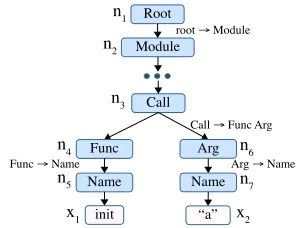
Figure 1: The abstract syntax tree (AST) of code:init(a).
It has been pointed out that programs contain rich struc-tural information, which is important to program model-ing (Rabinovich, Stern, and Klein 2017; Yin and Neubig 2017). However, traditional Seq2Seq neural networks do not explicitly model program structures. Figure 1 shows an ex-ample of a Python abstract syntax tree (AST), where the two nodesn3andn6 should have interacted intensively as parent-child nodes, but are far away from each other if the tree is pre-order traversed to a sequence. This brings diffi-culties to Seq2Seq models.
To address this problem, Dong and Lapata (2016) pro-posed an approach that generates code along the abstract syntax tree (AST) of a program, but their generation is still in the token level. More recent work generates pro-grams by predicting the grammar rule or rewriting rule to apply at each step (Xiong et al. 2018; Yin and Neubig 2017; Rabinovich, Stern, and Klein 2017); thus, the generated pro-grams are guaranteed to be syntactically correct. When neu-ral network is used in those approaches, an RNN is used to capture theautoregressiveness1of predictions within the de-coder.
In the deep learning community, researchers are showing growing interest in using the convolutional neural network (CNN) as the decoder (Gehring et al. 2017; Chaturvedi, Pan-dit, and Garain 2018), because of its efficiency and easi-ness of training. We further observe that a program is much larger than a natural language sentence and that RNNs—
1
Rule Explanation
stmt → If | For | ... A statement (stmt) could be anIf-block, aFor-block, and many others. They are different rules, and the network predicts the most appropriate rule to apply at a time step.
If → expr stmt* stmt* AnIf-block starts with a testing expression (expr). If it is true, the first statement list is executed, or otherwise, the second statement list is executed. In the official python grammar, a rule may generate a list of tokens (e.g.,stmt*) with an arbitrary length. We examine the training samples and treat each length as a separate rule to predict.
Table 1: Examples of python grammar rules.
even with long short-term memory (Hochreiter and Schmid-huber 1997, LSTM) units—suffer from the long dependency problem (Bengio, Simard, and Frasconi 1994). CNNs, on the contrary, are able to capture features effectively at different regions by sliding windows.
To this end, we propose a grammar-based structural CNN for code generation. Our model generates code by grammar rules of construction in AST, e.g.,If → expr
stmt* stmt*, following the framework in our previous
work (Xiong et al. 2018). Since the sequence of child nodes is generated by one step of prediction, it enables more com-pact prediction than the token-by-token generation. In other words, our model predicts the sequence of grammar rules, which eventually form an entire program.
In our approach, the prediction of a grammar rule is mainly based on three types of information: the source se-quence that specifies the program to be generated, the pre-viously predicted grammar rules, and the partial AST that has been generated. Here, the former one is the input to the encoder. The latter two enable the autoregressiveness of the decoder, and as usual, the decoder is also conditioned on the encoder.
We design several distinct components for the structural CNN, suited to program generation: (1) We first adopt an idea of tree-based convolution that applies sliding windows on the AST structures (Mou et al. 2016). Then we design another CNN module to the pre-order traversal of nodes in the partial AST. These two types of CNNs capture neighbor-ing information not only in the sequence but also in the tree structure. (2) To enhance “autoregressiveness,” we apply an-other CNN module to the ancestors of the node to be gen-erated, and thus the network is aware of where to generate at a certain step. (3) We design a dedicated attentive pooling mechanism that aggregates CNN features interacting with different neural modules. In particular, we find it useful to consider the scope names (e.g., function and method names) during code generation, and use such information as the con-troller of several attentive pooling layers.
We conducted experiments on an established benchmark dataset, HearthStone, for python code generation (Ling et al. 2016). Experimental results show that our CNN-based code generator outperforms previous RNN approaches to a large extent. We further evaluate our approach on two se-mantic parsing tasks, where the target programs are shorter than HearthStone; our approach also achieves comparable results to previous state-of-the-art methods, indicating the robustness of our method. We conducted extensive ablation tests, showing that our design of grammar-based structural CNN is better than applying CNN in a na¨ıve fashion.
Information Type CNN Modules Pooling & Attention Program
description
Predicted grammar rules
Partial AST
CNN
Tree-based CNN
Tree-path CNN
Pre-order CNN
Max pooling
Attentive pooling CNN
Attentive pooling
Attentive pooling
Attentive pooling Max
pooling
Function/method
scope Embedding
ML
P
so
ftm
ax
Prediction
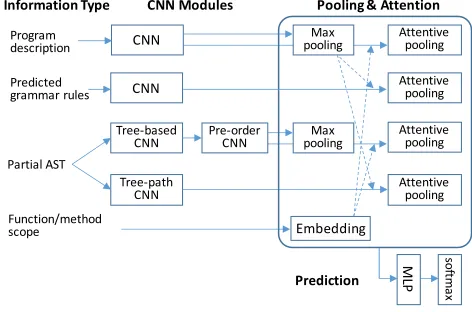
Figure 2: Overview of our model. The dashed arrows indi-cate attention controllers.
To the best of our knowledge, we are the first to success-fully apply CNN decoders for code generation.
The Proposed Model
Figure 2 shows the overall structure of our network. We will first describe the process of grammar-based code generation, and then introduce each module in detail.
Grammar-Based Code Generation
For an input of program description, our task is to generate a piece of executable code that complies with the description. In traditional Seq2Seq models, a program can be represented as a sequence of tokensx1,x2,· · ·,xT, and these tokens are
generated in sequence.
Alternatively, a valid program can be represented by an abstract syntax tree (AST) in Figure 1. Leaf nodes are the terminal symbols, denoted as x1,· · · ,xT. Non-leaf nodes
are non-terminal symbols n1,· · · ,nN, each representing
an abstract component of the program (e.g., anIf-block). Moreover, child nodesn1,· · ·,nk, stemming from their
par-ent nodep, are obtained by applying some grammar ruler, denoted asp→r n1· · ·nk. In our work, leaf nodes of
differ-ent user-defined variables are treated as separate grammar rules by examining the training set. Table 1 illustrates sev-eral Python rules and their meanings.2
Dong and Lapata (2016) propose to generate an exe-cutable command by following the AST, but they predict child nodes n1· · ·nk one at a time with an RNN. In our
2
study, we follow more recent work (Rabinovich, Stern, and Klein 2017; Yin and Neubig 2017; Xiong et al. 2018), pre-dicting the rules r1,r2,· · ·,rM that generate the program.
We traverse the tree in depth-first pre-order, and for the first encountered non-terminal symbol, we predict what rule should be used to expand it. In other words, the probability of a program is decomposed as
p(program) =YM
n=1p(rn|r1· · · ,rn−1) (1) Although a typical programming language contains more grammar rules than distinct AST nodes, grammar-based generation is more compact because the child nodes c1,· · ·,ckbecome in place by a single prediction of the rule
p →r c1· · ·ck. Moreover, the generated program is
guaran-teed to be syntactically correct.
In the rest of this section, we describe our CNN encoder-decoder model for the prediction of grammar rules.
CNN for the Input
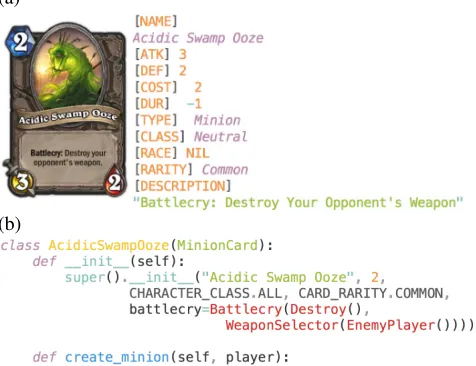
The input of our model is a piece of description that specifies the program to be generated. For code generation of a card in HearthStone, the input is semi-structured data, contain-ing the card’s name, properties, and descriptions, illustrated in Figure 4a. For other tasks like semantic parsing (Zettle-moyer and Collins 2005), the input could be a natural lan-guage sentence.
We tokenize the input, and obtain a sequence of tokens x(enc)1 ,· · ·,x(enc)I , whereIis the length of the input. The to-kens are represented as real-valued vectorsx(enc)1 ,· · ·,x(enc)I , known asembeddings.
Then, a set of convolutional layers are applied and extract featuresy(enc,1 L),· · ·,y(enc,I L). In particular, we adopt short-cut connections every other layer parallel to linear transfor-mation before the activation function, as in ResNet (He et al. 2016). This helps the training of a deep neural network.
Formally, the extracted featuresyi(enc,l)are computed by
yi(enc,l)= ReLU c(enc,l)·y(enc,l−2)
i−1
+W(enc,l)[yd(enc,i−sle−1);· · ·;y(enc,di+sle−1)] (2)
whereW(enc,l) are the convolution weights for the encoder CNN, sis computed by s = (k−1)/2, kis the window size (set to 2 in our experiment), andl= 1,· · ·, Lindicates the layer in the deep CNN. In particular,yi(enc,0) is the input embeddingx(enc)i .c(enc,l) = 1for even layers and0for odd layers, indicating whether the shortcut connection exists for this layer. For the first and last several words, we perform zero padding.
CNN for Predicted Rules
Since the probability of a program is decomposed by gram-mar rules (Equation 1), we keep track of all previously pre-dicted rules, and build a deep neural network to extract such information.
Let r1,· · · ,rn−1 be the previously predicted rules. We embed them as real-valued vectors,r1,· · ·,rn−1, where the
…
n6 n2
n3 n4 n5 n1
n2
n3 n4 n5
n6 n1
(a) Tree-based convolution (b) Pre-order convolution
Pre-order traverse with backtracking
…
nPHD
…
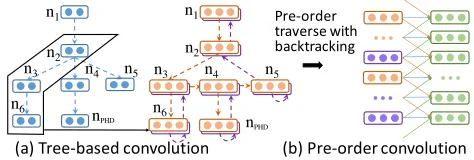
nPHDFigure 3: CNN for the partial AST. The dashed arrows are not a part of the neural network, but indicate topologically neighboring information. In particular, the purple up arrows are backtracking traces.
embeddings are randomly initialized and learned by back-propagation.
We apply a deep CNN module with shortcut connec-tions to rule embeddingsr1,· · · ,rn−1, extracting features
y1(rule,L),· · ·,y(rule,n−1L). The computation is the same as Equa-tion 2, but with different weight parameters. Details are not repeated here.
The predicted grammar rules fully specify the generated (partial) program in a compact fashion, which is beneficial for accurate code generation.
However, it is improper to feed the decoder with only pre-dicted rules for autoregressiveness, as they do not provide a concrete/pictorial view of the program due to the compact-ness. To alleviate this problem, we enhance the decoder with the partial AST, described below.
CNN for Partial AST
An abstract syntax tree (AST) is a tree-structured represen-tation of a program, where a rulep→r n1· · ·nkis expanded
as parent-child edges ofpandn1,· · · ,nk.
We design a deep CNN module to capture AST’s struc-tural information. It contains tree-based convolutional lay-ers, pre-order traversal convolutional laylay-ers, as well as a tree-path CNN submodule to inform the network of where the next grammar rule is applied.
Tree-Based CNN. We first apply a tree-based CNN to the partial AST, similar to Mou et al. (2016; 2018). The main intuition is to design a local feature detector of a fixed depth, sliding over a tree to extract structural features, shown in Figure 3a.
The input of tree-based CNN is the partial AST that has been generated, each node represented by an embedding. We also put a placeholder node (nPHDillustrated in Figure 3) to indicate where the next grammar rule is applied.
Suppose a nodenihas a parent nodepi and a
grandpar-ent nodegi, and their vector representations areni,pi,and gi, respectively. Then the tree-based CNN extracts features y1(ast),· · ·,yn(ast)−1, computed by
y(ast)i = ReLU(W(ast)[ni;pi;gi]) (3)
Note that our tree-based convolution slightly differs from Mou et al. (2016) in that we have a deeper window but do not consider sibling information. This is because our grammar-based generation obtains all siblings at a time by apply-ing a certain rule, and hence, the siblapply-ings are less impor-tant than ancestors. The complexity of Mou et al. (2016) unfortunately grows exponentially with depth, and is less tractable, whereas our tree-based CNN variant grows lin-early. In terms of the convolution computation, we follow Mou et al. (2016) and adopt a perceptron-like interaction. Deep tree-based convolution and shortcut connections as in ResNet could be explored as future work.
Pre-Order Traversal CNN. After obtaining a set of vec-tors extracted by tree-based CNN, we apply a pre-order traversal convolution with y(ast) being input (Figure 3b). That is, the AST nodes are organized in a sequence by pre-order traversing.
It can be shown that a simple pre-order traverse is not invertible to the tree structure, i.e., different tree structures could yield a same sequence. To address this problem, we keep track of backtracking traces during pre-order travers-ing. For example, the AST in Figure 3 yields the sequence n1,n2,n3,n6,n(bt)6 ,n
(bt)
3 ,n4,n(bt)4 ,nPHD,n(bt)PHD,n5,n(bt)5 ,n (bt) 2 ,
n(bt)1 . Their vector representations (including backtracking nodes and the placeholder node) are predicted by tree-based convolution. Then a deep CNN as in Equation 2 is applied to extract features y(tree,1 L),· · ·,y(tree,2S L), where L is the number of CNN layers. T is the number of nodes in the AST, and pre-order traverse with backtracking yields 2S input units.
It should be noted that the tree-based CNN and the pre-order traversal CNN capture different information. Pre-pre-order traverse yields an order that addresses sequential neighbor-hood of an AST node during generation, whereas tree-based convolution enables information fusion for nodes that are structurally neighboring. In Figure 3, for example, noden4 is a child node ofn2. However, after the generation of some other part of the program (namely,n3andn6), the nodesn2 andn4are no longer close to each other. Tree-based convo-lution directly builds a feature extractor for a node and its ancestors to enable their interaction. Therefore, we believe these two types of CNNs are complementary to each other.
Tree-Path CNN. Should we only consider the above
CNNs, it would be hard for the model to tell the posi-tion where the next grammar rule is applied. For example, the tree-based CNN and the pre-order traversal CNN would yield very similar features if we expandn4orn5in Figure 3, despite the placeholder we introduce for pre-order CNN.
Technically speaking, if we follow leftmost derivation, then where the next rule is applied is unambiguous. But such clue is too implicit and should be modeled more explicitly.
We thus extract the path from the root to the node to ex-pand. For example, if we are about to expandn4, the path should ben1,n2,n4. Then a set of convolutional layers ex-tract featuresy(path,1 L),· · ·,yJ(path,L), also computed as Equa-tion 2. (J is the number of nodes in the path, andLis the number of CNN layers.) We call thistree-path convolution.
Pooling and Attention Mechanisms
CNNs extract a set of features with the same size or shape as input. To facilitate softmax prediction for code generation, we need to aggregate information into one or a few fixed-size vectors, regardless of the input fixed-size.
Traditionally, people use max pooling for CNNs (Krizhevsky, Sutskever, and Hinton 2012) as well as tree-based CNNs (Mou et al. 2016; Mou and Jin 2018). However, this makes the underly-ing CNN modules separate and unable to communicate during information aggregation.
Therefore, we incorporate attention mechanisms for CNN pooling, similar to Yu et al. (2018). Essentially, an attention mechanism computes a weighted sum of a set of candidate features (extracted by CNN), where the weights are com-puted by a controlling vector (for example, a max pooling vector for another CNN module).
Formally, given a controlling vector c and a set of candidate convolutional features y1,· · · ,yD extracted by
a CNN module (D is the number of feature vectors), we compute attention logit by
e
αi=yi>W
(att)c (4)
whereW(att) is a trainable matrix, inspired by metric learn-ing. Then the attention weightαifor the nodeiis
αi=
exp{αei}
PD
j=1exp{αej}
(5)
Finally, the attentive pooling yields a vectory(att)by
y(att)=XD
i=1αiyi (6)
To apply such an attentive pooling layer to our underlying CNNs, we consider several key information as the control-ling vector. (1) The input description specifies the program to be generated, and we use it to control the grammar rule CNN and the tree-path CNN. In particular, we apply a max pooling layer to aggregate input CNN features as a fixed-size controlling vector, which is used to compute the attention weights for tree-path CNN and the CNN for predicted gram-mar rules. (2) We note that ascope name(namely, a function name or a method name) provides illuminating information about its descendants. Such information is not captured by AST node types, and thus we embed the scope name as a vector and use it to control the pre-order traversal CNN and the CNN for the input. It should be noted that if the current program snippet is under two or more scopes (a function and a method), we only consider the nearest scope as the con-trolling vector. If the code snippet does not belong to any function or class, then the scope embedding is set to a zero vector.
(a)
(b)
Figure 4: Example card of HearthStone. (a) Input descrip-tion; (b) Output program.
We would also like to point out that there are different choices of designing the attention mechanism and its con-trolling connections in a deep neural network with multiple modules. For example, we might as well use the CNN for the input to control all other modules, following the spirit of attention in the encoder-decoder framework. However, our pilot experiment shows that such design yields a worse per-formance, and thus we adopt the current architecture.
Training and Inference
We concatenate all max pooling and attentive pooling lay-ers. They are fed to a two-layer perceptron, where the last layer has a softmax activation function for predicting the next grammar rule, given by
p(ri|·) =
exp{h(MLP)i }
PR
j=1exp{h (MLP)
j }
(7)
whereh(MLP)i is the input logit of softmax, andRis the num-ber of candidate grammar rules.
Our model is trained by cross-entropy loss against the groundtruth program. Since our entire model is differen-tiable, all parameters are learned by gradient-based update.
For inference, we seek a sequence of grammar rules that maximizes the probability conditioned on input. The recur-sive prediction of the rules terminates if every leaf node in the (partial) tree is a terminal symbol. We use beam search to approximate the global inference, and the beam size is 5 in our experiments. Invalid rules for a particular node type are not considered during inference. For example,p2 → c1c2 cannot be applied to the nodep1ifp16= p2.
Evaluation
In this section, we present experimental results of our CNN-based code generation. We evaluated our method on two
Dataset
Statistics HS ATIS JOBS
# Train 533 4,434 500
# Dev 66 491
-# Test 66 448 140
Avg. tokens in description 35.0 10.6 8.7 Max. tokens in description 76.0 48 22
Avg. tokens in code 83.2 33.9 18.1
Max. tokens in code 403 113 50
Avg. nodes in AST 151.0 47.2 40.0
Max. nodes in AST 744 154 138
Table 2: Statistics of the datasets.
types of tasks: (1) Python code generation for the Hearth-Stone game, and (2) executable logic form generation for semantic parsing.
Experiment I: HearthStone Code Generation
Dataset. Our first (and main) experiment is based on an established benchmark dataset, HearthStone (Ling et al. 2016, HS). The dataset comprises 665 different cards of the HearthStone game; the input of each data point is a semi-structured description of fields, such as the card name, cost, attack, description, and other attributes; and the output is a Python code snippet that implements the functionality of the card, shown in Figure 4. We follow the train-dev-test split as in Ling et al. (2016). The column HS in Table 2 lists relevant statistics of the dataset.Metrics. We evaluated our approach by accuracy and
BLEU scores. Ideally, the accuracy should count the frac-tion of funcfrac-tionally correct programs, which unfortunately is not Turing computable. We followed most previous stud-ies (Ling et al. 2016; Yin and Neubig 2017), and calculated the accuracy based on string match (denoted asStrAcc).3 We also find that several generated programs use a different variable name but implements a correct functionality, and that sometimes an argument name in a function call is or is not specified. Although different from the reference pro-gram, they are obviously correct programs after manual in-spection, and we denote human-adjusted accuracy byAcc+. Here, we did not perform checking for non-obvious alterna-tive implementation of an algorithm, and thus Acc+ is still a lower bound of functional accuracy.
The quality of the generated code is further evaluated by theBLEUscore as an auxiliary metric, which computes how close the generated code is to the groundtruth code in terms ofn-grams.
Settings. For the input descriptions, we replace all punctu-ations with a space; all letters are lower cased. For the neural network, we set the number of CNN layersLto 21, where
3
Model StrAcc Acc+ BLEU LPN (Ling et al. 2016) 6.1 – 67.1 SEQ2TREE (Dong and Lapata 2016) 1.5 – 53.4 SNM (Yin and Neubig 2017) 16.2 ∼18.2 75.8 ASN (Rabinovich, Stern, and Klein 2017) 18.2 – 77.6 ASN+SUPATT
22.7 – 79.2 (Rabinovich, Stern, and Klein 2017)
Our system 27.3 30.3 79.6
Table 3: Performance of our model in comparison with pre-vious state-of-the-art results. Accuracies are in percentage. Yin and Neubig (2017) report an approximately 2% percent boost after human adjustment.
Line # Model Variant Acc+ BLEU
1 Full model 30.3 79.6
2 Pre-order CNN→LSTM 21.2 78.8 3 −Predicted rule CNN 24.2 79.2 4 −Pre-order CNN 25.8 80.4
5 −Tree-based CNN 25.8 79.4 6 −Tree-path CNN 28.8 80.4
7 −Attentive pooling 24.2 79.3
8 −Scope name 25.8 78.6
Table 4: Ablation test.
the bottom layer does not have skipping connections. We also find it helpful to build a separate network (i.e., the same architecture, but with different weight parameters) for dif-ferent AST node types (namely, nonterminal nodes, variable nodes, and function name nodes). This enables us to be bet-ter aware of node types during generation. When predicting variable nodes, we introduce a new softmax target, for each slot, that could copy the slot value. The layers of difference CNN modules are set to the same dimension, chosen by vali-dation from{128, 192, 256}for each predictor network. We applied dropout (drop rate= 0.5) and`2penalty to regular-ize the fully connected layers. The network is trained by the Adam optimizer (Kingma and Ba 2015) with default hyper-parameters.
Overall Results. Table 3 presents the results of our CNN-based code generation, in comparison with previous state-of-the-art models: (1) Latent Predictor Network (Ling et al. 2016, LPN), an enhanced sequence-to-sequence model with multiple token-level predictors; (2) SEQ2TREE (Dong and Lapata 2016), a sequence-to-sequence model based on AST; (3) Syntactic Neural Model (Yin and Neubig 2017, SNM), an LSTM decoder based on AST structures; and (4) Ab-stract Syntax Networks (Rabinovich, Stern, and Klein 2017, ASN), another AST-based sequence-to-sequence model, which builds two LSTMs predicting rules in the horizontal and vertical directions, respectively. The ASN model has a variant (ASN+SUPATT) where attention is trained in a su-pervised fashion.
As shown, our model outperforms all previous results in terms of both accuracy and BLEU scores. In particular, our accuracy is significantly higher than the previous
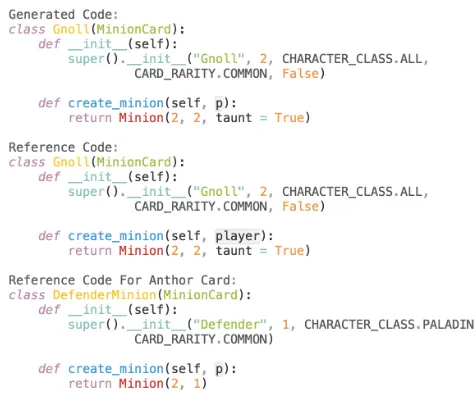
state-of-Figure 5: Example of the generated code. (Compared with reference codes, the code we generated has a different vari-able, but a correct functionality.)
the-art result by about 5 percentage points in terms of string accuracy. For human adjusted accuracy (Acc+), Yin and Neubig (2017) report approximately 2 percentage points im-provement. Similar phenomena are observed in our scenario, and we achieve an Acc+ score of 30.3%, showing strong ev-idence of the effectiveness of our approach.
We find an intriguing fact that several previous methods could achieve a similar BLEU score to our approach, but with a much lower accuracy. For example, the ASN model has a BLEU score of 79.2, comparable to 79.6 given by our model. However, ASN only achieves 22.7% string accuracy, whereas ours is 27.3%. This is because the BLEU metric only measures surfacen-gram similarity of programs. Pre-vious methods (like ASN) are able to generate seemingly plausible code, which are in fact incorrect in terms of details. Therefore, we only consider BLEU scores (adopted in previ-ous work) as a secondary metric. The major metric, namely, accuracy, shows that our approach generates much more ac-curate programs than previous models.
Ablation test. We conducted extensive ablation tests to analyze the contribution of each component. Although the development of our network started from a simple baseline and we incrementally added on useful components, the ab-lation test was conducted in an opposite way: it started from the full model, and we either removed a single component of our model or substituted it with some reasonable alterna-tives. We report results of our ablation test in Table 4.
Input description: list airport in ci0
Outputλ-calculus:
Figure 6: Example of the ATIS dataset for semantic parsing.
where RNN is the main building block achieving lower ac-curacy.
The scenario can be better understood if we consider the setting where we simply remove the pre-order traver-sal CNN (Line 4, Table 4). Both based on a tree-based CNN layer, the LSTM component yields a 4% lower accuracy than simply without LSTM. This implies that RNNs are not suit-able to this task, which is probably because a program con-tains too many tokens and AST nodes. An RNN applied to such a long sequence can be very difficult to train (Pascanu, Mikolov, and Bengio 2013), achieving significantly worse performance.
We also analyze other components of our model, includ-ing the CNN for predicted rules, the tree-based convolu-tional layer, the tree-path convolution, the attentive pooling mechanism, and the scope controllers for pooling (Lines 3– 8, Table 4). We see that each of the above components con-tributes to the whole model in its own way, improving the accuracy by 3–6 percent. These results show that we have designed reasonable components of the neural architecture, suited to the code generation task.
Experiment II: Semantic Parsing
Dataset and Settings. Semantic parsing aims to generate logical forms given a natural language description. It can be thought of as code generation for a domain-specific lan-guage, because the logical form is an executable, unambigu-ous formal language. However, the style of semantic parsing differs significantly from python code generation. Since our model is mainly developed on the HS dataset, this experi-ment serves as additional evaluation of the generalizability of our model.
We evaluated our model on two semantic parsing datasets (ATIS and JOBS) used in Dong and Lapata (2016), where the input is a natural language sentence. The output of ATIS is in the λ-calculus form (illustrated in Figure 6), while for JOBS, it is in the Prolog-style form. We used the stan-dard train-dev-test split for the datasets Zettlemoyer and Collins (2005). We see from the statistics in Table 2 that the logical forms for semantic parsing contain significantly fewer nodes and tokens than HS Python code.
We adopted mostly the same network from the Hearth-Stone experiment to semantic parsing. The number of lay-ers Lis 7 in this experiment. We did not build a separate network for different node types as our network is prone to overfitting for such small datasets. Besides, we introduced the pointer network (See, Liu, and Manning 2017) to copy variable names (e.g.,ci0in Figure 6) due to the property of the datasets, which is also the practice of previous work (Ra-binovich, Stern, and Klein 2017).
ATIS JOBS
T
raditional
System Accuracy System Accuracy
ZH15 84.2 ZH15 85.0
ZC07 84.6 PEK03 88.0
WKZ14 91.3 LJK13 90.7
Neural
SEQ2TREE 84.6 SEQ2TREE 90.0
ASN 85.3 ASN 91.4
ASN-SUPATT 85.9 ASN-SUPATT 92.9
Our System 85.0 Our System 89.3
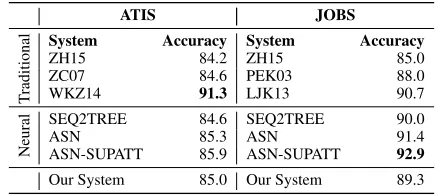
Table 5: Accuracy in semantic parsing (in percentage).
Results. We followed Dong and Lapata (2016) and
eval-uated our approaches by accuracy. It counts the fraction of exact match, except that we adjusted the order of conjunc-tion and disjuncconjunc-tion clauses to avoid spurious errors, as in all previous work. We did not measure BLEU since it is not used in existing studies.
Table 5 shows the performance of our model. As seen, neural models are generally worse than the WKZ14 sys-tem (Wang, Kwiatkowski, and Zettlemoyer 2014), which uses a large number of rules and templates, but they out-perform other traditional semantic parsing systems, includ-ing ZH15 (Zhao and Huang 2015), ZC07 (Zettlemoyer and Collins 2007), PEK03 (Popescu, Etzioni, and Kautz 2003), and LJK13 (Liang, Jordan, and Klein 2013).
We also see that our grammar-based structural CNN de-coder achieves similar results to the state-of-the-art neu-ral models (Dong and Lapata 2016; Rabinovich, Stern, and Klein 2017). It should also be pointed out that in semantic parsing, we do not achieve a large performance boost as in HearthStone (HS) code generation. This is probably because the logic form for semantic parsing is usually short, contain-ing only 1/4–1/3 tokens as in HS, and thus, both RNN and CNN are fine for logic form generation. This experiment nevertheless provides additional evidence of the generaliz-ability and flexibility of our CNN code generation, since our model is basically designed for long programs (such as HS) but also works fine with semantic parsing.
Related Work
Early studies on code generation mostly focus on domain specific languages (Zettlemoyer and Collins 2005; Kushman and Barzilay 2013; Wang, Kwiatkowski, and Zettlemoyer 2014). They are largely based on rules and human defined features, and thus are highly restricted.
Recently, researchers introduce neural networks to gener-ate code in a general-purpose programming language. Ling et al. (2016) adopt a sequence-to-sequence model, but en-hance it with multiple predictors. Other studies generate pro-grams along abstract syntax trees (Dong and Lapata 2016; Rabinovich, Stern, and Klein 2017; Yin and Neubig 2017). However, their decoders are all based on RNNs, which are shown improper for code generation in our experiments.
ex-tended to general graphs, e.g., molecule analysis (Duve-naud et al. 2015). Recently, researchers develop deep CNNs for decoders (Gehring et al. 2017; Chaturvedi, Pandit, and Garain 2018). In our paper, we incorporate the idea of structure-sensitive CNN and CNN for generation, and de-sign a grammar-based structural CNN for code generation.
Conclusion
In this paper, we propose a grammar-based structural CNN for code generation. Our model makes use of the abstract syntax tree (AST) of a program, and generates code by pre-dicting the grammar rules. We address the problem that tra-ditional RNN-based approaches may not be suitable to pro-gram generation, possibly due to the large number of to-kens/nodes in a program. We thus design a CNN encoder-decoder model based on AST structures.
Our main experiment on the HearthStone dataset shows that we have achieved significantly better performance than previous RNN-based methods. Additional experiments on two semantic parsing tasks demonstrate the robustness of our approach. We also conducted in-depth ablation test to verify the effectiveness of each component in our model.
Acknowledgments
This work is sponsored by the National Key Re-search and Development Program of China under Grant No. 2017YFB1001803, and National Natural Science Foun-dation of China under Grant Nos. 61672045 and 61529201.
References
Bengio, Y.; Simard, P.; and Frasconi, P. 1994. Learning long-term dependencies with gradient descent is difficult. IEEE Trans. Neural Networks5(2):157–166.
Chaturvedi, A.; Pandit, O.; and Garain, U. 2018. CNN for text-based multiple choice question answering. InACL. Dong, L., and Lapata, M. 2016. Language to logical form with neural attention. InACL, 33–43.
Duvenaud, D. K.; Maclaurin, D.; Iparraguirre, J.; Bombarell, R.; Hirzel, T.; Aspuru-Guzik, A.; and Adams, R. P. 2015. Convolutional networks on graphs for learning molecular fingerprints. InNIPS, 2224–2232.
Gehring, J.; Auli, M.; Grangier, D.; Yarats, D.; and Dauphin, Y. N. 2017. Convolutional sequence to sequence learning. InICML, 1243–1252.
He, K.; Zhang, X.; Ren, S.; and Sun, J. 2016. Deep residual learning for image recognition. InCVPR, 770–778.
Hochreiter, S., and Schmidhuber, J. 1997. Long short-term memory.Neural Computation9(8):1735–1780.
Kingma, D. P., and Ba, L. 2015. J. ADAM: a method for stochastic optimization. InICLR.
Krizhevsky, A.; Sutskever, I.; and Hinton, G. E. 2012. Im-ageNet classification with deep convolutional neural net-works. InNIPS, 1097–1105.
Kushman, N., and Barzilay, R. 2013. Using semantic uni-fication to generate regular expressions from natural lan-guage. InNAACL, 826–836.
Lecun, Y., and Bengio, Y. 1995. Convolutional networks for images, speech, and time-series. InThe Handbook of Brain Theory and Neural Network. MIT Press.
Liang, P.; Jordan, M. I.; and Klein, D. 2013. Learning dependency-based compositional semantics. Computational Linguistics39(2):389–446.
Ling, W.; Blunsom, P.; Grefenstette, E.; Hermann, K. M.; Koˇcisk`y, T.; Wang, F.; and Senior, A. 2016. Latent predictor networks for code generation. InACL, 599–609.
Mei, H., and Zhang, L. 2018. Can big data bring a break-through for software automation? SCIENCE CHINA Informa-tion Sciences61(5):056101:1–056101:3.
Mou, L., and Jin, Z. 2018. Tree-Based Convolutional Neural Networks: Principles and Applications. Springer.
Mou, L.; Li, G.; Zhang, L.; Wang, T.; and Jin, Z. 2016. Convolutional neural networks over tree structures for pro-gramming language processing. InAAAI, 1287–1293. Pascanu, R.; Mikolov, T.; and Bengio, Y. 2013. On the difficulty of training recurrent neural networks. InICML. Popescu, A.-M.; Etzioni, O.; and Kautz, H. 2003. Towards a theory of natural language interfaces to databases. InProf. Int. Conf. Intelligent User Inferfaces, 149–157.
Rabinovich, M.; Stern, M.; and Klein, D. 2017. Abstract syntax networks for code generation and semantic parsing. InACL, 1139–1149.
See, A.; Liu, P. J.; and Manning, C. D. 2017. Get to the point: Summarization with pointer-generator networks. In ACL, 1073–1083.
Sutskever, I.; Vinyals, O.; and Le, Q. V. 2014. Sequence to sequence learning with neural networks. InNIPS.
Wang, A.; Kwiatkowski, T.; and Zettlemoyer, L. 2014. Morpho-syntactic lexical generalization for CCG semantic parsing. InEMNLP, 1284–1295.
Xiong, Y.; Wang, B.; Fu, G.; and Zang, L. 2018. Learning to synthesize. InProc. 4th Int. Genetic Improvement Workshop, GI@ICSE 2018, 37–44.
Yin, P., and Neubig, G. 2017. A syntactic neural model for general-purpose code generation. InACL, 440–450. Yu, A. W.; Dohan, D.; Luong, M.-T.; Zhao, R.; Chen, K.; Norouzi, M.; and Le, Q. V. 2018. QANet: Combining local convolution with global self-attention for reading compre-hension. InICLR.