Iranian Rehabilitation Journal, Vol. 10, No. 16, October 2012
Original Article
Compression of Cognitive Flexibility and Adjustment of Students
with Developmental Coordination Disorder and Typically
Developing Students
Hasan Sadeghi
1;
2Islamic Azad University, Ardabil, Iran
Abbass Abolghasemi, PhD.; Nader Hajloo, PhD.
University of Mohaghegh Ardabili, Ardabil, Iran
Objectives: The aim of this research was to compare cognitive flexibility and adjustment between two
groups of students with Developmental Coordination Disorder (DCD) and typically developing students (TDS).
Method: Fifty students with DCD and 50 TDS were chosen from 12 primary schools. The
Developmental Coordination Disorder Questionnaire (DCD-Q), Adjustment Inventory for School Students (AISS) and Wisconsin Card Sorting Test (WCST) were used to measure the research variables.
Results: The results of the multivariate analysis of variance (M-ANOVA) showed that the mean scores of
cognitive flexibility, emotional, educational and social adjustment were significantly higher in the students with DCD (P<001). The results of multivariate regression analysis also showed that a 25% variance in cognitive flexibility and adjustment that can explain the variance of DCD in people with such a disorder (p<.001).
Conclusions: The results of the present study provide further evidence on low cognitive flexibility and
adjustment observed in students with DCD.
Keywords: Developmental Coordination Disorder (DCD), Cognitive Flexibility, Adjustment
Submitted: 18 May 2012 Accepted: 04 Sep 2012
Introduction
In the Diagnostic and Statistical Manual (DSM-IV-TR), developmental coordination disorder (DCD) is considered a motor skills disorder, which is characterized by malfunction in developing motor coordination abilities in 6 percent of children. These problems are not in accordance with children’s intellectual abilities and/or a developmental prevailing disorder or general medical condition (1). It has a considerable effect on daily life and educational performance of children (2) that might persist until adolescence (3) and be accompanied with increased problems in executive functions (4), neurological disorders (5, 6) and psychosocial maladjustments (7, 8, 3, 9, 10).
Among executive functions, lack of attention and distraction toward external stimuli has been extensively reported in children with DCD (11, 12).
However, other executive functions, such as cognitive flexibility are variables that have not been sufficiently studied (4). Cognitive flexibility is an individual’s ability to use cognitive processing strategies to adapt to new and unexpected environmental conditions (13). This definition includes three important conceptual features. Firstly, cognitive flexibility is an ability which might indicate a learning process, as it can be acquired by experience. Secondly, cognitive flexibility includes the strategies of adaptation with cognitive processing. In this definition, strategy is the
children and youth (15), health and function come under the influence of their activities and participations (16). Improvement of functional abilities, which may increase participatory activities, has always been the main goal of occupational therapists who work with children with DCD (17). Nevertheless, most therapists merely concentrate on these children’s motor function rather than their abilities, such as executive functions 18).
Adjustment is one of the variables that have not been
studied sufficiently in children with DCD (11). It was discovered in a research that children with DCD had lower scores in attention and learning as compared to typically developing children. This factor leads to social problems of a higher level in these children. These findings indicate that children with DCD are more likely to have adjustment problems (12). On the other hand, they experience
more anxiety resulting from emotional problems. Such anxiety leads to negative emotions, depression, isolation and low self-esteem (19, 20, 21). Therefore, these children experience more social and psychological maladjustments (22).
To our knowledge, earlier studies have emphasized the identification of characteristics in DCD children, and have not sufficiently discussed the psychological factors involved. Thus, attempts were made in the present study to compare cognitive flexibility and adjustment in DCD and typically developing children. Also, the role of cognitive flexibility and adjustment in predicting DCD has not been examined in any research, until now.
Method
Participants - The population under study included
all secondary school first and second graders in Ardabil city in 2012 (n=990). Before beginning the study, a meeting was held with school managers and members of the parent-teacher association to achieve their informed consent and to make necessary arrangements with the schools, teachers and parents for the research process. The children with DCD were in the form of heterogeneous groups. Therefore, it was likely that different evaluations would not provide identical outcomes on identifying
children with DCD. Hence, in order to better identify the children with DCD, sampling was done in two steps: the participants were chosen from students aged 10-14 from 12 primary schools in three districts of Ardabil city. A letter describing the research objectives, a letter containing the parental informed consent form, a developmental coordination disorder questionnaire (23) and a Persian guideline used for the DCDQ (24) were sent to the parents. 800 out of 990 questionnaires were completed and returned by the parents. 80 students were randomly selected among the students who received scores lower than 57 in the DCD questionnaire (DCD-Q) (23). In the second stage, in order to identify the children with DCD accurately, the ‘Children’s Self-Perceptions ofAdequacy in and Predilection for Physical Activity’ questionnaire (CSAPPA) (25) was completed for the selected students. Also, clinical interviews were carried out with them. Finally, 50 students with DCD were selected. As the research method was the causal-comparative type, 50 people were selected as the control group (the selection conditions were the same, that is to say, the number of students selected with DCD in a class was the same as the number of the typically developing individuals in that class).
Measures - The Wisconsin Card Sorting Test (WCST) (26) was revised by Heaton and his
colleagues in 1993.A short form of theWCST (27) contains images in different colors (red, yellow, blue and/or green), shapes (cross, circle, triangle and/or star) and numbers (one to four numbers). WCST is one of the most famous neuropsychological tests used to measure abstract thinking, cognitive flexibility, perseveration, problem solving, concept development, modification, and sustenance of attention reasoning (28).
The Developmental Coordination Disorder Questionnaire’s (DCD-Q) (29) first version included
general coordination (29). Regarding the basic acceptance of this coefficient (0/07) the amount of the result indicates the acceptance and high reliability of this tool.
The Adjustment Inventory for School Students (AISS)
(30) contains 60 items measuring three main fields of emotional, social and educational adjustment (20 questions for each field). The answers are either “Yes” or “No”. A high score shows maladjustment and a low score indicates adjustment. Validity of the
main form of the inventory was reported to be 0.51. It was assessed through integration of its total scores by ranking the data related to 60 students at five levels of adjustment. Reliability coefficient in the main inventory form for the total adjustment through the test-retest method was 0.93 and for all the above-mentioned fields were 0.96, 0.90, 0.93, respectively (30).
Results
The percentages of typically developing boys and girls respectively were 62% and 38%. (Boys) 62 and (girls) 33percent of the parents of typically developing student (TDS) had primary school degrees, and (boys) 44 and (girls) 56percent of them had high school Diploma or higher degrees. In addition, the mean (standard deviation) ages of the students with DCD and TDS aged 12-14 were 12.94 (0.74) and 1.84 (0.79), respectively.
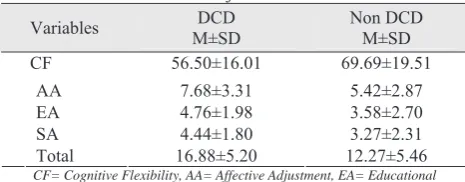
The mean (standard deviation) scores of the students with DCD and TDS was 16.88 (5.20) and 12.27 (5.46), respectively. Moreover, the mean (SD) of the scores for cognitive flexibility of students with DCD and TDS was 56.50 (16.01) and 69.69 (19.51), respectively (Table 1).
Table 1. Mean and standard deviation of cognitive flexibility
and adjustment
Variables M±SD DCD Non DCD M±SD
CF 56.50±16.01 69.69±19.51
AA 7.68±3.31 5.42±2.87
EA 4.76±1.98 3.58±2.70
SA 4.44±1.80 3.27±2.31
Total 16.88±5.20 12.27±5.46
CF= Cognitive Flexibility, AA= Affective Adjustment, EA= Educational Adjustment, SA= Social Adjustment
Before applying parametric multivariate analysis of variance, Box’s and Levene’s tests were used to observe its assumptions. According to Box’s test, which was not meaningful for any of the variables, uniformity condition for variance/covariance matrices was observed correctly (P>0.05).
According to Levene’s test, which was not meaningful for all the variables, equality condition for the group variances was observed.
The results of Wilk’s Lambda Test showed that the effect of the group on the combination of cognitive flexibility and adjustment components is significant [Wilks=.568, F=17.59]. The test mentioned above permitted the usability of multivariate analysis of variance (M-ANOVA). The results showed that there is a significant difference between at least one of the variables of the study in the two groups. Eta-square (which is, in fact, the correlation coefficient square between dependent variables and group membership) shows that the difference among the two groups -with respect to cognitive flexibility and adjustment- issignificant and the rate of difference is approximately 43 percent. That is to say, 43% of the variance related to the difference between the three groups is due to the influence of interaction of dependent variables.
The results obtained from the analysis of multivariate variance showed that the means of emotional adjustment (F(1,96)=13.02), educational adjustment (F(1,96)=6.09), and social adjustment
(F(1,96)=7.84) scores were significantly higher in the
students with developmental coordination disorder (P<0.001) (Table 2).
Table 2. Results of the analysis of multivariate variance on
mean cognitive flexibility and adjustment in students with DCD and TDS
Variables DF MS F P
Partial Eta Squared
CF 1 4259.02 13.43 .000 .123
1 125.45 13.02 .000 .119 1 33.91 6.09 .015 .060 AA
EA
SA 1 33.48 7.84 .006 .076
(P<0.001). The t-test was used for the two
independent groups to compare the total mean scores of adjustment. The results showed that the mean scores of the students with DCD were significantly higher than the ones in the typically developing group (t=4.241, df=96, p<0.001).
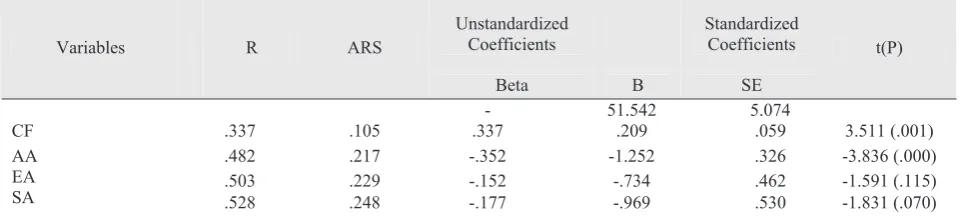
In order to determine the influence of each variable, cognitive adjustment and flexibility — as the predicator variables, and DCD — as the criterion
variable — they were analyzed by multivariate regression. The results showed that 25% of the variance is explained by cognitive adjustment and flexibility. With respect to beta values, cognitive flexibility (Beta=.337) and emotional adjustment (Beta=0.352) can explain variance of developmental coordination disorder in people suffering from it (P<0.001) (Table. 3).
Table 3. Results of the analysis of multivariate regression of cognitive flexibility and adjustment
in two groups of students with DCD and TDS
Unstandardized
Coefficients Standardized Coefficients
Variables R ARS
Beta B SE
t(P)
- 51.542 5.074
CF .337 .105 .337 .209 .059 3.511 (.001)
.482 .217 -.352 -1.252 .326 -3.836 (.000)
.503 .229 -.152 -.734 .462 -1.591 (.115)
AA EA
SA .528 .248 -.177 -.969 .530 -1.831 (.070)
** P<.001
Discussion
The results of the present research showed that children with DCD have lower cognitive flexibility and adjustment than typically developing children. They also showed that children with DCD have lower cognitive flexibility than typically developing children.
Typically, in growing children, performance in complex cognitive tasks and performance in motor coordination are related to each other (30, 31, 32). In research conducted on children with DCD, Roebers & Cover (31) concluded that the two functions of complex cognitive tasks and motor coordination (even by controlling age of participants) are significantly related to each other. These results indicate that there are common processes in cognitive and motor functions. It might also indicate that there are high-level cognitive processes in both factors and this is responsible for simultaneity of cognitive and motor deficits in the children with DCD. The results of the studies specified that there is a close relationship between developmental coordination disorder and executive functions, for when the duties are in the high-level executive functions such as cognitive flexibility, accuracy and
quick action in tasks, working memory and self-regulation and performance of children aged 6-15 with DCD decrease extensively (33, 12, 34, 35). Michel et al. (37) concluded that children with lower
motor coordination in controlling avoidance responses (Stroop Test) and distraction (cognitive flexibility) showed weaker performances. Stating that the problem of children with DCD in cognitive tasks is due to a disorder in motor coordination does not seem to be entirely true.
problems in learning skills, because cognitive flexibility is extremely important in acquiring new skills and cognitive processes and facilitating motor functions (38).
Another finding of this research was adjusting problems in the students with DCD. We observed that students with DCD had less adjustment as compared to the TDS. Because of weakness and lack of motor activities, these students also have communication problems at school, while playing and being among their peers. Perpetuation of such conditions for prolonged periods of time will result in reduction of adjustment in these children (39). In another research, Stephenson & Chesson (10) showed that developmental coordination disorder causes problems in psychosocial and emotional adjustments, isolation, educational problems, anxiety, obsessive-compulsive disorder and some other disorders. Moreover, children with DCD enjoy insufficient social support, have low self-esteem, and possibly have a higher level of self-perception in proportion to their isolation (40). Therefore, the feedback of this level of self-perception in proportion to interaction and performance makes a child pay more attention to his/her weaknesses, insufficiencies and failures. Finally, a child will be isolated and will experience considerable social problems. Educational maladjustment of the students with DCD starts when these students enter school while having motor problems and weak social skills. It seems that these children are kept away from school activities from the very beginning, and on the other hand, are not supported by their own peers; nor are they allowed participation in school activities. Therefore, these conditions remain as a constant feature in educational performance. Since children with DCD have problems in shifting accuracy in doing complex and common tasks in the educational atmosphere of school (such as dictation or doing class exercises in a limited time), these factors cause educational adjustment problems for these students and finally lead to their academic failure (41). Our findings confirmed earlier studies on cognitive flexibility problems and emotional, educational and social adaptabilities in children with DCD. These
variables are related to one another at a deep level. Therefore, existence of each of them predicts the prevalence of the other.
The results of the multivariate regression analysis showed that cognitive flexibility and adjustment explain 25% of variance of developmental coordination disorder. Meanwhile, cognitive flexibility and emotional adjustment have significant predictive power for DCD. This result shows that 75% of variance and the remaining factors are explained by other variables affecting DCD. With respect to the lack of corresponding findings in the record, this finding can be used to prove that cognitive flexibility and adjustment have considerable effects on the symptoms of developmental coordination disorder. Therefore further studies are required in this field.
Limitation- One of the limitations of this research is
lack of control of co-morbid disorders with developmental coordination disorder in the participants; the co-morbidity of certain movement neurological disorders such as attention deficit/ hyperactivity disorder (ADHD) / or learning disorders might have affected the research findings. This should be kept in mind by other researchers. Another limitation is that the present research was conducted at a certain time span. Therefore, it is recommended that cognitive flexibility and adjustment in different groups of neurodevelopment disorders be studied in a follow-up manner to gain a better understanding of the possible damages in this regard.
Acknowledgements:
The researchers appreciate all the managers and schoolteachers’ efforts who helped conduct the current study, especially the parents and students who took time to contribute to this research.
Authors’ Contributions - All authors had equal
roles in design, work, statistical analysis and manuscript writing.
Conflict of Interest: None declared.
References
1. American Psychological Association. Diagnostic and statistical manual of mental disorders: DSM-IV-TR, 2000; (fourth, text revision ed.). Washington DC.
2. Mandich A, Buckolz E, Polatajko H. On the ability of children with developmental coordination disorder (DCD) to inhibit response initiation: the simon effect. Brain Cogn 2002; 50, 150-62.
3. Rasmussen P, Gillberg C. Natural outcome of ADHD with DCD at age 22 years: A controlled longitudinal community based study. J AM ACAD CHILD PSY 2000; 39, 1424– 1431.
4. Wuang Y P, Su Ch Yng, Su J H. Wisconsin Card Sorting Test performance in children with developmental coordination disorder. RES DEV DISABIL 2011; 32, 1669– 1676.
5. Geuze R H. Postural control in children with developmental coordination disorder. NEURAL PLAST 2005; 12,183-196. 6. Kephart N C. The slow learner in the classroom (2nded.).
Columbus, OH 1971; Merrill.
7. Cantell M H, Smyth M M, Ahonen T P. Clumsiness in adolescence: Educational, motor and social outcomes of motor delay detected at 5 years. ADAPT PHYS ACT Q; 1994 11, 115–129.
8. Hands B, Larkin D. Physical fitness differences in children with and without motor learning difficulties. European J SPEC EDUC 2006; 21, 447–456.
9. Smyth M, Anderson H I. Coping with clumsiness in the school playground: Social and physical play in children with coordination impairments. BRIT J DEV PSYCHOL 2000; 18, 389–413.
10.Stephenson E A, Chesson R A. ‘Always the guiding hand’: Parents’ accounts of the long-term implications of developmental co-ordination disorder for their children and families. CHILD CARE HLTH DEV 2008; 34, 335–343. 11.Chen Yw, Tseng M H, Hu F C, et al. Psychosocial
adjustment and attention in children with developmental coordination disorder using different motor tests. Division of Occupational Science and Occupational Therapy, University of Southern California 2009; Los Angeles, CA 90089, United States.
12.Dewey D, Kaplan B J, Crawford S G, et al. Developmental coordination disorder: Associated problems in attention, learning, and psychosocial adjustment. HUM MOVEMENT SCI 2002; 21, 905–918. Manual of mental disorders (4th ed.).
13.Cañas J J, Quesada J F, Antolí A, Fajardo I. Cognitive flexibility and adaptability to environmental changes in dynamic complex problem-solving tasks. Ergonomics 2003; 46, 482.
14.Payne J W, Bettman J R, Johnson E J. The adaptive decision maker Cambridge, England. Cambridge University Press1993.
15.World Health Organization (WHO). International classification of functioning, disability, and health-children and youth. Geneva 2007; Author.
16.Simeonsson R J, Leonardi M, Lollar D, Bjock-Akesson E, Hollenweger J, Martinuzzi A. Applying the International Classification of Functioning, Disability and Health (ICF) to measure childhood disability. DISABIL REHABIL 2008; 24, 602–610.
17.Missiuna C, Rivard L, Bartlett D. Exploring assessment tools and the target of intervention for children with developmental coordination disorder. PHILOS OCCUP
THER PEDIATRICS 2006; 26, 71–89.
18.Pless M, Carlsson M. Effects of motor skill intervention on developmental coordination disorder: A meta analysis. ADAPT PHYS ACT Q 2000; 17, 381–401.
19.Dreer E, Elliot R, Fletcher C, Swanson M. Social problem solving abilities and psychological adjustment of persons in low vision rehabilitation. REHABIL PSYCHOL 2005; 89(3) 232-238.
20.Fornells A, Olivers A. Impulsive-careless problem solving style as predictor of subsequent academic achievement. PERS INDIV DIFFER 2000; 28, 639-645.
21.Grant S, Elliot R, Giger N, Bartoluci A. Social problem solving abilities, social support, and adjustment among family caregivers individuals with a stroke. REHABIL PSYCHOL 2001; 46(1), 44-57.
22.Schoemaker M, M, Kalverboer A F. Social and affective problems of children who are clumsy: How early do they begin? ADAPT PHYS ACT Q 1994; 11, 130–140.
23.Wilson B N, Kaplan B J, Crawford S, et al. The Developmental Coordination Questionnaire 2007 (DCDQ’07). Alberta Children Hospital 2007; Alberta, Canada.
24.Salehi H, Afsordeh-Bakhshayesh R, Movahedi A R, et al. Psychometric properties of a Persian version of developmental coordination disorder Questionnaire in boys aged 6-11 year-old. 6-11 years boys. Quarterly Psychology of Exceptional Individuals 2012;1(4), 135-161.
25.Hay J. Adequacy in and predilection for physical activity in children. CLIN J SPORT MED 1992; 2, 192–201.
26.Grant D A, Berg E A. A behavioral analysis of the degree of reinforcement and ease of shifting to new responses in a Weigly-type card-sorting problem. J EXP PSYCHOL 1948; 38, 404-411.
27.Kongs S K, Thompson L, Iverson G L, Heaton R K. WCST-64: Wisconsin Card Sorting Test-64 Card Version Professional Manual. Odessa, FL: PSYCHOL ASSESSMENT RES 2000.
28.Butler M, Retzlaff P, Vanderpioeg R. Neuropsychological test usage. Professional Psychology: RES PRACT 1991; 22, 510–521.
29.Wilson B, Crawford, M Sc. Administration manual for the DCDQ’07 with psychometric properties. Decision Support Research Team Research Portfolio, Alberta Health Services Calgary 2005; Alberta, Canada.
30.Sinha AKP, Singh RP. Adjustment Inventory for School Students (AISS). Agra 1993; National Psychological Corporation.
31.Livesey D, Keen J, Rouse J, White F. The relationship between measures of executive function, motor performance and externalizing behavior in 5- and 6- year-old children. HUM MOVEMENT SCI 2006; 25, 50-64.
32.Roebers C M, Kauer M. Motor and cognitive control in a normative sample of 7-year-olds. DEVELOPMENTAL SCI 2009; 12, 175–181.
33.Wassenberg R, Feron F, Kessels A, Hendriksen J, Kalff A, Kroes M, et al. Relation between cognitive and motor performance in 5- to 6-year old children: Results from a largescale cross-sectional study. CHILD DEV 2005; 76, 1092–1103.
34.Alloway T P, Temple K J. A comparison of working memory skills and learning in children with developmental coordination disorder and moderate learning difficulties. APPL COGNITIVE PSYCH 2007; 21(4), 473–487.
may not be a discrete disorder. HUM MOVEMENT SCI 1998; 17, 471–490.
36.Kastner J, Petermann F. Entwicklungsbedingte Koordinationsstörung. Psychologische Rundschau 2009; 60, 73–81.
37.Michel E, Roethlisberger M, Neuenschwander R, Roebers C M. Development of Cognitive Skills in Children with Motor Coordination Impairments at 12-Month Follow-up. CHILD NEUROPSYCHOL 2011; 17(2), 151–172.
38.Blair C, Razza R P. Relating effortful control, executive function, and false belief understanding to emerging math and literacy ability in Kindergarten. CHILD DEV 2007; 78, 647–663.
39.Purcell, C., John, P.W., Wilmut, K. & Poulter D. (2011). Roadside judgments in children with Developmental Co-ordination Disorder. RES DEV DISABIL 2011; RIDD-1082; No. of Pages 10, article in press.
40.Parker H, Larkin D. Children’s co-ordination and developmental movement difficulty. In G. Savelsbergh, K. Davids, J. van der K. & S. J. Benett (Eds.) Development of movement co-ordination in children (pp. 107–132). London, UK 2003; Routledge.