I
IJJMMCCMM Review Article
W
Wiinntteerr22001155,,VVooll44,,NNoo11
Rab11 in Disease Progression
Tanmay Bhuin1, Jagat Kumar Roy∗2
1. Cell and Developmental Biology Unit, Department of Zoology, The University of Burdwan, Golapbag-713104, India.
2. Cytogenetics Laboratory, Department of Zoology, Banaras Hindu University, Varanasi-221 005, India.
Abstract: Membrane/protein trafficking in the secretory/biosynthetic and endocytic pathways is mediated by
vesicles. Vesicle trafficking in eukaryotes is regulated by a class of small monomeric GTPases: the Rab protein
family. Rab proteins represent the largest branch of the Ras superfamily GTPases, and have been concerned in a
variety of intracellular vesicle trafficking and different intracellular signalling pathways. Rab11 (a subfamily of
the Ypt/Rab gene family), an evolutionarily conserved ubiquitously expressed subfamily of Rab GTPases, has
been implicated in regulating vesicular trafficking through the recycling of endosomes. Rabs have been grouped
into different subfamilies based on the distinct unambiguous sequence motifs. Three members: Rab11a, Rab11b
and Rab25 make up the Rab11 GTPase subfamily. In this review article, we describe an overview over Rab11
subfamily with a brief structural aspect and its roles in implicating different disease progression.
Key words: Vesicle trafficking, Rab proteins, Ras superfamily, Rab11, disease progression
∗
Corresponding author: Cytogenetics Laboratory, Department of Zoology, Banaras Hindu University, Varanasi-221 005, India. Email: [email protected]
verview over Rab family proteins and
Rab11 subfamily
Rab proteins, the evolutionarily conserved small
(21-25 kDa) monomeric GTP-binding molecules
(GTPases) forming the largest branch of the Ras
superfamily, have been found to be present from
yeast to humans. These proteins participate in
receptor cargo collection during transport vesicle
formation and enable motor proteins to interact
with membranes to drive vesicle motility,
mediating the complex events of precise docking
and fusion of transport vesicles with their targets. In
addition to the aforesaid general functions, Rabs
also act as key players in performing a variety of
cellular functions, viz., growth, protein trafficking
and different signalling pathways. So far, over 70
Rab proteins are encoded by the vertebrates; while
most of them are ubiquitously expressed but some
of these are tissue-specific also. A variety of Rabs
are defective and abnormally expressed in different
diseases including cancers (1). Rabs are associated
with cyclical activation and inactivation in the form
of GTP-bound/active state-regulated by upstream
regulators known as GEFs (guanine nucleotide
exchange factors) and GDP-bound/inactive state-
regulated by GAPs (GTPase activating proteins)
between the membranes and cytosol, respectively.
In their active states, Rab proteins are associated
O
Submmited 10 September 2014; Accepted 24 November 2014; Published 16 December 2014
with the cytosolic face of membranous
compart-ments and act together with downstream effector
proteins carrying out their biological functions (2).
Yeast has a relatively simple endomembrane
system and contains only 11 Rab proteins. In
humans, the numbers of Rab proteins have
progressively been increased along with the
evolution to almost 70 family members,
comparable to an increase in the complexity of
vesicular trafficking system (3-4). In addition,
around 33 Rabs in Drosophila melanogaster (5), 29
in Caenorhabditis elegans, 57 in Arabidopsis
thaliana (6-7) have also been characterized so far.
Rab11, an evolutionarily conserved
ubiquitou-sly expressed subfamily of the Ypt/Rab gene family,
is associated with recycling endosomes (REs) and
has been implicated in regulating vesicular
trafficking through recycling of endosomal
compartment (REC) and early endosomes (EEs) to
the trans-Golgi network (TGN) and plasma
membrane through recycling pathways (8-10).
Drosophila has a single Rab11 gene whereas,
the vertebrate Rab11 subfamily consists of
three members viz., Rab11a, Rab11b and Rab25,
and they have been characterized as regulators
of REs in both polarized and non-polarized cells
which are encoded by distinct genes (11-13). This
review focuses on a brief structural description of
Rab11, and its roles in implicating disease
progression.
Structure of Rab11
Rab GTPases undergo post-translational
modifications for its functional activity. Rab11a
terminates with isoleucine at its C-terminus,
suggesting that it may be geranylgeranylated.
Studies showed that Rab11a can be modified in
vitro, by different prenyl groups: farnesyl and
geranylgeranyl (14), whereas in vivo, it is
exclusively modified post-translationally only by
geranylgeranyl groups indicating that there must be
other determinant(s) that are essential for
prenyltransferase recognition (15). Pasqualato et al.
2004 (16) have reported the crystallographic
analysis of the GDP/GTP cycle of human Rab11a.
The crystal structures indicate that the nucleotide-
sensitive switch 1 and 2 regions differ from those of
other Rab proteins. In Rab11-GDP, they contribute
to a close crammed symmetrical dimer, which may
associate with membranes in the cell and allow
Rab11 to undergo GDP/GTP cycles without
recycling to the cytosol. The structure of active
Rab11 delineates a three-dimensional site that
includes switch 1 and is separated from the site
defined by the Rab3/Rab-philin interface. It is
proposed to form a novel interface for a Rab11
partner compatible with the simultaneous binding
of another partner at the Rab-philin interface.
Mutation of Ser 29 to Phe in this epitope resulted in
morphological modifications of the recycling
compartment that are distinct from those induced by
the classical dominant-negative and constitutively-
active Rab11 mutants.
Rab11 dysfunction and diseases
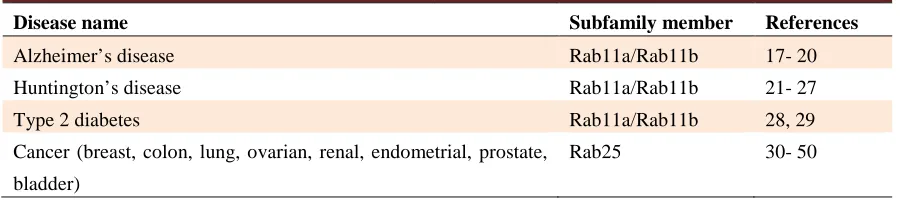
Rab11 has been implicated in a number of
patho-physiological diseases (Table 1), which are
summarized below:
Table 1. Diseases associated with Rab11 subfamily members
Disease name Subfamily member References
Alzheimer’s disease Rab11a/Rab11b 17- 20
Huntington’s disease Rab11a/Rab11b 21- 27
Type 2 diabetes Rab11a/Rab11b 28, 29
Cancer (breast, colon, lung, ovarian, renal, endometrial, prostate,
bladder)
Rab25 30- 50
Neurodegenerative diseases
Most of the neurodegenerative diseases are
characterized by synaptic dysfunction; neuronal
loss and cognitive or behavioural anomalies. Rab11
has been implicated in the following
neuro-degenerative diseases:
Alzheimer’s disease (AD)
It is the most common form of dementia and
has been characterized by the cerebral deposition of
β-amyloid (Aβ) peptides as amyloid plaques which
are generated from amyloid precursor protein
(APP) by β and γ secretases. APP and the secretases
are membrane associated proteins (17-18).
Aggregation of Aβ peptides leads to synaptic
disturbance and neurodegeneration in AD. A
portion of endocytosed Aβ is transported through
Rab11-positive recycling vesicles. Cellular
accu-mulation of Aβ is enhanced after inhibiting Aβ
recycling pathway by using a constitutively-active
Rab11. Inhibition of lysosomal enzymes results in
the Aβ accumulation and aggregation (19). An
RNAi screen using human Rab GTPases, identified
that Rab11 has been implicated in the recycling of
β-secretase to the plasma membrane and thereby
affecting Aβ production. Exome sequencing
exposed an important genetic relationship of
Rab11a with late-onset AD, and network analysis
identified Rab11a and Rab11b as components of
the late-onset AD risk network. This suggests a
causal link between Rab11 and AD indicating
trafficking pathways regulating Aβ levels and
unravels the molecular complexity underlying
AD (20).
Huntington disease (HD)
It is characterized by the presence of nuclear
and cytoplasmic inclusions, striatal neuronal loss,
and gliosis. Disruption of axonal transport within
long, narrow-caliber axons results in the
accumulations causing cell death and ultimately
neuronal dysfunction. Synaptic dysfunction in a
Drosophila model of HD can be prevented by
enhanced neuronal expression of Rab11. Inhibition
of Rab11 function in fibroblasts of HD patients has
been observed to perturb vesicle formation from
recycling endosomes. Rab11 is involved in synaptic
dysfunction prior to the onset of HD symptoms,
with the aim of finding a possible early intervention
to disease progression. Rab11 ameliorates synaptic
dysfunction due to expression of mutant huntingtin
(the causative protein in HD) by normalizing
synaptic vesicle size, which consequently
ameliorates locomotor deficits in Drosophila larvae
(21). The HD mutation causes polyglutamine
expansion in huntingtin protein (Htt) and
neuro-degeneration. Htt interacts with a complex
containing Rab11-GDP and is involved in the
activation of Rab11, which functions in endosomal
recycling and neurite growth and long term
potentiation. Rab11-GDP undergoes nucleotide
exchange to Rab11-GTP for its activation. Striatal
membranes of HD 140Q/140Q knock-in mice are
impaired in supporting conversion of Rab11-GDP
to Rab11-GTP. Dominant-negative Rab11
expressed in the striatum and cortex of normal mice
caused neuropathology and motor dysfunction,
suggesting that a deficiency in Rab11 activity is
pathogenic in vivo. Primary cortical neurons from
HD140Q/140Q mice were delayed in recycling
transferrin receptors back to the plasma membrane.
Partial rescue from glutamate induced cell death
occurred in HD neurons expressing dominant active
Rab11 (22). The polyglutamine expansion in the
Htt protein leads to perturbations in many cellular
pathways, including the disruption of
Rab11-dependent endosomal recycling. Impairment of the
small GTPase Rab11 leads to the defective
formation of vesicles in HD models and may thus
contribute to the early stages of the synaptic
dysfunction in this disorder. The expression of
mutant htt in the Drosophila larval neuromuscular
junction decreases the presynaptic vesicle size,
reduces quantal amplitudes and evoked synaptic
transmission and alters larval crawling behavior.
Furthermore, these indicators of early synaptic
dysfunction are reversed by the over expression of
Rab11 (23). Oxidative stress contributes to
neuro-degeneration in HD. Studies in HD transgenic
models suggest involvement of mitochondrial
dysfunction, which would lead to overproduction of
reactive oxygen species (ROS). Impaired
mitochondrial complexes occur in late stages of HD
but not in presymptomatic or early stage HD
patients. Thus, other mechanisms may account for
the earliest source of oxidative stress caused by
endogenous mutant Htt. Decreased levels of a
major intracellular antioxidant glutathione coincide
with the accumulation of ROS in primary HD
neurons prepared from embryos of HD knock-in
mice (HD 140Q/140Q), which have human
huntingtin exon1 with 140 CAG repeats inserted
into the endogenous mouse huntingtin gene. Uptake
of extracellular cysteine through the
glutama-te/cysteine transporter EAAC1 is required for de
novo synthesis of glutathione in neurons. HD
neurons had less numbers of cell surface EAAC1 in
comparison to the wild type neurons and were
deficient in taking up cysteine. Rab11 mediates
constitutive trafficking of EAAC1 from recycling
endosomes and this trafficking is defective in the
brain of HD 140Q/140Q mice. Dominant-active
Rab11 mutant expression in primary HD neurons
improved the deficit in cysteine uptake, increased
levels of intracellular glutathione, normalized
clearance of ROS, and improved neuronal survival
and hence support a novel mechanism for oxidative
stress in HD. Deregulation of Rab11 function
impairs both trafficking of EAAC1 to the cell
surface and cysteine uptake, thereby leading to
deficient synthesis of glutathione (24). HD is also
caused by the increase of a poly glutamine tract in
the huntingtin protein (Htt) that mediates the
formation of intracellular protein aggregates.
Accretion of protein aggregates, in the brains of HD
patients and HD transgenic mice, has been coupled
to lesions in axo-dendritic and synaptic
compartments. Places of synaptogenesis, i.e.,
dendritic spines are vanished in the closeness of Htt
accumulation because of functional defects in
Rab11 mediated by local endosomal recycling. In
cultured hippocampal neuron cells expressing a
mutant Htt fragment, impaired exit from recycling
endosomes (RE) and the association of endocytosed
protein with intracellular structures containing Htt
aggregates was found. Dendrites in hippocampal
neurons became dystrophic around enlarged Rab11
positive amphisome-like structures where mutant
Htt aggregates. Rab11 over-expression rescues
neurodegeneration and significantly extends
lifespan in a Drosophila model of HD. These
findings are consistent with the model that mutant
Htt aggregation increases local autophagic activity,
thereby sequestering Rab11 and diverting
spine-forming cargo from RE into enlarged amphisomes.
This mechanism may contribute to the toxicity
caused by protein mis-folding found in a number of
neurodegenerative diseases (25). This is also caused
by a CAG repeat expansion in the huntingtin gene.
In the brain of HD patients, a decline in glucose
metabolism is observed. Glucose consumption in
embryonic primary cortical neurons of wild type
(WT) and HD knock-in mice have 140 CAG
repeats inserted in the endogenous mouse
huntingtin gene; HD (140Q/140Q). Lesser amount
of glucose is significantly taken up by primary HD
(140Q/140Q) cortical neurons than WT neurons.
Glucose uptake in WT neurons is equally altered by
expression of permanently inactive and
permanently active forms of Rab11 suggesting that
normal activity of Rab11 is needed for neuronal
uptake of glucose. These results suggest that
deficient activity of Rab11 is a novel mechanism
for glucose hypometabolism in HD (26). Htt plays
an important role in manipulating Rab11 vesicles.
Reduction of Htt, kinesin and dynein motors
diminished Rab11 vesicle transport indicating a role
of these motors and Htt in bidirectional transport of
Rab11. Therefore, Htt plays a key role in the
movement of Rab11 vesicles within axons and thus,
disruption of transport mediated by mutant Htt
could contribute to early neuropathology observed
in Huntington's diseases (27).
Type 2 diabetes
Glucose is uptaken by insulin through
translocation of the glucose transporter, GLUT4 to
the plasma membrane. In the basal state, GLUT4
interact with cytosolic proteins within various
endosomal recycling compartments. Depending on
the unambiguous vesicles that GLUT4 travels
through, several Rab GTPase family members are
vital to this process. In case of type 2 diabetes,
insulin resistance disrupts translocation of the
intracellular resources of GLUT4 to the plasma
membrane, in spite of normal GLUT4 expression.
Rab11 is functionally associated with GLUT4
trafficking from storage vesicles to the endocytic
recycling pathway (28, 29).
Cancer
Studies have indicated that recycling members
(Rab11a, Rab11b, Rab25/Rab11c as well as their
effectors) exert an important role in cancers of
multiple lineages, including breast, colon, lung,
ovarian, renal, endometrial, prostate, bladder and
carcinoid types (30). It has been shown that Rab25
is involved in cancer progression by cell
proliferation and fortification from apoptosis. Its
increased expression was seen in ovarian and in
breast cancers, where it has been shown to have a
key function both in vitro and in vivo cancer
progression (31-33). Increased expression was also
seen in transitional cell carcinoma of the bladder
(Wilms tumour), in prostate cancer (34, 35), in
invasive breast tumour cells (33), and in colon
cancer cells (36). All of these studies have indicated
that it has a pathological role in tumor progression
in several epithelial lineages. Investigations have
indicated that Rab25 has been implicated in the
succession of tumor by regulating the localization
of integrin-recycling vesicles to develop tumor
invasion. It has also been shown to decrease
apoptosis and to increase proliferation as well as
aggressiveness of ovarian and breast cancer. Over
expression of Rab25 in ovarian cancer cell lines
enhances anchorage-independent colony-formation,
cell proliferation and cell survival over various
stress conditions (37). It has also been associated
with the α5β1 integrin enhancing the ability of
ovarian cancer cells to invade the extracellular
matrix (38). Recently, investigations have shown
that Rab25 acts as a tumor suppressor in colon and
oesophageal cancers, regulating cell adhesion,
polarity and signalling pathways. Further more,
research has implicated that an important protein
CLIC3 (chloride intracellular channel protein 3)
may determine whether or not Rab25 acts as a
tumor promoter or suppressor (39-42). It has also
been suggested that the expression status of the
Rab25 effector RCP could be a determinant of the
ability of Rab25 to act as a tumor promoter or
suppressor (43). Regulation of cell survival is
mediated by anti-apoptotic molecules such as
BCL-2, BAX, BAK, and phosphoinositide-3-kinase.
Forced expression of Rab25 in ovarian cancer cells
reduces the levels of BAX and BAK, and enhances
the AKT phosphorylation, which in turn activates
the phosphoinositide-3-kinase pathway.
Down-regulation of Rab25 reverses apoptotic signalling
cascade through BAK and BAX protein signalling
as well as AKT activity pathways. The BCL-2 and
phosphoinositide-3-kinase pathways are enhanced
by Rab25-mediated signaling for cell survival (37,
44-46). In 50% of ovarian cancers, 1q22 amplicon
having Rab25 is amplified (32). In addition,
chromosome 1q is gained in 50% of breast cancer
patients. Rab25 has also been shown to function as
a tumor suppressor in hormonally insensitive breast
tumors where its expression is lost (47). It may
function as a tumor suppressor in intestinal mucosa
cells and human colorectal adenocarcinoma where
loss of Rab25 leads to increased tumorigenesis
through alteration in the regulation of protein
trafficking to the cell surface (38). Research has
identified that loss of Rab25 expression occurs
through a mutation in locus 1q22-23 of human
breast cancer tissues. Therefore, Rab25 could be
used as a biological marker for breast cancer (48).
Another member of Rab11 family, Rab11a, acts as
a novel tumor associated c-Fos/AP-1 target, may
point to an as yet unrecognized function of Rab11a
in the development of skin cancer (49). Rab25 has
more frequently been implicated in tumorigenesis
than other members of Rab11 family because of the
presence of DTAGLE sequence at GTP binding site
instead of DTAGQE found in Rab11 as well as in
most of the Rab family members. This makes
Rab25 constitutively active similar to the Q61L
oncogenic mutation in Ras (50).
Conclusion
Rab11, a master regulator of intracellular
membrane trafficking routes, is the most
characterized molecule among all the Rab proteins.
It has been implicated in the progression of a
number of human diseases. It is noteworthy to
mention that Rab11 has an extensive
protein-protein interactions network and a variety of
distinct cargo molecules. But still, several
significant questions remain unclear including how
Rab11 mediated pathways are regulated; what is the
precise molecular mechanism of the upstream
activation of Rab11 subfamily members. Indeed,
understanding the precise molecular mechanism for
Rab11 in membrane recruitment is a key question
elucidating its functional role within the cell. A
more complete picture of the molecular and cellular
events controlled by Rab11 proteins will uncover
additional important physiological processes of the
Rab11 subfamily members and will prompt further
research in molecular mechanisms for many of the
diseases in which it has been implicated. Further,
understanding how the various interdependent
cellular processes occur is now an important goal in
the field of membrane trafficking pathways which
is yet to be addressed. The members of Rab11
GTPase family are involved in a variety of disease
settings including cancer progression. As the
actions of mechanisms of these GTPases are
identified; the signalling and trafficking pathways
in which they operate may present novel targets for
therapeutic invention.
Conflict of interest
The authors declared no conflicts of interest.
References
1. Bhuin T, Roy JK. Rab proteins: the key regulators of intracellular vesicle transport. Exp Cell Res 2014;328:1-19. 2. Stenmark H. Rab GTPases as coordinators of vesicle traffic. Nat Rev Mol Cell Biol 2009;10:513-25.
3. Pereira-Leal JB, Seabra MC. Evolution of the Rab family of small GTP-binding proteins. J Mol Biol 2001;313:889-901. 4. Jiang SY, Ramachandran S. Comparative and evolutionary analysis of genes encoding small GTPases and their activating proteins in eukaryotic genomes. Physiol Genomics 2006;24:235-51.
5. Zhang J, Schulze KL, Hiesinger PR, et al. Thirty-one flavors of Drosophila rab proteins. Genetics 2007;176:1307-22. 6. Pereira-Leal JB, Seabra MC. The mammalian Rab family of small GTPases: definition of family and subfamily sequence motifs suggests a mechanism for functional specificity in the Ras superfamily. J Mol Biol 2000;301:1077-87.
7. Vernoud V, Horton AC, Yang Z, et al. Analysis of the small GTPase gene superfamily of Arabidopsis. Plant Physiol 2003;131:1191-208.
8. Ullrich O, Reinsch S, Urbe S, et al. Rab11 regulates recycling through the pericentriolar recycling endosome J Cell Biol 1996;135:913-24.
9. Ren M, Xu G, Zeng J, et al. Hydrolysis of GTP on rab11 is required for the direct delivery of transferrin from the pericentriolar recycling compartment to the cell surface but not from sorting endosomes. Proc Natl Acad Sci U S A 1998;95:6187-92.
10. Wilcke M, Johannes L, Galli T, et al. Rab11 regulates the compartmentalization of early endosomes required for efficient transport from early endosomes to the trans-golgi network. J Cell Biol 2000;151:1207-20.
11. Casanova JE, Wang X, Kumar R, et al. Association of Rab25 and Rab11a with the apical recycling system of polarized Madin-Darby canine kidney cells. Mol Biol Cell 1999;10:47-61.
12. Cox D, Lee DJ, Dale BM, et al. A Rab11-containing rapidly recycling compartment in macrophages that promotes phagocytosis. Proc Natl Acad Sci U S A 2000;97:680-5. 13. Wang X, Kumar R, Navarre J, et al. Regulation of vesicle trafficking in madin-darby canine kidney cells by Rab11a and Rab25. J Biol Chem 2000;275:29138-46.
14. Joberty G, Tavitian A, Zahraoui A. Isoprenylation of Rab proteins possessing a C-terminal CaaX motif. FEBS Lett 1993;330:323-8.
15. Gromov P, Celis JE. Rab11a is modified in vivo by isoprenoid geranylgeranyl. Electrophoresis 1998;19:1803-7. 16. Pasqualato S, Senic-Matuglia F, Renault L, et al. The structural GDP/GTP cycle of Rab11 reveals a novel interface involved in the dynamics of recycling endosomes. J Biol Chem 2004;279:11480-8.
17. De Strooper B. Proteases and proteolysis in Alzheimer disease: a multifactorial view on the disease process. Physiol Rev 2010;90:465-94.
18. Frisoni GB, Hampel H, O'Brien JT, et al. Revised criteria for Alzheimer's disease: what are the lessons for clinicians? Lancet Neurol 2011;10:598-601.
19. Li J, Kanekiyo T, Shinohara M, et al. Differential regulation of amyloid-beta endocytic trafficking and lysosomal degradation by apolipoprotein E isoforms. J Biol Chem 2012;287:44593-601. 20. Udayar V, Buggia-Prevot V, Guerreiro RL, et al. A paired RNAi and RabGAP overexpression screen identifies Rab11 as a regulator of beta-amyloid production. Cell Rep 2013;5:1536-51. 21. Giorgini F, Steinert JR. Rab11 as a modulator of synaptic transmission. Commun Integr Biol 2013;6:e26807.
22. Li X, Sapp E, Chase K, et al. Disruption of Rab11 activity in a knock-in mouse model of Huntington's disease. Neurobiol Dis 2009;36:374-83.
23. Steinert JR, Campesan S, Richards P, et al. Rab11 rescues synaptic dysfunction and behavioural deficits in a Drosophila model of Huntington's disease. Hum Mol Genet 2012;21:2912-22.
24. Li X, Valencia A, Sapp E, et al. Aberrant Rab11-dependent trafficking of the neuronal glutamate transporter EAAC1 causes oxidative stress and cell death in Huntington's disease. J Neurosci 2010;30:4552-61.
25. Richards P, Didszun C, Campesan S, et al. Dendritic spine loss and neurodegeneration is rescued by Rab11 in models of
Huntington's disease. Cell Death Differ 2011;18:191-200. 26. Li X, Valencia A, McClory H, et al. Deficient Rab11 activity underlies glucose hypometabolism in primary neurons of Huntington's disease mice. Biochem Biophys Res Commun 2012;421:727-30.
27. Power D, Srinivasan S, Gunawardena S. In-vivo evidence for the disruption of Rab11 vesicle transport by loss of huntingtin. Neuroreport 2012;23:970-7.
28. Bryant NJ, Govers R, James DE. Regulated transport of the glucose transporter GLUT4. Nat Rev Mol Cell Biol 2002;3:267-77.
29. Kaddai V, Le Marchand-Brustel Y, Cormont M. Rab proteins in endocytosis and Glut4 trafficking. Acta Physiol (Oxf) 2008;192:75-88.
30. Mosesson Y, Mills GB, Yarden Y. Derailed endocytosis: an emerging feature of cancer. Nat Rev Cancer 2008;8:835-50. 31. Fan Y, Xin XY, Chen BL, et al. Knockdown of RAB25 expression by RNAi inhibits growth of human epithelial ovarian cancer cells in vitro and in vivo. Pathology 2006;38:561-7. 32. Cheng KW, Lahad JP, Kuo WL, et al. The RAB25 small GTPase determines aggressiveness of ovarian and breast cancers. Nat Med 2004;10:1251-6.
33. Wang W, Wyckoff JB, Frohlich VC, et al. Single cell behavior in metastatic primary mammary tumors correlated with gene expression patterns revealed by molecular profiling. Cancer Res 2002;62:6278-88.
34. Mor O, Nativ O, Stein A, et al. Molecular analysis of transitional cell carcinoma using cDNA microarray. Oncogene 2003;22:7702-10.
35. Croizet-Berger K, Daumerie C, Couvreur M, et al. The endocytic catalysts, Rab5a and Rab7, are tandem regulators of thyroid hormone production. Proc Natl Acad Sci U S A 2002;99:8277-82.
36. Goldenring JR, Shen KR, Vaughan HD, et al. Identification of a small GTP-binding protein, Rab25, expressed in the gastrointestinal mucosa, kidney, and lung. J Biol Chem 1993;268:18419-22.
37. Cheng KW, Lahad JP, Gray JW, et al. Emerging role of RAB GTPases in cancer and human disease. Cancer Res 2005;65:2516-9.
38. Caswell PT, Spence HJ, Parsons M, et al. Rab25 associates with alpha5beta1 integrin to promote invasive migration in 3D
microenvironments. Dev Cell 2007;13:496-510.
39. Nam KT, Lee HJ, Smith JJ, et al. Loss of Rab25 promotes the development of intestinal neoplasia in mice and is associated with human colorectal adenocarcinomas. J Clin Invest 2010;120:840-9.
40. Goldenring JR, Nam KT. Rab25 as a tumour suppressor in colon carcinogenesis. Br J Cancer 2011;104:33-6.
41. Tong M, Chan KW, Bao JY, et al. Rab25 is a tumor suppressor gene with antiangiogenic and anti-invasive activities in esophageal squamous cell carcinoma. Cancer Res 2012;72:6024-35.
42. Dozynkiewicz MA, Jamieson NB, Macpherson I, et al. Rab25 and CLIC3 collaborate to promote integrin recycling from late endosomes/lysosomes and drive cancer progression. Dev Cell 2012;22:131-45.
43. Tang BL. Is Rab25 a tumor promoter or suppressor--context dependency on RCP status? Tumour Biol 2010;31:359-61. 44. Liu J, Yang G, Thompson-Lanza JA, et al. A genetically defined model for human ovarian cancer. Cancer Res
2004;64:1655-63.
45. Liu R, Itoh T, Arai KI, et al. Two distinct signaling pathways downstream of Janus kinase 2 play redundant roles for antiapoptotic activity of granulocyte-macrophage colony-stimulating factor. Mol Biol Cell 1999;10:3959-70.
46. Wei MC, Zong WX, Cheng EH, et al. Proapoptotic BAX and BAK: a requisite gateway to mitochondrial dysfunction and death. Science 2001;292:727-30.
47. Cheng JM, Volk L, Janaki DK, et al. Tumor suppressor function of Rab25 in triple-negative breast cancer. Int J Cancer 2010;126:2799-812.
48. Cheng JM, Ding M, Aribi A, et al. Loss of RAB25 expression in breast cancer. Int J Cancer 2006;118:2957-64. 49. Gebhardt C, Breitenbach U, Richter KH, et al. c-Fos-dependent induction of the small ras-related GTPase Rab11a in skin carcinogenesis. Am J Pathol 2005;167:243-53.
50. Mitra S, Cheng KW, Mills GB. Rab GTPases implicated in inherited and acquired disorders. Semin Cell Dev Biol 2011;22:57-68.