http://mojem.um.edu.my 29 Corresponding Author:
Faculty of Education, Al-Madinah International University,
MALAYSIA.
Email: [email protected]
ABSTRACT
The aim of this study is to investigate the relationship between communication management indicators namely communication practices, communication tools and learners' cognitive engagement in distance learning programme. A set of hypotheses concerning correlational links between constructs are derived from the literature. This study was conducted using quantitative approach. Questionnaire was used to elicit responses from 405 randomly selected distance learners from three Malaysia Public universities offering distance-learning programmes. Data analysis was conducted using Analysis of Moment Structures (AMOS) version 18 software to test the relationship between communication practices, communication tools and learners' cognitive engagement. Confirmatory Factor Analysis (CFA) was conducted to establish the validity and reliability of the items. Tests of hypotheses provided evidence of measures of fit and statistical significance of the measurement model. The findings provide evidences of model fit and that effective communication practices and communication tools have strong positive relationship with students' cognitive engagement. The study establishes the relevance of communication management in enhancing self-directed, self-motivated and self-dependent distance learners.
Keywords: Communication Management, Distance Learning, Scale Validation, Communication Tools.
July 2018, VOLUME 6, ISSUE 3, 29- 47 E-ISSN NO: 2289 – 4489
https://doi.org/10.22452/mojem.vol6no3.2
COMMUNICATION MANAGEMENT IN DISTANCE LEARNING SCALE VALIDATION
http://mojem.um.edu.my 30
INTRODUCTION
Separation between learners and instructors in distance learning programme require special patterns of learner and teacher behaviours (Moore & Kearsley 2005). This separation leads to a communication space to be crossed. Consequently, potential misunderstanding usually ensues between the inputs of instructor and that of the learner. To cross this communication space, there is need for a concerted effort to develop measures that will enable programmes and process owners in distance education to manage the mismatch between instructors and learners. There have been efforts to develop measures for distance learning communication and learning from authors such as Kaur (2006) and Dzakiria (2012). However, these measures only look into the use of technological variables to enhance teaching online. Variables that measure coordination of technological use, effective teaching and learning, interaction and engagement of distance learners as maintain by Moore and Kearsley (2005), has yet to be developed. Literature suggest that effective management of communication between distance learners and instructors facilitate engagement in learning. Communication management involves communication practices and communication tools. Communication practices relate to teachers' presentation skills, technical competencies, virtual management techniques, and the ability to engage students through virtual communication, organizing course material, timely response, clarity of content and feedback (Moore & Kearsley, 2005; Partlow & Gibbs 2003). Communication tools are different types of computer/internet-based technology that are used by the distance-learning instructors to communicate and teach the students (learner-interface). They include Learning Management System (LMS), Web CT, emails, Facebook and threaded discussion forum (Khan, 2005). Of recent is the emergent of new learning platforms such as Massive Open Online Courses (MOOCs), Webinar, Moodle, WiZiq etc. All these are components of communication tools in the context of this study.
Student cognitive engagement describes students' feedback, students' representation and students' participation in learning. It also includes feelings and sense making or involving in learning activity. It depicts the cognitive engagement and compliance of student with cognitive activities norms, such as active participation in online forum discussion attendance and involvement in-group work, completion and submission of assignment (Trowler, 2010).
The classroom (conventional) method of teaching and learning which involves the physical presence of teachers and students does not cover the need of learners that are constrained by time and space (Khan, 2005). Therefore, rather than meeting in a conventional classroom, teachers and students in distance learning communicate synchronously via online communication. In synchronous communication, students and lecturers interact at different locations. At the same time, video conferencing, group chat or webinar are also used. With this development, many universities and colleges have included distance education programmes as part of their educational services. Distance education programmes require a systematic management of communication process (Dabaj, 2011). This include processes such as planning, curriculum design, instructional design, evaluation and implementation of policy that can foster and support active learning in distance education environment (Khan, 2005; Moore & Kearsely, 2012). Higher institutions need to embrace communication management techniques in response to the rapid expansion of distance education opportunities. These opportunities can be utilized by adopting and integrating the composite function of communication management sub-constructs of communication practices, communication tools and students’ cognitive engagement to facilitate teaching and learning (Beaty, 2004; Peggy, 2014).
http://mojem.um.edu.my 31 That is, instead of improving teaching and learning process, it will lead to it degradation. In addition, findings from the study of Motaghian, Hassanzadeh, and Moghadam (2013) showed that factors such as monetary, instructors’ pedagogical and technical competencies affect the success of distance learning initiative. Mei, Su, Ahmad & Rosnaini (2017) stated, “School leadership is often unable to provide strong leadership and strong support due to their own lack of technological knowledge and experience” (p. 28). Mei, Su, Ahmad and Rosnaini (2017) also pointed out that lack of understanding of distance learning environment (embedding technology into pedagogy for effective teaching) leads to poor instructional support of instructors. Therefore, the pedagogical aspect of the course material presented in distance learning programme should do away with traditional ways of teaching (Sa’adon, Dahlan, & Zainal, 2013; Rajasegeran, 2012). This occurs especially in institutions that are not fully into distance education settings per se. In this kind of settings, the prevalence perception is that instructor’s role is mainly to grade or mark students’ assignments that are completed at appointed time (Lentell, 2003). As the need for quality materials that can improve learners’ engagement in distance education increases, the emphasis and demand for the need of self-regulated learners becomes necessary.
The recruitment of less experienced instructors in teaching and learning at a distance in most institutions poses challenge of inability to transmit necessary instructional supports for learners in distance learning programme (Khan, 2005; Moore & Kearsley, 2005). The norm is that distance-learning (DL) instructors do make a difference in student engagement. Nevertheless, the extent to which students learn is related to instructors’ communication practices and handling of communication tools. To address this concern, it is important to develop a clear understanding of the unique nature of teaching and learning activities in distance learning programme. Specifically, the need for instructors to effectively harness the communication practice and communication tools resources to facilitate learners’ engagement. As such, it is rational to argue that students’ cognitive engagement in learning is the function of efficient and effective communication management by the instructors.
http://mojem.um.edu.my 32 The present study aimed at examining the relationship between communication management components (communication practices and communication tools) and distance learners’ cognitive engagement, in doing so, the study sought to clarify the meaning of communication management construct itself. Accordingly, the study served as foundation of a rating scale that would produce valid and reliable scores to assess distance-learning instructors’ communication management competency towards handling distance learning communication tools. Specifically, the study empirically tested the probability of a three-common-factor for communication management in distance learning programme.
Communication Management and Student Engagement Theory
This study is affected by transactional distance learning theory. To a large extent, Moore's Transactional Distance Learning Theory has opened-up a new pathway into distance education programmes and pointed out the important research directions (Gorsky & Caspi, 2005). Presently, Transactional Distance Learning Theory (TDLT) is useful in the discussion of distance education literatures. Many researchers now view it as a foundation framework for understanding distance education systems. According to Jung (2001), "Transactional Distance Theory provides a useful conceptual framework for defining and understanding distance education in general" (p. 527). Transactional distance theory is rooted in the assumption that the word distance in distance education is more of
pedagogy than a geographic separation of instructors and students. That is, “distance” may be a driving force, in
helping individual learners or group to wrest the control of their learning from educational institution (Moore & Kearsley, 2005). The theory emphasizes the importance of the effective management of interaction between learners-content, learner, teachers (communication practices) (Holmberg, 2001) as well as learner-interface (communication delivery tools) in reducing the transactional distance between instructors and learners (Creedon, 2007; Dzakiria, 2012).
Transactional distance theory looks into the unique organization and unique teaching behaviours of instructors in distance education. Transactional distance in education usually occurs whenever students did not take interest in their learning or are not engaged in meaningful dialog especially with their instructors (Saba, 2000; Stirling, 1997). Transactional distance learning theory postulated that effective communication reduces transactional distance in educational programme. In other word, the use of electronic device that relied heavily on communication technology will not only curtail the distance between learner and instructor, but also foster learning in distance education (Hillman, Willis, & Gunawardena, 1994). Moore and Kearsley (2005) stated that communications spaces between learner and his/her instructor are not always synonymous. In other words, transactional distance constructs are continuous rather than a discrete variable. In addition, within the family of distance education programmes there are variations of transactional distance (Moore, 2005). Although, Moore have argued that it will be a gainsaying that transactional distance is a relative rather than an absolute variable. This is particularly true because other variables that shape instructor and learners’ behaviours besides those of teaching and learning exist in distance education environment. Therefore, there is need for other theories that can fill the vacuum. These may include education administration; a theory of distance education history; a theory of distance learner motivation and so on (Moore & Kearsley, 2005). However, these theories are yet to be propounded. Therefore, transactional distance learning theory still offers explanation of relationships that is shaped around most constructs in distance education field - namely, management of the structure of instructional programmes, the interaction between learners and teachers, and the nature and degree of self-directedness of the learner (Moore & Kearsley, 2005).
http://mojem.um.edu.my 33
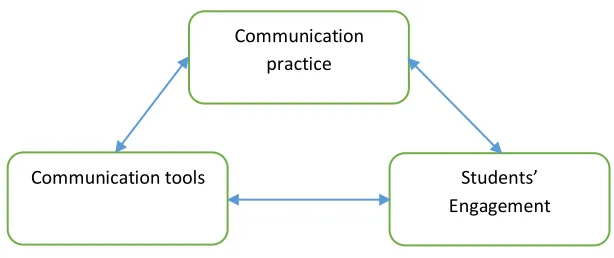
Figure 1: Hypothesized Model for Communication management in Distance Learning Programmes
Technological apparatus support for teaching and learning usually help both instructors and learners to achieve
their goals(Ahmad, Basha, Marzuki, Hisham, & Sahari, 2010). Moreover, with respect to the use of communication
tool in distance learning, there is high degree that the technologies that are used as media of communication would facilitate or increase practices that enhance student interaction such as timely feedback, content management presentation. Evidences from previous studies supported the leaners' expectation that technology improves practices such as timely feedback from lecturers, responses to forums and students’ interactions (Angelaki, 2013). Based on these evidences, the current study hypothesized that:
H1: communication practices have relationship with communication tool
For students to be actively engaged in learning, instructors must seek to ensure that communication practices— that facilitate dialogue (learner-learner, learner-teacher and learner-content) such as instructional materials, course design, learning devices, clarity of language and timely response to students' questions are well organized (Moore & Kearsley, 2012). In relation to this argument, this study hypothesized that:
H2: Communication practices has relationship with distance learners' cognitive engagement
The use of discussion in distance education courses, must allow the students to “build a sense of community”. Building sense of community as argued by Appana (2008) means that students could return to the dialogues that take place during lecture period later and re-examine issues and/or to remind themselves of the discussions that took place. This will eventually activate participation and increase engagement. Participation as illustrated by Al-Shalchi (2009), is the ability of the learner to reflect on thought whether the course has encouraged him/her to look at the subject from a different perspective. Via the teaching processes such as content management and course planning instructors will be able to exhibit a special teaching required in distance learning, and thus improve students' participation and interaction (Moore & Kearsley, 2005). Computer-mediated (communication tools) tools have a great potential in achieving the learning objective for both student and instructors (Bonk & King, 1998). The use of computer-based technology influences learners' behaviour, hence learning outcome (Compeau & Higgins, 1995; Fallon, 2011; Angelaki, 2013). This study therefore hypothesized that:
H3: Communication tools has relationship with distance learners' cognitive engagement
In the light of the preceding theory, the present study aimed to examine the relationship between communication management components—communication practices, communication tools and student cognitive engagement in distance learning programme.
Communication practice
Communication tools Students’
http://mojem.um.edu.my 34
METHODOLOGY
Research Design
This study used correlational research design. Correlational design was adopted in order to find-out if the data obtained from the three-communication management components have observable relationship that can further be specified in terms of magnitude and/or an increase or decrease in number of observable items that made up the latent constructs. Therefore, this research design of choice has been used to determine the relationship among communication management components, which consist of communication practices, communication tools and on students' cognitive engagement.
Population and Sampling
The populations of this research are distance-learning students in Program Pensiswazahan Guru (Teachers
Graduate Programme) (PPG) from three universities in Malaysia. These universities are International Islamic University (IIUM), University Pendidikan Sultan Idris (UPSI) and University Sains Malaysia (USIM). The total population from these universities is four thousand four hundred and sixteen (4116) PPG learners. Using Systematic random sampling procedure, 405 students were selected. This sample size is adequate in terms of providing sufficient estimates of the population parameters. According to Hair, Black, Babin and Anderson (2010), sample size of >= 200 respondents are deemed appropriate in determining the psychometric properties of latent constructs by using Confirmatory Factor Analysis (CFA). Therefore, the sample size requirements in this study are based on structural equation modelling (SEM). Thus, the researcher put up for the ratio of 10 respondents per parameter (Hair et al., 2010). The researcher obtained 405 samples for an instrument of 40 questions. Before employing this technique, the researcher identified two basic components namely the confidence interval and the margin of error. The confidence interval was set at 95% and the margin of error was set the lowest margin of error ± 5%. At this level, the difference between estimation from the sample and real population characteristics is around ± 5% (Sekaran & Bougie, 2010; Vockell & Asher, 1995).
Instrumentation
http://mojem.um.edu.my 35 Although, some authors caution that the inclusion of midpoint in scale attracts more negative answers from respondents (Nowlis, Kahn, & Dhar, 2002). Velez and Ashworth (2007), and O’Muircheartaigh, Gaskell, & Wright (1995), also argued that the inclusion of a midpoint in scale will result in the inability or unwillingness of the respondents to make the required trade-offs decision to choose sides. However, Bond and Fox (2007) suggested that having a balanced response category in scale will not only provide respondent with more attitudinal response options, but also increases the reliability of the items. Therefore, the researcher adopted a 5-point scale with a balanced response and mid-point as suggested by Bond and Fox (2007).
Data Collection Procedure
The researcher discussed with the authorities of each selected university, precisely the Deans, Heads of departments and coordinators of distance learning programme. After fruitful discussions with authorities of each university, permission was also sought from the programme coordinators to meet the students on the day they had face-to-face meeting. Researcher met the students on their first face-to-face meeting with their instructors at their respective universities. The students were briefed on content and importance of the research and requested their cooperation. After that, questionnaires were administered to the students and collected on the same day. Follow-up communication was carried out via email for those who did not complete the questionnaire. The percentage of the students that did not complete the questionnaire was 2.8% of the total population. The researcher also informed the students that participation in the study was voluntary, and that their responses would be kept anonymous and strictly confidential.
Data Analysis
This present study employed three stages of data analysis. The first stage involved item category function and ordering test. The second stage covered descriptive statistics—which included data screening, manipulation and data reduction. The third stage involves the confirmatory factor analysis and convergent/divergent reliability test. Statistical package for social science (SPSS) version 20.0 was used to compute the descriptive and as well as reliability. Analysis of moment structure (AMOS) version 18.0 with Maximum likelihood estimation (MLE) was used to perform confirmatory factor analyses (CFA).
Reliability & Validity
The instrument was subjected to steps involved in the face, content and construct validity. Two committee members (one of whom was a former PPG distance learning coordinator) and three PhD students— majoring in instructional technology, educational management and language and literacy, conducted the first round of face validity. The researcher improved on the instrument based on the suggestions provided. This was followed by empirical evidence on the construct validity and reliability of the instrument (see Table 2 for reliability values). Details of the whole instrument validation processes are discussed in the study.
RESULTS
Demographic Profile of Samples
Four hundred and five (405) completed sample data from PPG distance learners form the final analysis of this study. The respondents background with respect to gender included 95 males (23.5%) and 310 females (76.5%).
http://mojem.um.edu.my 36 Table1
Frequency and percentage of Demographic Characteristic of Respondents (n=405)
Characteristics N %
Gender
Male 95 23.5
Female 310 76.5
Institutions
UPSI 217 53.6
IIUM 104 25.7
USIM 84 20.7
Religion
Islam 315 77.8
Christianity 18 4.4
Buddhist 57 14.1
Hindu 14 3.5
Other 1 0.2
Highest Education
Secondary 50 12.3
Diploma 355 87.7
Total 405 100
This result showed that the number of female students is more than male students in distance learning programme. That is early school workforce is still dominated by women. Societal perception, status and payment might be the contributing factors. The highest education qualification obtained by the respondents is Diploma certificate (355, 87.7%) followed by secondary certificates (50, 12.3%). Majority of the respondents are Muslims (315, 77.8%), followed by Buddhists (57, 14.1%). Christians consist of (18, 4.4%), Hindus (14, 3.5%) and other religion (1, 0.2%). More than half (217, 53.6%) of the respondents are students from UPSI, followed by IIUM students (104, 25.7%) the remaining 84 (20.7%) of the respondents are from USIM. The respondents' ages are within the range of 30 to 50 years old.
Descriptive Statistics
The descriptive statistics for all 40 items of communication management and student engagement from the whole samples (N= 405) showed that the data does not violate multivariate normal distribution assumption. In the present study, inspection of bivariate scatter plots resulted oval-shaped array of points demonstrating that variables are linearly related and their variances are homogenously distributed. The means score from the 5-Likert scale range from 2.840 to 4.050 and the standard deviations from 0.656 to 1.094. The statistics values (z) of skewness index (SI) and kurtosis Index (KI), fall below the absolute value of SI >±3.0 and KI > ± 3.0 indicating that all the 40 items are normally distributed, and thus suitable for any parametric statistical test as suggest by Kline (2011).
Based on the results of the descriptive analysis, communication practice, communication tools and student engagement items mean respectively are well above the anchor points of 3.00 and within the good range of standard deviation of 0.625 to 1.094 indicating a well-dispersed variation of data. In general, the statistics for skewness and kurtosis are within the accepted limits, indicating that the items are normally distributed.
http://mojem.um.edu.my 37 Hypothesized Model
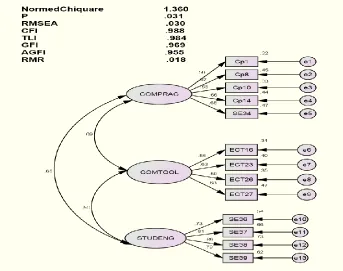
To validate the likelihood of the Hypothesized three-factor model, confirmatory factor analysis was conducted. The overall goodness of fit indices of the 13-items measurement model is presented in figure2. The initial 40-items were reduced to 13, due to low factor loading. The goodness-of-fit of the hypothesized model is consistent with the data. The observed covariance matrix, accounted for 90% of the proportion of variance explained. The magnitude and direction of the factor loading were substantially significant. The model is free from negative estimates, and the internal consistency values satisfied the standard deemed necessary in construction. The composite reliability value for the sub-constructs were 0.95 (Communication Practice), 0.89 (Communication tools) and 0.88 (Student Engagement) see Table 1.
Measurement Model of Communication Management in Distance Learning
Confirmatory Factor Analysis (CFA) was conducted on the hypothesized three-factor structural model using AMOS 20.0 model-fitting program. The program adopted maximum likelihood estimation to generate the whole measurement model. To assess the fit of the 40-item model, the analysis relied on number of goodness of fit (GOF) indices, Discrepancy Divided by Degree of freedom (CMIN/DF), the Comparative Fit Index (CFI) and the Root Mean Square Error of Approximation (RMSEA), Goodness-of-fit index (GFI), Adjusted Goodness-of-fit index (AGFI), Root mean square residual (RMR), Tucker-Lewis Coefficient TLI. According to Arbuckle and Wothke (1999), CMIN/df with a value of between 2 and 5 is considered acceptable. They further stress that the threshold values of CFI, GFI, AGFI and TLI range from zero to 1, with values close to 1 demonstrating a good fit (normally above 0.9). Finally, a value of RMSEA and RMR of ≤ 0.1 shows a reasonable error of estimation was determined.
http://mojem.um.edu.my 38 The measurement model showed that the overall model fit normed-chi-square χ2 (2)/df = 1.360 (see Figure 2). Significance chi-square indicates good fit of the data to the model. Chi-square test is biased with sample size and tends to be significant with large sample size, Comparative Fit Index (CFI), the Root Mean Square Error of Approximation (RMSEA), Goodness of fit index (GFI) and Root square mean Residual (RMR) were used to establish the goodness-of-fit of the hypothesized model to the data. The CFI was 0.988 (above the 0.9 minimum), GFI was 0.984 (above the 0.9 minimum) and the RMSEA was 0.03 (within the acceptable value of ≤ 0.1). All these indicate that the revised model fit the data. Therefore, we concluded that the revised model fits the data and response to the purpose of the study.
Reliability and Convergent Validity
Reliability of the items was assessed using construct reliability (CR) and average variance extracted (AVE) and validity was assessed using convergent and discriminant. Table 1 represents the result of construct, convergent for the CFA model of communication Management in distance learning with 13 items. As shown in figure 2, all indicators have high factor loadings ranging from 0.56 to 0.81 indicating that the meaning of the factors has been preserved by these indicators. Table 2 also shows that the AVE values, which reflect the overall amount of variance in the indicators accounted for by the latent construct, were 0.399, 0.397and 0.638 for Communication practice, communication tools and student engagement. All of these values were below the cut-off 0.5 except for student engagement. Evidence of convergence validity is established only with students’ engagement construct. Evidence of convergent validity seems to be daunting in other two constructs as suggested by Nunnally and Bernstein (1994).
Table 2
Validity and Reliability estimates
CR AVE
Communication Practice 0.95 0.399
Communication Tools 0.89 0.397
Student Engagement 0.88 0.638
Validity Concerns
Note:
a: AVE = (summation of the square of the factor loadings)/ {(summation of the square of the factor loadings) + (summation of the error variances)}.
b: Composite reliability = (square of the summation of the factor loadings)/ {(square of the summation of the factor loadings) + (square of the summation of the error variances)}. Diagonals represent the square root of the AVE while the other entries represent the correlations.
http://mojem.um.edu.my 39 Testing the Study’s Hypothesis
The models evaluated the path relationships to answer the following hypotheses:
Hypothesis 1: communication practices has relationship with communication tool
The relationship between communication practice and communication tools was found to be significant (CR = 6.729) with high positive value of correlation coefficient of 0.690 (see Fig. 2 and table 2). Thus, the hypothesis is supported. This result is in line with the contribution of communication tools to communication practices use for academic purposes in the study context, the more the instructors are confident or comfortable with the use of pedagogical tools, the more they practice communication for effective learning. In terms of a correlation coefficient, the size of the observed effect was r = .690. This, based on Cohen’s Conventions is considered a strong uphill positive linear relationship.
Hypothesis 2: Communication practices has relationship with distance learners' cognitive engagement
Communication practices (COMPRAC) significantly correlate with distance learners’ cognitive engagement by a standardized correlation coefficient of 0.648 (CR > 7.224). Instructors’ presentation of learning materials, feedback and assessment in an interactive way positively relates to learners’ cognitive engagement (see Fig. 2, table3). This based on Cohen’s Conventions is considered a strong uphill positive linear relationship.
Hypothesis 3: Communication tools has relationship with distance learners' cognitive engagement
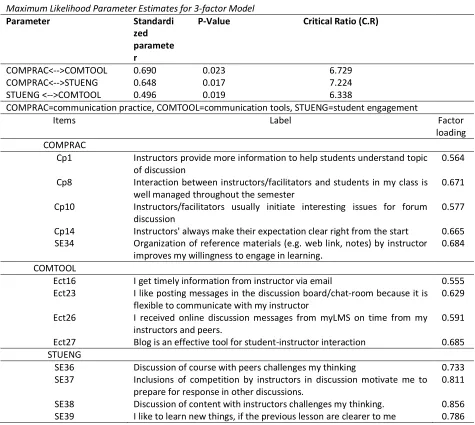
http://mojem.um.edu.my 40 Table 3
Maximum Likelihood Parameter Estimates for 3-factor Model
Parameter Standardi
zed paramete r
P-Value Critical Ratio (C.R)
COMPRAC<-->COMTOOL 0.690 0.023 6.729
COMPRAC<-->STUENG 0.648 0.017 7.224
STUENG <-->COMTOOL 0.496 0.019 6.338
COMPRAC=communication practice, COMTOOL=communication tools, STUENG=student engagement
Items Label Factor
loading COMPRAC
Cp1 Instructors provide more information to help students understand topic
of discussion
0.564
Cp8 Interaction between instructors/facilitators and students in my class is
well managed throughout the semester
0.671
Cp10 Instructors/facilitators usually initiate interesting issues for forum
discussion
0.577
Cp14 Instructors' always make their expectation clear right from the start 0.665
SE34 Organization of reference materials (e.g. web link, notes) by instructor
improves my willingness to engage in learning.
0.684
COMTOOL
Ect16 I get timely information from instructor via email 0.555
Ect23 I like posting messages in the discussion board/chat-room because it is
flexible to communicate with my instructor
0.629
Ect26 I received online discussion messages from myLMS on time from my
instructors and peers.
0.591
Ect27 Blog is an effective tool for student-instructor interaction 0.685
STUENG
SE36 Discussion of course with peers challenges my thinking 0.733
SE37 Inclusions of competition by instructors in discussion motivate me to
prepare for response in other discussions.
0.811
SE38 Discussion of content with instructors challenges my thinking. 0.856
SE39 I like to learn new things, if the previous lesson are clearer to me 0.786
DISCUSSION
http://mojem.um.edu.my 41 There are strong and moderate correlation between all the constructs. This distinctive relationship has shown that as distance learners (PPG) experience their instructors to be versatile at using diverse features in communication medium such LMS, email and Facebook (communication tools), they felt that their lecturers established interaction—which include feedback on assignment and organized material (communication practices) for them. Wahlstedt and Honkaranta (2007) supported and asserted that communication tools like LMS, emails, Facebook etc., have provided tremendous prospect for students' interaction and prompt feedback. The need for communication that fosters interaction between students and content, students-students, students-lecturer and students-interface ultimately improves positive learning behaviour and is supported by Moore (1993), Anderson (2003) and Dzakiria (2012). Thus, it can be concluded that 69% of the number of times the respondents (the in-service teachers) experience communication practices (presentation of interesting e-forum discussions and well-organized reference of study materials) in distance learning programme is attributable to efficient utilization of communication tools such as private emails, myLMS and use of Blog and Facebook by the instructors. While the remaining 41% of the number of time the student experience good communication practice is due to other reasons. Therefore, the more the instructors in distance learning utilize the features available in myLMS, blogs and private emails in teaching, the greater the students experience efficient communication practices. This finding contrast that of Moore and Kearsley (2005) who cautioned distance learning handlers of the impending risk of investing much on communication tools for teaching and learning at the expense of content-based training for instructors. However, based on the finding of this study, the impending risk of underutilization of communication tools by instructor due content-ability-technology mismatch identified by Moore can be circumvented with consistent practice and use of the latest teaching aids by the instructors.
In tandem with Burgess (2006), communication practice (interaction and teamwork among students and cooperation between students and instructors) is necessary for learners' creative and critical thinking in a genuine context. In addition, this study is in support with McGivney (2004) and Khan (2005) which view managing learning resources such as course content and presentation together with an interactive learners' group promote higher thinking and self-directed distance learning students’ feedback from tutors. This study is supported by findings of Yu and Yu (2002) and Almrashdeh et al. (2010). The studies confirmed that relationship between communication tools and students’ engagement is viable in promoting students' cognitive growth and engagement especially in distance learning. Sadat and Rahman (2003) in their study on Bangladesh Open University students, also find out that email and Facebook are effective tools for interaction as well as to make a bridge of communication barrier between both tutors and learners. In the study by Sharifah and Zahra (2015), a significant relationship was found among variables such connectivity, assessment and feedback and collaboration in predicting student engagement when learning via communication tools like Facebook.
CONCLUSION AND IMPLICATION
http://mojem.um.edu.my 42 Previous researches and literatures have revealed that students’ cognitive engagement can be influenced by composite of—student-learning competency, socio-economic predisposition of learners, highly structured course content and repetitive teaching. This study however, has supported that in the context of distance learning; instructional practices and effective utilization of communication tools by instructors/lecturers/tutors could as well provide alternative measure variables that work well on students’ cognitive engagement especially in distance learning programme. It can be concluded that if distance-learning students are provided with self-digested learning materials, well-organized contents, regular feedback and the use of multiple communication tools, they will experience high-level engagement in learning.
The correlation between the communication practice and communication tools indicated an interaction between students-students, students-content, students-lecturer and student-interface. Distance learning instructors who are prudent in handling communication medium will in turn promote regular feedback on students' assignments, provision of self-explanatory course materials for students and ability to organized course content in a more interactive way. This information provides an extension of the literature in communication management and distance learning management framework.
REFERENCES
Ahmad, T. B. T., Basha, K. M., Marzuki, A. M., Hisham, N. A. & Sahari, M. (2010). Faculty's acceptance of computer
based technology: Cross-validation of an extended model. Australasian Journal of Educational Technology,
26(2), 268-279.
Almrashdeh, I .A, Sahari, N., Zin, A .M. & Alsmadi, M. (2010). Distance Learning Management System Reqiurements
From Student’s Perspective. Journal of Theoretical and Applied Information Technology, 6 (5), 1-9
Anderson, T. (2003). Getting the mix right again: An updated and theoretical rationale for interaction. The
International Review of Research in Open and Distance Learning, 4 (2). Retrieved July 8, 2016, from http://www.irrodl.org/index.php/irrodl/article/view/149/230.
Angelaki, C. (2013). Communication and Social Presence: The Impact on Adult Learners’ Emotions in Distance
Learning. Journal of the Theoretical Humanities,16(1), 78-93.
Al-Shalchi, O.N. (2009). The Effectiveness and Development of Online Discussions MERLOT. Journal of Online
Learning and Teaching, (5)1, 104-108.
Appana, S. (2008). A review of benefits and limitations of online learning in the context of the student, the
instructor, and the tenured faculty. International Journal on E-Learning, 7(1),5-22.
Arbuckle, J., & Wothke, W. (1999). AMOS 4 user’s reference guide. Chicago: Smallwaters Corp
Bagozzi, R.P., & Yi, Y. (1988). On the evaluation of structural equation model. Journal of Academy of Marketing
Science, 16 (1), 74-94.
Beaty, E. (2004). The personal experience of learning in higher education: Changing views and enduring
http://mojem.um.edu.my 43 Burgess, J. (2006). Transactional distance theory and student satisfaction. (Doctorate dissertation, The University
of West Florida). Retrieved from http://uwf.edu/vburgess/Final_Dissertation.pdf
Bond, T.G., & Fox, C.M. (2007). Applying The Rasch Model: Fundamental Measurement in the Human Sciences
(2nd ed.). Mahwah, NJ, US. Lawrence Erlbaum Associate, Inc.
Bonk, C.J., & King, K.S. (Eds.). (1998). Electronic collaborators: Learner-centered technologies for literacy,
apprenticeship, and discourse. Mahwah, NJ: Lawrence Erlbaum.
Compeau, D.R., & Higgins, C.A. (1995, June). Computer Self-Efficacy: Development of a Measure and Initial Test.
MIS Quarterly, 19(2), 189-212.
Creedon, S. (2007). Preparing nurses on-line to work off-line: Experiences gained from teaching final year undergraduate nursing students in Ireland. Online Journal of Nursing Informatics (OJNI), 11, (1) [Online]. Available at: http://ojni.org/11_1/creedon.htm
Dabaj, F. (2011). Analysis of Communication Barriers to Distance Education: A Review Study. Online Journal of
Communication and Media Technologies, 1(1), 1-15. Retrieved from http://www.ojcmt.net/ articles/11/111
Dzakiria, H. (2012). Illuminating the Importance of Learning Interaction to Open Distance Learning (ODL) Success: A
Qualitative Perspective of Adult Learners in Perlis, Malaysia. The journal of open distance learning, 16(59),
1-9.
Fallon, G. (2011). Making the connection: Moore's theory of transactional distance and its relevance to the use of a
virtual classroom in postgraduate online teacher education. Journal of Research on Technology in
Education, 43(3), 187-209.
Gorsky, P., & Caspi, A. (2005). A Critical Analysis of Transactional Distance Theory. The Quarterly Review of
Distance Education, 6(1), 1-11.
Hair, J.F., Black, W.C., Babin, B.J., & Anderson, R.E. (2010). Multivariate Data Analysis. Seventh Edition. Pearson Prentice Hall.
Hillman, D. C., Willis, D.J., & Gunawardena, C.N. (1994). Learner interface interaction in distance education: An
extension of contemporary models and strategies for practitioners The American Journal of Distance
Education, 8(2), 30-42.
Holmberg, B. (2001). Distance Education in Essence: An overview of theory and practice in the early twenty-first century Oldenburg, Germany: Biblio theksund Information system der Universität Oldenburg.
Khan, B.H. (2005). Managing E-learning Strategies: Design, Delivery, Implementation and Evaluation. Information
Science Publishing United State
Kaur, A. (2006). E-Learning Challenges as Perceived by Communities of Practice. AAOU Journal, 2 (1), 51-65.
Kline, R.B.(2011). Principles and Practice of Structural Equation Modeling (3rd ed.). The Guildford Press. New
http://mojem.um.edu.my 44 Kuleshov, G.G. (2008). Computerized education: What is behind the attractive curtain? In M. Iskander (Ed.),
Innovative techniques in instruction technology, e-learning, e-assessment, and education. Bridgeport, CT, USA: Springer.
Lentell, H. (2003). The importance of the tutor in open and distance learning. In A. Tait & R. Mills (Eds.),
Rethinking learner support in distance education Change and continuity in an international context.
London: Routledge Falmer.
McGivney, R. (2004). Technologies of online learning (E-learning). In T. Anderson & F. Elloumi (Ed.), Theory and
practice of online learning. Athabasca, Canada: Athabasca University.
Mei L., Su L., W Ahmad F.A., &Rosnaini. M. (2017). Teachers’ Perceptions of E-Learning in Malaysian Secondary
Schools. Malaysian Online Journal of Educational Technology, 5 (2) 20-33.
Moore, M. G. (1993). Theory of transactional distance. In D. Keegan (ed.). Theoretical principles of distance
education (pp. 22-38). London: Routledge.
Moore, M.G. & Kearsley, G. (2005). Distance education: A systems view. New York: Wadsworth.
Moor e, M. G., & Kearsley, G. (2012). Distance education: A systems view of online learning (3rd ed.). Belmont, CA:
Wadsworth.
Motaghian, H., Hassanzadeh, A., & Moghadam, D. K. (2013). Factors affecting university instructors' adoption of
web-based learning systems: Case study of Iran. Computers & Education, 61, 158-167.
Nunnally, J. C., & Bernstein, I. H. (1994). Psychometric theory (3rd ed.). New York: McGraw-Hill. Google Scholar
Nowlis, S.M., Kahn, B.E., & Dhar, R. (2002). Coping with Ambivalence: the Effect ofRemoving a Neutral Option on
Consumer Attitude and Preference Judgments. Journal ofConsumer Research, 29, 319-334.
O’Muircheartaigh, C., Gaskell, G., & Wright, D.B. (1995). Weighing Anchors: Verbal and Numerical Labels for
Response Scales. Journal of Official Statistics, 11, 295-307.
Partlow, K. M., & Gibbs, W. J. (2003). Indicators of constructivist principles in Internet-based courses. Journal of
Computing in Higher Education, 14(2), 68-97.
Peggy, S.B. (2014). How others see us: leaders’ perceptions of communication and communication managers.
Journal of Communication Management,18 (1), 58-79.
Rajasegeran Ramasamy 2012 Blended Discrete Trial Clinical Method to Enhance Performance in e-Learning Mathematics Courses (B7). Smart innovations in Education and lifelong learning. June 14-15 Hall 9 IMPACT, Muang Thong Thani, Nonthaburi, Thailand.
Rienties, B., Giesbers, B., Lygo-Baker, S., Ma, H. W. S., & Rees, R. (2016). Why some teachers easily learn to use a
new virtual learning environment: a technology acceptance perspective. Interactive Learning
http://mojem.um.edu.my 45
Saba, F. (2000). Research in distance education: A status report. International Review of Research in Open and
Distance Learning, 1(1) Retrieved from: http://www.irrodl.org/content/v1.1/farhad.html
Sa'don, N. F. B., Dahlan, H. B. M., & Zainal, H. B. (2013, November). Derivation for design of Virtual Learning Environment (VLE) framework for Malaysian schools. In Research and Innovation in Information Systems (ICRIIS), 2013 International Conference on (pp. 570-575). IEEE.
Sadat, A & Rahman K. M. R. (2003) Prospect of Email Communication as an Educational Tool for Distance Education in Bangladesh Theme: Provision for youth and young children: Annual Conference, Held on Thailand, 12-14.
Sekaran, U., & Bougie R. (2010). Research Method for Business. Scotprint, Haddington, East Lothian (5th ed. ).
West Sussex, UK: John Wiley & Sons Ltd.
Sharifah, S. S., H. & Zahra, M.L (2015). The Use of Social Networks Sites (SNSs) among University Students: How Far
do They Learn. International Journal of Social Science and Humanity, 5 (5), 1-17.
Steel, C. (2009). Reconciling university teacher beliefs to create learning designs for LMS environments.
Australasian Journal of Educational Technology, 25(3), 399-420.
Stirling, D. (1997). Toward a theory of distance education: Transactional distance. Retrieved from http://www.stirlinglaw.com/ deborah/stir4.htm.
Trowler. V. (2010). Student engagement literature review, The Higher Education Academy. Innovation Way York
Science Park Heslington York YO10 5BR.
Velez, P., & Ashworth, S. D.(2007). The impact of item readability on the endorsement of the midpoint response in
surveys. Survey Research Methods, 1 (2), 69–74.
Vockell, E.L. & Asher, J.W. (1995). Educational Research (2nd ed.). Prentice Hall, Upper Saddle River.
Wahlstedt A. & Honkaranta A. (2007). Bridging the Gap between Advanced Distributed Teaching and the Use of Learning Management Systems in the University Context. Seventh IEEE International Conference proceeding on Advanced Learning Technologies (ICALT 2007).
Yu, F. Y., & Yu, H. J. (2002). Incorporating e-mail into the learning process: its impact on student academic
http://mojem.um.edu.my 46 Appendix: