ijer.skums.ac.ir
INTRODUCTION
Nowadays, hypnosis has opened its position in the medical community and many associations at different levels are researching and experiencing this phenomenon in the fields of psychology and medicine.1 Generally, hypnosis has two applications
under which the rest of its sub-application are categorized. The first application is the treatment of mental health issues such as phobias or pathological fears, fears induced anxieties, and psychosomatic diseases such as migraines, gastric ulcer, nocturnal
Effectiveness of hypnosis in the treatment of pain and enhancing
mental performance in Iran: A systematic review and meta-analysis
Zaynab Mirzaei1, Shahram Mami1, Mandana Sarokhani1, Kourosh Sayehmiri1,2*
1
Psychiatry Dept., Islamic Azad University, Ilam, I.R. Iran; 2Psychosocial Injuries Research Center, Ilam University of Medical Sciences, Ilam, I.R. Iran.
Received: 27/Oct/2015 Accepted: 6/Jan/2016
ABSTRACT
Background and aims: Nowadays, hypnosis has opened its position in the medical community. Based on controlled trials, hypnosis has been superior compared to other interventional procedures to reduce acute pain. This investigation aims to determine the effectiveness of hypnosis in the treatment of pain and enhancing mental performance in Iran, using the meta-analysis method.
Methods: The search has been conducted in international database such as: ISI, Scopus, Pubmed, Google Scholar, and Iranian databases such as: Medlib, SID, Magiran, and Iran Medex. The data have been analyzed using meta-analysis method (random effects model). Heterogeneity between articles was assessing using I2 index and “Dersimonia and Lardi” statistics. In all studies, hypnotic effect size was expressed as a dichotomous (yes or no) variable. Relative Risk (RR) was used to show effect size.
Results: Among the 45 articles, 6 of them had eligibility to inter to meta-analysis. Sample size of 6 articles was 546. The effectiveness of hypnosis in the case group has been 20% more than the control group RR=1.20 (Confidence interval 95%: 0.97 to 1.46), But, there was no significant difference between test and control groups.
Conclusion: There was not statistical significance evidence in effectiveness of hypnosis in pain and reduction of psychological tensions, but 20% of effectiveness can be important from medical view of point. So, this method can be used as a routine procedure in the treatment of pain and enhancing mental performance.
Keywords: Hypnosis; Pain; Mental performance. Meta-analysis, Systematic review.
Re
view
ar
tic
enuresis, and tics. The second application self-training and spiritual promotion.2 In recent years, the discussion about hypnosis, as a new phenomenon, has become increasingly popular among students and academic circles and even more stilted among the public. Everyone express their own opinions and comments regarding this matter, most of which contain false, unscientific, and distorted points.3 Unlike many conventional human thoughts, phenomena of hypnotism has nothing to do with the human spirit and only depicts a motion from outside to into the mind.4 Notwithstanding the long history of this phenomenon in Iran and in the world and also many existing works in this area, it can clearly be seen that the current standing is far away from its real position and is associated with many superstitions. Therefore, it can be seen that hypnosis nowadays, as a complementary therapy in combination with conventional medical and pharmaceutical therapies or even as an alternative to drugs. It can be contributed to the treatment of a wide range of physical and mental illnesses in the various branches of clinical internal medicine, psychology, pediatrics, different surgeries specialty obstetrics and gynecology, orthopedics, oral and dental, and sports and also have a positive impact on the improvement of quality of life. Also, treatment with hypnosis is very successful in acute and chronic pains.5
Taylor et al., Myers et al. showed that cognitive-behavioral strategies, such as hypnosis can have an impact on the performance of athletes.6,7 According to Agurest et al. 295 types of painless delivery were managed with different methods of hypnosis. 94% of the childbirth operations that were done with the hypnosis painless method, were conducted successfully.8 Hypnosis also have other advantages over the topical anesthesia method.9
Hypnosis is the focus of the advanced conditions where the person focuses on a particular stimulus and regarding other stimulus such as environmental or bodily stimulus shows no attention.10 Psychologists gradually put aside the old assumption that hypnotism changes human beings into strange creatures, passive and are dominated and they replaced it with the belief that for creating new behavior and natural reactions hypnotism should be employed. They are convinced that gradually with the help of hypnotism, human behavior can be studied scientifically and in a controlled state.11
The hypnotism changes that can create in the physiology of our body system are vast and comprehensive changes. These include changes in the action of the voluntary muscles, in the involuntary organs and glands, the five senses. Also, it includes changes in the immune system, cardiovascular apparatus, respiratory system and in different parts of the brain such as blood flow to the brain region cortex, cortical and brain waves which in normal individuals and athletes are observed, the generated changes are effective in their sport performance.4
Hypnos cognitive behavioral therapy is a combined Hypnotherapy with methods and concepts of cognitive and behavioral therapy.12
and creates a degree of relaxation in patients which can cause tinnitus be tolerable.16
Several studies was done about efficacy of hypnotherapy in alleviating PTSD, hypnotherapy for insomnia, the efficacy of hypnotherapy in the treatment of irritable bowel syndrome, effect of antidepressants and psychological therapies, including hypnotherapy, in irritable bowel syndrome, and hypnotherapy for disability-related pain using systematic review and meta-analysis. There was not any study about hypotrophy using meta-regression and systematic review.17-21
Different researches have been conducted in Iran in order to assess the effectiveness of hypnotism on treating the pain and enhancing mental functions. Yet, no comprehensive estimation of the effectiveness of hypnotism on healing the pain and enhancing mental functions in the Iranian society and special sub categories has been done. The goal for this study is to assess the effectiveness of hypnotism on healing the pain and enhancing mental functions in Iran through systematic revision and meta-analyze methods. This study was designed first by the systematic revision of the previous researches and then meta-analysis the final data and combining both of their results.
METHODS
The search was done in Iranian database such as: SID, Medlib, Iran Medex, Magiran and international dadabase such as: ISI, Scopus, Pubmed, google scholar and google. Considering the title of the research and in order to find the conducted studies on “the effectiveness of hypnotism on healing the pain and enhancing mental functions,” key words such as hypnotism, pain, hypnotherapy and mental function were used to find related articles. These key words were first looked for separately, then
in order to be better the quality and further enhance the universality of the research, the keywords were combined through searching functions and possible combination were also looked for more collectivity. All the published articles on “the effectiveness of hypnotism on healing the pain and enhancing mental functions in Iran,” in the period between 2002 and 2013 were searched.
After finishing searching for the articles, a list of all the titles and abstracts of the available articles that were mentioned in the data stations was prepared. The main factor for finding the eligible article to enter the study was: the article should report “the effectiveness of hypnotism on healing the pain and enhancing mental functions” in Iran. In the research, a total number of 45 articles related to “the effectiveness of hypnotism on healing the pain and enhancing mental functions” were found that had done in Iran.
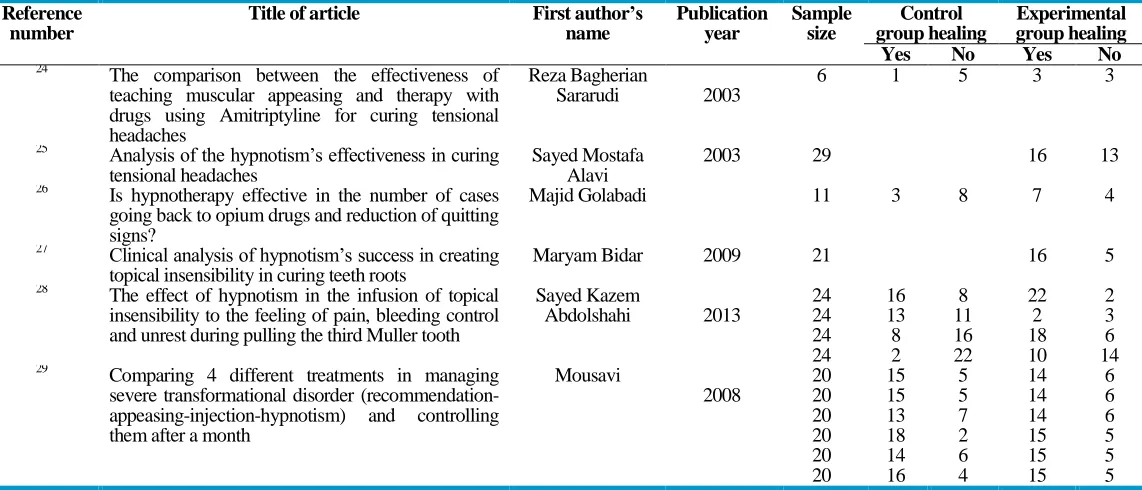
the effectiveness of hypnotism on healing the pain and enhancing mental functions. The cases that included the above mentioned experimental in the check list and their quality was confirmed, were chosen. In the end, 6 articles were chosen and looked through and analyzed by the researches. In each study, the name of the author, the year that the study was conducted, the number of samples in experiment and control group, average standard deviation of the hypnotism rate in experiment and control group and the result of the test was registered in the content analysis check list and the information related to it was presented in table number 1 (yes= effectiveness, no= ineffectiveness).
The data were interred in the SPSS software after they were imported to STATA Version 11.2 and the meta-analysis was conducted using meta command.
The heterogeneity among of the studies was checked with I2, Dersimonia and, Laird statistic. As the studies were not homogeneous, studies were pooled using random effects model. To find the effects
elimination of each study on the total result, sensitivity analysis was used. Publication bias was checked using Egger test.
Quality assessment with Ottawa or STROBE checklist did not do in these studies because the number of included studies was small.
The data of eligible studies in this mate-analysis were dichotomous (yes or no). So, effect size was defined as relative risk (RR). Distribution of relative risk, odds ratio and hazard ration were not normal. Log transformation was used to provide normality assumption for RR to combine the results of the studies in each research the RR logarithm was utilized.22,23
RESULTS
In a systematic revision, 45 articles were found with a look through their titles. 6 cases were chosen and for the final analysis of different aspects in each study (Figure 1). They were entered in the meta-analysis check list (Table 1).
Table 1: The meta-analysis check list of hypnotherapy effectiveness in pain dealing and the enhancement of mental functions in Iran
Reference number
Title of article First author’s name
Publication year
Sample size
Control group healing
Experimental group healing Yes No Yes No
24 The comparison between the effectiveness of
teaching muscular appeasing and therapy with drugs using Amitriptyline for curing tensional headaches
Reza Bagherian
Sararudi 2003
6 1 5 3 3
25 Analysis of the hypnotism’s effectiveness in curing
tensional headaches
Sayed Mostafa Alavi
2003 29 16 13
26 Is hypnotherapy effective in the number of cases
going back to opium drugs and reduction of quitting signs?
Majid Golabadi 11 3 8 7 4
27 Clinical analysis of hypnotism’s success in creating
topical insensibility in curing teeth roots
Maryam Bidar 2009 21 16 5
28 The effect of hypnotism in the infusion of topical
insensibility to the feeling of pain, bleeding control and unrest during pulling the third Muller tooth
Sayed Kazem
Abdolshahi 2013
24 16 8 22 2
24 13 11 2 3
24 8 16 18 6
24 2 22 10 14
29 Comparing 4 different treatments in managing
severe transformational disorder (recommendation-appeasing-injection-hypnotism) and controlling them after a month
Mousavi
2008
20 15 5 14 6
20 15 5 14 6
20 13 7 14 6
20 18 2 15 5
20 14 6 15 5
Figure 1: The follow diagram election of studies
NOTE: Weights are from random effects analysis .
.
.
Overall (I-squared = 59.7%, p = 0.004) ID
Abdolshahi SK (2013)
2008
Subtotal (I-squared = 0.0%, p = 0.910) Study
Subtotal (I-squared = 0.0%, p = 0.824) 2013
Golabadi M (2003)
Mousavi SG (2008) Abdolshahi SK (2013) 2003
Mousavi SG (2008)
Subtotal (I-squared = 49.9%, p = 0.112)
Mousavi SG (2008) Abdolshahi SK (2013) Bagherian R (2003)
Abdolshahi SK (2013)
Mousavi SG (2008)
Mousavi SG (2008) Mousavi SG (2008)
1.20 (0.97, 1.48) RR (95% CI)
2.25 (1.22, 4.15)
0.94 (0.81, 1.09) 2.47 (0.97, 6.29) 2.33 (0.81, 6.76)
0.93 (0.64, 1.37) 1.62 (1.09, 2.40)
0.93 (0.64, 1.37) 1.74 (1.21, 2.51)
0.83 (0.62, 1.12) 5.00 (1.22, 20.46) 3.00 (0.42, 21.30)
1.38 (1.01, 1.87)
1.08 (0.70, 1.66)
0.94 (0.67, 1.31) 1.07 (0.73, 1.57)
1.20 (0.97, 1.48) RR (95% CI)
2.25 (1.22, 4.15)
0.94 (0.81, 1.09) 2.47 (0.97, 6.29) 2.33 (0.81, 6.76)
0.93 (0.64, 1.37) 1.62 (1.09, 2.40)
0.93 (0.64, 1.37) 1.74 (1.21, 2.51)
0.83 (0.62, 1.12) 5.00 (1.22, 20.46) 3.00 (0.42, 21.30)
1.38 (1.01, 1.87)
1.08 (0.70, 1.66)
0.94 (0.67, 1.31) 1.07 (0.73, 1.57)
1
.047 1 21.3
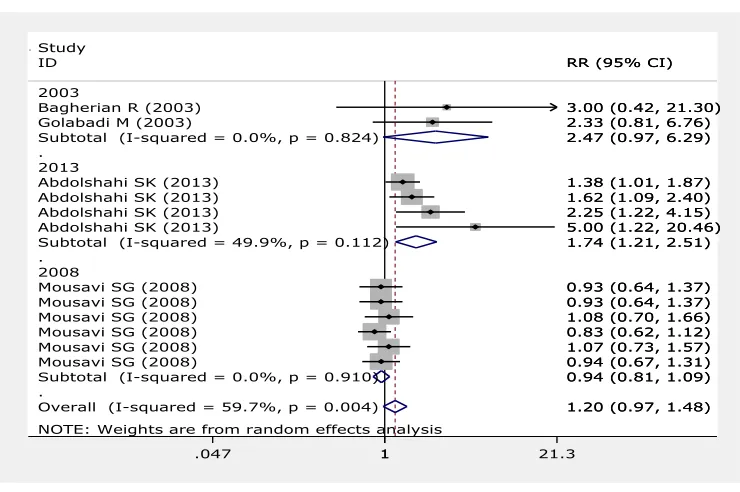
Figure 2: Comparison of hypnotism with control group
The relative risk (RR) from each study is represented by a black square and the 95% CIs by the line through the square. Summary RRs (center of open diamond) and 95% CIs (width of open diamond using a random-effects model.
The method of the study in all cases was case-control, and the sampling method in all studies was to procure a list of the eligible cases. In the study of Sayed Mostafa Alavi and Maryam Bidar because of luck of control group, we could not compute RR. In three studies, there was no significant difference
group. In the study was done by Mousavi in 2008, he showed hypnotherapy was not effective.
In Baqerian et al. study entitled the effectiveness of teaching muscular appeasing and drug therapy using Amitriptyline in treatment of tensional headache, 3 persons With search in databases 45 articles were found
The title and abstract of 35 articles were checked
The full texts of 15 articles were looked through
6 articles were inserted to the meta-analysis
10 articles removed because of duplication
20 unrelated articles were removed
control group were improved and their relative risk RR was estimated as RR=3 which indicates that people who were subjected to hypnotism had three times better improvement than the control group who were subjected to drug therapy, but as 95% CI of RR crossed line one and therefore, the total effect is not significant (Figure 2).
In the study conducted by Gol-Abadi, entitled: The effects of hypnotherapy on the amount of cases who go back to opium drugs and the reduction of quitting signs, improvement in the experimental group was seen in 7 cases and in 3 cases from the control group and the relative risk was estimated in the amount of RR=2.33. It means that people who were subject to hypnotism had 2.33 times less going back to drugs and less reduction of quitting drugs signs than the control group, but as the line (95% CI of RR) has crossed line one, in total, the amount of the effect was not significant (Figure 2).24 In Abdol-Shahi study, entitled: The effect of hypnotism in the infusion of topical insensibility to the feeling of pain, bleeding control and unrest during pulling the third Muller tooth, hypnotism had a significant effect on factors 2, 3 and 4. In general, people who were subject to
hypnotism had 1.47 times more improvement than the control group RR=1.74, and was significant in the total effect P<0.001. Also, in the study conducted by Mousavi entitled: Comparing four different treatments in managing severe transformational disorder, 4 factors of recommendation, appeasing, venous injection and hypnotism were analyzed. The RR was in the amount of RR=0.94 and the combination of all the studies showed that hypnotism was 20% more effective than the control group.31
With combining the results of the 6 studies using the random effects model, it was shown that the effectiveness of the hypnotism in the hypotrophy group was 20% more than the control group RR= 1.20 (95% CI: 0.97-1.47).
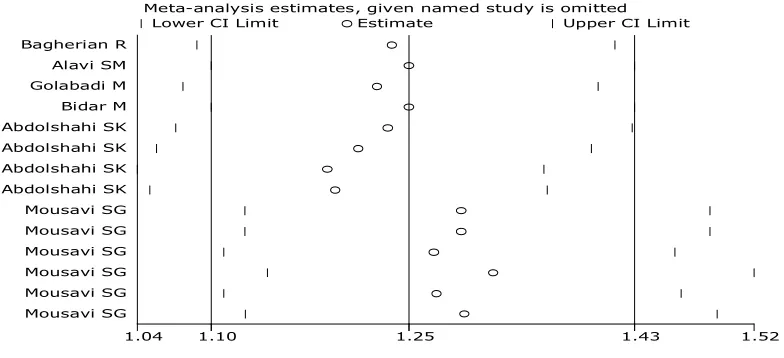
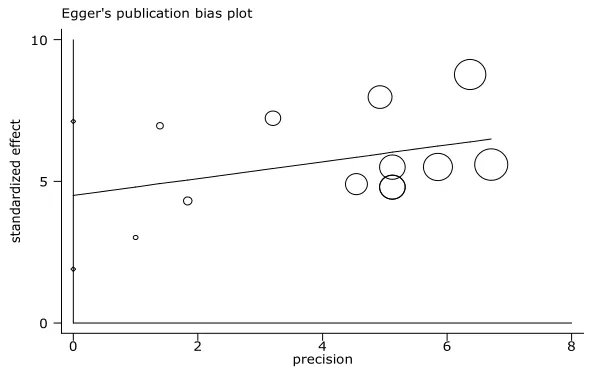
According to the results of the sensitivity analysis, it is shown in diagram 2, in general, with the elimination of the Abdol-Shahi study (The effects of hypnotism on bleeding control), hypnotism had less effect and with the elimination of the Mousavi study (Comparing the proposed method in managing the severe alternate derangement) hypnotism had more effects (Figure 3). Egger test shows that the effects of publication bias was not significant (P>0.05) (Figure 4).
1.04 1.10 1.25 1.43 1.52
Bagherian R Alavi SM Golabadi M Bidar M Abdolshahi SK Abdolshahi SK Abdolshahi SK Abdolshahi SK Mousavi SG Mousavi SG Mousavi SG Mousavi SG Mousavi SG Mousavi SG
Lower CI Limit Estimate Upper CI Limit
Meta-analysis estimates, given named study is omitted
Figure 3: Sensitivity analyze figure of hypnotrapy
Egger's publication bias plot
st
an
dardi
ze
d e
ff
ec
t
precision
0 2 4 6 8
0 5 10
Figure 4: Publication bias figure using the Egger test.
The circles show sample size (bigger circle shows bigger sample size and verses).
DISCUSSION
In 6 studies were done in Iran with the total sample of 546 people and with the average of 91 person per study, which were conducted during 2002 to 2013, the effectiveness of hypnotism in the experiment group was 20% more than the control group. To determine the studies that could change the results of meta-analysis, sensitivity analysis was used. In this diagram each time, it was omitted one of the studies and was analyzed again with the absence of that study. Then, the result of the analysis, before and after the elimination of the study is compared to indicate how much the existence or the absence of each study can affect the final result. The sensitivity analyze showed that there is not any study that change the results of meta-analysis fundamentally.
Probably hypnotism with the induction a local anesthetic, de-stress the muscles, creates inner peace and reduces patient stress.30 Others also have reported that effect of hypnotherapy on the degree of anxiety was successful.31 In psychotherapy, the aim is helping the patient to control their anxiety, stress, relax and focus and increasing the
therapeutic hypnosis can be used. Controlled studies have shown that the effectiveness of this method is equally or more than other psychological interventions to control a variety of chronic pain.32
the defectiveness of information deducted from the abstracts of some studies, etc.
Limitations of this study were lack of standard report of studies results, few studies and publication about hypnotherapy in Iran, and execution studies without control group in analysis.
CONFLICT OF INTEREST
The authors declare that there are no conflicts of interest.
ACKNOWLEDGEMENT
This research was done using financial support of psychosocial injuries Research Centre of Ilam University of Medical Sciences.
REFERENCES
1. Van der Hart O, Brown P, Turco RN. Hypnotherapy for traumatic grief: Janetian and modern approaches integrated. Am J Clin Hypn. 1990; 32(4): 263-71.
2. Pashah G. hypnotism. N J Psychother. 2010; 18: 10-7.
3. Salari I, Sajadi S. Hypnotism: Contra-indication and hypnotism risks arepot of some hypnotherapy. Ofogh-e-Danesh. 2003; 1(1): 36-44.
4. Heidari A, Hamkaran V. The effect of hipneutizm on the performance of sport players Futsal. Andisheh va Raftar. 2010; 4(16): 37-48.
5. Gupta A, Sharma A, Agrawal A, Bénéi V, Clarke J, EcheverriGent J, et al. Globalization and postcolonial states. Curr Anthr. 2006; 47(2): 277-307.
6. Taylor J, HOrevitz R, Balague G. The use of hypnosis in applied sport psychology. Sport Psychol. 1993; 7(1): 58-78.
7. Meyers A, Whelan J, Murphy S. Cognitive behavioural strategies in athletic performance enhancement. Prog Behav Modif. 1995; 30: 137-64.
8. August RV. The obstetrician and hypnosis. Am J Clin Hypn. 2009; 51(4): 391-4.
9. Liossi C. Hypnosis in cancer care hypnosis. Contemp Hypn. 2006; 23(1): 47-57.
10. Cope TE. Clinical hypnosis for the alleviation of tinnitus. Int Tinnitus J. 2008; 14(2): 135-8.
11. Puhart A, Tad J. Principles of clinical psychology and counselling. USA: Resa Pub; 2004.
12. Robertson D. A brief introduction of cognitive-behavioral hypnotherapy. (cited). Available from: URL; http://hypnosynt hesiscom; 2008.
13. Burrows GD, Stanley RO, Bloom PB. International handbook of clinical hypnosis. USA: John Wiley and Sons; 2002.
14. Lindfors P, Unge P, Arvidsson P, Nyhlin H, Bjornsson E, Abrahamsson H, et al. Effects of gut-directed hypnotherapy on IBS in different clinical settings-results from two randomized, controlled trials. Am J Gastroenterol. 2012; 107(2): 276-85.
15. Gibreston AD, Kemp K. Uses of hypnosis in treating anxiety states. Psychiatr Med. 1992; 10(4): 13-20.
16. Mason JD, Rogerson DR, Butler JD. Client centred hypnotherapy in the management of tinnitus--is it better than counselling? J Laryngol Otol. 1996; 110(2): 117-20.
17. Rotaru TS, Rusu A. A meta-analysis for the efficacy of hypnotherapy in alleviating PTSD symptoms. Int J Clin Exp Hypn. 2016; 64(1): 116-36.
How to cite the article: Mirzaei Z, Mami S, Sarokhani M, Sayehmiri K. Effectiveness of hypnosis in the treatment of pain and enhancing mental performance in Iran: A systematic review and meta-analysis. Int J Epidemiol Res. 2016; 3(2): 176-184.
20. Ford AC, Quigley EM, Lacy BE, Lembo AJ, Saito YA, Schiller LR, et al. Effect of antidepressants and psychological therapies, including hypnotherapy, in irritable bowel syndrome: systematic review and meta-analysis. Am J Gastroenterol. 2014; 109(9): 1350-65.
21. Bowker E, Dorstyn D. Hypnotherapy for disability-related pain: A meta-analysis. J Health Psychol. 2016; 21(4): 526-39.
22. Sayehmiri F, Babaknejad N, Bahrami S, Sayehmiri K, Darabi M, Rezaei-Tavirani M. Zn/Cu levels in the field of autism disorders: A systematic review and meta-analysis. Iran J Child Neurol. 2015; 9(4): 1-9.
23. Sayehmiri K, Eshraghian MR, Mohammad K, Alimoghaddam K, Foroushani AR, Zeraati H, et al. Prognostic factors of survival time after hematopoietic stem cell transplant in acute lymphoblastic leukemia patients: Cox proportional hazard versus accelerated failure time models. J Exp Clin Cancer Res. 2008; 27: 74.
24. Bagheri Ansararoudi R. Comparsion effect tivenesseducstion muscle relaxation medication with Amitryptyline in tension hedache treatment. 2003; 8: 89-91.
25. Alavi S, Mahjobifar M, Lashkaripour k, Fathi M. Evaluation of the effect of hypnosis on the treatment of tension. Anaesth Intens Care. 2003, 23(42): 22-5.
26. Moner G. Is hypnotherapy effect on recurrence of opioid dependence And Reduce withdrawal symptom? J Clin Psychiat. 2005; 2: 212-8.
27. Bidar M, Gharehchaghi M, Ghabel N, Hafez B. Clinical evaluation of hypnotism-induced local anesthesia in endodontics. Jundishapur Sci Med J. 2009; 8(3): 338-43. 28. Abdeshahi SK, Hashemipour MA, Mesgarzadeh V, Shahidi Payam A, Halaj Monfared A. Effect of hypnosis on induction of local anaesthesia, pain perception, control of haemorrhage and anxiety during extraction of third molars: a case-control study. J Craniomaxillofac Surg. 2013; 41(4): 310-5. 29. Mousavi SG, Rahimi J, Afshar H. Comparison of four different treatment options in the management of acute conversion disorder. Iran J Psychiatry Behav Sci. 2008; 2(1): 21-5.
30. Moghtaderi S, Mirzamani S, Bahrami H. Evaluate the effectiveness of hypnotherapy in the treatment of mental buzz listen. J Audiol. 2012; 21: 61-7.
31. Hammond DC. Handbook of hypnotic suggestions and metaphors. USA: WW Norton and Company; 1990.
32. Mirzamani S. Hypnosis training: facts and myths. Tehran: Golban; 1984.