Rajs Arkadiusz, Aleksiewicz Mariusz, Goździewska-Nowicka Agnieszka, Parczyk Krystyna. Composite morphological structural element in the edge
detecting. Journal of Education, Health and Sport. 2016;6(11):299-304. eISSN 2391-8306. DOI http://dx.doi.org/10.5281/zenodo.167138
http://ojs.ukw.edu.pl/index.php/johs/article/view/3996
The journal has had 7 points in Ministry of Science and Higher Education parametric evaluation. Part B item 755 (23.12.2015). 755 Journal of Education, Health and Sport eISSN 2391-8306 7
© The Author (s) 2016;
This article is published with open access at Licensee Open Journal Systems of Kazimierz Wielki University in Bydgoszcz, Poland
Open Access. This article is distributed under the terms of the Creative Commons Attribution Noncommercial License which permits any noncommercial use, distribution, and reproduction in any medium, provided the original author(s) and source are credited. This is an open access article licensed under the terms of the Creative Commons Attribution Non Commercial License
(http://creativecommons.org/licenses/by-nc/4.0/) which permits unrestricted, non commercial use, distribution and reproduction in any medium, provided the work is properly cited. This is an open access article licensed under the terms of the Creative Commons Attribution Non Commercial License (http://creativecommons.org/licenses/by-nc/4.0/) which permits unrestricted, non commercial
use, distribution and reproduction in any medium, provided the work is properly cited. The authors declare that there is no conflict of interests regarding the publication of this paper.
Received: 01.11.2016. Revised 12.11.2016. Accepted: 16.11.2016.
COMPOSITE MORPHOLOGICAL STRUCTURAL ELEMENT IN THE EDGE DETECTING
dr inż. Arkadiusz Rajs
Institute of Telecommunications and Computer Science, University of Science and Technology, Al. Prof. S. Kaliskiego 7, 85-789 Bydgoszcz, [email protected]
dr inż. Mariusz Aleksiewicz
Institute of Telecommunications and Computer Science, University of Science and Technology, Al. Prof. S. Kaliskiego 7, 85-789 Bydgoszcz,, [email protected]
dr Agnieszka Goździewska-Nowicka
University of Science and Technology, Faculty of Management, ul. Fordońska 430, 85-790 Bydgoszcz, [email protected]
dr Krystyna Parczyk
WSB University in Toruń, ul. Młodzieżowa 31a, 87-100 Toruń, [email protected]
Summary. Edge detection is an important step in image analysis. Using mathematical morphology and individual structural elements can detect certain types of edges. But much remains undetected. This paper proposes edge detection algorithm based on the structural element made up of many individual structure elements. The experimental results are showing.
Key words: mathematical morphology, edge detection
Introduction
Edge detection is one of the major operations performed on the image. In today's image-analysis systems it is used very often. The correct edge detection is very important for the next steps of image analysis. This article proposes a method based on morphological operations. Existing methods based on erosion and dilation used the structural element (SE) of various shapes (cross, diamond, etc.), and therefore their use is not always gave satisfactory results. The use of a structural element of a complex structure is an alternative approach that could give better results.
- edge of image using erosion denoted by Ge defined as a difference between the domain A (input
set) and erosion of domain A
A B
A
Ge (1)
where B is an structural element SE
- edge of image using dilation denoted by Gd defined as a difference between dilation of domain A
and domain A (input set):
A B
AGd (2)
- morphological gradient (Mgrad) is defined as the difference between dilation and erosion input set
A:
A A B
A B
Mgrad (3)
Composite morphological structural element SE
Typically, the edge detection is used symmetrical structural elements. However, in many cases, such an approach does not guarantee the detection of all edges. The proposed method enables more accurate detection of edges [2]. The final result also depends on the shape and size of the structural element. Therefore, it is appropriate to submit a structural element of many individual shapes.
Let
F
m,n
m,nZ
is digital image, (m,n) is its centre. Structure elements in (2N+1) x (2N+1) square window can be denoted by:
F m m n n i N m n N
Ai 0, 0 ,i , 0, 0 (4)
where i=1,2,…4N-1, =180/4N, I is the direction angle of structure element.
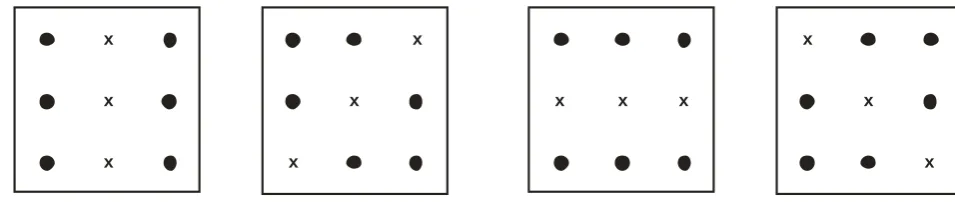
If N=1 then square window is 3x3 size and the direction angle of structure elements are =0o, 45o, 90oand 135o (Fig. 1).
[image:2.595.54.532.476.577.2]
Fig. 1. Four different structure elements in 3x3 square window.
o o o
[image:3.595.58.536.91.326.2]
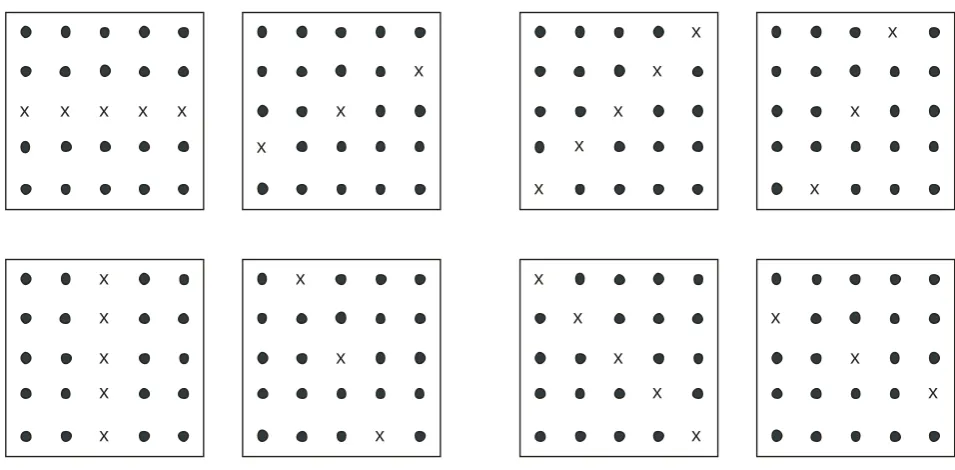
Fig. 2. Eight different structure elements in 5x5 square window.
Use of the structural elements prepared according to the expression (4) can detect edges in the image. For this purpose can be used morphological gradient expressed by (3). For each of the direction angles will be determined edges of original digital image. Next, the results are summing and based on the weighted average will determine the final result of the edges detection (expression 5).
A k M
AM i M i i grad
1 (5)where Mgrad(A) is final detected edges of original image, M is number of structure elements, ki is the
weight of different detected edge (in this paper be calculate by ki=1/M).
Results for example image
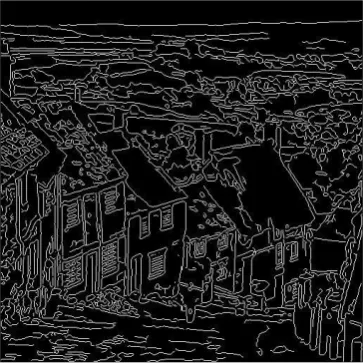
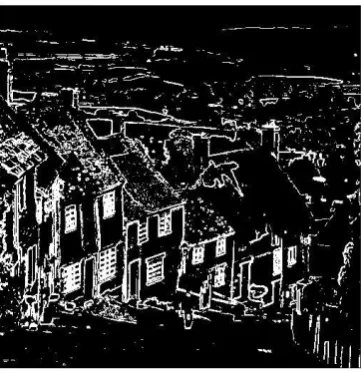
The experiment used the image in bitmap format with a resolution of 512-512 points in 256 gray-scale levels. Figure 3 shows the original image. For comparison Figure 4 shows the detected edges by Prewitt operator, Figure 5 by Sobel operator and Figure 6 by Canny operator. Figure 7 shows the detected edges by using morphological methods (structural elements is a simple crisscross), and Figure 8 and Figure 9 show the result of the edge detection based on a composite morphological structural element, respectively, according to Figure 1 and Figure 2
x x x x x
Fig. 3. Original image Fig. 4. Edge detection result by Prewitt operator
[image:4.595.328.510.331.513.2] [image:4.595.88.268.331.516.2]Fig. 7. Edge detection result by 3x3 crisscross SE Rys.8. Edge detection result by composite 3x3 morphological SE
Fig. 9. Edge detection result by composite 5x5 morphological SE
According to the results shown in Figures 4 and 5, the edges are not detected continuously, detection by Canny operator (Fig. 6) detects the edges continuously, however, as the edges sometimes detects noise. As shown in Figures 8 and 9 detecting the edges of the composite structural element is precise and constant (also in relation to edge detection result by 3x3 crisscross SE – Fig. 7).
Conclusions
References
[1] Serra J., Image Analysis and Mathematical Morphology, Academic Press, New York, 1982.
[2] Song J., Delp E. J., The analysis of morphological filters with multiple structuring elements. Computer Vision, Graphics, and Image Processing, vol. 50, no. 3, pp. 308-328, June 1990.
[3] Maragos P., Differential morphology and image processing. IEEE Trans Image Processing, vol. 5, no. 6, pp. 922–937, June 1996.