R E S E A R C H
Open Access
An inertial S-iteration process
Aniruth Phon-on
1*, Nifatamah Makaje
1, Areeyuth Sama-Ae
1and Kittiya Khongraphan
1*Correspondence: [email protected]
1Department of Mathematics and
Computer Science, Faculty of Science and Technology, Prince of Songkla University, Pattani, Thailand
Abstract
In this paper, we establish a new iteration method, called an InerSP (an inertial S-iteration process), by combining a modified S-iteration process with the inertial extrapolation. This strategy is for speeding up the convergence of the algorithm. We then prove the convergence theorems of a sequence generated by our new method for finding a common fixed point of nonexpansive mappings in a Banach space. We also present numerical examples to illustrate that the acceleration of our algorithm is effective.
MSC: 47H04; 54H25
Keywords: Common fixed point; MIS-iteration; Nonexpansive mapping; Inertial extrapolation
1 Introduction
In the last half century, mathematicians have been studied the approximation methods for fixed point problems and various iteration schemes for several classes of nonexpansive mappings to solve some mathematical problems such as convex optimization problems, convex feasibility problems, and variational inequalities problems. The details of those studies can be found in [1–12].
In 2008, Mainge [13] studied convergence of the inertial Mann algorithm by combining the Mann algorithm and the inertial extrapolation:
wn=xn+αn(xn–xn–1),
xn+1=wn+βn
S(wn) –wn
,
(1)
for eachn≥1. The study is for speeding up the convergence of the given algorithm. The author showed that the sequence{xn}converges weakly to a fixed point of the mapping Sunder certain assumptions. The author also applied the method to convex feasibility problems, fixed point problems and monotone inclusions.
Dong et al. [14] introduced a modified inertial Mann algorithm and an inertial CQ-algorithm by unifying the accelerated Mann CQ-algorithm with the inertial extrapolation as follows: LetT :H→Hbe a nonexpansive mapping such that Fix(T)=∅. Chooseμ∈ (0, 1),λ> 0 andx0,x1∈Harbitrarily and setd0:= (T(x0) –x0)/λ. Computedn+1andxn+1
as follows:
wn=xn+αn(xn–xn–1),
dn+1=
1 λ
T(wn) –wn
+βndn,
yn=wn+λdn+1,
xn+1=μγnwn+ (1 –μγn)yn,
(2)
for eachn≥1. Under some conditions they proved that the sequence{xn}generated by
this algorithm converges weakly to a fixed point ofT. They also studied an inertial CQ-algorithm by combining the CQ-CQ-algorithm and the inertial extrapolation defined as fol-lows: Let Hbe a Hilbert space andT :H→Hbe a nonexpansive mapping such that
Fix(T)=∅. Let{αn}∞n=0⊂[α1,α2],α1∈(–∞, 0],α2∈[0,∞),{βn}∞n=0⊂[β1, 1],β1∈(0, 1).
Setx0,x1∈Harbitrarily. Define the iterative sequence{xn}by the following iteration
pro-cess:
wn=xn+αn(xn–xn–1),
yn= (1 –βn)wn+βnTwn,
Cn=
z∈H: yn–z ≤ wn–z
,
Qn=
z∈H:xn–z,xn–x0 ≤0
,
xn+1=PCn∩Qnx0.
(3)
They showed that the sequence{xn}converges in norm toPFix(T)(x0). In this study, they
also performed numerical experiments to illustrate that the modified inertial Mann algo-rithm and inertial CQ-algoalgo-rithm significantly reduced the running time compared with some previous methods without the inertial extrapolation. Some studies of the inertial algorithm can be found in [15–23].
Suparatulatorn et al. [24] introduced a modified S-iteration process defined as follows:
x0∈Cand
yn= (1 –βn)xn+βnS1xn,
xn+1= (1 –αn)S1(xn) +αnS2(yn),
(4)
n≥0, whereCis a nonempty subset of a real Banach space, two sequences{αn}and{βn}
are in the interval (0, 1) andS1,S2:C→Care G-nonexpansive mappings. Under some
given conditions, they proved weak and strong convergence theorems of this iteration process for finding common fixed points of two G-nonexpansive mappings in a uniformly convex Banach space. They also provided an example from a numerical experiment which supported the idea that the sequence generated by the modified S-iteration converges faster than the one generated by an Ishikawa iteration. So, to obtain a faster algorithm revised from a modified S-iteration process, it should be combined with the inertial ex-trapolation as well.
a fixed point of a nonexpansive mapping in a Banach space defined as follows: LetHbe a Banach space andS1,S2:H→Hbe nonexpansive mappings such thatF=Fix(S1)∩ Fix(S2)=∅. Define
ωn=xn+γn(xn–xn–1),
yn= (1 –βn)ωn+βnS1(ωn),
xn+1= (1 –αn)S1(ωn) +αnS2(yn),
(5)
n≥1, where{γn},{αn}and{βn}satisfy:
(D1) ∞n=1γn<∞,{γn} ⊂[0,γ],0≤γ< 1,{αn},{βn} ⊂[δ, 1 –δ]for someδ∈(0, 0.5); (D2) {Si(ωn) –ωn}is bounded fori= 1, 2;
(D3) {Si(ωn) –y}is bounded for anyy∈Ffori= 1, 2.
We prove, under some assumptions, the weak and strong convergence of our new iter-ation process for finding common fixed points ofS1andS2.
2 Preliminaries
In this section we review some definitions and lemmas which will be used in the next section. We start with the following identity that will be used several times in the paper:
αx+ (1 –α)y 2=α x 2+ (1 –α) y 2–α(1 –α) x–y 2, (6)
for allα∈R,x,y∈H.
Definition 2.1 A Banach spaceXis said to haveOpial’s propertyif whenever a sequence
{xn}inXconverges weakly tox, then
lim inf
n→∞ xn–x ≤lim infn→∞ xn–y ,
for ally∈X,y=x.
Definition 2.2([25]) LetCbe a nonempty closed convex subset of a real uniformly convex Banach spaceX. The mappingsS1andS2onCare said to satisfyCondition Bif there exists
a nondecreasing functionf: [0,∞)→[0,∞) withf(0) = 0 andf(r) > 0 forr> 0 such that, for allx∈C,
max x–S1(x) , x–S2(x) ≥f
d(x,F),
where we denote F=Fix(S1)∩Fix(S2) andFix(Si) is the set of fixed points ofSifor all i= 1, 2.
Definition 2.3([25]) LetCbe a subset of a metric space (X,d). A mappingS:C→C
is semicompact if for a sequence{xn} inCwithlimn→∞d(xn,S(xn)) = 0, there exists a
subsequence{xni}of{xn}such thatxni→p∈C.
lim infn→∞ xn ≤c,lim infn→∞ yn ≤c andlim infn→∞ αnxn+ (1 –αn)yn =c for some c≥0.Thenlim infn→∞ xn–yn = 0.
In 2002, Berinde [27] compared the rate of convergence between the two iterative meth-ods by using the following definition.
Definition 2.5 Let{an}and{bn}be two sequences of positive numbers that converges to aandb, respectively. Assume there exists
lim
n→∞ |an–a| |bn–b|
=l.
i. Ifl= 0, then it is said that the sequence{an}converges toafaster than the sequence {bn}tob.
ii. If0 <l<∞, then we say that the sequence{an}and{bn}have the same rate of convergence.
Lemma 2.6([28]) Let X be a Banach space that has Opial’s property,and let{xn}be a sequence in X.Let x,y in X be such thatlimn→∞ xn–x andlimn→∞ xn–y exist.If{xnj}
and{xnk}are subsequences of{xn}that converge to x and y,respectively,then x=y.
Lemma 2.7([29]) Let{ψn},{δn},and{αn}be sequences in[0,∞)such thatψn+1≤ψn+ αn(ψn–ψn–1) +δnfor all n≥1,
∞
n=1δn<∞and there exists a real numberα with0≤ αn≤α< 1for all n≥1.Then the following hold:
1. n≥1[ψn–ψn–1]+<∞where[t]+=max{t, 0}. 2. there existsψ∗∈[0,∞)such thatlimn→∞ψn=ψ∗.
Lemma 2.8([30]) Let C be a nonempty set of a real Hilbert spaceHand{xn}a sequence inHsuch that the following two conditions hold:
1. for anyx∈C,limn→∞ xn–x exists;
2. every sequential weak cluster point of{xn}is inC. Then{xn}converges weakly to a point in C.
Lemma 2.9([30]) Let C be a nonempty closed convex subset of a real Hilbert spaceH,
T :C→Ha nonexpansive mapping. Let{xn} be a sequence in C and x∈Hsuch that xn x and Txn–xn→0as n→ ∞.Then x∈Fix(T).
3 Results and discussions
In this section we prove the weak and strong convergence of a sequence generated by the proposed algorithm for finding a common fixed point of two nonexpansive mappings.
Theorem 3.1 Let X be a uniformly convex Banach space.Let y∈F=Fix(S1)∩Fix(S2).Let {xn}be a sequence defined by Eq. (5).If(D1), (D2)and(D3)hold,then
1. limn→∞ xn–y exists.
Proof
1. By the triangle inequality and the nonexpansiveness ofS1, we have
yn–y = (1 –βn)ωn+βnS1(ωn) –y
≤(1 –βn) ωn–y +βn S1(ωn) –y ≤(1 –βn) ωn–y +βn ωn–y
= ωn–y . (7)
So
xn+1–y = (1 –αn)S1(ωn) +αnS2(yn) –y
= (1 –αn)
S1(ωn) –y
+αn
S2(yn) –y
≤(1 –αn) S1(ωn) –y +αn S2(yn) –y . (8)
Using the nonexpansiveness ofS1,S2and (7), we have
xn+1–y ≤(1 –αn) S1(ωn) –y +αn S2(yn) –y ≤(1 –αn) ωn–y +αn yn–y
≤(1 –αn) ωn–y +αn ωn–y
= ωn–y . (9)
It is not difficult to see that{ωn–y}is bounded. Indeed, by the conditions (D2) and (D3) and the triangle inequality,
ωn–y = ωn–S1(ωn) +S1(ωn) –y
≤ S1(ωn) –ωn + S1(ωn) –y
≤K, (10)
for someK∈[0,∞). That is,{ωn–y}is bounded. Hence by (9),{xn–y}and {xn–xn–1}are bounded. By the identity in (6),
ωn–y 2= (1 +γn)(xn–y) –γn(xn–1–y) 2
= (1 +γn) xn–y 2–γn xn–1–y 2+γn(1 +γn) xn–xn–1 2. (11)
This implies that
xn+1–y 2≤ ωn–y 2
= (1 +γn) xn–y 2–γn xn–1–y 2+γn(1 +γn) xn–xn–1 2. (12)
DenoteΨn:= xn–y 2. Then (12) becomes
whereδn=γn(1 +γn) xn–xn–1 2. Observe that by (D1),
∞
n=1
δn= ∞
n=1
γn(1 +γn) xn–xn–1 2
≤
∞
n=1
γn(1 +γ)(2K)2
<∞. (14)
By Lemma2.7(2), there existsΨ∗∈[0,∞)such thatlimn→∞Ψn=Ψ∗. This means thatlimn→∞ xn–y 2exists and, therefore,limn→∞ xn–y exists. This completes the proof of 1.
2. Setc=limn→∞ xn–y . By the nonexpansiveness ofS1andS2, we get
xn–Si(xn) ≤ xn–y + Si(xn) –y ≤ xn–y + xn–y
= 2 xn–y . (15)
So, ifc= 0, then xn–Si(xn) →0. Now assume thatc> 0. Note that
∞
n=1γn<∞implieslimn→∞γn= 0. It follows from (11)
lim
n→∞ ωn–y 2= lim
n→∞
(1 +γn) xn–y 2–γn xn–1–y 2
+γn(1 +γn) xn–xn–1 2
= lim
n→∞ xn–y
2
=c2. (16)
That is,limn→∞ ωn–y =c. So, this forces
lim supn→∞ yn–y ≤lim supn→∞ ωn–y =c. Next we will claim that
lim infn→∞ yn–y ≥c. SinceS1andS2are nonexpansive, by (6) we have
xn+1–y 2= (1 –αn) S1(ωn) –y 2
+αn S2(yn) –y 2
–αn(1 –αn) S1(ωn) –S2(yn) 2
≤(1 –αn) ωn–y 2+αn yn–y 2. (17)
Rearranging (17) and by (D1), we have
ωn–y 2≤ yn–y 2+
1 αn
ωn–y 2– xn+1–y 2
≤ yn–y 2+
1 δ
ωn–y 2– xn+1–y 2
. (18)
By (18) and (9), it yieldslim infn→∞ yn–y 2≥c2and solim infn→∞ yn–y ≥c. Since
c≤lim inf
it follows thatlimn→∞ yn–y =c. Since
lim sup
n→∞
S1(ωn) –y ≤lim sup
n→∞ ωn–y ≤c,
lim sup
n→∞
S2(yn) –y ≤lim sup
n→∞ yn–y ≤c,
lim
n→∞ (1 –βn)(ωn–y) +βn
S1(ωn) –y = lim
n→∞ yn–y =c,
and
lim
n→∞ (1 –αn)
S1(ωn) –y
+αn
S2(yn) –y = lim
n→∞ xn+1–y =c,
by Lemma2.4,
lim
n→∞ S1(ωn) –ωn = 0 (19)
and
lim
n→∞ S1(ωn) –S2(yn) = 0. (20)
However, we know thatyn–ωn=βn(S1(ωn) –ωn)andωn–xn=γn(xn–xn–1) which yield
0≤ lim
n→∞ yn–ωn
= lim
n→∞βn S1(ωn) –ωn
≤ lim
n→∞ S1(ωn) –ωn
= 0 (21)
and
lim
n→∞ ωn–xn =nlim→∞γn xn–xn–1
= 0. (22)
Note that by (D2) andγn→0we have
lim
n→∞ S1(ωn) –xn ≤nlim→∞ S1(ωn) –ωn +nlim→∞γn xn–xn–1
= 0. (23)
It follows that, by (20), (21), (22), (23) and the nonexpansiveness ofS1andS2, we have
0≤ lim
n→∞ S1(xn) –xn
≤ lim
≤ lim
n→∞ xn–ωn +nlim→∞ S1(ωn) –xn
= 0 (24)
and
0 ≤ lim
n→∞ S2(xn) –xn
≤ lim
n→∞ S2(xn) –S2(yn) +nlim→∞ S2(yn) –S1(ωn) +nlim→∞ S1(ωn) –xn ≤ lim
n→∞ xn–yn +nlim→∞ S2(yn) –S1(ωn) +nlim→∞ S1(ωn) –xn
≤ lim
n→∞ xn–ωn +nlim→∞ ωn–yn
= 0. (25)
Therefore,limn→∞ S1(xn) –xn = 0 =limn→∞ S2(xn) –xn as desired.
Theorem 3.2 LetHbe a Banach space having Opial’s property.Suppose that S1,S2:H→ Hare two nonexpansive mappings with F=Fix(S1)∩Fix(S2)=∅.Then the sequence{xn} in(5)converges weakly to a common fixed point of S1and S2.
Proof Lety∈F. By Theorem3.1(1),limn→∞ xn–y exists. Hence{xn}is bounded. Let {xnk}and{xnj}be subsequences of the sequence of{xn}with the two weak limitsq1andq2,
respectively. By Theorem3.1(2),limn→∞ xnk–Si(xnk) = 0 andlimn→∞ xnj–Si(xnj) =
0 fori= 1, 2. By Lemma (2.9),Si(q1) =q1 andSi(q2) =q2 fori= 1, 2. That is,q1,q2∈F.
Applying Theorem3.1(1) again, we havelimn→∞ xn–q1 andlimn→∞ xn–q2 exist and
both{xnk}and{xnj}are sequences converging toq1andq2, respectively. By Lemma (2.6),
q1=q2. Therefore,{xn}converges weakly to a common fixed point inF.
Under certain conditions, we can deduce the strong convergence theorem as follows.
Theorem 3.3 LetHis a uniformly convex Banach space,Suppose that S1,S2:H→Hare two nonexpansive mappings with F =Fix(S1)∩Fix(S2)=∅and satisfy the Condition B. Then the sequence{xn}in(5)converges strongly to a common fixed point of S1and S2.
Proof Lety∈F. Now by (12), we get
inf
y∈F
xn+1–y 2
≤inf
y∈F
ωn–y 2
=inf
y∈F
(1 +γn) xn–y 2
+inf
y∈F
–γn xn–1–y 2
+inf
y∈F
γn(1 +γn) xn–xn–1 2
≤inf
y∈F
xn–y 2
+γninf y∈F
xn–y 2
–γninf y∈F
xn–1–y 2
+γn(1 +γn) xn–xn–1 2
=inf
y∈F
xn–y 2
+γn
inf
y∈F
xn–y 2
–inf
y∈F
xn–1–y 2
DenoteΨn:=infy∈F{ xn–y 2}. Then (26) becomes
Ψn+1≤Ψn+γn(Ψn–Ψn–1) +δn, (27)
whereδn=γn(1 –γn) xn–xn–1 2. Observe that by (D1)
∞
n=1
δn= ∞
n=1
γn(1 +γn) xn–xn–1 2
≤
∞
n=1
γn(1 +γ)(2K)2
<∞. (28)
By Lemma2.7(2), there existsΨ∗∈[0,∞) such thatlimn→∞Ψn=Ψ∗.
That is,limn→∞infy∈F{ xn–y 2}exists. Therefore,limn→∞infy∈F{ xn–y }exists. Since S1andS2satisfy Condition B, by Theorem3.1(2) it implies that
lim
n→∞f
inf
y∈F
xn–y
= 0
and, thus,
lim
n→∞infy∈F
xn–y
= 0.
So, we can find a subsequence{xnj}of{xn}and a sequence{xj∗} ⊂Fsatisfying xnj–x∗j < 1
2j. Next we will show that{x
∗
j}is a Cauchy sequence. Let> 0. Sincelimn→∞infy∈F{ xn– y }= 0, there isN∈Nsuch thatinfy∈F{ xn–y }< 6 for alln≥N. For allm,n≥N, we
have
xm–xn ≤ xm–y + xn–y
for ally∈F. Thus,
xm–xn ≤inf y∈F
xm–y + xn–y
=inf
y∈F
xm–y
+inf
y∈F
xn–y < 6+ 6= 3
for allm,n≥N. Also, there isj0∈Nsuch that 21j0 <3. ChooseM=max{N,j0}. Then, for
allj>k≥M, we have
x∗j –x∗k ≤ x∗j –xnj + xnj–xnk + xnk–x
∗ k <
3+
3+
3 =.
Therefore,{x∗j}is a Cauchy sequence and so there existsq∈Hsuch thatx∗j converges toq. SinceFis closed,q∈F. As a result, we see thatxnjconverges toq. Sincelimn→∞ xn–q
exists by Theorem3.1(1), the conclusion follows.
Proof From Theorem3.1,{xn}is bounded andlimn→∞ xn–S1(xn) = 0 =limn→∞ xn– S2(xn) . By the semicompactness of one ofSi, there existsq∈Hand a subsequence{xnj}
of{xn}such thatxnj→qasj→ ∞. Then
q–Si(q) ≤ q–xnj + xnj–Si(xnj) + Si(xnj) –Si(q)
≤ q–xnj + xnj–Si(xnj) + xnj–q
→0 asj→ ∞. (29)
Thus,q∈F. As in the proof of Theorem3.3,limn→∞infy∈F{ xn–y }exists. We observe
that infy∈F{ xnj –y } ≤ xnj–q →0 as j→ ∞, hence limn→∞infy∈F{ xn–y }= 0. It
follows, as in the proof of Theorem3.3, that{xn}converges strongly to a common fixed
point ofS1andS2. This completes the proof.
4 Numerical illustrations
We next demonstrate the efficiency of the InerSP iteration and compare it with the MSP iteration defined in [24] by giving some numerical examples. We use program MATLAB R2017a running on Core i7 setup processor installed with 8.00 GB of RAM using Win-dows 7. First, we apply our method to solve the following convex feasibility problem (see [31]).
Problem 1([31]) For any nonempty closed convex setCi⊂RN for eachi= 0, 1, . . . ,m,
ifC:=
m
i=1
Ci=∅, findx∗∈C.
Define a mappingT:RN →RN by
T:=P0
1
m m
i=1 Pi
,
wherePi=PCi,i= 0, 1, 2, . . . ,mis the metric projection ontoCi. Note thatPiis
nonexpan-sive for alli= 1, 2, . . . ,m, so this implies that the mappingT is also nonexpansive. More-over, it is straightforward to check that
Fix(T) =Fix(P0)∩ m
i=1
Fix(Pi) =C0∩ m
i=1
Fix(Pi) =C.
We use the inertial S-iteration process (InerSP) and the modified S-iteration process
(MSP) to solve Problem1. For InerSP, setS1=S2=T,γ = 0.98,δ= 0.1,γn=
0.95, n≤1010, 1
(n+1)2,n> 1010, andβn=αn= 0.65 +(n+1)10.25, wherendenotes the number of iterations. For MSP, the con-trol parameters are defined the same as InerSP exceptγandγn, which are not parameters
in MSP. In the experiment, we setm= 30 andCi,i= 0, 1, . . . ,mas a closed ball with center ci∈RN and radiusri> 0. Thus, for eachi,Pican be computed as
Pi(x) := ⎧ ⎨ ⎩
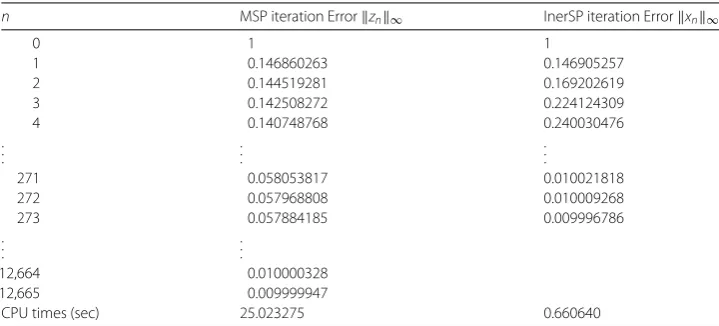
Table 1 Convergence comparison of MSP and InerSP for the given function in Problem1
n MSP iteration Error zn ∞ InerSP iteration Error xn ∞
0 1 1
1 0.146860263 0.146905257
2 0.144519281 0.169202619
3 0.142508272 0.224124309
4 0.140748768 0.240030476
. . .
. . .
. . .
271 0.058053817 0.010021818
272 0.057968808 0.010009268
273 0.057884185 0.009996786
. . .
. . .
12,664 0.010000328
12,665 0.009999947
CPU times (sec) 25.023275 0.660640
Chooseri:= 1 for alli= 0, 1, . . . ,m,c0:= 0,c1= [1, 0, . . . , 0], andc2= [–1, 0, . . . , 0]. For 3≤ i≤m,ci∈(–1/
√
N, 1/√N) are randomly chosen. From the choice ofc1,c2andr1,r2, we
haveFix(T) ={0}. We select initial pointsx0=rand(N, 10) andx1=x0+rand10,000(N,1) where N= 30. SinceFix(T) ={0}, we can consider the error as
xn ∞=maxxn(1),xn(2), . . . ,xn(N)<= 0.01,
and take it to be the stopping criterion. In Table1,ndenotes the number of iterations,{xn}
and{zn}denote the sequence of approximated fixed points generated by InerSP and MSP,
respectively. The results are shown in Table1.
The results are listed in Table1, which illustrate that the errors for both the MSP iter-ation and the InerSP iteriter-ation reduce, which means that the approximated solutions for both methods converge to the fixed point 0. In addition, from Table1and Fig.1, we can see that xn ∞≤ zn ∞andlimn→∞ xznn∞∞ = 0 so the InerSP iteration behaves better than the MSP and the sequence{xn}converges faster than{zn}. Moreover, the running CPU
time for finding the fixed point using InerSP is much less than MSP.
In the next example, we perform a numerical experiment to find a common fixed point of two nonexpansive mappings.
Problem 2 DefineS1,S2:R2→R2by
S1(x,y) =
1 +x
2 , 1 +
y
2
and
S2(x,y) =
x, 3 –y 2
.
It is easy to check that bothS1andS2are nonexpansive onR2. In this problem, for InerSP
we setγ = 0.98,δ= 0.1,γn=
0.25, n≤1010 1
(n+1)2,n> 1010, andβn=αn= 0.65 +
1
(n+1)0.25. For MSP we set
Figure 1Error comparison between MSP and InerSP
Table 2 Convergence comparison of MSP and InerSP for the given function in Problem2
Iteration MSPzn= (z1n,z2n) InerSPxn= (x1n,x2n) Error xn–x0 2
n z1n z2n x1n x2n MSP InerSP
1 721 –5 721 –5 720.0340 720.0340
2 393.4 3.3825 423.5113 53.0044 392.4024 425.5787
3 232.8733 1.8392 206.7190 –5.6175 231.8733 205.8600
4 140.6855 2.0138 92.2796 3.9063 139.6856 91.2944
. . .
. . .
. . .
. . .
. . .
. . .
. . .
13 2.6602 2 1.0007 2 1.0177 0.0007
14 2.0177 2 0.6239
. . .
. . .
. . .
. . .
29 1.0007 2 0.0007
CPU times (sec) 0.010388 0.001049
andS2. Setx0= (500, 1000) andx1= (721, –5) as the initial values. Let{zn}and{xn}be
se-quences generated by MSP and InerSP, respectively, wherezn= (z1n,z2n) andxn= (x1n,x2n)
are inR2. Moreover, we take err = x
n–x∗ 2to be the error of the iterative algorithm where · 2is the Euclidean norm. The results are shown in Table2.
From Table2, we see that both{zn}and{xn}converge to fixed pointx∗= (1, 2). If we
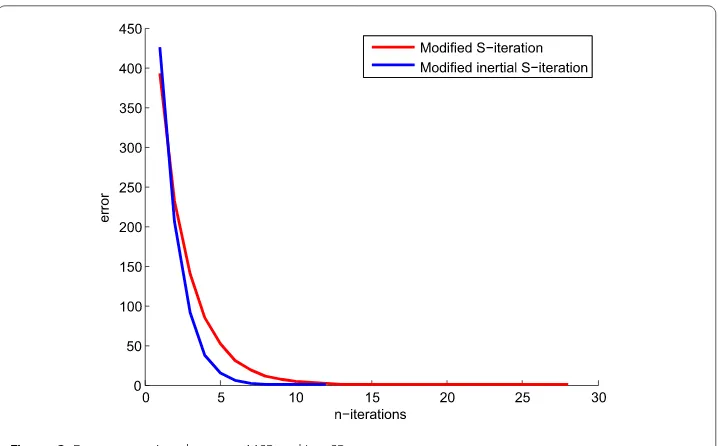
iterate until the error is less than 0.001 the MSP converges to fixed point in 29 iterations and InerSP converges in 13 iterations. From Table2and Fig.2, it can be observed that
xn–x∗ ≤ zn–x∗ for alln≥2 andlimn→∞ xn–x
∗ 2
zn–x∗ 2 = 0 so the sequence{xn}converges faster than{zn}. In addition, the running time to find the common fixed point using InerSP
is 10 times less than MSP. As illustrated in the two examples, we can perceive that the InerSP iteration has a better behavior than the MSP iteration.
5 Conclusions
Figure 2Error comparison between MSP and InerSP
InerSP method. Although the number of steps of the iteration process of the InerSP is higher than MSP, the numerical examples show that sequences generated by InerSP itera-tion converge to fixed points more rapidly than MSP iteraitera-tion when using the number of iterations and CPU running times as measures.
Acknowledgements
The authors would like to thank the referee for helpful and detailed comments.
Funding
This article is funded by the authors.
Abbreviations
InerSP, Inertial S-iteration process; MSP, A modified S-iteration; CPU, Central Processing Unit.
Availability of data and materials Not applicable.
Competing interests
The authors declare that they have no competing interests.
Authors’ contributions
All authors read and approved the final manuscript.
Publisher’s Note
Springer Nature remains neutral with regard to jurisdictional claims in published maps and institutional affiliations.
Received: 20 September 2018 Accepted: 16 January 2019
References
1. Ishikawa, S.: Fixed points by a new iteration method. Proc. Am. Math. Soc.44, 147–150 (1974)
2. Chen, P., Huang, J., Zhang, X.: A primal-dual fixed point algorithm for convex separable minimization with applications to image restoration. Inverse Probl.29, 025011 (2013)
3. Iiduka, H.: Iterative algorithm for triple-hierarchical constrained nonconvex optimization problem and its application to network bandwidth allocation. SIAM J. Optim.22, 862–878 (2012)
4. Micchelli, C.A., Shen, L., Xu, Y.: Proximity algorithms for image models: denoising. Inverse Probl.27(4), 045009 (2011) 5. Zhou, H., Zhou, Y., Feng, G.: Iterative methods for solving a class of monotone variational inequality problems with
applications. J. Inequal. Appl.2015, 68 (2015)
9. Phuengrattana, W., Suantai, S.: On the rate of convergence of Mann, Ishikawa, Noor and SP-iterations for continuous functions on an abitrary interval. J. Comput. Appl. Math.235, 3006–3014 (2011)
10. Phuengrattana, W., Suantai, S.: Comparison of the rate of convergence of various iterative methods for the class of weak contrations in Banach spaces. Thai J. Math.11, 217–226 (2013)
11. Yuan, H.: A splitting algorithm in a uniformly convex and 2-uniformly smooth Banach space. J. Nonlinear Funct. Anal.
2018, Article ID 26 (2018)
12. Zhao, J., Zong, H., Muangchoo, K., Kumam, P., Cho, Y.J.: Algorithms for split common fixed point in Hilbert spaces. J. Nonlinear Var. Anal.2, 273–286 (2018)
13. Mainge, P.E.: Convergence theorems for inertial KM-type algorithm. J. Comput. Appl. Math.219, 223–236 (2008) 14. Dong, Q.L., Yuan, H.B., Cho, Y.J., Rassias, T.M.: Modified inertial Mann algorithm and inertial CQ-algorithm for
nonexpansive mappings. Optim. Lett.12(1), 87–102 (2018).https://doi.org/10.1007/s11590-016-1102-9
15. Alvarez, F., Attouch, H.: An inertial proximal method for maximal monotone operators via discretization of a nonlinear oscillator with damping. Set-Valued Anal.9(1–2), 3–11 (2001)
16. Moudafi, A., Oliny, M.: Convergence of a splitting inertial proximal method for monotone operators. J. Comput. Appl. Math.155, 447–454 (2003)
17. Lorenz, D.A., Pock, T.: An inertial forward-backward algorithm for monotone inclusions. J. Math. Imaging Vis.51, 311–325 (2015)
18. Chan, R.H., Ma, S., Yang, J.F.: Inertial proximal ADMM for linearly constrained separable convex optimization. SIAM J. Imaging Sci.8(4), 2239–2267 (2015)
19. Beck, A., Teboulle, M.: A fast iterative shrinkage-thresholding algorithm for linear inverse problems. SIAM J. Imaging Sci.2(1), 183–202 (2009)
20. Chambolle, A., Dossal, C.: On the convergence of the iterates of the “fast iterative shrinkage/ thresholding algorithm”. J. Optim. Theory Appl.166, 968–982 (2015)
21. Bot, R.I., Csetnek, E.R., Hendrich, C.: Inertial Douglas–Rachford splitting for monotone inclusion problems. Appl. Math. Comput.256, 472–487 (2015)
22. Alvarez, F.: Weak convergence of a relaxed and inertial hybrid projection-proximal point algorithm for maximal monotone operators in Hilbert space. SIAM J. Optim.14(3), 773–782 (2004)
23. Polyak, B.T.: Some methods of speeding up the convergence of iteration methods. USSR Comput. Math. Math. Phys.
4(5), 1–17 (1964)
24. Suparatulatorn, R., Cholamjiak, W., Suantai, S.: A modified S-iteration process for G-nonexpansive mappings in Banach spaces with graphs. Numer. Algorithms77(2), 479–490 (2018).https://doi.org/10.1007/s11075-017-0324-y
25. Shahzad, S., Al-Dubiban, R.: Approximating common fixed points of nonexpansive mappings in Banach spaces. Georgian Math. J.13(3), 529–537 (2006)
26. Nakajo, K., Takahashi, W.: Strong convergence theorems for nonexpansive mappings and nonexpansive semigroups. J. Math. Anal. Appl.279, 372–379 (2003)
27. Berinde, V.: Iterative Approximation of Fixed Points. Editura Dfemeride, Baia Mare (2002)
28. Dong, Q.L., Lu, Y.Y.: A new hybrid algorithm for a nonexpansive mapping. Fixed Point Theory Appl.2015, 37 (2015) 29. Alvarez, F.: Weak convergence of a relaxed and inertial hybrid projection-proximal point algorithm for maximal
monotone operators in Hilbert space. SIAM J. Optim.14(3), 773–782 (2004)
30. Bauschke, H.H., Combettes, P.L.: Convex Analysis and Monotone Operator Theory in Hilbert Spaces. Springer, Berlin (2011)