Original Article
* Corresponding Author: Department of Hematology and Blood Banking, Cancer Molecular
Frequency of FLT3 ITD and FLT3 TKD Mutations in
Multiple Myeloma Patients (A Case Control Study)
Mohammad Mehdi Kooshyar
1M.D., Mohammad Hadi Sadeghian
2M.D.,
Mohammad Reza Keramati
3M.D
., Hossein Rahimi
1M.D.,
Seyyede Fatemeh
Shams
2M.Sc., Sepideh Shakeri
2M.Sc., Hossein Ayatollahi
2*M.D.
1Department of Internal Medicine, Faculty of Medicine, Mashhad University of Medical Sciences, Mashhad,
Iran.
2
Department of Hematology and Blood Banking, Cancer Molecular Pathology Research Center, Faculty of Medicine, Mashhad University of Medical Sciences, Mashhad, Iran.
3Neonatal Research Center, Imam Reza Hospital, Faculty of Medicine, Mashhad University of Medical
Sciences, Mashhad, Iran.
A B S T R A C T
Article history
Received 5 Feb 2015 Accepted 10 Apr 2015 Available online 11 May 2015
Keywords
FLT3
Multiple Myeloma Polymerase chain Reaction
Background and Aims:Multiple myeloma is a malignant proliferation of plasma cells
derived from a single clone. The tumor, its products and the host response lead to organ
damages. Some factors that are responsible in its pathogenesis are recognized. As FMS
like Tyrosine Kinase 3 receptor (FLT3) mutation has been proved as a determining
factor in leukemic patients; the goal of this study was to find association of FLT3
internal tandem duplication (ITD) and FLT3 tyrosine kinase domain (TKD) mutations
with multiple myeloma
.
Materials and Methods: This case-control study was conducted on 60
paraffin-embedded bone marrow biopsies (30 multiple myeloma and 30 normal bone marrow
specimens) in the pathology departments of Ghaem and Imam Reza hospitals in
Mashhad. After sections preparation, DNA was extracted and two PCR reactions were
set up for detection of FLT3/ ITD and FLT3/TKD mutations.
Results: The Mean age of samples was 64±10 years. No FLT3 mutations were
detected in multiple myeloma patients.
Conclusion: Our findings showed that occurrence of FLT3 mutations seem unusual in
multiple myeloma.
Introduction
Hematopoiesis is adjusted by cytokine-induced
arousal of different signal transductions to
instigate differentiation and propagation of
various cell lines [1-3]. FMS like Tyrosine
Kinase 3 receptor (FLT3) whose gene's position
is 13q12 [2, 4], induces normal hematopoiesis in
progenitor cells [3-5]. It encodes a protein with
993 amino acids in length [6], which is highly
expressed in liver, brain and placenta [3, 6, 7].
FLT3 belongs to class III tyrosine kinase
receptor family [4], and is made up of five
extracellular immunoglobulin-like domains, a
short juxtamembrane intracellular segment and a
transmembrane portion [7, 8].
Multiple myeloma (MM) is a kind of
hematopoietic neoplasms, which is due to
proliferation and differentiation of plasma cells
in bone marrow. This disease causes some
clinical symptoms such as hypercalcemia, renal
failure as a result of high concentration of
immunoglobulins in serum, anemia and bone
lesions. All these symptoms emerge from
proliferation of plasma cells in bone marrow [9].
Different FLT3 activating mutations have been
detected, but two types are more common as
described in detail previously [3, 10]; 1) internal
tandem duplication (ITD) which is seen in
15-35% of adult patients with acute myeloid
leukemia (AML) and 2) point mutation in
tyrosine kinase domain as known D835 or TKD
[1, 4, 6, 8, 10-13]. Both types stimulate FLT3
activation, followed by ligand binding in
hematologic malignancy process [1]. ITD
mutation was first discovered by Nakao et al. in
1996 [6, 14]. It is very important in prognosis
prediction [5, 6]. ITD is associated with high risk
of relapse in most AML cases [4, 10, 15, 16]
whereas TKD does not have any effect in disease
prognosis [7]. Studies state different frequencies
for FLT3 ITD mutation. FLT3 ITD has been
detected in up to 40% of AML, 10% of chronic
myelogenous leukemia (CML), 10% of
myelodysplastic syndrome (MDS), 10% of
pediatric AML and rarely in acute lymphoblastic
leukemia (ALL) cases [8, 12, 13, 17-20].
Limited numbers of studies have evaluated FLT3
mutations in a few MM cases, and little is known
about its expression in MM. This study was
performed to assess occurrence of FLT3
mutations in MM.
Material and Methods
Case selection
The specimens were selected from MM patients'
tissue paraffin block in pathology departments of
Ghaem and Imam Reza hospitals of Mashhad
(Northeast of Iran) during September 2010 to
2014. Preparation, analysis and morphologic
assessment of slides, DNA extraction and
molecular analysis were performed in Cancer
Molecular Pathology Research Center of
Mashhad University of Medical Sciences.
Plasma cell count of bone marrow was higher
than 30% and patients were in symptomatic
phase. A full pathological review consisting of
bone marrow aspiration and bone marrow biopsy
assessment was conducted on all slides to
establish malignancy which was previously
diagnosed. Repeat sections followed by
hematoxylin and eosin staining were done for
specimens not having appropriate slides. Some
cases were excluded from this study: specimens
with plasma cell count less than 30% in bone
marrow biopsies, samples with no sufficient
tissue in biopsy paraffin blocks for DNA
extraction, and cases with extracted DNA
concentration less than 20 ng/ml). Control cases
were obtained from normal bone marrow
biopsies, matched by age and gender to be
compared with MM population. Pathological
review was performed for each person.
Finally 30 MM cases and 30 samples belonging
to healthy population as control group were
included in the study. Ethics committee of
Mashhad University of Medical Sciences,
Mashhad, Iran approved this research.
Molecular analysis
For detection of mutation, DNA was extracted
from 60 bone marrow biopsies using QIAamp
tissue DNA extraction reagent according to the
QIAGEN (USA) protocol. The concentration
and quality of the DNA were analyzed with
Nano Drop 2000 spectrophotometer (Nano Drop
Technologies, Wilmington, DE, USA). A ratio
value of 1.8 was considered to indicate DNA
purity. FLT3 mutations encoded by GATATC
nucleotides sequence which exhibit EcoRV
restriction were detected by restriction fragment
length polymorphism (RFLP), followed by
electrophoresis on 2.5% agarose gel and
ethidium bromide staining. Primers were
designed by Blast software (NCBI.gov website)
and synthesized by METABION Company
(Germany). The following primers were used for
amplified ITD mutation region: 14 Forward 5'
GCAATTTAG-GTATGAAAGCCAGC-3' and
15 Reverse 5'
CTTTCAGCATTTTGACGGCAACC-3' were
used over 35 cycles that included 1 minute 94°C,
30 seconds 60°C and 90 seconds 72°C. The
following primers were performed for TKD
mutation, too: 17 Forward 5'
-CCGCCAGGAACGTGC-TG-3' and 17 Reverse
5'-GCAGCCTCACATTGCCCC-3' over 35
cycles that included 1 minute at 94°C, 1 minute
at 66°C and 90 seconds at 72ºC. The master mix
was composed of 1µl DNA (1µg/ml), 10 Pmol of
each primer, 10mmol dNTP, 2.5 Unit EX-Taq
DNA polymerase (Takara, Japan) in the buffer
(10 mmol/l Tris–HCl (pH 8.3), 50 mmol/l KCl
and 1.5 mmol/l MgCl2). PCR procedure was
performed in ABI verity thermocycler
machinery. Amplified products were incubated
with EcoRV restriction enzyme (thermo
scientific, Lithuania) overnight in 37°C, and
electrophoresis was performed on agarose gel.
ITD mutations were detected by agarose gel
electrophoresis of the PCR products. This
protocol usually demonstrates a wild-type band
(328bp) and a larger-size band as ITD mutation.
TKD mutations were detected by electrophoresis
of the amplified products following digestion
with EcoRV (Thermo scientific, Lithuania). The
amplified products of wild-type alleles were
digested into two bands (68 bp and 46 bp) by
EcoRV. When amplified products contain TKD
mutations, undigested bands (114 bp) are
visualized on agarose gel electrophoresis.
Inclusion of a negative control is essential to
ensure complete digestion by EcoRV thereby
eliminating the possibility of false-positive
results in patient samples [15]. (Fig.1)
Fig. 1. Electrophoresis of PCR products related to FLT3 ITD (a) and TKD (b)
(a): PCR product of the FLT3/ITD mutation in the juxtamembrane domain. Positive control is
included. (b): EcoRV restricted positive control related to FLT3-TKD.
C.pos: Positive control; C. neg: Negative control.
Statistical analysis
Data management and analysis was performed
using SPSS (Statistical software for social
sciences-version 11.5). Differences between
variables were evaluated by the chi-square test
and t-test for categorical and continuous
variables, respectively. All P-values were
two-sided, and values less than 0.05 were
considered to be significant.
Results
No FLT3 mutation, either ITD or TKD was
found among 30 multiple myeloma patients and
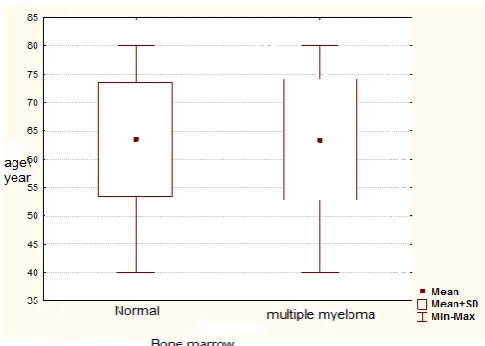
subjects of the control group. Age comparison
between the control and test groups is shown in
Fig. 2.
Gender population assessment of 30 multiple
myeloma cases revealed 14 (46.7%) and 16
(53.3%) as male and female, respectively. This
gender ratio was the same in the control group.
Some diagnostic tests of case group are
represented in table 1. The mean value of
erythrocyte sedimentation rate, creatinine,
calcium and lactate dehydrogenase were higher
than normal in patients as plasma cell
proliferation affects different organs. Due to
replacement of erythroid progenitors in bone
marrow, hemoglobin was lower than normal
range.
Fig. 2. Age distribution in the case and control groups.
Table 1. Some diagnostic tests in the patients group
Variable Hemoglobin
(gr/dl)
Red blood
cell
(1012/liter)
White blood
cell
(109/liter)
Platelet
(109/liter)
Erythrocyte
sedimentatio
n rate
(mm/h)
Prothrom
bin time
(second)
Partial
thrombop
lastin time
(second)
Calcium
mg/dl
Creatin
ine
mg/dl
Lactate
dehydrogenase
U/liter
Mean±SD 10.2±2.6 3.4±0.8 6.5±3.7 224.5±109. 75.6±44.2 14.1±1.3 31.1±7.1 9.4±0.8 2.2±2 604.9±476.1
Range 6.3-15.5 2-5.1 0.5-17-3 58-534 3-132 12.5-17.1 20-47.5 8.1-11.9 0.6-9.1 240-2012
Discussion
FLT3 mutation has been proved as a determining
factor in some hematologic malignancies, and its
evaluation may guide proper treatment [10]. In
this research no FLT3 mutation either TKD or
ITD was found in the study groups. According to
table 1, high creatinine levels of serum and low
count of white blood cells in MM patients
reveals kidney damage and bone marrow
involvement. Frequency of this mutation is
mentioned in the latest studies as below: AML,
14.4% ITD and 4.1 %TKD [21]; ALL, 1.3% ITD
and 1.3% TKD [22]; CML, 3.4% ITD and
1.14%TKD [23]; and MDS, 0.71% ITD and
0.23% TKD [24]. Some slight diversities are
seen; these frequencies are similar to some
recent studies and are very different from
Zeramba's et al. research results about FLT3
mutation and adult T-cell leukemia/lymphoma
(ATLL). These data are very different from those
of our findings in the field of MM, too. The data
suggest that mutations in the listed malignancies
may determine prognosis of disease and adopted
treatment. The epidemiologic distribution of
FLT3 mutations is less known in some
proliferative disorders. It's very rare in
lymphoma as its frequency is approximately 4%
in ATLL [25].
In this study we tried to assess the epidemiologic
distribution features of FLT3 ITD mutation in
MM patients. So far, it is the first study that has
been done to determine frequency of FLT3
mutations in MM patients. Liu et al. (2007)
studied the clinical significance of FLT3
mutations in hematologic malignancies and did
not found any of them in 3 cases of non-Hodgkin
lymphomas and 9 cases of MM [26]. In
Yamamota's study in field of FLT3 mutations
prevalence in hematologic malignancies, no
mentioned mutations were seen in 40 MM cases.
This study is in line with our finding about lack
of relation between MM and FLT3 mutations
[18]. Yokota's findings show no FLT3 mutations
in 38 multiple myeloma patients [27]. That
research supports our data, too.
Conclusions
Although FLT3 mutation occurrence is unusual
in Multiple myeloma, it seems that FLT3 gene
changes can affect multiple myeloma
pathogenesis. This study was a novel project
regarding the analysis of FLT3 mutations in the
field of multiple myeloma research. More studies
of MM patients in combination with other
hematologic malignancies may reveal FLT3
mutation presence in the mentioned cases.
Evaluations of more cases can achieve more
accurate results.
Conflict of Interest
The authors declare that they have no conflict of interest.
Acknowledgement
This research was aided by program project grant of Mashhad University of Medical Sciences, Mashhad, Iran. We are very thankful to the technicians of Cancer Molecular Pathology Research for their technical support.
References
[1]. Small D. FLT3 mutations: biology and treatment. ASH Education Program Book 2006;2006(1):178-84.
[2]. Xu B, Chen G, Luo X, Tang J. Detection of FLT3/ITD gene mutations in patients with hematologic malignancy and their clinical significance. The Chinese-German Journal of Clinical Oncology 2009;8(2):100-3. [3]. Meshinchi S, Appelbaum FR. Structural
and functional alterations of FLT3 in acute myeloid leukemia. Clinical Cancer Research 2009;15(13):4263-69.
[4]. Chang P, Kang M, Xiao A, Chang J, Feusner J, Buffler P, et al. FLT3 mutation incidence and timing of origin in a population case series of pediatric leukemia. BMC cancer 2010;10(1):513. [5]. Reilly JT. FLT3 and its role in the
pathogenesis of acute myeloid leukaemia. Leukemia & lymphoma 2003;44(1):1-7. [6]. Gilliland DG, Griffin JD. The roles of
FLT3 in hematopoiesis and leukemia. Blood 2002;100(5):1532-42.
[7]. D Kottaridis P, Gale RE, Linch DC. Flt3 mutations and leukaemia. British journal of haematology 2003;122(4):523-38.
[8]. Lin P, Jones D, Medeiros LJ, Chen W, Vega-Vazquez F, Luthra R. Activating FLT3 mutations are detectable in chronic and blast phases of chronic myeloproliferative disorders other than
chronic myeloid leukemia. American journal of clinical pathology 2006;126(4):530-533.
[9]. Keneth Kaushansky MAL, Ernest Bentler, Thomas J. Kipps, Uri Seligsohn, Josef T. Prechal. Plasma cell neoplasms, in: Williams hematology. 8 ed: MC Graw Hill Company 2010: 1627-35
[10].Warren M, Luthra R, Yin CC, Ravandi F, Cortes JE, Kantarjian HM, et al. Clinical impact of change of FLT3 mutation status in acute myeloid leukemia patients. Modern Pathology 2012;25(10):1405-12. [11].Bacher U, Haferlach C, Kern W,
Haferlach T, Schnittger S. Prognostic relevance of FLT3-TKD mutations in AML: the combination matters—an analysis of 3082 patients. Blood 2008;111(5):2527-37.
[12].Bains A, Luthra R, Medeiros LJ, Zuo Z. FLT3 and NPM1 Mutations in Myelodysplastic Syndromes Frequency and Potential Value for Predicting Progression to Acute Myeloid Leukemia. American journal of clinical pathology 2011; 135(1):62-9.
[13].Beitinjaneh A, Jang S, Roukoz H, Majhail NS. Prognostic significance of FLT3 internal tandem duplication and tyrosine kinase domain mutations in acute promyelocytic leukemia: a systematic
review. Leukemia research 2010;34(7):831-36.
[14].Levis M, Small D. FLT3: ITD does matter in leukemia. Leukemia 2003; 17(9):1738-52.
[15].Wang L, Lin D, Zhang X, Chen S, Wang M, Wang J. Analysis of FLT3 internal tandem duplication and D835 mutations in Chinese acute leukemia patients. Leukemia research 2005;29(12):1393-98.
[16].Levis M. Who's dancing with FLT3? Blood 2008;111(5):2503-4.
[17].Dombret H. Gene mutation and AML pathogenesis. Blood 2011;118(20):5366-7. [18].Yamamoto Y, Kiyoi H, Nakano Y, Suzuki
R, Kodera Y, Miyawaki S, et al. Activating mutation of D835 within the activation loop of FLT3 in human hematologic malignancies. Blood 2001;97(8):2434-39. [19].Daver N, Strati P, Jabbour E, Kadia T,
Luthra R, Wang S, et al. FLT3 mutations in myelodysplastic syndrome and chronic myelomonocytic leukemia. American journal of hematology 2013;88(1):56-9. [20].Sino-US SLCG. FLT3 gene mutation and
its prognostic implication in patients with acute leukemia. Zhonghua xue ye xue za zhi=Zhonghua xueyexue zazhi 2010;31(1):1.
[21].Elyamany G, Awad M, Fadalla K, Albalawi M, Al Shahrani M, Al 3Abdulaaly A. Frequency and Prognostic Relevance of FLT3 Mutations in Saudi Acute Myeloid Leukemia Patients. Advances in hematology 2014;6:337-49. [22].Elyamany G, Awad M, Alsuhaibani O,
Fadalla K, Al Sharif O, Al Shahrani M, et al. FLT3 Internal Tandem Duplication and
D835 Mutations in Patients with Acute Lymphoblastic Leukemia and its Clinical Significance. Mediterranean journal of hematology and infectious diseases 2014;6(1): e2014038..
[23]. Annamaneni S, Kagita S, Gorre M, Digumarti RR, Satti V, Battini MR Incidence of internal tandem duplications and D835 mutations of FLT3 gene in chronic myeloid leukemia patients from Southern India. Hematology 2014;19(3):129-35.
[24].Daver N, Strati P, Jabbour E, Kadia T, Luthra R, Wang S, et al. FLT3 mutations in myelodysplastic syndrome and chronic myelomonocytic leukemia. American journal of hematology 2013;88(1):56-9. [25].Zaremba CM, Oliver D, Cavalier M, Fuda
F, Karandikar NJ, Chen W. Distinct immunophenotype of early T-cell progenitors in T lymphoblastic leukemia/lymphoma may predict FMS-like tyrosine kinase 3 mutations. Annals of diagnostic pathology 2012;16(1):16-20. [26].Liu H, Yu H, Jia HY, Zhang W, Guo CJ.
Detection of FLT3 gene mutation in hematologic malignancies and its clinical significance. Hematology/Chinese Association of Pathophysiology 2007; 15(4):709-13.
[27].Yokota S, Kiyoi H, Nakao M, et al. Internal tandem duplication of the FLT3 gene is preferentially seen in acute myeloid leukemia and myelodysplastic Syndrome among various hematological malignancies: a study on a large series of patients and cell lines. Leukemia 1997; 11:1605-1609.