Adbrakhimov R. Screening investigation of clinical and psychological manifestations of post-traumatic stress syndrome in combatants with optic trauma. Journal of Education, Health and Sport. 2018;8(3):548-553. eISSN 2391-8306. DOI http://dx.doi.org/10.5281/zenodo.3408721
http://ojs.ukw.edu.pl/index.php/johs/article/view/7464
The journal has had 7 points in Ministry of Science and Higher Education parametric evaluation. Part B item 1223 (26.01.2017). 1223 Journal of Education, Health and Sport eISSN 2391-8306 7
© The Authors 2018;
This article is published with open access at Licensee Open Journal Systems of Kazimierz Wielki U niversity in Bydgoszcz, Poland
Open Access. This article is distributed under the terms of the Creative Commons Attribution Noncommercial License which perm its any noncommercial use, distribution, and reproduction in any medium, provided the original author(s) and source are credited. This is an open access article licensed under the terms of the Creative Commons Attribution Non Commercial License (http://creativecommons.org/licenses/by-nc/4.0/) which permits unrestricted, non commercial use, distribution and reproduction in any medium, provided the work is properly cited. This is an open access article licensed under the terms of the Creative Commons Attribution Non Commercial License (http://creativecommons.org/licenses/by-nc/4.0/) which permits unrestricted, non commercial
use, distribution and reproduction in any medium, provided the work is properly cited. The authors declare that there is no conflict of interests regarding the publication of this paper.
Received: 20.03.2018. Revised: 10.03.2018. Accepted: 30.03.2018.
SCREENING INVESTIGATION OF CLINICAL AND PSYCHOLOGICAL
MANIFESTATIONS OF POST-TRAUMATIC STRESS SYNDROME IN
COMBATANTS WITH OPTIC TRAUMA
R. Adbrakhimov
Kiev Clinical Hospital No. 2 for Railway Transport
ORCID: https://orcid.org/0000-0002-8574-4310
e-mail: [email protected]
Abstract
The objective: to make screening evaluation of post-traumatic stress syndrome in
combatants with optic injuries to further optimize their medical and psychological support.
Under the conditions of PIC 100 combatants were examined. 54 of them had optic injury with
partial vision loss at the background of post-traumatic stress syndrome (PTSS) and 46 persons
had symptoms of PTSS. Mental health of all the subjects was examined. For this they used
the CAPS - scale and Neurotization and Psychopathization Questionnaire (NPQ). Use of
CAPS –scale for screening allows to suspect symptoms of PTSS in the persons under
examination. For their understanding and interpretation it is necessary to compare them with
the data of clinical - diagnostic examinations. The use NPQ for screening with the aim to
identify signs of psychological maladjustment among combatants and those with visual
trauma fully satisfies the research. The established levels of neurotization and
psychopathisation clearly demonstrate a shift in psychological maladjustment. Further
research is advisable to direct to the development of a detailed study of the psychological
Key words: post-traumatic stress syndrome, psychological maladjustment,
combat optic injury.
Introduction. Although optic area is small and does not exceed 0.1% of the human ‘s
body total surface, optic injuries account for 6% of casualties in combat (according to
Operation Iraqi Freedom / Operation Enduring Freedom) [1]. According to the analysis of the
combatants with the consequences of military trauma, who were certified by medical expert
commissions of 20 Ukrainian regions in 2015 and were recognized as disabled, the number of
combatants with optic and orbit injuries constituted 3.5% [2]. According to the Military
Medical Center of the Western Region data, the number of individuals with eye and orbit
injuries receiving medical care at this facility in 2014 - 2017 constituted 2% [3].
Not accounting for the overwhelming amount, optic and orbit traumata are among the
major disabling pathologies of combat trauma and disability due to trauma of such
localization is 84.5% [4]. However, if advances in ophthalmology over the past 30 years give
rise to the hope that the number of cases of blindness after combat wounding will decrease
significantly [1] in the future, the problem of psychological consequences of combat optic
trauma is still unsolved. Meanwhile, it is clear that in a situation of partial loss of vision due
to wounding in combat, the person suffers from the action of several powerful stress factors:
psychological maladaptation through the change of civilian lifestyle to the military one;
psychopathological response to participation in military actions; the consequences of a partial
loss of vision that destroys the habitual lifestyle of the injured.
The origins and consequences of each of these manifestations are different, but the
importance of their interaction investigation is undeniable. Taking this into account, we
believe that there is an urgent need to develop specialized high-targeted approaches to
medical – and - psychological rehabilitation of combatants with partial loss of vision of
traumatic genesis, because neglect of any factors of psychopathogenesis, especially
psychological care, leads to poor rehabilitation of this contingent.
So, in our opinion, there is a need to optimize measures for rendering medical and
psychological support for combatants with partial loss of vision of traumatic genesis in
combination with manifestations of post-traumatic stress syndrome (PTSS).
The objective: to conduct a screening assessment of the manifestations of PTSS to
further optimization of medical and psychological support for combatants with partial loss of
Materials and methods. Under the conditions of PIC and adhering to the principles of
bioethics and deontology, 100 combatants were examined during 2014–2018. 54 of them had
optic injury with partial vision loss (index group); group of comparison consisted of 42
combatants. The persons under study aged 20-53 y.o. The candidates with clinically verified
and officially diagnosed (in health care establishments) diagnoses of brain injuries that
preceded or accompanied optic injury. Persons with officially established mental illnesses,
including alcoholism, drug and substance abuse, also did not participate in the investigation,
too. The examination of mental state was carried out at 6th -7th months after surgical
intervention in persons with optic traumatic lesions and after the completion of participation
in the military actions and demobilization.
All respondents were screened for a psychiatric condition using the CAPS-scale
(Clinical-administered PTSD Scale) [5, 6], Neurotization and Psychopathization questionnaire
(NPQ) [7, 8]. The results were processed by statistical analysis methods.
Results. All participants were identified signs of psychological post-traumatic stress
syndrome of different content and severity.
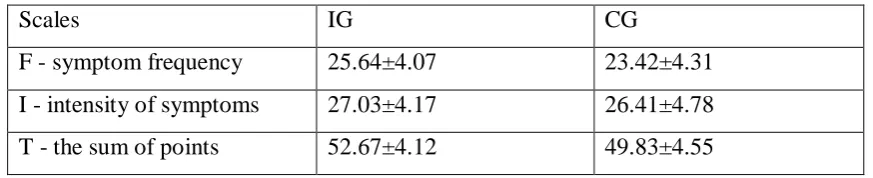
Screening testing of participants with CAPS-scale for one month period found
[image:3.595.85.522.462.551.2]significant deviations compared to the range of regulatory indicators (Table 1).
Table 1
Clinical administered PTSD Scale (CAPS) assessment levels
Scales IG CG
F - symptom frequency 25.64±4.07 23.42±4.31
I - intensity of symptoms 27.03±4.17 26.41±4.78
T - the sum of points 52.67±4.12 49.83±4.55
Scores in the study by scales-method were increased compared to the generally
accepted range of norms (especially this concerned the assessment of the intensity of
manifestations). But in meaningful interpretation, clinical manifestations were interpreted by
the participants as short-term (paroxysmal) ones. By affiliation to diagnosis criteria A-G
manifestations did not always meet the requirements of the methodology. Two or three of
them were the frequency, time of occurrence, or meaningful characteristics of the
manifestations. In their totality, the signs did not meet the criteria for PTSS diagnosis. They
did not satisfy the requirements both in time of occurrence and their spectrum. Compared
results got according to the method mentioned. This testified to the need to combine clinical
and diagnostic studies in combination with psychodiagnostic.
Substantial analysis of NPQ - scale showed that the statements included in the
neuroticism scale contain such characteristic manifestations of neurotic states as rapid fatigue,
sleep disturbance, hypochondriacal fixation on unpleasant somatic sensations, decreased
mood, increased irritability, agitation, excitability, fears, anxiety, self-dout (Table 2).
Table 2
Levels of neuroticism and psychopathization
Scales IG CG
neurotization -67.24 ± 4.21 -56.34 ± 4.28
Psychopathization -43.37 ± 4.35 -34.51 ± 4.35
The statements of the psychopathization scale cover only some of the traits typical for
psychopathic persons: indifference to the principles of sense of duty and morality,
indifference to the opinion of others, increased non-conformism, desire to stand out among
others, hypocrisy, hot temper, suspicion, self-esteem and self-confidence. It should be noted
that the farther from the pole of the scales the individual scores are located, the less the
individuals will have the following characteristics. At a high level of neuroticism (high
absolute value of a negative assessment), a pronounced emotional excitability can be
observed, which produces various negative experiences (anxiety, tension, confusion,
irritability). The uninitiated nature of these individuals generates feelings connected with of
dissatisfaction of desires. Their self-centered personality orientation manifests itself in a
tendency to hypochondriacal fixation on unpleasant somatic sensations, and in a focus on the
experiences of their personal defects. This, in turn, creates feelings of inferiority, difficulty in
communication, social timidity and dependence, self-doubt, and the worst general
adaptability. Sleep disturbances, increased fatigue and other asthenic manifestations are
possible.
High level of psychopathization testifies to lightness, cold attitude to people,
perseverance, stubborness in interpersonal relationships; neglect of norms of sense of duty
and morality, unpredictability of actions and possibility of creating conflict situations; the
desire to stand out from the environment, increased self-esteem and self-confidence;
indifference to the opinion of others, increased non-conformism, carelessness, hypocrisy,
Formation of PTSS phenomena is under the influence of stressful influence of external
circumstances, which correct the development of personality new behavioral strategies. When
return to the usual framework of life (in our case – peace time) and against the background of
new behavior optimization, there is a conflict between old and new strategies in similar
situational conditions. The first structure that contributes to the development of PTSS was
stress after-effects acquired during military service and combat affected the formation of new
behavioral strategies. Their assimilation took place under the conditions of psychological and
somatic stress, the presence of a real vital threat. This process was in line with the individual’s
life new conditions. These strategies were quite relevant and accompanied by a high level of
emotional and affective manifestations. They were confirmed by their successful use in
combat and allowed the individual to survive and function under these conditions. It can be
said that as a result of participation in military operations, the person has acquired relevant to
him experience and received additional tools for successful life. But the application of
behavioral patterns acquired and effective in combat leads to conflict situations in public and
personal life and professional activities and this resulted in psychological maladaptation.
Another factor contributing to the development of PTSS in response to stressful effects with
signs of a vital threat, is participation in military operations. In the event of optic trauma with
subsequent partial loss of vision an additional stress reaction develops. It requires the
personality to further modify behavioral strategies aimed at adapting to new conditions of life,
namely, partial loss of vision. The summation of these factors contributes to the development
of PTSS.
Conclusions
1. The use of the Clinical administered PTSD Scale (CAPS) for screening of
post-traumatic stress syndrome presence in combatants suggests suspicion of these changes. For
their understanding and interpretation it is necessary to make comparisons with the data of
clinical and diagnostic examination.
2. The use of neurotization and psychopathization questionnaire for screening to
identify signs of psychological maladaptation with post-traumatic stress syndrome in
combatants and with optic trauma completely satisfies the study. The levels of neurotization
and psychopathization found clearly demonstrate damages of psychological maladaptation.
Research prospects. Further research should be directed to the development of a
References:
1. Immediate military surgery. Eye injuries. URL
//www.aumf.net/emergencywarsurgery/eng_chapters/EWS_Chapter14.pdf
2. Belyaeva NM, Yavorovenko OB, Kurilenko IV, Galyutina O. Yu., Kuvikova IP,
Gumeniuk OV, Danilenko Yu. Disability caused by the consequences of combat traumas in
participants of the Anti-terrorist operation in the regions of Ukraine // Coll. of sciences.
works. cooperation. NMAPO named after L. L. Shupik 2017. № 27. P. 186 - 201.
3. Gaida IM, Badyuk MI, Sushko YI Features of the structure and course of modern
combat trauma in the military of the Armed Forces of Ukraine // Pathology. 2018. T. 15, N. 1
(42). P. 73–76.
4. Belyaeva NM, Yavorovenko OB, Kurilenko IV, Danilenko Yu.A., Pavlichenko GV
Causes and severity of disability in the participants of the Anti-terrorist operation //
Biomedical and biosocial anthropology. 2016. № 27. P. 187 - 191.
5. Tarabrina NV. Workshop on psychology of post-traumatic stress. (Psychology
Workshop Series). St. Petersburg: Peter., 2001. - 272 p.
6. Agaev NA, Kokun OM, Pishko IO, Lozinskaya NS, Ostapchuk VV, Tkachenko VV
Collection of methods for diagnostics of negative mental states of servicemen: Methodical
manual. - K .: NDC of the SSU, 2016. - P. 208-225.
7. Bliznyuk A.I. Post-traumatic stress disorder (PTSD) in combatants, clinic,
diagnosis, correction / A.I. Bliznyuk / Military Medical Journal, No. 1, Belarusian State
Medical University, Minsk, 2005 - S. 1-14.
8. Practical psychodiagnostics. Methods and tests. Tutorial. Ed. and comp.