INCREASING RETURNS
TO SCALE
AND IMPERFECT
COMPETITION
6
1
Basics of Imperfect Competition
2
Trade under Monopolistic Competition
3
Empirical Applications of Monopolistic Competition
and Trade
4
Introduction
•
We will look at trade in golf clubs, a good that the
U.S. imports and exports in large quantities.
•
Many countries that sell to the U.S. are also
buying from the U.S.
The total value of imports is close to the total value of exports.
•
Why does the U.S. export and import golf clubs to
and from the same countries?
We observe intra-industry trade.
Introduction
Introduction
Introduction
•
We will look at a model of monopolistic
competition where goods are differentiated.
Gives a degree of market power
•
Firms tend to specialize because in monopolistic
competition we have increasing returns to scale
•
The imperfect competition model also predicts
that larger countries will trade more with each
other.
Trade Under Monopolistic Competition
•
We begin this section with a few assumptions
Assumption 1: each firm produces a good that is similar to, but differentiated from, the goods that other firms in the industry produce.
Assumption 2: there are many firms in the industry.
Assumption 3: firms produce using a technology with increasing returns to scale (decreasing AC, fig. 6.3).
Assumption 4: firms can enter and exit the industry
Trade Under Monopolistic Competition
Trade Under Monopolistic Competition
•
Numerical Example
Using the cost curve in figure 6.3, we get:
Fixed costs = $100
Marginal costs = $10/unit
Q VC=Q*MC TC=FC+VC AC=TC/Q
10 $100 $200 $20
20 200 300 15
30 300 400 13.3
40 400 500 12.5
50 500 600 12
100 1000 1100 11
Trade Under Monopolistic Competition
•
Equilibrium Without Trade
Short-Run Equilibrium
Figure 6.4 shows our monopolistically competitive firm.
Each firm maximizes profits by producing Q0, where MR=MC.
Price is from the demand curve at P0.
Since price is greater than average cost, the firm is earning positive monopoly profits.
Long-Run Equilibrium
Since firms are making positive profits, firms will enter the industry.
Trade Under Monopolistic Competition
Price
Quantity MC AC
Demand curve facing each firm, d0 mr0
P0
Q0
Figure 6.4
Trade Under Monopolistic Competition
Price MC AC d0 D/NA P0 Figure 6.5 d1 mr1Equilibrium is at A, producing Q1, where mr1 crosses MC. This gives price, PA, from the demand, d
1
PA A
Firm demand when all firms charge the same price
At Q1, the no-trade price PA = AC so the
firms are all earning zero monopoly profits and there is no entry or exit
Trade Under Monopolistic Competition
• Equilibrium With Free Trade
Assume Home and Foreign are exactly the same.
Same number of consumers
Same technology and cost curves
Same number of firms in the no-trade equilibrium (NA)
If there were no economies of scale, there would be no reason for trade.
• Short-Run Equilibrium with Trade
When trade opens, the number of customers available to each firm
doubles, but the number of product varieties available to each consumer also doubles.
Trade Under Monopolistic Competition
•
Short-Run Equilibrium with Trade
After trade, demand is no longer tangent to the AC.
Each firm now produces at Q2 charging P2.
Firms are making positive monopoly profits.
This shows the firm’s incentive to lower its price
Every firm in the industry has the same incentive.
If all firms lower prices, though, the quantity demanded from each firm increases along D/NA, instead of d
2.
Remember D/NA is the demand if all firms had the same price.
Trade Under Monopolistic Competition
Price Quantity MC AC D/NA Figure 6.6 d2 mr2PA A
Q1
B’
Q’2 Q2
B P2 Long-run equilibrium without trade Short-run equilibrium with trade
Opening trade makes the firm’s demand even more
elastic, shown by d2. The firm chooses to produce at Q2, where MR=MC, selling at P2. At this price the firm makes monopoly profits as P2>AC
As all firms lower their price to P2, the relevant demand is D/NA at B’ selling only Q’
2. At this point firms are
Trade Under Monopolistic Competition
•
Long-Run Equilibrium with Trade
Since firms will exit the industry, increasing demand for the remaining firms’ products and decrease the
available product varieties to consumers.
We now only have NT firms which is fewer than the NA
firms we had before.
The new demand D/NT lies to the right of D/NA.
Long-run equilibrium with trade is at point C.
Trade Under Monopolistic Competition
Price Quantity MC AC D/NT Figure 6.7 d3 mr3PA A
Q1 Q3
C
PW
Long-run equilibrium without trade
Since some firms have exited the
industry, we are left with T firms which gives each firm a share of the demand shown by D/NT
The demand faced by each firm is d3 with mr3. mr3=MC shows that each firm produces Q3 at a price PW
Since PW = AC, firms are making zero
monopoly profits, no firms exit or enter the industry, and C is the long run equilibrium with trade
Trade Under Monopolistic Competition
•
Long-Run Equilibrium with Trade
The world number of products is greater than the number available in each country before trade.
Fewer firms remain in each country, but each is bigger.
As quantity increases, average costs fall due to increasing returns to scale, therefore so do prices.
•
Gains From Trade
There are two sources of gains for consumers:
Price is lower after trade.
Trade Under Monopolistic Competition
• Adjustment Costs from Trade
There are adjustment costs as some firms shut down and exit the industry.
Workers in those firms experience a spell of unemployment.
Over the long run however, we expect those workers to find new positions.
Temporary costs
Compare short-run and long-run adjustment costs.
Empirical Applications of Monopolistic
Competition and Trade
• Gains and Adjustment Costs for Canada
The potential for Canadian firms to expand output was a key factor in Canada’s free-trade agreement with the U.S. in
1989 and entry into NAFTA (along with Mexico) in 1994.
Studies in Canada as early as the 1960s predicted substantial gains from free trade with the U.S.
Firms would expand their scale of operations to service the larger market and lower their costs.
Studies by Harris in the mid-80s influenced Canadian policy makers to proceed with the free trade agreement with the U.S.
HEADLINES
What Happened When Two countries Liberalized Trade?
•
Data from 1988–1996 was used by Daniel Trefler
of University of Toronto to estimate effects of the
Canada-U.S. Free Trade Agreement.
•
Some findings:
Short-run adjustment costs of 100,000 jobs, or 5% of manufacturing employment.
Some industries that had very large tariff cuts saw employment fall by as much as 12%
Over time, however, these job losses were more than made up for by creation of new jobs elsewhere in
manufacturing.
HEADLINES
What Happened When Two countries Liberalized Trade?
•
In the long run, large positive effects on
productivity were found.
15% over eight years in industries most affected by tariff cuts— compound growth of 1.9%/year.
6% for manufacturing overall—compound growth of 0.7%/year. The difference of 1.2%/year is an estimate of how free trade with
the U.S. affected the Canadian industries over and above the impact on other industries.
There was also a rise of 3% in real earnings over this period.
Empirical Applications of Monopolistic
Competition and Trade
•
Gains and Adjustment Costs for Mexico
Joining NAFTA was a way to ensure the permanence of economic reforms already underway.
Under NAFTA, Mexican tariffs on U.S. goods declined from an average of 14% in 1990 to 1% in 2001.
In addition, U.S. tariffs on Mexican imports fell as well.
•
Productivity in Mexico (figure 6.8)
Panel A shows productivity over time.
Empirical Applications of Monopolistic
Competition and Trade
Empirical Applications of Monopolistic
Competition and Trade
•
Productivity in Mexico
For the maquiladora plants, productivity rose 45% from 1994 to 2003—compound growth rate of 4.1%/year.
For non-maquiladora plants, productivity rose overall by 25%—compound growth rate of 2.5%/year.
The difference, 1.6%/year, is an estimate of the impact of NAFTA on the productivity of maquiladora plants
Empirical Applications of Monopolistic
Competition and Trade
• Real Wages and Income
From 1994 to 1997, there was a fall of over 20% in real wages in both sectors, even with increase in productivity. Why did it happen?
Shortly after joining NAFTA, Mexico suffered a financial crisis that led to a large devaluation of the peso.
Mexican CPI went up leading to a fall in real wages.
The decline was, however, short lived.
Real wages in both sectors began to rise again in 1998.
By 2003, real wages were almost back to their 1994 value.
Since real wages were not higher than in 1994, any
Empirical Applications of Monopolistic
Competition and Trade
•
Real Wages and Income
If we look at real monthly income, the picture is a little better.
This includes other sources of income beside wages, especially for higher-income persons.
In the maquiladora sector, real incomes were higher in 2003 than in 1994.
Some gains for workers in plants most affected by NAFTA.
Higher-income workers fared better than unskilled workers in Mexico.
Empirical Applications of Monopolistic
Competition and Trade
Empirical Applications of Monopolistic
Competition and Trade
•
Adjustment Costs in Mexico
When Mexico joined NAFTA, it was expected that the agricultural sector would fare the worst due to
competition from the U.S.
Tariff reductions in agriculture were phased in over 15 years.
The evidence to date shows the corn farmers did not suffer as much as was feared. Why?
The poorest farmers consume the corn they grow.
Mexican government was able to use subsidies to offset the reduction in income for other corn farmers.
Empirical Applications of Monopolistic
Competition and Trade
•
Adjustment Costs in Mexico
Increasing volatility due to trade can be counted as adjustment costs.
For maquiladora plants, employment grew rapidly following NAFTA to a peak of 1.29 million in 2000.
After that, this sector entered a downturn.
The U.S. entered a recession decreasing demand for Mexican exports.
China was competing for U.S. sales by exporting goods similar to those sold by Mexico.
The Mexican peso became over-valued, making it difficult to export abroad.
Empirical Applications of Monopolistic
Competition and Trade
•
Gains and Adjustment Costs for the U.S.
Studies on the effects of NAFTA on the U.S. have not estimated its effects on the productivity of U.S. firms.
It would be hard to identify the impact since Mexico and Canada are only two of many trading partners.
Instead, researchers have estimated the second source of gains from trade: the expansion of import varieties available to consumers.
For U.S. we will compare the long-run gains to
consumers due to expanded product varieties with the short-run adjustment costs from exiting firms and
Empirical Applications of Monopolistic
Competition and Trade
• Expansion of Variety to the U.S.
To understand how NAFTA affected the range of products available to U.S. customers, we will look at imports from Mexico in 1990 and 2001.
Focus on the number of different types of products Mexico sells to the U.S. compared to the total the U.S. imports from all countries.
Empirical Applications of Monopolistic
Competition and Trade
•
Expansion of Variety to the U.S.
According to one estimate, the total number of product varieties imported into the U.S. from 1972–2001 has increased four times.
That expansion in import variety has had the same effect as a reduction in import prices of 1.2% per year.
Using an average $90 billion in U.S. imports per year and the 1.2% reduction in prices to U.S. consumers, $90(1.2%) = $1.1 billion per year in savings to
consumers.
These consumer savings are permanent and increase over time as export varieties grow.
In 2003, the 10th year of NAFTA, consumers would gain
Empirical Applications of Monopolistic
Competition and Trade
• Adjustment Costs in the U.S.
These come as firms exit the market due to import competition and
the workers employed there are temporarily unemployed.
One way to measure this loss is to look at claims under the U.S.
Trade Adjustment Assistance (TAA) provisions.
From 1994–2002, about 525,000 workers, or about 58,000 per year, lost their jobs and were certified as adversely affected by trade under the NAFTA-TAA program.
Compare to the annual number of workers displaced in
manufacturing or 444,000 workers per year.
Empirical Applications of Monopolistic
Competition and Trade
• Adjustment Costs in the U.S.
Another way to measure effects is to compare the loss in wages from the displaced workers to the consumer gains.
Suppose the average length of unemployment for laid off workers is 3 years.
Average yearly earnings for manufacturing workers was $31,000 in 2000 so each displaced worker lost $93,000 in wages. total losses were $5.4 billion.
These private costs of $5.4 billion are nearly equal to the average welfare gains of $5.5 billion.
Empirical Applications of Monopolistic
Competition and Trade
•
Summary of NAFTA
We have been able to measure in part the long-run gains and short-run costs from NAFTA for Canada, Mexico, and the U.S.
It is clear that for Canada and the U.S., the long-run gains considerably exceed the short-run costs.
In Mexico the gains have not been reflected in the growth of real wages for production workers.
Empirical Applications of Monopolistic
Competition and Trade
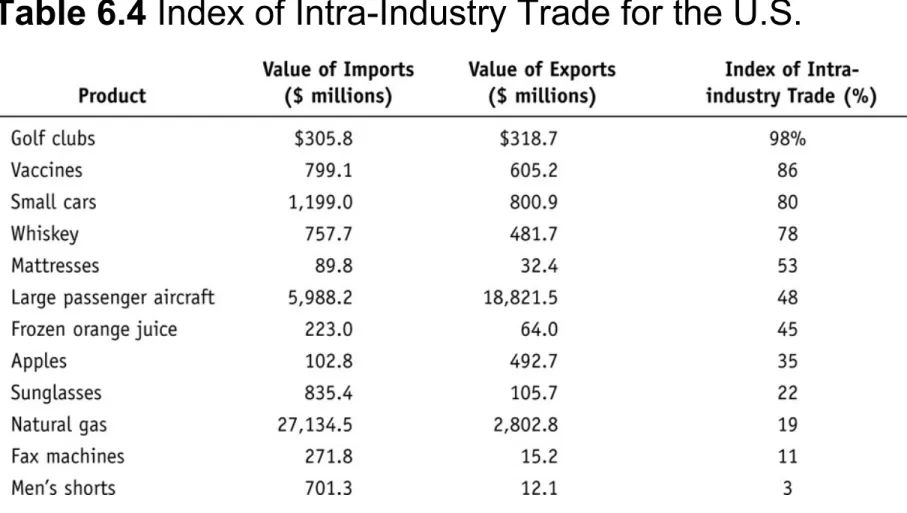
• Intra-Industry Trade
Countries will specialize in producing different varieties of a differentiated good and will trade those varieties back and forth.
The index of intra-industry trade tells us what
proportion of trade in each product involves both imports and exports.
100 = equal quantities of exports and imports 0 = only exports or imports
Imports
Empirical Applications of Monopolistic
Competition and Trade
•
Index of Intra-Industry Trade
For the golf clubs, we can use data from Table 6.1.
The minimum of imports and exports is $305.8.
Using the other data, we have
Index of IIT = 305.8/[.5(305.8+318.7)] = 98%.
In Table 6.4 there are other examples of intra-industry trade in other products for the U.S.
To obtain a high index of intra-industry trade, it is necessary for the good to be differentiated and for
Empirical Applications of Monopolistic
Competition and Trade
Empirical Applications of Monopolistic
Competition and Trade
• The Gravity Equation
To explain the value of trade, we need a different equation called the gravity equation.
Dutch economist and Nobel laureate, Jan Tinbergen was trained in physics and thought the trade between countries was similar to the force of gravity between objects.
Objects with larger mass or those that are close together have greater gravitational pull between them.
The force of gravity between these two masses is: Fg = G[M1M2/d2]
G is the constant that tells the magnitude of the relationship.
Empirical Applications of Monopolistic
Competition and Trade
•
The Gravity Equation in Trade
We use a similar equation to measure the trade between two countries.
Instead of mass, we use the GDP of each country.
The distance still matters, but we are not sure of the precise relationship between distance and trade.
There is also a constant term that indicates the relationship between the gravity term and trade.
n
dist
GDP
GDP
B
Empirical Applications of Monopolistic
Competition and Trade
•
The Gravity Equation in Trade
The constant term can also be interpreted as
summarizing the effects of all factors, other than
distance and size, that influence the amount of trade between two countries.
The effect of size is an implication of the monopolistic competition model we studied in this chapter.
Empirical Applications of Monopolistic
Competition and Trade
• Deriving the Gravity Equation
Start with Country 1, which produces a differentiated product.
Other countries’ demand for Country 1’s goods depends on:
The relative size of the importing country
The distance between the two countries
Relative size, is a country’s share of world GDP.
Share2 = GDP2/GDPw
Exports from Country 1 to Country 2 will equal the goods available in Country 1 times the relative size of country 2, divided by the transportation costs:
n W n
dist
GDP
GDP
GDP
dist
Share
GDP
Trade
1 21
1 2APPLICATION
The Gravity Equation for Canada and the United States
• Figure 6.9 shows data collected on the value of trade
between Canadian provinces and the U.S. states in 1993.
• An exponent of 1.25 is used on the distance variable based on other research studies.
• The horizontal axis is the log of the gravity equation The higher the value means either a large GDP for the trading province and state or a smaller distance between them
APPLICATION
The Gravity Equation for Canada and the United States
• Each of the points in panel A represents the trade flow and gravity term between one state and one province
.
• We can see that a pair with a high gravity term also has more trade
.
This supports the gravity equation theory.
• We can also estimate a best fit line through the data points which gives a constant term of 93
.
APPLICATION
The Gravity Equation for Canada and the United States
APPLICATION
Trade with Canada
• The gravity equation should also work well at predicting trade within a country, or intra-national trade.
• Panel B of figure 6.9 graphs the value of exports and the gravity term between any two Canadian provinces.
• There is a strong positive relationship between the gravity term between two provinces and their trade.
• The best fit line gives a constant term of 1300.
When gravity term is 1, the predicted amount of trade is $1.3
APPLICATION
Trade with Canada
APPLICATION
Trade with Canada
• Taking the ratio of the constant terms (1300/93 = 14), means on average there is 14 times more trade within Canada than occurs across the border.
• The number is even higher if we consider an earlier year before the free trade agreement.
In 1988, intra-national trade within Canada was 22 times higher.
• The fact that there is so much trade within Canada reflects all the barriers to trade that occur between countries.
Tariffs and Quotas
Imperfect Competition with Homogeneous
Products: The Case of Dumping
• While product differentiation is a good assumption for many goods, it does not hold for unprocessed goods traded between firms.
Chemicals, lumber, minerals, steel, can all be treated as homogeneous.
• However, in many of these goods, the markets are not perfectly competitive.
We want to assume imperfect competition here even though the
goods are homogeneous.
Imperfect Competition with Homogeneous
Products: The Case of Dumping
•
A Model of Product Dumping
Dumping occurs when a firm sells a product abroad at a price that is either less than the price it charges in its local market, or less than its average cost to produce the product.
Under the rules of the WTO, am importing country is entitled to apply a tariff, called an antidumping duty any time a foreign firm dumps its product on a local market.
Imperfect Competition with Homogeneous
Products: The Case of Dumping
•
Discriminating Monopoly
Assume a foreign monopolist sells both to its local market and exports to Home.
The monopolist is able to charge different prices in the two markets.
Discriminating monopoly
Firm has a monopoly at home but faces a competitive export market
Downward sloping demand curve in home market.
Horizontal demand curve in export market.
Imperfect Competition with Homogeneous
Products: The Case of Dumping
Price Foreign Quantity MC* Local Demand, D* Local Marginal Revenue, MR* AC* Export Price, P
Export Demand, D, and export marginal revenue, MR
C Local Price, P* Q2 B Q1 Local Sales Exports
The export monopoly maximizes profits at point B where local marginal costs, MC*, equal export marginal revenues, MR
AC1
The monopolist sells Q2 to its local market and (Q1-Q2) to its export market
The quantity sold in the local market is at point C where local marginal costs, MC*, equal local marginal revenues, MR*. They can then charge a local price, P*, from the local demand curve
Notice the local price, P*, is greater than AC*; but, the export price, P, is less than AC*. This means the firm is dumping into the export market
Imperfect Competition with Homogeneous
Products: The Case of Dumping
•
The Profitability of Dumping
The Foreign firm charges P* selling Q2 in the local market.
The local price is higher than the export price.
It is dumping its product into the export market.
The average costs are lower than the local price but higher than the export price.
Imperfect Competition with Homogeneous
Products: The Case of Dumping
•
Numerical Example of Dumping
Suppose the following data:
Fixed costs = $100; Marginal costs = $10/unit
Local price = $25; Local quantity = 10
Export price = $15; Export quantity = 10 Profits from the local market are:
$25(10) - $10(10) - $100 = $50
Average costs for the firms are $20.
Profits in the export market are:
[$25(10) + $15(10)] - $10(20) - $100 = $100
Imperfect Competition with Homogeneous
Products: The Case of Dumping
•
Reciprocal Dumping
It can happen that firms in both countries are accused of dumping in the other—this is reciprocal dumping.
For example, shortly after the U.S. ruled that Canadian greenhouse tomatoes were being dumped into the
U.S., the Canadian government investigated dumping against American fresh tomatoes.
Imperfect Competition with Homogeneous
Products: The Case of Dumping
•
Reciprocal Dumping
How can it be profitable for both firms to charge prices for their exports that are below their local prices?
We show that, in fact, it is a common feature of imperfectly competitive markets.
Rather than selling additional units in the local market and depressing its own price, a firm can enter the
export market.
It then depresses the price of firms abroad by increasing quantity.
Imperfect Competition with Homogeneous
Products: The Case of Dumping
•
Numerical Example of Reciprocal Dumping
Assume Home and Foreign have identical demand curves: P = 100 – Q
Remember, marginal revenue, MR = P – ΔP*Q
The price drops $1 for even extra unit sold, so ΔP=1 and MR = P-Q, this gives:
MR = P – Q = (100 – Q) – Q = 100 – 2Q
Home and Foreign have identical MC = $20/unit.
Without trade, we get the monopoly equilibrium
Imperfect Competition with Homogeneous
Products: The Case of Dumping
(a) Home (b) Foreign
Figure 6.11
Quantity Quantity
Price Price
D
MR MR* D*
$20
$60 A A*
40 40 MC No-trade monopoly equilibrium No-trade monopoly equilibrium
Imperfect Competition with Homogeneous
Products: The Case of Dumping
• Trade Equilibrium in the Home Market
Foreign has an incentive to export to Home (since price is still above marginal cost and doing so depresses price for the other firm).
The Foreign firm will export more than one unit since the MR>MC.
We can use the equilibrium condition (MR=MC) from before to determine how much will be exported.
In this case we will assume there are transportation costs for the exports of $10 per unit, so the equilibrium condition is:
$20 + $10 = P – QF
Imperfect Competition with Homogeneous
Products: The Case of Dumping
• Trade Equilibrium in the Home Market
In response to the price decline, the Home firm will reduce the quantity it produces in Home.
Home firm will choose the Home quantity by comparing MR to MC in the Home market:
QH = P - 20
The price in the Home market is related to the total quantity sold:
P = 100 – Q = 100 – QF – QH
Using the profit maximizing conditions and the demand equation, we get:
P = 100 – (P - $30) – (P - $20) = $50
Imperfect Competition with Homogeneous
Products: The Case of Dumping
•
Two-way Trade
Since the Foreign firm has an incentive to enter the Home market and both firms are the same, the Home firm has the same incentive in the Foreign market.
Foreign price with trade will also be $50 with Foreign producing 30 units for its own market and importing 20 units from Home.
B and B* in figure 6.11
Notice that as each firm sells in the other market, prices fall in both market. Firms are engaged in “reciprocal
Imperfect Competition with Homogeneous
Products: The Case of Dumping
(a) Home (b) Foreign
Quantity Quantity
Price Price
D
MR MR* D*
$20
$60 A A*
40 40 MC No-trade monopoly equilibrium No-trade monopoly equilibrium
30 30 50
B*
50 B $50
Local Exports= Reciprocal Dumping Local Exports=
Exports equal imports for both Home and Foreign from each other – Reciprocal Dumping
From the previous derivation, we saw that equilibrium with reciprocal dumping will occur at points B and B*, at a price of $50 selling 50. Each country will have 30 in local sales and export 20.
Imperfect Competition with Homogeneous
Products: The Case of Dumping
•
Measurement of Dumping
In trade disputes over dumping, the government in each country compares the price that a Foreign firm earns in the country’s market, net of transportation costs, to the price the Foreign firm earns in its local market.
In our example, Foreign exports at $50 with $10 in transportation costs: net $40.
Since the price in local market is $50, Foreign is dumping in the Home market.
Similarly, Home is dumping into the Foreign market.
Imperfect Competition with Homogeneous
Products: The Case of Dumping
•
Measurement of Dumping
This example has allowed us to illustrate the incentives for firms to enter markets abroad.
For the first units sold to the export market, the MR for the exporting firm will always be higher than the MR of the local firm abroad.
The exporting firm does not lose as much revenue from existing sales by selling additional units in the export market.
The Foreign firm has an incentive to enter the Home market and the Home firm has an incentive to enter the Foreign market.