Multi-frame Image Processing Based on
Wireless Sensor Networks
https://doi.org/10.3991/ijoe.v14i10.9306
Xianfeng Yang(*), Xiaojian Jia
Henan Institute of Science and Technology, Xinxiang 453003, China,
Abstract—With multi-frame image processing based on wireless sensor net-work as research object, this study analyzes the problems existing in the two clas-sic multi-node collaborative distributed image processing algorithms based on wavelet transform using literature analysis, simulation experiment, data analysis and other research methods, proposes a distributed image compression algorithm based on SHIHT with the application of wireless sensor network, SPIHT algo-rithm and wavelet transform to image compression as theoretical foundations, and adopts the matrix laboratory to simulate the energy performance of the algo-rithm. Through comparative analysis, the feasibility of distributed image com-pression algorithm based on SHIHT presented in this study is verified.
Keywords—Wireless Sensor, Image Processing, Distributed Image Compres-sion, Wavelet Transform
1
Introduction
Image is the visual expression of an object through the eyes, and is one of the major ways to obtain outside information [1], which plays a remarkable role in environmental monitoring, military applications, medical care and other fields. In view of the huge image data amount, it is necessary to compress the data while ensuring the image qual-ity in order to guarantee a high speed in the transmission process.
Wireless sensor network (WSN), a distributed sensor network that can inspect and sense the external world, can realize the functions of data collection, processing and transmission, which belongs to a special form of multi-hop self-organizing network [2]. In the process of image acquisition and transmission, especially when the amount of acquired image information is large, distributed image compression technology is par-ticularly important, as the large bandwidth and energy consumption of each node would lead to the low efficiency of data collection and transmission.
cycle is short [4]. The general distributed compression algorithm can improve the life cycle of wireless sensor networks to a certain extent, but its energy consumption distri-bution is uneven and the energy consumption of wireless transceiver is too large.
To sum up, based on the elaborations of the application of wireless sensor network, SPIHT algorithm, and wavelet transform to image compression, this study analyzes the problems existing in two classic multi-node collaborative distributed image processing algorithms based on wavelet transform, proposes a distributed image compression al-gorithm based on SHIHT, designs its processing structure in detail and finally obtains experimental data through matrix laboratory simulation. The data are analyzed from the aspects of the relationship between node energy consumption and the single-hop aver-age distance, the relationship between total energy consumption and hop number, and the relationship between network life cycle and node density, which verifies the feasi-bility of the proposed SHIHT-based distributed image compression algorithm.
2
Research on Distributed Image Compression Algorithms for
Wireless Sensor Networks
Wireless Sensor Network (WSN), a distributed sensor network that can inspect and perceive the external world, can realize the functions of data collection, processing, and transmission, which is composed of processor, sensor, wireless communication and en-ergy supply [5].
Table 1. WSN network development
Time Name Sensor network development
70s First generation sensor network Point-to-point transmission
80s Second generation sensor network Ability to comprehensively process information 90s Third generation sensor network Fieldbus technology is applied
to date Fourth generation sensor network Data-centric, self-organizing sensor networks
Table 1 shows the history of WSN development [6]. The fourth generation sensor network, also known as wireless sensor network, has been widely used in military, medical, environmental monitoring and other fields. Distributed image compression and data fusion technologies among others are the key technologies for wireless sensor networks [7].
2.1 Application of wavelet transform in image compression
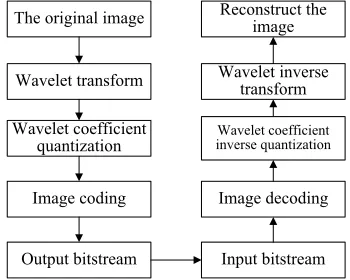
Fig. 1. Wavelet transform image compression and decoding process
2.2 Multi-node collaborative distributed image processing algorithm based on wavelet transform
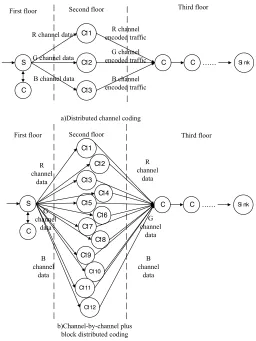
The image distributed compressed encoding method can reduce the energy con-sumption of the compression processing of a single node, integrate the resources of each node, and improve the network life cycle without increasing the network cost [11]. The realization of a multi-node collaborative distributed image processing algorithm requires the cooperation and exchange of sensor nodes. The two classic multi-node col-laborative distributed image processing algorithms based on wavelet transform are shown in Figure 2 [12], both of which adopt the clustering structure commonly used in sensor networks. Through the analysis of the two algorithms, it can be found that alt-hough the algorithm b) can effectively reduce the energy consumption and improve the compression effect compared with the algorithm a), both algorithms have the large en-ergy consumption of wireless transmission between nodes, and unbalanced node enen-ergy consumption [13-14].
Fig. 2. Multi-node collaborative distributed image processing algorithm based on wavelet transform
The original image
Wavelet transform
Wavelet coefficient quantization
Image coding
Output bitstream Input bitstream Image decoding
Wavelet coefficient inverse quantization
Wavelet inverse transform Reconstruct the
3
Design of Distributed Image Compression Algorithm Based on
SHIHT
3.1 Analysis of SPIHT algorithm
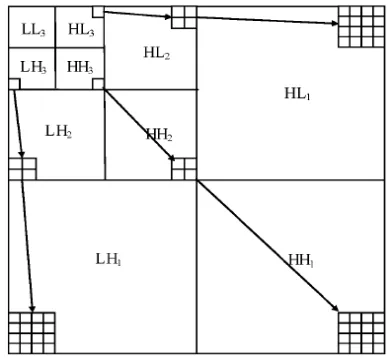
Embedded zero-wavelet coding (EZW), set partitioning in hierarchical trees (SPIHT), and embedding block coding algorithm with optimized truncation points (EBCOT) are three classic compression algorithms for images based on wavelet trans-form [15], which make full use of the multiresolution nature of wavelet transtrans-forms. The SPIHT algorithm is an improvement over the EZW algorithm, which, unlike the EZW algorithm, defines a spatial direction tree structure [16]. As shown in Figure 3, the wavelet pixels of each node are represented by coordinates, which effectively improves the encoding efficiency.
Fig. 3. Spatial Directional Tree Structure of SPIHT Algorithm
3.2 Design of distributed image compression algorithm based on SHIHT
Fig. 4. Distributed processing architecture
Inspired by the multi-node collaborative distributed image processing algorithm and SHIHT algorithm based on wavelet transform, a distributed image compression algo-rithm based on SHIHT is proposed in this study, which can perform distributed channel compression on color images. Figure 4 shows the SHIHT-based distributed image com-pression algorithm processing architecture [18]. The structure consists of three layers of data streams. The S nodes and the cluster head node Ci responsible for collecting and processing the images in separate channels form the first layer of data streams. The second layer consists of Cij nodes that are responsible for receiving images and
per-forming SHIHT compressed encoding. The images are compressed and sent to the next layer of nodes through this layer. The third layer of data stream is composed of the cluster head nodes of the next layer, whose function is to send the encoded stream of the summary encoded processing node to the sink node in a multi-hop manner.
S
C
C11
C12
C13
C C Si nk
R channel data
G channel data
B channel data
R channel encoded traffic G channel encoded traffic B channel encoded traffic ……
First floor Second floor Third floor
a)Distributed channel coding
S
C
First floor Second floor Third floor
C11 C12 C13 C14 C15 C16 C17 C18 C19 C110 C111 C112
C C …… Si nk
3.3 Simulation of energy consumption performance of the algorithm
(1) Energy consumption model
Data acquisition, transceiving and processing are major parts of the energy consump-tion of wireless sensor networks. There is little difference in energy consumpconsump-tion of data acquisition, thus can be ignored. The differences in energy consumption of the latter two are mainly considered.
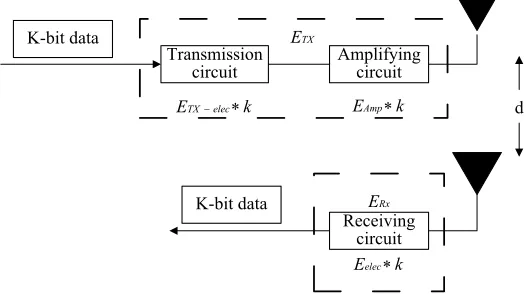
Fig. 5. Sensor wireless transceiver FORM energy consumption model
Figure 5 shows a common energy consumption model of wireless sensing network radio, in which the receiving module (receiving circuit) and the transmitting module are the main energy consumption points of the sensor nodes. The energy consumption per bit of data (k) at the receiving terminal and at the transmitting terminal can be de-termined by the following formula:
(1)
Where, ETX-elec and ERX-elec represent the received and transmitted energy
consump-tion per unit of bit, and Eamp represents the energy consumed by the transmitting
termi-nal when sending data through the amplifier, which is proportiotermi-nal to the fourth power of distance d, i.e.:
(2)
According to the transmission distance, choose Eamp=εfs×d2, then
(3)
Energy consumption of image processing includes two parts: quantization coding (Ecode) and wavelet decomposition energy consumption (Ecode), that is.
K-bit data
Transmission
circuit Amplifying circuit
K-bit data Receiving circuit TX E TX elec
E - *k EAmp*k
elec
E *k
Rx E d Rx Rx Sender : Receiver:E =E
TX TX elec amp
elec
E E - E -= + 2 0 4 0 , , fs amp mp
d d d E
d d d
e e
ì ´ £
ï =í ´ > ïî 2
+
TX TX elec fs
(4) (2) Performance simulation analysis
With the proposed distributed algorithm and the SPIHT algorithm based on wavelet transform, this study selects the color images with a resolution of M×N and 8 bits per pixel for matrix laboratory simulation, through which the relevant experimental data are obtained. The energy consumption of each node is analyzed as follows:
(5)
If a centralized processing method is adopted, wherein the images at node S are first collected and compressed and then transmitted, then the energy consumption at node S is:
(6)
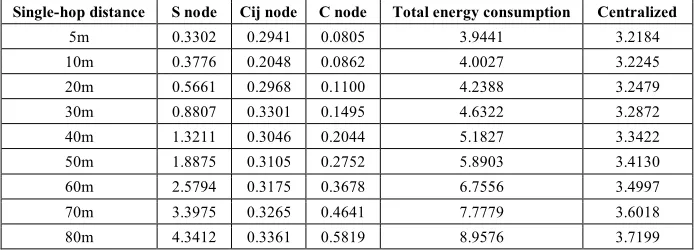
Analysis of relationship between node energy consumption and single-hop av-erage distance. Table 2 shows the relationship between energy consumption and sin-gle-hop transmission distance in distributed and centralized processing acquisition nodes when the compression ratio is 8.
The energy consumption at each node in the code cluster increases with the increase of single-hop distance. The energy consumption at node S is the most obvious, while the energy consumption at encoding node Cij is the least affected by the single-hop distance. This is because the images acquired at the node S are uncompressed thus the data amount is huge, and that the increase in energy consumption is proportional to the square of the distance. However, after the distributed structure distributes the compres-sion tasks evenly, the compressed encoding reduces the data transmiscompres-sion volume, thus the data processing capacity of the encoding node Cij decreases. Through the above analysis, in the distributed network structure, the node used for encoding processing should be set near the node S so as to reduce the transmission volume and reduce the energy consumption.
The total energy consumption of distributed compression is higher compared to cen-tralized compression. When the single-hop distance is small, the energy consumption among nodes is not much different, and the S node consumes the most energy. How-ever, the energy consumption of centralized compression is all concentrated on node S, and when the energy of centralized compression is exhausted, the whole compression structure network will fail. Therefore, compared with the distributed compression struc-ture, when the distance is small, the integrated compression structure has fast energy consumption and short network life cycle.
When the single-hop distance is greater than 70m, compared with the integrated compression structure, the distributed compression structure has larger total energy
comp DMT
+
CodeE
=
E
E
s
ij Cij Rx comp
C Rx
Collect energy consumption of node S: 8 3
Processing node C energy consumption: ( 8 E + 8 + 8 )/4 Receive node C energy consumption : 8 3 ( +E ) / r
Distributed s
TX
TX
TX
E M N E
E
E M N M N r M N E
E M N E
= ´ ´ ´ ´
= ´ ´ ´ ´ ´ ´ ´ ´ ´
= ´ ´ ´ ´
1 s p C
ystem total energy consumption :E E E= + ´ ´4 3+E
2 8 3 comp+ 8 3 ETX
consumption and a shorter life cycle, thus does not have much advantages. However, due to the fact that sensor network nodes are usually arranged at a distance of less than 70m, the use of a distributed system at this time is conducive to extending the life cycle of the sensor network.
Table 2. Node energy consumption and single-hop transmission distance (J) Single-hop distance S node Cij node C node Total energy consumption Centralized
5m 0.3302 0.2941 0.0805 3.9441 3.2184 10m 0.3776 0.2048 0.0862 4.0027 3.2245 20m 0.5661 0.2968 0.1100 4.2388 3.2479 30m 0.8807 0.3301 0.1495 4.6322 3.2872 40m 1.3211 0.3046 0.2044 5.1827 3.3422 50m 1.8875 0.3105 0.2752 5.8903 3.4130 60m 2.5794 0.3175 0.3678 6.7556 3.4997 70m 3.3975 0.3265 0.4641 7.7779 3.6018 80m 4.3412 0.3361 0.5819 8.9576 3.7199
Fig. 6. Comparison of the total energy consumption per bit for transmitting an image
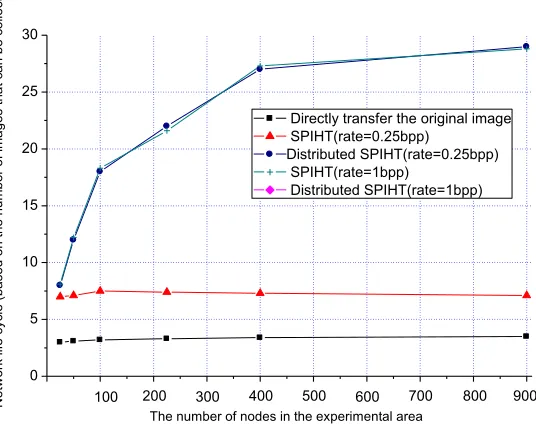
Relationship between network life cycle and node density. It is assumed that a different number of sensor nodes with an initial energy of 10 joules are arranged in a 200×200 area. When the energy is exhausted, the network life cycle ends. The compar-ison between the integrated model and the proposed SPIHT distributed structure algo-rithm is conducted.
Fig. 7. Distributed and centralized structure network life cycle comparison
0 200 400 600 800 1000 1200 1400 1600 1800 15 10 The to ta l e ne rg y con su mp tio n pe r bi t f or t ra nsmi tti ng a n ima ge
The number of hops from the source node to the destination node Directly transfer the original image
SPIHT(rate=0.25bpp) Distributed SPIHT(rate=0.25bpp) SPIHT(rate=1bpp) Distributed SPIHT(rate=1bpp) 5 0 5 10 15 20 25 30 900 800 700 600 500 400 300 200 Net wor k lif e cy cle (b as ed on the num ber of im ages that c an be co llec te d)
The number of nodes in the experimental area
Directly transfer the original image SPIHT(rate=0.25bpp)
Distributed SPIHT(rate=0.25bpp) SPIHT(rate=1bpp)
Distributed SPIHT(rate=1bpp)
Figure 7 shows the comparison of network life cycle between distributed and cen-tralized structures, from where it can be seen that the life cycle of the distributed struc-ture network increases with the increase of the number of nodes in the area, and the influence of the reduction of compression ratio on the life cycle of the network can be neglected. This is because the acquisition node in the distributed structure is the node with the largest energy consumption, thus the energy consumed by compressed encod-ing is not reflected in it, but the increase of node number has little effect on the life cycle of the integrated structure, and that its life cycle also decreases to a certain extent with the decrease of compression ratio.
4
Conclusions
Based on the references at home and abroad, this study discusses the distributed im-age compression technology based on wireless sensor network in depth, with the multi-frame image processing method based on wireless sensor network as the research ob-ject. The specific conclusions are as follows.
1.A distributed image compression algorithm based on SHIHT is proposed in light with the analysis of the problems existing in two classic multi-node collaborative distributed image processing algorithms based on wavelet transform.
2.The structure of the distributed image compression algorithm based on SHIHT is designed in detail, which divides the color image into blocks or channels for pro-cessing.
3.Through the simulation experiment of energy consumption performance of the algo-rithm, it is verified that the SHIHT-based distributed image compression algorithm proposed in this study can effectively reduce energy consumption and extend the network life cycle.
5
References
[1]Razzak, M. I., Khan, M. K., Alghathbar, K., Park, J.H. (2011). Energy efficient distrib-uted face recognition in wireless sensor network. Wireless Personal Communications, 60(3): 571-582. https://doi.org/10.1007/s11277-011-0310-y
[2]Pham, D. M., & Aziz, S. M. (2013). Object extraction scheme and protocol for energy effi-cient image communication over wireless sensor networks. Computer Networks, 57(15): 2949-2960. https://doi.org/10.1016/j.comnet.2013.07.001
[3]Phat, N. H., & Vinh, T. (2010). Low-complexity and energy-efficient algorithms on image compression for wireless sensor networks. Ieice Transactions on Communica-tions, 93-B(12): 3438-3447.
[4]Ye, S., Lin, Y., Yi, Y. (2011). Energy-aware interleaving for robust image transmission over visual sensor networks. Iet Wireless Sensor Systems, 1(4): 267-274.
https://doi.org/10.1049/iet-wss.2011.0050
[6]Nasri, M., Helali, A., Sghaier, H., Maaref, H. (2012). Trade-off analysis of energy con-sumption and image quality for multihop wireless sensor networks. International Journal of Wireless Information Networks, 19(3), 254-269. https://doi.org/10.1007/s10776-012-0174-4
[7]Aziz, S. M., & Pham, D. M. (2013). Energy efficient image transmission in wireless multi-media sensor networks. IEEE Communications Letters, 17(6): 1084-1087.
https://doi.org/10.1109/LCOMM.2013.050313.121933
[8]Kim, S.P., Su, W.Y. (1993). Recursive high-resolution reconstruction of blurred mul-tiframe images. IEEE Transactions on Image Processing, 2(4): 534-539. https://doi.org/10.1109/ 83.242363
[9]Ozkan, M.K., Erdem, A.T., Sezan, M.I., Tekalp, A.M. (1992). Efficient multiframe wie-ner restoration of blurred and noisy image sequences. IEEE Transactions on Image Processing, 1(4): 453-476. https://doi.org/10.1109/83.199916
[10]Zhou, Y., Xiang, W., Wang, G. (2015). Frame loss concealment for multiview video trans-mission over wireless multimedia sensor networks. IEEE Sensors Journal, 15(3), 1892-1901.
https://doi.org/10.1109/JSEN.2014.2366511
[11]Farsiu, S., M.D. Robinson, Elad, M., Milanfar, P. (2004). Fast and robust multiframe super resolution. IEEE Transactions on Image Processing, 13(10): 1327-1344.
https://doi.org/10.1109/TIP.2004.834669
[12]Horio, T., Suzuki, T. (2009). Multihit two-dimensional charged-particle imaging sys-tem with real-time image processing at 1000 frames/s. Review of Scientific Instru-ments, 80(1): 013706. https://doi.org/10.1063/1.3062945
[13]Showail, A., Elrasad, A., Meer, A., Daghistani, A., Jamshaid, K., Shihada, B. (2014). Ifrag: interference-aware frame fragmentation scheme for wireless sensor networks. Wireless Net-works, 20(7): 2019-2036. https://doi.org/10.1007/s11276-014-0722-1
[14]Fedali, S., Madani, H. (2017). Azeotropic points with relative volatility-prediction and cal-culation. Mathematical Modelling of Engineering Problems, 4(1): 38-42.
https://doi.org/10.18280/mmep.040108
[15]Reddy, R.K., De, S., Gupta, H.M. (2010). Joint control of transmit power and frame size for energy-optimized data transfer in wireless sensor networks. IEICE Transac-tions on Com-munications, 93(8): 2043-2052. https://doi.org/10.1587/transcom.E93.B.2043
[16]Cordeiro, P. J., Assunção, P. (2012). Distributed coding/decoding complexity in video sen-sor networks. Sensen-sors, 12(3), 2693-709. https://doi.org/10.3390/s120302693
[17]Lloret, J., Bosch, I., Sendra, S., Serrano, A. (2011). A wireless sensor network for vine-yard monitoring that uses image processing. Sensors, 11(6): 6165-6196. https://doi.org/10.3390/ s110606165
[18]Zhulina, Y.V. (2006). Multiframe blind deconvolution of heavily blurred astronomi-cal im-ages. Applied Optics, 45(28): 7342-7352. https://doi.org/10.1364/AO.45.007342
6
Authors
Xiaojian Jia received her bachelor's degree in Information Engineering from Henan University of Science and Technology, Luoyang, Henan, China, in 2009, the master's degree in Communication and Information System from Shandong University, Jinan, China, in 2013. She is now an assistant at School of Information Engineering, Henan Institute of Science and Technology, Xinxiang, China. Her current research interests include image processing, pattern recognition, wireless resource optimization and Cog-nitive radio network.