511
Vihaan Patel
1, ETJ Volume 04 Issue 01 January 2019
Engineering and Technology
Journal e-ISSN: 2456-3358
Volume 04 Issue 01 January- 2019, Page No.-511-516
DOI:10.31142/etj/v4i1.01, I.F. - 4.449
© 2019, ETJ
Dynamic Cellular Manufacturing Systems and Their Solution Using Genetic
Algorithm
Vihaan Patel
1, Sai Anand
21,2 Khalsa University, College of Commerce and Management Studies
Abstract: Production planning and cell formation problems are two important parts of this system, which have mutual effects. In
this work, a comprehensive, non-linear mathematical model with integer variables has been proposed for such problems for cell formation and production planning in a dynamic cellular manufacturing system. The proposed model is aimed at reduction of the expenses associated with production planning under dynamic conditions and the costs related to the construction and formation of cells including the costs of cell preparation and activation. The expenses investigated in this research include the costs of buying machinery, machine operation, intercellular material transfer, cell reconfiguration, activation of cells, maintenance of an inventory of assurance, maintenance of an end of the period inventory and part production as well as the unpredictable, variable costs of cell activation and buying machinery. Since the proposed model is an NP-Hard model, an effective genetic algorithm has been used. In order to evaluate and confirm the performance of the algorithms used, the results have been compared with those obtained from GAM software for different problems from the perspectives of response quality and solution time.Keywords: Dynamic cellular manufacturing systems, Production planning, Cell formation problem, Genetic algorithm
I. INTRODUCTION
Cellular manufacturing system (CMS) is referred to the processing of a set of similar parts on a certain group of machinery or manufacturing processes. The most important objectives of CMS include reduction of progress time, cost of material transfer, activation time and inventory of the manufactured commodities and those being manufactured as well as planning for simpler production and more job satisfaction [1]. CMS implementation steps include cell formation, deployment design, planning and timing production of parts and allocation of resources [2]. Given the importance of cell formation step, it has often been of major interest to the researchers and has been investigated more compared with other design steps although production planning is another important part of the system the objective and results of which affect the formation of other cells. Considering the dynamic nature of the problem of production planning due to the fluctuations in the demand and composition of the products, the integration of this problem with the cell formation problem in CMS is a difficult and complicated tradition. In traditional CMS, any variation in the demand over time from redesigning of the product to other factors, are ignored and the product composition and part demand for the entire planning horizon is considered constant. Therefore, the cells formed in a period may not be optimal and efficient for the next period. Thus, dynamic cell manufacturing system (DSMS) has been
developed to overcome the disadvantages of traditional CMS [3].
512
Vihaan Patel
1, ETJ Volume 04 Issue 01 January 2019
activation). This research focuses on the selection ofproduction planning with minimum total costs, reduction of maintenance of the inventory and inventory of assurance and consideration of the production balance for prevention of shortages for the entire planning horizon. The other objective of this research is providing the possibility of the implementation of the proposed model in industrial media via providing answers to large scale problems, which is a meta-innovative, effective method for the proposed model considering the hardness of the problem. Being NP-hard, a hybrid genetic algorithm is adopted to solve this model, as the genetic algorithms have been proven to be an efficient technique to solve this type of problems. Its applications are apparent in most of the engineering fields. For instance, Genetic Algorithm (GA) as a zeroth order optimization method has been used for the training of the Engineered Neural Networks successfully in civil engineering applications [4].
II. PAGE LAYOUT
Rheault et al. were the first to consider the concept of dynamicity in cellular implementation [3]. Chen and Cao proposed an integrated model for production planning in a DCMS problem with the objectives of minimization of intercellular transfer cost, fixed cost of activation of production cells, cost of storage of final products, machine operation cost and intercellular load balance. They first converted the proposed model to a less complicated problem and then used TS method for optimal solution of the converted problem [2]. Defersha and Chen investigated the effect of production planning on the formation of dynamic cells. Their proposed model consisted of minimization of the costs of machine operation, reintegration, outsourcing of pieces, tool consumption, activation and work load balance of the cells. They developed a non-linear mixed integer model, took linearization steps, and then implemented them in various ways [5].
In a similar research, Defersha and Chen proposed a comprehensive mathematical model for DCMS design, based on the tool requirements of pieces and availability of tools on the machinery. This model minimizes the costs of machine operation, reintegration, intercellular transfer, tool consumption, outsourcing of pieces, and intercellular work load balance [6]. Kioon et al. have proposed an integrated production planning and dynamic cell manufacturing model with the aims of minimization of costs of intercellular and intracellular transfer, material storage, domestic production, reintegration and variable and overhead costs of machinery. They solved the proposed model using several small and medium random problems using CPLEX software [7]. Deljoo et al. solved a cellular manufacturing problem under dynamic conditions using genetic algorithm. The shortcomings of the models reviewed have been improved in the model proposed in this work. The results of solving the model using genetic algorithm and LINGO software have
then been shown. Finally, it has been concluded that LINGO software is not capable of solving large size problems. However, such problems can be solved by genetic algorithm within a reasonable time in comparison with LINGO software [8]. Another metaheuristic algorithm has been applied to solve a scheduling and production planning mathematical optimization problems in [9], in which a multi objective Invasive Weed is adopted to solve a no-wait two-stage flow-shop and the results are satisfactory in terms of the objective value and running time comparing to the LINGO software. Rafiei et al. have proposed a comprehensive mathematical model for cell formation problems in which the reduction of cell formation costs including those corresponding to manufacturing costs under dynamic conditions and the costs of machine capacity limitations, operation sequences, cell size restrictions, and machine disabilities have been considered. The model proposed has then been solved using PSO algorithm [10]. Rafiei and Ghodsi have proposed a comprehensive mathematical model for cell formation problem in which the first objective function deals with the reduction of the costs of machinery, locating, machinery variable, intercellular and intracellular transport, overtime and work force transport between the cells while the second objective function deals with increasing the productivity of the work force. An ACO metaheuristic algorithm has been developed to solve the model [11]. Finally, it has been concluded that LINGO 8 software is not very effective for large size problems.
III.MODEL ASSUMPTION
1. The demand for each type of part in the beginning of each period is known.
2. Relocation of machinery from one cell to another is carried out between periods and the required time is zero.
3. The fixed cost for the manufacture and formation of cells (activation of cells) in the beginning of each period is known for each cell.
4. Inventory reserve and maintenance costs in the beginning of each period are known and fixed for all the pieces.
5. The cells have been designed such that they are capable of performing the corresponding functions. However, the costs of activation of the cells are different.
6. Each type of machine may perform one or more operations and each operation may be carried out on different machines at different times.
7. The operation cost per hour for each type of machine is known.
8. Deficiency is not allowed.
9. Operation times for all the operations of different parts on different machines are known.
513
Vihaan Patel
1, ETJ Volume 04 Issue 01 January 2019
A. Decision parameters and variables
P= Number of different parts H= Number of periods M= Number of machines C= Number of cells
= Number of operations performed on part P
= Time required for operation j on part P in machine m
part p during period h
= Number of m type machines originally present in cell C
B= Group size for intercellular transfer of materials
= Cost of purchasing machinery m
= Operation cost per hour for an m type machine γ = Cost of intercellular material location in each group = Installation cost of type m machine
= Elimination cost of type m machine
= Time capacity of each type m machine = Maximum cell size
= Maintenance cost of part P inventory during period h
= Production cost of part P during period h in cell C = Available capital for formation of cells during period h
= Available capital for purchase of equipment during period h
= Total available time during each period for production of customer demands for all cells
A large positive number
= Fixed cost for formation of cell C during period h = Cost of maintaining an inventory of assurance of part P during period h
= Maximum allowable inventory during a period
B. Decision variables
= Number of m type machines used in cell C during period h
= Number of m type machines added to cell C during period h
= Number of m type machines removed from cell C during period h
= Inventory of part P at the end of period h
Inventory of assurance of part P at the end of period h
= Amount of production of part P by cell C during period h
Amount of unpredicted variable capital for purchase of equipment during period h
= Amount of unpredicted variable capital for cell formation during period h
IV.PROPOSED MODEL
s.t.
(1)
(2)
(3)
(4)
(5)
(6)
(7)
(8)
(9)
(10)
(11)
(12)
514
Vihaan Patel
1, ETJ Volume 04 Issue 01 January 2019
(14)
The proposed objective function is aimed at reducing the costs corresponding to production planning under dynamic conditions and those related to the production and formation of cells. Constraints 1 and 2 ensure that if there is a demand for the production of a part within a specified period, each operation is limited to one machine and one cell. Constraint 3 ensures the provision of the demand and not exceeding the machine capacity. Constraint 4 shows the maximum cell capacity. Constraints 5 and 6 show the number of the machines in all the periods. Constraint 7 is the balance of production to prevent shortages throughout the planning horizon. Constraints 8 and 9 show that the inventory at the end of the period is greater than or equal to the inventory of assurance and does not exceed or equal the maximum allowable inventory throughout all the periods. Constraint 10 shows the production and formation of cells considering the fixed capital and variable costs throughout all the periods. Constraint 11 shows that the production time of the parts in the manufactured cells does not exceed the available time throughout all the periods. Constraint 12 ensures that if a cell is activated, the production of the part in that cell will be definitely carried out and constraints 13 and 14 show the type of decision variables.
V. MODEL LINEARIZATION
The first sentence in the objective function of the proposed model is a non-linear expression. Therefore, the original model has been converted into a linear expression by adding two new variables ( and Maximmh) and constraint 16 [7]:
Maximmh= Maximum number of m type machines added to the production system during period h
= Total number of m type machines added to a model during a period
Maximmh
(16)
Linearized expression corresponding to the first sentence in the objective function
Original objective
Thus, variable and constraint 16 are added to the original model.
The third sentence in the objective function, which includes the absolute value and a non-linear expression, has been linearized by adding ( ) and constraint 17.
(17)
Linearized expression corresponding to the third sentence in the objective function
Therefore, variables and constraint 17 are
added to the original model.
Constraints 16 and 17 correspond to the constraints added to the original model to linearize it. Constraint 18 shows the purchase of machinery considering the fixed capital and variable costs throughout all the periods and constraint 19 shows the variables added to the linear model.
VI.LINEARIZED MATHEMATICAL MODEL
+
Constraints added to the linear model
s.t
(16)
(17)
(18)
VII. ANALYSIS OF THE RESULTS
To improve the performance of the designed genetic algorithm we promoted it with a swift path planning algorithm called SPP [12] which has a close to zero running time and is suitable for a problems with big dimensions.
515
Vihaan Patel
1, ETJ Volume 04 Issue 01 January 2019
Figure 1- Comparison of the results of solving objective functions of problems of different sizes using LINGO 8
and GA method
Figure 2- Comparison of solving times of problems of different sizes usingLINGO 8 and GA method
A comprehensive, non-linear, single objective, numerical programming model has been proposed for the integrated problem of production planning and the formation of cells
under dynamic conditions by the development of the models reported in the literature. The cellular manufacturing system proposed consists of several types of pieces each requiring some operations with a specific sequence on different limited capacity machines.
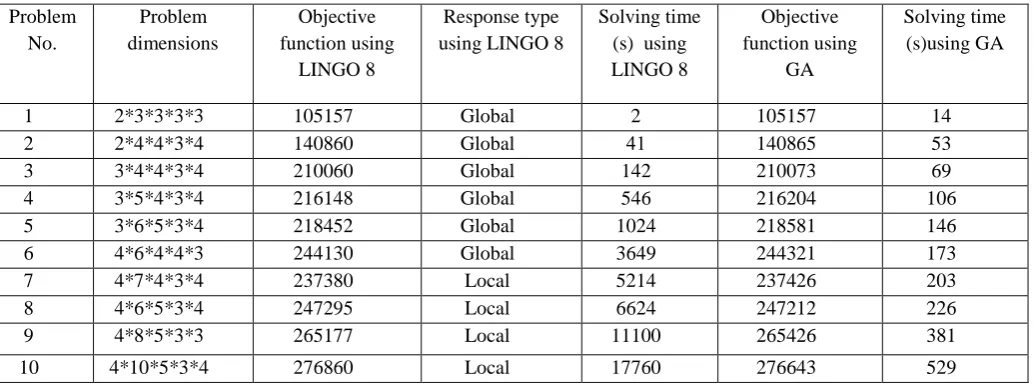
As observed in Table 1, ten problems of different sizes (six small to medium and four large problems) have been solved using LINGO 8 software and the genetic algorithm developed. The results obtained using both methods have been compared from the solving time and response quality aspects. According to figures 1 and 2 and Table 1, the following observations can be made: The genetic algorithm used in this work is comparable to LINGO 8 software from the response quality aspect. The results indicate that LINGO 8 software is not very effective for large size problems.
In addition, the solving time using the genetic algorithm used in this research is longer only in the cases of the first two problems compared with LINGO 8 software, but is shorter in other cases. Therefore, the genetic algorithm used in this research is capable of solving different size problems within a reasonable period of time. As observed in Table 1, ten problems of different sizes (six small to medium and four large problems) have been solved using LINGO 8 software and the genetic algorithm developed. The results obtained using both methods have been compared from the solving time and response quality aspects. According to figures 1 and 2 and Table 1, the following observations can be made: The genetic algorithm used in this work is comparable to LINGO 8 software from the response quality aspect. The results indicate that LINGO 8 software is not very effective for large size problems. In addition, the solving time using the genetic algorithm used in this research is longer only in the cases of the first two problems compared with LINGO 8 software, but is shorter in other cases. Therefore, the genetic algorithm used in this research is capable of solving different size problems within a reasonable period of time.
TABLE 1-COMPARISON OF THE RESULTS OF SOLVING PROBLEMS OF DIFFERENT SIZES USING GLINGO8AND GAMETHOD
0 50000 100000 150000 200000 250000 300000
1 2 3 4 5 6 7 8 9 10
O
bje
ct
iv
e
funct
ion usi
ng
bot
h m
e
thods
Problem No.
زا فده عبات رادقم لح
LINGO8
زا فده عبات رادقم کیتنژ متیروگلا لح
0 2000 4000 6000 8000 10000 12000 14000 16000 18000 20000
1 2 3 4 5 6 7 8 9 10
So
lv
in
g
ti
me
s usi
n
g b
o
th
me
th
o
d
s
Problem No.
بسح رب لح نامز زا هدافتسا اب هیناث
LINGO 8
بسح رب لح نامز زا هدافتسا اب هیناث کیتنژ متیروگلا
Problem No.
Problem dimensions
Objective function using
LINGO 8
Response type using LINGO 8
Solving time (s) using LINGO 8
Objective function using
GA
Solving time (s)using GA
1 2*3*3*3*3 105157 Global 2 105157 14
2 2*4*4*3*4 140860 Global 14 140865 53
3 3*4*4*3*4 210060 Global 142 210073 69
4 3*5*4*3*4 216148 Global 546 216204 106
5 3*6*5*3*4 218452 Global 1024 218581 146
6 4*6*4*4*3 244130 Global 3649 244321 173
7 4*7*4*3*4 237380 Local 5214 237426 203
8 4*6*5*3*4 247295 Local 6624 247212 226
9 4*8*5*3*3 265177 Local 11100 265426 381
10 4*10*5*3*4 276860 Local 17760 276643 529
Solving time (s)
using LINGO 8
Solving time
(s) using GA
Solving time (s)
using LINGO 8
Solving time
516
Vihaan Patel
1, ETJ Volume 04 Issue 01 January 2019
VIII. CONCLUSION
A single objective planning model has been proposed in this work for the integrated problem of cell manufacture and formation in a dynamic cellular manufacturing system. The proposed model included the costs of buying machinery, machine operation, intercellular material transfer, cell reconfiguration, activation of cells, maintenance of an inventory of assurance, maintenance of an end of the period inventory and part production as well as the unpredicted, variable costs of activation of cells and purchase of machinery. In addition, two types of capital constraints including those for the initial activation of cells and purchase of equipment and machinery as well as one constraint associated with the balance of the production amount to prevent shortages have been considered in the model. The fixed and unpredicted variable capital constraints for activation of cells and purchase of equipment and machinery have been both considered in the proposed model. Effective genetic algorithm was then used to solve the proposed model. To study and validate the efficiency of the genetic algorithm used, the results obtained were compared to those of LINGO 8 software from the response quality and solving time perspectives.
REFERENCES
1. mungwattana, A. , 2000. Design of Cellular Manufacturing Systems for Dynamic and Uncertain Production Requirements with Presence of Routing Flexibility, thesis for the degree of Doctor of Polytechnic, Industrial and Systems Engineering, Virginia Polytechnic Institute, pp. 20-30 and 63-75. 2. Chen, M., Cao, D., 2004. Coordinating production
planning in cellular manufacturing environment using Tabu search, Computers & Industrial Engineering, Vol. 46 , No. 3, pp. 571-588
3. Rheault, M., Drolet, J.R., and Abdulnour, G., 1996."Dynamic Cellular Manufacturing Systems (DCMS)", Computers Industrial Engineering, Vol. 31, No. ½, pp. 143-146.
4. Farrokh, M., Dizaji, M.S. and Joghataie, A., 2015. Modeling hysteretic deteriorating behavior using generalized Prandtl neural network. Journal of Engineering Mechanics, 141(8), p.04015024.
5. Defersha, F., Chen, M. A., 2006. comprehensive mathematical model for the design of cellular manufacturing systems", International Journal of Production Economics, Vol. 103, No. 2, pp. 767-783. 6. Defersha, F., Chen, M., 2008. A parallel genetic
algorithm for dynamic cell formation in cellular manufacturing systems, International Journal of Production Research, Vol. 46, No. 22, pp. 6389-6413. 7. Kioon, S.A., Bulgak, A.A. and Bektas, T.,2009.
integrated cellular manufacturing systems design with
production planning and dynamic system
reconfiguration, European Journal of Operational Research, Vol. 192, No. 2, pp. 414-428,.
8. Deljoo,V., Mirzapour Al-e-hashem, S.M.J., Deljoo, F., Aryanezhad, M.B.2010. Using genetic algorithm to solve dynamic cell formation problem, Aplied Mathematical Modelling,vol.34,1078-1092.
9. Jafarzadeh, H., Moradinasab, N. and Gerami, A., 2017. Solving no-wait two-stage flexible flow shop scheduling problem with unrelated parallel machines and rework time by the adjusted discrete Multi Objective Invasive Weed Optimization and fuzzy dominance approach. Journal of Industrial Engineering and Management, 10(5), pp.887-918.
10. Rafiee, K., Rabbani, M., Rafiei, H,. Rahimi-Vahed , A., 2011. A new approach towards integrated cell formation and inventory lot sizing in an unreliable cellular manufacturing system", Aplied Mathematical Modelling,vol.35,1810-1819.
11. Rafiei, H, Ghodsi, R., 2012. A bi-objective mathematical model toward dynamic cell formation considering labor utilization", Appl. Math. Modelling, APM 8939.