IJPAR |Vol.5 | Issue 3 | July - Sep -2016 Journal Home page: www.ijpar.com
Research article Open Access
Development and validation for the simultaneous quantification of
Montelukast and Levocetirizine by UV, RP-HPLC and HPTLC methods in
tablets
N.Ramesh Kumar*
1, V. Vaidhyalingam
21
Department of Pharmaceutical Chemistry, C.L.Baid Mehta College of Pharmacy, Chennai- 600097
2
Director, KK College of Pharmacy, Chennai- 602101 *Corresponding author: N. Ramesh Kumar
Email: [email protected]
ABSTRACT
The present study was aim to develop and validate a UV, HPLC and HPTLC methods for simultaneous estimation of montelukast and levocetirizine in tablet dosage form. Linearity was observed for levocetirizine and montelukast in all the methods. Percent recoveries obtained for both the drugs were 99-100%. The percentage RSD for precision and accuracy of the method was found to be less than 2% as per the ICH these methods. The percentage purity thus found is 99.02% and 100.04% for montelukast and levocitirizine. A simple, selective, linear, precise, and accurate UV, HPTLC and RP-HPLC method was developed and validated for the simultaneous estimation of montelukast and levocetrizine in its bulk and liquid dosage form. The method was validated according to the ICH guidelines with respect to specificity, linearity, accuracy, precision, robustness and ruggedness. The methods were developed successfully it is applied for the analysis of simultaneous estimation of montelukast and levocetirizine in tablet dosage form.
Keywords:Montelukast, Levocetirizine, HPTLC, RP-HPLC
INTRODUCTION
Levocetirizine (LCZ), is a third-generation non-sedative antihistamine used for the treatment of allergic rhinitis and chronic idiopathic urticaria, chemically described as 2-[2-[4-[(R)- (4-chlorophenyl) - phenyl-methyl] piperazin-1-yl] ethoxy] acetic acid. It is an active Renantiomer of cetirizine, orally active, potent, selective and long acting H1- histaminereceptorantagonist with no
anticholinergic activity [1]. Montelukast (MLK) is a selective and orally active leukotriene receptor antagonist that inhibits the cysteinyl leukotriene receptor in the lungs and bronchial tubes. It is used for the treatment of asthma and to relieve symptoms of seasonal allergies. MLK described chemically as 2-[1-[[(1R)- 1- [3- [2- (7-chloroquinolin-2-yl) ethenyl]phenyl]-3-
[hydroxypropan-2yl) phenyl] propyl]
sulfanylmethyl] cyclopropyl]acetic acid [2]. The
molecular chemical structure of Levocetirizine and Montelukast were shown in Figure 1. Pharmacotherapeutic application of combination therapy is used in the management of chronic asthma and allergic rhinitis [3].
Several analytical methods were reported for the determination of LCZ either alone or in combination with other drugs including UV spectrophotometric and HPLC where as montelukast was determined alone or in combined
dosage form by UV spectrophotometric, capillary electrophoresis, Voltammetric and HPLC methods [4,5,6]. Literature survey for simultaneous determination of LCZ and MLK in their binary mixture was revealed UV spectrophotometric HPLC and HPTLC methods [7,8,9]. The present work describes newly developed and validated UV spectrophotometric, RP-HPLC and HPTLC methods for simultaneous estimation of LCZ and MLK in pharmaceutical tablet dosage form.
Figure 1: Chemical structure of Montelukast and Levocetirizine
MATERIALS AND METHODS
Materials
Working standards of pharmaceutical grade Levocetirizine dihydrochloride (99.78 %, w/w) and Montelukast sodium (99.30 %, w/w) were obtained as gift samples from Unichem Laboratories Ltd. India and Lupin Ltd. India respectively. Fixed dose combination Tablets (Montair-LC) containing 5 mg of levocetirizine dihydrochloride and 10 mg of Montelukast sodium sodium were purchased. All chemicals and reagents of analytical grade were purchased from Merck Chemicals, Mumbai, India. High purity deionized water was obtained from Millipore, Milli-Q (Bedford, MA, USA) water purification system.
METHODS
UV spectroscopy analysis
Preparation of standard stock solution
Weighed 100mg each of Montelukast sodium RS and Levocetirizine hydrochloride RS was transferred to 100ml volumetric flask and dissolved separately in 95% methanol and diluted to the mark with the same solvent.For simultaneous estimation of Montelukast sodium (MON) and Levocetirizine hydrochloride (LC), 10 µg/ml solution of MON and 5 µg/ml solution of LC were prepared by diluting
appropriate volumes of the standard stock solutions. The scanning of the solution MON and LC were carried out in the range 200 – 400 nm for obtaining the overlain spectra. Absorbances and Absorptivities of standard solutions were recorded at selected wavelengths λ1 (267nm) and λ2 (225nm).
Preparation and analysis of tablet
Twenty tablets were weighed and triturated to fine powder. The powder equivalent to 10mg of MON and 5mg of LC was transferred to 100ml volumetric flask and the content was dissolved in 95% methanol and was sonicated for 10 minutes finally the volume was made up to the mark with 95% methanol. The solution was filtered through a 0.45µ membrane filter. The final concentration was made to 10 µg/ml of MON and 5 µg/ml of LC with 95% methanol. Absorbances of this solution were measured at 267 nm (λmax of MON) and 225 nm (λmax of LC).
RP-HPLC ANALYSIS
Preparation of standard solution
Weighed about 50mg of Montelukast sodium RS and 25mg of Levocetirizine hydrochloride RS working standard in a 50ml volumetric flask, dissolved the content and the volume make up with mobile phase. Pipetted out 1ml of the above solution in a 100ml volumetric flask and the
volume make up with diluent and filtered through a 0.45 μ membrane filter and degassed. (Stock solution contains 10 μg/ml and 5 μg/ml respectively).
Preparation of sample solution
Twenty tablets were weighed and triturated to a fine powder. A quantity of powder equivalent to 50mg of Montelukast Sodium and 25mg of Levocetirizine hydrochloride was weighed and transferred to a 50ml volumetric flask. The powder was dissolved by sonication with sufficient amount of mobile phase and then made up to the mark with mobile phase. The solution was filtered through a 0.45 μ membrane filter. Pipetted out 1ml of the above solution and transferred in 100 ml volumetric flask and volume make up with diluent so as give a concentration of 10 μg/ml of Montelukast sodium and 5 μg/ml of Levocetirizine hydrochloride.
20μl of standard and sample solutions were injected under the optimized chromatographic conditions and the scans were recorded. Each solution was injected six times at an interval of 10 minutes, to ensure complete elution earlier injection. The amount of Montelukast sodium and Levocetirizine hydrochloride present in each tablet formulation was calculated by comparing the peak area of standard. Chromatogram was recorded under the following conditions after injecting the mixture of Montelukast and Levocetirizine.
Conditions
Mobile phase : Buffer: Methanol (35: 65, v/v)
Column : Inertsil ODS (250 x 4.6 mm, 5µ) Column
Diluent : Mobile phase
UV Detection : 234 nm
Injection volume : 20μl
Flow rate : 1.5 ml/min
Temperature : Ambient
Run time : 10 minutes
HPTLC analysis
The chromatography estimation was performed using the following conditions: stationary phase was precoated silica gel 60 F254 aluminum sheets (10 x 10 cm, E. Merck) and the mobile phase used was chloroform: methanol: toluene: glacial acetic acid (10:5:3:0.5 v/v/v/v). Chromatogram was developed in a camag twin trough chamber using a
linear ascending technique. The chamber saturation time for mobile phase was optimized to 25 min. The length of chromatogram run was approximately 60 mm. Subsequent to the development; the TLC plates were dried in a current of air. The densitometric analysis was performed on a Camag TLC scanner III in the absorbance at 302 nm with slit dimensions of 5.0 x 0.45 mm and scanning speed of 15mm/s were employed. Spotting parameters used were, 5 mm bandwidth, 15 mm space between two bands and spraying rate 20 s/µl.
Calibration-curve
Stock solutions of Montelukast sodium (10 mg/ml) and Levocetirizine (10 mg/ml) were prepared in glacial acetic acid. A series of standard curves were prepared over a concentration range of 200-3,200 ng for Montelukast sodium. For Levocetirizine the stock solution was spotted to give concentrations in the range of 400-1,300 ng. The data of spot area versus drug concentration was treated by linear least square regression analysis. Calibration curve was established by plotting peak area on ordinate and corresponding concentration on abscissa.
Validation of UV, HPTLC and HPLC method
The optimized UV, HPTLC & HPLC method was validated with respect to the following Parameters. The validation was performed as per the ICH guidelines.
Linearity
responses were approximately three (For LOD) or ten times (for LOQ) the responses of the blank.
Precision
The precision of the method was analyzed by repeatability and intermediate precision studies. Repeatability studies were performed by analysis of three different concentrations of 500, 1500, 2500 ng spot-1 and 1000, 3000, 5000 ng spot-1 for levocetirizine dihydrochloride and Montelukast sodium, respectively by HPTLC and 1, 4, 10 µg mL-1 and 2, 8, 20 µg mL-1 for levocetirizine dihydrochloride and Montelukast sodium, respectively by HPLC. Method repeatability was achieved from RSD% values obtained by repeating the assay six times on the same day for intra-day precision. The intermediate (interday) precision of the method was checked by performing same procedure on different days under the same experimental conditions.
Robustness
The robustness was studied by evaluating the effect of small but deliberate variations in the chromatographic conditions. For HPTLC method, following the introduction of small changes in the mobile phase composition (±0.1 mL for ammonia), the effect on the results was examined. Mobile phases having different proportions of components, e.g. toluene: ethyl acetate: methanol: ammonia (2.6: 7: 2.5: 1, v/v/v/v), (2.4: 7: 2.5: 1, v/v/v/v), (2.5: 7: 2.6: 1, v/v/v/v), (2.5: 7: 2.4: 1, v/v/v/v) etc., were tried and chromatograms were run. The amount of mobile phase was varied over the range of ±5%. The time from spotting to chromatography and from chromatography to scanning was varied by 10 min and analysed. The robustness of the method was determined at three different concentration levels of 500, 1500, 2500 ng spot-1for levocetirizine dihydrochloride and 1000, 3000, 5000 ng spot-1 for montelukast sodium. For HPLC, robustness of the method was studied by deliberately varying parameters like flow rate (±0.1 mL min-1) and mobile phase composition (±1 mL).
Specificity
The ability of an analytical method to unequivocally assess the analyte in the presence of other components (impurities, degradents and excipients) can be demonstrated by evaluating specificity. The specificity of the HPTLC method
was determined by analyzing standard drug and test samples. The spot for levocetirizine dihydrochloride and montelukast sodium in the samples was confirmed by comparing the RF and spectrum of the spot to that of a standard. The peak purity of levocetirizine dihydrochloride and montelukast sodium was determined by comparing the spectrum at three different regions of the spot i.e. peak start (S), peak apex (M) and peak end (E). For HPLC, The specificity of the method was determined by injecting excipient solution having the same concentration as that of the tablet solution.
Accuracy
Accuracy of the two proposed methods was carried out by applying the methods to drug sample (Levocetirizine dihydrochloride and Montelukast sodium combination tablets) to which known amount of levocetirizine dihydrochloride and
montelukast sodium standard powder
corresponding to 50, 100 and 150% of label claim had been added (standard addition method). The absolute recovery was calculated by comparing the peak areas obtained from standard solution of levocetirizine dihydrochloride and montelukast sodium with the peak areas of samples of different concentration.
Assay of tablets
Twenty tablets were weighed and triturated to fine powder. The powder equivalent to 10mg of MON and 5mg of LC was transferred to 100ml volumetric flask and the content was dissolved in 95% methanol and was sonicated for 10 minutes finally the volume was made up to the mark with 95% methanol. The solution was filtered through a 0.45µ membrane filter. The final concentration was made to 10 µg/ml of MON and 5 µg/ml of LC with 95% methanol. Absorbances of this solution were measured at 267 nm (λmax of MON) and 225 nm (λmax of LC) and the values were substituted in respective simultaneous equation to obtain concentrations.
RESULTS AND DISCUSSION
Optimization of UV, RP-HPLC and HPTLC
2.5-12.5 µg/ml respectively. Absorptivity values for Montelukast sodium and Levocetirizine hydrochloride were calculated. A summary of the data showing the slopes, y-intercepts values are furnished in Table 1 and 2. To optimize the HPLC assay conditions, different ratios of Sodium dihydrogen phosphate buffer and methanol at different pH were tried. The ideal mobile phase was used Buffer: Methanol in the ratio of 30:70 v/v by isocratic elution to obtain satisfactory, good resolution and sensitivity. The detection was carried out by using UV-Visible detector at 234 nm. The separation was carried out at ambient temperature with a flow rate of 1.0 ml/min. The retention times for levocetirizine dihydrochloride and montelukast sodium were found to be 2.05 and 5.22 min, respectively (Figure 2). Acceptable retention time (tR), theoretical plates, asymmetry and good resolution for levocetirizine
dihydrochloride and montelukast sodium were obtained. A summary of the linearity data showing the slopes, y-intercepts values are furnished in
Table 3. The correlation coefficients for standard preparation of Montelukast sodium and Levocetirizine hydrochloride are 0.999847 and 0.999824. The relationship between the concentration and response (peak area) of Montelukast sodium and Levocetirizine hydrochloride is linear in the range examined as all the points fall in a straight line and the correlation coefficients are within the specified limit. The Limit of Detection (LOD) were found to be 1.85 µg/ml for the Montelukast sodium and 1.63 µg/ml Levocetirizine hydrochloride while Limit of Quantitation (LOQ) were found to be 3.42 µg/ml for Montelukast sodium and 4.14 µg/ml Levocetirizine hydrochloride.
Figure 2: Retention times for levocetirizine dihydrochloride and montelukast sodium
HPTLC analysis of montleukast and levocetrizine was shown in Figure 3 and 4. The proposed HPTLC method shows that the chromatographic layer gives the best separation of the two component in the mobile phase consisting of n-Hexane: Chloroform: Methanol: Acetic Acid (3.5:5.0:1.2:0.3); other system like Toluene: Ethyl Acetate: Acetic Acid (4.5:5.0:0.5); where the components move along with solvent front; chloroform: Methanol: Formic acid: Acetic Acid (9:0.5:0.25:0.25) where the component (Levocetirizine) not moved. Finally n-Hexane:
Chloroform: Methanol: Acetic Acid
(3.5:5.0:1.2:0.3) gave the complete separation with Rf values of Montelukast and Levocetirizine were
different than zero, the P- value was determined for each line. If P-value was >0.05 then the intercept
was considered statistically equal to zero.
Figure 3: 3 Dimensional spectra of Montelukast and Levocetirizine (HPTLC)
Figure 4: Densitogram of Montelukast and Levocetirizine (HPTLC)
Table 1: Linearity of Montelukast and Levocetirizine (UV)
Montelukast sodium Levocetirizine hydrochloride S. No Concentration
in µg/ml
Absorbance at 267nm Concentration in µg/ml
Absorbance at 225nm
1 5 0.10972 2.5 0.17823
2 10 0.21129 5 0.33674
3 15 0.30971 7.5 0.47628
5 25 0.49908 12.5 0.80708
Table 2: Analytical performance of Montelukast and Levocetirizine (UV Spectrophotometry)
Parameters Montelukast sodium Levocetirizine Hydrochloride
Absorption maximum ( max) 267 225
Beer’s lamberts limit (µg/ml) 5-25 2.5-12.5
Molar absorptivity 0.0133 x 10⁵ 0.0329 x 10⁵
Coefficient correlation (r2) 0.9991 0.9994
Regression equation y = 0.0196x + 0.0144 y = 0.063x + 0.018
Slope 0.0196 0.063
Intercept 0.0144 0.018
Limit of detection (µg/ml) 0.2 0.6
Limit of Quantification (µg/ml) 0.6 1.8
Standard error 0.0002 0.0001
Table 3: Linearity of Montelukast and Levocetirizine (RP-HPLC)
S. No Montelukast sodium Levocetirizine hydrochloride Conc. (μg/ml) Peak area Conc. (μg/ml) Peak area
01 4 334905 2 297899
02 8 380802 4 333456
03 12 423994 6 371796
04 16 467911 8 408126
05 20 515854 10 448101
Table 4: Linearity of Montelukast and Levocetirizine data (HPTLC)
S. No Montelukast sodium Levocetirizine hydrochloride
Conc.(µg/ml) Peak area Rf Conc.(µg/ml) Peak area Rf
1 5.0 827.54 0.30 2.5 2316.48 0.65
2 7.5 1625.76 0.29 3.75 4609.07 0.65
3 10.0 2517.85 0.29 5.0 6711.27 0.63
4 12.5 3271.99 0.29 6.25 8948.22 0.65
5 15.0 4061.03 0.29 7.5 11041.52 0.66
Table 5: Analytical performance parameter (HPTLC)
Parameter Montelukast sodium Levocetirizine hydrochloride
Slope 324.5 ± 4.862 1743 ± 14.89
y-intercept -784.5 ± 51.57 -1990 ± 78.97
Correlation coefficient 0.9993 0.9998
p-value of intercept 0.24 0.24
Percentage of intercept at Quantification level
+3.89 +1.12
Limit of detection(ng/spot) 100 110
Precision
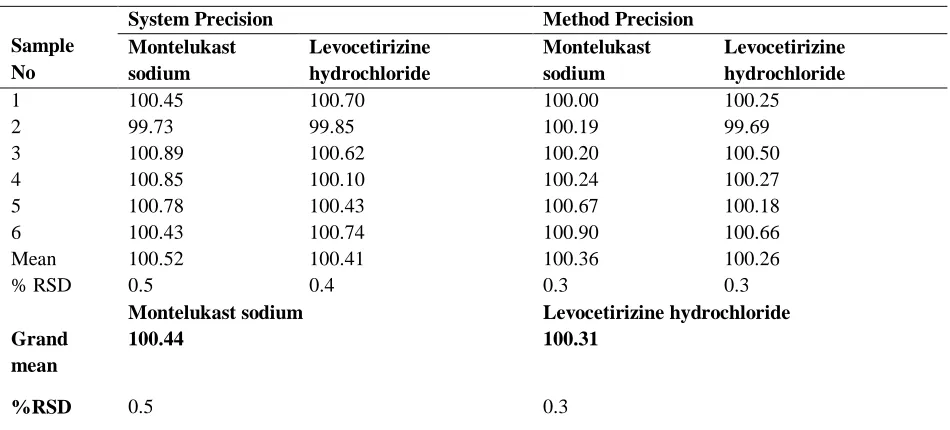
The precision for the Montelukast sodium and Levocetirizine hydrochloride were evaluated by using homogeneous sample in six times determination for both system precision and method precision (100% target). The results of the
repeatability and intermediate precision experiments are shown in Table 6 and 7. The developed methods were found to be precise as the RSD values for repeatability and intermediate precision studies were <2%, respectively as recommended by ICH guidelines.
Table 6: Statistical data for precision (RP-HPLC)
Sample No
System Precision Method Precision Montelukast
sodium
Levocetirizine hydrochloride
Montelukast sodium
Levocetirizine hydrochloride
1 100.45 100.70 100.00 100.25
2 99.73 99.85 100.19 99.69
3 100.89 100.62 100.20 100.50
4 100.85 100.10 100.24 100.27
5 100.78 100.43 100.67 100.18
6 100.43 100.74 100.90 100.66
Mean 100.52 100.41 100.36 100.26
% RSD 0.5 0.4 0.3 0.3
Montelukast sodium Levocetirizine hydrochloride Grand
mean
100.44 100.31
%RSD 0.5 0.3
Table 7: Precision Data (HPTLC)
Montelukast sodium Levocetirizine hydrochloride
99.89 100.10
100.12 99.57
99.94 100.34
99.84 99.57
100.60 99.96
99.73 99.49
Mean 100.02 99.83
% RSD 0.28 0.31
Robustness
For HPLC, robustness of the method was studied by deliberately varying parameters like flow rate (±0.1 mL min-1) and mobile phase composition (±1 mL).The low values of the RSD
%, indicated the robustness of the two proposed methods (Table 8). The standard deviation of the peak areas was calculated for each parameter and the RSD was found to be less than 2 % for HPTLC.
Table 8: Robustness data (RP-HPLC)
Parameter Condition Assay (% Labeled amount)
Montelukast sodium % RSD Levocetirizine hydrochloride % RSD
-10% 99.91 0.3 100.62 0.4
+10% 100.24 0.1 99.52 0.3
Mobile phase -2% 99.71 0.9 99.48 0.1
+2% 100.58 0.2 100.51 0.3
Wavelength -2 nm 100.39 0.3 100.26 0.4
+2 nm 100.84 0.0 99.80 0.2
Specificity
The specificity of both methods was noticed by the complete separation of levocetirizine dihydrochloride and montelukast sodium peaks in the presence of tablet excipients. The peak purity of levocetirizine dihydrochloride and Montelukast sodium was assessed by comparing their respective spectra at the peak start, apex and peak end positions of the spot i.e., r = 0.9979. A good correlation (r2 = 0.9981) was also obtained between the standard and sample spectra of levocetirizine dihydrochloride and Montelukast sodium, respectively. For UV, HPLC and HPTLC no interference was observed due to any unknown excipients of tablet dosage forms at the retention times of levocetirizine dihydrochloride and montelukast sodium. The peaks obtained were sharp and had clear baseline separation for all the methods.
Accuracy
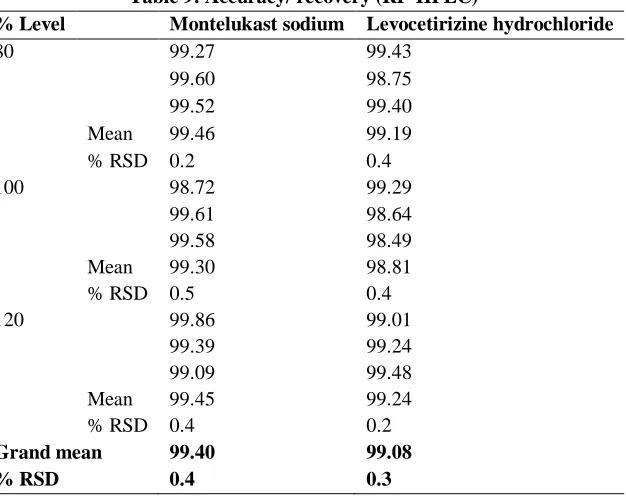
The Accuracy/Recovery for the Montelukast sodium and Levocetirizine hydrochloride were
determined by fortifying sample and standard drug substances at concentration from (80 to 120% of target level and results were shown in Table 9. Overall recovery of Montelukast sodium ranging from 98.72% - 99.86% and grand mean of 99.40% whereas Levocetirizine hydrochloride ranging from 98.49% – 99.48% grand mean of 99.08%.The % RSD for all recovery values (3 concentrations) are within the range of 2.0%. The percentage relative standard deviation for Montelukast sodium and Levocetirizine hydrochloride was found to be 0.6 and 0.3. Hence, the method is accurate in the range of 80% to 120% of test concentration. As shown from the data, satisfactory recoveries % with small relative standard deviations (RSD%) were obtained at various added concentrations for both the methods. The results indicate that the methods are highly accurate for simultaneous determination of the two drugs.
Table 9: Accuracy/ recovery (RP-HPLC)
% Level Montelukast sodium Levocetirizine hydrochloride
80 99.27 99.43
99.60 98.75
99.52 99.40
Mean 99.46 99.19
% RSD 0.2 0.4
100 98.72 99.29
99.61 98.64
99.58 98.49
Mean 99.30 98.81
% RSD 0.5 0.4
120 99.86 99.01
99.39 99.24
99.09 99.48
Mean 99.45 99.24
% RSD 0.4 0.2
Grand mean 99.40 99.08
Analysis of a marketed formulation (Assay)
Using the proposed UV, HPLC and HPTLC methods, assays of levocetirizine dihydrochloride and montelukast sodium in their tablets were carried out. Satisfactory results were obtained for both drugs in a good agreement with the label claims thereby suggesting suitability of the methods.
CONCLUSION
The proposed UV, HPTLC and RP-HPLC methods provide simple, accurate and reproducible methods of quantitative analysis for simultaneous determination of levocetirizine dihydrochloride and
montelukast sodium in bulk and in pharmaceutical formulation. Both methods were validated as per ICH guidelines. The methods are specific and there is no interference from any of the sample components. The statistical analysis proves that the method is reproducible and selective for the simultaneous estimation of Montelukast sodium and Levocetirizine in pharmaceutical formulations. The proposed method has advantage of simplicity and convenience for the separation and quantitation of Montelukast sodium and Levocetirizine in the combination and can be used for the assay of their dosage form.
REFERENCES
[1]. Day JH, Ellis AK, Rafeiro E Levocetirizine: A new selective H1 receptor antagonist for use in allergic disorders. Drugs Today 40, 2004, 415-421.
[2]. Ciebiada M, Górska-Ciebiada M, DuBuske LM, Górski P Montelukast with desloratadine or levocetirizine for the treatment of persistent allergic rhinitis. Ann Allergy Asthma Immunol 97, 2006, 664-671.
[3]. Gupta V, Matreja PS. Efficacy of Montelukast and Levocetirizine as Treatment for Allergic Rhinitis. J Aller Ther 2010, 1, 103.
[4]. Ashokkumar S, Senthil Raja M, Perumal P RP-HPLC Method Development and Validation for Simultaneous Estimation of Montelukast Sodium and levocetirizine Dihydrochloride. International journal of pharmaceutical research 1, 2009, 8-12.
[5]. Smita Sharmaa MC, Sharma DV, Kohlib AD, Sharma C Development and validation of tlc-densitometry method for simultaneous quantifi cation of montelukast sodium and levocetirizine dihydrochloride pharmaceutical solid dosage form. Der Pharmacia Lettre 2, 2010, 489-494.
[6]. Ambadas R. R ote & Vaishai S. Niphadea, Journal of Liquid Chromatography & Related Technologies, 34(3), 2011, 155-167.
[7]. Arindam B, Krishnendu B, Mithun C and Inder Singh R. Simultaneous RP-HPLC estimation of levocetirizine hydrochloride and montelukast sodium in tablet dosage form. Int J Pharm Tech Res. 3(1), 2011, 405-410. [8]. Eswarudu MM, Sunil J and Narendrachary T. RP-HPLC method development and validation for simultaneous
estimation of montelukast sodium and levocetirizine dihydrochloride in tablet dosage form. Int J Pharm World Res. 2(4), 2011, 1-18.