310 Iranian Journal of Electrical & Electronic Engineering, Vol. 13, No. 4, December 2017
A Comparison between Different Meta-Heuristic Techniques
in Power Allocation for Physical Layer Security
N. Okati*, M. R. Mosavi*
(C.A.)and H. Behroozi**
Abstract: Node cooperation can protect wireless networks from eavesdropping by using the physical characteristics of wireless channels rather than cryptographic methods. Allocating the proper amount of power to cooperative nodes is a challenging task. In this paper, we use three cooperative nodes, one as relay to increase throughput at the destination and two friendly jammers to degrade eavesdropper’s link. For this scenario, the secrecy rate function is a non-linear non-convex problem. So, in this case, exact optimization methods can only achieve suboptimal solution. In this paper, we applied different meta-heuristic optimization techniques, like Genetic Algorithm (GA), Partial Swarm Optimization (PSO), Bee Algorithm (BA), Tabu Search (TS), Simulated Annealing (SA) and Teaching-Learning-Based Optimization (TLBO). They are compared with each other to obtain solution for power allocation in a wiretap wireless network. Although all these techniques find suboptimal solutions, but they appear superlative to exact optimization methods. Finally, we define a Figure of Merit (FOM) as a rule of thumb to determine the best meta-heuristic algorithm. This FOM considers quality of solution, number of required iterations to converge, and CPU time.
Keywords: Physical Layer Security, Cooperation, Wireless Network, Power Allocation, Secrecy Rate, Meta-Heuristic.
1 Introduction1
HYSICAL layer security can keep wireless network immune to eavesdropper attack by using the physical characteristics of wireless channels rather than cryptographic methods. Physical layer security can be used when there are some deficiencies in using the cryptographic methods. For instance, using the cryptographic methods for real time applications is not suitable since the encryption and decryption of message causes delay and as the key size increases, the delay will increase as well. Moreover, sharing the secret key between source and destination needs a secure channel which may not be available all the time. To sum up, physical layer security is an alternative when the
Iranian Journal of Electrical & Electronic Engineering, 2017. Paper first received 11 August 2016 and accepted 28 October 2017. * The authors are with the Department of Electrical Engineering, Iran University of Science and Technology, Tehran, Iran.
E-mails: [email protected] and [email protected]. ** The author is with the Department of Electrical Engineering, Sharif University of Technology, Tehran, Iran.
E-mail: [email protected]. Corresponding Author: M. R. Mosavi.
channel condition or application is not compatible with cryptographic methods. This technique was first introduced by Wyner in 1975 [1], by presenting a wiretap channel. Wyner proved that even in the presence of eavesdroppers, source and destination can communicate securely at a non-zero rate without applying cryptographic methods. This key parameter in designing and analyzing the wiretap channels, is called secrecy rate.
Relay-based communication is a promising technique for expanding the coverage region and increasing the transmission rate. The most commonly used relay strategies are Decode-and-Forward (DF), Amplify-and-Forward (AF), Compress-and-Amplify-and-Forward (CF) and Randomize-and-Forward (RaF) [2]. Relay selection for wireless networks has been widely studied [3-5]. In [3], a multi-criteria decision making optimization has been proposed for relay selection. Superior relay is selected using an information theoretic measure, i.e., divergence. In [4], joint relay and antenna selection is performed in cases of perfect and partial Channel State Information (CSI). A semi-distributed relay selection is proposed in [5]. In this method, first each node decides on its
P
Iranian Journal of Electrical & Electronic Engineering, Vol. 13, No. 4, December 2017 311
feasibility individually and then the final selection will be made in a centralized manner among all feasible relays. Due to the fact that there is no need for global CSI, the computational complexity has been reduced [5]. In this paper, we use AF strategy in which each relay amplifies the received signal in the first time slot of transmission and transmits it to the destination without performing any signal reconstruction.
Due to transmitting the signal in two phases in relay networks, it becomes more vulnerable to eavesdropping. To overcome this weakness, jammer-based approaches have been proposed in the literature [6-9]. In these works, one or two intermediate nodes cooperate as jammer and send intentional noise signal to the eavesdropper in order to degrade its link during the two phases. This method may also degrade the signal which is received at relay or destination. In [6], determination of relay weights and power allocation are considered in three cooperative schemes, i.e., DF, AF and cooperative jamming in presence of one or multiple eavesdropper. In [7, 8], a hybrid scheme which switches between jamming and non-jamming approaches is discussed. Also in [9], cooperative jammers are used to enhance physical layer security. Convex optimization and a one dimensional search are applied for optimizing secrecy rate [9]. In [6-9] and many other papers in the literature, after obtaining the constraints to optimize the achievable secrecy rate, exhaustive search is applied to satisfy these constraints.
Some previous which have applied heuristic methods for power allocation are as follows. In [10], joint resource allocation and relay selection is considered in a multi-user DF cooperative system using GA. The objective is to maximize capacity. In [11], source and relay allocation is performed in order to minimize symbol error rate using PSO. In [12, 13], PSO is used for resource allocation in cognitive radio networks. In [14], a genetic simulated annealing algorithm is applied for resource allocation.
Since the optimization problem for the defined scenario is a non-convex problem, exact optimization methods appear very complicated. So, we applied meta-heuristic optimization methods for allocating transmitted power to cooperative nodes. Also the complexity of exact methods increases as the number of cooperative nodes increases. So, in this case, meta-heuristic techniques which can find the solution iteratively appear more powerful. Another motivation to apply meta-heuristic techniques is that they do not require any knowledge of the characteristics of the target function.
Our main objectives in this paper are power allocation for maximizing secrecy rate in the wireless network, while reducing the computational complexity and CPU time. Considering the achievable secrecy rate as the cost function, we apply different meta-heuristic optimization techniques for power allocation.
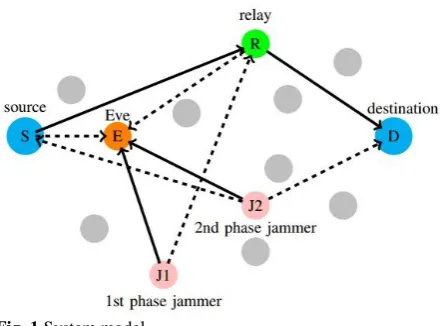
Fig. 1 System model.
The meta-heuristic methods are compared with suboptimal solution obtained by Lagrange multipliers optimization technique. Simulation results show that the heuristic methods outperform the Lagrange multipliers in terms of solution quality and CPU time. In some previous works such as [15, 16], which have utilized convex optimization, the presence of malicious nodes is not taken into consideration. So, the proposed method will outperform the previous works in terms of simplicity, efficiency and security. Finally, in order to evaluate all heuristic methods, we define a Figure of Merit (FOM) in which all properties of a heuristic method such as solution quality, number of required iterations to converge with a specific stopping criteria, and CPU time are considered. This FOM can be used as a rule of thumb to decide on which algorithm to be used for secrecy rate optimization in a wireless network. The organization of this paper is as follows. Section 2 describes the system model and problem formulation. In section 3, we investigate the problem of power allocation using exact and some meta-heuristic optimization techniques. Numerical result are provided in section 4. Finally, we conclude the paper in section 5.
2 System Model and Problem Formulation
Fig. 1 illustrates the system model and nodes establishment. It consists of one source (S), one destination (D) and N{1, 2,..., }K randomly distributed intermediate nodes. An eavesdropper (E) is assumed to be in the line of sight of the source and destination. All N potential nodes can cooperate as relay (R) or jammer (J1, J2). Solid lines and dashed lines
represent permissible and undesired signal flows, respectively, during the two phases of transmission. Our communication scenario is performed in two phases. During the first phase source broadcasts the data to all intermediate nodes. Moreover, in this phase, the cooperative node which is selected as a jammer, denoted by J1, sends intentional noise signal to degrade
eavesdropper’s link. This may also degrade the links of the legitimate nodes. In the second phase, the relay
312 Iranian Journal of Electrical & Electronic Engineering, Vol. 13, No. 4, December 2017
which has been selected, forwards the received message to the destination using AF strategy. Simultaneously, the preselected jammer for this phase, denoted by J2
sends its interference in order to confuse eavesdropper. Note that the legitimate nodes, i.e., source, destination and relay cannot distinct the message signals from the artificial jamming signals.
All channels are considered as slow, flat multi-path fading in both phases of transmission. hi,j represents the
channel gain between node i and node j. hi,j is assumed
to be complex Gaussian random variable, so there is a Rayleigh and uniform distribution for the amplitude and phase of hi,j, respectively. Moreover, we assume a
zero-mean and unit variance Additive White Gaussian Noise (AWGN) for all nodes. PS,PR,
1 J
P and 2 J
P denote the source power, relay power, jammer power in the first phase and jammer power in the second phase, respectively. Furthermore, all nodes are equipped with a single omni-directional antenna and operate in a half-duplex manner, so they cannot transmit and receive simultaneously [6].
As a common assumption in most of physical layer based security literature, the availability of full CSI for all nodes is assumed. Similarly, as in [6] the eavesdropper channel is known. Also, the cooperative protocol, i.e., existence of relay and jammers is not confidential [6].
The received signals at the relay and eavesdropper at the end of the first phase are:
(1) 1 1
, , 1
sr S S R J J R R
Y P h S P h J n
(2)
1 1 1
1 S S E, J J E, 1 E
E P h S P h J n
where S is the transmitted signal from source, J1 is the first jammer signal, nR and
1 E
n are the AWGN noise at R and E, respectively. In the second phase, R which is assumed to use AF strategy, sends:
(3)
rd sr
Y Y
Considering the power constraints,
1 1
2 2
, ,
.
| | | | 1
R
S S R J J R
P
P h P h
Thus, the received
signal at D and E are:
(4) 1 1
2 2
, , , , 1
, , 2
S S R R D J J R R D
R D R J J D d
Y P h h S P h h J
h n P h J n
(5) 1 1
2 2 2
2 , , , , 1
, , 2
S S R R E J J R R E
R E R J J E E
E P h h S P h h J
h n P h J n
where J2 is the second jammer signal, nd and 2 E
n
represent the AWGN noise at D and E, respectively.
Using (4), we can achieve the Signal to Interference-plus-Noise Ratio (SINR) of the channel SD from (6). Note that the channel SD is figurative and a direct path for this channel does not exist.
(6) 1 2 , , , , SNR SINR
SNR SNR SNR 1
S D D
J D J D R D
where SNRi,j denotes the instantaneous signal-to-noise
ratio of link ij:
(7)
2 2 2
, , ,
SNRS D
P hS| S R| |hR D|(8)
1 1 1
2 2 2
, , ,
SNRJ D PJ |hJ R| |hR D|
(9)
2 2 2
2
, ,
SNRJ D PJ |hJ D|
As mentioned in [8], we assume that eavesdropper applies Maximal Ratio Combining (MRC) in order to use the signals which has received during the two phases. Considering this assumption, the SINR of the channel SE, can be calculated as:
(10) 1 1 2 , , , , , , , , SNR SINR SNR 1 SNR ,
SNR SNR SNR 1
S E E
J E
S R E
J R E J E R E
where: (11) 2 , ,
SNRS E P hS| S E|
(12)
1 1 1
2
, ,
SNRJ E PJ |hJ E|
(13)
2 2 2
2
, ,
SNRJ E PJ |hJ E|
(14)
2 2 2
, , , ,
SNRS R E
P hS| S R| |hR E|(15)
1 1 1
2 2 2
, , , ,
SNRJ R E PJ |hJ R| |hR E|
(16)
2 2
, ,
SNRR E
|hR E|Note that if the instantaneous channel knowledge is not available, we can use the expectation of SNRs for eavesdropper links [8]. Thus the achievable secrecy rate equals:
(17)
(1 SINR ) (1 SINR )
2 2 1 1 log log 2 2 D E s R
where
x max{0, }.x So the constrained optimization problem can be formulated as:(18) 1 SINR maximize 1 SINR D E (19) 1
subject to PTPSPJ 0
(20)
2 0
T R J
P P P
(21) PS 0
Iranian Journal of Electrical & Electronic Engineering, Vol. 13, No. 4, December 2017 313
(22) PR 0
(23)
1 0
J
P
(24)
2 0
J
P
3 Power Allocation Optimization Techniques
In this section, we introduce exact and meta-heuristic suboptimal optimization techniques for optimizing constrained problem (11).
3.1 Power Allocation using Exact Method
Optimization
Problem Eq. (11) is a multi-variable non-linear programing with inequality constraints. Without making any assumption for Eq. (11) to be convex, a well-known suboptimal optimization for non-linear programing with inequality constraints is Lagrange multipliers. The Lagrange function corresponding to problem Eq. (11) and its constraints in Eq.s (11)-(17) is:
(25) 1
2
2
1
2
3 4 5 1 6
( , ) ( )
( )
i s T S J
T R J
S R j
L P R P P P
P P P
P P Pj P
where P = [PS PR Pj1 Pj2] and i are Lagrangian multipliers. To obtain suboptimal values for P and also Lagrange multipliers first, we differentiate with respect to all variables. Then, we take all of these differentiations as an equation to solve a system of equations. By solving this system of equations, we can achieve suboptimal values for power of nodes. However, because of dynamic nature of wireless network, these suboptimal closed forms will be expired as the network constellation or number of cooperative nodes changes. So using Lagrange multipliers method increase computational load and impose undesired delays on wireless network due to multiple differentiations and solving systems of equations. For example, in our scenario with three cooperative nodes, we need to solve a systems of ten equations. Each cooperative node adds two equations to this system of equations.
For wireless network design, we should compromise between different parameters such as complexity, speed, power and secrecy rate. Although exact optimization methods guarantee optimum solution, they may impose complexity and computational load to the system. Another advantage of using meta-heuristic techniques is that we do not need to know about target function characteristics which would be a complicated task, especially as the number of cooperative nodes increases. So, iterative optimization techniques would be more appropriate in terms of simplicity and flexibility.
3.2 Meta-Heuristic Optimization Techniques
In this paper, various meta-heuristic optimization techniques like GA, PSO, SA, BA, TS and TLBO are compared in terms of solution quality, convergence and CPU time. However, these methods usually provide suboptimal solution, they are known for their speed when computational complexity is considered. Some of these methods which have been applied in this paper for optimization of problem Eq. (11) are:
3.2.1 Genetic Algorithm (GA)
GA was pioneered by John Holland in 1970. GA produces a large set of solutions called population. All solutions are evaluated by a cost function. Afterward three main operators of GA which are selection, crossover and mutation create new solutions. Selection operator selects the most meritorious chromosomes to produce new offsprings. Crossover uses elite population, which have been picked out in the selection step to produce new solutions. Mutation changes some chromosomes randomly to create new offsprings. Selection and crossover are convergence operations which are intended to pull the population toward a local extremum while mutation is a divergence operation. It is intended to discover a better extremum space. Main parameters of GA are population size, crossover percentage, mutation percentage and mutation rate.
3.2.2 Partial Swarm Optimization (PSO)
PSO was first introduced by J. Kennedy and R. C. Eberhart in 1995 [17]. It is based on colony behavior of insects. In PSO, each individual in a swarm behaves using its own intelligence as well as the group intelligence of the swarm. Firstly, PSO generates random initial population of particles each of which represents a solution for optimization problem. Each particle is represented by three parameters which are position, velocity and fitness value. Particles tune their position and velocity according to their own best position and their global best position. PSO is defined by five key parameters which are population size, inertia weight, inertia weight damping ratio, personal learning coefficient and global learning coefficient.
3.2.3 Bees Algorithm (BA)
BA is a meta-heuristic optimization algorithm, inspired by food foraging behavior of honey bee colonies. It has been proposed by Pham et al., in 2005 [18]. In this algorithm, the mechanism of waggle dance is used to simulate the communication between bees. Better bees (solutions), have more opportunity to do waggle dance and hence they are capable of attract more bees to go to their proposed location and target. This helps the algorithm to investigate the promising areas in the search space, more in detail. There are two main parameters for BA which are number of scout bees and
314 Iranian Journal of Electrical & Electronic Engineering, Vol. 13, No. 4, December 2017
neighborhood radius damp rate.
3.2.4 Tabu Search (TS)
TS is a local search based meta-heuristic, which is proposed by W. Glover, in 1986 [19]. TS is defined by neighborhood and actions converting solutions to its neighboring solutions. TS starts with a single solution and searches for better solutions, using actions and moving between neighbor solutions. However, acceptance applicability and availability of actions, are managed using a set of rules. There are two components in the TS algorithm, the Tabu length and the aspiration criteria. Tabu length consist of tabus which are those solutions which causes sticking in local optima. Aspiration criteria allows a move if the result in the objective value is better than the current solution even if it is in the TL.
3.2.5 Simulated Annealing (SA)
SA proposed by S. Kirkpatrick et al., in 1983 [20], and by V. Cerny in 1985 [21], independently. It is based on the principle of solid annealing. SA starts with initial solution and an initial control parameter (temperature). Through iterations it improves the quality of solutions while gradually reduces the value of control parameter. At the terminating point the current solution is the approximate to the optimal solutions. The main parameters of SA are population size, initial temperature, temperature reduction rate, number of neighbors per individual and mutation rate.
3.2.6 Teaching-Learning-Based Optimization
(TLBO)
TLBO is a meta-heuristic, inspired by process of teaching and learning via a simplified mathematical model of knowledge improvements gained by students in a class. This algorithm is proposed by Rao et al., in 2011 [22]. This works on the effect of influence of a teacher on learners. Like other nature inspired algorithms, TLBO is also a population based method. The population is considered as a group of learners or a class of learners. The process of TLBO is divided into two parts: the first part consists of the teacher phase and the second part consists of the learner's phase. TLBO is defined by two parameters which are population size and teaching factor.
Quality of solution, number of required iteration to converge and CPU time are three key parameters which determine the merit of a heuristic algorithm. In this paper, we define an FOM which takes all these parameters into consideration. It is defined as Eq. (26):
(26)
, 0
k s
R
FOM k
CT It
where Rs is secrecy rate, CT is CPU time and Itis the number of required iterations for the algorithm to
converge. We assign power of k to give more worthiness to secrecy rate in a wireless network. Using Eq. (26), we can decide about the best heuristic method to apply for power allocation optimization.
4 Numerical Results and discussion
In this part different meta-heuristic methods are applied for power allocation of source and cooperative nodes. Also, the results obtained from evolutionary techniques are compared with suboptimal solution obtained by Lagrange multipliers method.
4.1 Numerical Results
To achieve numerical results, we suppose that source and destination are placed at two adjacent edges of a 50×50 (unit: meters) square and there is an eavesdropper in between. All other cooperative nodes are distributed randomly within the square.
Fig. 2 illustrates the described simulation environment. The channel gain, hi,j, assumed to have Rayleigh distribution for flat multi-path fading environment, i.e., |hS D, |dS D, , where dS D, is the distance between source and destination and
is the path loss exponent for free space. The AWGN noise is assumed to have zero-mean and unit power (
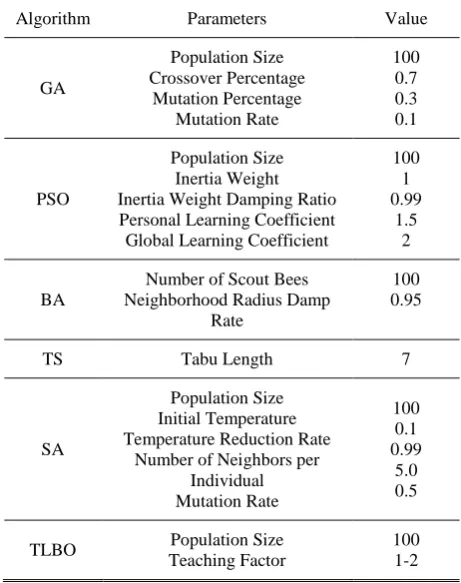
21). Table 1 illustrates parameters applied meta-heuristic methods. Simulation results are compared in terms of secrecy rate, convergence and CPU time.Table 1 Applied meta-heuristic methods parameters.
Algorithm Parameters Value
GA
Population Size Crossover Percentage
Mutation Percentage Mutation Rate
100 0.7 0.3 0.1
PSO
Population Size Inertia Weight Inertia Weight Damping Ratio Personal Learning Coefficient
Global Learning Coefficient
100 1 0.99
1.5 2
BA
Number of Scout Bees Neighborhood Radius Damp
Rate
100 0.95
TS Tabu Length 7
SA
Population Size Initial Temperature Temperature Reduction Rate
Number of Neighbors per Individual Mutation Rate
100 0.1 0.99
5.0 0.5
TLBO Population Size
Teaching Factor
100 1-2
Iranian Journal of Electrical & Electronic Engineering, Vol. 13, No. 4, December 2017 315 Fig. 2 The 50×50 simulation environment for N=10
cooperative nodes.
Fig. 3 Secrecy rate versus average total power.
Fig. 3 depicts the achievable secrecy rate versus average total power PT allocated during the two phases of transmission. As can be seen in Fig. 3, GA, PSO and TLBO algorithms have the same solution quality while outperforming the results obtained by BA, TS and SA. Also we can conclude that BA, SA and TS are placed in the second, third and fourth rank, respectively. Moreover, all meta-heuristic algorithms outperform Lagrange multipliers technique. From the results, we can conclude that evolutionary algorithms which apply population based strategies to improve solutions, have better solution quality than those which refine the solutions according to each individual.
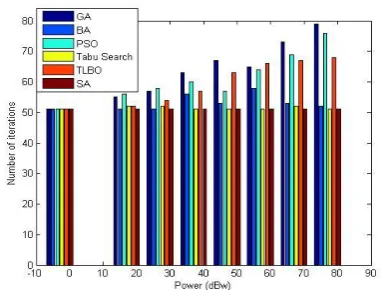
Fig. 4 illustrates the number of iterations before algorithm's termination due to satisfaction of a defined stopping criteria. As can be seen in Fig. 4, there is a gradual rise in number of iterations as the average total power increases, for GA, PSO and TLBO algorithms. For BA, TS and SA the average total power does not affect the number of iterations. So, we can figure out that for meta-heuristic algorithms which are more dependent on population, it takes longer to converge. In our optimization problem, total power constraint increment causes more chance of divergence for population, i.e., solutions can be selected from a wider range of optimization variables. So, for the same size of population set, it will converge in larger iterations. On the other hand for other meta-heuristic techniques like BA, TS and SA which are more individual based,
Fig. 4 The number of iterations versus average total power. Table 2 CPU time comparison for different meta-heuristic methods and Lagrange multipliers.
Algorithms CPU time (Sec.)
GA 0.77
PSO 1.4
BA 12.8
TS 0.71
SA 4.6
TLBO 0.67
Lagrange Multipliers 1.46
divergence of initial solutions does not affect the number of iterations.
In Table 2, CPU time of different methods are compared. We can figure out from Table 2 that GA, PSO, TLBO and TS have the lowest CPU times among the others. Also, their CPU times are less than Lagrange multipliers method. BA and SA have poor performance in terms of CPU time in comparison with Lagrange multipliers and also other meta-heuristics.
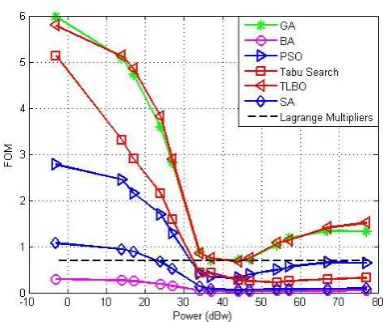
Finally, FOM of different meta-heuristic methods and also Lagrange multipliers technique are compared in Fig. 5. Note that in Eq. (26) is normalized to secrecy rate of Lagrange multipliers method to obtain values greater than one. As it has been illustrated in this figure, GA and TLBO have the highest FOM among other methods. We can see in Fig. 5 that FOM declines as total power increases and after passing a minimum point which is almost around 40 dBw, it has a gradual rise again. Also, it has been shown that BA has even smaller FOM than Lagrange multipliers in full power range. As total power increases FOM of PSO, TS and SA will be declined and go beneath the Lagrange multipliers FOM diagram.
4.2 Discussion
We aimed at providing a rule of thumb to compare different heuristic methods in terms of solution quality,
316 Iranian Journal of Electrical & Electronic Engineering, Vol. 13, No. 4, December 2017 Fig. 5 FOM versus total power.
number of required iterations to converge and CPU time. This comparison is so much valuable for future researchers in order to decide which method would be more satisfying. From simulation results, we can figure out that GA and TLBO have the highest FOM among all methods. SA shows poorer performance in terms of CPU time and accuracy. However, it can converge in fewer iterations as the total power increases. We could see that there is a gradual rise in the number of iterations as the average total power increases for GA, PSO and TLBO algorithms. We can justify it by the fact that as the total available power increases the search space becomes wider. So, it takes more iterations and consequently more CPU time for convergence of the algorithm as well.
5 Conclusion
In this paper, physical layer security was considered in presence of one eavesdropper. Three intermediate nodes cooperate, one as a relay to improve throughput at the receiver and two friendly jammers to degrade eavesdropper's link. The scenario was formulated as a non-linear non-convex optimization function, called secrecy rate.
To avoid computational complexity in the wireless network, we applied different meta-heuristic methods to find the suboptimal solution for power allocation problem.
On the other hand, due to dynamic nature of wireless network, closed form solutions which are obtained by exact optimization method will be expired by network changes. Simulation results proved that meta-heuristics like GA, PSO and TLBO that rely more on the whole population to improve the solution, have better solution quality than those which do it based on single individuals, i.e., BA, TS and SA. In terms of convergence, it takes longer for GA, PSO and TLBO to converge and this will be intensified as total allocated power increases. Also, CPU times of different meta-heuristics and also Lagrange multipliers method are compared. Simulations show that GA, PSO, TLBO and
TS have the lowest CPU time among other methods. Finally, we defined an FOM to evaluate all algorithm based on their solution quality, number of required iteration to converge and CPU time. According to this FOM, GA and TLBO appeared superior to others. We can understand from the results of this paper that meta-heuristic techniques can find suboptimal solution in a reasonable time with an acceptable solution quality and without much knowledge of the target function characteristics. When the nature of the intended problem is time varying, attaining closed forms by exact optimization methods will impose high computational complexity on wireless network.
References
[1] A. Wyner, “The Wire-Tap Channel,” The Bell System Technical Journal, Vol. 54, No. 8, pp. 1355-1387, Oct. 1975.
[2] N. Okati, B. Razeghi and M. R. Mosavi, “On Relay Selection to Maximize Coverage Region for Cooperative Cellular Networks with Multiple Fixed and Unfixed Relays,” in 6th International Conference on Computing, Communication and Networking Technologies, pp. 1-6, Jul. 2015. [3] B. Razeghi, N. Okati and G. Abed Hodtani, “A
Novel Multi-Criteria Relay Selection Scheme in Cooperation Communication Networks,” in Proc. the 49th Annual Conference on Information Sciences and Systems (CISS), Baltimore, Maryland, pp. 1-4, Mar. 2015.
[4] G. Amarasuriya, C. Tellambura and M. Ardakani, “Joint Relay and Antenna Selection for Dual-Hop Amplify-and-Forward MIMO Relay Networks,”
IEEE Transaction on Wireless Communications, Vol. 11, No. 2, pp. 493-499, Feb. 2012.
[5] J. Cai, X. Shen, J. Mark and A. Alfa, “Semi-Distributed user Relaying Algorithm for Amplify-and-Forward Wireless Relay Networks,” IEEE Transaction on Wireless Communications, Vol. 7, No. 4, pp. 1348-1357, Apr. 2008.
[6] L. Dong, Z. Han, A. Petropulu and H. Poor, “Improving Wireless Physical Layer Security via Cooperating Relays,” IEEE Transactions on Signal Processing, Vol. 58, pp. 1875-1888, Mar. 2010. [7] I. Krikidis, J. S. Thompson and S. McLaughlin,
“Relay Selection for Secure Cooperative Networks with Jamming,” IEEE Transactions on Wireless Communications, Vol. 8, No. 10, pp. 5003-5011,Oct. 2009.
[8] J. Chen, R. Zhang, L. Song, Z. Han and B. Jiao, “Joint Relay and Jammer Selection for Secure Two-Way Relay Networks,” IEEE Transactions on Information Forensics and Security, Vol. 7, No. 1, pp. 310-320, Feb. 2012.
Iranian Journal of Electrical & Electronic Engineering, Vol. 13, No. 4, December 2017 317
[9] G. Zheng, L. C. Choo and L. K. Wong, “Optimal Cooperative Jamming to Enhance Physical Layer Security using Relays,” IEEE Transactions on Signal Processing, Vol. 59, No. 3, pp. 1317-1322, Mar. 2011.
[10]W. H Fang, C. F Chen and H. S Lang, “Joint Resource Allocation and Relay Selection via Genetic Algorithm in Multi-User Decode-and-Forward Cooperative Systems,” IET Networks, Vol. 3, No. 2, pp. 65-73, Jun. 2014.
[11]A. D. Tera, K. K. Gurrala and S. Das, “Power Allocation for AF Cooperative Relaying using Particle Swarm Optimization,” International Conference on Green Computing Communication and Electrical Engineering (ICGCCEE), Coimbatore, pp. 1-4, Mar. 2014.
[12]N. Ma, M. Yang and Y. Shin, “A Distributed Power Allocation Algorithm for OFDM-based Cognitive Radio Networks,” IEEE Region 10 Conference (TEN-CON), Coimbatore, pp. 1-4, Oct. 2013. [13]S. Xu and Q. Zhang and W. Lin, “PSO-Based
OFDM Adaptive Power and Bit Allocation for
Multiuser Cognitive Radio System,” 5th
International Conference on Wireless Communications, Networking and Mobile Computing, Beijing, pp. 1-4, Sept. 2014.
[14]Z. Wang, Y. Li, C. Zhao and J. Chen, “An Energy-Efficient Resource Allocation Scheme based on
Genetic Simulated Annealing Algorithm,”
International Symposium on Communications and Information Technologies (ISCIT), Gold Coast, QLD, pp. 867-870, 2012.
[15]M. F. Uddin, C. Assi and A. Ghrayeb, “Joint Relay Assignment and Power Allocation for .Multi-Cast Cooperative Networks,” IEEE Communication Letters, Vol. 16, No. 3, pp. 368-371, Mar. 2012. [16]X. Gong, S. A. Vorobyov and C. Tellambura, “Joint
Bandwidth and Power Allocation with Admission Control in Wireless Multi-User Networks with and without Relaying,” IEEE Transactions on Signal Processing, Vol. 59, No. 4, pp. 1801-1813, Apr. 2011.
[17]J. Kennedy and R. Eberhart, “Particle Swarm optimization”, IEEE International Conference on Neural Networks, Vol. 4, pp. 1942-1948, 1995. [18]DT. Pham, A. Ghanbarzadeh, E. Koc, S. Otri, S.
Rahim and M. Zaidi “The Bees Algorithm,”
Technical Note, Manufacturing Engineering Centre, Cardiff University, UK, 2005.
[19]F. Glover, “Applications of Integer Programming Future Paths for Integer Programming and Links to Artificial Intelligence,” Computers and Operations Research, Vol. 13, No. 5, pp. 533-549, 1986. [20]S. Kirkpatrick, C. D. Gelatt Jr. and M. P. Vecchi,
“Optimization by Simulated Annealing,” American Association for the Advancement of Science, Vol. 220, No. 4598, pp. 671-680, May 1983.
[21]V. Cerny, “Thermo Dynamical Approach to the Traveling Salesman Problem: An Efficient Simulation Algorithm,” Journal of Optimization Theory and Applications, Vol. 45, No. 1, pp. 41-51, Jan. 1985.
[22]R. V. Rao, V. J. Savsani and D. P. Vakharia, “Teaching-Learning-Based Optimization: A Novel Method for Constrained Mechanical Design Optimization Problems,” Computer-Aided Design, Vol. 43, No. 3, pp. 303-315, Mar. 2011.
N. Okati received her B.Sc. degree in Electronic Engineering from Shiraz University of Technology (Sutech), Shiraz, Iran, in 2012. She is currently a M.Sc. student in the Department of Electrical Engineering at Iran University of Science and Technology (IUST). Her research interests include wireless
networks and cooperative
communications.
M. R. Mosavi received his B.Sc., M.Sc., and Ph.D. degrees in Electronic Engineering from Iran University of Science and Technology (IUST), Tehran, Iran, in 1997, 1998, and 2004, respectively. He is currently faculty member of Department of Electrical Engineering of IUST as professor. He is the author of more than 320 scientific publications on journals and international conferences. His research interests include circuits and systems design.
H. Behroozi (S’04–M’08) received the B.Sc. degree in Electrical Engineering from the University of Tehran, Tehran, Iran, in 2000, the M.Sc. degree in Electrical Engineering from Sharif University of Technology, Tehran, in 2003, and the Ph.D. degree in Electrical Engineering from Concordia University, Montreal, QC, Canada, in 2007. From 2007 to 2010, he was a Postdoctoral Fellow with the Department of Mathematics and Statistics, Queen’s University, Kingston, ON, Canada. He is currently an Assistant Professor with the Department of Electrical Engineering, Sharif University of Technology, Tehran. His re-search interests include information theory, joint source-channel coding, and cooperative communications.
Dr. Behroozi was the recipient of several academic awards, including Ontario Postdoctoral Fellowship awarded by the Ontario Ministry of Research and Innovation (MRI), Quebec Doctoral Research Scholarship awarded by the Government of Quebec (FQRNT), Hydro Quebec Graduate Award, and Concordia University Graduate Fellowship.