An Objective Evaluation of Robust Phase
Based Binarization Model to Improve
Degraded Document Image
Samreen M. Shaikh A. , Mayur S. Burange
Student, Dept. of CSE, Sant Gadge Baba Amravati University, Amravati, Maharashtra, India Lecturer, Dept. of CSE, Sant Gadge Baba Amravati University, Amravati, Maharashtra, India
ABSTRACT: Binarization is an important preprocessing step in several document image processing tasks. Binarization of historical document with poor contrast, strong noise, and non-uniform illumination is a challenging problem. A new binarization algorithm has been developed to address this problem. In this approach, we describe a new method which does utilize statistical properties of the intensity histogram of a gray-scale image to determine a threshold. It uses low pass Weiner filter method as a preprocessing step to enhance the image by deblurring the image. It uses Median Filter method as a postprocessing step to reduce noise in the image. Our result shows that this new binarization method produce high quality binary image for historical document than any other global methods such as Otsu‟s method.
KEYWORDS: Binary image, gray scale image, enhancement, pixel classification, phase binarization, ORC.
I. INTRODUCTION
A binary image is a digital image that has only two possible values for each pixel, a 0 or 1. In Photoshop parlance, a binary image is the same as an image in "Bitmap" mode. In the document-scanning industries, this is often referred to as "bi-tonal". The names black-and-white, B&W, monochrome or monochromatic are often used for this concept, but may also designate any images that have only one sample per pixel, such as grayscale images. Binary images are also called bi-level or two-level. The color used for the object(s) in the image is the foreground color while the rest of the image is the background color [1]. Typically, the two colors used for a binary image are black and white, though any two colors can be used. This means that each pixel is stored as a single bit [2].Historical documents are documents that contain important information about a person, place or event. Most of that information will do lost in future since they are either printed on ordinary paper or leaf such as palm leaf or papyrus which has a limited lifespan. This process consists of converting the original image in binary image which can be used for further processing. Hence Binarization method is an important for improving degraded document image preprocessing to eliminate background noise and improve the document quality.
FIGURE I: Sample of Degraded Document Images
images are as below. A removal is one of the steps in pre- processing. Some forms of clutter noise appear in an image because of document skew while scanning or are from holes punched in the document, or background noise, such as uneven contrast, show into effects, interfering strokes, and background spots, etc. The marginal noise usually appears in a large dark region around the document image and can be textual or non-textual. Next, we will discuss each type in detail.
.
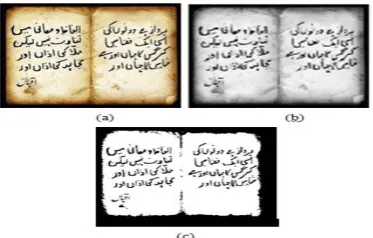
FIGURE II: Sample images obtained in different stages (a) input Image(b) Grayscale Image (c) Binarized Image
II. RELATED WORK
Nobuyuki Otsu et al. (1979) [3] has proposed a method to select a threshold automatically from a gray level histogram has been derived from the viewpoint of discriminant analysis. A nonparametric and unsupervised method of automatic threshold selection for picture segmentation is presented. An optimal threshold is selected by the discriminant criterion, namely, so as to maximize the separability of the resultant classes in gray levels.
Z.J.Hou, G.W.Wei et al. (2001) [4] have introduced the discrete singular convolution (DSC) algorithm for edge detection. Two classes of new edge detectors, DSC edge detector (DSCED) and DSC anti-noise edge detector (DSCANED), are proposed for the detection of multi scale edges. The DSCED is capable of extracting the 4ne details of images, whereas DSCANED is robust against noise.
Itay Bar-Yosef et al. (2004) [5] has described an input sensitive thresholding algorithm for ancient Hebrew calligraphy documents. The method detects a very high percent of the noisy characters, and that the local method achieves very accurate results. However, the distribution of noise in one document is not uniform and the characters quality may vary. Usually, historical document images are of poor quality since the documents have degraded over time due into storage conditions.
Raymond H. Chan, Chung-Wa Ho, and Mila Nikolova et al. (2004) [6] (2004) [6] have proposed a two-phase scheme for removing salt-and-pepper impulse noise. In terms of edge preservation and noise suppression, our restored images show a significant improvement compared to those restored by using just nonlinear filters or regularization methods only. In the first phase, an adaptive median filter is used into identify pixels which are likely through be contaminated by noise (noise candidates). In the second phase, the image is restored using a specialized regularization method that applies only through those selected noise candidates.
E. Saund, J. Lin, P. Sarkar et al. (2009) [7] have presented a user interface design for labeling elements in document images at a pixel level. Unlike general paint- type programs, the UI design is targeted specifically through selection of collections of foreground pixels that are likely to be meaningful elements in a document image analysis con- text. Labels are represented by overlay color, which might map through such terms as “hand- writing”, “machine print”, “graphics”, etc. The primary purpose is toward streamline processes for manual production of ground truth data, which is necessary for training algorithms and evaluating performance.
M. Valizadeh, E. Kabir et al. (2010) [8] have proposed a new algorithm for the binarization of degraded document images. In addition, this algorithm does not need any parameter setting by the user and is appropriate for various types of degraded document images. They map the image through a 2D feature space in which the text and back- ground pixels are separable and then they partition this feature space into small regions.
the local image gradient that is tolerant to text and background variation caused by different types of document degradations.
H. Z. Nafchi, S. M. Ayatollahi, R. F. Moghaddam, and M. Cheriet et al. (2013) [10] have purposed of facilitating benchmark contri- butions for binarization methods, a new fast ground truthing approach, called the PhaseGT, is proposed. The PhaseGT is a semi- automatic approach to ground truthing of images of any languagsse, especially designed for historical document images.
E. Zemouri, Y. Chibani, and Y. Brik et al. (2014) [11] have presented a combined binarization technique for historical document images. Usually, many binarization techniques are implemented in the literature for different types of binarization problems. The method was evaluated on the benchmarking dataset used in the Handwritten Document Image Binarization Contest (H-DIBCO 2012) and an Arabic historical document from National Library of Algeria. Zemouri, Y.
III.PROPOSED ALGORITHM
A. Flow diagram for Phase Binarization Model
The task of binarization itself is necessary since most commercial recognition algorithms work only on binary images since it proves to do simpler toward do so.Convert an image from color or greyscale to black-and-white (called a "binary image" because there are two colours).[12] In addition, the effectiveness of the binarization step influences into a significant extent the quality of the character recognition stage and the careful decisions are made in the choice of the binarization employed for a given input image type; since the quality of the binarization method employed through obtain the binary result depends on the type of the input image (scanned document, scene text image, historical degraded document etc.). The task of Binarization is performed as a simple way of separating the text (or any other desired image component) from the background [11].
FIGURE III: Flowdaigram of proposed phase binarization model
B. Algorithm:
1. Read the scanned input image (Color/ Grayscale) 2. Divide the image pixels.
4. Compute the average RGB values.
5. Perform the preprocessing method on the image includes enhance resolution and pixel classification. 6. Apply phase binarization method. Get multiple threshold images.
7. Manually select the suitable binarized image. 8. Display output
9. Stop
C. Preprocessing I. Image Resolution
Programs specialized for image enhancement is sometimes called image editors. In computer graphics, the process of improving the quality of a digitally stored image by manipulating the image with software is quite easy, for example, toward make an image lighter or darker, or to increase or decrease contrast. Advanced photo enhancement software also supports many filters for altering images in various ways. [1]
II. Pixels Classification
An auxiliary binary image is produced to generate the primary labels of pixels, to classify region Ri, the text and background pixels of the auxiliary binary image, which their feature vectors lie in Ri, are counted.After image resolution and partitioning the feature space into small regions, we use the result of an auxiliary binarization algorithm toward classify each region as either text or background. Suppose Nab(Ri) and Nat(Ri) are the number of pixels in Ri labeled as background and text in the auxiliary image, respectively. Ri is classified as follows:
Class(Ri) = BackgroundText if Nat(Ri) > 𝑁𝑎𝑏(𝑅𝑖) otherwise
Where Class(Ri) represents the class of Ri. This is the reason why we first partition the feature space and then classify the resulting regions instead of classifying all single points in the feature space. Although this method accurately classifies the partitions, using it for classifying the single points in the feature space leads toward some classification errors because there are some errors in the primary labels.
D. Phase Binarization
This is the main binarization technique, we have used c# coding to perform this phase binarization. The logic behind this phase binarization is very simple. The c# coding used in our proposed methodology is given below.
int rn = threshold;
We use the classification results of regions to binarize the document image. Suppose G(x, y) is mapped into [f1, f2] in the feature space where [f1, f2]∈Ri. The binary image, B(x, y), is obtained as follows:
B(x, y) = 0 1
if class (Ri) = Text
otherwise class (Ri) = Background
In this way, we obtain a binarization algorithm that can deal with document images suffering from uneven background, shadows, non-uniform illumination, and low contrast. Partitioning the feature space into small regions and classifying them rather than directly dividing the feature space into text and background regions are the main reason for the success of our algorithm.
IV.SIMULATION RESULTS
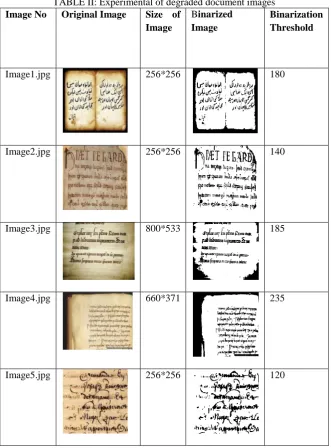
To give the readers more sense from the performance of our proposed methodology, we illustrate the results by 10 images in below Table. Although SC is sensitive to character size, in these images our algorithm yields satisfactory results even for the documents that have text with different font size. In these images, the gray level discriminates the text from background.
TABLE II: Experimental of degraded document images
Image No Original Image Size of
Image
Binarized Image
Binarization Threshold
Image1.jpg 256*256 180
Image2.jpg 256*256 140
Image3.jpg 800*533 185
Image4.jpg 660*371 235
Image5.jpg 256*256 120
TABLE III: Parameters Evaluation during Binarization process
Image No Entropy Mean Intensity MSE Time(millisecond)
Image1.jpg 17.5417 0.49804 2204.3016 32110.7633
Image2.jpg 17.2113 0.53333 1838.4300 69365.0841
Image3.jpg 17.5437 0.55686 2532.7116 67777.7124
Image4.jpg 17.4378 0.52549 3166.2798 46675.119
Image5.jpg 17.5689 0.50196 3358.2867 94359.8901
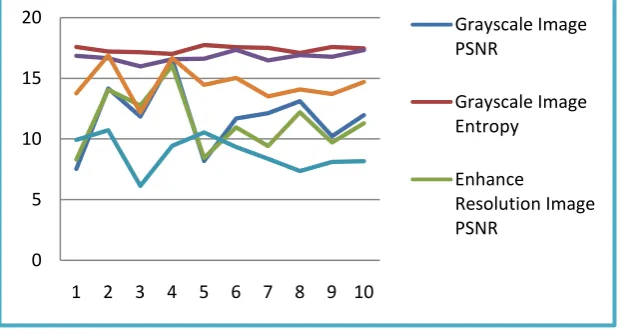
The performance of the algorithm is evaluated on 50 text samples. Many qualitative measures are available in the literature for measuring the quality of the image. PSNR is one measure, used to estimate the quality of the image. The PSNR ratio of 10 samples in each iteration are presented Below Table.
TABLE IV: Performance Evaluation of Input images during Binarization process
Sr.No. Grayscale Image Enhance Resolution Image Pixels classified Image
PSNR Entropy Mean
Intensity
PSNR Entropy Mean
Intensity
PSNR Entropy Mean
Intensity
1. 7.5427 17.5749 0.49804 8.3071 16.8419 0.48235 9.9269 13.7633 0.52549
2. 14.1693 17.2114 0.53333 14.0641 16.6501 0.50196 10.7151 16.8861 0.57255
3. 11.6838 17.5562 0.55686 10.9484 17.346 0.57647 9.3237 15.0306 0.6
4. 12.1338 17.4939 0.52549 9.4157 16.4681 0.42745 8.3541 13.5009 0.54118
5. 10.2352 17.5692 0.50196 9.7068 16.7718 0.48627 8.0984 13.6956 0..55294
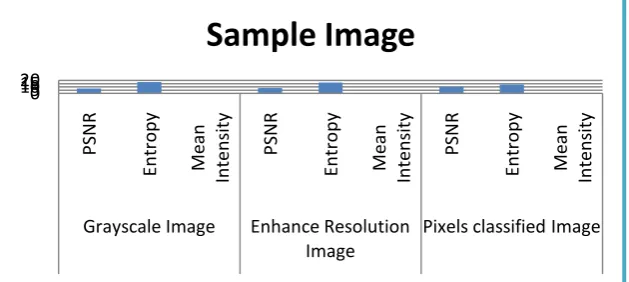
We summarize the performance of different methods in below Figures. From the plots, we see that proposed methods focus on the entropy and mean intensity during several steps of binarization. However when the noise level increases, noise patches will be formed and they may be considered as noise free pixels. This causes difficulties in the noise detection. On the other hand, our proposed denoising scheme achieves a significantly high PSNR and MSE even when the noise level is high. This is mainly 3based on the accurate noise detection by the adaptive median filter and the edge-preserving property of the variation method of [19].
Among the restorations, except for our proposed one, Algorithm I gives the best performance in terms of noise suppression and details preservation. As mentioned before, it is because the algorithm locates the noise accurately. In fact, about 70.2% and 70.4% pixels are detected as noise candidates in input images but much of the noise is suppressed but the blurring and distortion are serious. This is because every pixel has to be examined and may have been altered. It has successfully suppressed the noise with the details and the edges of the images being preserved very accurately. We can clearly see the visual differences and also the improvement in PSNR by using our algorithm.
FIGURE V: Comparative experimental result
0 5 10 15 20 PSN R En tro p y Me an In ten sity PSNR En tro p y Me an In ten sity PSN R En tro p y Me an In ten sity
Grayscale Image Enhance Resolution Image
Pixels classified Image
In the proposed binarization model the degradation images conversion takes several steps. The flow of model has to be followed by the user. The following is the table where we get the values of parameters i.e. entropy, mean intensity, MSE and time for the bnarization process.
FIGURE VI: PSNR and Entropy at different image samples
The results presented here show that for any document, a substantial set of its characters are thresholded correctly in the first global stage, and the remaining noisy characters are well identified by the evaluation procedure and are thresholded accurately by the local refinement method. Our algorithm was compared to the multi-stage binarization algorithm presented in (Bar-Yosef et al., 2004), in which first the image was threshol- ded using the a global method, and then a similar refining method was invoked on each connected component to produce the final accurate binary image. We compared only the results of the set CCseg for each document, which in (Bar-Yosef et al., 2004) was processed with the refining method:
• In cases where the characters had brighter regions or faded strokes due to intensity degradation, the algorithm presented in this paper performed better since the refining method was too accurate to handle the rapid intensity changes, while the CCseg members were correctly segmented.
• The computational complexity is strongly reduced since the refining method is very time consuming.
V. CONCLUSION AND FUTURE WORK
The aim of the system is to present a phase based binarization technique that is tolerant to different types of document degradation such as uneven illumination and document smear. The proposed technique is simple and robust, only few parameters are involved. Moreover, it works for different kinds of degraded document images. The proposed technique makes use of multiple threshold vales for the binarized image. The proposed method has been tested on the various degraded images. Experiments show that the proposed method outperforms most reported document binarization methods in term of the Entropy, Mean intensity, MSE, PSNR.
ACKNOWLEDGMENT
I would like to thank my guide Prof. Mayur S. Burange for helping me with this paper. I also express my gratitude to Prof. Vijay Gadicha, Head, Department of Computer Science & Engineering and Prof. Dr. S. D. Wakde, Principal, P. R. Pote (Patil) College of Engineering & Management, Amravati for constant inspiration and valuable advice. I am equally thankful to all the faculty members of Computer sci. &Engineering Department of P. R. Pote (Patil) College of Engineering &Management, Amravati for constant inspiration and valuable suggestions.
REFERENCES
1. R. F. Moghaddam and M. Cheriet, “A multi-scale framework for adaptive binarization of degraded document images”, Pattern Recognit., vol. 43, no. 6, pp. 2186–2198, 2010.
0 5 10 15 20
1 2 3 4 5 6 7 8 9 10
Grayscale Image PSNR
Grayscale Image Entropy
Enhance
2. B. Su, S. Lu, and C. L. Tan, “Robust document image binarization technique for degraded document images”, IEEE Trans. Image Process., vol. 22, no. 4, pp. 1408–1417, Apr. 2013.
3. NOBUYUKI OTSU, “A Threshold Selection Method from Gray-Level Histograms”, IEEE TRANSACTIONS ON SYSTREMS, MAN, AND CYBERNETICS, VOL. SMC-9, NO. 1, JANUARY 1979.
4. Z.J.Hou,G.W.Wei ,“A new approach to edge detection”, http://www.elsevier.com/locate/patcog.
5. Itay Bar-Yosef , “Input sensitive thresholding for ancient Hebrew manuscript”, http://www.elsevier.com/locate/patcog.
6. Raymond H. Chan, Chung-Wa Ho, and Mila Nikolova , “Salt-and-Pepper Noise Removal by Median-Type Noise Detectors and Detail-Preserving Regularization”, IEEE TRANSACTIONS ON IMAGE PROCESSING, VOL. 14, NO. 10, OCTOBER 2005 1479.
7. Eric Saund, Jing Lin, Prateek Sarkar, “ PixLabeler: User Interface for Pixel-Level Labeling of Elements in Document Images,” 2009 10th International Conference on Document Analysis and Recognition.
8. Morteza Valizadeh · Ehsanollah Kabir, “ Binarization of degraded document image based on feature space partitioning and classification”, December 2010 © Springer-Verlag 2010.
9. Bolan Su, Shijian Lu, Chew Lim Tan, “A Robust Document Image Binarization Technique for Degraded Document Images”, IEEE TRANSACTION ON IMAGE PROCESSING, 2012.
10. Hossein Ziaei Nafchi, Seyed Morteza Ayatollahi, Reza Farrahi Moghaddam, and Mohamed Cheriet, “An Efficient Ground Truthing Tool for Binarization of Historical Manuscripts”, 2013 12th International Conference on Document Analysis and Recognition.
11. E. Zemouri, Y. Chibani, and Y. Brik, “ Enhancement of Historical Document Images by Combining Global and Local Binarization Technique”, International Journal of Information and Electronics Engineering, Vol. 4, No. 1, January 2014.
12. B. Gatos, I. Pratikakis, and S. Perantonis, “Adaptive degraded document image binarization”, Pattern Recognit., vol. 39, no. 3, pp. 317–327, 2009.
13. R. Hedjam, R. F. Moghaddam, and M. Cheriet, “A spatially adaptive statistical method for the binarization of historical manuscripts and degraded document images”, Pattern Recognit., vol. 44, no. 9, pp. 2184–2196, 2011.
14. K. Ntirogiannis, B. Gatos, and I. Pratikakis, “A combined approach for the binarization of handwritten document images”, Pattern Recognit. Lett., vol. 35, pp. 3–15, Jan. 2014.
15. M. Valizadeh and E. Kabir, “Binarization of degraded document image based on feature space partitioning and classification”, Int. J. Document Anal. Recognit., vol. 15, no. 1, pp. 57–69, 2010.
BIOGRAPHY
Samreen M. Shaikh A. received the B.E.(I.T.)from I.B.S.S. College of Engineering, SCB Amravati University. Now I am pursuing M.E.(CSE) P.R.Pote (Patil) College of Engineering and Management, Amravati, Maharashtra, India.