GENETICS | INVESTIGATION
Natural Variations in
SLG7
Regulate Grain
Shape in Rice
Yong Zhou,*,1Jun Miao,*,1Haiyong Gu,†,1Xiurong Peng,* Mamotshewa Leburu,* Fuhai Yuan,* Houwen Gu,* Yun Gao,* Yajun Tao,* Jinyan Zhu,‡Zhiyun Gong,* Chuandeng Yi,* Minghong Gu,* Zefeng Yang,*,2and Guohua Liang*,2 *Jiangsu Key Laboratory of Crop Genetics and Physiology/Co-Innovation Center for Modern Production Technology of Grain Crops, Key Laboratory of Plant Functional Genomics of the Ministry of Education, Yangzhou University, Yangzhou 225009, China, †Rice Research Institute, Guangdong Academy of Agricultural Sciences, Guangzhou 510640, China, and‡Institute of Food Crops, Jiangsu Academy of Agricultural Sciences, Nanjing 210014, China
ABSTRACTRice (Oryza sativa) grain shape, which is controlled by quantitative trait loci (QTL), has a strong effect on yield production and quality. However, the molecular basis for grain development remains largely unknown. In this study, we identified a novel QTL,
Slender grain on chromosome 7(SLG7), that is responsible for grain shape, using backcross introgression lines derived from 9311 and Azucena. TheSLG7allele from Azucena produces longer and thinner grains, although it has no influence on grain weight and yield production. SLG7 encodes a protein homologous to LONGIFOLIA 1 and LONGIFOLIA 2, both of which increase organ length in
Arabidopsis.SLG7is constitutively expressed in various tissues in rice, and the SLG7 protein is located in plasma membrane. Mor-phological and cellular analyses suggested thatSLG7produces slender grains by longitudinally increasing cell length, while transversely decreasing cell width, which is independent from cell division. Our findings show that the functions ofSLG7family members are conserved across monocots and dicots and that theSLG7allele could be applied in breeding to modify rice grain appearance.
KEYWORDSrice; quantitative trait loci; grain shape; cell elongation
R
ICE (Oryza sativaL.) is a staple food for half of the world’s population (Khush 2001). Three major components, panicle number per plant, grain number per panicle, and grain weight, determine rice yield production. Grain weight is associated with grain size and shape, which are defined as grain length, grain width, and grain thickness (Duanet al. 2014). There is a striking diversity of grain size among the rice species worldwide. The grains of domesticated rice range from 3 to 11 mm in length and from 1.2 to 3.8 mm in width (Fitzgerald et al. 2009). Despite the influence of several environmental factors on plant growth and develop-ment, such as water supply and fertilizer level, the final grain size of rice is reasonably constant within a given species.Rice grain traits are quantitatively inherited. In the past decade, several quantitative trait loci (QTL) controlling grain size and shape have been cloned.GS3, encoding a transmem-brane protein containing four putative domains, was thefirst characterized QTL that regulates grain length (Fan et al. 2006).qGL3encodes a putative protein phosphatase with a Kelch-like repeat domain, and an aspartate-to-glutamate transition in the second Kelch domain leads to a long-grain phenotype (Zhanget al. 2012).GW6 encodes a GNAT-like protein that harbors intrinsic histone acetyltransferase activ-ity, and an elevated expression enhances grain length and weight by enlarging spikelet hulls and accelerating grainfi ll-ing (Song et al. 2015). GW2, GW5/qSW5, GS5, and GW8 were identified as regulators of rice grain width.GW2 en-codes a previously unknown RING-type protein with E3 ubiquitin ligase, which negatively regulates cell division by degrading its substrate(s) through the ubiquitin-proteasome pathway (Songet al.2007).GW5/qSW5encodes a nuclear-located protein that physically interacts with polyubiquitin. Loss of function ofGW5/qSW5leads to a significant increase in sink size, reflecting an increase in cell number in the outer glume of the rice flower (Shomuraet al.2008; Wenget al.
Copyright © 2015 by the Genetics Society of America doi: 10.1534/genetics.115.181115
Manuscript received August 20, 2015; accepted for publication September 30, 2015; published Early Online October 4, 2015.
Supporting information is available online at www.genetics.org/lookup/suppl/ doi:10.1534/genetics.115.181115/-/DC1.
1These authors contributed equally to the article.
2008). GS5encodes a putative serine carboxypeptidase (Li et al.2011), andGW8encodes squamosa promoter-binding protein-like 16, which belongs to the SBP domain family of transcription factors (Wang et al. 2012). Both are positive regulators of grain width. Higher expression of these two genes contributed to larger grain size through their effects on the cell-cycle machinery. Additionally, theGIF1gene en-codes a cell-wall invertase required for carbon partitioning during early grainfilling (Wanget al.2008), andTGW6 en-codes an indole-3-acetic acid-glucose hydrolase affecting the transition from the syncytial to the cellular phase of the en-dosperm (Ishimaru et al. 2013). GIF1 and TGW6 directly affect the endosperm size and consequently regulate grain size and weight. GS3, qSW5/GW5, GS5, GW8, GIF1, and TGW6 have been artificially selected and widely used in rice-breeding programs. However, the advantageous alleles ofGW2,qGL3, andGW6are present in rare varieties or sub-species and have not been actively exploited.
Most genes involved in rice panicle development, such as SP1,qPE9-1,EP2,DEP2, and DEP3, influence grain size or shape (Liet al.2009, 2010; Zhouet al.2009; Zhuet al.2010; Qiaoet al.2011). Moreover, based on the phenotypic analyses of null mutants, the genes involved in gibberellin and brassinosteroid biosynthesis or signaling also modulate rice grain size (Ashikariet al.1999; Yamamuroet al.2000; Hong et al.2003; Tanabeet al.2005; Nakagawaet al.2012). These studies suggested that the control of grain size in rice is com-plicated. To further reveal the molecular mechanism that de-termines grain size, genes that affect grain development were identified using mutants and backcross populations as genetic materials. In this study, we isolated and characterized a QTL, Slender grain on chromosome 7 (SLG7), which may produce longer and thinner grains and, if applied to breeding, will sig-nificantly improve rice grain yield and appearance quality.
Materials and Methods
Plant materials and growth conditions
A set of backcrossed introgression lines (ILs) derived from a cross between Azucena and 9311 was developed to clone QTL for grain size or shape. Their F1plants were backcrossed with
9311 for four times, and the BC4F1seeds were selfed to
pro-duce BC4F4lines (Supporting Information,Figure S1). One of
the lines, IL5084, carrying an introgressed segment of chro-mosome 7 from Azucena, showed extremely slender grains. Rough mapping and fine mapping ofSLG7was carried out using the segregating populations derived from IL5084 and 9311. From the BC5F3 generation, a pair of near-isogenic
lines (NILs), NIL-SLG7and NIL-slg7, was developed to eval-uate the genetic effect. NIL-SLG7carried a small segment including the AzucenaSLG7allele in the 9311 background, whereas its matching line, NIL-slg7, had the homologous seg-ment from 9311. All the plants were grown in the experimen-talfield of Yangzhou University (E 119°259/N 32°239). Field management and control of diseases and pests followed the
standard procedures to prevent yield loss during the growth period.
Mapping of SLG7
In each generation, short-grain plants (grain length,10.5 mm) in the derived segregating populations were used to screen recombinants. Fine mapping was performed using a total of 2500 short-grain plants in the BC5F3and BC5F4
pop-ulations. SLG7 was finally narrowed into a 60-kb interval between markers S7-272 and S7-258, and cosegregated with S7-257. The molecular markers used forfine mappingSLG7 are shown inTable S3. TheSLG7candidate genes from Azucena and 9311 genomic DNA were amplified and sequenced. The primers are listed inTable S4.
RNA extraction, complementary DNA synthesis, and qRT-PCR
Total RNA from various organs was isolated using an RNA extraction kit following the manufacturer’s instruction (Beijing Tiangen Biotechnology,http://www.tiangen.com/). First-strand complementary DNA (cDNA) was reverse transcribed from 1mg gDNase-treated RNA using a FastQuant RT Kit follow-ing the manufacturer’s instruction (Beijing Tiangen Biotech-nology). Gene expression analyses were measured using quantitative real-time reverse transcription-PCR (qRT-PCR) with the rice Actin gene as control. The qRT-PCR was per-formed in a total volume of 25ml, containing 2ml of the cDNA, 0.2 mM of each primer, and 12.5ml of 23SYBR green PCR master mix (Takara, http://www.takara.com.cn). The qRT-PCR was carried out using an ABI ViiA7 real-time qRT-PCR system using the following program: 95°for 3 min and then 40 cycles of 94°for 30 sec, 55°for 30 sec, and 72°for 40 sec. Comparison of the expression level was done with the 2-DDC
Tmethod. Vector construction and plant transformation
To confirm the target gene ofSLG7, the full coding regions of ORF1 and ORF2 were amplified from Azucena cDNA and were inserted into the p1300-Actin-3*flag vector to generate two overexpression constructs, pActin::ORF1Azucenaand
pAc-tin::ORF2Azucena. For the complementary test, a DNA
frag-ment2 kb upstream of the ORF1 translation start site was amplified from Azucena genomic DNA. Both segments were then cloned into the binary pCAMBIA1301 vector to generate apORF1::ORF1Azucenaconstruct in which the Azucena ORF1
can be driven by its native promoter. All the constructs were transformed by Agrobacterium tumefaciens-mediated trans-formation (Hieiet al.1994).
Subcellular localization
Morphological and cellular analyses
Fresh spikelets from the panicles of NIL-SLG7and NIL-slg7at heading time were directly observed with a scanning electron microscope (SEM). For histology, spikelets werefixed in 2% glutaraldehyde, dehydrated in a graded ethanol series, and embedded in Spurr resin. The transverse sections of each spikelet were produced using an ultramicrotome (EM UC7, Leica), then stained with 0.5% toluidine blue, and viewed using a microscope (DM1000, Leica). The areas of the outer parenchyma cell layer of the spikelet palea and lemma were measured using Image J software.
Data availability
Materials and plasmids described here and in the Supporting Information are available upon request.
Results
Identification of a major QTL for slender grains on chromosome 7
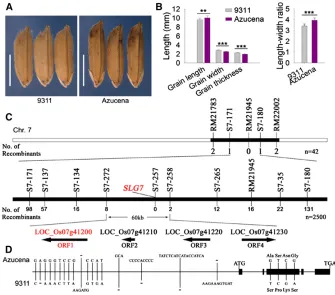
To explore the genetic control of rice grain size and shape, we developed a set of backcrossed introgression lines derived from the cross between Azucena and 9311 (Figure S1). The average length and width of 9311 grains were 9.6260.36 mm and 2.8260.14 mm, respectively. By contrast, the av-erage grain length and width of Azucena were 10.0360.50 mm and 2.5460.06 mm, respectively (Figure 1, A and B). Using this IL population, several QTL for grain weight and size were mapped (Y. Zhou and G. Liang, unpublished data).
One of the BC4F4 lines, IL5084, produced longer but thinner
grains than 9311. To reveal the genetic basis of this phenotypic variance, we made a cross between IL5084 and 9311 to generate the derived segregating populations. The distributions of grain traits in a random BC5F3subpopulation of 400 individuals are
illustrated inFigure S2. The ratio of the grain length and length– width ratiofitted well to the expected 3:1 ratio of single locus Mendelian segregation (x2
c = 1.92 ,x20.05,1= 3.84; x2c=
2.25,x2
0.05,1= 3.84, respectively). However, no bimodal
dis-tribution was observed in grain width. We also found that grain length was negatively associated with grain width (r=20.325). Linkage analysis suggested that a major gene,SLG7, located be-tween molecular markers RM21783 and RM22002 on chromo-some 7, was responsible for the grain-shape variation (Figure 1C).
Fine mapping and cloning of SLG7
As shown in Figure S2, the grain length showed a bimodal distribution with 10.75 mm as the boundary. Therefore, the plants with short grains (,10.5 mm in length) were consid-ered as recessive individuals, which could be used to screen recombinants. SLG7was mapped between markers S7-171 and S7-180 using 42 recessive plants from the BC5F2
segre-gating population (Figure 1C). Fine mapping was further performed using 2500 recessive plants in the BC5F3 and
BC5F4 populations. SLG7 wasfinally narrowed down to a
60-kb interval between markers S7-272 and S7-258, with eight and two recombinants, respectively, and cosegregated with marker S7-257. Within this region, there are four pre-dicted ORFs (Figure 1C). To define the candidate gene of SLG7, the genomic DNA sequences that corresponded to
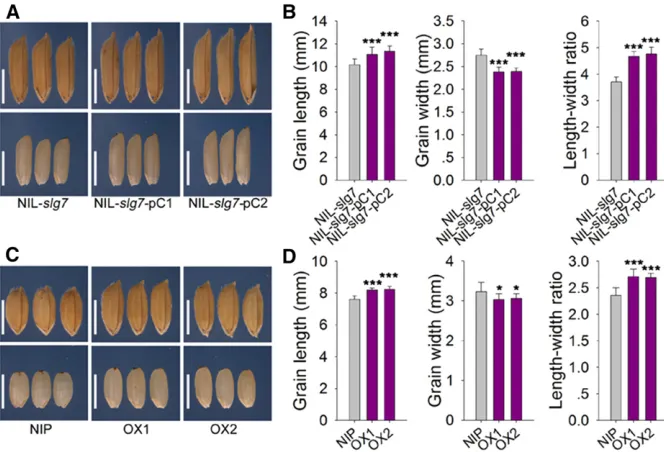
these four ORFs from 9311 and Azucena were sequenced. There was no nucleotide difference between 9311 and Azucena in ORF3 and ORF4, respectively; however, multiple variances were found in ORF1 and ORF2 between the two parents. Thus, ORF1 and ORF2 were considered as good candidates forSLG7. A pair of NILs, NIL-SLG7and NIL-slg7, was also developed whilefine mapping was carried out. NIL-SLG7carried a small segment including the AzucenaSLG7 allele in the 9311 background, whereas its matching line, NIL-slg7, had the homologous segment from 9311. Several constructs were generated and transformed to confirm the candidates. The transgenic NIL-slg7plants (NIL-slg7-pC1 and NIL-slg7-pC2) produced longer and thinner grains when expressing the Azucena ORF1-coding region under the con-trol of its native promoter (Figure 2, A and B). We also over-expressed the Azucena ORF1-coding region using the Actin promoter in Nipponbare (OX1 and OX2) and found that the grains of the transgenic plants became slender (Figure 2, C and D;Figure S3). However, no visible change in grains was found in the transgenic Nipponbare plants expressing ORF2 using the constitutive Actin promoter (data not shown). Therefore, ORF1 must be theSLG7gene. Sequence analysis revealed that 12 SNPs andfive indels in the promoter region and four SNPs in the coding region were found between 9311 and Azucena (Figure 1D and Table S1). All four SNPs are present in the third exon ofSLG7and cause amino acid res-idue changes from alanine to serine (Ala462Ser), serine to proline (Ser518Pro), asparagine to lysine (Asn605Lys) and glycine to serine (Gly620Ser) (Figure 1D andTable S1).
SLG7 encodes a protein homologous to Arabidopsis LONGIFOLIA1 and LONGIFOLIA2
BLASTP searches revealed that the homologs of riceSLG7are present only in seed plants including gymnosperm and angio-sperm. There are two homologs in rice genome, SLG7-like1 (LOC_Os03g30530) andSLG7-like2 (LOC_Os07g01860),
hav-ing 52% and 30% identities withSLG7, respectively. Both mono-cot and dimono-cot genomes contained multiple SLG7-like genes (Figure 3).Arabidopsishas four homologs ofSLG7, but only two of them,LONGIFOLIA1(LNG1, At5g15580) andLONGIFOLIA12 (LNG2, At3g02170), were functionally characterized. Both of them activate longitudinal organ expansion (Leeet al.2006).
SLG7 inactivates grain and panicle elongation but does not affect yield production
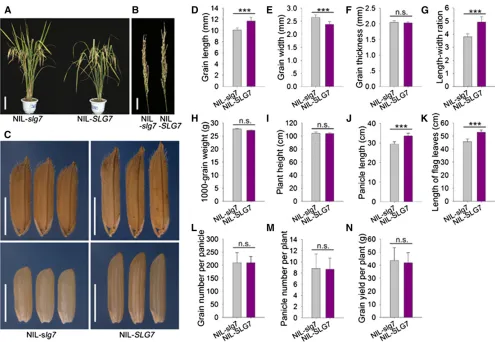
NIL-SLG7and NIL-slg7lines were developed to investigate the effect ofSLG7on rice agronomic traits. We confirmed the allele variances of six reported grain-size genes,GS3,GIF1, GW2, GW8,GL3, and GW6, in NIL-SLG7and NIL-slg7and found that this pair of NILs shared common alleles at these loci (Table S2). The grain and other agronomic traits of NIL-SLG7and NIL-slg7were evaluated underfield conditions (Figure 4). The grains of NIL-SLG7were 19.0% longer and 14.3% nar-rower than those of NIL-slg7(Figure 4, C–G). No difference was detected in 1000-grain weight between NIL-SLG7and NIL-slg7 (Figure 4H), suggesting that the two NILs did not differ from one another with respect to grain weight although their grain shapes were clearly distinct. NIL-SLG7 also produced longer panicles (+14.2%) andflag leaves (+15.8%) compared with NIL-slg7 (Figure 4, A, B, J, and K). No significant differences in plant height and two other rice yield components, grain number per panicle and panicle number per plant, were observed between NIL-SLG7 and NIL-slg7(Figure 4, A, I, L, and M). As a result, there was no difference in grain yield per plant between the two NILs (Figure 4N). These data indicated that theSLG7allele from Azucena produces slender grains but has no effect on grain weight and yield production.
SLG7 promotes cell expansion but has no effect on cell division
To investigate whether cell number or cell size contributes to the development and patterning of grain shape, we compared
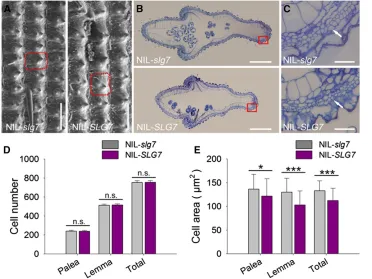
the length and width of the outer glume epidermal cells using SEM. The outer epidermal cells of NIL-SLG7were longer but narrower than those of NIL-slg7(Figure 5A). We further ex-amined the cross sections of spikelet hull central parts be-tween NIL-SLG7 and NIL-slg7 (Figure 5, B and C). The
number of outer parenchyma cell layers in NIL-SLG7did not differ from that in NIL-SLG7(Figure 5D). However, the cell sizes of outer parenchyma cell layers of the palea and lemma in NIL-SLG7were 10.8 and 20.8% smaller, respectively, than those in NIL-slg7 (Figure 5E). These results suggested that
SLG7produces slender grains by longitudinally increasing cell length while transversely decreasing cell width, which is inde-pendent from cell division.
Expression pattern of SLG7 and subcellular localization of the SLG7 protein
qRT-PCR was used to investigate the expression pattern ofSLG7. As shown in Figure 6A,SLG7was constitutively expressed in leaf, panicle, stem, sheath, node, and root. The transcripts in panicle accumulated to a higher level than those in other tis-sues, which was consistent with the biological function ofSLG7 in the regulation of rice inflorescences and grain development. Additionally, the difference of expression level was observed throughout the whole panicle developmental process (Figure 6B). These results implied that the sequence variations in pro-moter may affect the expression level ofSLG7. The expression pattern ofSLG7was further analyzed using transgenic plants expressing theb-glucuronidase (GUS) reporter gene under the control ofSLG7promoter. A strong GUS staining was detected in the spikelet hulls of transgenic lines, and the GUS activities in the spikelet hulls from young inflorescences were much higher
than those from developed inflorescences (Figure 6C). These data suggested that the expression ofSLG7decreased with the development of inflorescences and grains. To investigate the sub-cellular localization of SLG7, we constructed an SLG7-GFP fusion the expression of which was driven by the CaMV 35S promoter. The expression of this fusion protein in rice protoplasts clearly suggested that SLG7 is a plasma membrane protein (Figure 6D).
Sequence diversities of SLG7 in germplasms
It was detected that allelic variances ofSLG7among 50 rice germplasms from a wide geographic range in Asia and America. The SLG7 alleles were classified into five types, namely Azucena, 9311, Nipponbare, Guangluai 4, and Dular (Table S1). The Nipponbare and Guangluai four haplotypes were exclusively found injaponicaandindicasubspecies, re-spectively, while the other three haplotypes were detected in both subspecies. The AzucenaSLG7alleles were identified in 13 germplasms from the United States, the Philippines, Indo-nesia, and southern China, suggesting thatSLG7is not a rare allele and has been collected during rice breeding. In addi-tion, the varieties carrying the Azucena-typeSLG7allele are
significantly higher than those having the other fourSLG7 alleles in grain length (Figure 7). This result indicated that SLG7is a positive factor for grain length and plays a dominant role in shaping extremely long rice grains.
Discussion
Rice grain shape is a determinant of evolutionaryfitness and is also an important agronomic trait for yield production and appearance quality. Several genes for this trait have been characterized recently (Zuo and Li 2014). However, the mo-lecular components and regulatory network have not been fully illustrated.
To reveal more genes for rice grain size or shape, we de-veloped a set of backcrossed introgression lines using 9311 as the recipient and Azucena as the donor. Thefirstindicarice to have its whole-genome sequenced is 9311; it forms long grains because of a nonsense mutation in the second exon of the GS3 gene in comparison with short-grain varieties including Nipponbare (Fan et al.2006; Takano-Kaiet al. 2009; Wang et al.2011). Azucena produces longer and thinner grains than 9311. A map-based cloning strategy was employed to isolate the target gene, SLG7, responsible for the slender grains of Azucena. The data from NILs and transgenic lines showed that theSLG7allele from Azucena promotes spikelet elongation and produces slender grains under both 9311 and Nipponbare backgrounds. Surprisingly,SLG7has no effect on grain weight, probably because of the reduced grain width that accompanies the increased grain length (Figure 4). These results imply that SLG7 is different from the other grain size-related QTL that directly modify grain weight and yield. Varieties with long
and slender grains are preferred by consumers and cultivars in the United States, China, and most Asian countries. By con-trast, short and round grain varieties are popular in Japan, South Korea, and Sri Lanka (Juliano and Villareal 1993). Therefore,SLG7can be used to develop varieties with diverse grain shapes to meet different market demands.
The BLASTP analysis revealed thatSLG7shares numerous putative homologs (Figure 3), including two functionally char-acterized genes,LNG1(At5g15580) andLNG2(At3g02170), both of which function in the elongation of leaves, siliques, and seeds inArabidopsis(Leeet al.2006).LNG2(also namedTON1 Recruiting Motif 1) is identified as a microtubule-associated protein, which is able to target TON1 to cortical microtubules (Drevenseket al. 2012). We found that SLG7homologs are restricted to the land plants and are found within several im-portant crops including barley (Hordeum vulgare), millet (Seta-ria italica), maize (Zea mays), and sorghum (Sorghum bicolor) (Figure 3). In view of the results in rice andArabidopsis,SLG7 homologs represent key components controlling grain and organ size and could be employed to improve agronomic traits in crop breeding.
Organ size or shape is determined by cell proliferation and cell expansion, two processes that are coordinated and com-pensated (Orozco-Arroyoet al.2015). Morphological and cel-lular analyses indicated thatSLG7has a function in regulating cell elongation in spikelets (Figure 5). Similar to our data, LNG1andLNG2were also reported to play a positive role in increasing leaf and silique length through longitudinal cell elongation inArabidopsis(Leeet al.2006). These results sug-gested that the functions ofSLG7family members are probably conserved across monocots and dicots.
Very recently, two novel alleles of SLG7,GL7andGW7, were identified (S. Wanget al.2015; Y. Wanget al.2015). GL7 was characterized as a positive regulator for grain length, and the functional allele produced longer seeds resulting from elongated longitudinal cells (Y. Wang et al. 2015). By contrast,GW7was reported to influence cell pro-liferation, rather than cell expansion (S. Wanget al.2015). We compared the expression levels of 25 genes, including 14 putatively involved in the G1/S and 11 in the G2/M phase, as
shown in a previous report (Li et al. 2011). None of them showed more than a twofold change in transcript levels be-tween NIL-SLG7and NIL-slg7inflorescences (Figure S4A). A
similar result was also observed between Nipponbare and the SLG7overexpression transgenic line (Figure S4B). It seems that our results are similar to the data fromGL7. Genes regulating rice grain size or shape on chromosome 7, such asqGL7,qGL7-2, and GS7, have been mapped using several populations (Bai et al.2010; Shaoet al.2010, 2012; Qiuet al.2012). These four genes are close toSLG7, but none of them have been cloned. Perhaps there is a gene cluster associated with rice grain size or shape on the long arm of chromosome 7.
Nucleotide diversities ofSLG7were analyzed in 50 accessions (Table S1). The AzucenaSLG7allele was found in 13 germplasms from the United States, the Philippines, Indonesia, and China (Table S1), suggesting that this allele has been selected in breed-ing in these areas. It was noted that one variety with the Azucena SLG7allele, Zenith, did not produce longer and thinner grains, which is different from the other materials within this group. Thus, the genetic basis for the grain size in this variety was of interest. GS3andGW8are two widely distributed major determinants for rice grain length, and the mutationgs3andgw8alleles promote the elongation of spikelets (Fan et al. 2006; Takano-Kai et al. 2009; Wanget al.2012). Sequence analysis indicated that Zenith has negative alleles at theGS3andGW8loci, respectively (Table S5). This can be explained by the fact that Zenith lacks thegs3and gw8alleles, which are able to increase grain length, although it has a functionalSLG7gene. These data also suggested thatSLG7 could be combined with other genes for grain size and shape to regulate rice grain appearance in breeding.
Acknowledgments
This work was supported by grants from the Key Program of Basic Research of China (2013CBA01405); the National Natural Science Foundation of China (31471458 and 31271679); the Key Science and Technology Support Program
Figure 6 Expression pattern ofSLG7and subcellular localization of SLG7 protein. (A) Relative expression levels ofSLG7in different tissues analyzed by qRT-PCR. (B) Quantitative expression analysis ofSLG7in 2- to 3-, 4- to 5-, 6- to 7-, 11- to 12-, 19- to 20-, and 30- to 31-cm stages of NIL-slg7 and NIL-SLG7panicles. The expression level of the riceActingene was amplified as a control. Values are means6SE of three independent exper-iments. (C) GUS activities in the spikelet hulls from inflorescences with dif-ferent lengths. Bars, 1 mm. (D) Subcellular localization of SLG7 protein. Localization of 35S::GFP and 35S::SLG7-GFP in rice protoplast cells is shown. The photos were taken in an opticfield to examine cell morphology (light), in a dark field to localize green fluorescence (GFP), and in combination (merged). White arrow shows the nucleus stained by DAPI. Bars, 5mm.
of Jiangsu Province (BE2015341); the Natural Science Foun-dation of Jiangsu Province (BK20150010 and BK20130725); and the Priority Academic Program Development of Jiangsu Higher Education Institutions.
Literature Cited
Ashikari, M., J. Wu, M. Yano, T. Sasaki, and A. Yoshimura, 1999 Rice gibberellin-insensitive dwarf mutant geneDwarf 1
encodes the alpha-subunit of GTP-binding protein. Proc. Natl. Acad. Sci. USA 96: 10284–10289.
Bai, X., L. Luo, W. Yan, M. R. Kovi, W. Zhanet al., 2010 Genetic dissection of rice grain shape using a recombinant inbred line population derived from two contrasting parents andfine mapping a pleiotropic quantitative trait locusqGL7. BMC Genet. 11: 16. Drevensek, S., M. Goussot, Y. Duroc, A. Christodoulidou, S. Steyaert
et al., 2012 TheArabidopsis TRM1–TON1 interaction reveals a recruitment network common to plant cortical microtubule arrays and eukaryotic centrosomes. Plant Cell 24: 178–191.
Duan, P., Y. Rao, D. Zeng, Y. Yang, R. Xu et al., 2014 SMALL GRAIN 1, which encodes a mitogen-activated protein kinase ki-nase 4, influences grain size in rice. Plant J. 77: 547–557. Fan, C., Y. Xing, H. Mao, T. Lu, B. Hanet al., 2006 GS3, a major
QTL for grain length and weight and minor QTL for grain width and thickness in rice, encodes a putative transmembrane pro-tein. Theor. Appl. Genet. 112: 1164–1171.
Fitzgerald, M. A., S. R. McCouch, and R. D. Hall, 2009 Not just a grain of rice: the quest for quality. Trends Plant Sci. 14: 133–139. Hiei, Y., S. Ohta, T. Komari, and T. Kumashiro, 1994 Efficient transformation of rice (Oryza sativaL.) mediated by Agrobacte-rium tumeficience and sequence analysis of the boundaries of the T-DNA. Plant J. 6: 271–282.
Hong, Z., M. Ueguchi-Tanaka, K. Umemura, S. Uozu, S. Fujioka
et al., 2003 A rice brassinosteroid-deficient mutant, ebisu dwarf (d2), is caused by a loss of function of a new member of cytochrome P450. Plant Cell 15: 2900–2910.
Ishimaru, K., N. Hirotsu, Y. Madoka, N. Murakami, N. Haraet al., 2013 Loss of function of the IAA-glucose hydrolase gene
TGW6 enhances rice grain weight and increases yield. Nat. Genet. 45: 707–711.
Juliano, B. O., and C. P. Villareal, 1993 Grain quality evaluation of world rices, pp, International Rice Research Institute, Manila, Philippines.
Khush, G. S., 2001 Green revolution: the way forward. Nat. Rev. Genet. 2: 815–822.
Lee, Y. K., G. T. Kim, I. J. Kim, J. Park, S. S. Kwak et al., 2006 LONGIFOLIA1 and LONGIFOLIA2, two homologous genes, regulate longitudinal cell elongation inArabidopsis. De-velopment 133: 4305–4314.
Li, F., W. Liu, J. Tang, J. Chen, H. Tonget al., 2010 RiceDENSE AND ERECT PANICLE 2is essential for determining panicle out-growth and elongation. Cell Res. 20: 838–849.
Li, S., Q. Qian, Z. Fu, D. Zeng, X. Menget al., 2009 Short panicle1
encodes a putative PTR family transporter and determines rice panicle size. Plant J. 58: 592–605.
Li, Y., C. Fan, Y. Xing, Y. Jiang, L. Luoet al., 2011 Natural vari-ation inGS5plays an important role in regulating grain size and yield in rice. Nat. Genet. 43: 1266–1269.
Nakagawa, H., A. Tanaka, T. Tanabata, M. Ohtake, S. Fujiokaet al., 2012 Short grain1decreases organ elongation and brassinos-teroid response in rice. Plant Physiol. 158: 1208–1219. Orozco-Arroyo, G., D. Paolo, I. Ezquer, and L. Colombo,
2015 Networks controlling seed size inArabidopsis. Plant Reprod. 28: 17–32.
Qiao, Y., R. Piao, J. Shi, S. I. Lee, W. Jiang et al., 2011 Fine mapping and candidate gene analysis ofdense and erect panicle 3,DEP3, which confers high grain yield in rice (Oryza sativaL.). Theor. Appl. Genet. 122: 1439–1449.
Qiu, X., R. Gong, Y. Tan, and S. Yu, 2012 Mapping and charac-terization of the major quantitative trait locusqSS7associated with increased length and decreased width of rice seeds. Theor. Appl. Genet. 125: 1717–1726.
Shao, G., S. Tang, J. Luo, G. Jiao, X. Weiet al., 2010 Mapping of
qGL7–2, a grain length QTL on chromosome 7 of rice. J. Genet. Genomics 37: 523–531.
Shao, G., X. Wei, M. Chen, S. Tang, J. Luo et al., 2012 Allelic variation for a candidate gene for GS7, responsible for grain shape in rice. Theor. Appl. Genet. 125: 1303–1312.
Shomura, A., T. Izawa, K. Ebana, T. Ebitani, H. Kanegae et al., 2008 Deletion in a gene associated with grain size increased yields during rice domestication. Nat. Genet. 40: 1023–1028. Song, X. J., W. Huang, M. Shi, M. Z. Zhu, and H. X. Lin, 2007 A
QTL for rice grain width and weight encodes a previously un-known RING-type E3 ubiquitin ligase. Nat. Genet. 39: 623–630. Song, X. J., T. Kuroha, M. Ayano, T. Furuta, K. Nagai et al., 2015 Rare allele of a previously unidentified histone H4 acetyltransferase enhances grain weight, yield, and plant biomass in rice. Proc. Natl. Acad. Sci. USA 112: 76–81. Takano-Kai, N., H. Jiang, T. Kubo, M. Sweeney, T. Matsumotoet al.,
2009 Evolutionary history of GS3, a gene conferring grain length in rice. Genetics 182: 1323–1334.
Tanabe, S., M. Ashikari, S. Fujioka, S. Takatsuto, S. Yoshidaet al., 2005 A novel cytochrome P450 is implicated in brassinosteroid biosynthesis via the characterization of a rice dwarf mutant, dwarf11, with reduced seed length. Plant Cell 17: 776–790. Wang, C., S. Chen, and S. Yu, 2011 Functional markers developed
from multiple loci in GS3 forfine marker-assisted selection of grain length in rice. Theor. Appl. Genet. 122: 905–913. Wang, E., J. Wang, X. Zhu, W. Hao, L. Wanget al., 2008 Control
of rice grain-filling and yield by a gene with a potential signa-ture of domestication. Nat. Genet. 40: 1370–1374.
Wang, S., K. Wu, Q. Yuan, X. Liu, Z. Liuet al., 2012 Control of grain size, shape and quality byOsSPL16in rice. Nat. Genet. 44: 950–954. Wang, S., S. Li, Q. Liu, K. Wu, J. Zhanget al., 2015 TheOsSPL16– GW7 regulatory module determines grain shape and simulta-neously improves rice yield and grain quality. Nat. Genet. 47: 949–954.
Wang, Y., G. Xiong, J. Hu, L. Jiang, H. Yuet al., 2015 Copy num-ber variation at theGL7locus contributes to grain size diversity in rice. Nat. Genet. 47: 944–948.
Weng, J., S. Gu, X. Wan, H. Gao, T. Guoet al., 2008 Isolation and initial characterization ofGW5, a major QTL associated with rice grain width and weight. Cell Res. 18: 1199–1209.
Yamamuro, C., Y. Ihara, X. Wu, T. Noguchi, S. Fujioka et al., 2000 Loss of function of a ricebrassinosteroid insensitive1 ho-molog prevents internode elongation and bending of the lamina joint. Plant Cell 12: 1591–1606.
Zhang, X., J. Wang, J. Huang, H. Lan, C. Wanget al., 2012 Rare allele of OsPPKL1 associated with grain length causes extra-large grain and a significant yield increase in rice. Proc. Natl. Acad. Sci. USA 109: 21534–21539.
Zhou, Y., J. Zhu, Z. Li, C. Yi, J. Liuet al., 2009 Deletion in a quanti-tative trait geneqPE9–1associated with panicle erectness improves plant architecture during rice domestication. Genetics 183: 315–324. Zhu, K., D. Tang, C. Yan, Z. Chi, H. Yuet al., 2010 Erect panicle2
encodes a novel protein that regulates panicle erectness inindica
rice. Genetics 184: 343–350.
Zuo, J., and J. Li, 2014 Molecular genetic dissection of quantitative trait loci regulating rice grain size. Annu. Rev. Genet. 48: 99–118.
GENETICS
Supporting Information
www.genetics.org/lookup/suppl/doi:10.1534/genetics.115.181115/-/DC1
Natural Variations in
SLG7
Regulate Grain
Shape in Rice
Yong Zhou, Jun Miao, Haiyong Gu, Xiurong Peng, Mamotshewa Leburu, Fuhai Yuan, Houwen Gu, Yun Gao, Yajun Tao, Jinyan Zhu, Zhiyun Gong, Chuandeng Yi, Minghong Gu, Zefeng Yang and Guohua Liang
Table S1
Available for download at
Supplemental Table S2. Allelic variances of six reported genes in NIL-
slg7
and
NIL-
SLG7
.
Genes
NIL(
SLG7
)
NIL(
slg7
)
GS3
gs3
gs3
GIF1
GIF1
GIF1
GW2
GW2
GW2
GW8
gw8
gw8
GL3
GL3
GL3
Supplemental Table S3. New developed m
olecular markers used for fine mapping in this
study.
Supplemental Table S4. Primers used for cloning and function analysis.
Primers Forward (5’-3’) Reverse (5’-3’) Purpose
07g41200_ox AAATCTAGAATGCCTCCGGCGAGGGTGCTCGGC AAAGTCGACGCTTGTACTACTAAATGACAGCTGCCTCT Overexprssion for SLG7
41200HB_Pro AAAGGTACCCCCTGTTACTTGGTTAACCGCCCTTGTATG AAAGTCGACCTCCTCCTCCGACTCCGACTCCTCC Complementary test for SLG7
41200_CDS AAAGTCGACATGCCTCCGGCGAGGGTGCTCGG AAACCATGGTCAGCTTGTACTACTAAATGACAGCTGCCT Complementary test for SLG7
07g41200GFP AAAGTCGACATGCCTCCGGCGAGGGTGCTCGGCG AAACCATGGTGCTTGTACTACTAAATGACAGCTGCCTC Subcellular Localization of SLG7 protein 07g41210HB AAAGGTACCTAGGCTCGCTGTCACTTC AAAAAGCTTCGTCGTTCCCTCACTCTT Complementary test for LOC_Os07g41210 07g41210OX AAACCCGGGATGGACGACCACCCCAAGTTCACG AAATCTAGAGTTGCAGATGGATCCGCGGATAGCC Overexprssion for LOC_Os07g41210 07g41200GUS AAAGGATCCAACCGCCCTTGTATGTCACACTCCAGC AAACCATGGCTCCTCCTCCGACTCCGACTCCTC Promoter-GUS staining for SLG7
Real_Actin GATGACCCAGATCATGTTTG GGGCGATGTAGGAAAGC Expression analysis for SLG7
Real_41200 CCCAAGCAAGAAGTCCAG TGAAGCAAGAACTGAAGGA Expression analysis for SLG7