Design and fabrication of Automatic Solar
Panel Cleaning System
Sharvari Nikesh Ghate1, Karan Rajendra Sali1, Avinash Sureshprasad Yadav1, Namita Sandeep Neman1,
Jagdish Chahande2
UG student, Department of Mechanical Engineering, Mahatma Gandhi Mission’s College of Engineering and Technology, Kamothe, Navi Mumbai, India 1
Assistant professor, Department of Mechanical Engineering, Mahatma Gandhi Mission’s College of Engineering and Technology, Kamothe, Navi Mumbai, India 2
ABSTRACT: Today energy demands are increasing sharply, therefore the need to conserve energy and utilize available energy efficiently is very important. There are many forms of renewable energy available, with the increasing demands there is a need to exploit renewable sources of energy. Solar is one of them and it is a time-dependent and intermittent energy source. Thus, it is important to store available energy and use later on when the need is greatest. While storing solar energy which will drive us towards the goal of universal energy access, there is one major drawback. This paper aims to eradicate that drawback by designing and installing an automatic solar panel cleaning system. Dust accumulation on PV modules is the area of growing concern for the reliability of solar panels. So developing such a mechanism that will maintain the efficiency of PV modules connected in arrays as in solar farms spread over a large area and also for the rooftop assemblies at low cost is the main concern. This paper includes the study of effects of change in efficiency of PV modules due to the accumulation of different dust particles found in different regions, factors governing for the decrease in efficiency accounts a lot due to soiling and developing an automated mechanism for cleaning. Labor-based cleaning methods for PV modules are expensive and uses a large amount of water. This prototype includes DC motors controlled by a drive unit that moves a cleaning head horizontally with or without using a spraying system. This results in an increase in efficiency of overall PV modules, the amount of renewable energy harnessed is more, less water usage and less water usage.
KEYWORDS: PV modules, arduino, efficiency, automation, cost effective, universal energy.
I. INTRODUCTION
timely dependent due to environmental factors such as cloud gathering, rainfalls, floods, sandstorms in desert areas etc., so it equally important to store solar energy. There are many ways to collect and store solar energy, the direct conversion of solar energy into electrical energy is achieved by the photovoltaic effect by using solar cells. Due to this, the use of solar energy and installation of PV arrays are taking place in large numbers but it is equally important to maintain its efficiency. Accumulation of dust on PV modules is the main area of concern which restricts the use of solar energy as it decreases the efficiency of solar panels. This project is mainly focused on the effects of dirt and dust accumulation on PV modules which affects its efficiency, efficient operating strategies, design, and fabrication with a successful installation. Soiling and layers of dust accumulated on solar panel act as an obstacle for PV modules. There are different types of dust in different regions with varying sizes of dust particles due to local environment which can be cleaned. Cleaning solar panel, however, is not straight forward due to the issue of accessibility of panels. Since PV modules are located at places which are having high temperatures such as in desert areas, it is dangerous and difficult to reach out there for cleaning solar panels manually also it takes time to do it safely. Leaving solar panels can lead to permanent damage to the glass and can also reduce its lifespan. Therefore, it is a better option to develop a system which can clean the panel array automatically. Since the sensitivity of the dust accumulation density to an electrical parameter of the PV module is a very important parameter for providing auto cleaning mechanism to remove the layer of dust particle from PV surface in order to achieve better efficiency.
II. RELATED WORK
Considering the PV module structure, it has transparent glass on the top of the panel which absorbs and traps the solar radiation and reflects it to the panel, but if the glass transparency is reduced then the efficiency of solar panels gets affected. Thus cleaning process is essential for longer life span and uninterrupted working of the solar panel with higher efficiency. The cleaning properties depend mainly on the type of dust in that region. The cleaning process of solar panel installed on the roof of the house, industry, desert areas are very difficult as dust particle does not allow the solar radiations to absorb in the panel properly. The cleaning methods of solar panel can be broadly classified into active methods and passive methods.
As shown in the above table, an active method is the one which makes use of power and passive method is the one which does not make use of power for cleaning of solar panels. These methods are studied and described below: VACUUM SUCTION CLEANING
This method makes use of a device known as an air pump to create a partial vacuum to suck up the dust and dirt from PV modules. As this is one of the active methods, it makes use of electricity supply given to vacuum cleaner motor which creates suction pressure. As this method uses vacuum cleaner it has to manually operate as it is not fully automated and hence this method does not fully justify the use of power consumption in watts. Also, proper cleaning is not achieved on panel corners. Proper training will be needed to the operator as it includes physical movements of the operator. Over a period of time this method of cleaning can produce scratches and deterioration of PV modules.
ACTIVE METHODS PASSIVE METHODS
Make use of power Donot make use of power Includes,
VACUUM SUCTION CLEANING
AUTOMATIC WIPER BASED CLEANING
ELECTROSTATIC PRECIPITATOR
CLEANING ROBOT
AIR BLOWING FROM AIR CONDITIONING SYSTEM
Includes,
MANUAL CLEANING
SUPERHYRDOPHOBIC COATING
SUPERHYDROPHILIC COATING
AUTOMATIC WIPER BASED CLEANING
As the name itself suggests us that it will make use of wiper which is made up of rubber and a water storage vessel will be provided to spray water with additives over the panel for purpose of cleaning. This mechanism is battery operated and controlled automatically by suitable control mechanism but the impacts are similar to those studied earlier. As far as possible solar panel should not be cleaned with soapy water as it contains a coarse powder which ultimately produces scratches and deteriorates panel life.
ELECTROSTATIC PRECIPITATOR
This is a non-contact method of cleaning solar panel. It cleans the PV module surface without any physical contact. ESP or electrostatic precipitator is a filtration device that removes fine dust particles from the surface of solar PV panel using induced electrostatic charge force. This device is controlled by Arduino signals. It has electrodes fixed on either side of a solar panel connected to a voltage source. The negative charge electrode charges up the dust particles with a negative charge on the surface, due to an attraction of unlike charges dust particles get collected on the positive electrode placed on the opposite side. Whenever dust accumulates on the solar panel, weight increased due to the dust layer is sensed by the weight sensor. Further, Arduino signals the ESP supply to be applied for the collection of dust. This method is not highly effective as research is still going on make improvements such as installing moving electrodes that will roll over the panel. Like, computer scanner which scans all over the paper to collect information, doing so willmake the whole system expensive.
MANUAL CLEANING METHODS
As this method indicates the manual cleaning of solar panel which will require a human operator. This manual work can be done with the help of mop or any sweeping cloth with a suitable support structure. Many types of cleansers would also be used during manual cleaning which is not acceptable as it will deteriorate panel life. The time required in this type of cleaning is more and it is also a threat for the purpose of safety of the operator. Not only this, there are inevitable chances that PV modules will get damaged.
NATURAL METHODS
Natural methods make use of nature as their cleaning agent. These natural methods include wind power, rainwater from rainfalls and gravitation from earth. High wind velocity can blow away the dry dust particles but not the one which is found in humid regions also wind intensity matters for such type of cleaning. Similarly for rainwater cleaning of PV modules is not favorable as rainfall will not last for more than 4 months. Though this method is very cost effective still they can't be used on regular and timely cleaning of the solar panel as this method is highly nature dependent.
SUPERHYDROPHILIC COATINGS
These method come under the self-cleaning mechanism of solar panels with the help of Nano filming over PV modules. Several coatings have been innovated by the researchers to protect the solar panel which has properties such as adhesion, wettability, corrosion resistance, and wear resistance. Coatings can be applied on the substrate by spraying using solids, liquids or gases according to the end user. Superhydrophilic coatings are the ones which have good wettability properties as they are water affectionate, so high surface energy materials must be considered. They have smooth surface Nano film which easily spreads water so that the entire surface on the glass remains wet. The most popularly used photo catalyst chemical is titanium oxide nowadays, scientists have modified this titanium dioxide Nano film with other polymers to enhance the speed rate of the catalyst. It acts in two stages the first stage is a photo catalytic process where TiO2 film reacts under the UV light and split the organic dust, the second stage is the one in which rainwater scatter over the whole surface of PV module instead of mixing with dust. This self-cleaning method cannot be used most effectively in desert regions where rain is seldom.
SUPERHYDROPHOBIC COATINGS
are also found on plants and animals anatomy. Superhydrophobic surfaces such as the leaves of the lotus plant show high hydrophobicity. Various studies show that superhydrophobic surfaces are formed by microstructures and nanostructures. They can be fabricated from fluorocarbons, carbon nanotubes, polystyrene, polyurethane urea copolymer etc. Water molecules that will hit the PV modules would quickly roll off, carrying the dust and other particles. Further, more studies are needed to prove the efficient use of self-cleaning coatings on PV modules.
CLEANING ROBOT
Cleaning robot is an approach of cleaning solar panel with synergetic integration of mechanical systems. Ecoppia is one of the most empowering and leading product in the world for robotic solar panel cleaning system. Cleaning robot requires a high cost for implementation of PV modules cleaning. This robot makes use of smart technology for the cleaning process, such as AI and data-driven autonomous programming for the cleaning process.
AIR BLOWING FROM AIR CONDITIONING SYSTEM
In regions of very hot climates, the best source of cleaning panel is by forcing airflow over the PV modules which is the return air from air conditioning systems. In UAE, air conditioning systems constitute a major part in electrical power load for most parts of the year and where the buildings handle a large amount of air flow from the supply and return ducts. These buildings have separate duct for air flow of hot air that is emitted from the air conditioners from the supply duct. Provided that the 50% of air flow from return air is being regenerated through a central chiller and remaining 50% is exhausted to surroundings ambiance through a return duct and keeping in mind that 50% has to be supplied at the rooftop of buildings. This air supplied on the roof tops helps to clean the dust particles away from the solar panel, not only this cool air returned from air-conditioned spaces can help in removing additional heat from PV modules thus increasing the efficiency and power output.
III. EFFECTS OF DUST AND DIRTACCUMULATION
Dust accumulates and they interact over the PV surface, this deposition enhances the thickness of dust with several millimeters on PV modules. This thick layer of dust formed on PV modules makes it difficult for sunlight to penetrate through photovoltaic cover and reach PV cells. Adhesion and interaction of particles depends on several parameters such as the charge of the particle, type of dust, electrostatic property, size of the particle, the shape of dust particles, weight and, hardness and roughness of particle. Other properties such as climatic conditions, humidity, wind condition, and temperature play a vital role. Dust can be further classified as chemical type and biological type. Dust with chemical type includes mineral dust such as coals, free crystalline silica, and cement dust; metallic dust such as lead and nickel dust; and bulk chemicals. Dust with biological type includes organic dust such as pollens; vegetable dust such as flour, tea dust; biohazards such as molds and spores; and fibrous dust like asbestos.
Local environmental factors include human activities that contribute to dust environments such as driving vehicles on roads and highways, refineries, air pollution from industrial areas have more dust on PV modules. In urban and industrial areas dust accumulation can be more complicated due to high exposure to HC and HFCs. It causes shading issues and thus makes it very difficult to wipe away. Also, this dust reduces the performance of PV modules drastically which are exposed in the outdoor conditions. In desert areas where mostly the dust is sand also called as dry dust typically having dry adhesion are comparatively easy to clean. There are various cleaning methods available for solar panel cleaning.
IV. EXPERIMENTAL SETUP
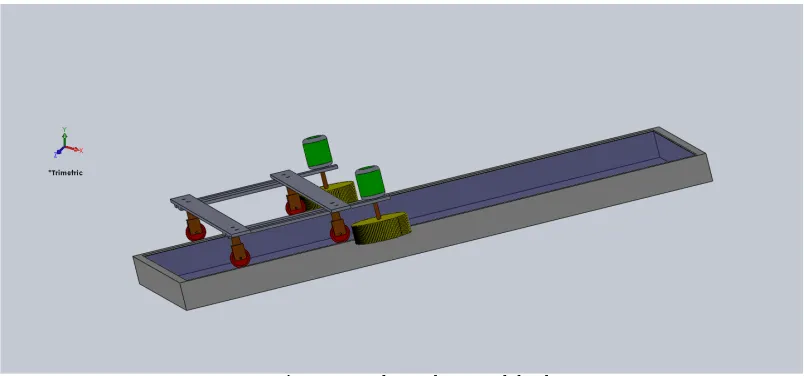
constrained. The motion in downward Y- direction is constrained by four roller wheels at each corner. This roller has its motion constrained only on the frame constructed such that they will not interfere in the active region of the solar panel. These wheels attached to the aluminum frame bears the maximum load. The motion is totally constrained in z-axis in both positive as well as the negative z-axis. Attached to the aluminum frame are wheels out of which 2 are primary & 2 are secondary wheels. Primary wheels are the once which are having DC motor attached along the wheels. Secondary wheels are the once which are having inbuilt bearing in-order to compensate the torque generated by the forces without restricting the motion in the z-axis. All 4 wheels are in contact with an aluminum frame in which solar cells are enclosed to make the panel.
Figure 1: Experimental setup drawn in solidworks.
As described above, all these parts make the body of a SKAN Robot (Automatic Solar Panel Cleaner). In order to provide locomotion to robot micro-controller unit i.e. Arduino UNOR3 in our case provides intelligence and gives the command to the body. We all controlling motor by means of H-bridge Dual DC motor drives. The system is also provided with 2 ultrasonic sensors. Cleaning purpose is achieved by a soft compressed sponge used for PV module cleaning in mild environment regions. While roller can also be accommodated if required. The system itself is powered by the solar panel in the day time and during the night if required, power can be supplied by using lead acetate battery.
V. WORKING
The MCU is programmed in such a way that we can vary the speed of cleaning by using PWM. High duty cycle will give more rapid cleaning while using low PWM it will give low-speed cleaning. Depending upon the requirement, we can control the speed. As the MCU works on the logic level so it cannot drive 12V DC motors. Hence, we use an H-bridge dual driver which acts as an interface between MCU and DC motors.
Ultrasonic sensors attached to body senses where the solar panel ends and sends the signal to the MCU. After accepting this signal, MCU reads it and accordingly takes the decision. There are 2 Ultrasonic sensors, which gives a message when the panels end. They are attached to right and one at left arm of the body. Depending upon the data provided by ultrasonic sensors, microcontroller rotates both the DC motors accordingly. After cleaning the panel the system can be placed in a shed adjacent to the arrays of solar panel.
VI. RESULTS
performed a short experiment in time lapse of 15-20 min at 1.10pm IST we measured the solar panel Voc (open circuit
voltage) and Isc (short circuit current) which was 23V and 2.07amp. At 1.13pm IST we added 10gm of talcum powder
on it gradually increasing the quantity of talcum powder from 1gm to 10gm and the up to approximately 20gm, we got the following readings. The distribution of talcum was uneven in order to meet the natural conditions and similarly observations were made for fuller earth.
DUST TYPE BEFORE CLEANING AFTER CLEANING
EFFICIENCY INCREASE
AFTER CLEANING
V I Η V I η
Talcum (in gms) 10 22.5 1.59 15.3 23.5 2 20.11 4.81 20 22.1 0.9 8 23.4 2.01 20.1 12.1
Fuller earth (in gms) 15 22 1.84 17.3 23.4 2 20.08 2.78 30 21.4 0.68 6.22 22.9 2.05 20.07 13.85 Efficiency of solar panel at 380C, considering solar panel at steady state and manufacturer has provided irradiation as 1000 W/m2. At 12.44 pm IST considering sunrays approximately perpendicular to the solar panel we get ratings as 23V and 2.07amp. From this we can calculate power (VI) that is equal to 47.61W, further solar power can be calculated by multiplying irradiation and area. Area of solar panel = L*B (of active region) equals to 0.23368 m2. Therefore, solar power= 1000*0.23368 = 233.68W and efficiency (
η
) =20.37%.Figure 2: Graph plotted for Talcum Powder as Dust Particle – Volt v/s Weight in Gms & Ampere v/s Weight in Gms
The above-mentioned graphs as shown in figure 2, are the graphs plotted for talcum powder which we have spread unevenly over the solar panel to see the effect of the decrease in the efficiency. For calculating the percent decrease in
22 22.1 22.2 22.3 22.4 22.5 22.6 22.7 22.8 22.9 23 23.1
0 5 10 15 20 25
Volts
0 0.5 1 1.5 2 2.5
0 5 10 15 20 25
the efficiency we have recorded the readings in the lapse of 15-20 min which are plotted on graphs above. Similarly, below-mentioned graphs as shown in figure 3, are the graphs plotted for fuller earth. Readings for the same have been recorded in the time lapse of 15-20 min. By plotting graphs it is easy to understand the decreasing efficiency of solar panels.
Figure 3: Graph plotted for Fuller Earth as Dust Particle – Volt v/s Weight in Gms & Ampere v/s Weight in Gms
As we can see in the above graphs as plotted for talcum powder and fuller earth respectively, we can see a noticeable decrease in efficiency. Graphs plotted above shows us the Voltage-current characteristics for artificial dust that we used to understand the efficiency decrease. After sweeping the dust by using our mechanism there was the percent increase in the efficiency of the solar panel. Our mechanism can be driven by using a battery which can be recharged and thus the efficiency of the panel will not be reduced by any means and continual efficiency of PV module can be maintained.
VII.CONCLUSIONS
As we can see deposition of dust (biological or chemical) leads to a decrease in efficiency of solar panel which affects its performance. So cleaning of solar panel is equally important also in this paper we have discussed different types of cleaning systems and methods that can applied. Compared to other methods our system is the best and more importantly cost effective. The effect of presence of dust was studied using artificial dust, using our mechanism. From the results inferred, efficiency after cleaning was increased by 4.81% for 10gm and 12% for 20gm of talcum powder. Efficiency after cleaning was increased by 2.78% for 15gm and 13.85% for 30gm of fullers’ earth. The system developed by us is to overcome following problems faced after solar panel installation: reduced power due to dust accumulation, cost reduction for the overall cleaning of solar panel, manual labor for cleaning which has inevitable physical harms is avoided, reduced time for cleaning. By replacing conventional cleaning methods of the solar panel with the automation we can maintain the efficiency without affecting its performance. Hence, periodically dust must be removed from solar panel, in order to ensure the highest performance.
REFRENCES
1. Zeki Ahmed Darwish, Hussein A Kazem, K. Sopian, M.A.Alghoul and Miqdam T Chaichan, “Impact of Some Environmental Variables with Dust on Solar Photovoltaic (PV) Performance: Review and Research Status”, publication at:
https://www.researchgate.net/publication/263275124, Volume 7, Issue 4, 2013.
21.2 21.4 21.6 21.8 22 22.2 22.4 22.6 22.8
0 10 20 30 40
Volts
0 0.5 1 1.5 2 2.5
0 10 20 30 40
2. Aslan Gholami, Ali Akbar Alemrajabi, Ahmad Saboonchi, “Experimental study of self-cleaning property of titanium dioxide and Nanospray coatings in solar applications” paper published in sciencedirect.com, journal homepage:www.elsevier.com/locate/solener, 2017.
3. Chaichan M T, Abaas K I & Hussein A Kazem, “The effect of variable designs of the central reciever to improve the solar tower efficiency”,
International Journal of Engineering and Science, Vol. 1, No. 7, pp.56-61, 2012.
4. Hussein A Kazem & Chaichan M T, “Status and future prospects of renewable energy in Iraq”, Renewable and Sustainable Energy Reviews, Vol. 16, No. 1, pp. 6007–6012, 2012.
5. Hussein A Kazem, Chaichan M T, Al-Shezawi I M, Al-Saidi H S, Al-Rubkhi H S, Al-Sinani J K and Al-Waeli A H A, "Effect of Humidity on the PV Performance in Oman", Asian Transactions on Engineering , Vol.2, Issue 4, pp.29-32, 2012.
6. Abd-Elhady, M., Zayed, S., Rindt, C., “Removal of dust particles from the surface of solar cells and solar collectors using surfactants”, In: International Conference on Heat Exchanger Fouling and Cleaning, pp. 342–348, 2011.
7. Brian Parrott, Pablo Carrasco Zanini, Ali Shehri, Konstantinos Kotsovos, Issam Gereige, “Automated, robotic dry-cleaning of solar panels in Thuwal, Saudi Arabia using a silicone rubber brush” paper published in sciencedirect.com, 2018.
8. Wadhawan, S.R., Pearce, J.M., “Power and energy potential of mass-scale photovoltaic noise barrier deployment: a case study for the U.S. Renew. Sustain. Energy”, Rev. 80, http://dx.doi.org/10.1016/j.rser.2017.05.223, 125–132, 2017.
9. Deb, D., Brahmbhatt, N.L., “Review of yield increase of solar panels through soiling prevention, and a proposed water-free automated cleaning solution. Renew. Sustain. Energy”, Rev. 0–1,http://dx.doi.org/10.1016/j.rser.2017.10.014, 2017.
10. Hallegatte, S., Rogelj, J., Allen, M., Clarke, L., Edenhofer, O., Field, C.B., Friedlingstein, P., Van Kesteren, L., Knutti, R., Mach, K.J., “Mapping the climate change challenge”, http://dx.doi.org/10.1038/nclimate3057, Nat. Publ. Gr. 6, 663–668, 2016.
11. M. Mani, R. Pillai, “Impact of dust on solar photovoltaic (PV) performance: research status, challenges and recommendations, Renew. Sustain. Energy”, Rev. 143124–3131, 2010.
12. S.A.M. Said, H.M. Walwil, “Fundamental studies on dust fouling effects on PV module performance, Sol. Energy”,107,328–337, 2014. 13. S.C.S. Costa, A.S.A.C. Diniz, L.L. Kazmerski, “Dust and soiling issues and impacts relating to solar energy systems: literature review update
for 2012–2015”, Renew. Sustain. Energy Rev. 63, 33–61,2013.
14. T. Sarver, A. Al-Qaraghuli, L.L. Kazmerski, “A comprehensive review of the impact of dust on the use of solar energy: history, investigations, results, literature, and mitigation approaches”, Renew. Sustain. Energy Rev. 22, 698–733, 2013.
15. M.R. Maghami, H. Hizam, C. Gomes, M.A. Radzi, M.I. Rezadad, S. Hajighorbani, “Power loss due to soiling on solar panel: a review”, Renew. Sustain. Energy Rev. 59, 1307–1316, 2016.
16. C.I. Calle, J.L. Mcfall, C.R. Buhler, S.J. Snyder, E.E. Arens, “Dust particle removal by electrostatic and dielectrophoretic forces with applications to NASA exploration missions, Proc. ESA Annu. Meet. Electrost., 2008.
17. M.K. Mazumder, M.N. Horenstein, J.W. Stark, J.N. Hudelson, A. Sayyah, N. Joglekar, J. Yellowhair, A. Botts, “Self-Cleaning Solar Mirrors Using Electrodynamic Dust Shield: Prospects and Progress”, in: Vol. 1 Comb. Energy Cycles, CHP, CCHP, Smart Grids; Conc. Sol. Power, Sol. Thermochem. Therm. Energy Storage; Geothermal, Ocean. Emerg. Energy Technol. Hydrog. Energy Technol. Low/Zero Emiss. Power Plants an, ASME, 2014.
18. H. Kawamoto, T. Shibata, “Electrostatic cleaning system for removal of sand from solar panels”, J. Electrostat. 73, 65–70, 2015.
19. W.J. Jamil, H. Abdul Rahman, S. Shaari, Z. Salam, “Performance degradation of photovoltaic power system: review on mitigation methods”, Renew. Sustain. Energy Rev. 67, 876–891, 2017.
20. www.bpsolar.com, June 22, 2012.
21. Moharram KA., “Improving the performance of the solar cells in desert area using a cleaning cooling agent”. M.Sc. thesis. Faculty of Engineering and Materials Science, German University in Cairo, Egypt; 2012.
22. Kim Y, Jo H, Kim D., “A new peak power tracker for cost-effective photovoltaic power systems”. IEEE Proce, 3(1):1673–8, 1996.
23. www.ni.com/labview/, June 22, 2012.
24. <http://www.rendimientosolar.com/>, June 22, 2012.
25. Rosen MJ., “Surfactant and Interfacial Phenomena”,3rd ed. Hobeken, New Jersey: John Wiley and Sons, p. 1–10, 2010.
26. Workman JJ, “The academic press handbook of organic compounds: NIR, IR, Raman, and UV–Vis spectra featuring polymers, and surfactants”, 1st ed. Boston: Mass, Academic Press/Elsevier, 2000.
27. http://www.crest-ultrasonics.com/aqueous-industrial-cleaning-systems.html
28. V.N. Khmelev, S.N. Tsyganok, S.S. Khmelev, A.V. Shalunov, A.N. Lebedev, A.N. Galahov, K.V. Shalunova, “Multifrequency ultrasonic transducer with steppedplate disk, in: International Conference and Seminar on Micro/Nanotechnologies and Electron Devices”, EDM’2009, pp. 250–253,2009.
29. P. Vasiljev, R. Bareikis, A. Struckas, S.-J. Yoon, “Ultrasonic cavitations research in flowing liquids, with low depth of duct”, Vibroengineering, Journal of Vibroengineering 14, ISSN 1392-8716, 2012.
30. A.O. Mohamed, A. Hasan, “Effect of dust accumulation on performance of photovoltaic solar modules in Sahara environment”, J. Basic Appl. Sci. Res. 2(11), 11030e11036, 2012.
31. Molki, “Dust affects solar cell efficiency”, Phys. Educ. 45 (5), 456e458, 2010.