LAWSON, DANIELLE FRANK. Intergenerational Learning and Climate Change: Empowering Children to be a Solution Now and in the Future. (Under the direction of Dr. Kathryn Stevenson and Dr. M. Nils Peterson).
As issues associated with climate change grow increasingly complex, the need for a citizenry prepared to address them cannot be overstated. Unfortunately, ideologically polarized contexts render climate change education and communication efforts challenging or ineffective among US adults. Promisingly, however, recent research suggests that adolescents are more capable than adults of separating climate science facts from their ideological contexts when forming perceptions. Novel communication and education strategies that leverage children’s unique perspectives may provide an opportunity to make inroads with adults where climate change communication efforts have previously failed. Intergenerational learning (IGL), a sub-theory of sociocultural sub-theory, posits that interactions between two generations can result in the bidirectional transfer of knowledge, attitudes, and/or behaviors. For example, marketing
specialists have long relied on the ability of children to influence parent purchasing decisions around food, toys, and other products. In this same vein, environmental education efforts around multiple subjects including recycling, farming technology, and water quality have been
associated with the transfer of environmental learning from children to their parents. However, this phenomenon has not been tested with more controversial topics such as climate change.
This dissertation examines the potential of IGL from children to the parents in the climate change context through three separate studies: (1) a perspective establishing why IGL of climate change can be effective and how to implement IGL of climate change in environmental
in the Future
by
Danielle Frank Lawson
A dissertation submitted to the Graduate Faculty of North Carolina State University
in partial fulfillment of the requirements for the degree of
Doctorate of Philosophy
Parks, Recreation & Tourism Management
Raleigh, North Carolina 2019
APPROVED BY:
_______________________________ _______________________________ Kathryn T. Stevenson M. Nils Peterson
Committee Co-Chair Committee Co-Chair
ii DEDICATION
iii BIOGRAPHY
iv ACKNOWLEDGMENTS
There are a myriad people that deserve my thanks and a place on this page – without them, I would not have finished this degree. First, and foremost, a huge thank you to my committee for all their time, support, and effort. Sarah, thank you for always being my
cheerleader and always believing in me – you helped me believe in myself. Erin, thank you for all of your time and constant encouragement when needed most. Renee, thank you for always having my back in all things – conferences, research, EENC, and more. Nils, thank you for being an incredible co-advisor, guiding me and pushing me when I needed it most. Finally, thank you Kathryn for being a wonderful mentor, teacher, and main advisor. Your dedication to helping me succeed, tough love when it was needed, never-ending support, and guiding hand helped get me here today. I will always appreciate it more than words can express.
Another huge thank you goes to my community of support both at NC State and outside of it. Thank you to my lab mates, both past and present: Rene, Kaly, Rachel, and Brent. A special thank you goes to my lab mate Jenna. Jenna, you have quickly become a friend, constant
supporter, and confidant. Thank you to the faculty, staff, and students of the Department of Parks, Recreation and Tourism Management and NC State. You have all played a part in my Ph.D. A special thank you to Dr. Carla Barbieri, Dr. Myron Floyd, Dr. Shaefny Grays, Aranzazu Lascurain, Cari Furness, Anju Singh, Maude Dinan, Ray Person, Brendali Carrillo, Emily Reed, and Tina Mozelewski. Your support, friendship, and encouragement mean the world. A special thank you to my WW community – you know who you are. Finally, thank you to North Carolina Sea Grant who funded all the research included here.
vi TABLE OF CONTENTS
LIST OF TABLES ... viii
LIST OF FIGURES ... ix
CHAPTER 1: Introduction ... 1
How is Climate Change Perceived in the United States? ... 1
Why is Building Climate Concern and Action among Adults so Difficult? ... 2
How Might Children Be the Answer? ... 4
Intergenerational Learning: A New Method to Bridge the Climate Communication Gap? ... 5
Dissertation Focus ... 6
References ... 7
CHAPTER 2: Intergenerational learning: Are children key in spurring climate action? ... 12
Abstract ... 12
Introduction ... 12
Why is Intergenerational Learning So Promising? ... 15
How Do We Leverage Intergenerational Learning to Combat Anti-Reflexivity? ... 17
References ... 22
CHAPTER 3: Evaluating climate change behaviors and concern in the family context ... 29
Abstract ... 29
Introduction ... 30
Climate change perceptions among young adults ... 30
Potential of family dynamics in shaping climate change perceptions ... 32
Study Objective ... 33
Methods... 34
Sampling ... 34
Questionnaire Development and Deployment ... 35
Analysis... 37
Results ... 37
Discussion ... 39
Conclusions and future research ... 43
References ... 45
CHAPTER 4: How children can foster climate change concern among political conservatives and men ... 55
Introductory Paragraph ... 55
Main Text ... 56
Methods... 62
Ethics Statement... 62
Curriculum Design ... 62
Sampling ... 63
Teacher Training ... 64
Questionnaire Development and Deployment ... 65
vii
References ... 67
Supplementary Materials ... 76
Supplemental Note 1. Study Area ... 76
Supplemental Note 2.Curriculum Development ... 77
References ... 83
CHAPTER 5: Conclusion... 84
Reflection ... 84
viii LIST OF TABLES
Table 1.1 Summary tables of the theory of intergenerational learning as applied to
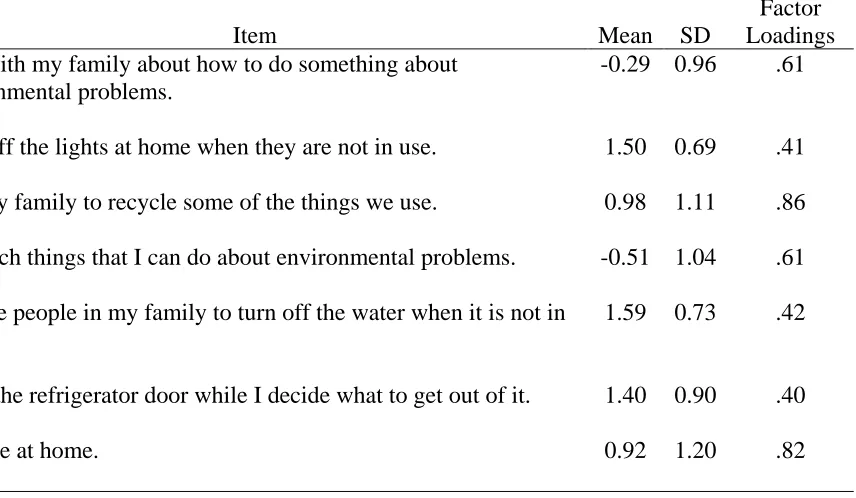
Environmental Education studies ... 11 Table 3.1 Item factor loadings for the parent climate behavior scale (n = 241, α = .77).
Each item associated with a 5-point Likert scale ranging from (-2) never to
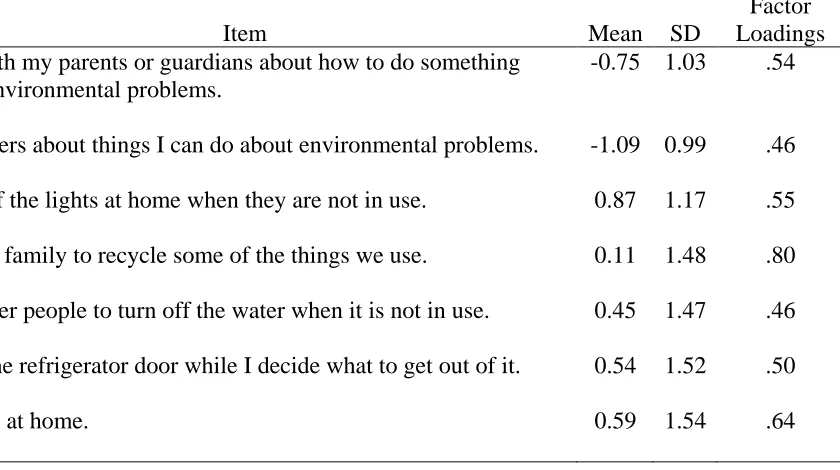
(2) always ... 51 Table 3.2 Item factor loadings for the child climate behavior scale ( n = 180, α = .76).
each item associated with a 5-point Likert scale ranging from (-2) never to
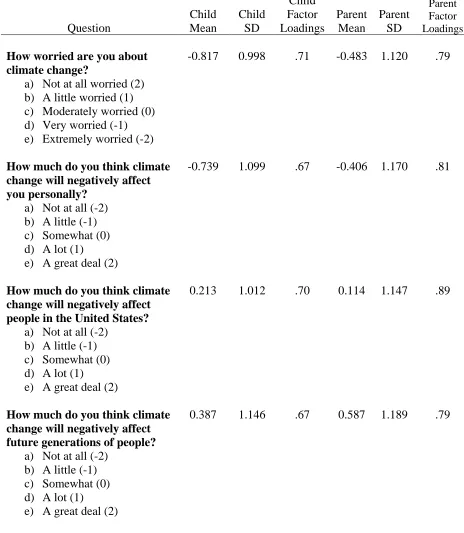
(2) always ... 52 Table 3.3 Item factor loadings for the child & parent climate change concern scale
(Child: n = 180, α = .79; Parent: n = 241, α = .90). Numbers beside each
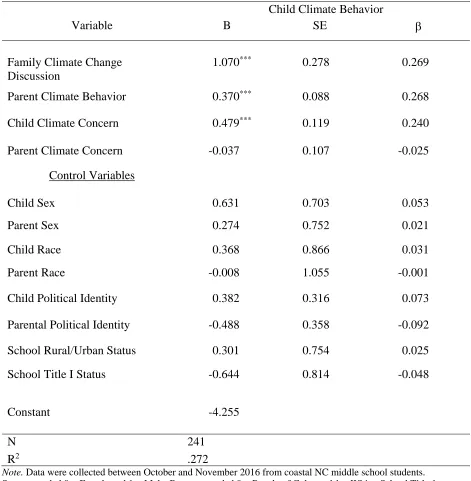
answer choice represent coding used ... 53 Table 3.4 Regression Results of Model Predicting Child Climate Change Behavior
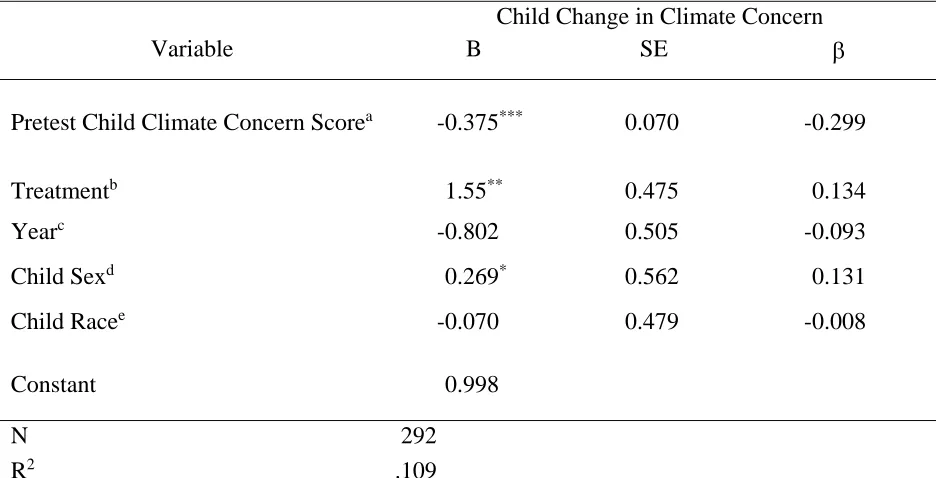
Based on Climate Scales and Control Variables ... 54 Table 4.1 Regression results of child change in climate concern on pretest scores,
treatment, and control variables ... 70 Table 4.2 Regression results of parent change in climate concern on pretest scores,
treatment, child change in climate concern, and control variables... 71 Table 4.3. Summary of the Weather, Wildlife, Climate, & Change Activities. Table
modified from Stevenson, K.T., Peterson, M.N., & Bondell, H.D. Development of a casual model for adolescent climate change behavior.
Climatic Change, (2018). Permission was received from authors prior to
submission ... 78 Table 4.4 Curricular alignment with Intergenerational Learning Best Practices.
These best practices are derived from several key review papers
focusing on IGL7,8 ... 79 Table 4.5 Examples of Service-Learning Projects Completed by Students ... 80 Table 4.6 Item factor loadings for the child & parent pre-test climate change concern
scale (Child: n = 238, α = .79; Parent: n = 292, α = .89). Numbers beside
each answer choice represent coding used ... 81 Table 4.7 Item factor loadings for the child & parent post-test climate change concern
scale (Child: n = 238, α = .91; Parent: n = 292, α = .90). Numbers beside
ix LIST OF FIGURES
Figure 4.1 a) Control parent mean climate change concern scores based on political ideology, pre- and post-test comparison. b) Treatment parent mean climate change concern scores based on political ideology, pre- and post-test comparison. 95% confidence interval error bars included on each bar
graph ... 73
Figure 4.2 a) Control parent mean climate change concern scores, separated by fathers and mothers, comparing pre- and post-test scores. b) Treatment parent mean climate change concern scores, separated by fathers and mothers, comparing pre- and post-test scores. 95% confidence interval
error bars included on each bar graph ... 74 Figure 4.3 a) Control parent mean climate change concern scores, for those with
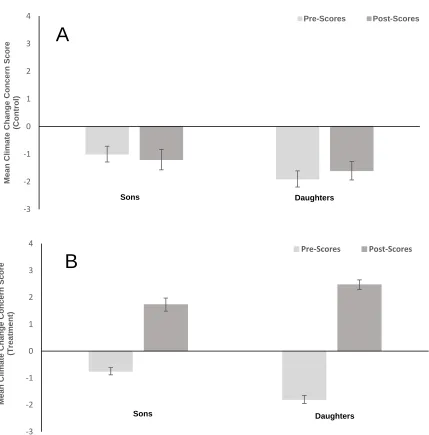
sons and those with daughters, comparing pre- and post-test scores. b) Treatment parent mean climate change concern scores, for those with sons and those with daughters, comparing pre- and post-test scores.
1 CHAPTER 1: Introduction
How is Climate Change Perceived in the United States?
Climate change is undoubtedly one of the largest modern environmental crises.
Temperature-related mortality, extreme weather events, sea level rise, air pollution-related health problems, and water, food, vector, and rodent-borne diseases include only a few of the known problems that will exacerbate with the changing climate (IPCC, 2014; National Assessment Synthesis Team, 2001; Pátz et al. 2000). In response to these impacts, technological advances have generated solutions such as disease and drought resistant crops (Godfray et al., 2010), subsurface water desalinization techniques (Zuurbier, Raat, Paalman, Oosterhof, & Stuyfzand, 2016), and community smart grids (Stephens, Wilson, & Peterson, 2015). Similarly, individuals’ decisions about reduced meat consumption (Hedenus, Wirsenius, & Johansson, 2014), riding a bicycle for transportation (Peterson, Peterson, & Liu, 2013), and using energy saving options in the household such as the installation of Energy Star appliances (Jaffe, Newell, & Stavins, 2001) may mitigate the effects of climate change, but addressing the global challenge ultimately requires collective action of some form, such as carbon cap and trade and carbon taxes (Goulder & Schein, 2013).
2 anthropogenic causes (Moser & Dilling, 2008; Moser, 2009) is a gateway belief that leads to increased climate concern and, ultimately, climate action (CRED, 2009; Moser & Dilling, 2007; Moser, 2009; van der Linden et al., 2015). Over half of Americans (57%) do not believe that climate change will personally affect them, their families, or neighborhoods; rather, it is believed the effects of climate change will be a problem just for developing nations (Leiserowitz, 2012; 2013; 2018). This is problematic because studies show that one of the first step to both
individual and collective climate action behaviors is an increase in climate change concern on a personal level (Hornsey, Harris, Bain, & Fielding, 2016; Lorenzoni, Nicholson-Cole, &
Whitmarsh, 2007). These patterns are unsurprising as behavior theories (e.g., Theory of Planned Behavior [Ajzen, 1991]; Value-Belief-Norm Theory [Stern et al., 1995]) posit that beliefs and attitudes (e.g., concern) are key in predicting behaviors. Understanding how to increase acceptance and concern are key to ultimately building the societal support to adapt to and mitigate the effects of climate change.
Why is Building Climate Change Concern and Action among Adults so Difficult? Among adults, building concern that results in action remains difficult for a variety of reasons, both cognitive and affective. For example, the complexity of climate science makes climate change difficult for many to grasp, including those who are scientifically literate
3 tend to seek out information sources that fit within their personal ideologies (Hamilton, 2011) and because people who are scientifically literate are more adept at using new information to reinforce their worldview-driven beliefs (Kahan et al., 2012). Other studies highlight how climate change action is related to demographics (e.g., white males are more likely to deny or act on climate change, McCright & Dunlap, 2011) and sociocultural norms (e.g., socially identifying oneself as a conservative results in being less likely to support climate change action, Fielding & Hornsey, 2016). These barriers are particularly discouraging for those aiming to spur action on climate change because they are incredibly powerful and difficult to change.
Fortunately, climate change communicators have developed tools to navigate
ideologically driven resistance to climate action, such as strategic framing (Nisbet, 2009) and the use of trusted messengers or popular icons (Moser, 2009) that are specifically designed to
4 How Might Children Be the Answer?
Engaging with younger audiences provides a promising approach to overcoming social barriers to widespread adoption of climate change mitigation behaviors. Children are still developing cognitively, socially, and emotionally, including in forming ideologies and
worldviews (Keating, 2004), which may explain why they approach climate change differently than older generations. For example, recent research with adolescents suggests that although worldviews may drive polarization at low levels of climate change understanding (Stevenson, Peterson, Bondell, Moore, & Carrier, 2014), climate change specific education results in a greater consensus in climate change beliefs and concern, regardless of worldview (Bofferding & Kloser, 2015; Flora et al., 2014; Reinfried, Aeschbacher, & Rottermann, 2012; Stevenson et al., 2014). This emerging research is encouraging because united climate action among future generations will be imperative, as recent studies have shown that the effects of climate change will be widespread by 2030, when today’s children will be entering adulthood (IPCC, 2014; McMichael, 2014).
5 predictor of their concern levels (Stevenson, Peterson, & Bondell, 2016). This trend continues when exploring dynamics between measured (rather than perceived) climate change perceptions between children and parents, with children’s climate change concern positively predicting behavior, independent of their parents’ levels of concern (Lawson et al., 2019).
6 Dissertation Focus
7 REFERENCES
Anderson, A. (2011). Sources, media, and modes of climate change communication: The role of celebrities. Wiley Interdisciplinary Reviews: Climate Change, 2(4), 535–546.
https://doi.org/10.1002/wcc.119
Baily, C. (2009). Reverse intergenerational learning: A missed opportunity? AI and Society,
23(1), 111–115. https://doi.org/10.1007/s00146-007-0169-3
Bofferding, L., & Kloser, M. (2015). Middle and high school students??? conceptions of climate change mitigation and adaptation strategies. Environmental Education Research, 21(2), 275–294. https://doi.org/10.1080/13504622.2014.888401
Bolsen, T., & Shapiro, M. A. (2018). The US News Media, Polarization on Climate Change, and Pathways to Effective Communication. Environmental Communication, 12(2), 149–163. https://doi.org/10.1080/17524032.2017.1397039
Bottery, M. (2016). The future of intergenerational learning: Redefining the focus? Studia Paedagogica, 21(2). 9-24.
Boudet, H., Ardoin, N. M., Flora, J., Armel, K. C., Desai, M., & Robinson, T. N. (2016). Effects of a behaviour change intervention for Girl Scouts on child and parent energy-saving behaviours. Nature Energy, 1(8). https://doi.org/10.1038/nenergy.2016.91
Cornforth, A. (2011). Does knowledge about climate change predict concern ? Concern for climate change and the knowledge-deficit theory, (March).
Duvall, J., & Zint, M. (2007). A Review of Research on the Effectiveness of Environmental Education in Promoting Intergenerational Learning. The Journal of Environmental Education, 38(March 2015), 14–24. https://doi.org/10.3200/JOEE.38.4.14-24
Flora, J. A., Saphir, M., Lappé, M., Roser-Renouf, C., Maibach, E. W., & Leiserowitz, A. A. (2014). Evaluation of a national high school entertainment education program: The Alliance for Climate Education. Climatic Change, 127(3–4), 419–434.
https://doi.org/10.1007/s10584-014-1274-1
Flurry, L. A., & Burns, A. C. (2005). Children’s influence in purchase decisions: A social power theory approach. Journal of Business Research, 58(5), 593–601.
https://doi.org/10.1016/j.jbusres.2003.08.007
Franz, J. & Scheunpflug, A. (2016). A systematic perspective on intergenerational learning: Theoretical and empirical findings 1. Studia Paedagogica, 21(2), 25-41.
8 Godfray, H. C. J., Beddington, J. R., Crute, I. R., Haddad, L., Lawrence, D., Muir, J. F., …
Toulmin, C. (2010). Food security: the challenge of feeding 9 billion people. Science,
327(5967), 812–818. https://doi.org/10.1126/science.1185383
Goulder, L.H. & Schein, A.R., 2013. Carbon taxes versus cap and trade: A critical review. Climate Change Economics 4(3). https://doi.org/10.1142/S2010007813500103
Hamilton, L. C. (2011). Education, politics and opinions about climate change evidence for interaction effects. Climatic Change, 104(2), 231–242. https://doi.org/10.1007/s10584-010-9957-8
Hedenus, F., Wirsenius, S., & Johansson, D.J.A., 2014. The importance of reduced meat and dairy consumption for meeting stringent climate change targets. Climatic Change 124(2), 79-91.
Hornsey, M. J., Harris, E. A., Bain, P. G., & Fielding, K. S. (2016). Meta-analyses of the determinants and outcomes of belief in climate change. Nature Climate Change, 6(6), 622– 626. https://doi.org/10.1038/nclimate2943
IPCC. (2014). Summary for Policy Makers. In O. Edenhofer, R. Pichs-Madruga, Y. Sokona, E. Farahani, S. Kadne, K. Seyboth, … J. C. Minx (Eds.), Climate Change 2014, Mitigation of Climate Change. Cambraige, U.K. and N.Y., USA: Cambridge University Press.
Jaffe, A.B., Newell, R.G., & Stavins, R.N., 2001. Energy-Efficient Technologies and Climate Change Policies: Issues and Evidence. In M.A. Toman (Ed.) Climate Change Economics and Policy: An RFF Anthology. Washington, DC: Resources for the Future.
Kahan, D. M., Jenkins‐Smith, H., & Braman, D. (2011). Cultural cognition of scientific consensus. Journal of Risk Research, 14(2), 147–174.
https://doi.org/10.1080/13669877.2010.511246
LaSala, M. C. (2000). Lesbians, gay men, and their parents: Family therapy for the coming-out crisis. Family Process, 39(1), 67–81. https://doi.org/10.1111/j.1545-5300.2000.39108.x Leiserowitz, A., Maibach, E., Roser-Renouf, C., Feinberg, G., & Howe, P. (2018). Climate
Change in the American Mind: March 2018. Environment.Yale.Edu, (March), 61. https://doi.org/10.2139/ssrn.2298705
Leiserowitz, A., Maibach, E., Roser-Renouf, C., Rosenthal, S., & Cutler, M. (2017). Climate Change in the American Mind, (October). Retrieved from
http://climatecommunication.yale.edu/wp-content/uploads/2017/01/Climate-Change-American-Mind-November-2016.pdf
9 Long, D.E., 2011. The politics of teaching evolution, science education standards, and Being a creationist. Journal of Research in Science Teaching 49(1), 122-139.
Lorenzoni, I., Nicholson-Cole, S., & Whitmarsh, L. (2007). Barriers perceived to engaging with climate change among the UK public and their policy implications. Global Environmental Change, 17(3–4), 445–459. https://doi.org/10.1016/j.gloenvcha.2007.01.004
McCright, A. M., & Dunlap, R. E. (2011). The Politicization of Climate Change and Polarization in the American Public’s Views of Global Warming, 2001-2010. Sociological Quarter,
52(2), 155–194. https://doi.org/10.1111/j.1533-8525.2011.01198.x
Moser, S. C. (2009). Communicating climate change: History, challenges, process and future directions. Wiley Interdisciplinary Reviews: Climate Change, 1(1), 31–53.
https://doi.org/10.1002/wcc.11
Moser, S. C., & Dilling, L. (2008). Creating a Climate for Change: Communicating Climate Change and Facilitating Social Change. Cambridge, UK: Cambridge University Press. National Assessment Synthesis Team. (2001). Climate Change Impacts on the United States:
The Potential Consequences of Climate Variability and Change: Foundation Report.
Cambridge, New York: Cambridge University Press.
Nisbet, M. C. (2009). Communicating Climate Change: Why Frames Matter for Public
Engagement. Environment: Science and Policy for Sustainable Development, 51(2), 12–23. https://doi.org/10.3200/ENVT.51.2.12-23
Nisbet, M. C., & Mooney, C. (2007). Framing Science. Science, 316, 56.
Peterson, M. N., Peterson, T. R., & Liu, J. (2013). The housing bomb. Johns Hopkins.
Plutzer, E. & Hannah, A. L. 2018. Teaching climate change in middle schools and high schools: investigating STEM education's deficit model. Climatic Change, 1-13.
https://doi.org/10.1007/s10584-018-2253-8
Plutzer, E., Hannah, A. L., Rosenau, J., Mccaffrey, M. S., Berbeco, M., & Reid, A. H. (2016).
Mixed Messages: How Climate is Taught in America’s Schools. Oakland, CA. https://doi.org/10.1093/toxsci/kfm117
Reinfried, S., Aeschbacher, U., & Rottermann, B. (2012). Improving students ’ conceptual understanding of the greenhouse effect using theory-based learning materials that promote,
21(2), 155–178.
10 Spence, A., & Pidgeon, N. (2010). Framing and communicating climate change : The effects of
distance and outcome frame manipulations. Global Environmental Change, 20(4), 656–667. https://doi.org/10.1016/j.gloenvcha.2010.07.002
Stephens, J. C., Wilson, E. J., & Peterson, T. R. (2015). Smart Grid (R)Evolution. New York, NY: Cambridge University Press.
Sterman, J. D. (2011). Communicating climate change risks in a skeptical world. Climatic Change, 108(4), 811–826. https://doi.org/10.1007/s10584-011-0189-3
Stevenson, K. T., Peterson, M. N., & Bondell, H. D. (2016). The influence of personal beliefs, friends, and family in building climate change concern among adolescents. Environmental Education Research, 4622(May), 1–14. https://doi.org/10.1080/13504622.2016.1177712 Stevenson, K. T., Peterson, M. N., Bondell, H. D., Moore, S. E., & Carrier, S. J. (2014).
Overcoming skepticism with education: Interacting influences of worldview and climate change knowledge on perceived climate change risk among adolescents. Climatic Change,
126, 293–304. https://doi.org/10.1007/s10584-014-1228-7
Stevenson, K. T., Peterson, M. N., & Bradshaw, A. (2016). How climate change beliefs among U.S. Teachers do and do not translate to students. PLoS ONE, 11(9).
https://doi.org/10.1371/journal.pone.0161462
Stoutenborough, J., & Vedlitz, A. (2015). Knowledge, Information, and Views of Climate Change: An Examination of Coastal Stakeholders along the Gulf of Mexico. Climate, 3(4), 983–998. https://doi.org/10.3390/cli3040983
Tempest, S. (2003). Intergenerational learning. Management Learning, 34(2), 181-200 van der Linden, S. (2015). The social-psychological determinants of climate change risk
perceptions: Towards a comprehensive model. Journal of Environmental Psychology, 41, 112–124. https://doi.org/10.1016/j.jenvp.2014.11.012
Wardekker, J. A., Petersen, A. C., & van der Sluijs, J. P. (2009). Ethics and public perception of climate change: Exploring the Christian voices in the US public debate. Global
Environmental Change, 19(4), 512–521. https://doi.org/10.1016/j.gloenvcha.2009.07.008 Williams, S., McLean, L., & Quinn, N., 2017. As the climate changes: Intergenerational
action-based learning in relation to flood education. The Journal of Environmental Education 48(3), 154-171. https://doi.org/10.1080/00958964.2016.1256261
11 Table 1.1. Summary table of the theory of intergenerational learning as applied to
Environmental Education Studies.
Study Using Intergenerational Transfer Environmental Topic Researched
1. Ballantyne, Connell, & Fein (1998) Endangered plants and animals 2. Ballantyne, Fein, & Packer (2001) Water and land conservation 3. Boudet, Ardoin, Flora, Armel, Desai, &
Robinson (2016)
Energy conservation
4. Damerell, Howe, & Milner-Gulland (2012)
Wetland management 5. Istead (2004)
Unpublished Master’s Thesis
General environmental conservation
6. Kaplan & Brintnall-Peterson (2001)
Perspective Article
4-H and Agriculture Extension
7. Leeming, Porter, Dwyer, Cobern, & Oliver (1997)
General environmental conservation
8. Legault & Pelletier (2000) Green School Project
9. Rakotomamonjy, Jones, Razafimanahaka, Ramamonjisoa, & Williams (2015)
Lemur conservation in Madagascar
10.Sutherland & Ham (1992) Local watershed conservation
11.Uzzell (1994) Water pollution
12.Vaughan, Gack, Solorazano, & Ray (2003)
Scarlet Macaw conservation
12 CHAPTER 2: Intergenerational learning: Are children key in spurring climate action? This chapter is published in Global Environmental Change:
Lawson, D.F., Stevenson, K.T., Peterson, M.N., Carrier, S.J., Strnad, R., & Seekamp, E. (2018). Intergenerational learning: Are children key in spurring climate action? Global
Environmental Change, 53, 204-208. Doi: 10.1016/jgloenvcha.2018.10.002
Abstract
Complex environmental problems are typically resolved after the public is no longer willing to accept their risks and demands change (i.e., Reflexive Modernization). Notable
13 Introduction
Technological solutions to many climate-related challenges exist, but social barriers to climate action stymie the scale of response needed to avoid the worst of projected impacts. Individuals’ decisions about reduced meat consumption (Hedenus, Wirsenius, & Johansson, 2014), riding a bicycle for transportation (Peterson, Peterson, & Liu, 2013), and using energy saving options in the household such as the installation of Energy Star appliances (Jaffe, Newell, & Stavins, 2001) may mitigate the effects of climate change, but addressing the global challenge ultimately requires collective action of some form, such as carbon cap and trade and carbon taxes (Goulder & Schein, 2013). As has been the case with other environmental challenges including ozone depletion (Mäder et al., 2010) or sulfur oxide related acid deposition (Brady & Selle, 1985; Stavins, 1998), we might expect participation in and support for these strategies as both the scientific and general communities become more informed about climate-related risks and refuse to accept them, a pattern described as reflexive modernization (Beck, 1992). In the case of climate change, however, individuals’ political ideologies and worldviews sometimes act as anti-reflexive forces, causing people to ignore risks, particularly within the United States (McCright & Dunlap, 2010). Accordingly, climate change communication efforts aimed at encouraging climate action (e.g., driving less, support for renewable energy) must address political ideologies and worldviews in tandem with scientific knowledge (Kahan et al., 2012; McCright & Dunlap, 2011).
14 messages in a way that is compatible with the worldviews of receivers (Moser & Dilling, 2008; Nisbet, 2009). This technique has been successfully used in contexts such as vaccinations (Gerend & Shepherd, 2007), evolution (Long, 2011), and climate change (Nisbet & Mooney, 2007). Similarly, trusted messengers are utilized to signal that messages conform to group values (e.g., evangelical leaders talking about climate change action or evolution as consistent with conservative Christian values; Long, 2011;Wardekker, Petersen, & van der Sluijs, 2009). Although these climate change communication techniques have been successful in specific cases (Anderson, 2011; Spence & Pidgeon, 2010), polarization over climate change continues,
particularly in the United States (Bolsen & Shapiro, 2018), indicating failure to overcome anti-reflexive forces (i.e., politically driven climate change skepticism) and the need for novel strategies.
We propose reaching adults through their children represents a productive but
understudied communication pathway for climate communication. Several scholars have pointed out that because children will experience the brunt of projected mid-century impacts of climate change, there is a moral imperative to prepare future generations to address those impacts (Curren, 2007; Lombardi, Danielson, & Young, 2016; Schlottmann, 2012). We agree with this view, and offer that child-based communication may also spur action among current adults where other strategies have failed. We suggest children may be able to overcome anti-reflexive tendencies of adults through intergenerational learning (IGL) in the context of climate change. Indeed, communication pathways through children are uniquely positioned to combat the anti-reflexive nature of adult perceptions on climate change.
15 Why is Intergenerational Learning So Promising?
The bulk of IGL research has highlighted how older generations influence younger generations’ knowledge, attitudes, and behaviors, but emerging research suggests younger generations may influence their parents’ approach to a variety of controversial topics. Adults are known to influence children in a variety of ways, including student academic achievement
(Davis-Kean, 2005), their approach to future marital relations (Axinn & Thornton, 1993), and the choice to stop smoking (Varcoe, Bottorff, Carey, Sullivan, & Williams, 2010). However, as adults are more prone to anti-reflexive thinking that clouds their judgement when forming perceptions on controversial subjects (Gifford, 2011; Kollmuss & Agyeman, 2002), relying on older generations to be the teachers may be counterproductive in the case of climate change. Fortunately, recent research finds that child to parent IGL is successful in a host of contexts. Children actively influence parental grocery shopping behaviors such as the purchase of high sugar cereals (Flurry & Burns, 2005), encourage their parents to use modern technology such as computers (Baily, 2009), and are capable of changing parental views on sexual orientation (LaSala, 2000). Environmental education (EE) programs directed at children, but designed with intergenerational learning in mind, also result in the successful transfer of environmental knowledge, attitudes, and behaviors to adults. Empirical research of such programming reveals successful child to adult IGL, including waste education behaviors (Maddox, Doran, Williams, & Kus, 2011), flood education knowledge (Williams, McLean, & Quinn, 2017), energy
16 Not only is child to parent IGL a proven method for reaching older generations, it is especially promising for an ideologically fraught topic like climate change for two reasons. First, children seem more able than adults to parse scientific fact from political contexts. Among adults, political ideologies and worldviews are the primary drivers of polarization around climate change perceptions (McCright & Dunlap, 2011), with education seeming to drive viewpoints farther apart (Kahan et al., 2012). However, at high levels of climate change knowledge, children reach consensus on anthropogenic climate change, regardless of worldview (Flora et al., 2014; Stevenson, Peterson, Bondell, Moore, & Carrier, 2014). Further, children’s acceptance of
anthropogenic climate change seems robust to the potential influence of denial from the adults in their lives. For instance, teachers’ beliefs around the anthropogenic nature of global warming have no relationship to similar views of their students (Stevenson, Peterson, & Bradshaw, 2016), which is encouraging considering US science teachers are just as polarized on climate change as the general public (Plutzer et al., 2016; Plutzer & Hannah, 2018). Instead, if teachers accept that global warming is happening, their students are more likely to think it is both happening and human caused (Stevenson et al., 2016). Although children who think their friends and family accept anthropogenic global warming are more likely to be concerned about climate change, their own views on global warming are the strongest predictor of their concern levels (Stevenson, Peterson, & Bondell, 2016). This trend continues when exploring dynamics between measured (rather than perceived) climate change perceptions between children and parents, with children’s climate change concern positively predicting behavior, independent of their parents’ levels of concern (Lawson et al. unpublished results).
17 education, parents reported being uncomfortable talking about sexuality generally but were more willing to talk to their children about the subject than other adults in their lives, independent of which party initiated the conversation (Morawska, Walsh, Grabski, & Fletcher, 2015). This suggests that the bond between parent and child helps facilitate conversations around
uncomfortable topics. In the case of climate change, this unique relationship between parents and children may create a context in which children may be best positioned to overcome
anti-reflexivity. For example, a former US Congressman and climate change denier, Bob Inglis, noted that his son was the reason that he chose to change his climate change perceptions, and now fights for effective climate policies (Sausser, 2018). In summary, children appear to be the ideal conduit for climate change communication to their parents, as they are capable of understanding and acting on the subject more effectively than parents and are more trusted by parents than other information sources.
How Do We Leverage Intergenerational Learning to Combat Anti-Reflexivity? At least five key principles should guide efforts to promote child to adult
intergenerational learning (IGL) of climate action. Education efforts focused on local issues
(Ballantyne et al., 2001; Sutherland & Ham, 1992), longer term and more in depth lessons
18 encouraging IGL even among skeptical parents. Similarly, Sutherland & Ham (1992) revealed that hands-on exploration of a watershed led by enthusiastic teachers, that included parental participation in the form of a workbook completed at home, resulted in successful child to parent IGL. Other IGL studies also document the inclusion of a homework component that encourages parental engagement (e.g., parental interviews) as a key for successful child to parent IGL (Ballantyne, Connell, & Fien, 1998; Leeming et al., 1997; Uzzell et al., 1994; Vaughan et al., 2003; Williams, McEwen, & Quinn, 2017).
Although observational studies suggest many of these practices may promote child to parent IGL in climate change contexts, experimental studies are needed to evaluate causality. Research on climate change perceptions in family settings indicates parents and their children share perceptions on climate change (Leppanen, Haala, & Lensu, 2012), suggesting that IGL could be occurring. Adolescent students who perceived their family members as concerned about anthropogenic climate change and discussed climate change with their families were more likely to be concerned themselves (Stevenson, Peterson, & Bondell, 2016) and engage in climate mitigation behaviors (Valdez, Peterson, & Stevenson, 2017). Similarly, children and parent engagement in climate change mitigation behaviors seems to be linked, with a parents’ choice to participate in climate mitigation behaviors predicting a child’s likelihood to participate in those same behaviors (Lawson et al. unpublished results), along with information seeking behaviors concerning climate change (Mead et al., 2012). These studies demonstrate that parents’ and children’s climate change perceptions and behaviors are related, but no empirical research has been undertaken to test for directionality of influence.
19 units. Research with children is generally harder to get approved than research with adults given human subjects concerns of research review boards, and the need to secure permission from school administrators, and parents in addition to children themselves adds additional logistical barriers (Kilngner, Ahwee, Pilonieta, & Menendez, 2003; Swauger, 2009). Similarly, collecting data from paired groups of parents and children requires steps not typically associated with survey research, such as data collection protocols where teachers collect data from students, and students from parents. This approach invariables reduces response rates, and communication between children, parents, and sometimes teachers is difficult to coordinate (Wellington, 2015). Challenges developing equivalent and comparable instruments that both parents and children understand (Greig, Taylor, & MacKay, 2012) creates another barrier to IGL research. Finally, research with adults and children is typically conducted by scholars from different fields creating a need for collaboration in interdisciplinary research teams - something long advocated for within research circles, but admittedly difficult to achieve in practice (Youngblood, 2007). These barriers may explain why research exploring IGL from children to parents that began decades ago (e.g., Sutherland and Ham, 1992) has been so slow to develop. These barriers, however, are not insurmountable. For example, studies in the fields of family exercise habits (Solomon-Moore et al., 2016), adolescent substance abuse therapy (Boustani, Henderson, & Liddle, 2016), and child educational achievement (Davis-Kean, 2005), to name a few, has overcome them. Key elements include funding agencies and journals recognizing and rewarding the extra work, administrators and research institutions supporting efforts to build interdisciplinary teams needed to conduct the research.
Beyond overcoming these challenges related to IGL research, we offer several
20 climate change communication and education focuses on behavior change (e.g., Hall, Lewis, & Ellsworth, 2018; Ojala & Bengsston, 2018), climate change IGL research should utilize and contribute to behavior theories. This work would build understanding of the role of IGL in predicting behavior among children and adults help discover which factors are particularly effective at fostering IGL. For instance, children may be particularly influential in activating parents’ attitudes toward certain behaviors but not others (Ajzen, 1991; Boudet et al., 2016). Secondly, research is needed to understand under what contexts IGL occurs. For instance, IGL may be more common in multi-generation households (e.g., grandparents, parents & children together), among families whose children act as the primary language translators (Knafo & Galansky, 2008), or in countries outside of the United States, as the United States is unique in its political framing of climate change (McCright & Dunlap, 2011). Third, IGL research may
21 Research on IGL of climate action would provide insight to a particularly promising and novel climate communication strategy as well as dovetail with emerging efforts by younger generations to combat climate change. Although some may argue that IGL-based approaches inappropriately burden children (e.g., Thompson, 2014), both research (Stapleton, 2017), and recent child-led efforts offer a counterpoint (e.g., Wells, 2014). Although younger generations cannot vote, numerous examples show they are working toward solutions to make large political impacts. Across the United States, movements such as Black Lives Matter (Black Lives Matter, 2018) and the March for Our Lives protests (The New York Times, 2018) echo other youth-led social movements around child labor laws or civil rights (Center for Community Change, 2018). In environmental contexts, a Change.org petition on the behalf of fourth and fifth graders
successfully convinced Dunkin’ Donuts, Inc. to stop selling Styrofoam coffee cups on Earth Day 2015 (Wells, 2014). At the time of this paper, 21 adolescents aged 10 to 21 from Oregon are suing the United States government for failure to address climate change in the landmark court case, Juliana v. US (Our Children's Trust, 2018). Children’s voices are also calling for solutions to environmental degradation and taking active roles in advocacy based endeavors globally (United Nations Children’s Fund, 2007), including on climate change (Plan International Australia Youth Ambassadors, 2015). These examples suggest children are eager and able to take an active role in combating climate change, and are poised to transform society in ways that will be necessary to avoid the most catastrophic impacts of climate change (Center for
22 REFERENCES
ACE, 2017. The Power of Conversation: Training Youth to Lead Climate Conversations with Parents. Retrieved from
https://acespace.org/sites/default/files/The%20Power%20of%20Conversation_%20ACE%2 0Climate%20Conversations%20Executive%20Summary.pdf
Ajzen, I., 1991. The theory of planned behavior. Organizational Behavior and Human Decision Processes 50(2), 179-211. https://doi.org/10.1016/0749-5978(91)90020-T.
Anderson, A., 2011. Sources, media, and modes of climate change communication: The role of celebrities. Wiley Interdisciplinary Reviews: Climate Change 2, 535–546.
https://doi.org/10.1002/wcc.119
Axinn, W. G., & Thornton, A., 1993. Mothers , Children , and Cohabitation : The
Intergenerational Effects of Attitudes and Behavior. American Sociological Review 58, 233–246.
Ballantyne, R., Connell, S., & Fien, J., 1998. Students as Catalysts of Environmental Change: a framework for researching intergenerational influence through environmental education. Environmental Education Research. https://doi.org/10.1080/1350462980040304
Ballantyne, R., Fien, J., & Packer, J., 2001. Program Effectiveness in Facilitating
Intergenerational Influence in Environmental Education: Lessons From the Field. The Journal of Environmental Education 32, 8–15. https://doi.org/10.1080/00958960109598657 Baily, C., 2009. Reverse intergenerational learning: A missed opportunity? AI & Society 23(1),
111-115.
Beck, U., 1992. Risk Society: Towards a New Modernity. New York, NY: Sage Publications, Inc.
Black Lives Matter, 2018. Herstory. Retreived from https://blacklivesmatter.com/about/herstory/ Bolsen, T., & Shapiro, M. A., 2018. The US News Media, Polarization on Climate Change, and
Pathways to Effective Communication. Environmental Communication 12, 149–163. https://doi.org/10.1080/17524032.2017.1397039
Boudet, H., Ardoin, N., Flora, J., Armel, K.C., Desai, M., & Robinson, T.N., 2016. Effects of a behaviour change intervention for Girl Scouts on child and parent energy-saving
behaviours. Nature Energy 1(8).
Boustani, M.M., Henderson, C.E., & Liddle, H. 2016. The Oxford Handbook of Adolescent Substance Abuse. Cambridge, UK: Oxford University Press.
23 Environmental Studies 24, 217–230. https://doi.org/10.1080/00207238508710195
Busch, K. & Roman, D., 2017. Fundamental climate literacy & the promise of the NGSS. In D. Shepardson, A. Roychoudhury, & A. Hirsch (Eds.). Teaching and Learning about Climate Change: A Framework for Educators. New York, NY: Routledge.
Center for Community Change., 2014. 100 Years of Youth-Led Social Activism.
Curren, R., 2007. Philosophy of Education: An Anthology. Malden, MA: Blackwell Publishing, Ltd.
Davis-Kean, P. E., 2005. The influence of parent education and family income on child
achievement: The indirect role of parental expectations and the home environment. Journal of Family Psychology 19, 294–304. https://doi.org/10.1037/0893-3200.19.2.294
Flora, J. A., Saphir, M., Lappé, M., Roser-Renouf, C., Maibach, E. W., & Leiserowitz, A. A., 2014. Evaluation of a national high school entertainment education program: The Alliance for Climate Education. Climatic Change 127, 419–434. https://doi.org/10.1007/s10584-014-1274-1
Flurry, L. A., & Burns, A. C., 2005. Children’s influence in purchase decisions: A social power theory approach. Journal of Business Research 58, 593–601.
https://doi.org/10.1016/j.jbusres.2003.08.007
Gerend, M.A. & Shepherd, J.E., 2007. Using message framing to promote acceptance of the human papillomavirus vaccine. Health Psychology 26(6), 745-752.
Gifford, R., 2011. The dragons of inaction: pychological barriers that limit climate change mitigation and adaptation. The American Psychologist 66, 290–302.
https://doi.org/10.1037/a0023566
Goulder, L.H. & Schein, A.R., 2013. Carbon taxes versus cap and trade: A critical review. Climate Change Economics 4(3). https://doi.org/10.1142/S2010007813500103
Greig, A., Taylor, J., & MacKay, T. 2012. Doing research with children: A practical guide (3rd ed.). Thousand Oaks, CA: SAGE Publication, Ltd.
Hall, M.P., Lewis, N.A., & Ellsworth, P.C. 2018. Believing in climate change, but not behaving sustainably: Evidence from a one-year longitudnal study. Journal of Environmental
Psychology 56, 55-62.
Hedenus, F., Wirsenius, S., & Johansson, D.J.A., 2014. The importance of reduced meat and dairy consumption for meeting stringent climate change targets. Climatic Change 124(2), 79-91.
24 Education System: An Institutional Policy Analysis. The Canadian Journal of Higher
Eduation 47(1), 1-26.
Hestness, E., McGinnis, R., Riedinger, K., & Marbach-Ad, G., 2011. A study of teacher candidates' experiences investigating global climate change within an elementary science methods course. Journal of Science Teacher Education 22(4), 351-369.
https://doi.org/10.1007/s10972-011-9234-3
Jaffe, A.B., Newell, R.G., & Stavins, R.N., 2001. Energy-Efficient Technologies and Climate Change Policies: Issues and Evidence. In M.A. Toman (Ed.) Climate Change Economics and Policy: An RFF Anthology. Washington, DC: Resources for the Future.
Kahan, D. M., Peters, E., Wittlin, M., Slovic, P., Ouellette, L. L., Braman, D., & Mandel, G., 2012. The polarizing impact of science literacy and numeracy on perceived climate change risks. Nature Climate Change 2, 1–19. https://doi.org/10.1038/NCLIMATE1547
Klingner, J.K., Ahwee, S., Pilonieta, P., & Menendez, R., 2003. Barriers and facilitators in scaling up research-based practices. Exceptional Children 69(4), 411-429.
https://doi.org/10.1177/001440290306900402
Knafo, A. & Galansky, N., 2008. The influence of children on their parents' values. Social and Personality Psychology Compass 2(3), 1143 - 1161.
Kollmuss, A., & Agyeman, J., 2002. Mind the Gap : Why do people act environmentally and what are the barriers to pro- environmental behavior? Environmental Education Research 8, 37–41. https://doi.org/10.1080/1350462022014540
LaSala, M. C., 2000. Lesbians, gay men, and their parents: Family therapy for the coming-out crisis. Family Process 39, 67–81. https://doi.org/10.1111/j.1545-5300.2000.39108.x Leeming, F. C., Porter, B. E., Dwyer, W. O., Cobern, M. K., & Oliver, D. P., 1997. Effects of
Participation in Class Activities on Children’s Environmental Attitudes and Knowledge. The Journal of Environmental Education 28, 33–42.
Leppanen, J.M., Haala, A.E., & Lensu, A.M., 2012. Parent-child similarity in environmental attitudes: A pairwise comparison. Journal of Environmental Education 43, 162-176.
Lombardi, D., Danielson, R.W., & Young, N., 2016. A plausible connection: Models examining the relations between evaluation, plausibility, and the refutation text effect. Learning and Instruction 44, 74-86. https://doi.org/10.1016/j.learninstruc.2016.03.003
Long, D.E., 2011. The politics of teaching evolution, science education standards, and Being a creationist. Journal of Research in Science Teaching 49(1), 122-139.
25 influence in waste education programmes: The THAW project. Waste Management 31(12), 2590–2600.
Made Clear, 2018. About. Retrieved from https://madeclear.org/about/
Mäder, J. A., Staehelin, J., Peter, T., Brunner, D., Rieder, H. E., & Stahel, W. A., 2010. Evidence for the effectiveness of the Montreal Protocol to protect the ozone layer. Atmospheric Chemistry and Physics 10, 12161–12171. https://doi.org/10.5194/acp-10-12161-2010 McCright, A. M., & Dunlap, R. E., 2010. Anti-Reflexivity: The American conservative
movement's success in undermining climate science and policy. Theory, Culture, and Society 27, 100-133. https://doi.org/10.1177/0263276409356001
McCright, A. M., & Dunlap, R. E., 2011. The Politicization of Climate Change and Polarization in the American Public’s Views of Global Warming, 2001-2010. Sociological Quarter, 52, 155–194. https://doi.org/10.1111/j.1533-8525.2011.01198.x
Mead, E., Roser-Renouf, C., Flora, J. A., Maibach, E. W., Leiserowitz, A., Rimal, R. N., Leiserowitz, A., 2012. Information Seeking about Global Climate Change among Adolescents: The Role of Risk Perceptions, Efficacy Beliefs and Parental Influences. Atlantic Journal of Communication 20, 31–52.
https://doi.org/10.1080/15456870.2012.637027
Morawska, A., Walsh, A., Grabski, M., & Fletcher, R., 2015. Parental confidence and
preferences for communicating with their child about sexuality. Sex Education 15, 235–248. https://doi.org/10.1080/14681811.2014.996213
Moser, S. C., 2009. Communicating climate change: History, challenges, process and future directions. Wiley Interdisciplinary Reviews: Climate Change 1, 31–53.
https://doi.org/10.1002/wcc.11
Moser, S. C., & Dilling, L., 2008. Creating a Climate for Change: Communicating Climate Change and Facilitating Social Change. Cambridge, UK: Cambridge University Press. Nisbet, M.C. & Mooney, C., 2007. Framing Science. Science 316(5821), 56.
Nisbet, M. C., 2009. Communicating Climate Change: Why Frames Matter for Public
Engagement. Environment: Science and Policy for Sustainable Development 51, 12–23. https://doi.org/10.3200/ENVT.51.2.12-23
North American Association for Environmental Education, 2017. Guidelines for Excellence: Community Engagement. Retrieved from
26 Ojala, M. & Bengsston, H., 2018. Young people's coping strategies concerning climate change:
Relations to perceived communication with parents and friends and proenvironmental behavior. Environment and Behavior, 1-29.
https://doi.org/10.1177/0013916518763894
Our Children's Trust, 2018. Juliana v. U.S. - Climate Lawsuit. Retrieved from https://www.ourchildrenstrust.org/us/federal-lawsuit
Percy-Smith, B. & Burns, D., 2013. Exploring the role of children and young people as agents of change in sustainable community development. Local Environment: The International Journal of Justice and Sustainability 18(3), 3323-3399.
Peterson, M.N., Peterson, T., & Liu, J. 2013. The Housing Bomb: Why Our Addiction to Houses is Destroying the Environment and Threatening Our Society. Baltimore, MD: The Johns Hopkins University Press.
Plan International Australia Youth Ambassadors, 2015. We Stand As One: Children, Young People and Climate Change. Retrived from
https://www.plan.org.au/~/media/plan/documents/resources/we-stand-as-one--children-young-people-and-climate-change.pdf
Plutzer, E. & Hannah, A. L. 2018. Teaching climate change in middle schools and high schools: investigating STEM education's deficit model. Climatic Change, 1-13.
https://doi.org/10.1007/s10584-018-2253-8
Plutzer, E., Hannah, A. L., Rosenau, J., Mccaffrey, M. S., Berbeco, M., & Reid, A. H., 2016. Mixed Messages: How Climate is Taught in America’s Schools. Oakland, CA.
https://doi.org/10.1093/toxsci/kfm117
Sausser, L., 2018. Former S.C. GOP Congressman Bob Inglis finds new focus in climate change, criticizing Trump. Retrieved March 27, 2018, from
https://www.postandcourier.com/news/former-s-c-gop-congressman-bob-inglis-finds-new-focus/article_a25f3aba-dea5-11e7-bf96-37fdc3b1c863.html
Schlottmann, C., 2012. Conceptual Challenges for Environmental Education: Advocacy, Autonomy, Implicit Education, & Values. New York, NY: Peter Lang Publishing, Inc. Shea, N.A., Mouza, C., & Drewes, A., 2016. Climate change professional development: Design,
implementation, and initial outcomes on teacher learning, practice, and student beliefs. Journal of Science Teacher Education 27(3), 235-258. https://doi.org/10.1007/s10972-016-9456-5
27 Spence, A., & Pidgeon, N., 2010. Framing and communicating climate change : The effects of
distance and outcome frame manipulations. Global Environmental Change 20, 656–667. https://doi.org/10.1016/j.gloenvcha.2010.07.002
Stapleton, S.R., 2017. A case for climate justice education: American youth connecting to intragenerational climate injustice in Bangladesh. Environmental Education Research. https://doi.org/10.1080/13504622.2018.1472220
Stavins, R. N., 1998. What Can We Learn from the Grand Policy Experiment? Lessons from SO2 Allowance Trading. Journal of Economic Perspectives 12, 69–88.
https://doi.org/10.1257/jep.12.3.69
Stevenson, K. T., Peterson, M. N., & Bondell, H. D., 2016. The influence of personal beliefs, friends, and family in building climate change concern among adolescents. Environmental Education Research 4622, 1–14. https://doi.org/10.1080/13504622.2016.1177712
Stevenson, K. T., Peterson, M. N., Bondell, H. D., Moore, S. E., & Carrier, S. J., 2014. Overcoming skepticism with education: Interacting influences of worldview and climate change knowledge on perceived climate change risk among adolescents. Climatic Change 126, 293–304. https://doi.org/10.1007/s10584-014-1228-7
Stevenson, K. T., Peterson, M. N., & Bradshaw, A., 2016. How climate change beliefs among U.S. Teachers do and do not translate to students. PLoS ONE 11.
https://doi.org/10.1371/journal.pone.0161462
Sutherland, D. S., & Ham, S. H., 1992. Child-to-parent transfer of environmental ideology in costa rican families: An ethnographic case study. Journal of Environmental Education 23, 9–16. https://doi.org/10.1080/00958964.1992.9942797
Swauger, M., 2009. No kids allowed!!!: How IRB ethics undermine qualitative researchers from achieving socially responsible ethical standards. Race, Gender & Class 16(1), 63-81. The New York Times, 2018. March for Our Lives Highlights: Students Protesting Guns Say
'Enough Is Enough.' Retrieved from https://www.nytimes.com/2018/03/24/us/march-for-our-lives.html
Thompson, R. A., 2014. Stress and Child Development. The Future of Children 24, 41–59. https://doi.org/10.1353/foc.2014.0004
United Nations Children's Fund, 2007. Climate Change and Children. Retrieved from: https://www.unicef.org/publications/files/Climate_Change_and_Children.pdf
28 Valdez, R. X., Peterson, M. N., & Stevenson, K. T., 2017. How communication with teachers,
family and friends contributes to predicting climate change behaviour among adolescents. Environmental Conservation. https://doi.org/https://doi.org/10.1017/S0376892917000443 Varcoe, C., Bottorff, J. L., Carey, J., Sullivan, D., & Williams, W., 2010. Wisdom and influence
of elders: Possibilities for health promotion and decreasing tobacco exposure in first nations communities. Canadian Journal of Public Health 101, 154–158.
https://doi.org/10.2307/41996130
Vaughan, C., Gack, J., Soloranzo, H., & Ray, R., 2003. The effect of environmental education on schoolchidlren, their parents, and community members: A study of intergenerational and intercommunity learning. The Journal of Environmental Education 34, 12–21.
Wardekker, J. A., Petersen, A. C., & van der Sluijs, J. P., 2009. Ethics and public perception of climate change: Exploring the Christian voices in the US public debate. Global
Environmental Change 19, 512–521. https://doi.org/10.1016/j.gloenvcha.2009.07.008 Wellington, J. 2015. Educational research: Contemporary issues and practical approaches (2nd
ed.). London, UK: Bloomsbury Publishing, Plc.
Wells, T., 2014. Kids Stoppin’ Styrofoam at Dunkin’ Donuts. Retrieved February 21, 2018, from https://www.huffingtonpost.com/ted-wells/4th-and-5th-graders-stopp_b_5352923.html Williams, S., McLean, L., & Quinn, N., 2017. As the climate changes: Intergenerational
action-based learning in relation to flood education. The Journal of Environmental Education 48(3), 154-171. https://doi.org/10.1080/00958964.2016.1256261
29 CHAPTER 3: Evaluating climate change behaviors and concern in the family context This chapter is published in Environmental Education Research:
Lawson, D.F., Stevenson, K.T., Peterson, M.N., Carrier, S.J., Seekamp, E., & Strnad, R. (2019). Evaluating climate change behaviors and concern in the family context. Environmental Education Research. doi: 10.1080/13504622.2018.1564248.
Abstract
30 Introduction
Recent technological advances have generated solutions to many climate-change related challenges, but social barriers to action continue to prevent a collective response to climate change. Although innovative strategies such as disease and drought resistant crops (Godfray et al. 2010), subsurface water desalinization techniques (Zuurbier et al. 2016), and community smart grids (Stephens, Wilson, and Peterson 2015) continue to make important contributions to future adaptations, the success of these approaches hinges on broad societal support. Among adults, building support remains difficult for a variety of reasons. The complexity of climate science makes climate change difficult for many to grasp, including those who are scientifically literate (Cornforth 2011; Sterman 2011; Stoutenborough and Vedlitz 2015). Further, although scientific understanding of climate change has been linked to climate change concern (Shi et al. 2016), a robust body of research suggests political ideology and cultural worldview are the largest drivers of climate change perceptions (Hamilton 2011; Hornsey et al. 2016). Some research suggests increasing the public’s scientific literacy tends to further polarize climate change perceptions, both because individuals tend to seek out information sources that fit within their personal ideologies (Hamilton 2011) and because people who are scientifically literate are more adept at using new information to reinforce their worldview-driven beliefs (Kahan et al. 2012). Combined with the prevalence of climate communication efforts designed to foster
climate change denial (Boykoff 2013; Medimorec and Pennycook 2015), climate communication efforts among adults have largely failed to encourage a collective response to climate change.
Climate change perceptions among young adults
31 behaviors”), such as energy conservation. Children are an age group that is particularly important as they are developing cognitively, socially, and emotionally (Keating 2004), which may explain why they approach climate change differently than older generations. For example, recent
research with adolescents suggests that although worldviews may drive polarization at low levels of climate change understanding (Stevenson et al. 2014), climate change specific education results in a greater consensus in climate change beliefs and concern, regardless of worldview (Bofferding and Kloser 2015; Flora et al. 2014; Reinfried, Aeschbacher, and Rottermann 2012; Stevenson et al. 2014). This emerging research is encouraging because collective climate action among future generations will be imperative, as recent studies have shown that the effects of climate change will be widespread by 2030, when today’s children will be entering adulthood (IPCC 2014; McMichael 2014). Collective action on climate change among voters, decision makers, and consumers will be critical to generating adaptive strategies and mitigating future impacts.
32 also found that teachers’ views on anthropogenic causes had no relationship with the views of their students. Additionally, Feldman et al. (2010) found that although adolescents trusted
scientists as a source of scientifically accurate information about climate change, adolescents did not expect scientists to be responsible for taking action and instead placed that charge on the government. In terms of their social circles, children who perceived their friends and family accepted anthropogenic climate change were more likely to be concerned themselves (Stevenson, Peterson, and Bondell 2016), and those who discussed climate change with their friends and family were more likely to be concerned (Mead et al. 2012; Stevenson et al. 2016) and engage in climate behaviors (Valdez, Peterson, and Stevenson 2017).
Potential of family dynamics in shaping climate change perceptions
Unique familial characteristics may play a pivotal, yet understudied, role in explaining climate behaviors among adolescents. There is a large body of research showing clear links between parent and child behaviors in the developmental psychology literature, with notable examples including eating behaviors (Scaglioni, Salvioni, and Galimberti 2008), sexuality (Slater and Tiggemann 2016), and academic habits (Hofferth and Sandberg 2001). However, less
research has related parent and child behaviors within the realm of the environment or climate change. Studies highlight links between perceived parental climate change beliefs and adolescent climate change concern (Stevenson et al. 2016), and find that children appear to mirror parents’ information-seeking behaviors when gathering information on climate change (Mead et al. 2012). Looking broadly to literature on general environmental engagement, parents seem to play a significant role in shaping their children’s environmental perceptions (Corner et al. 2015). Yet, to our knowledge, none of these studies have explored how parental climate concern or
33 which we are aware utilized matched household level data of both parents and children (Mead et al. 2012), and this study did not directly address climate behaviors. More research investigating familial influences within the realm of climate change is needed, particularly with matched household level data, as it will allow researchers to begin understanding the relative importance of variables that cannot be easily changed (e.g., family dynamics) compared to those variables that may be changed through education interventions with children (e.g., climate change knowledge and concern).
Study objective
In this study, we address the need for research linking climate change related views and behaviors within families through a case study in North Carolina (NC), USA, using matched parent and child level data. We examined a random sample of 182 unique families consisting of one or two parents and one child in early adolescence (i.e., 11-14 years old). For the purposes of this paper, “parent” refers to parents, parental figures, and/or guardians (e.g., grandparents, foster parents). We hypothesized: 1) Child climate change concern would be positively related to child climate behaviors, 2) parent climate change concern would be positively related to child climate change behaviors, and 3) parent climate behaviors would be positively related to child climate behaviors. As research supports the importance of climate change discussions among families for influencing family engagement in climate issues (Corner et al. 2015; Mead et al. 2012;
34 positively associated with belief in anthropogenic climate change (Brownlee, Powell, and Hallo 2012; McCright 2010; McCright and Dunlap 2011; Stevenson et al. 2014).
Methods
Sampling
We chose to focus on early adolescents as this age group is developmentally capable of understanding complex topics such as climate change (Mason and Scirica 2006) while also still forming opinions on controversial topics and constructing their worldviews (Vollerberg, Iedema, and Raaijmakers 2001). We used a hierarchical sampling design (Ericson and Gonzalez 2003) through public schools, as this affords access to a diverse sample of children. First, we sampled middle school teachers (grades 6-8) and then students (ages 11-14); and through the students, we were able to gain access to and sample their parents. To begin, we compiled a sample frame of all middle school science teachers in a region that included the 20 coastal counties in North Carolina (NC), and confirmed the accuracy of the sample frame by phone calls to each school to ensure teacher employment. We chose to use the coastal counties for this study as they are particularly vulnerable to climate change impacts such as sea level rise, storm surges, and salt water intrusion (Riggs et al. 2011). We randomly selected 200 of the 432 teachers to recruit through email invitation. Of those 200 teachers, 43 responded as interested (21.5% response rate), and 20 committed to the study (46.5% compliance). Over the course of the project, five teachers withdrew from the study, citing missed instructional time because of lost school days from Hurricane Matthew in October 2016, which resulted in 15 participating teachers. The participating teachers’ students were included in the study based on their assignment to
35 parents to participate in the study through distributing invitation letters distributed from the teachers through their students.
Our child sample consisted of 284 sixth-grade students, 353 seventh-grade students, and 328 eighth-grade students. Children respondents’ ages ranged from 11-14 years of age, and were 49.1% male, and 56.5% Caucasian. Our parent sample consisted of 241 responses, representing a 24.9% response rate assuming a possible sample of at least one parent per child (n = 965). In most households, only one parent responded, although 61 households had two parents respond, resulting in 180 unique family units. Parent respondents ranged from 29 to 77 years of age, were 30.9% male, and 78.3% Caucasian.
Questionnaire Development and Deployment
In creating our parent and child instruments, we relied on previously published scales that have been used with adolescents. To measure concern for global climate change on both the child and parent instruments, we drew on scales utilized in the 2011 nation-wide climate change adolescent survey (Leiserowitz, Smith, and Marlon 2011). Our climate behaviors scales for both parents and children were modified from the Climate Change Behavior scale utilized by
36 Stevenson 2017) on the student instrument that asked, “How often have you discussed climate change at home with your family?”
We pilot tested the child and parent instruments with two classes of coastal NC middle school students (n = 62) and a group of adults accessed through social media (i.e., Facebook) and email (n = 83), respectively. For middle school students, we sent a Qualtrics survey link to three middle school teachers who agreed to administer the online survey to their students. For adults, we posted the link to the survey on social media outlets managed by the researchers and sent individual invitation emails to gather responses. On the Qualtrics surveys, both children and parents were given the opportunity to comment on which questions or parts of questions they felt were confusing, through open-ended guided questions (e.g., “Did any parts of this question not make sense to you?” and “In your opinion, what is this question asking?”). We conducted
follow-up cognitive interviews (Desimone and Le Floch 2004), with 11 children and 12 adults to further refine items to improve clarity and face validity. We analyzed each scale within the pilot
test, and found each to have acceptable internal consistency (Cronbach 1951) (α = .90 for parent
climate concern, α = .77 for parent climate behaviors, α = .79 for child climate concern, α = .76
for child climate behaviors), and be single factor scales (all items in each of the four scales had factor loadings of at least 0.4 (Comrey and Lee 2009) .
37 sufficient copies of a paper survey along with addressed stamped return envelopes, and teachers sent home these survey packets with students.
Analysis
We used multiple linear regression analyses to model child climate behaviors as a function of child climate concern, parent climate concern, parent climate behaviors, and discussion of climate change in the family setting. We tested for an interaction between family discussions and parent behaviors, as well as an interaction between discussions and parent concern. We also included control variables of sex (male vs. female), race/ethnicity (white vs. people of color), and political identity of both parents and children. Prior to statistical analysis, we collapsed both child and parent ethnicity into dichotomous variables (white = 1, people of color = 0) due to small sample size. We included school level development status (rural = 1, non-rural = 0), and Title 1 Status (Title 1 = 1, Non-Title = 0) as a measure of income level. Title I status is a commonly used measure in the United States of school-level socioeconomic status. Title I schools receive additional funding from the federal government based on a high
percentage of students that fall into low-income categories (107th Congress 2002). We conducted data analysis using STATA 14.2.
Results