Named Entity Discovery Using Comparable News Articles
Yusuke SHINYAMA and Satoshi SEKINEComputer Science Department New York University 715, Broadway, 7th Floor
New York, NY, 10003
[email protected],[email protected]
Abstract
In this paper we describe a way to discover Named Entities by using the distribution of words in news articles. Named Entity recog-nition is an important task for today’s natural language applications, but it still suffers from data sparseness. We used an observation that a Named Entity is likely to appear synchronously in several news articles, whereas a common noun is less likely. Exploiting this characteris-tic, we successfully obtained rare Named Enti-ties with 90% accuracy just by comparing time series distributions of a word in two newspa-pers. Although the achieved recall is not suf-ficient yet, we believe that this method can be used to strengthen the lexical knowledge of a Named Entity tagger.
1 Introduction
Recently, Named Entity (NE) recognition has been getting more attention as a basic building block for practical natural language applications. A Named Entity tagger identifies proper expressions such as names, locations and dates in sentences. We are trying to extend this to an Extended Named Entity tagger, which additionally identifies some common nouns such as disease names or products. We be-lieve that identifying these names is useful for many applications such as information extraction or ques-tion answering (Sekine et al., 2002).
Normally a Named Entity tagger uses lexical or contextual knowledge to spot names which appear in documents. One of the major problem of this task is its data sparseness. Names appear very frequently in regularly updated documents such as news arti-cles or web pages. They are, however, much more varied than common nouns, and changing contin-uously. Since it is hard to construct a set of pre-defined names by hand, usually some corpus based approaches are used for building such taggers.
However, as Zipf’s law indicates, most of the names which occupy a large portion of vocabulary are rarely used. So it is hard for Named Entity tagger developers to keep up with a contemporary
set of words, even though a large number of docu-ments are provided for learning. There still might be a “wild” noun which doesn’t appear in the cor-pora. Several attempts have been made to tackle this problem by using unsupervised learning tech-niques, which make vast amount of corpora avail-able to use. (Strzalkowski and Wang, 1996) and (Collins and Singer, 1999) tried to obtain either lex-ical or contextual knowledge from a seed given by hand. They trained the two different kind of knowl-edge alternately at each iteration of training. (Yan-garber et al., 2002) tried to discover names with a similar method. However, these methods still suffer in the situation where the number of occurrences of a certain name is rather small.
2 Synchronicity of Names
In this paper we propose another method to strengthen the lexical knowledge for Named Entity tagging by using synchronicity of names in com-parable documents. One can view a “comcom-parable” document as an alternative expression of the same content. Now, two document sets where each doc-ument of one set is associated with one in the other set, is called a “comparable” corpus. A compara-ble corpus is less restricted than a parallel corpus and usually more available. Several different news-papers published on the same day report lots of the same events, therefore contain a number of compa-rable documents. One can also take another view of a comparable corpus, which is a set of paraphrased documents. By exploiting this feature, one can ex-tract paraphrastic expressions automatically from parallel corpora (Barzilay and McKeown, 2001) or comparable corpora (Shinyama and Sekine, 2003).
0
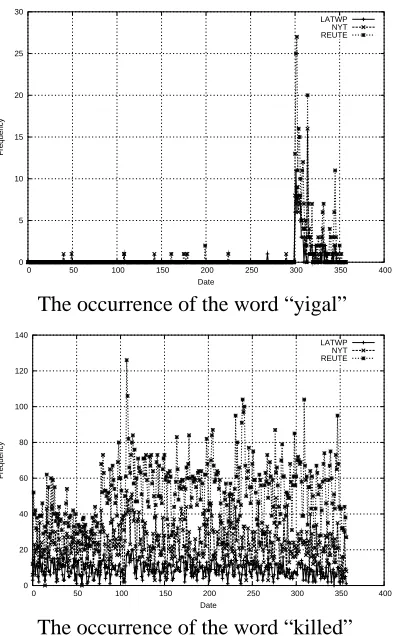
The occurrence of the word “yigal”
0
The occurrence of the word “killed”
Figure 1: The occurrence of two words in 1995
Consequently, if one has two sets of documents which are associated with each other, the distribu-tion of a certain name in one document set should look similar to the distribution of the name in the other document set.
We tried to use this characteristic of Named En-tities to discover rare names from comparable news articles. We particularly focused on the time series distribution of a certain word in two newspapers. We hypothesized that if a Named Entity is used in two newspapers, it should appear in both news-papers synchronously, whereas other words don’t. Since news articles are divided day by day, it is easy to obtain the time series distribution of words ap-pearing in each newspaper.
Figure 2 shows the time series distribution of the two words “yigal” and “killed”, which appeared in several newspapers in 1995. The word “yigal” (the name of the man who killed Israeli Prime Minister Yitzhak Rabin on Nov. 7, 1995) has a clear spike. There were a total of 363 documents which included the word that year and its occurrence is synchronous between the two newspapers. In contrast, the word “killed”, which appeared in 21591 documents, is spread over all the year and has no clear
character-istic.
3 Experiment
To verify our hypothesis, we conducted an experi-ment to measure the correlation between the occur-rence of Named Entity and its similarity of time se-ries distribution between two newspapers.
First, we picked a rare word, then obtained its document frequency which is the number of articles which contain the word. Since newspaper articles are provided separately day by day, we sampled the document frequency for each day. These numbers form, for one year for example, a 365-element in-teger vector per newspaper. The actual number of news articles is oscillating weekly, however, we nor-malized this by dividing the number of articles con-taining the word by the total number of all articles on that day. At the end we get a vector of fractions which range from 0.0 to 1.0.
Next we compared these vectors and calculated the similarity of their time series distributions across different news sources. Our basic strategy was to use the cosine similarity of two vectors as the likeli-hood of the word’s being a Named Entity. However, several issues arose in trying to apply this directly. Firstly, it is not always true that the same event is re-ported on the same day. An actual newspaper some-times has a one or two-day time lag depending on the news. To alleviate this effect, we applied a sim-ple smoothing to each vector. Secondly, we needed to focus on the salient use of each word, otherwise a common noun which constantly appears almost ev-ery day has an undesirable high similarity between newspapers. To avoid this, we tried to intensify the effect of a spike by comparing the deviation of the frequency instead of the frequency itself. This way we can degrade the similarity of a word which has a “flat” distribution.
In this section we first explain a single-word ex-periment which detects Named Entities that consist of one word. Next we explain a multi-word exper-iment which detects Named Entities that consist of exactly two words.
3.1 Single-word Experiment
In a single-word experiment, we used two one-year newspapers, Los Angeles Times and Reuters in 1995. First we picked a rare word which appeared in either newspaper less than 100 times throughout the year. We only used a simple tokenizer and con-verted all words into lower case. A part of speech tagger was not used. Then we obtained the docu-ment frequency vector for the word. For each word
fA(w, t) =dfA(w, t)/NA(t)
wheredfA(w, t)is the number of documents which contain the wordwat date tin newspaperA. The normalization constant NA(t) is the number of all articles at date t. However comparing this value between two newspapers directly cannot capture a time lag. So now we apply smoothing by the fol-lowing formula to get an improved version offA:
fA0 (w, t) = X
−W≤i≤W
r|i|fA(w, t+i)
Here we give each occurrence of a word a “stretch” which sustains forW days. This way we can cap-ture two occurrences which appear on slightly dif-ferent days. In this experiment, we used W = 2 andr= 0.3, which sums up the numbers in a 5-day window. It gives each occurrence a 5-day stretch which is exponentially decreasing.
Then we make another modification to fA0 by computing the deviation offA0 to intensify a spike:
fA00(w, t) = f
T is the number of days used in the experiment, e.g.
T = 365for one year. Now we have a time series vectorFA(w)for wordwin newspaperA:
FA(w) ={fA00(w,1), fA00(w,2), ..., fA00(w, T)}
Similarly, we calculated another time series
FB(w) for newspaper B. Finally we computed
sim(w), the cosine similarity of two distributions of the wordwwith the following formula:
sim(w) = FA(w)·FB(w)
|FA(w)||FB(w)|
Since this is the cosine of the angle formed by the two vectors, the obtained similarity ranges from −1.0to1.0. We usedsim(w)as the Named Entity score of the word and ranked these words by this score. Then we took the highly ranked words as Named Entities.
3.2 Multi-word Experiment
We also tried a similar experiment for compound words. To avoid chunking errors, we picked all consecutive two-word pairs which appeared in both newspapers, without using any part of speech tagger or chunker. Word pairs which include a pre-defined stop word such as “the” or “with” were eliminated. As with the single-word experiment, we measured the similarity between the time series distributions for a word pair in two newspapers. One different point is that we compared three newspapers1rather than two, to gain more accuracy. Now the ranking scoresim(w) given to a word pair is calculated as follows:
sim(w) =simAB(w)×simBC(w)×simAC(w)
where simXY(w) is the similarity of the distribu-tions between two newspapersXandY, which can be computed with the formula used in the single-word experiment. To avoid incorrectly multiply-ing two negative similarities, a negative similarity is treated as zero.
4 Evaluation and Discussion
To evaluate the performance, we ranked 966 sin-gle words and 810 consecutive word pairs which are randomly selected. We measured how many Named Entities are included in the highly ranked words. We manually classified as names the words in the following categories used in IREX (Sekine and Isa-hara, 2000): PERSON, ORGANIZATION, LOCA-TION, and PRODUCT. In both experiments, we re-garded a name which can stand itself as a correct Named Entity, even if it doesn’t stretch to the entire noun phrase.
4.1 Single-word Experiment
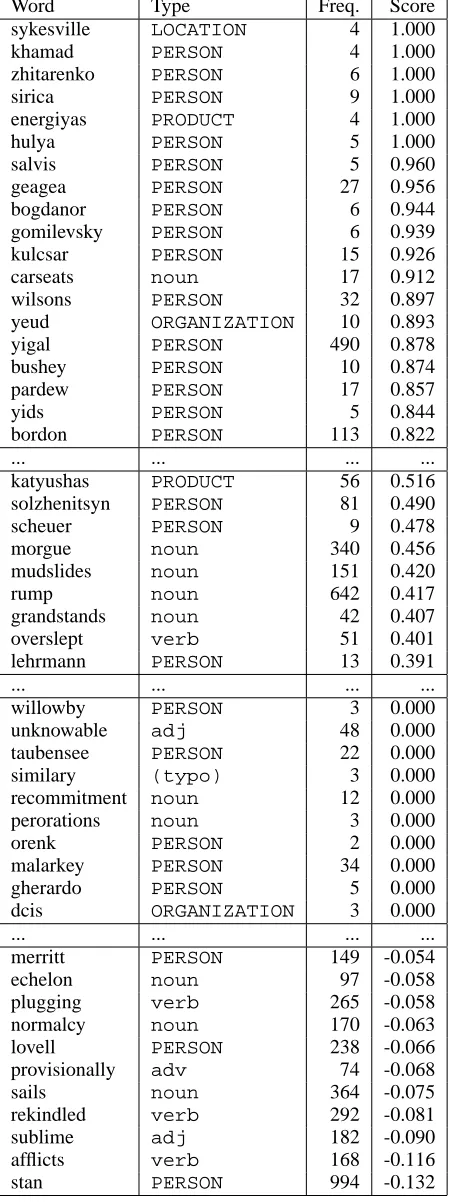
Table 1 shows an excerpt of the ranking result. For each word, the type of the word, the document fre-quency and the similarity (score) sim(w)is listed. Obvious typos are classified as “typo”. One can ob-serve that a word which is highly ranked is more likely a Named Entity than lower ones. To show this correlation clearly, we plot the score of the words and the likelihood of being a Named Entity in Fig-ure 2. Since the actual number of the words is discrete, we computed the likelihood by counting Named Entities in a 50-word window around that score.
Table 3 shows the number of obtained Named En-tities. By taking highly ranked words (sim(w) ≥
1
Word Type Freq. Score sykesville LOCATION 4 1.000
khamad PERSON 4 1.000
zhitarenko PERSON 6 1.000
sirica PERSON 9 1.000
energiyas PRODUCT 4 1.000
hulya PERSON 5 1.000
salvis PERSON 5 0.960
geagea PERSON 27 0.956
bogdanor PERSON 6 0.944
gomilevsky PERSON 6 0.939
kulcsar PERSON 15 0.926
carseats noun 17 0.912
wilsons PERSON 32 0.897
yeud ORGANIZATION 10 0.893
yigal PERSON 490 0.878
bushey PERSON 10 0.874
pardew PERSON 17 0.857
yids PERSON 5 0.844
bordon PERSON 113 0.822
... ... ... ...
katyushas PRODUCT 56 0.516 solzhenitsyn PERSON 81 0.490
scheuer PERSON 9 0.478
morgue noun 340 0.456
mudslides noun 151 0.420
rump noun 642 0.417
grandstands noun 42 0.407
overslept verb 51 0.401
lehrmann PERSON 13 0.391
... ... ... ...
willowby PERSON 3 0.000
unknowable adj 48 0.000
taubensee PERSON 22 0.000
similary (typo) 3 0.000
recommitment noun 12 0.000 perorations noun 3 0.000
orenk PERSON 2 0.000
malarkey PERSON 34 0.000
gherardo PERSON 5 0.000
dcis ORGANIZATION 3 0.000
... ... ... ...
merritt PERSON 149 -0.054
echelon noun 97 -0.058
plugging verb 265 -0.058 normalcy noun 170 -0.063 lovell PERSON 238 -0.066 provisionally adv 74 -0.068
sails noun 364 -0.075
rekindled verb 292 -0.081
sublime adj 182 -0.090
afflicts verb 168 -0.116 stan PERSON 994 -0.132
Table 1: Ranking Result (Single-word)
0 0.2 0.4 0.6 0.8 1
0 0.2 0.4 0.6 0.8
Likelihood
Score
Figure 2: Relationship of the score and the likeli-hood of being a Named Entity (Single-word). The horizontal axis shows the score of a word. The ver-tical axis shows the likelihood of being a NE. One can see that the likelihood of NE increases as the score of a word goes up. However there is a huge peak near the score zero.
0.6), we can discover rare Named Entities with 90% accuracy. However, one can notice that there is a huge peak near the scoresim(w) = 0. This means that many Named Entities still remain in the lower score. Most such Named Entities only appeared in one newspaper. Named Entities given a score less than zero were likely to refer to a completely differ-ent differ-entity. For example, the word “Stan” can be used as a person name but was given a negative score, be-cause this was used as a first name of more than 10 different people in several overlapping periods.
Also, we took a look at highly ranked words which are not Named Entities as shown in Table 2. The words “carseats”, “tiremaker”, or “neurotripic” happened to appear in a small number of articles. Each of these articles and its comparable counter-parts report the same event, but both of them use the same word probably because there was no other succinct expression to paraphrase these rare words. This way these three words made a high spike. The word “officeholders” was misrecognized due to the
Word Type Freq. Score
carseats noun 17 0.9121 tiremaker noun 21 0.8766 officeholders noun 101 0.8053 neurotrophic adj 11 0.7850 mishandle verb 12 0.7369
Words NEs All words 966 462 (48%)
sim(w)≥0.6 102 92 (90%)
sim(w)≤0 511 255 (50%)
Table 3: Obtained NEs (Single-word)
Word pairs NEs All word pairs 810 60 (7%)
sim(w)≥0.05 27 11 (41%)
sim(w)≤0 658 30 (5%)
Table 4: Obtained NEs (Multi-word)
repetition of articles. This word appeared a lot of times and some of them made the spike very sharp, but it turned out that the document frequency was undesirably inflated by the identical articles. The word “mishandle” was used in a quote by a per-son in both articles, which also makes a undesirable spike.
4.2 Multi-word Experiment
In the multi-word experiment, the accuracy of the obtained Named Entities was lower than in the single-word experiment as shown in Table 4, al-though correlation was still found between the score and the likelihood. This is partly because there were far fewer Named Entities in the test data. Also, many word pairs included in the test data incorrectly capture a noun phrase boundary, which may con-tain an incomplete Named Entity. We think that this problem can be solved by using a chunk of words instead of two consecutive words. Another notable example in the multi-word ranking is a quoted word pair from the same speech. Since a news article sometime quotes a person’s speech literally, such word pairs are likely to appear at the same time in both newspapers. However, since multi-word ex-pressions are much more varied than single-word ones, the overall frequency of multi-word expres-sions is lower, which makes such coincidence easily stand out. We think that this kind of problem can be alleviated to some degree by eliminating completely identical sentences from comparable articles.
The obtained ranking of word pairs are listed in Table 5. The relationship between the score of word pairs and the likelihood of being Named Entities is plotted in Figure 3.
5 Conclusion and Future Work
In this paper we described a novel way to discover Named Entities by using the time series distribution
Word Type Freq. Score
thai nation ORG. 82 0.425 united network ORG. 31 0.290 government open - 87 0.237 club royale ORG. 32 0.142
columnist pat - 81 0.111
muslim minister - 28 0.079
main antenna - 22 0.073
great escape PRODUCT 32 0.059 american black - 38 0.051 patrick swayze PERSON 112 0.038 finds unacceptable - 19 0.034 mayor ron PERSON 49 0.032 babi yar LOCATION 34 0.028
bet secret - 97 0.018
u.s. passport - 58 0.017
thursday proposed - 60 0.014 atlantic command ORG. 30 0.013 prosecutors asked - 73 0.011 unmistakable message - 25 0.010
fallen hero - 12 0.008
american electronics ORG. 65 0.007
primary goal - 138 0.007
beach boys ORG. 119 0.006 amnon rubinstein PERSON 31 0.005
annual winter - 43 0.004
television interviewer - 123 0.003 outside simpson - 76 0.003 electronics firm - 39 0.002 sanctions lifted - 83 0.001 netherlands antilles LOCATION 29 0.001
make tough - 60 0.000
permanent exhibit - 17 0.000
Table 5: Ranking Result (Multi-word)
0 0.2 0.4 0.6 0.8 1
0 0.02 0.04 0.06 0.08 0.1
Likelihood
Score
of names. Since Named Entities in comparable doc-uments tend to appear synchronously, one can find a Named Entity by looking for a word whose chrono-logical distribution is similar among several compa-rable documents. We conducted an experiment with several newspapers because news articles are gener-ally sorted chronologicgener-ally, and they are abundant in comparable documents. We confirmed that there is some correlation between the similarity of the time series distribution of a word and the likelihood of being a Named Entity.
We think that the number of obtained Named En-tities in our experiment was still not enough. So we expect that better performance in actual Named Entity tagging can be achieved by combining this feature with other contextual or lexical knowledge, mainly used in existing Named Entity taggers.
6 Acknowledgments
This research was supported in part by the De-fense Advanced Research Projects Agency as part of the Translingual Information Detection, Extrac-tion and SummarizaExtrac-tion (TIDES) program, un-der Grant N66001-001-1-8917 from the Space and Naval Warfare Systems Center, San Diego, and by the National Science Foundation under Grant ITS-00325657. This paper does not necessarily reflect the position of the U.S. Government.
References
Regina Barzilay and Kathleen R. McKeown. 2001. Extracting paraphrases from a parallel corpus. In
Proceedings of ACL/EACL 2001.
Michael Collins and Yoram Singer. 1999. Unsuper-vised models for named entity classification. In
Proceedings of EMNLP 1999.
Satoshi Sekine and Hitoshi Isahara. 2000. IREX: IR and IE evaluation-based project in Japanese. In Proceedings of LREC 2000.
Satoshi Sekine, Kiyoshi Sudo, and Chikashi No-bata. 2002. Extended named entity hierarchy. In
Proceedings of LREC 2002.
Yusuke Shinyama and Satoshi Sekine. 2003. Para-phrase acquisition for information extraction. In
Proceedings of International Workshop on Para-phrasing 2003.
Tomek Strzalkowski and Jin Wang. 1996. A self-learning universal concept spotter. In
Proceed-ings of COLING 1996.