Mylar: A Platform for Encrypted Data Access Controller in
Web Applications
Arun Kumar Silivery
1,Suvarna S
21
Dept of CSE,Raja Mahendra College of Engineering,Ibrahimpatnam,Hyderabad, Telangana.
2
Assistant Professor,Dept of CSE,Raja mahendra College of Engineering,Ibrahimpatnam,Hyderabad,
Telangana
Abstract:
We build up a systematic approach for
evaluating client and server applications that
plan to hide sensitive client information from
untrusted servers. We at that point apply it to
Mylar, a structure that utilizes multi-key
searchable encryption (MKSE) to manufacture
Web applications over encrypted data. This
paper presents Mylar, a stage for building web
applications, which secures information
confidentially against malwares with full access
to servers. Mylar stores sensitive information
encoded on the server and decoded that
information just in clients’ programs. Mylar
tends to three difficulties in making this
approach work. In the first place, Mylar permits
the servers to play out the keyword search over
encoded records, regardless of the possibility
that the reports are encrypted with various keys.
Second, Mylar enables clients to share keys and
encoded information safely within the sight of a
dynamic adversary. At last, Mylar guarantees
that customer side application code is genuine,
regardless of the possibility that the server is
malicious.
Keywords: Mylar, Multi-key Search, IDP and
client –server side Applications.
I. INTRODUCTION
The modern Web and mobile applications are
built utilizing the client and server structural
design: clients collaborate with the application’s
customers in clients' browsers or gadgets, while
the server is dependable for centralized storage
and management of clients' information. This
outline offers attractive adaptability and
performance in the event that the server is
compromised; the attacker accesses each client's
information. Regardless of the possibility that
this information is encrypted very still yet
decrypted when the server works on it, it is
potentially presented to a persevering or lucky
attacker. Client side encryption can relieve the
harm from server compromise by guaranteeing
that the server just observes encrypted clients’
information and never decrypted it. By
unfortunately, if the server goes about as a
"dumb" storage and communication medium, all
operations on the information must be
performed by the customers, relinquishing the
technique. A promising methodology is to give
every client their own encryption key, encrypt a
client's information with that client's key in the
web program, and store just encrypted
information on the server. This model
guarantees that an adversary would not have the
capacity to peruse any confidential data on the
server, since they don’t have the fundamental
decryption keys. Actually, this model has been
as of now embraced by a few protection
conscious web applications. Sadly, this approach
experiences from three huge security,
functionality, and effectiveness shortcomings.
Initial, a traded off server could give malicious
customer side code to the browser program and
concentrate the client's key and information.
Guaranteeing that the server did not corrupt with
the application code is troublesome in light of
the fact that a web application comprises of
many documents, for example, HTML pages,
JavaScript code, and CSS templates, and the
HTML pages are regularly created. Second, this
approach does not give information sharing
between clients, a significant capacity of web
applications. To address this issue, one should
seriously think about encrypted shared reports
with separate keys, and conveying each key to
all clients sharing an archive by means of the
server. In any case, distributing keys through
the server is challenging since a compromised
server can supply arbitrary keys to clients, and in
this way trap a client into utilizing invalid keys.
Third, this approach requires that the greater part
of the application logic keeps running in a
client's browser program since it can decrypt the
client's encrypted information. In any case, this
is frequently impractical: for example, doing a
keyword search would require downloading
every one of the reports to the browser program.
II. SECURITY MODEL FOR MULTI-KEY
SEARCHABLE ENCRYPTION (MKSE)
Mylar depends on a multi-key searchable
encryption (MKSE) technique created by Popa
and Zeldovich. Popa et al. argue that Mylar is
secure by speaking to the cryptographic
evidences of security for this present scheme.
Mylar's multi-key search model gives a
straightforward abstraction. In the event that a
client needs to look for a word in a set of
archives on a server, each encrypted with an
alternate key, the client's machine needs to give
just a single search token for that word to the
server. The server, in turn, restores each
encrypted report that contains the client’s
keyword, as long as the client approaches that
archive’s key. The instinct for our plan is as per
the following. Say that the documents that a
client approaches are encrypted under keys
and the client's own particular key is
uk. The client’s machine figures a search token
for a word w utilizing key uk, indicated . In
the event that the server had ... of
, the server could compare the search token
against the encrypted reports utilizing a current
searchable encryption model. Our thought is to
without anyone else; that is, to alter the
underlying to for each i. To enable the
server to play out the change, the client’s
machine should at first register deltas, which are
cryptographic values that empower a server to
adjust a token starting with one key then onto
the next key. We utilize Δ uk→ to indicate the
delta that enables a server to change to
. These deltas indicate to the client's access to
the archives, and critically, these deltas can be
reused for each keyword search, so the client's
machine needs to create the deltas just once. For
instance, if Alice wants to access Bob's
information, she needs to give one delta to the
server, and the server will be ready to alter every
single future token from Alice to Bob's key. This
paper exhibits the multi-key search model at a
abnormal state, with accentuation on its interface
and security properties as required in our
framework. Figure shows pseudocode for our
multi-key search model.
Figure 1: Mylar’s multi-key search scheme
We build the multi-key search model using
bilinear maps on elliptic curves, which, at a
elevated level, are functions e: G1 ×G2 → GT,
where G1, G2, and GT are special groups of
primary order p on elliptic curves. Let g be a
generator of G2. Let H and H2 be definite hash
functions on the elliptic curves. e has the
property that e(H(w)a,gb) = e(H(w),g)ab.
III. MYLAR SYSTEM OVERVIEW
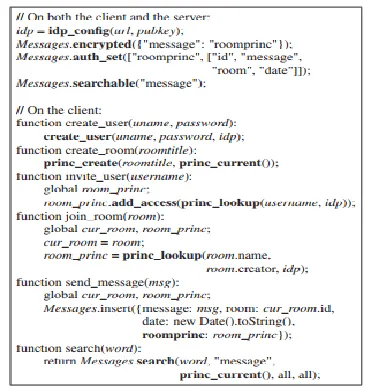
To secure this application with Mylar, a
developer utilizes Mylar's API (Figure 2), as we
clarify in whatever is left of this paper. There are
three distinct parties in Mylar: the clients,
website owners, and the server administrator.
Mylar will probably enable the site owner to
ensure the confidential information of clients in
the face of a malicious or compromised server
administrator. To start with, the developer
utilizes Mylar's authentication library for client
login and account creation. On the off chance
that the application enables a client to pick what
different clients to share information to, the
developer also indicate the URL and public key
of a convictional IDP. Second, the developer
determines which information in the application
should be encrypted, and who should have
approach to it. Mylar utilizes principals for
access to control; a principle compares to a
public/private key pair, and speaks to an
application-level access control element, for
example, a client, a group, or a common archive
(document). In our model, all information is
developer explains every collection with the set
of fields that contain sensitive information and
the name of the central that should approach that
information (i.e., whose key should be utilized).
Third, the developer determines which
principals in the application approach which
different principals. For illustration, if Alice
needs to welcome Bob to a secret chat, the
application must conjure the Mylar customer to
grant Bob’s principle access to the chat room
primary. Fourth, the developer changes their
side code to summon the Mylar
server-side library when performing keyword search.
Our model's client side library gives capacities
for normal operations, for example, keyword
search over a particular field in a MongoDB
collection.
Figure 2: Mylar API for application developers
split in three sections: authentication,
encryption/integrity annotations, and access
control.
At last, as a major aspect of introducing the web
application, the site owner creates a
public/private key pair, and signs the
application's documents with the private key
utilizing Mylar’s packaging tool. To get the full
security certifications of Mylar, a client must
install the Mylar browser program extension,
which recognizes corrupted code.
3.1 User Identity provider Service (IDP): An
application needs the IDP if the application has
no trusted method for confirming the clients who
make accounts; what’s more, the application
enables clients to pick whom to share
information with. For instance, if Alice needs to
share a sensitive document with Bob, Mylar's
customer needs public key of Bob to encrypt the
document. A compromised server could give
public key of a malicious attacker, so Mylar
needs an approach to check public key. The IDP
helps Mylar play out this check by marking the
client' public key what’s more, username. An
application does not require the IDP if the site
owner needs to secure against just passive
attacks, or if the application has a restricted
sharing pattern for which it can utilize a static
foundation of trust. An IDP can be shared by
numerous applications, comparable to an
OpenID supplier [30]. The IDP does not store
per application state, and Mylar contacts the IDP
just when a client initially makes a account in an
application; a short time later, the application
server stores the authentication from the IDP.
3.2 Client and Server side Library: Every
client has a private/public key pair. The
customer side library stores the private key of
the client at the server, encrypted with the
client side library gets and decrypts the client's
private key. For shared information, Mylar's
customer makes isolate keys that are
additionally put away at the server in encoded
form. Server-side library performs calculation
over encrypted information at the server. In
particular, Mylar supports keyword search over
encoded information, since we have discovered
that numerous applications utilize keyword
search.
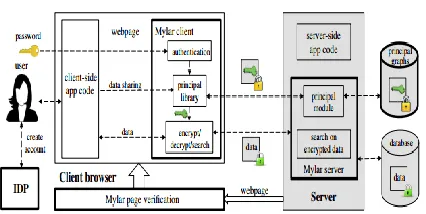
Figure 3: Mylar: A Platform for Encrypted data
access controller
3.3 Browser extension: Every client of Mylar
applications should install the Mylar program
extension in their browser program, which
checks that Mylar applications are legitimately
marked before running them. It is responsible
for checking that the client side code of a web
application that is filled from the server has not
been crashed with. In this manner, as long as the
site owner incorporates the public key in every
single such authentication, at that point clients
going to the right site by means of https will
gain the owner's public key, and will confirm
that the page was marked by the owner.
3.4 Client Side Code Verification: Mylar
utilizes encryption to ensure secret information
put away on the untrusted server, the
cryptographic keys what's more, the plaintext
information are both accessible to code
executing in the client's web browser. Mylar
requires the webpage owner to make a
public/private key pair, and to sign the
application's top level HTML page with the
private key. Any references to other content
must refer to the secondary origin, and must be
enlarged to incorporate a mylar_hash=h
parameter in the query string, determining the
normal hash of the reaction. The hash keeps an
adversary from messing with that substance or
moving it back to a prior version.
Figure 4: Mylar’s code verification extension
Rollback adversaries are available on the best
level HTML, yet all things considered, the
whole application is moved back: hashes keep
the adversary from moving back a few however
not the greater part of the records, which could
be confuse the application.
IV. PROTECTING SENSITIVE DATA
SHARING METHOD
To empower sharing, every delicate information
item is encrypted with a key available to clients
who share the item. To keep the server from
corrupting during key propagation, Mylar gives
a component to building up the rightness of keys
declaration ways to bear witness to public keys,
and enables the application to indicate what
endorsement ways can be trusted in each
utilization setting. In combination with a UI that
shows the suitable endorsement parts to the
client, this procedure guarantees that even a
compromised server can't trap the application
into utilizing the wrong key.
a. Access graph: Mylar requires the application
to express its access control strategy regarding
access connections between principals.
Specifically, if Principle A can get to important
B's private key, at that point we say approaches
to B. The approaches connection is transitive: if
B thusly approaches C, at that point A can get to
C's private key too. To express the application's
approach in the access graph, the application
must make proper approaches connections
between principals. The application can likewise
make middle of the road principals to speak to,
say, groups of clients that all should approach
similar private keys.
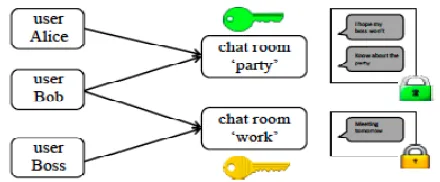
Figure 5: Example access graph for a chat
application
b. Computing Keyword Search on encrypted
Data
Keyword search is a typical operation in web
applications; however it is regularly impractical
to keep running on the customer since it would
require downloading a lot of information to the
client's machine. While there exist functional
cryptographic techniques for keyword search,
they require that information be encoded with a
single key. This restriction makes it hard to
apply these plans to web applications that have
numerous clients what’s more, thus have
information encrypted with a wide range of
keys. Mylar gives the principal cryptographic
plan that can perform keyword search
effectively over information encoded with
various keys. The customer gives an encrypted
word to the server and the server can restore all
documents that contain this word, without taking
in the word or the contents of the reports
(Documents).
c. Integrating search with the principal graph
Mylar incorporates the multi-key search
technique with the essential chart as takes after.
At the point when an principle P is made, Mylar
produces a key utilizing KEYGEN (Figure
1). At whatever point P gets access to some new
principle A, Mylar incorporates in the
wrapped key for P. The first time through a
client with access to P comes on the web, the
Mylar customer in that client's browser program
recovers kA from the wrapped key, processes
Δ → ←DELTA( , ), and stores it at the
server. This delta calculation happens only once
for a pair of principals. To encrypt a record for
some central A, the client’s program encrypts
each word w in the record independently
utilizing ENC ( , w). Since the multi-key
Mylar encrypts all accessible reports twice: once
with the multi-key search technique, for seeking,
and once with a customary encryption conspire
like AES, for unscrambling. To look for a word
w with principle P, the client’s customer utilizes
TOKEN ( , w) to register a token tk, and sends
it to the server. To seek over information
encrypted for principle A, the server acquires
Δ → , and employments ADJUST (tk,
Δ → ) to alter the token from to ,
acquiring the balanced token at . At that point,
for each document encoded under kA with
haphazardness r, the server figures v ←
COMBINE(r, at ) and checks if v exists in
the record utilizing a list. The server computes
the same process for every single other principle
that P approaches. Coordinating the access graph
with keyword search raises two challenges. 1)
The primary originates from the reality that our
multi-key search technique permits modifying
tokens just once. In the basic instance of an
access graph where all ways from a client to the
information's encryption key comprise of one
edge, (for example, the chart in Figure 5), Mylar
partners the pursuit delta with the edge, and
stores it along with the wrapped key. In our talk
illustration, this permits a client’s browser
program to seek over all talk rooms that the
client approaches, by sending only one search
token. 2) The second test originates from the
way that looking over information provided by a
adversary can release the word being hunt down.
For instance, assume a adversary makes a
document containing every one of the words in a
lexicon, furthermore, gives the client access to
that archive. On the off chance that the client
scans for a word w in the greater part of the
documents he has access to, including the one
from the adversary, the server will see which of
the words in the adversary 's archive matches
the client's token, and subsequently will know
which lexicon word the client scanned for. To
keep this, clients should unequivocally
acknowledge access to a mutual archive, what’s
more, designers must invoke the allow search
work, given by Mylar to this reason, as fitting.
V. PERFORMANCE ANALYSIS
We quantified the performance of kChat, the
homework accommodation application
("submit"), what’s more, the endometriosis
application. Despite the fact that kChat has just a
single encrypted field, each message sent
activities this field. We utilized two machines
running recent versions of Debian Linux to play
out our analyses. The server had an Intel Xeon
2.8 GHz processor and 4 GB of RAM; the
customer had eight 10-center Intel Xeon
E7-8870 2.4 GHz processors with 256 GB of RAM.
The customer machine is fundamentally more
capable to enable us to run enough browser
programs to saturate the server. For browser
latency tests, we simulate a 5 Mbit/s client and
server system with 20 msec round-trip latency.
All analyses were done over https, utilizing
nginx as an https turn around proxy on the
server.
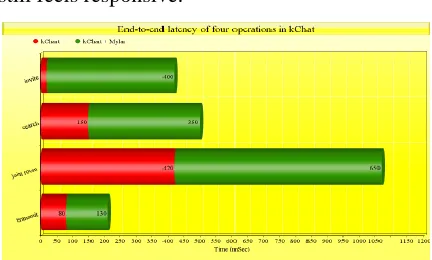
a. End-to-end latency in kChat: Mylar
transmitting a message, joining a room, hunting
a word in all rooms, and welcoming a client to a
room. For message transmission, we analyze the
time from the sender clicking "send" until the
point that the message renders in the
beneficiary’s browser. This is the most
successive operation in kChat, and Mylar
includes just 50 msec of latency to it. This
distinction is for the most part because of
accessible encryption, which takes 43 msec. The
most overhead is for welcoming a client,
because of primary operations: turning upward
and checking a client important (218 msec) and
wrapping the key (167 msec). By and large, we
trust the subsequent latency is adequate for some
applications, and subjectively the application
still feels responsive.
Figure 6: End-to-end latency of four operations in
kChat
b. Server throughput for kChat: To analyze
Mylar's effect on server throughput, we utilized
kChat, and we set up many sets of programs like
a sender and a beneficiary, where the sender
persistently sends new messages. Recipients
check the add up to number of messages got
during a period of time. Figure 10 demonstrates
the outcomes, as a component of the aggregate
number of customers (each pair of browsers
considers 2 customers). Mylar reduces the
greatest server throughput by 17%. Since the
server does not play out any cryptographic
operations, Mylar’s overhead is because of the
expansion in message measure caused by
encryption, and the encrypted search file that is
added to each message to make it accessible.
Figure 7: Server throughput for kChat
VI .CONCLUSION
The Mylar system for building web applications
on best of encoded information was guaranteed
to be secure against dynamic attacks. Mylar
depends on a multi-key searchable encryption
(MKSE) technique, which was demonstrated
secure in the formal model proposed by Popa
and Zeldovich. Mylar use the current move to
exchanging information, as opposed to HTML,
between the browser program and server, to
encode all information put away on the server,
what’s more, decode it just in clients' browser
programs. Mylar gives a principle reflection to
safely share information between clients, what’s
more, utilizes a browser program expansion to
check code downloaded from the server that
keeps running in the browser program. For
keep running in the browser program, Mylar
proposes a cryptographic technique with
perform keyword search at the server over
encrypted data with various keys.
VII. REFERENCES
[1] M. Bellare, A. Boldyreva, and A. O’Neill.
“Deterministic and efficiently searchable
encryption”. In CRYPTO, 2007.
[2] A. Boldyreva, N. Chenette, Y. Lee, and A.
O’Neill. “Order-preserving symmetric
encryption”. In EUROCRYPT, 2009.
[3] D. Boneh, K. Lewi, M. Raykova, A. Sahai,
M. Zhandry, and J. Zimmerman. “Semantically
secure order-revealing encryption: Multi-input
functional encryption without obfuscation”. In
EUROCRYPT, 2015.
[4] D. Cash, P. Grubbs, J. Perry, and T.
Ristenpart. “Leakage-abuse attacks against
searchable encryption”. In CCS, 2015.
[5] D. Cash, J. Jaeger, S. Jarecki, C. S. Jutla, H.
Krawczyk, M.-C. Rosu, and M. Steiner.
“Dynamic searchable encryption in very-large
databases: Data structures and implementation”.
In NDSS, 2014.
[6] D. Cash, S. Jarecki, C. Jutla, H. Krawczyk,
M.-C. Ro¸su, and M. Steiner. “Highly-scalable
searchable symmetric encryption with support
for Boolean queries”. In CRYPTO, 2013.
[7] P. Chapman and D. Evans. “Automated
black-box detection of side-channel
vulnerabilities in Web applications”. In CCS,
2011.
[8] S. Chen, R. Wang, X. Wang, and K. Zhang.
“Side-channel leaks in Web applications: A
reality today, a challenge tomorrow”. In S&P,
2010.
[9] R. Cheng, W. Scott, P. Ellenbogen, J.
Howell, and T. Anderson. “Radiatus: Strong
user isolation for scalable Web applications”.