Automatic Treadmill Speed Control with Heart
Rate and Hemoglobin Level Sensor System
Jagatheshkumr.S1, Vishnu.S2, L.Jenibha3
Assistant Professor, School of Electronics,Vignan’s University, Guntur, Andhra Pradesh, India1
Assistant Professor, School of Electronics, Vignan’s University, Guntur, Andhra Pradesh, India2
PG Student, Dept. of EEE, Coimbatore Institute of Technology, Coimbatore, Tamilnadu, India3
ABSTRACT: Treadmill is an exercise machine which is used for walking or running while staying in the same place. The proposed system accords a method to control the treadmill speed automatically with respect to the person’s heart rate and Hemoglobin. A low hemoglobin count can leave tired, weak, dizzy and give an increased heart rate to the person. Normal range of Hemoglobin ranges from 14 to 18 for men and 12 to 16 for women, with any reading below 10 being cause for serious concern. Lower-impact exercising such as lifting light weights, aquatic exercise and walking can help keep you safe when you work out with a low hemoglobin count. Also the pulse rate of a person may vary while exercising, according to the medical condition of the person. Since the exercising of the body causes adverse effects on the heart rate, it is important to control the speed of the treadmill to maintain the heart rate in a balanced level. Hence in this proposed system speed of the treadmill is controlled according to the Heart rate when the person has hemoglobin level of normal range or more than normal range. A newly developed LED based sensor system is used to determine the Heart rate and Hemoglobin level noninvasively. The speed of the motor (treadmill) is set differently according to the input heart rate range and Hemoglobin level. Since PMDC motor has higher torque level than the DC motors during lower speeds, it is used for controlling the treadmill. Voltage given to the motor is regulated by a controller by generating PWM signal.
KEYWORDS: Hemoglobin;treadmill; noninvasive; PWM; Heart rate
I.INTRODUCTION
Hemodynamic parameters such as heart rate and blood hemoglobin level are the important parameters in evaluating the physiological status of an individual. Treadmill is an exercising machine used for walking and running while staying in same place. Treadmill provides a moving platform with a wide conveyor belt driven by an electric motor or a flywheel. The belt moves to the rear requiring the user to run at a speed matching with that of the conveyor belt. The speed rate of the conveyor belt is the rate of the running or walking. Thus the speed of the running may be controlled and measured.
A. RELATED WORK
variation in the PWM technique. [1]A treadmill controlled by a computer along with data collection and processing system is implemented for the monitoring and control of heart rate while performing the treadmill exercise. In order to minimize the deviations of heart rate from a predefined profile, the motor speed and the gradient of the treadmill are controlling carefully. Also for measuring the heart rate a simple and practical algorithmic is developed. [3]For estimating the heart rate and the hemoglobin concentration in non-invasive manner a sensor is using in the fingertip. The signal receiving from the fingertip is processed by using a microcontroller. [8].Pulse oximeter is a simple device, but it can detect body healthy situation. Because it can be designed into a small device, it is a welcome device in our daily life. The core theory behind the pulse oximeter is the variance of absorption level of photons going through the human tissues at different wavelength. The human’s blood consists of oxygenated hemoglobin and deoxygenated hemoglobin and these are having stronger absorbers of lighting in the wavelength ranges from 650nm to 1000nm. In this wavelength range, the other tissues in the body, for instance water and fat, have a very low absorption coefficient comparing withoxygenated hemoglobin and deoxygenated hemoglobin. Also the good news is that the light absorption of Hb and deoxy-Hb at the two different wavelengths is different. When the light in the range of 650nm is applied to the human body major amount of photons will be absorbed by the deoxygenated hemoglobin and vice versa, if the wavelength is around 1000nm, a majority part of photons can be absorbed by Hb. Thus, the ratio of absorption at the two different wavelengths can be used to determine the oxygen saturation.
II. SYSTEM DESCRIPTION
A. EXERCISING WITH VARIOUS HEART RATE AND HEMOGLOBIN LEVELS
A low hemoglobin level can leave tired, dizzy and give an increased heart rate. Any reading below 10g/dl being cause for series concert. Lower impact exercise such as walking, lifting light weights and aquatic exercise can help keep the person safe when he works out with low hemoglobin count. The heart rate also may vary while exercising, according to the medicalcondition of the person. Since the exercising of the body causes adverseeffects on the heart rate, so heart rate should be maintained in the correct level by controlling the speed of the motor. In the proposed system the speed of treadmill is controlled according to the heart rate when the person has hemoglobin level of normal or more than normal range.
B. BLOCK DIAGRAM
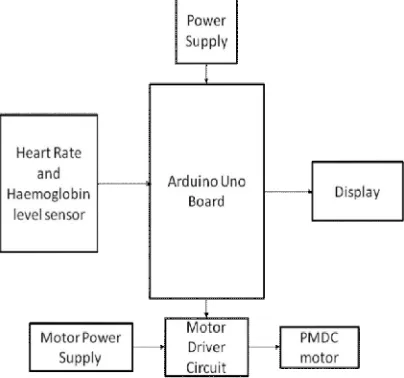
The proposed method is illustrated in the block diagram shown in Figure.1. Heart rate and Hemoglobin levels are detected noninvasively by using the LED based sensor system. Signal conditioning of the signals is done in between which is not included in the block.The Heart Rate and Hemoglobin level sensor system detects the heart rate and hemoglobin level of the person running on the treadmill. If the level of Hemoglobin (<10g/dl) is very low, exercise is not advised. If the hemoglobin level is low (10<Hb<12)g/dl means walking is preferred. If the Hemoglobin level is normal or greater than normal then controlling of motor is done based upon the heart rate level.The heart rate and hemoglobin level is sensed and is passed to the Arduino Uno controller
Pulse Width Modulated output from the controller is used for controlling the speed of the motor. The motor speed increases and decreases according to the heart rate. A simple permanent magnet DC motor is used for controlling the treadmill. Since a permanent magnet DC motor is used in the proposed method, rectification of the signal is required. The separate motor drive circuit for PMDC motor is shown in Figure 2.
Fig.2 Motor Drive Circuit
III. HEART RATE AND HEMOGLOBIN LEVEL SENSOR SYSTEM
Presently clinically used methods for Hemoglobin measurement are Spectrophotometry, Hemoglobin cyanide and conductivity based method. However, in these method the blood sample should be taken from human body for testing. This is painful and it will take more time for getting the results also. But in the proposed system non-contact LED based sensor is using for measuring the hemoglobin.
A. SYSTEM OVERVIEW
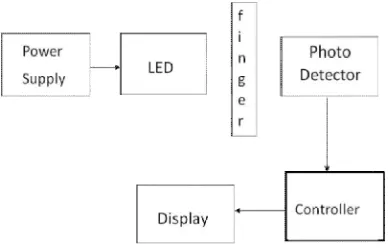
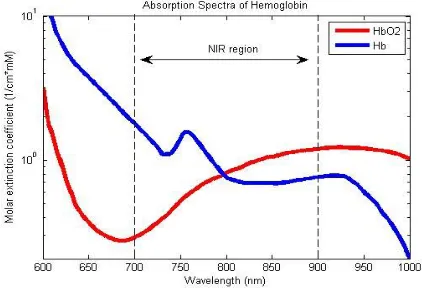
Basic block diagram of noninvasive hemoglobin and heart rate measurement system are described in figure (3). The noninvasive LED based sensor systems allow a continuous measurement of the hemoglobin concentration and heart rate level which is based on a pulse photometric measurement method. Thereby an area of skin on the fingertip is transilluminated by a LED light in the range from 750nm -850nm. Figure 4 describe the absorption spectra for oxy and deoxyhemoglobin. The objective of the sensor system described here is the non-invasive continuous measurement of heart rate and light absorbent blood components(hemoglobin) in the blood of the human finger.
Fig 3 Block diagram of hemoglobin and heart rate measurement system
Fig 4 Absorption spectra of oxy- and deoxyhemoglobin
A wavelength which is suited for the monitoring of hemoglobin concentration changes was selected. The principle for the measurement of Hemoglobin and Heart rate is based on the fact of a substantial absorption or transmission difference of light in near infrared region. Since both the oxy and deoxyhemglobin has the same extinction coefficient in 800nm, this wavelength is used for the measurement of Hemoglobin and Heart rate level.
B. MATHEMATICAL IMPLEMENTATION
Hemoglobin is a molecule in the red blood cells which has a role of delivering oxygen to tissue cells. Hemoglobin contains four home groups and a protein group called globin. For all spectrophotometric experiments, Beer-Lambert’s law is used and developed the notation of absorbance to express the absorption of light as a function of hemoglobin concentration as given in equatation:
OD=log(I0/I)=ɛcl
Where OD is the optical density, I0 is the intensity of incident light on the finger, I is the light intensity of transmitted
light, ε is the extinction coefficient of hemoglobin at a particular wavelength, c is the concentration of hemoglobin, and
L (Assume 1cm) is the length of light path through solution.
C. Controlling Speed of Motor
• If Hb is very low (<10) then exercise is not advised.
• If Hb is low (10<X<12) then walking is preferred (duty cycle is 25%)
• If Hb is normal and greater than normal (>12), based on heart rate level duty cycle is selected • If HR<50 then duty cycle is 90%
• If 50<HR<75 then duty cycle is 75% • If 75<HR<100 then duty cycle is 50% • If HR>100 then duty cycle is 25%
IV. CIRCUIT ANALYSIS
necessary step because the AC component is very small in magnitude, compared to the DC offset which it is riding upon. Theoretically, a magnification of the order of magnitude of 104 is necessary to view the AC (high frequency) signal clearly.
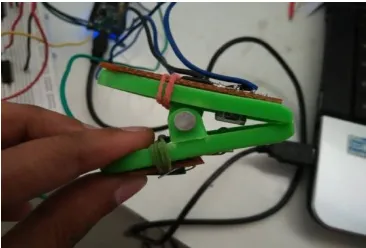
OPT101 transimpedance amplifier is using to detect the transmitted light from the finger. The OPT101 is a monolithic photo detector with on-chip transimpedance amplifier. This photo detector is installed in the lower shell of the finger clip. The probe is placed to the person’s finger. Infrared light is then emitted through the body tissue. The transmitted light is sensed by photo detector. Out-put voltage of photodiode increases linearly with light intensity of the transmitted light from the finger. The amplifier is designed for single or dual power supply operation for making it ideal for battery operated equipment. Integrated combination of both photodiode and transimpedance amplifier on a single chip eliminates the problems in discrete designs such as leakage current errors, gain peaking due to stray capacitance and noise pick-up. The 0.09 × 0.09-inch photodiode is operated in the photoconductive mode for low dark current and excellent linearity. The photo detector operates from +2.7V to +36V supplies and quiescent current is about 120μA. It is available in clear plastic 8-pin DIP, and the Temperature range is 0℃ to + 70℃.
V. RESULT AND ANALYSIS
An optical sensor is developed for the measurement of hemoglobin and heart rate by using wavelength- 800nm.Aurdino Uno controller is used to detect the output signal from photo detector for various subject and corresponding output voltage is also measured. The output wave form is obtained by using CRO. Voltage observed is as shown in Table 1: Source wave length is of 800nm:
Hemoglobin level(g/dl)
Output voltage(V)
14 0.5
15 0.6
12.8 0.59
12.5 0.54
Fig 5 Simulation Result in Proteus
In simulation a sine wave is given instead of the signal from photo detector. For that sine wave, frequency and amplitude is calculated using interrupt service routine in Arduino Uno board.The difference between maximum amplitude and minimum amplitude is proportional to the level of Hemoglobin. Multiplying 60 with frequency gives the heart rate of the person.A dc motor is controlled by generating PWM signals with various duty cycles based on the heart rate when the person has hemoglobin level of normal range.The heart rate (in bpm) is the frequency of the signal from photo detector multiplied by 60, since the frequency of the signal is calculated as number of cycles or beats per second. Beer Lambert Law which a relation between absorbance and concentration of absorbing species, is used to estimate hemoglobin level in this work.
Fig 6 Sensor Design
In the proposed system the parameters to the Beer Lambert Law are the input voltage to the sensor and output voltage from the sensor (photo detector). The parameters are measuring with and feeding to the microcontroller. The calculations are performed by taking the mean value of the measurements over the input time. In order to get the input voltage(Vin) and output voltage(Vout) the reflected light is monitored. Instead of incident and reflected intensities in the equation the Vin and Vout are using, because they are having linear dependence with intensities.
The hemoglobin concentration is calculating by using the equation shown below.
−
= 10
ɛVI. CONCLUSION
A system is developed to control the speed of a treadmill according to the person’s heat rate and hemoglobin level. The system is able to maintain the heart beat in the balanced level. LED based sensor system is developed to determine the heart rate and hemoglobin level non-invasively.
REFERENCES
[1] Greeshma.C.R.,Dr.N.P.Ananthamoorthy, “Automatic Treadmill Speed Control with Heart Rate”, internatinal conference for Trends in Engineering & Technology, Volume 3 issue 1, 2015 – ISSN- 9303.
[2] Arthur S. Leon, Barry A. Franklin, Fernando Costa, Gary J. Balady, Kathy A. Berra, Kerry J. Stewart, Paul D. Thompson, Mark A. Williams
and Michael S. Lauer, ―Cardiac Rehabilitation and Secondary Prevention of Coronary Heart Disease‖, Circulation. 2005;111:369-376 [3] Chen-Yi Chu, Shu-Yun Lu, Kuei-Fu Lin, ―Influences of exercise experience and exercise settings on heart rate responses during selfselected
intensity exercises‖, Elsevier J Exerc Sci Fit, Vol 8, No 2, 73–77, 2010.
[4] Y. Yorozu, M. Hirano, K. Oka, and Y. Tagawa, “Electron spectroscopy studies on magneto-optical media and plastic substrate interface,” IEEE Transl. J. Magn. Japan, vol. 2, pp. 740-741, August 1987 [Digests 9th Annual Conf. Magnetics Japan, p. 301, 1982].
[5] U. Timm, E. Lewis, D. McGrath, J. Kraitl, H. Ewald, "LED Based Sensor System for Non-Invasive Measurement of the Hemoglobin Concentration in Human Blood", IFMBE Proceedings Vol. 23, 825- 28, 2008.
[6] Suzaki, H.; Kobayashi, “Noninvasive measurement of total hemoglobin and hemoglobin derivatives using multiwavelength pulse spectrophotometry - In vitro study with a mock circulatory system” EMBS 28th Annual International Conference of the IEEE, 2006 .
[7] Dr RavikiranKisan, Dr Swapnali Ravikiran Kisan, Dr Anitha and Dr Chandrakala, ―Treadmill and Bicycle Ergometer Exercise:
Cardiovascular Response comparison‖, Global Journal Of Medical Research, Volume 12 Issue 5 Version 1.0 June 2012.
[8] Rajashree Doshi , Anagha Panditraom,”Noninvasive optical sensor for Hemoglobin Determination”, International Journal of Engineering Research and Applications (IJERA) ISSN: 2248-9622 www.ijera.com Vol. 3, Issue 2, March -April 2013, pp.559-562.