Statistical Analysis on Weld Bead Geometry of
Pulsed Current Micro-plasma Arc Welded AISI
316Ti Austenitic Stainless Steel Sheets
1Ch. Swetha,
2Dr. M. Murali Krishna
1,2
Department of Mechanical Engineering, Sai Ganapathi Engineering College,
Visakhapatnam, Andhra Pradesh, India
Abstract
Micro-plasma arc welding (MPAW) uses low
amperage to join sheets, where the thickness
is low, such that they can be used for
manufacturing
metal
bellows,
metal
diaphragms etc. In the present work, pulsed
current MPAW is used for joining 0.3 mm
thick AISI 316Ti austenitic stainless steel
sheets. Peak current, base current, pulse rate
and pulse width are considered as input
parameters
and
weld
bead
geometry
parameters namely front width, back width,
front height, back height are considered as
output responses. Total 27 experiments are
performed as per Box-Benhken design of
response
surface
method.
Weld
bead
geometry parameters are measured using
metallurgical
microscope.
Empirical
mathematical models are developed using
statistical software (MINITAB). Analysis of
variance (ANOVA) is carried out at 95%
confidence level. Main and interaction effects
are studied. Scatter plots are drawn to
understand the variation of actual and
predicted values of weld bead parameters.
Keywords:
Pulsed current; micro-plasma arc
welding; austenitic stainless steel; weld bead
geometry; AISI 316Ti.
INTRODUCTION
In 1964 plasma arc welding process was
introduced to the welding industry as a
method of bringing better control to the arc
welding process in lower current ranges [1]. It
is used to produce high quality welds in both
miniature and pre-precision applications and
to provide long electrode life for high
production requirements at all levels of
amperage. Plasma welding is equally suited to
manual and automatic applications. It is used
in a variety of joining operations ranging
from welding of miniature components to
seam welding, to high volume production
welding, and many others.
the anodic polarization curves in a 1 N H2SO4
solution of a 0Cr19Ni9 steel submerged arc
welded joint before and after surface melting
using a 4-A micro-plasma arc [4].
The results showed that both the heat-affected
zone and the weld metal of the as-welded joint
had a lower corrosion resistance than the as-
received parent material, while the arc melted
joint had a significantly increased corrosion
resistance. This increase in corrosion
resistance is attributed to a rapid solidification
of the melted layer. Rapid solidification of the
melted layer refines its microstructure,
decreases micro-segregation and inhibits the
precipitation of chromium carbides at the
grain
boundaries.
Karimzadeh
et
al
.
investigated the effect of micro-plasma arc
welding (MPAW) process parameters on
grain growth and porosity distribution of thin
sheet Ti6Al4V alloy weldment [5]. The
MPAW procedure was performed at different
current, welding speed and flow rates of
shielding and plasma gas. Square-butt welding
in a single pass, using direct current and
straight polarity (DCEN) was selected for the
welding process. The titanium alloy studied in
the present experiment is a thin sheet of
Ti6Al4V alloy with a thickness of 0.8 mm.
Karimzadeh
et al.
examined the effect of
epitaxial growth on microstructure of
Ti-6Al-4V alloy weldment by artificial neural
networks (ANNs) [6].
The micro-plasma arc welding (MPAW)
procedure was performed at different currents,
welding speeds and flow rates of shielding
and
plasma
gas.
Micro-structural
characterizations were studied by optical and
scanning electron microscopy (SEM). Finally,
an artificial neural network was developed to
predict grain size of fusion zone (FZ) at
different currents and welding speeds. Xu
et
al
. developed a model to simulate the
electromagnetic phenomena and fluid field in
plasma arc occurring during the low-current
micro-plasma arc welding process [7]. They
also discussed the effects of the nozzle
neck-in and weldneck-ing current of micro-plasma arc on
the arc electromagnetic field distribution.
From the works reported on plasma arc
welding, it is understood that most of the
works reported were on higher thickness; very
few works are reported on thickness less
than0.3 mm. So, it is intended to study the
effect of pulsed MPAW process parameters on
weld bead geometry parameters of 0.3 mm
thick austenitic stainless steel sheets of AISI
316 Ti, which are used for metal bellow
manufacturing. Peak current, base current,
pulse rate and pulse width are considered as
input parameters and weld bead geometry
parameters namely front width, back width,
front height, back height are considered as
output responses.
EXPERIMENTAL PROCEDURE
quality characteristics [8–11]. The values of
process parameters used in this study are the
optimal values obtained from our earlier
papers [8–11]. Hence peak current, back
current, pulse rate and pulse width are chosen
as parameters and their levels are presented in
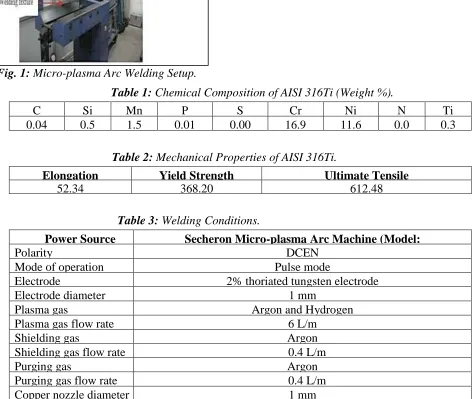
Table 4. Details about experimental setup are
shown in Figure 1.
Fig. 1:
Micro-plasma Arc Welding Setup.
MEASUREMENT OF WELD BEAD
GEOMETRY
The weld pool geometries were measured
using inverted trinocular
metallurgical
microscope, make: BS Pyromatic, model no.:
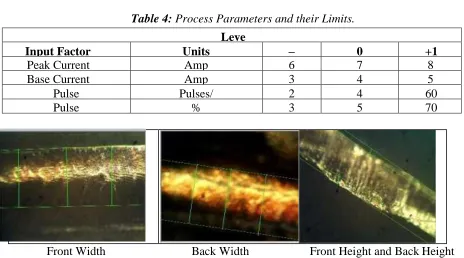
BSPIL-MET-01013. Weld bead geometry for
sample is presented in Figure 2.
Table 1:
Chemical Composition of AISI 316Ti (Weight %).
C
Si
Mn
P
S
Cr
Ni
N
Ti
0.04
2
0.5
6
1.5
7
0.01
4
0.00
4
16.9
9
11.6
3
0.0
2
0.3
2
Table 2:
Mechanical Properties of AISI 316Ti.
Elongation
(%)
Yield Strength
(MPa)
Ultimate Tensile
Strength (Mpa)
52.34
368.20
612.48
Table 3:
Welding Conditions.
Power Source
Secheron Micro-plasma Arc Machine (Model:
PLASMAFIX 50E)
Polarity
DCEN
Mode of operation
Pulse mode
Electrode
2% thoriated tungsten electrode
Electrode diameter
1 mm
Plasma gas
Argon and Hydrogen
Plasma gas flow rate
6 L/m
Shielding gas
Argon
Shielding gas flow rate
0.4 L/m
Purging gas
Argon
Purging gas flow rate
0.4 L/m
Nozzle to plate distance
1 mm
Welding speed
260 mm/min
Torch position
Vertical
Operation type
Automatic
Table 4:
Process Parameters and their Limits.
Leve
ls
Input Factor
Units
–
1
0
+1
Peak Current
Amp
6
7
8
Base Current
Amp
3
4
5
Pulse
rate
Pulses/
Sec
2
0
4
0
60
Pulse
width
%
3
0
5
0
70
Front Width
Back Width
Front Height and Back Height
Fig. 2:
Weld Bead Geometry
ANALYSIS OF EXPERIMENTAL DATA
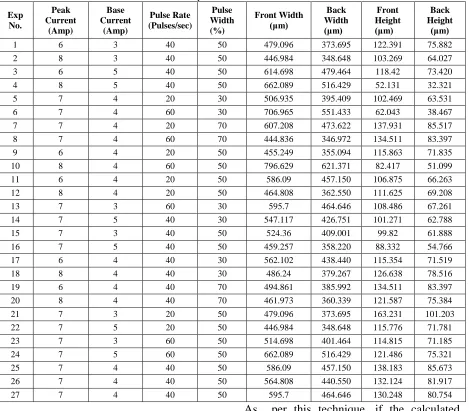
The experiments were conducted as per
the design matrix (Table 5) and the values of
weld
bead
geometry
measured
by
metallurgical microscopes are presented.
Table 5: Experimental Results.
Exp No.
Peak Current
(Amp)
Base Current
(Amp)
Pulse Rate (Pulses/sec)
Pulse Width (%)
Front Width (μm)
Back Width (μm)
Front Height (μm)
Back Height
(μm)
1 6 3 40 50 479.096 373.695 122.391 75.882
2 8 3 40 50 446.984 348.648 103.269 64.027
3 6 5 40 50 614.698 479.464 118.42 73.420
4 8 5 40 50 662.089 516.429 52.131 32.321
5 7 4 20 30 506.935 395.409 102.469 63.531
6 7 4 60 30 706.965 551.433 62.043 38.467
7 7 4 20 70 607.208 473.622 137.931 85.517
8 7 4 60 70 444.836 346.972 134.511 83.397
9 6 4 20 50 455.249 355.094 115.863 71.835
10 8 4 60 50 796.629 621.371 82.417 51.099
11 6 4 20 50 586.09 457.150 106.875 66.263
12 8 4 20 50 464.808 362.550 111.625 69.208
13 7 3 60 30 595.7 464.646 108.486 67.261
14 7 5 40 30 547.117 426.751 101.271 62.788
15 7 3 40 50 524.36 409.001 99.82 61.888
16 7 5 40 50 459.257 358.220 88.332 54.766
17 6 4 40 30 562.102 438.440 115.354 71.519
18 8 4 40 30 486.24 379.267 126.638 78.516
19 6 4 40 70 494.861 385.992 134.511 83.397
20 8 4 40 70 461.973 360.339 121.587 75.384
21 7 3 20 50 479.096 373.695 163.231 101.203
22 7 5 20 50 446.984 348.648 115.776 71.781
23 7 3 60 50 514.698 401.464 114.815 71.185
24 7 5 60 50 662.089 516.429 121.486 75.321
25 7 4 40 50 586.09 457.150 138.183 85.673
26 7 4 40 50 564.808 440.550 132.124 81.917
27 7 4 40 50 595.7 464.646 130.248 80.754
Checking the Adequacy of the
Developed Model
The adequacy of the developed model was
tested using the analysis of variance
technique (ANOVA) as shown in Table 6.
Table 6: Analysis of Variance.
Analysis of Variance for Front Width (μm)
Source DF Seq SS Adj SS Adj MS F P
Regression 14 140952 140952 10068 1.74 0.170
Linear 4 60010 13582 3396 0.59 0.678
Square 4 28396 14853 3713 0.64 0.642
Interaction 6 52546 52546 8758 1.52 0.254
Residual Error 12 69325 69325 5777
Lack-of-Fit 9 60265 60265 6696 2.22 0.277
Pure Error 3 9060 9060 3020
Total 26 210277
Analysis of Variance for Back Width (μm)
Source DF Seq SS Adj SS Adj MS F P
Regression 14 85755 85755 6125 1.74 0.170
Linear 4 36510 8264 2066 0.59 0.678
Square 4 17276 9037 2259 0.64 0.642
Interaction 6 31969 31969 5328 1.52 0.254
Residual Error 12 42177 42177 3515
Lack-of-Fit 9 36666 36666 4074 2.22 0.277
Pure Error 3 5512 5512 1837
Total 26 127932
Analysis of Variance for Front Height (μm)
Source DF Seq SS Adj SS Adj MS F P
Regression 14 8017.4 8017.37 572.67 1.10 0.438
Linear 4 4850.9 1473.02 368.25 0.71 0.602
Square 4 1363.5 1000.03 250.01 0.48 0.750
Interaction 6 1803.0 1803.03 300.50 0.58 0.742
Residual Error 12 6242.0 6242.05 520.17
Lack-of-Fit 9 6167.3 6167.26 685.25 27.49 0.010
Pure Error 3 74.8 74.79 24.93
Total 26 14259.4
Analysis of Variance for Back Height (μm)
Source DF Seq SS Adj SS Adj MS F P
Regression 14 3081.86 3081.86 220.133 1.10 0.438
Linear 4 1864.64 566.23 141.556 0.71 0.602
Square 4 524.12 384.42 96.104 0.48 0.750
Interaction 6 693.10 693.10 115.516 0.58 0.742
Residual Error 12 2399.41 2399.41 199.951
Lack-of-Fit 9 2370.66 2370.66 263.407 27.49 0.010
Pure Error 3 28.74 28.74 9.581
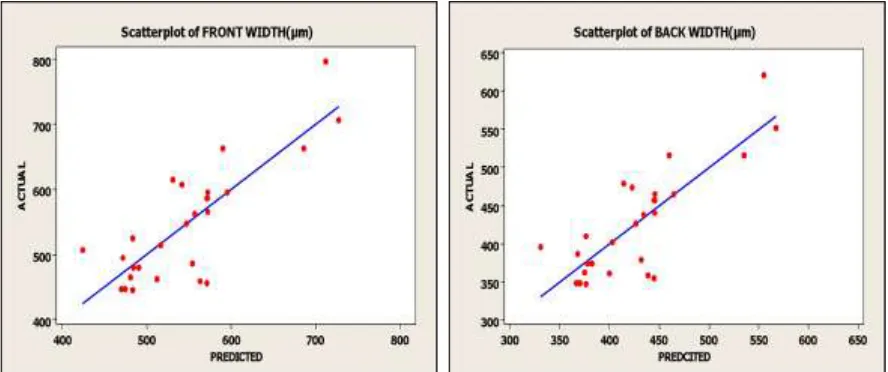
Fig. 3: Scatter Plot for Front Width. Fig. 4: Scatter Plot for Back Width.
Fig. 5: Scatter Plot for Front Width. Fig. 6: Scatter Plot for Back Height.
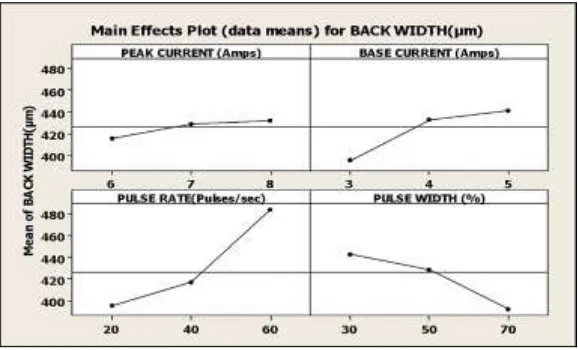
Fig. 8: Main Effect on Back Width.
Fig. 9: Main Effect on Front Height.
Surface Plots
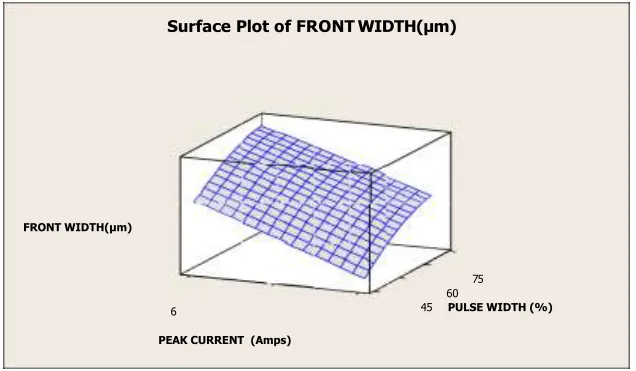
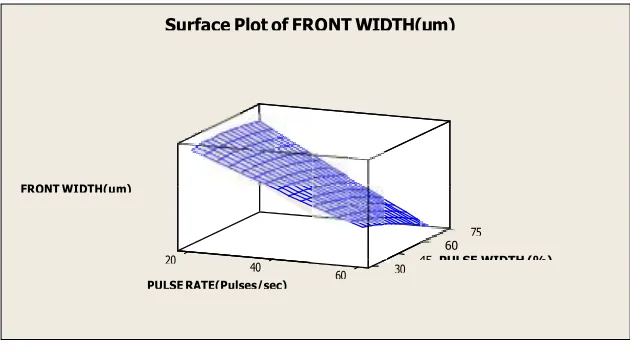
Surface plots are drawn to identify the optimal combination of input parameters, so that desired output response is achieved. Figures 11(a) to (f) represent the surface plots for front width.
From Figure 11(a), it is understood that front width is maximum at a peak current of 6 Amps and base current of 3 Amps.
From Figure 11(b), it is understood that front width is maximum at a peak current of 6 Amps and pulse rate of 60 pulses/sec.
From Figure 11(c), it is understood that front width is maximum at a peak current of 6 Amps and pulse width of 70%.
From Figure 11(d), it is understood that front width is maximum at a base current of 3 Amps and pulse rate of 20 pulses/sec.
From Figure 11(e), it is understood that front width is maximum at a base current of 3 Amps and pulse width of 70%.
From Figure 11(f), it is understood that front width is maximum at a pulse rate of 20 pulses/sec and pulse width of 70%.
Available online:https://edupediapublications.org/journals/index.php/IJR/ P a g e | 967
Fig. 10: Main Effect for Back Height.
Fig. 11(a): Surface plot for Front Width (Peak current versus Base Current).
Fig. 11(b)
:
Surface plot for Front Width (Peak current versus Pulse Rate).60
45 PULSE WIDTH (%)
6
Surface Plot of FRONT WIDTH(μm)
FRONT WIDTH(μm)
5
6 4 BASE CURRENT (Amps)
7 8 3
PEAK CURRENT (Amps)
Surface Plot of FRONT WIDTH(μm)
FRONT WIDTH(μm)
75
4
Fig. 11(c): Surface plot for Front Width (Peak Current versus Pulse Width).
Fig. 11(d): Surface plot for Front Width (Base Current versus Pulse Rate).
Fig. 11(e): Surface plot for Front Width (Base Current versus Pulse Width). 3
40 Surface Plot of FRONT WIDTH(μm)
FRONT WIDTH(μm)
60
PULSE RATE(Pulses/sec)
5 20
BASE CURRENT (Amps)
Surface Plot of FRONT WIDTH(μm)
FRONT WIDTH(μm)
75
3
60
45 PULSE WIDTH (%)
4
5 30
BASE CURRENT (Amps)
Surface Plot of FRONT WIDTH(μm)
FRONT WIDTH(μm)
75
20 40 45 PULSE WIDTH (%) 60
Available online:https://edupediapublications.org/journals/index.php/IJR/ P a g e | 969
7
7 30
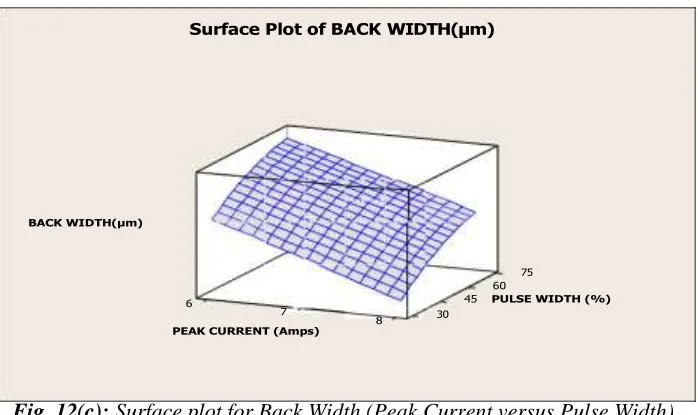
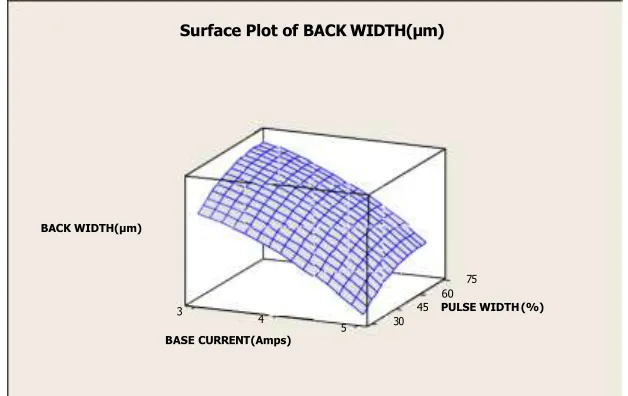
Figures 12(a) to (f) represent the surface plots for back width.
From Figure 12(a), it is understood that back width is maximum at a peak current of 6 Amps and base current of 3 Amps.
From Figure 12(b), it is understood that back width is maximum at a peak current of 6 Amps and pulse rate of 60 pulse/sec.
From Figure 12(c), it is understood that back width is maximum at a peak current of 6 Amps and pulse width of 70%.
From Figure 12(d), it is understood that back
width is maximum at a base current of 3 Amps and pulse rate of 60 pulse/sec.
From Figure 12(e), it is understood that back width is maximum at a base current of 3 Amps and pulse width of 70%.
From Figure 12(f), it is understood that back width is maximum at a pulse rate of 20 pulses/sec and pulse width of 60%.
From all the surface plots, it is understood that back width is maximum when peak current is 6 Amps, base current is 3 Amps, pulse rate of 60 pulses/sec and pulse width of 70%.
Fig. 12(a): Surface plot for Back Width (Peak current versus Base Current).
Fig. 12(b): Surface plot for Back Width (Peak current versus Pulse Rate).
Fig. 12(c): Surface plot for Back Width (Peak Current versus Pulse Width). 60
45 PULSE WIDTH (%)
6
PULSE RATE(Pulses/sec)
40 6
Surface Plot of BACK WIDTH(μm)
BACK WIDTH(μm)
60
PEAK CURRENT (Amps)
Surface Plot of BACK WIDTH(μm)
BACK WIDTH(μm)
75
8 20
8
4
4 30
40 30
Fig. 12(d): Surface plot for Back Width (Base Current versus Pulse Rate).
Fig. 12(e): Surface plot for Back Width (Base Current versus Pulse Width).
Fig. 12(f): Surface plot for Back Width (Pulse Rate versus Pulse Width). 60
45 PULSE WIDTH (%)
20
60
45 PULSE WIDTH (%)
3
PULSE RATE(Pulses/sec)
40 3
Surface Plot of BACK WIDTH(μm) vs PULSE
BACK WIDTH(μm)
60
BASE CURRENT (Amps)
Surface Plot of BACK WIDTH(μm)
BACK WIDTH(μm)
75
BASE CURRENT (Amps)
Surface Plot of BACK WIDTH(μm)
BACK WIDTH(μm)
75
PULSE RATE(Pulses/sec)
5 20
5
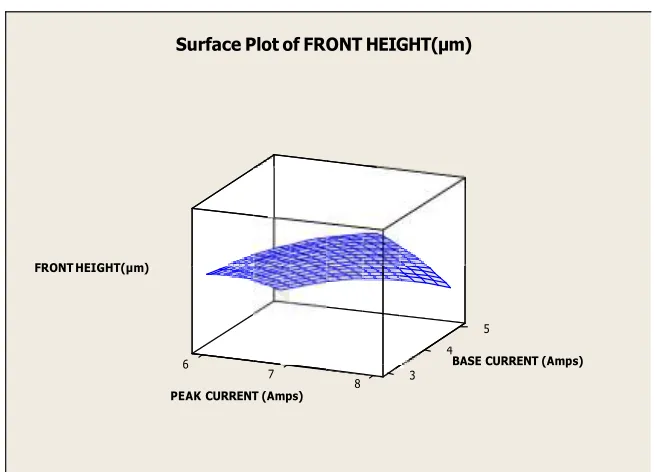
Figures 13(a) to (f) represent the surface plots for front height.
From Figure 13(a), it is understood that front height is minimum at a peak current of 6 Amps and base current of 5 Amps.
From Figure 13(b), it is understood that front height is minimum at a peak current of 6 Amps and pulse rate of 60 pulses/sec.
From Figure 13(c), it is understood that front height is minimum at a peak current of 6 Amps and pulse width of 70%.
From Figure 13(d), it is understood that front
height is maximum at a base current of 3 Amps and pulse rate of 60 pulses/sec.
From Figure 13(e), it is understood that front height is minimum at a base current of 3 Amps and pulse width of 60%.
From Figure 13(f), it is understood that front height is minimum at a pulse rate of 20 pulses/sec and pulse width of 60%.
From all the surface plots, it is understood that front height is minimum when peak current is 6 Amps, base current is 3 Amps, pulse rate of 60 pulses/sec and pulse width of 70%
Fig. 13(a): Surface plot for Front Height (Peak current versus Base Current).
Fig. 13(b): Surface plot for Front Height (Peak current versus Pulse Rate).
Surface Plot of FRONT HEIGHT(μm)
FRONT HEIGHT(μm)
5
6 4 BASE CURRENT (Amps)
7 8 3
PEAK CURRENT (Amps)
Surface Plot of FRONT HEIGHT(μm)
200
FRONT HEIGHT(μm)
100
60
0 40
6 PULSE RATE(Pulses/sec)
7
8 20
Fig. 13(c): Surface plot for Front Height (Peak Current versus Pulse Width).
Fig. 13(d): Surface plot for Front Height (Base Current versus Pulse Rate).
Fig. 13(e): Surface plot for Front Height (Base Current versus Pulse Width). Surface Plot of FRONT HEIGHT(μm)
FRONT HEIGHT(μm)
75
6
60
45 PULSE WIDTH (%)
7
8 30
PEAK CURRENT (Amps)
Surface Plot of FRONT HEIGHT(μm)
RONT HEIGHT(μm)
60 40
3 PULSE RATE(Pulses/sec)
4
5 20
BASE CURRENT (Amps)
Surface Plot of FRONT HEIGHT(μm)
RONT HEIGHT(μm)
75
3
60
45 PULSE WIDTH (%)
4 5 30
Available online:https://edupediapublications.org/journals/index.php/IJR/ P a g e | 973
Fig. 13(f): Surface plot for Front Height (Pulse Rate versus Pulse Width).
Figures 14(a) to (f) represent the surface plots for back height.
From Figure 14(a), it is understood that back height is minimum at a peak current of 6 Amps and base current of 5 Amps.
From Figure 14(b), it is understood that back height is minimum at a peak current of 6 Amps and pulse rate of 60 pulses/sec.
From Figure 14(c), it is understood that back height is minimum at a peak current of 6 Amps and pulse width of 75%.
From Figure 14(d), it is understood that back
height is maximum at a base current of 3 Amps and pulse rate of 60 pulses/sec.
From Figure 14(e), it is understood that back height is minimum at a base current of 3 Amps and pulse width of 60%.
From Figure 14(f), it is understood that back height is minimum at a pulse rate of 20 pulses/sec and pulse width of 70%.
From all the surface plots, it is understood that back height is minimum when peak current is 6 Amps, base current is 3 Amps, pulse rate of 60 pulses/sec and pulse width of 70%
Fig. 14(a): Surface plot for Back Height (Peak current versus Base Current).
Surface Plot of BACK HEIGHT(μm)
BACK HEIGHT(μm)
5
6 4 BASE CURRENT (Amps)
7 3
8 PEAK CURRENT (Amps)
Surface Plot of FRONT HEIGHT(μm)
RONT HEIGHT(μm)
75
20
60
45 PULSE WIDTH (%)
40 60 30
Fig. 14(b): Surface plot for Back Height (Peak current versus Pulse Rate).
Fig. 14(c): Surface plot for Back Height (Peak Current versus Pulse Width).
Fig. 14(d): Surface plot for Back Height (Base Current versus Pulse Rate).
Surface Plot of BACK HEIGHT(μm)
BACK HEIGHT(μm)
60 40
6 PULSE RATE(Pulses/sec)
7
8 20
PEAK CURRENT (Amps)
Surface Plot of BACK HEIGHT(μm)
BACK HEIGHT(μm)
75
6
60
45 PULSE WIDTH (%)
7
8 30
PEAK CURRENT (Amps)
Surface Plot of BACK HEIGHT(μm)
BACK HEIGHT(μm)
60 40
3 PULSE RATE(Pulses/sec)
4 5 20
Fig. 14(e): Surface plot for Back Height (Base Current versus Pulse Width)
Fig. 14(f): Surface plot for Back Height (Pulse Rate versus Pulse Width).
CONCLUSIONS
From the experiments and developed models the following conclusions are drawn:
Empirical mathematical models are
developed for front width, back width, front height and back height of weld bead
in order to predict their values within the range of the welding parameters selected for the chosen material (AISI 316Ti).
The adequacy of the developed model is checked using ANOVA at 95% confidence level and found to be adequate.
From the scatter plot it is understood that
Surface Plot of BACK HEIGHT(μm)
BACK HEIGHT(μm)
75
3
60
45 PULSE WIDTH (%)
4
5 30
BASE CURRENT (Amps)
Surface Plot of BACK HEIGHT(μm)
BACK HEIGHT(μm)
75
20
60
45 PULSE WIDTH (%)
40 60 30
experimental and predicted values are close to each other.
Front width and back width increase with increase in peak current, back current and pulse rate. However they decrease with increase in pulse width.
Front height and back height decrease with increase in peak current, back current and pulse rate. However they increase with increase in pulse width.
From the surface plots of front width and back width, it is understood that maximum front width and back width can be achieved when peak current is 6 Amps, base current 3 Amps, pulse rate of 60 pulses/sec and pulse width of 70%.
From the surface plots of front height and back height, it is understood that front height is minimum when peak current is 6 Amps, base current is 3 Amps, pulse rate of 60 pulses/sec and pulse width of 70%.
From all the surface plots, it is understood that optimal weld bead geometry is obtained when peak current is 6 Amps, base current is 3 Amps, pulse rate of 60 pulses/sec and pulse width of 70%
The developed mathematical models for weld bead geometry parameters are valid only for 0.3 mm thick AISI 316Ti austenitic stainless steel.
The developed model is valid within the specified range of the selected welding parameters; however the accuracy can be improved by considering more number of factors and their levels.
REFERENCES
[1] Jean Marie Fortain. Plasma Welding
Evolution & Challenges. Air Liquid CTAS,
Welding and Cutting Research Center, 95315, Cergy Pontoise, France. 2010; 11p. [2] Voropai NM, Shcherbak VV, Grigorev
AA. Pulsed Microplasma Welding of Thin
Aluminum Gaskets. Equipment
Manufacturing Technology. 1971; 11: 19p. [3] Sepokurov AS, Sergatskii GI, Alikin
AP. Use of Microplasma Welding in
Component Construction. Japan Welding Society. 1971; 11: 20p.
[4] Luo W. Effect of Micro-Plasma Arc Melting on the Corrosion Resistance of a 0Cr19Ni9 Stainless Steel SAW Joint. Mater Lett. 2002; 55: 290–295p.
[5] Karimzadeh F, Salehi M, Saatchi A, et al. Effect of Microplasma Arc Welding Process Parameters on Grain Growth and Porosity Distribution of Thin Sheet Ti6Al4V Alloy Weldment. Mater Manuf Processes. 2005; 20(2): 205–219p.
[6] Karimzadeh F, Ebnonnasir A, Foroughi A. Artificial Neural Network Modeling for Evaluating of Epitaxial Growth of Ti6Al4V Weldment. Mater Sci Eng. 2006; A 432: 184–190p.
[7]Pei-quan Xu, Shun Yao, Jian-Ping He, et al. Numerical Analysis for Effect of Process Parameters of Low-Current Micro-PAW on Constricted Arc. Int J Adv Manuf Technol. 2009; 44: 255–264p.
[8]Kondapalli Siva Prasad, Ch. Srinivasa Rao, Nageswara Rao D. Application of Grey Relational Analysis for Optimizing Weld Pool Geometry Parameters of Pulsed Current Micro Plasma Arc Welded Inconel 625 Sheets. Int J Adv Manuf Technol, (Springer). 2015. DOI: 10.1007/s00170-014-6665-y.
[9]Siva Prasad K, Ch. Srinivasa Rao, Nageswara Rao D. Effect of Process Parameters of Pulsed Current Micro Plasma Arc Welding on Weld Pool Geometry of Inconel 625 Welds. Kovove
Materialy-Metallic Materials (Kovove
Mater). 2012; 0(3): 153–159p.