Available online: www.edupediapublications.org/journals P a g e | 712
Secured Authentication for Banking Services using
Visual Cryptography
G. Mohini
1& M. Chandra Sekhar
21PG Scholar, Department of CSE, MVR College of Engineering and Technology, Paritala. Krishna District, A.P, India.
2Assistant Professor, Department of CSE, MVR College of Engineering and Technology, Paritala. Krishna
District, A.P, India.
Abstract:
Now a day’s authentication plays a very important role in banking services. But, because of hacking it is not safe to depend on text passwords and graphical image passwords. Services providing system need to be more secure and reliable because each and eve ry task performed is related to customer’s money and customer’s confidential data. Especially authentication and validation of user access is the major task. Text passwords and graphical image passwords are not secure as there is a chance of shoulder surfi ng proble m. So in orde r to overcome this proble m we are proposing an efficient algorithm for secured services authentication. The algorithm mainly deals with Images and Visual Cryptography. In this paper, at the time of ne w registration, user provide email id and then image of the applicant's choice. Image given as input is processed in such a way that, particular selected image by applicant is taken as input and is divided into two shares and then encrypted. One share is preserved in the service provide r’s database and other share is sent to the applicant's email id. The applicant need to provide share during every transaction and that share is over lapped with the already existing share in service provide r’s database and verification of data for authentica tion will be done. If username, password and uploaded encrypted image share got matched with existing database details, then the authentication is said to be succeeded.
Keywords: Authentication, Hacking, Visual Cryptography, Image Based Authentication.
I.INTRODUCTION
Available online: www.edupediapublications.org/journals P a g e | 713
monitor user activity in logs and reports. This allows you to assess how well your policies are working or track down users who are misusing resources or exposing your network to potential threats.
There are authentication techniques like text password based authentication, graphical image authentication, biometric authentication, image based authentication and so on. Mostly now a day's authentication system in use is text related passwords. But, text passwords are insecure for most of the applications that use security by access control mechanisms.
Authenticating through text based passwords has some drawbacks. Some secured text password related authentication processes are costly and may require some hardware. In graphical password system authentication is by clicking on images rather than typing text. Categorized techniques of graphical password system are Recognition Based Techniques and Recall Based Techniques. But there is a problem of sho ulder sniffing problem with graphical passwords. Biometric authentication is an expensive process as it requires a hardware. So here to overcome all these drawbacks we are going through a system that use image based authentication using visual cryptography.
Image based authentication is based on a user's successful identification of image password set. User is given a image share at the time of registration and during authentication user have to provide the image share correctly to get authenticated. We are using visual cryptography technique for secure authentication. Visual Cryptography technique involves encryption of image and t ha t e nc r yp t e d i ma ge is divided into some shares and decrypting those shares and overlapping will give us the original image. Image password is easily remembered than string of character password and is more secure. Image based authentication is less vulnerable by attacker.
Visual cryptography scheme(VCS) is proposed by Naor and Shamir [2]. Visual cryptography(VC) is the scheme used for the secrete share of image, in that secret share the original image is divided into number of shares and that share is distributed to some number of participants as each to one. That secret image is recoverable only when participant share their secret.
Visual Cryptography System divides image into random shares and information of shares is not revealed but only size of share can be known. We get the original image by stacking shares. Visual cryptography encodes binary image into n shares of random binary patterns. The image can be visually decoded. This cryptographic encryption technique involves pixel shuffling and inter changing their position to create the ciphered image, this proposed method makes it difficult for decryption of the image without prior knowledge of the algorithm.
II.RELATED WORK
Available online: www.edupediapublications.org/journals P a g e | 714
Segment based VC [4], encrypts only symbols and numbers. VCS proposed by Wei-Q i Yan et al[5]., can be only useful for printed text or image. If user reveals image share to any other person and trusting that person wont cheat is not true always.
So cheating prevention methods are proposed by Yan et al.,[6], Horng et al.,[7], Hu et al.,[8] but there is no authentication testing. Authentication testing done but this proposed system use signature image which is not so secure and require external hardware which becomes an expensive authentication process. After all the analysis a system is proposed which is a secure authentication scheme.
III.METHODOLOGY
During Internet banking registration time user is asked to select any image of his choice. That image is taken as input. Input image is encrypted and is d ivided into two shares, O ne will be sent to bank user's email id provided during registration and another will be sent to regarding bank. The original image stored in respective bank database, and one share sent to bank is also stored in bank database. Whe n user want to login and do any transaction then user must upload secrete share image. O nce the correct image share is uploaded while login then user share and bank database share is stacked and the stacked image is decrypted. After decryption if the image matched with the bank database original image then we can avail all the services that banking site provide. In this methodology there are two phases.
A. Registration Phase
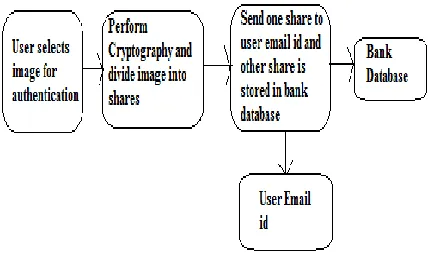
During Registration user have to upload an image of user choice. That uploaded image is encrypted and then divided into two shares. O ne share is sent to users email id and other share is stored in bank server database. Original image is also stored in bank database that was uploaded at the time of user registration. The procedure is shown in figure 1.
figure 1. User Registration Process
B. Login Phase
Available online: www.edupediapublications.org/journals P a g e | 715
figure 2. User Login Process
For encryption and decryption of image we are using RSA Algorithm[11].
RSA algorithm is complete public key cryptosystem [9, 10]. This paper applies the RSA algorithm for information hiding to secure the user information. RSA algorithm is based on the theory of a special kind of reversible arithmetic for modular and exponent. The steps for RSA algorithm are:
(1) Find two large primes p, q.
(2) n = p * q, z = (p - 1) * (q-1).
(3) Select a number e which is less than n and prime to z, so that e and z have no common factors.
(4) Select another number d, where (e*d-1) is divisible by z.
(5) The public key is (n, e) and the private key is (n, d).
(6) For a message m, if the cipher text is c, decryption and encryption process as follows:
Encryption: c = m ^ e mod n.
Decryption: m = c ^ d mod n.
Data is embedded into encrypted image by using Least-Significant-Bit(LSB) method.
Algorithm to hide the data in encrypted image using LSB method:
STEP-1: Consider an encrypted image (cover image).
Available online: www.edupediapublications.org/journals P a g e | 716 STEP-3: Convert all the pixel values of the encrypted image from grayscale to binary (8-bit).
STEP-4: Embed the message or data into the cover image by hiding the data into the LSB bit of cover image.
Thus, the image encryption is obtained. Decryption done by doing the reverse of encryption.
IV. ALGORITHM
An algorithm is a sequence of unambiguous instructions for solving a problem, i.e., for obtaining a required output for any legitimate input in a finite amount of time. Algorithm flowchart shown in Fig 3.
Fig: 3 System Architecture
In this algorithm, the first step is pre-processing. In this step the input image is uploaded during registration process. In the second step, input image is e ncrypted and the encrypted image is divided into two shares and one share is stored to bank database and other share is sent to user email id. In third step, reconstruct shared images and it will be construct single image. In the fourth step an encrypted single image has to be decrypted to get original image. Fifth step is final step and in this step system authenticate the user is valid or not.
1.Pre-Processing:
Available online: www.edupediapublications.org/journals P a g e | 717
Fig: 4 Original Image.
Image in the fig: 4 uploaded by applicant during registration will be encrypted using regarding VCS technique. In this encryption image converted to binary format. The encrypted form of fig: 4 is as follows
Fig: 5 Encrypted image.
2.Creation of Shares:
Encrypted image in Fig:5 is divided into two shares as shown in below Fig:6.
Fig: 6 Encrypted image shares.
Available online: www.edupediapublications.org/journals P a g e | 718
When user want to transaction, then he/she should be upload a shared secrete image. Later it will pass through the stacking state. In Stacking the bank image share and user share, two images are overlaps and combine both as single image that also encrypted. Combine two images shown in Fig:6 into single image as shown in below Fig:7.
Fig:7 Stacked Image
4.Post-Processing:
The overlapped shares results in required image with randomly distributed redundant information. After completed Stacking state, post processing state taken input as encrypted overlap image. In this state decrypted the overlapped image by using VCS technique.
Fig: 8 Decrypted image.
Available online: www.edupediapublications.org/journals P a g e | 719 Fig: 9 Authenticated Image
The creation of image share algorithm and authentication process algorithm shown in Alg1 and Alg2. Alg1 shows the creation of shares. Alg2 shows the authentication process.
Alg1: Creating Image Shares
begin
content=read image()
fs=content.size()
ff content odd
content+1
firstshare=contentdata/2
secondshare=content- firstshare
sf firstshare & secondshare
setresimg=1
else
setresimg=0
End
Alg2: Authentication Testing
Begin
secondshare=usershare
firstshare=bankshare
Available online: www.edupediapublications.org/journals P a g e | 720
if originalimg==img
authenticated
else
not valid
end
V. FUTURE ENHANCEMENT
In this paper we developed enhancement is offline transaction. Mostly transactions are done through online only.
Hence, the system has been implemented as per the requirement of the client. However it can be extended to few more and we can provide feature for the client. During login the client if he/she wants to change image which was submitted in register form he/she can select new image, the new image was updated in the database.
VI. CONCLUSION
Image segmentation is secured because of divide and sharing image shares between user and database . This system is user- friendly and has simple interface. Provide strong security against both attacks and hackers. Protects system vulnerable to attacks.
VII. REFERENCES
[1] "Authentication and Authorization" from SANS Institute InfoSec reading room.
[2] M. Naor and A. Shamir, “Visual Cryptography”. Advances in Cryptography-EUROCRYPT'94, Lecture Notes in Computer Science 950, 1995, pp. 1-12
[3] “Visual Cryptography Schemes for Secret Image” N. Anusha, P. SubbaRao, International Journal of Engineering Research & Technology(IJERT) Vol. 1 Issue 5, July – 2012.
[4] B. Borchert, .”Segment Based Visual Cryptography”. WSI Press, Germany,2007.
[5] W-Q Yan, D. Jin and M. S. Kanakanahalli, “Visual Cryptography forPrint and Scan Applications”. IEEE Transactions, ISCAS-2004, pp.572-575.
Available online: www.edupediapublications.org/journals P a g e | 721
[7] G. B. Horng, T. G. Chen and D. S. Tsai, “Cheating in Visual Cryptography,” Designs, Codes, Cryptography, vol.38, no.2, 2006, pp.219- 236.
[8] C. M. Hu and W. G. Tzeng, .Cheating Prevention in Visual Cryptography,. IEEE Transaction on Image Processing, vol. 16, no. 1, Jan- 2007,pp. 36-45.
[9] Cryptographic and N/W security: Principles and Practices by Stalling. Prentice Hall. 2nd Edition.
[10] Sos Agaian and Yicong Zhou. 2011. "Image Encryption using the image Steganography concept and PLIP model". IEEE International conference on System Science and Engineering. pp. 699-703.