A Method Decentralized Access To Anonymous
Authentication Of Data Storage
Mr. Abdali Abdulkareem Abdali AL-rumdhan
Master of Science (Information System)
Dept. of Computer Science
Nizam college, Osmania University, India
ABSTRACT:
In this study, we examine the
issue of uprightness reviewing and
secure deduplication on cloud
information. In particular, going for
accomplishing both information
uprightness and deduplication in cloud,
secure data storage in clouds which
supports anonymous authentication. The
cloud verifies the authenticity of the
series without significant knowledge in
the user’s identity before storing
information. This scheme also has the
added feature of access control. In
access control scheme only valid users
are able to decrypt the stored
data/information. This scheme prevents
replay attacks also supports creation,
modification, and reading information
stored in the cloud. These schemes also
address user revocation. Moreover, the
authentication and access control scheme
is decentralized and robust in nature
unlike other access control schemes
designed for clouds which are
centralized. The computation,
communication, and storage overheads
are comparable to centralized
Keywords: Authentication,
Cryptosystem, Cloud computing,
Decentralized access control,
Decryption, Encryption.
INTRODUCTION:
Distributed storage is a model of
arranged endeavor stockpiling where
information is put away in virtualized
pools of capacity which are by and large
facilitated by third gatherings.
Distributed storage gives clients
advantages, going from cost sparing and
improved accommodation, to versatility
opportunities and adaptable
administration. These extraordinary
elements draw in more clients to use and
capacity their own information to the
distributed storage: as indicated by the
investigation report, the volume of
information in cloud is required to
Despite the fact that distributed storage
framework has been broadly received, it
neglects to suit some essential
developing needs, for example, the
capacities of reviewing trustworthiness
of cloud documents by cloud customers
and distinguishing copied records by
cloud servers. We delineate both issues
beneath [1].
The main issue is uprightness
inspecting. The cloud server can
diminish customers from the
overwhelming weight of capacity
administration and support. The most
contrast of distributed storage from
customary in-house stockpiling is that
the information is exchanged by means
of Internet and put away in an
unverifiable area, not under control of
the customers by any stretch of the
Which unavoidably raises
customers awesome worries on the
trustworthiness of their information.
These worries begin from the way that
the distributed storage is helpless to
security dangers from both outside and
within the cloud, and the uncontrolled
cloud servers might latently conceal
some information misfortune
occurrences from the customers to keep
up their notoriety. In addition genuine is
that for sparing cash and space, the cloud
servers may even effectively and
purposely dispose of once in a while got
to information documents fitting in with
a normal customer. Considering the
extensive size of the outsourced
information documents and the
customers' compelled asset capacities,
the principal issue is summed up as in
what manner can the customer
proficiently perform periodical
trustworthiness checks even without the
nearby duplicate of information records.
The second issue is secure
deduplication. The quick reception of
cloud administrations is joined by
expanding volumes of information put
away at remote cloud servers. Among
these remote put away documents, a
large portion of them are copied: by late
review by EMC, 75% of late
computerized information is copied
duplicates. This raises an innovation to
be specific deduplication, in which the
cloud servers might want to deduplicate
by keeping just a solitary duplicate for
every document (or square) and make a
connection to the record (or piece) for
each customer who possesses or requests
that store the same record (or square)
[2].
Sadly, this activity of
dangers possibly influencing the
capacity framework, for instance, a
server telling a customer that it (i.e., the
customer) does not have to send the
document uncovers that some other
customer has precisely the same, which
could be delicate once in a while. These
assaults begin from the reason that the
confirmation that the customer claims a
given record (or piece of information) is
exclusively in view of a static, short
esteem (much of the time the hash of the
document). Along these lines, the second
issue is summed up as by what method
can the cloud servers productively affirm
that the customer (with a specific degree
confirmation) claims the transferred
record (or square) before making a
connection to this document (or piece)
for him/her.
LITERATURE REVIEW:
Bitar, N., Gringeri, S., & Xia, T. J.
(2013), research says cloud today
confront a few difficulties when
facilitating line-of-business applications
in the cloud. Fundamental to a large
number of these difficulties is the
restricted backing for control over cloud
system capacities, for example, the
capacity to guarantee security, execution
sureties or separation, and to adaptably
intervene middleboxes in application
organizations. In this paper, we show the
configuration and usage of a novel cloud
organizing framework called
CloudNaaS. Clients can influence
CloudNaaS to convey applications
expanded with a rich and extensible
arrangement of system capacities, for
example, virtual system seclusion,
custom tending to, administration
separation, and adaptable intervention of
primitives are specifically executed
inside the cloud framework itself
utilizing fast programmable system
components, making CloudNaaS very
productive. We assess an
OpenFlow-based model of CloudNaaS and observe
that it can be utilized to instantiate a
mixed bag of system capacities in the
cloud, and that its execution is hearty
even despite huge quantities of
provisioned administrations and
connection/gadget disappointments.
Ramgovind, S., Eloff, M. M., & Smith,
E. (2010, August), cloud computing has
raised IT as far as possible by offering
the business environment information
stockpiling and limit with adaptable
versatile figuring preparing energy to
match flexible request and supply, whilst
lessening capital use. However the open
door expense of the fruitful execution of
Cloud registering is to successfully deal
with the security in the cloud
applications. Security cognizance and
concerns emerge when one starts to run
applications past the assigned firewall
and move closer towards the general
population space. The motivation behind
the paper is to give a general security
point of view of Cloud processing with
the expect to highlight the security
worries that ought to be appropriately
tended to and figured out how to
understand the maximum capacity of
Cloud registering. Gartner's rundown on
cloud security issues, also the
discoveries from the International Data
Corporation venture board study in view
of cloud dangers, will be examined in
this paper.
Oberheide, J., Veeraraghavan, K.,
Cooke, E., Flinn, J., & Jahanian, F.
(2008, June) research says mobile
capacities and extensibility of standard
desktop PCs. Shockingly, these gadgets
are likewise starting to face a large
number of the same security dangers as
desktops. As of now, portable security
arrangements reflect the conventional
desktop display in which they run
identification benefits on the gadget.
This methodology is complex and asset
concentrated in both processing and
force. This paper proposes another
model whereby versatile antivirus
usefulness is moved to an off-gadget
system administration utilizing various
virtualized malware location motors.
Our contention is that it is conceivable to
spend data transfer capacity assets to
essentially lessen on-gadget CPU,
memory, and force assets. We show how
our incloud model improves portable
security and decreases on-gadget
programming unpredictability, while
taking into consideration new
administrations, for example, stage
particular behavioral examination
motors. Our benchmarks on Nokia's
N800 and N95 cell phones demonstrate
that our portable specialists devours a
request of greatness less CPU and
memory while likewise expending less
power in like manner situations
contrasted with existing on-gadget
antivirus programming.
Knowledge engineering (KE) was
defined in 1983 by Edward Feigenbaum,
and Pamela McCorduck as follows: KE
is an engineering discipline that involves
integrating knowledge into computer
systems in order to solve complex
problems normally requiring a high level
of human expertise. At present, it refers
to the building, maintaining and
development of knowledge-based
with software engineering, and is used in
many computer science domains such as
artificial intelligence, including
databases, data mining, expert systems,
decision support systems and geographic
information systems. Knowledge
engineering is also related to
mathematical logic, as well as strongly
involved in cognitive science and
socio-cognitive engineering where the
knowledge is produced by
socio-cognitive aggregates (mainly humans)
and is structured according to our
understanding of how human reasoning
and logic works. In this work, we
exhibit Eucalyptus - an open-source
programming structure for Distributed
computing that actualizes what is usually
alluded to as framework as an
Administration (IaaS); frameworks that
give clients the capacity to run and
control wholevirtual machine
occurrences conveyed over an
assortment physical assets. We diagram
the essential standards of the Eucalyptus
outline, point of interest imperative
operational parts of the framework, and
talk about engineering exchange offs
that we have made with a specific end
goal to permit EUCALYPTUS to be
versatile, particular and easy to use on
foundation ordinarily found inside
scholarly settings. At long last, we give
confirm that EUCALYPTUS empowers
clients acquainted with existing matrix
and HPC frameworks to investigate new
distributed computing usefulness while
keeping up access to existing, well
known application advancement
programming and network middleware.
AES ALGORITHM:
The principal drawback of 3DES (which
was recommended in 1999, Federal
PUB 46-3 as new standard with 168-bit
key) is that the algorithm is relatively
sluggish in software. A secondary
drawback is the use of 64-bit block size.
For reasons of both efficiency and
security, a larger block size is desirable.
In 1997, National Institute of Standards
and Technology NIST issued a call for
proposals for a new Advanced
Encryption Standard (AES), which
should have security strength equal to or
better than 3DES, and significantly
improved efficiency. In addition, NIST
also specified that AES must be a
symmetric block cipher with a block
length of 128 bits and support for key
lengths of 128, 192, and 256 bits [3]. In
a first round of evaluation, 15 proposed
algorithms were accepted. A 2nd round
narrowed to 5 algorithms. NIST
completed its evaluation process and
published a final standard (FIPS PUB
197) in November, 2001. NIST selected
Rijndael as the proposed AES algorithm.
The 2 researches of AES are Dr. Joan
Daemon and Dr. Vincent Rijmen from
Belgium.
AES Evaluation
Security – 128 minimal key size
provides enough security
Cost – AES should have high
computational efficiency
Map Algorithm
call filePreProc method and send
documentContents
byte [][] generateSegments =
filePreProc(contents);
create segment array
byte[] [] segments = new byte[4][];
calulate total length of
long totalLength =
documentContentsBlock1.length;
calculate half length of
documentContents
long halfLength = totalLength/2
calculate quarter length of
documentContents
long quarterIndex = halfLength/2;
copy array between 0 & (quarter length
-1) range in segment 0
segments[0] =
Arrays.copyOfRange(documentContents
Block1,0, (int) (quarterIndex-1));
copy array between quarter length & half
length range in segment 1
segments[1] =
Arrays.copyOfRange(documentContents
Block1,(int) quarterIndex,
(int)halfLength-1);
copy array between half length & half
length+(quarter length -1) range in
segment 2
segments[2] =
Arrays.copyOfRange(documentContents
Block1,(int) halfLength ,
(int)(halfLength + quarterIndex -1));
copy array between half length+(quarter
length -1) & total length range in
segment 3
segments[3] =
Arrays.copyOfRange(documentContents
Block1,(int)(halfLength + quarterIndex),
(int)(totalLength - 1));
return segments
Similarly, the 128-bit is depicted as a
square matrix of bytes. This key is
expanded into an array of key schedule
words; each word is 4 bytes and the total
key. Ordering of bytes within a matrix is
by column.
Before delving into details, we can make
several comments about overall AES
structure:
This cipher is not a Feistel structure.
The key that is provided as input is
expanded into an array of 44 words
(32-bits each), w[i]. 4 distinct words (128
bits) serve as a round key for each
round;
4 different stages are used, 1
permutation and 3 of substitution:
Add round key – A simple bitwise XOR
of the current block with the portion of
the expanded key. The structure is quite
simple. Only the Add Round Key stage
uses the key. Any other stage is
reversible without knowledge of the key.
The Add Round Key is a form of
Vernam cipher and by itself would not
be formidable. The other 3 stages
together provide confusion, diffusion,
and nonlinearity, but by themselves
would provide no security because they
do not use the key. We can view the
cipher as alternating operations of XOR
encryption (Add Round Key), followed
by scrambling of the block [5].
Decryption uses the same keys but in the
reverse order. Decryption is not identical
to encryption. At each horizontal point
(e.g., the dashed line) in Figure 5.1, State
is the same for both encryption and
decryption. The final round of both
encryption and decryption consists of
only 3 stages; it is the consequence of
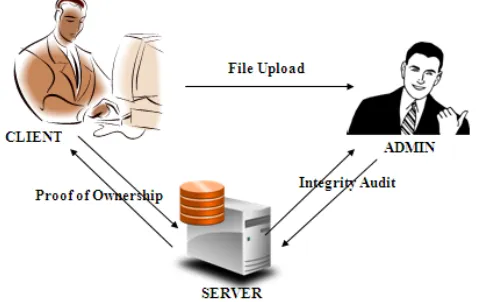
Figure 1: System Architecture
PROPOSED SYSTEM:
We indicate that our proposed
SecCloud framework has accomplished
both trustworthiness reviewing and
record deduplication. Be that as it may,
it can't keep the cloud servers from
knowing the substance of records having
been put away. As such, the
functionalities of honesty evaluating and
secure deduplication are just forced on
plain documents. In this segment, we
propose SecCloud+, which takes into
consideration respectability examining
and deduplication on scrambled records.
Cloud Clients have vast information
records to be put away and depend on
the cloud for information support and
calculation. They can be either singular
buyers or business associations; Cloud
Servers virtualize the assets as indicated
by the prerequisites of customers and
uncover them as capacity pools.
Normally, the cloud customers might
purchase or rent stockpiling limit from
cloud servers, and store their individual
information in these purchased or leased
Examiner which offers customers
some assistance with uploading and
review their outsourced information
keeps up a MapReduce cloud and acts
like an endorsement power. This
presumption presumes that the evaluator
is connected with a couple of open and
private keys. Its open key is made
accessible to alternate substances in the
framework. The configuration objective
of document secrecy requires keeping
the cloud servers from getting to the
substance of records. Exceptionally, we
require that the objective of record
privacy should be impervious to "word
reference assault". That is, even the
enemies have pre-learning of the
"lexicon" which incorporates all the
conceivable documents; despite
everything they can't recoup the
objective record.
ID-based Cryptosystems
The need to make accessible bona fide
duplicates of substances 'open keys is a
noteworthy downside to the utilization
of open key cryptography. The
customary methodology for doing this is
to utilize the general population key
frameworks, in which an affirmation
power (CA) issues a testament which
ties a client's personality with his/her
open key. With ID-based cryptosystems,
this coupling is redundant as the
character of the element would be
his/her open key (If not
straightforwardly, the general population
key is gotten from the personality). In
ID-based PKC, everybody's open Keys
are foreordained by data that
interestingly distinguishes them, for
example, their email address.
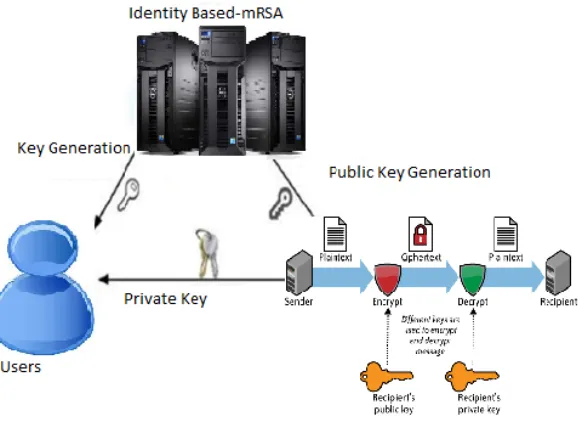
This idea unique inspiration for
endorsement administration in email
frameworks. Every substance in the
framework sends his/her personality to a
trusted outsider called the Key
Generation Center (KGC), to get the
private key. The private key is figured
utilizing the private key of the KGC and
the personality of the client. Key escrow
is inborn in ID-based frameworks since
the KGC knows all the private keys. For
different reasons, this makes execution
of the innovation much less demanding,
and conveys some additional data
security advantages. ID-based PKC
(ID-PKC) remained a hypothetical idea until
were proposed. A portion of the issues to
be tended to contrast the ID-based
frameworks and the customary PKI
upheld open key cryptography [7].
Figure 2: Proposed architecture
(Bilinear Map): Let G and GT are 2 cyclic multiplicative groups of large prime order p.
A bilinear pairing is a map e : G × G → GT with the subsequent properties:
• Bilinear: e (g1 a, g2 b) = e(g1, g2)ab for all g1, g2 ∈R G and a, b ∈R Zp;
• Non-degenerate: There occurs g1, g2 ∈ G such that(g1, g2) ̸= 1;
• Computable: There is effective algorithm to calculate e(g1, g2) for all g1, g2 ∈R G.
The examples of such groups can be found in great singular elliptic curves or hyper
elliptic curves throughout finite fields, and the bilinear pairings can be originated from
the Tate pairings or Weilc [8].
We then describe the Computational Diffie-Hellman difficulty, the rigidity it will be the
basis of the security of our proposed schemes.
(CDH Problem): The Computational DiffieHellman problematic is that, given g, gx, gy
∈ G1 for unknown x, y ∈ Z∗ p, to calculate gxy [9].
B. Convergent Encryption
Convergent encryption delivers data
confidentiality in deduplication. A user
(or data owner) derives a convergent key
from the data content and encrypts the
data reproduction with the convergent
key. In addition, the user will derive a
tag for the data copy, such that the tag
will be used to identify duplicates. Here,
we accept that the tag correctness
property holds [10], i.e., if two data
copies are the same, then their tags are
the same. Formally, a convergent
encryption scheme can be defined with
four primitive functions:
• KeyGen(F) : The key creation
algorithm receives a file content F as
output and inputs the convergent key
Encrypt(ckF, F) : The encryption
algorithm receives convergent key
i.e ckF and file content F as input
and outputs the ciphertext ctF;
Decrypt(ckF, ctF) : The decryption
algorithm receives the ciphertext ctF
and convergent key ckF as input and
outputs the plain file F [12];
TagGen(F) : The tag generation
algorithm recives a file content F as
input and outputs the tag tagF of F
[13]. Signs that in this paper, we also
permit TagGen(·) to generate the
(same) tag from the equivalent
ciphertext [14].
CONCLUSION
Going for accomplishing both
information trustworthiness and
deduplication in cloud, we propose
SecCloud and SecCloud+. SecCloud
presents a reviewing substance with
support of a MapReduce cloud, which
offers customers some assistance with
generating information labels before
transferring and in addition review the
honesty of information having been put
away in cloud. Also, SecCoud empowers
secure deduplication through presenting
a Proof of Ownership convention and
keeping the spillage of side direct data in
information deduplication. Contrasted
and past work, the calculation by client
in SecCloud is extraordinarily lessened
amid the record transferring and
examining stages. SecCloud+ is a
propelled development persuaded by the
way that clients dependably need to
encode their information before
transferring, and considers honesty
evaluating and secure deduplication
presented a decentralized access control
technique with anonymous
authentication, which provides user
revocation and prevents replay attacks.
The cloud does not know the identity of
the user who stores information, but only
verifies the user’s credentials. Key
distribution is done in a decentralized
way. One limitation is that the cloud
knows the access policy for each record
stored in the cloud. In future, we would
like to hide the attributes and access
policy of a user. This impact of the
limitations encompassing the usage are
prone to be more noteworthy given that
there doesn't appear to be such a solid
isolating element as the capacity to give
non-revocation is amongst symmetric
and topsy-turvy cryptography.
REFERENCE:
1. Oberheide, J., Veeraraghavan, K.,
Cooke, E., Flinn, J., & Jahanian, F.
(2008, June). Virtualized in-cloud
security services for mobile devices.
In Proceedings of the First
Workshop on Virtualization in
Mobile Computing (pp. 31-35).
ACM.
2. Schoo, P., Fusenig, V., Souza, V.,
Melo, M., Murray, P., Debar, H., ...
& Zeghlache, D. (2011). Challenges
for cloud networking security. In
Mobile Networks and Management
(pp. 298-313). Springer Berlin
Heidelberg.
3. Bitar, N., Gringeri, S., & Xia, T. J.
(2013). Technologies and protocols
for data center and cloud networking.
Communications Magazine, IEEE,
51(9), 24-31.
4. Houidi, I., Mechtri, M., Louati, W.,
service delivery across multiple
cloud platforms. In Services
Computing (SCC), 2011 IEEE
International Conference on (pp.
741-742). IEEE.
5. Nurmi, D., Wolski, R., Grzegorczyk,
C., Obertelli, G., Soman, S., Youseff,
L., & Zagorodnov, D. (2009, May).
The eucalyptus open-source
cloud-computing system. In Cluster
Computing and the Grid, 2009.
CCGRID'09. 9th IEEE/ACM
International Symposium on (pp.
124-131). IEEE.
6. Wodczak, M. (2011, November).
Resilience aspects of autonomic
cooperative communications in
context of cloud networking. In
Network Cloud Computing and
Applications (NCCA), 2011 First
International Symposium on (pp.
107-113). IEEE.
7. Bitar, N., Gringeri, S., & Xia, T. J.
(2013). Technologies and protocols
for data center and cloud networking.
Communications Magazine, IEEE,
51(9), 24-31.
8. Bechler, M., Hof, H. J., Kraft, D.,
Pahlke, F., & Wolf, L. (2004,
March). A cluster-based security
architecture for ad hoc networks. In
INFOCOM 2004. Twenty-third
AnnualJoint Conference of the IEEE
Computer and Communications
Societies (Vol. 4, pp. 2393-2403).
IEEE.
9. D. Boneh and M. Franklin.
Identity-based encryption from the Weil
Pairing. In Kilian, pages 213–229.
10.J.-S. Coron and D. Naccache.
Security analysis of the
gennaro-halevi-rabin signature scheme. In
11.E.Fujisaki,T.Okamoto,D.Pointcheval
,andJ.Stern. RSA-OAEP is secure
under the rsa assumption. In Kilian,
pages 260–274.
12.R. Ganesan. Augmenting kerberos
with pubic-key cryptography. In T.
Mayfield, editor, Symposium on
Network and Distributed Systems
Security, San Diego, Cal-ifornia,
Feb. 1995. Internet Society.
13.Covington, M. J., Fogla, P., Zhan,
Z., & Ahamad, M. (2002). A
context-aware security architecture
for emerging applications. In
Computer Security Applications
Conference, 2002. Proceedings. 18th
Annual (pp. 249-258). IEEE.
14.Zhou, L., & Chao, H. C. (2011).
Multimedia traffic security
architecture for the internet of things.
Network, IE