Evaluation of Field Performance of Eight Row Paddy Drum
Seeder
R.P. Murumkar Usha R. Dongarwar, P.S. Pisalkar D.S. Phad
Dr. Panjabrao Deshmukh Krishi Vidyapeeth, Akola (M.S.) - 444 104
Abstract
Field experiments were conducted on direct sown paddy using eight-row drum seeder under
puddled condition in farmers fields of Bhandara district, Mahrashtra during Kharif season for three years
from 2009-2010 to 2011-2012 to evaluate the performance of the eight row paddy drum seeder. The drum
seeder was tested on puddle fields. The results showed that use of paddy drum seeder increased the grain
yield compared to farmers practice of broadcasting. Drum seeder technology reduced the seed rate
compared to broadcasting of seed on puddled soil and resulted in higher returns to farmers over normal
broadcasting of paddy seeds. The labour requirement was found to less compared to the traditional
method of broadcasting. The maximum yield of 37.50 q/ha was observed in case of direct sowing of
sprouted/pre-germinated paddy seeds by drum seeder as against 27 q/ha by traditional method of
broadcasting.
Keywords: Direct sowing, Drum Seeder, Sprouted/Pre-germinated Seeds.
Introduction
Rice (Oryza Sativa) is major crop that is grown in more than 110 countries. Direct seeding and transplanting are the two general methods of planting rice. The traditional methods followed from many
years are broadcasting and transplanting of seedlings raised in nursery. Transplanting method involves
seedbed preparation, nursery growing, care of seedlings in nursery, uprooting of seedlings, hauling and
transporting operations. The preparation of seedbed and sowing are done 30 days before planting. The
seedbed area required is about 10 percent of the main area of the field (Khan and Majid, 1989). The
transplanting of paddy at right time is also important parameter. A delay in transplanting by one month
reduces the yield of rice by 25 percent and delay by two months results in 70 percent reduction in yield
(Khan and Majid, 1989). The rice farmers practicing transplanting are facing problems of high cost of
cultivation, less plant population, less tillers per plant, low yields, high weed population. To tackle all
these problems direct seeding of rice has been found most appropriate alternative. Direct seeding is
becoming increasingly popular now days in India. Direct seeding is of two types broadcasting and row
seeding by using drum seeder. In row seeding sprouted seeds are sown in puddle field. For drum seeding
sprouted seeds, seeds are soaked for 24 h and incubated for 24-48 h are sown in puddled soils 1-2 days
after puddling using perforated drum seeder. Eight row paddy is manually operated low cost equipment
and it is simple in construction. The advantage of drum seeder is that row to row spacing can be easily
maintained and dropping of seeds in hills is possible. Drum seeder is an effective mean for timely sowing
of rice. Also direct seeded rice may mature 7 to 10 days earlier than transplanted rice (Subbaiah et. al.
2002). Therefore the study was undertaken to evaluate the performance of paddy drum seeder in puddle
rice fields.
Material and Methods
The difficulties in nursery raising, drudgery in transplanting, uncertainty in rainfall and lack of
water in tanks and wells during nursery raising and labour shortage in nursery raising and transplanting
time necessitated for alternate method of rice cultivation. In transplanted rice which is a labour intensive
and expensive can be replaced by direct seeding that can reduce the labour needs by 20% (Pradhan, 1969
and Santhi et.al.1998). Direct seeding in rice is identified as viable technology to overcome the problem
of high cost of production and to mitigate flood and drought situation in nursery season. In present study
the drum seeder developed by DRR, Hyderabad (Plate 1 and Plate 2) was assessed by KVK in sandy loam
soils during 2009-2012. DRR drum seeder consists of four seed drums made of mild steel mounted over a
shaft, ground wheels, floats and handle. The seed drum is cylindrical shape with 200 mm diameter. The
cost of the unit was Rs. 4200/-. Advantages are uniformity in seed sowing, reduction in seed rate and cost
of thinning is reduced, hill dropping of the seed is achieved and continuous drilling is eliminated. DRR
drum seeder was evaluated against the conventional broadcasted paddy.
Plate 1:Paddy sowing using DRR drum seeder Plate 2:Paddy crop after 15 days
General specifications of paddy drum seeder
1. Model : DRR, Hyderabad
2. Power transmission: Ground wheel
3. Power source: Two labours
Specifications of drum
1. Material of construction : Mild steel sheet of thickness
2. Number of drums: 4
3. Shape of drums: Cylindrical
4. Drum diameter, cm:
Specifications of holes of drum
1. Number of holes on single row of drums:18
2. Average diameter of the holes, cm: 1
3. Spacing between two holes, cm: 1.5
4. Shape of holes: Circular
Specifications of ground wheel
1. Material of construction: Mild steel
2. Type of wheel: Lugged ground wheels
3. Diameter of wheel, cm: 150 cm
4. Spacing between two consecutive lugs, cm:8
Laboratory calibration of the drum seeder was done at Krishi Vigyan Kendra, Bhandara (Sakoli) and field
performance was carried out at farmers field. Sprouted seeds were used for sowing. For seed preparation,
the salt was mixed with water in the proportion of 1:10 and seeds were then soaked in salted water.
Lighter seeds and other impurities floating on the water were removed after one hour. Seeds were kept in
water for 24 h. After 24 h excess water was drained out. The soaked seeds were placed in gunny bags and
kept for incubation for next 24 h. The sprouted seeds (length 1-2 mm) were used for sowing purpose.
Results and Discussion
Sprouted paddy seeds were sown using eight row paddy drum seeder. The test conditions during the trials
are given in Table 1. The pre-germinated seeds were filled in the drums and the seeder was operated in
the puddle field condition. The combination of 75% drum fill and 1.5 km/h travel speed was used field
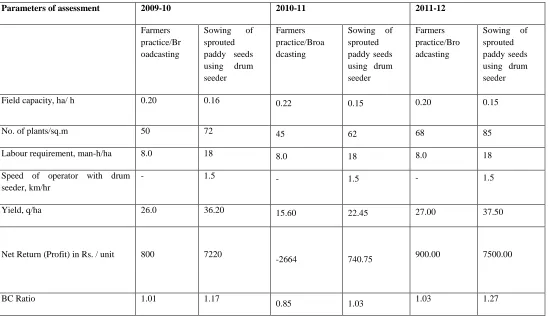
test of the eight row paddy drum seeder. The field performance of the paddy drum seeder is presented in
Table 2. Based on the field trials conducted during kharif 2009-2010, 2010-2011, 2011-2012, it was
observed that the field capacity of the eight row drum seeder was 0.16 ha/h at an average operating speed
of 1.5 kmph.
Table 1: Test conditions during the trials
Sr. No. Particulars 2009-10 2010-11 2011-12
1. Farming situation Rainfed Rainfed Rainfed
2. Location Farmers field Farmers field Farmers field
3. Type of soil Sandy loam Sandy loam Sandy loam
4. Field preparation Ploughing,
puddling and leveling Ploughing, puddling and leveling Ploughing, puddling and leveling
Table 2: Field performance of paddy drum seeder
Parameters of assessment 2009-10 2010-11 2011-12
Farmers practice/Br oadcasting Sowing of sprouted paddy seeds using drum seeder Farmers practice/Broa dcasting Sowing of sprouted paddy seeds using drum seeder Farmers practice/Bro adcasting Sowing of sprouted paddy seeds using drum seeder
Field capacity, ha/ h 0.20 0.16 0.22 0.15 0.20 0.15
No. of plants/sq.m 50 72 45 62 68 85
Labour requirement, man-h/ha 8.0 18 8.0 18 8.0 18
Speed of operator with drum seeder, km/hr
- 1.5 - 1.5 - 1.5
Yield, q/ha 26.0 36.20 15.60 22.45 27.00 37.50
Net Return (Profit) in Rs. / unit 800 7220
-2664 740.75 900.00 7500.00
BC Ratio 1.01 1.17
0.85 1.03 1.03 1.27
Farmers use to sow the seed in dry soil with broadcast method at a seed rate 100 kg/ha whereas sowing of
sprouted paddy seeds with drum seeder on puddled field at 20 cm line spacing at a seed rate 60 kg/ha
could save the cost of cultivation of paddy crop by saving the seed. Thus it is feasible to minimize the
cost of paddy cultivation. Thus mechanization in paddy sowing is a feasible solution for reducing the cost
of cultivation of paddy crop. The working of eight row paddy drum seedr was found to be satisfactory.
The labour requirement was found to be 18 man days per hectare. From the study, it can be concluded
that the eight row paddy drum seeder could be used successfully reducing the drudgery of labours. Direct
sowing reduced the cost of cultivation and increased the net profit per ha by avoiding nursery raising and
also due to reduction in cost of transplanting. The use of drum seeder for sowing of sprouted paddy seed
was better over broadcasting method. Drum seeder sowing recorded higher yield over farmers practice
(Table 2). Row sowing facilitated to take up fertilizer application, plant protection measures and weed
control in an efficient manner. In addition, crop duration is reduced by 8-10 days and more area is
covered per unit time. Wang and Sun (1990) noticed that duration can be shortened by 7-15 days in direct
seeded rice compared to transplanted rice. Seed rate was reduced to 30 kg/ha in drum seeder as against
62.5-75.0 kg/ha in nursery cum transplanting method. An area of 1.0 ha can be covered in a man day of
8.0 h.
Conclusion
It can be concluded that direct sowing with drum seeder can help when there is a shortage of labour for
transplanting, increases the yield, reduces the crop duration, drudgery and cost of cultivation.
References
Khan, A.S. and Majid, A. (1989). Direct sowing: An alternative to paddy transplanting. Agricultural
Mechanization in Asia, Africa and Latin America, 20(4):31-35.
Subbaiah, S.V., Balasubramanian, V. and Krishaiah, K. (2002). Evaluation of drum seeder in puddled
field conditions. Agricultural Mechanization in Asia, Africa and Latin America. 33(4): 23-41.
S.N Pradhan (1969), Mechanization of rice cultivation.
P Santhi, K Ponnuswamy and N K Chetty (1998). Effect of seeding methods
and efficient nitrogen management practices on the growth of lowland rice. J. of Ecobiol. 10(2): pp 123-132.