2790
K
-One Modulo Three Mean Labeling
Of Some Path Related Graphs
B.Gayathri1 and V. Prakash2
1
Associate professor, PG and Research Department of Mathematics, Periyar E.V.R. College ,Tiruchirappalli, India .
Email: [email protected] 2
Assistant professor, Department of Mathematics, RVS College of Arts and Science, Tiruchirappalli, India .
Email: [email protected]
Abstract- Jayanthi and Maheswari introduced one modulo three mean labeling and proved some standard graphs are one modulo three mean graphs. We extend this concept to k-one modulo three mean labeling. In this paper we discuss k-one modulo three mean labeling of some path related graphs.
Keywords-Mean labeling, Mean graphs, k-one modulo three mean labeling, k-one modulo three mean graphs. AMS Subject Classification— 05C78.
1. INTRODUCTION
This paper deals with graph labeling. All graphs considered here are simple, finite and undirected. The terms not defined here are used in the sense of Harary [7].
Somasundaram and Ponraj [9] have introduced the notion of mean labeling of a (p,q) graph. Different kinds of mean labeling are studied by Gayathri and Gopi in [6]. Swaminathan and Sekar [10] introduced the concept of one modulo three graceful labeling. As an analogue, Jayanthi and Maheswari [8] introduced one modulo three mean labeling and proved that some standard graphs are one modulo three mean graphs.
In [1], we obtained some necessary conditions and properties for one modulo three mean labeling. In [2], we obtained one modulo three mean labeling of some family of trees. In [3], we obtained one modulo three mean labeling of some special graphs. In [4], we obtained one modulo three mean labeling of disconnected graphs. In [5], k-one modulo three mean labeling of snake related graphs was obtained. Here we discuss k-one modulo three mean labeling of some path related graphs.
2. MAIN RESULTS Definition 2.1
A graph G( , )p q is said to be k-one modulo three mean graph if there is a function f from the
vertex set of G to the set
0, 1, 3, 4, 6, 7, ... 3(kq) – 6, 3(kq) – 5
with f is one-one and f induces a bijection
4,1 0,1 6, , 3 8
f x k from the edge set of G to
the set 3
6kq
where *( ) ( ) ( )
2
f u
v f
f u v
and
the function f is called as k-one modulo three mean
labeling of G. Here, f*(uv) 1(mod 3) for every edge
uv in G. Theorem 2.2
The path Pn is a k-one modulo three mean
graph for
1) n is even and k 1 2) n is odd and k 2. Proof
Let {ui, 1 in} be the vertices and {ei, 1 in – 1} be the edges which are denoted as in Figure 2.1.
u
1u
2u
3. . .
u
n-2u
n-1u
ne
n-2e
n-1e
2e
1Figure 2.1: Ordinary labeling of Pn
First we label the vertices as follows:
Define f : V {0, 1, 3, 4, ..., 3(k + q) – 6, 3(k + q) – 5} by
Case 1: n even and k 1
For 1 in, ( )i
f u = 3 3 6 odd
3 3 8 even
i k i
i k i
Case 2: n odd and k 2
For 1 in, ( )i
f u = 3 3 8 odd
3 3 6 even
i k i
i k i
Then the induced edge labels of the both cases are: For 1 in – 1,
*
( )i
f e = 3i + 3k – 5
The above defined f provides k-one modulo three mean labeling of the graph Pn.
7-one modulo three mean labeling of the graph P8 is
2791 18 19 24 25 30 31 36
31 34 22
19 37
37 25 28
Figure 2.2: 7-OMTML of P8
Theorem 2.3
The star graph K1,n is a k-one modulo three mean
graph for any kn. Proof
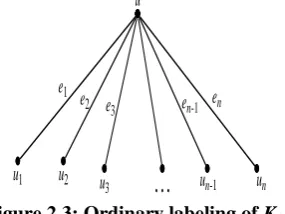
Let {ui, 1 in} be the vertices and {ei, 1 in}
be the edges which are denoted as in Figure 2.3.
u
u1 u2 u
3 un-1 un
en en-1 e3
e2 e1
[image:2.595.80.528.60.806.2]. . .
Figure 2.3: Ordinary labeling of K1,n
First we label the vertices as follows:
Define f : V {0, 1, 3, 4, ..., 3(k + q) – 6, 3(k + q) – 5} by
( )
f u = 3k + 3n – 5 For 1 in,
( )i
f u = 6(i – 1) + 3(k – n) Then the induced edge labels are: For 1 in,
*
( )i
f e = 3(i – 1) + 3k – 2
The above defined function f provides k-one modulo three mean labeling of the graph K1,n.
16- one modulo three mean labeling of the graph K1,10
is shown in Figure 2.4.
73
18 24 30 36 42 48 54 60 66 72 46
49 52
55 58 61 64 67 70 73
Figure 2.4: 16-OMTML of K1,10
Theorem 2.4
The comb graph Pm is a k-one modulo three mean graph for all m and k.
Proof
Let {ui, vi, 1 im} be the vertices and
{ei, 1 i 2m – 1} be the edges which are denoted as
in Figure 2.5.
u1 u2 u3 um-1 e2m-2 um
e2m-1
vm
vm-1
v1 v2 v3 . . .
e1
e2 e4
e3 e5 e2m-3
Figure 2.5: Ordinary labeling of Pm
First we label the vertices as follows:
Define f : V {0, 1, 3, 4, ..., 3(k + q) – 6, 3(k + q) – 5} by
For 1 im, ( )i
f u = 6( 1) 3 3 odd
6( 2) 3 4 even
i k i
i k i
( )i
f v = 6( 1) 3 2 odd
6( 2) 3 3 even
i k i
i k i
Then the induced edge labels are:
*
( )i
f e = 3i + 3k – 5, 1 i 2m – 1 The above defined function f provides k-one modulo three mean labeling of the graph Pm.
21-one modulo three mean labeling of the graph P10 is shown in Figure 2.6.
61 66 73 78 82 85 88 90 94 97
97 91 85 79 73 67 61
60 67 72 79 84 91 96
100 102 106 109 112 114
115 109 103
[image:2.595.112.255.225.332.2]103 108 115 64 70 76
Figure 2.6: 21-OMTML of P10
Theorem 2.5
The caterpillar G obtained by attaching n
pendant edges to each vertex of the path Pm is a k-one
modulo three mean graph for
i) m is even, for all n and k 1. ii) m is odd, for all n and kn. Proof
Let G be a caterpillar obtained from the path
Pm by attaching n pendant edges to each of its vertices.
Let {uij, uj, 1 i n, 1 j m} be the vertices and
{eij, 1 in, 1 jm, ej, 1 jm – 1} be the edges
which are denoted as in Figure 2.7.
u1 u2 . . . um
u11 u21 . . . un1 u12 u22 . . . un2 u1m u2m. . . unm
e11
e21 en1
e12e22 en2 e1me2m enm
. . .
e1 em-1
Figure 2.7: Ordinary labeling of Pm K1,n
First we label the vertices as follows:
Define f : V {0, 1, 3, 4, ..., 3(k + q) – 6, 3(k + q) – 5} by
Case 1: m even, for all n and k 1
For 1 in, 1 jm, ( ij)
f u = 3( 1)( 1) 6 3 9 odd 3( 1)( 2) 6 3 2 even
n j i k j
n j i k j
[image:2.595.319.513.327.413.2]2792 ( j)
f u = 3( 1)( 1) 3 2 odd 3( 1)( 2) 6 3 3 even
n j k j
n j n k j
Case 2: m odd, for all n and k n
For 1 in, 1 jm
( ij)
f u = 3( 1)( 1) 6( 1) 3 3 odd
3( 1)( 2) 6 3 3 5 even
n j i k n j
n j i k n j
( j)
f u = 3( 1)( 1) 3 3 5 odd
3( 1)( 2) 3 3 even
n j k n j
n j k n j
Then the induced edge labels of the both cases are: For 1in, 1 jm,
*
( ij)
f e = 3(n + 1) (j – 1) + 3i + 3k – 5 For 1 jm - 1,
*( )
j
f e = 3(n + 1) (j – 1) + 3k + 3n – 2 The above defined function f provides
k-one modulo three mean labeling of the graph
1,
m n
P K .
11-one modulo three mean labeling of the graph
5 1,4
P K is shown in Figure 2.8.
40 43 45 58 70 73 75 88 100
31 34 37 40 46 49 52 55 61 64 67 70 76 79 82 85 91 94 97 100
21 27 33 39 46 52 58 64 51 57 63 69 76 82 88 94 81 87 93 99
Figure 2.8: 11-OMTML of P5e K1,4
Theorem 2.6
The bistar Bm,n is a k-one modulo three mean
graph for
1) m = n and k 1. 2) m > n and km – n + 1. Proof
Let {ui, 1 im, vi, 1 in} be the vertices
and {ei, 1 i m + n + 1} be the edges which are
denoted as in Figure 2.9.
u1
u2
...
um
e1
e2
e3
em
u
em+1
em+2
em+3
em
+n+1 ...
...
v1
v2
vn
v
Figure 2.9: Ordinary labeling of Bm,n
First we label the vertices as follows:
Define f : V {0, 1, 3, 4, ..., 3(k + q) – 6, 3(k + q) – 5} by
Case 1: m = n and k 1
For 1 im, ( )i
f u = 6i + 3k – 8 For 1 in,
( )i
f v = 6i + 3k – 3 ( )
f u = 3k – 3; ( )f v = 3m + 3n + 3k – 2 Case 2: m > n and k m – n + 1
For 1 im, ( )f ui = 6i + 3n – 3m + 3k – 8 For 1 in,
( )i
f v = 6i + 3m – 3n + 3k – 3 ( )
f u = 3k + 3m – 3n – 3 ( )
f v = 3k + 3m + 3n – 2 Then the induced edge labels are:
*
( )i
f e = 3i + 3k – 5 1 im + n + 1
The above defined function f provides k-one modulo three mean labeling of the graph Bm,n.
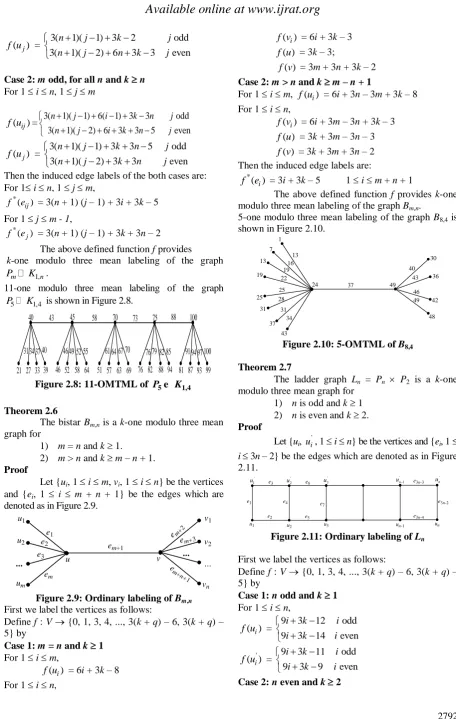
5-one modulo three mean labeling of the graph B8,4 is
shown in Figure 2.10.
43 1
7
13
19
25
31
37 13 16 19 22
25
28
31 34
24 37 49
40 43
46 49
[image:3.595.68.525.69.789.2]48 42 36 30
Figure 2.10: 5-OMTML of B8,4
Theorem 2.7
The ladder graph Ln = Pn P2 is a k-one
modulo three mean graph for 1) n is odd and k 1 2) n is even and k 2. Proof
Let {ui, ui', 1 in} be the vertices and {ei, 1 i 3n – 2} be the edges which are denoted as in Figure 2.11.
e1 e4 e7 e3n-2
e3n-4
un-1
e2 e5
u2
u1 u3 un
e3 e6
' 1
u '
2
u '
3
u '
1
n
u e3n-3 un'
Figure 2.11: Ordinary labeling of Ln
First we label the vertices as follows:
Define f : V {0, 1, 3, 4, ..., 3(k + q) – 6, 3(k + q) – 5} by
Case 1: n odd and k 1
For 1 in, ( )i
f u = 9 3 12 odd
9 3 14 even
i k i
i k i
'
( )i
f u = 9 3 11 odd
9 3 9 even
i k i
i k i
2793 For 1 in,
( )i
f u = 9 3 14 odd
9 3 12 even
i k i
i k i
'
( )i
f u = 9 3 9 odd
9 3 11 even
i k i
i k i
Then the induced edge labels are: For 1 i 3n – 2,
*
( )i
f e = 3i + 3k – 5
The above defined function f provides k-one modulo three mean labeling of the graph Ln.
6-one modulo three mean labeling of the graph L8 is
shown in Figure 2.12.
18 22 25 31 36 40 43 49 54 58 61 67 72 76 79
79 70 61 52 43 34 25 16
[image:4.595.307.496.101.228.2]13 19 24 28 31 37 42 46 49 55 60 64 67 73 78
Figure 2.12: 6-OMTML of L8
Definition 2.8
Let G = Pm( )Kn be the graph with the vertex set V(G) = {ui, vi, 1 im, 1 jn} and the edge set E(G) = {uiui+1, u1vj, umvj, 1 im – 1, 1 jn}.
Theorem 2.9
The graph G = Pm( ) Kn is a k-one modulo three mean graph if m 0 (mod 4) for all k 1 and for all n.
Proof
Let {ui, 1 im, vj, 1 jn} be the vertices
and {ei, 1 im – 1, aj, bj, 1 jn} be the edges
which are denoted as in Figure 2.13.
u1 e1 u2 e2 u3 e3 u4 e4 u5 . . . um-1 em-1 um a1
a2
an vn
vn
v1
bn
b2
b1
. . .
Figure 2.13: Ordinary labeling of Pm( ) Kn
First we label the vertices as follows:
Define f : V {0, 1, 3, 4, ..., 3(k + q) – 6, 3(k + q) – 5} by
( )i
f u =
3 3 6 1 , odd
2
3 3 5 1 , odd
2
3 3 8 1 , even
2
3 6 3 9 1 , even
2 m
i k i i
m
i k i m i
m
i k i i
m
i n k i m i
( )i
f v = 6i + 3m + 3k – 8 1 in
Then the induced edge labels are:
*
( )i
f e =
3 3 5 1 2
3 3 3 5 1 1
2
m
i k i
m
i n k i m
*
( j)
f a = 3j + 3 2
m
+ 3k – 5 1 jn
*
( j)
f b = 3j + 3(m + n) + 3k – 8 1 jn
The above defined function f provides k-one modulo three mean labeling of the graph Pm( )Kn.
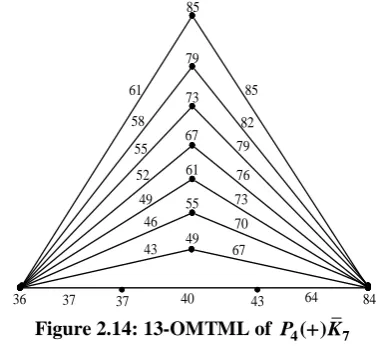
13-one modulo three mean labeling of the graph
P4 (+) K7 is shown in Figure 2.14.
36 37 37 40 43 84
43 46 49
67
55
49 76
70
67 61
73 52
55 73
79 58
79
82
64 61
85
[image:4.595.319.508.286.459.2]85
Figure 2.14: 13-OMTML of P4( ) K7
Theorem 2.10
The book graph K1,n P2 is a k-one modulo
three mean graph if n is even. Proof
Let {u, v, w, ui, vi: 1 in} be the vertices
and {ai, bi, ci, 1 i n} be the edges which are
denoted as in Figure 2.15.
u v
w b1
a1
a2
a3
an
un
. . .
u3
u2
u1
vn
. . .
v1
v2
v3
c1
c2
c3
cn
...
...
b2
b3
bn
Figure 2.15: Ordinary labeling of K1,n P2
First we label the vertices as follows:
Define f : V {0, 1, 3, 4, ..., 3(k + q) – 6, 3(k + q) – 5} by
( )
2794 ( )i
f u = 6i + 3k – 8 1 in Case 1: n 0 (mod 4)
( )i
f v =
6 6 3 8 1
4 2 6 6 3 2 1
4 2
2 3
6 3 3
2 4
3 8
6 3 9
4
n
n i k i
n n
n i k i
n n
i k i
n
i k i n
2 n
f v
= 9n + 3k – 3
3 4 4
n
f v = 15 3 2 2 n k
Case 2: n 2 (mod 4)
( )i
f v =
2 6 6 3 8 1
4
6 2
6 6 3 2
4 2
2 3 2 6 3 3
2 4
3 6 6 3 9
4
n
n i k i
n n
n i k i
n n
i k i
n
i k i n
2 n
f v
= 9n + 3k – 3
3 2
4
n
f v = 15 3 1 2 n k
Then the induced edge labels are:
*
( )i
f a = 3i + 3k – 5 1 in
*
( )
f w = 9 6 4
2
n k
Case 1: n 0 (mod 4)
*
( )i
f b =
3 6 3 8 1
4 2
3 6 3 5 1
4 2
2 3
6 3 5
2 4
3 8
6 3 8
4 n
n i k i
n n
n i k i
n n
i k i
n
i k i n
* 2 n
f b
= 6n + 3k – 5
*
3 4
4
n
f b
= 6n + 3k – 2
*( )
i
f c =
15
3 3 5 1
2 4
15 2
3 3 2 1
2 4 2
9 2 3
3 3 2
2 2 4
9 3 8
3 3 5
2 4
n n
i k i
n n n
i k i
n n n
i k i
n n
i k i n
* 2 n
f c
= 9n + 3k – 2
* 3 4 4
n
f c
= 33 3 2 4 n k
Case 2: n 2 (mod 4)
*
( )i
f b =
2
3 6 3 8 1
4
6 2
3 6 3 5
4 2
2 3 2
6 3 5
2 4
3 6
6 3 8
4 n
n i k i
n n
n i k i
n n
i k i
n
i k i n
* 2 n
f b
= 6n + 3k – 5
*
3 2
4
n
f b
= 6n + 3k – 2
*( )
i
f c =
15 2
3 3 5 1
2 4
15 6 2
3 3 2
2 4 2
9 2 3 2
3 3 2
2 2 4
9 3 6
3 3 5
2 4
n n
i k i
n n n
i k i
n n n
i k i
n n
i k i n
* 2 n
f c
= 9n + 3k – 2
*
3 2
4
n
f c
= 33 12 4
n k
The above defined function f provides k-one modulo three mean labeling of the graph K1,nP2.
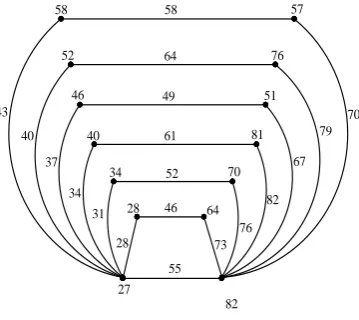
10-one modulo three mean labeling of the graph
2795
27
82 55 46
28 31 34 40
52
46
40
34
28
76
51
64 70
81
73 76
82 79
52 61
67 49
37
64
70 57 58
58
[image:6.595.93.273.100.260.2]43
Figure 2.16: 10-OMTML of K1,6 P2
3. CONCLUSION
Here k-one modulo three mean labeling of some path related graphs has been disused. More such graphs can be labeled so that we can find properties on it which will be our future study.
REFERENCES
[1] B. Gayathri and V. Prakash , Necessary conditions for one modulo three mean labeling of graphs, International Journal of Engineering Science, Advanced Computing and Bio-Technology, Vol. 6, No. 2, April-June 2015, pp. 41-61.
[2] B. Gayathri and V.Prakash , One modulo three mean labeling of some family of trees, Accepted for publication in International Journal of Engineering Science, Advanced Computing and Bio-Technology.
[3] B. Gayathri and V. Prakash, One modulo three mean labeling of some special graphs, Mathematical Sciences International Research Journal, Vol. 4, Issue 2( 2015), pp. 434 -440. [4] B. Gayathri and V. Prakash, One modulo three
mean labeling of disconnected graphs, Jamal Academic Journal: Interdisciplinary, Special Issue, February 2016, pp. 21-26.
[5] .B. Gayathri and V. Prakash, k-One modulo three mean labeling of snake related graphs, International Journal of Scientific Research and Review, Vol. 7, Issue 9( 2018), pp. 169 -177. [6] R. Gopi, A Study on Different kinds of Mean
labeling, Ph.D. Thesis, Bharathidasan University, Trichy, February (2013).
[7] F. Harary, Graph Theory, Addison Wesley Reading Massachusetts, 1972.
[8] P. Jeyanthi and A. Maheswari, One Modulo Three Mean Labeling of Graphs, Amer. J. Appl. Math. and Stat., 2(5) (2014) 302-306.
[9] S. Somasundaram and R. Ponraj, Mean labelings of graphs, National Academy Science Letter, 26 (2003) 10-13.
[10] V. Swaminathan and C. Sekar, Modulo three graceful graphs, Proceed. National Conference on Mathematical and Computational Models, PSG College of Technology, Coimbatore, 2001, 281-286.