DOI: 10.15680/IJIRSET.2014.0312051
Experimental Study on Light Weight Aggregate
Concrete with Pumice Stone, Silica Fume and Fly Ash
as a Partial Replacement of Coarse Aggregate
Lakshmi Kumar Minapu
1, M K M V Ratnam
2, Dr. U Rangaraju
3P.G. Student, Dept. of Civil Engineering, D.N.R.College of Engineering & Technology., Bhimavaram, Andhra Pradesh,
India1
Assistant Professor, Dept. of Civil Engineering, D.N.R.College of Engineering & Technology,Bhimavaram, Andhra
Pradesh, India2
Professor, Dept. of Civil Engineering, D.N.R.College of Engineering & Technology, Bhimavaram, Andhra Pradesh,
India3
ABSTRACT: In Design of concrete structures, light weight concrete plays a prominent role in reducing the density and to increase the thermal insulation. These may relate of both structural integrity & serviceability. More environmental and economical benefits can be achieved if waste materials can be used to replace the fine light weight aggregate. The new sources of Structural aggregate which is produced from environmental waste is Natural aggregates, synthetic light weight aggregate The use of structural grade light weight concrete reduces the self weight and helps to construct larger precast units. In this study, an attempt has been made to study the Mechanical Properties of a structural grade light weight concrete M30 using the light weight aggregate pumice stone as a partial replacement to coarse aggregate and mineral admixture materials like Fly Ash and Silica Fume. For this purpose along with a Control Mix, 12 sets were prepared to study the compressive strength, tensile strength and flexural strength. Each set comprises of 4 cubes, 2 cylinders and 2 prisms. Slump test were carried out for each mix in the fresh state. 28-days Compressive test, Tensile Strength and Flexural Strength tests were performed in the hardened state. The study is also extended for blending of concrete with different types of mineral admixtures. The test results showed an overall strength & weight reduction in various trails. Therefore, the light weight concrete is no way inferior for construction purpose..
KEYWORDS:Light weight concrete, Natural aggregate, synthetic light weight aggregate, coarse aggregate
I. INTRODUCTION
Most of the normal weight aggregate of normal concretes is natural stone such as lime stone and granite. With the increasing amount of concrete used, natural environment and resources are excessively exploited. Synthetic light weight aggregate produced from environmental waste like fly ash, is a viable new source of structural aggregate material. The use of light weight concrete permits greater design flexibility and substantial cost savings, reduced dead load, improved cyclic loading, structural response, longer spans, better fire ratings, thinner sections, smaller size structural members, less reinforcing steel and lower foundations costs. Light Weight Aggregate is a relatively new material. For the same crushing strength, the density of concrete made with such an aggregate can be as much as 35 percent lower than the normal weight concrete. In addition to the reduced dead weight, the lower modulus of elasticity and adequate ductility of light weight concrete may be advantageous in the seismic design of structures. Other inherent advantages of the material are its greater fire resistance, low thermal conductivity, low coefficient of thermal expansion and lower erection and transport costs for prefabricated members.
1.1 Light Weight Aggregates
(i) Naturally occurring materials which require further processing such as expanded clay, shale and slate, vermiculite etc.,
(ii) Industrial by-products such as sintered pulverized fuel ash, foamed or blast furnace slag, hemalite etc., (iii) Naturally occurring materials such as pumice, foamed lava, volcanic tuff and porous lime stone.
1.2 Light Weight Concrete
Structural light weight concrete has an in-place density (unit weight) on the order of 90 to 115 lb/ft3 (1440 to 1840 kg/m3) compared to normal weight concrete with a density in the range of 140 to 150 lb/m3 (2240 to 2500 kg/m3). For structural applications the concrete strength should be greater than 2500 psi (17.0 Mpa).
II.LITERATURE SURVEY
T. Parhizkar, M. Najimi and A.R. Pourkhorshidi (2011) [1] have presented experimental investigation on the properties of volcanic pumicelightweight aggregates concretes. To this end, two groups of lightweight concretes(lightweight coarse with natural fine aggregates concrete, and lightweight coarse and fineaggregates concrete) are built and the physical/mechanical and durability aspects of them arestudied. The results of compressive strength, tensile strength and drying shrinkage show thatthese lightweight concretes meet the requirements of the structural lightweight concrete.
N. Sivalinga Rao, Y.Radha Ratna Kumari, V. Bhaskar Desai, B.L.P. Swami (2013) [2]have studied on Fibre Reinforced Light Weight Aggregate (Natural Pumice Stone) Concrete. In their study, the mix design was M20 and the test results are as follows: More than the target means strength of M 20 concrete is achieved with 20 percent replacement of natural coarse aggregate by pumice aggregate and with 1.5 percent of fibber. Also with 40% pumice and with 0.5% of fibbers average target mean strength of M 20 concrete is achieved.
P.C.Taylor [3] presently a professor at Wuhan University of Technology has said that mineral admixtures affect the physical and mechanical properties of High Strength Structural Light Concrete. Addition of Fly Ash enhances the compressive strength and splitting tensile strength of HSSLC when FA was more than 20% in cementitious materials, its 28 days compressive strength and splitting tensile strengths are less than those of the concrete without FA. Addition of silica fume enhances the compressive strength about 25% and splitting tensile strength also. Incorporating
Swamy R.H & Lambert G.H (1984) [5] studied above the light weight aggregate and proved that the thermal efficiency is very more to the light weight concrete and the load carrying capacity of the light weight concrete is same as the normal concrete by using some mineral and chemical admixtures.
III.OBJECTANDSCOPEOFEXPERIMENTALINVESTIGATION
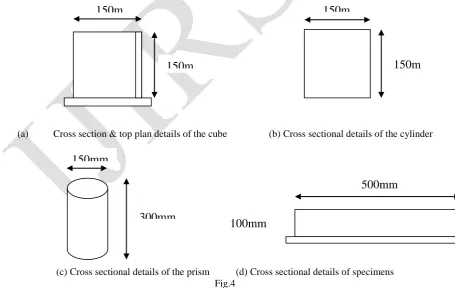
3.1 EXPERIMENTAL INVESTIGATION: The experimental investigation consists of casting and testing of 9sets along with control mix. Each set comprises of 4 cubes, 2 cylinders and 2 prisms for determining compressive, tensile and flexural strengths respectively. Pumice stone is used in the study with different percentagesas a partial replacement to natural weight coarse aggregate along with the varying percentages of the different admixtures like Silica Fume and Fly Ash.Cube section dimension is of15cmx15cmx15cm, cylinder section dimension is 15cmx30cm and prism dimension is 50cmx10cmx10cm. The moulds are applied with a lubricant before placing the concrete. After a day of casting, the moulds are removed. The cubes, cylinders and prisms are moved to the curing tank carefully.
3.1.1 MATERIALS: The constituent materials used in this study are given below :
1. Cement
2. Normal Weight Coarse Aggregate
3. Fine Aggregate
4. Fly Ash
5. Silica Fume
6. Pumice Stone (Light Weight Coarse Aggregate)
DOI: 10.15680/IJIRSET.2014.0312051
3.2.1 CEMENT : The cement used was ordinary Portland cement of 53- grade conforming to IS 12269. The cement should be fresh and of uniform consistency. Where there is evidence of lumps or any foreign matter in the material, it should not be used. The cement should be stored under dry conditions and for as short duration as possible.
3.2.2 AGGREGATES
A) FINE AGGREGATES: Sand shall be obtained from a reliable supplier and shall comply with ASTM standard C-33 for fine aggregates. It should be clean, hard, strong, and free of organic impurities and deleterious substance. It should inert with respect to other materials used and of suitable type with regard to strength, density, shrinkage and durability of mortar made with it.Grading of the sand is to be such that a mortar of specified proportions is produced with a uniform distribution of the aggregate, which will have a high density and good workability and which will work into position without segregation and without use of high water content. The fineness of the sand should be such that 100% of it passes standard sieve No.8.The fine aggregate which is the inert material occupying 60 to 75 percent of the volume of mortar must get hard strong nonporous and chemically inert. Fine aggregates conforming to grading zone II with particles grater than 2.36 mm and smaller than 150 mm removed are suitable.
B) NORMAL WEIGHT COARSE AGGREGATE: Machine crushed hard granite chips of 67% passing through 20 mm sieve and retained on 12 mm sieve and 33% passing through 12 mm and retained on 10 mm sieve was used a coarse aggregate throughout the work.
C) LIGHT WEIGHT COARSE AGGREGATE
PUMICE STONE: Pumice called pumicite in its powdered or dust form, is a volcanic rock that consists of highly vesicular rough textured volcanic glass, which may or may not contain crystals.
Fig.1 Pumice Stone
3.2.3 WATER: Water used in the mixing is to be fresh and free from any organic and harmful solutions which will lead to deterioration in the properties of the mortar. Salt water is not to be used. Potable water is fit for use mixing water as well as for curing of beams.
ADMIXTURES: Special considerations shall be given to the addition of materials to the mortar for special purposes. Approval may be given by the consulting engineer, when the materials is to be added directly or indirectly to reduce the water to the cement ratio or according to approve standards, if any. In this work, the admixtures used are namely Fly Ash and Silica Fume.
Fig.2 Fly Ash Fig. 3 SILICA FUME
i. Silica Fume: Silica fume is a byproduct of producing silicon metal or ferrosilicon alloys. One of the most beneficial uses for silica fume is in concrete. Because of its chemical and physical properties, it is a very reactive pozzolan. Concrete containing silica fume can have very high strength and can be very durable. Silica fume is available from suppliers of concrete admixtures and, when specified, is simply added during concrete production. Placing, finishing, and curing silica-fume concrete require special attention on the part of the concrete contractor.Silicon metal and alloys are produced in electric furnaces as shown in this photo. The raw materials are quartz, coal, and woodchips. The smoke that results from furnace operation is collected and sold as silica fume, rather than being landfilled. Perhaps the most important use of this material is as a mineral admixture in concrete. Silica fume consists primarily of amorphous (non-crystalline) silicon dioxide (SiO2). The individual particles are extremely small, approximately 1/100th the size of an average cement particle. Silica-fume concrete does not just happen.
3.2.7 MOULDS AND EQUIPMENTS: Moulds of required size and shape were prepared for casting process.The dimensions of the moulds for casting cubes, cylinders and prisms are 150mm x 150mm x 150mm,300mm x 150mm &500mm x 100mm x 100mm respectively are used. All the moulds are applied lubricant before concreting. After a day of casting moulds are de moulded and then cubes, prisms & cylinders are moved to the curing tank carefully for curing.
(a) Cross section & top plan details of the cube (b) Cross sectional details of the cylinder
(c) Cross sectional details of the prism (d) Cross sectional details of specimens Fig.4
3.3MIX DESIGN:
150m
m
150m
m
150m
m
150m
m
150mm
300mm
500mm
DOI: 10.15680/IJIRSET.2014.0312051
Mix design can be defined as the process of selecting suitable ingredients of concrete and determining their relative proportions with the object of producing concrete of certain minimum strength and durability as economically as possible.Mix design for each set having different combinations are carried out by using IS:10262 - 2009method. The mix proportion obtained for normal M60 grade concrete is 1:1.09:3.42with a water-cement ratio of 0.39
Objective:
The main objects of concrete mix design are:
1. To achieve the stipulated minimum strength and durability 2. To make the concrete in the most economical manner
Design of concrete mix requires complete knowledge of the various properties of the constituent materials, the implication in case of change on these conditions at the site, the impact of properties of plastic concrete on the hardened concrete and complicated inter-relationship between the variables.
3.4 PROCESS OF MANUFACTURE OF CONCRETE
(i)Batching: The measurement of materials for making concrete is known as Batching.
(ii)Weigh Batching: Weigh is the correct method of measuring the material. Use of weight system is batching, facilitates accuracy, flexibility and simplicity
(iii) Measurement of water: When weigh batching is adopted, the measurement of water must be done accurately. Addition of water by graduated bucket in terms of liters will not be accurate enough for the reason of spillage of water etc.
PREPARATION OF CONCRETE CUBES:Metal moulds, preferably steel or cast iron, strong enough to prevent distortion is required. They are made in such a manner as to facility the removal of the moulded. Specimen without damage and are so maintained that, when it is assembled, the dimensions and internal faces are required to be accurate with in the following limits.
Compacting: The testing cube specimens are made as soon as possible after mixing and in such a manner to produce full compaction of the concrete with neither segregation norexcessive bleeding.
Curing: The test specimens are stored in a place free from vibration in moist air of at least 90% relative humidity and at a temperature of 27o2oC for 24 hours from the time of addition of water to the dry ingredients. After this period, the specimens are marked and removed from the moulds.
Testing:
(i) Compressive Strength: After 28 days curing, cubical specimens are placed on compression testing machine having a maximum capacity of 3000 KNand a constant rate of loading of 40 kg/m2 per minute is applied on test specimen. Ultimate load at which the cubical specimen fails is noted down from dial gauge reading. This ultimate load divided by the area of specimen gives the compressive strength of each cube.
(ii) Tensile Strength: After 28 days curing, cylinder specimens are placed on tensile testing machine having a maximum capacity of 1000 KN and a constant rate of loading of 40 kg/m2 per minute is applied on the test specimen by placing two steel plates below and above the cylinder in the horizontal direction . Ultimate load at which the cylindrical specimen fails is noted down from dial gauge reading.
(iii) Flexural Strength : After 28 days curing, prismatic specimens are placed on flexural testing machine having a maximum of 100 KN and a constant rate of loading of 40 kg/m2 per minute is applied on the test specimen by placing the specimen in such a way that the two point loading should be placed at a distance of 13.3 cm from both the ends. Ultimate load at which the prismatic specimen fails is noted down from dial gauge reading.
0 10 20 30 40 50 Co m p re ssi ve S tr e n gth (M p a)
% replacement of light weight …
0 2 4 6 M30 10% P 20% P
30%P 40%P 50%P
Ten si le Str e n gth (M p a)
% replacement of light weight … S.No Mix
Designation Compressive Strength Mpa Tensile Strength Mpa Flexural Strength Mpa
1. M30
Control Mix
38.22 4.8 7.5
2. M30 10% P 36.44 4.38 6.75
3. M30 20% P 35.11 4.24 6.00
4. M30 30% P 32 3.96 5.00
5. M30 40% P 30.66 3.53 4.25
6. M30 50% P 29.77 3.11 3.5
7. M30 (5%
FA+5%SF)
39.11 5.37 8.75
Table 1 : Test Results for various proportions of mineral admixtures and light weight coarse aggregate (Pumice Stone) with steel fibers(S)
Effect of LWA on Cubes under Compression loading
S.No Mix Designation Compressive Strength (Mpa)
1. M30 Control Mix 38.22
2. M30 10% P 36.44
3. M30 20% P 35.11
4. M30 30% P 32
5. M30 40% P 30.66
6. M30 50% P 29.77
Table : 2 The behavior of Cubes casted with varying proportions of light weight aggregate are given below
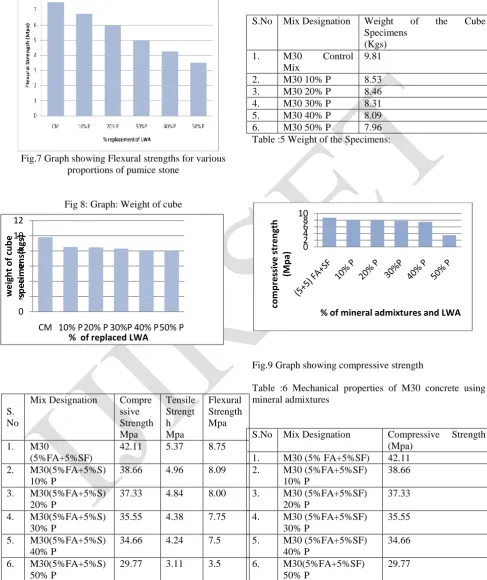
Fig5. compressive strengths for various proportions of pumice stone
Effect of LWA on Cylinders under tensile loading
S.No Mix Designation Tensile Strength (Mpa) 1. M30 Control Mix 4.8
2. M30 10% P 4.38
3. M30 20% P 4.24
4. M30 30% P 3.96
5. M30 40% P 3.53
6. M30 50% P 3.11
Table:3 The behavior of Cylinders casted with varying proportions of mineral admixtures are given below
Fig.6 Graph: Tensile strengths for various proportions of pumice stone
Effect of LWA on prisms under flexural loading
S.No Mix Designation Flexural Strength (Mpa) 1. M30 Control Mix 7.5
2. M30 10% P 6.75
3. M30 20% P 6.00
4. M30 30% P 5.00
5. M30 40% P 4.25
6. M30 50% P 3.5
DOI: 10.15680/IJIRSET.2014.0312051 0 2 4 6 8 10 12
CM 10% P20% P 30%P 40% P50% P
we ig h t o f c u b e sp e ci m e n s(kgs )
% of replaced LWA
Fig.7 Graph showing Flexural strengths for various proportions of pumice stone
Fig 8: Graph: Weight of cube
S.No Mix Designation Weight of the Cube Specimens
(Kgs) 1. M30 Control
Mix
9.81
2. M30 10% P 8.53
3. M30 20% P 8.46
4. M30 30% P 8.31
5. M30 40% P 8.09
6. M30 50% P 7.96
Table :5 Weight of the Specimens:
Fig.9 Graph showing compressive strength
S. No
Mix Designation Compre ssive Strength Mpa Tensile Strengt h Mpa Flexural Strength Mpa
1. M30
(5%FA+5%SF)
42.11 5.37 8.75
2. M30(5%FA+5%S) 10% P
38.66 4.96 8.09
3. M30(5%FA+5%S) 20% P
37.33 4.84 8.00
4. M30(5%FA+5%S) 30% P
35.55 4.38 7.75
5. M30(5%FA+5%S) 40% P
34.66 4.24 7.5
6. M30(5%FA+5%S) 50% P
29.77 3.11 3.5
Table :6 Mechanical properties of M30 concrete using mineral admixtures
S.No Mix Designation Compressive Strength (Mpa)
1. M30 (5% FA+5%SF) 42.11 2. M30 (5%FA+5%SF)
10% P
38.66
3. M30 (5%FA+5%SF) 20% P
37.33
4. M30 (5%FA+5%SF) 30% P
35.55
5. M30 (5%FA+5%SF) 40% P
34.66
6. M30(5%FA+5%SF) 50% P 29.77 0 2 4 6 8 10 co m p re ssi ve str e n gth (M p a)
DOI: 10.15680/IJIRSET.2014.0312051
Table :7 The behavior of Cubes casted with varying proportions of light weight aggregate are given below
S.No Mix Designation Tensile Strength (Mpa) 1. M30 (5% FA+5%SF) 5.37
2. M30 (5% FA+5%SF) 10% P
4.96
3. M30 (5% FA+5%SF) 20% P
4.84
4. M30 (5% FA+5%SF) 30% P
4.38
5. M30 (5% FA+5%SF) 40% P
4.24
6. M30 (5% FA+5%SF) 50% P
3.11
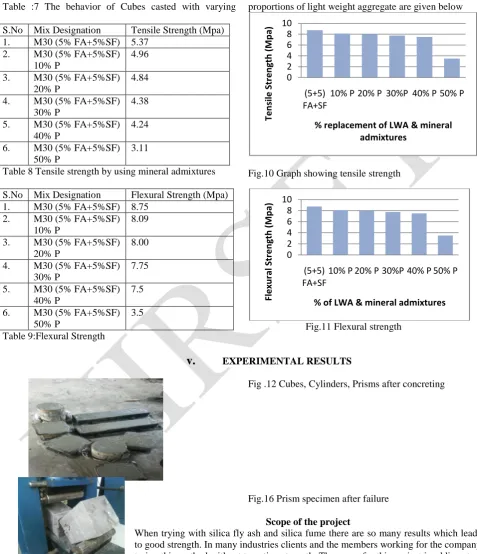
Table 8 Tensile strength by using mineral admixtures Fig.10 Graph showing tensile strength
S.No Mix Designation Flexural Strength (Mpa) 1. M30 (5% FA+5%SF) 8.75
2. M30 (5% FA+5%SF) 10% P
8.09
3. M30 (5% FA+5%SF) 20% P
8.00
4. M30 (5% FA+5%SF) 30% P
7.75
5. M30 (5% FA+5%SF) 40% P
7.5
6. M30 (5% FA+5%SF) 50% P
3.5
Table 9:Flexural Strength
Fig.11 Flexural strength
v.
EXPERIMENTAL RESULTSFig .12 Cubes, Cylinders, Prisms after concreting
Fig.16 Prism specimen after failure
Scope of the project
When trying with silica fly ash and silica fume there are so many results which leads to good strength. In many industries clients and the members working for the company trying this method without targeting strength. The scope for this project is adding steel
0 2 4 6 8 10 (5+5) FA+SF
10% P 20% P 30%P 40% P 50% P
Ten si le Str e n gth (M p a)
% replacement of LWA & mineral admixtures 0 2 4 6 8 10 (5+5) FA+SF
10% P 20% P 30%P 40% P 50% P
Fl e xu ral Str e n gth (M p a)
DOI: 10.15680/IJIRSET.2014.0312051
Copyright to IJIRSET www.ijirset.com 18138 fibers to cement will shows very good result and gives good strength. In this project it has shown that optimum value yields better, but whereas for steel fibers yields better economy and gives unexpected strength in our country
5.0 conclusions
By using 20% of light weight aggregate as a partial replacement to natural coarse aggregate the compressive strength is promising. The density of concrete is found to decrease with the increase in percentage replacement of natural aggregate by pumice aggregate. The compressive strength of concrete is found to decrease with the increase in pumice content. With the addition of mineral admixtures, the compressive, split-tensile and flexural strengths of concrete are increased. light weight aggregate is no way inferior to natural coarse aggregate and it can be used for construction purpose.
REFERENCES
[1] 1.T. Parhizkar*, M. Najimi and A.R. Pourkhorshidi, “(Application of pumice aggregate in structural lightweight concrete”, asian journal of civil engineering (building and housing) VOL. 13, NO. 1 (2012) PAGES 43-54.
[2] 2. N. Sivalinga Rao, Y.Radha Ratna Kumari, V. Bhaskar Desai, B.L.P. Swami, “Fibre Reinforced Light Weight Aggregate (Natural Pumice Stone) Concrete”, International Journal of Scientific & Engineering Research Volume 4, Issue 5, May-2013 ISSN 2229-5518.
[3] 3. Banthia, N. and Trottier, J., „Concrete reinforced deformed steel fibbers, part 1: Bond-slip mechanisms‟, ACI MaterialJournal 91 (5) (1994) 435-446.
[4] 4. Compione, G.,Mindess, S. and Zingone, G., „compressive stress-strain behavior of normal and high- strength Carbone- fiber concrete reinforced with steel spirals‟. ACI MaterialsJournal 96 (1) (1999) 27-34.