Performance Analysis of Chimney Type Solar
Dryerfor Drying Chilli
Sandeep Chevli
1,Vishal Patel
2, Arpan Patel
3Assistant Professor, Depart ment of Mechanical Engineering,Govt. Engg. Co llege, Surat, Guja rat, India1 P.G. Student, Depart ment of Mechanical Engineering,SVNIT, Surat, Gu jarat, India2
P.G. Student, Depart ment of Mechanical Engineering, C. K. Pithawala Co llege of Engg. & Tech. ,Surat, Guja rat, India3
ABSTRACT:The performance of a chimney type solar dryer is tested for drying chilli under the metrological conditions of Surat, India. The system consists of a flat plate solar collector with a dry ing cha mber. The a ir, a llo wed to enter the dryer, through collector inlet is heated up in the solar collector and a llo wed to flo w through the drying chamber where it is utilized fo r drying i.e. re mova l of the mo isture content from the food substance or agricultural produce loaded. Then its performance analysis using various parameters is carried out.
KEYWORDS:So lar dryer, Ch illi, Performance analysis , Ch imney, Solar Co llector.
I. IN TRO DUC TION
Drying is an e xcellent way to preserve food and it is one of the most important post -harvest operations for herbs and spices. It involves the removal o f moisture fro m agricultural produce so as to provide a product that can be safely stored for longer period of time. It also serves modificat ion in tastes and flavours in order to increase their market values of spices such as chili and pepper. So lar food dryers are appropriate food preservation technology for sustainable development.
Solar dryers are specialized devices that control the drying process and protect the agricultural product fro m damage by insect pests, dust and rain. In co mparison to natural sun drying, solar dryer generates higher temperatures, lower relat ive hu mid ity, lowe r p roduct mo isture content and reduced spoilage during the drying process. In addit ion, it takes up less space, takes less time and re latively ine xpensive compared to artific ial mechanical dry ing method. Thus, solar drying is a better alternative solution to all the drawbacks of natural drying and artific ia l mechanica l dry ing.
II. RELATEDWORK
III.DESC RIPTIO N O F THE DRYER
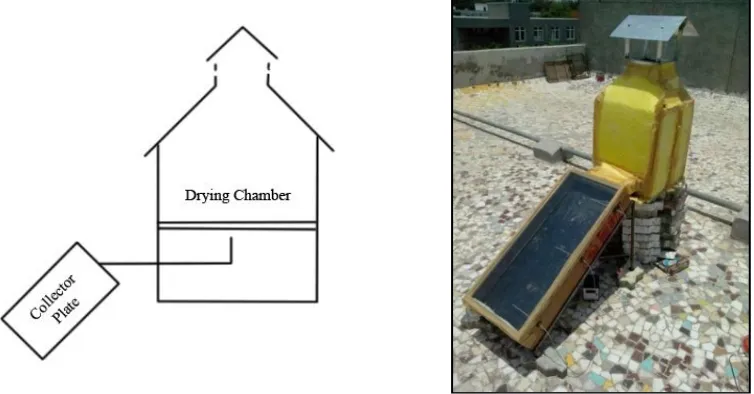
The solar dryer consis ted of flat plate solar collector connected with drying chamber. The solar air collector had thick copper absorber plate coated with black paint to absorb the incident solar radiat ion. The absorber plate was placed directly behind the transparent cover (glass) with a layer of a ir separating it fro m the co ver. The air to be heated was made to passthrough between glass cover and the copper absorber plate. The collector was connected with the drying chamber. The system was oriented to face south to ma ximize the solar radiation incident on the solar collector. The solar food dryer consisted of two major co mpart ment or cha mbers being integrated together as shown in Figure 1:
I.The solar collector co mpart ment, which can a lso be referred to as the air heater. II.The drying chamber, designed to accommodate a single dry ing tray.
Figure 1: Sche mat ic and actual figure of an e xpe rimental setup of solar dryer
The materials used for various components of solar dryer a long with thespecifications such as, area of dry ing bed, a rea of collector etc. are g iven in belo w Table 1.
Table 1: Materials Used and Specifications for Co mponents of Dryer
COMPONENT MATERIAL
Drying Plate Metal Mesh
Absorber Plate Copper
Cover Plate Glass
Insulating Material Glass wool
Outer Surface of Collector Wooden Ply
SPECIFICATION VALUE
Chimney He ight (h2) 50 c m
Thickness of bed (h) 3 c m
Height below bed (h1) 20 c m
Pressure drop of air (P) 0.03 mm of water
IV.METHO D O F MEASUREMEN T
1. Temperature Measure ment:
Temperature was measured using RTD PT100. These we re installed at s ix different p laces. Four o f the m we re in the collector, first at the collector inlet to measure the collector in let air te mperature, second at the middle portion of the collector, third at the collector outlet to measu re the collector e xit a ir te mperature and fourth was made contact with the copper plate ins ide of collector to measure a plate temperature. Other two we re installed in the drying chambe r, one below the dry ing bed and the other above the drying bed. Also on e more was used to measure the atmospheric air te mperature. A ll readings were taken in the interval of 1 hour for three days between 9:00 a.m. to 6:00 p.m.
2. Weight Measurement:
Weight measure ment of chillies was carried out on a we ighing machine ce rti fied by ISO: 9001. Th irteen samples of chillies we re selected for e xperiment which was placed on the drying bed inside the chamber with the help of a thread. Afte r every one hour these samples were ta ken out of the chamber fro m the top with the help of the thread and were we ighted on the weighing mach ine and again placed inside.
3. Veloc ity Measurement:
The velocity of air at in let was measured with the help of the Vane type Anemo meter. The Ane mo meter was placed at the collector inlet to measure the velocity of air at the inlet. Th is velocity is then used to calculate the mass flow rate of the air. These readings were taken afte r every one hour.
4. Solar Incident Rad iation Measurement:
Solar incident radiat ions were measured with the help of solarimet er. The instrument was p laced direct ly below the sun and the reading was shown on the digita l d isplay calibrated in W/ m2. These readings we re a lso taken after every one hour.
5. Dry And Wet Bulb Te mpe rature Measurement:
A dry and wet bulb thermo meter was us ed to measure the dry and wet bulb temperature of air and at the exit of the drying cha mber. These were then used to calculate the re lative hu midity of air and e xit of the dry ing chamber respectively.
V. EXP ERIMEN TAL PROC EDURE
VI. RESULTS AND DISCUSSION
Successful test was conducted for continuousthree days of May-2013 and these test data were used to calculate the collector efficiency, dry ing curves, humidity and te mperature measure ments in the dryer. During the tests period, the heated air was used to dry chillies.
Collector efficiency:
The effic iency of the collector could be seen from diffe rence in temperat ure of the e xit and inlet of the air to the solar collector. In this dryer, by fully opening the inlet and the e xit of the dryer, a te mperature with in 10-20℃ higher than the amb ient air te mperature was recorded. The graph of a mb ient te mperature (Tat m) and collector e xit te mperature (C3) was plotted and can be seen from the Figure 2.
Figure 2: A mbient Air Te mp. (Tat m) and Collector Exit A ir te mp.(C3) V/S Time for Day 1, 2 and 3
The instantaneous efficiency of the solar collector started to rise in the morning period and was relatively constant about 35% fro m 12:00 p m to 2:00 p m and dropped down in late afternoon. The variation obtained is typical for a flat plate collector and indicates strong dependence of effic iency on the metrological data especially on wind velocity and atmospheric conditions. The daily effic iency, averaged over 9 hours (9:00 a m to 6:00 p m) co mes out to be 35.15%. Here, Figure 3 depicts the collector effic iency obtained on three diffe rent days.
30 35 40 45 50 55 60 65 70 75 80
9 10 11 12 13 14 15 16 17 18
Te
m
p
e
ra
tu
re
˚C
Time of the day(Hour)
Tatm (day1) C3 (day1) Tatm (day2) C3 (day2) Tatm (day3) C3 (day3)
15 20 25 30 35 40 45
9 10 11 12 13 14 15 16 17 18
C
o
lle
ct
o
r
e
ff
ic
ie
n
cy
(%
)
DAY 1
DAY 2
Relati ve Humi dity and Capacity of the Air:
The Re lative hu midity during a ll the three days is plotted as shown in the Figure 4. The re lative humidity is affected by the air temperature. Heating the air decreases the relative humidity and respectively increases the capacity of the air to carry away moisture during a drying process. The extent to which this is achieved depends on the weather conditions, name ly the absolute humidity and the temperature of the ambient air. The re lative humidity and temperature of the amb ient air a re included for co mparison. The average relative humidity of the a mbient air was 51.06%. Ho wever, the low re lative humid ity of the exhaust air shows that the potential of the drying air to remove moisture was not fully utilized. Th is can be improved through proper utilizat ion of the drying potential of the air by increasing the number of the drying trays.
30 35 40 45 30 40 50 60 70 80
9 10 11 12 13 14 15 16 17 18
A m b ie n t te m p . ( °C) Re la tiv e h u m id it y % (k g va p o r/k g d ry a ir )
Time of the day (hour)
Day 1
RH of ambient air RH of air at exit of dryer Ambient air Temp.
30 35 40 45 30 40 50 60 70 80
9 10 11 12 13 14 15 16 17 18
A m b ie n t te m p . ( °C) R e la tiv e h u m id it y % (k g va p o r/k g d ry a ir )
Time of the day (hour)
Day 2
Figure 4: RH V/S Time for Day 1, 2 and 3
Drying Tests
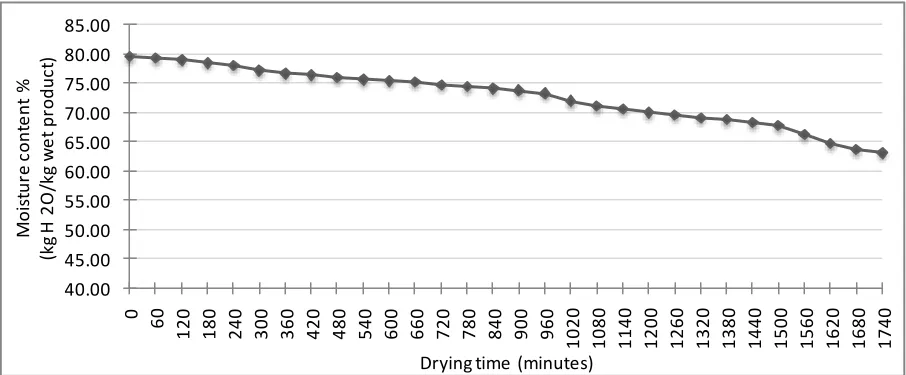
The experimental results obtained are shownin Figures 5,6. Figure 5 shows the moisture content of Chilli as a function of the drying. It can be seen fro m figures that moisture content on the wet basis gradually decreases with the time. The ma ximu m mo isture content remove is 1.51% and min imu m is 0.18% on wet basis. During night time there is also decrease in the moisture content, it is because during the night there was loss of moisture to the air in the dryer and in the room.
Figure 5: Moisture Content v/s Drying Time
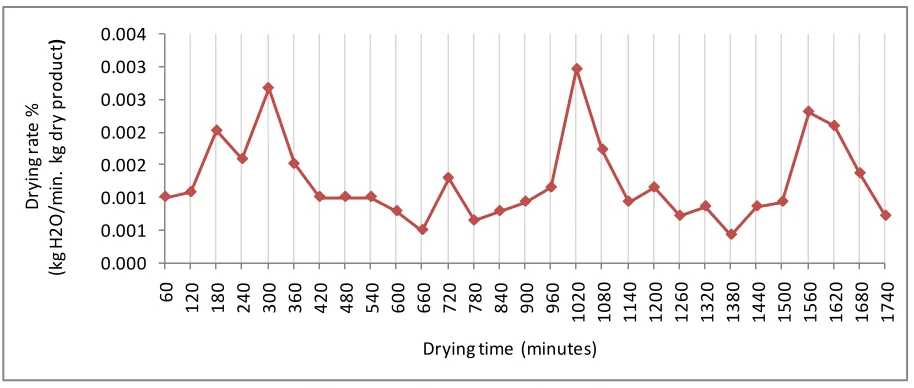
Figure 6 shows the drying rate of chilli as a function of the drying time. In the practica l environ ment it fluctuates at some point due sudden change in the weather condition. Even though there was moisture loss during the night in bed
30 35 40 45 30 40 50 60 70 80
9 10 11 12 13 14 15 16 17 18
A m b ie n t te m p . ( °C) R e la tiv e h u m id it y % (k g va p o r/k g d ry a ir )
Time of the day (hour)
Day 3
RH of ambient air RH of air at exit of dryer Ambient air Temp.
40.00 45.00 50.00 55.00 60.00 65.00 70.00 75.00 80.00 85.00 0 60
120 180 240 300 360 420 480 540 600 660 720 780 840 900 960 1020 1080 1140 1200 1260 1320 1380 1440 1500 1560 1620 1680 1740
M o is tu re c o n te n t % (k g H 2 O /k g w e t p ro d u ct )
Figure 6: Drying Rate v/s Drying Time
VII. CO NCLUSION
The performance of chimney type solar dryer was evaluated using 1kg of fresh chillies with collec tor of area 0.36m2. The results were as below.
1. The collector perfo rmance is encouraging. Co llector e ffic iency ranges from 20% - 43% and temperature rise was between 25 – 30 ˚C.
2. The drying material was protected from direct solar radiat ions, infestation by insects and con tamination by dust. As a result, the quality obtained was high.
3. The ma ximu m moisture content removed was 1.51% and minimu m mo isture content removed was 0.18%.
VIII. AC KNOWLEDGEMEN T
We wish to e xp ress an immense pleasure and sincere thanks to our colleagues Jay Mehta &Vive k Punjabifor their efforts and support.
REFER ENC ES
[1] Murthy, MV Ramana., "A review of new technologies, models and experimental investigations of solar driers" , Renewable and Sustainable
Energy Reviews, Vol.13, no. 4, pp.835-844, 2009.
[2] Sodha, Mahendra S., Narendra K. Bansal, Ashuni Kumar, Pradeep K. Bansal, and M. A. S. Malik .,"Solar crop drying, Volume I", 1987.
[3] Garg, H. P., and A. Krishnan., "Solar drying of agricultural products", Annals of Arid Zone, 1974.
[4] Lawand, T . A., "A solar-cabinet dryer", Solar Energy, Vol.10, no. 4, pp.158-164, 1966.
[5] Bala, B. K., M. R. A. Mondol, B. K. Biswas, BL Das Chowdury, and S. Janjai., "Solar drying of pineapple using solar tunnel drier",
Renewable Energy, Vol.28, no. 2, pp.183-190, 2003.
[6] Schirmer, P., S. Janjai, A. Esper, R. Smitabhindu, and W. Mühlbauer., "Experimental investigation of the performance of the solar tunnel
dryer for drying bananas", Renewable Energy, Vol.7, no. 2, pp.119-129, 1996.
[7] Bala, B. K., and J. L. Woods., "Simulation of the indirect natural convection solar drying of rough rice" , Solar Energy, Vol.53, no. 3, pp.
259-266, 1994.
[8] Hossain, M. A., and B. K. Bala., "Drying of hot chilli using solar tunnel drier", Solar Energy, Vol.81, no. 1, pp.85-92, 2007.
[9] Kaewkiew, J., S. Nabnean, and S. Janjai., "Experimental investigation of the performance of a large-scale greenhouse type solar dryer for
drying chilli in Thailand",Procedia Engineering, Vol.32, pp. 433-439, 2012.
[10] Montero, I., J. Blanco, T. Miranda, S. Rojas, and A. R. Celma., "Design, construction and performance testing of a solar dryer for
agroindustrial by-products", Energy Conversion and Management, Vol. 51, no. 7, pp.1510-1521, 2010.
0.000 0.001 0.001 0.002 0.002 0.003 0.003 0.004
60 120 180 240 300 360 420 480 540 600 660 720 780 840 900 960
1020 1080 1140 1200 1260 1320 1380 1440 1500 1560 1620 1680 1740
Dr
yin
g
ra
te
%
(k
g
H
2
O
/m
in
.
kg
d
ry
p
ro
d
u
ct
)
[11] Nijmeh, M. N., A. S. Ragab, M. S. Emeish, and B. A. Jubran., "Design and testing of solar dryers for processing food wastes" , Applied thermal engineering, Vol.18, no. 12, pp.1337-1346, 1998.
[12] Saleh, A., and I. Badran., "Modeling and experimental studies on a domestic solar dryer", Renewable Energy, Vol.34, no. 10, pp.2239-2245,
2009.
[13] Afriyie, John Kwasi, Marouan AA Nazha, HobinaRajakaruna, and F. K. Forson. , "Experimental investigations of a chimney-dependent solar
crop dryer", Renewable Energy, Vol.34, no. 1, pp.217-222, 2009.
[14] Chen, Zheng D., P. Bandopadhayay, J. Halldorsson, C. Byrjalsen, P. Heiselberg, and Y. Li. , "An experimental investigation of a solar
chimney model with uniform wall heat flux", Building and Environment, Vol.38, no. 7, pp.893-906, 2003.
[15] Ong, K. S., "A mathematical model of a solar chimney", Renewable Energy, Vol.28, no. 7, pp.1047-1060, 2003.