ABSTRACT
WRIGHT, NATALIE ANN. A Study of the Predictive Validity and Procedural Justice of the Implicit Association Test. (Under the direction of Dr. Adam Meade).
Recent research has provided evidence that scores on the Implicit Association Test (IAT) are contaminated by cognitive ability (e.g., Back, Schmulke, & Egloff, 2005;
A Study of the Predictive Validity and Procedural Justice of the Implicit Association Test
by
Natalie A. Wright
A thesis submitted to the Graduate Faculty of North Carolina State University
in partial fulfillment of the requirements for the degree of
Master of Science
Psychology
Raleigh, North Carolina
2010
APPROVED BY:
_______________________________ ______________________________ Mark A. Wilson, Ph.D. S. Bartholomew Craig, Ph.D.
________________________________ Adam W. Meade, Ph.D.
BIOGRAPHY
I grew up in Loveland, CO and graduated high school there. After a year and a half at Lewis and Clark College in Portland, OR, I attended Colorado State University in Fort
ACKNOWLEDGEMENTS
I‟d like to thank my advisor Dr. Adam Meade for his guidance with this study. His suggestions were invaluable, and I am certain that this study would have been pretty terrible without them.
My parents are owed a debt of gratitude for always believing in me, and encouraging me when I was feeling disheartened.
TABLE OF CONTENTS
LIST OF TABLES ... v
A STUDY OF THE PREDICTIVE VALIDITY AND PROCEDURAL JUSTICE OF THE IMPLICIT ASSOCIATION TEST ... 1
Introduction ... 1
Method ... 13
Results ... 19
Discussion ... 23
References ... 30
APPENDICES ... 49
Appendix A. TSA-IAT Processes and Stimuli... 50
Appendix B. Flower-Insect IAT Processes and Stimuli ... 51
Appendix C. General Procedural Justice Scale Items. ... 52
Appendix D. Items from the Selection Procedural Justice Scale ... 53
Appendix E. Microsoft Excel Familiarity Scale ... 54
Appendix F. Microsoft Excel Self-Efficacy Scale ... 55
LIST OF TABLES
Table 1 Fit Indices for Job Relatedness Confirmatory Factor Analyses………..39 Table 2 Descriptive Statistics for Study Variables………...40 Table 3 Intercorrelations of Study Variables………41 Table 4 Predictors of Declarative Knowledge Outcomes: TSA-IAT as Predictor…...43 Table 5 Predictors of Skill Acquisition Outcomes: TSA-IAT as Predictor………...44 Table 6 Predictors of Declarative Knowledge Outcomes: Flower-Insect IAT as
Predictor...45 Table 7 Predictors of Skill Acquisition Outcomes: Flower-Insect IAT as
Predictor………...46 Table 8 Hierarchical Regression Analysis: TSA-IAT Predicting Declarative
Knowledge Outcomes………..47 Table 9 Hierarchical Linear Regression: TSA-IAT Predicting Skill Acquisition
A STUDY OF THE PREDICTIVE VALIDITY AND PROCEDURAL JUSTICE OF THE IMPLICIT ASSOCIATION TEST
Introduction
Since its introduction in 1998, the Implicit Association Test (IAT) has been adapted and used in many areas of psychology. While initially developed as a measure of implicit attitudes related to social constructs such as race (e.g., McConnell & Leibold, 2001; Zeigert & Hanges, 2005), the IAT has been used to measure aggressiveness (Gollwitzer, Banse, Eisenbach, & Naumann, 2007), attitudes towards homosexuality (Banse, Seise, & Zerbes, 2001), implicit self-esteem and implicit self-concept (Greenwald & Farnham, 2000),
anxiousness (Schnabel, Banse, & Asendorpf, 2006), and conscientiousness and extraversion (Steffens, 2004). However, very few studies have addressed the applicability of the IAT to the workplace. Due the novel nature of the IAT and psychometric concerns, industrial-organizational psychologists have been reluctant to make use of the test. Landy (2008) argued that the methodology of IAT research is too far removed from real-life work settings to even consider applying it to personnel decisions and research. Zeigert and Hanges (2005) expressed doubt that the IAT could be used to predict macro-level behavior such as
Explanation and Theoretical Basis of the IAT
The original purpose of the IAT was to measure attitudinal variables in such a way as to avoid self-presentation bias. Self-presentation bias is the tendency of individuals to try to present themselves in the best possible light, sometimes at the cost of presenting themselves accurately (Greenwald, McGhee, & Schwartz, 1998). The IAT attempts to minimize this bias by assessing reaction times to index the strength of association between target categories and attributes (Lane, Banaji, Nosek, & Greenwald, 2007). Target categories are binary; for example, male vs. female, black vs. white, or insect vs. flower. Attribute categories are also binary; for example, good and bad or honest and dishonest.
or pleasant is flashed on the screen, and “I” anytime a word related to flower or unpleasant appears (Lane et al., 2007). Thus, both blocks three and five have the insect related words paired with the “E” key. However, block three also pairs “E” with unpleasant words, while block five also pairs “E” with pleasant words. Generally, incompatible and compatible blocks are counterbalanced from one participant to the other, as associations are usually stronger in the first pairing (Greenwald et al., 1998).
The strength of the associations between the target concepts and attributes is determined by computing the response latencies for the two pairings of concepts and attributes. In the above example, the “insect + unpleasant and flower + pleasant” trials would be compared to the “insect + pleasant and flower + unpleasant” trials. If responses in the first pairing were faster than the responses in the second pairing, it would be concluded that the participant expresses a stronger association between flowers and pleasant words (and insects and unpleasant words) than the converse (flowers-unpleasant and insects-pleasant). In short, this participant would demonstrate an implicit preference for flowers over insects. This difference in response latencies between the incompatible task and the compatible task is known as the IAT effect (Greenwald et al., 1998).
participants‟ general speed of responding, something that was not accounted for in the original scoring algorithm.
What do IAT scores represent?
Despite some promising findings with respect to the predictive validity of the IAT, there is some evidence challenging the construct validity of the IAT as a measure of implicit attitudes. Specifically, there has been considerable debate as to what exactly IAT scores represent. Although the standard explanation is that the IAT scores are reflective of
underlying implicit attitudes, there are many who disagree with this premise. Research into what scores on the IAT represent has flourished over the past decade and, accordingly, there are varying explanations for them. Mierke and Klauer (2003) examined the sources of variance that contribute to IAT scores and in addition to variance due to the attitudes and implicit associations purportedly measured by the IAT, they found method-specific variance was present as well. This methods variance was manifest as correlations between IATs that were not related in content: extraversion, flower-bug, and geometry IATs. Use of the D measure reduced these correlations, but they remained significant. In contrast to this finding, Perugini, O‟Gorman, and Prestwich (2007) found that the IAT is, at its root, a construct-valid measure. In the first stage of their experiment, participants‟ awareness of “self” was
The authors argued that a large portion of variance in IAT scores is construct-related, not method-related.
Although there are numerous explanations for the presence of construct-irrelevant variance in the IAT, one particular source of contamination of IAT scores warrants particular mention. Several studies have concluded that IAT scores are due partially to the effects of content-unrelated cognitive processes. Although the cognitive processes examined varies across studies (executive processes, task-switching ability, etc.), a significant body of
evidence has accumulated showing that these cognitive processes correlate with IAT scores. McFarland and Crouch (2002) argued that the IAT is contaminated by cognitive ability because the IAT requires controlled processing. Their data supported this conjecture such that a prejudice IAT correlated significantly with a control IAT, which was not related to explicit measures of prejudice. A similar lack of discriminant validity was found with an IAT created to measure self-esteem and a control IAT. They concluded that the cognitive ability confound present on the IAT is a result of task-switching and the difficulty of responding in the incongruent category pairings. In short, those with less cognitive ability are destined to achieve IAT scores that, in this case, show them to be more prejudiced and have lower self-esteem. Cai, Sriram, Greenwald, and McFarland (2004) pointed out that in McFarland and Crouch‟s (2002) study, the traditional scoring algorithm, rather than the D scoring method, was used. Cai and colleagues (2004) reanalyzed the study‟s original data using the D method instead of the traditional scoring algorithm and found that the
although the IAT may be contaminated somewhat by cognitive ability, this contamination is greatly reduced by using the D scoring method.
Blanton, Jaccard, Gonzales, and Christie (2006) argued that general processing speed is a significant contributor to IAT scores. That is, individuals who can process information at a rapid rate will have smaller latencies in IAT scores than individuals with a slower
processing speed. Mierke and Klauer (2001) concluded that IAT scores are largely
influenced by task switching. A person who has low task-switching ability will require more time to respond in the incompatible condition than someone with high task-switching ability, and as a result, this person will appear to have a stronger implicit preference for one of the target categories, even if this is not actually the case. Back, Schmulke, and Egloff (2005), like Mierke and Klauer (2001), found IAT scores to be related to individual differences in task-switching ability. Thus, IAT scores that are assumed to be content-related (i.e., revealing an implicit attitude) are contaminated by an individuals‟ task-switching ability. Using a task-switching ability IAT (the TSA-IAT) as a control, Back et al. found that an anxiety IAT was significantly correlated with the control IAT. Although the D scoring method reduced this correlation, some method-specific variance remained.
general cognitive ability (Grudnik & Kranzler, 2001). Moreover, perceptual speed tests can provide incremental predictive validity (related to prediction of job performance) when paired with traditional cognitive ability tests for low-complexity jobs (Mount, Oh, & Burns, 2008). Because the IAT bears resemblance to other stimulus-response tests due to its perceptual speed requirement (de Houwer et al., 2005), the IAT could be correlated with traditional general cognitive ability tests, regardless of what the specific IAT is designed to measure. This correlation is expected to occur regardless of which IAT is used.
Furthermore, if two IATs that do not measure the same construct both correlate with
cognitive ability, this will present additional evidence that the IAT method itself is related to cognitive ability.
Hypothesis 1: Scores on the IAT (using the D scoring algorithm) will be significantly and positively correlated with cognitive ability test scores.
Training and Learning Outcomes
Traditional cognitive ability tests, such as the Wonderlic Personnel Test, are widely used to predict personnel outcomes. Cognitive ability has been shown to relate to a number of important personnel outcomes, including job performance (e.g., Hunter, 1986; Morgeson, Delaney-Klinger, & Hemingway, 2005; Murphy & Shiarella, 1997; Schmidt, Hunter, & Outerbridge, 1986) and training outcomes (e.g. Colquitt, LePine, & Noe, 2000; Hunter, 1986; Ree, Carretta, & Teachout, 1995; Salgado, Anderson, Moscoso, Bertua, de Fruyt, & Rolland, 2003).
categories of training outcomes: declarative knowledge, skill acquisition, self-efficacy, and reactions to training. These outcomes are influenced by personality, age, environmental variables, self-efficacy, training valence, job and career variables, motivation to learn, and cognitive ability (Colquitt et al., 2000). According to this model, these variables all lead into the transfer of training, which is the application of the training to the job. When training can be applied to the job, job performance improves (Colquitt et al., 2000; Kraiger, Ford, & Salas, 1993).
The IAT has demonstrated a linkage with cognitive ability (Back et al., 2005; Blanton et al., 2006; Cai et al., 2004; McFarland & Crouch, 2002; Mierke & Klauer, 2001). Tests of perceptual speed are related to cognitive ability (Grudnik & Kranzler, 2001), and can add incremental validity to traditional cognitive ability tests (Mount, Oh, & Burns, 2008).
According to the Colquitt et al. (2000) model, cognitive ability is an important determinant of training outcomes. As such, it is possible that the IAT could be useful in predicting both declarative knowledge and skill acquisition training outcomes, a property which could pave the way towards its use as a selection measure. If the IAT does predict training outcomes, it could also provide incremental validity when paired with traditional selection tests.
Furthermore, if the IAT method itself is linked with cognitive ability, any IAT should predict training outcomes, regardless of what the specific IAT is designed to measure.
Hypothesis 2a: The Task-Switching IAT will predict post-training declarative knowledge outcomes.
Research Question 1: Will the Task-Switching IAT provide incremental validity to a traditional cognitive ability measure in predicting post-training declarative knowledge outcomes?
Research Question 2: Will the Task-Switching IAT provide incremental validity to a traditional cognitive ability measure in predicting post-training skill acquisition outcomes?
Procedural Justice
Validity is not the only concern relevant to selection tests. As the selection process is often the first experience applicants have with an organization, applicants often form their initial reactions to the organization based upon the selection process (Bauer, Maertz, Dolen, & Campion, 1998; Smither, Reilly, Millsap, Pearlman, & Stoffey, 1993). Feelings about the fairness and justice of the selection process have been shown to predict outcomes such as organizational attractiveness, intention to recommend the organization to others, and intention to accept a job offer from the organization (Hausknecht, Day, & Thomas, 2004). Many selection process characteristics have been found to impact applicant reactions. One of the most important that has emerged, however, is procedural justice.
Organizational justice is a topic that has received extensive attention in the I-O psychology literature, mostly due to its importance in determining organizational outcomes such as outcome satisfaction (Lind & Tyler, 1988), organizational attractiveness and
organizational justice that are important for organizations: procedural justice, distributive justice, interactional justice, and informational justice. These four dimensions of
organizational justice appear to exist as distinct, separate dimensions (Colquitt, Conlon, Wesson, Porter, & Ng, 2001). Distributive justice is feelings of satisfaction regarding how organizational outcomes are distributed (Greenberg, 1990), while interactional justice is concerned with the interpersonal treatment that individuals receive in any organizational process (Harris, 2000). Informational justice, a dimension that researchers have only recently split off from interactional justice, deals with the quality and frequency of
communication between an individual and the organization about organizational processes and systems (Colquitt, 2001). Procedural justice is defined as the perceived fairness of the processes that organizations use to reach decisions (Greenberg, 1990). Procedural justice, in a selection context, is the extent to which a selection process is viewed as being fair and equitable and is related to outcome satisfaction (Folger & Konovsky, 1989). Hausknecht et al. (2004), in a meta-analysis of applicant reactions to selection, found that procedural justice perceptions were significantly related to outcomes such as organizational attractiveness and willingness to recommend the organization to others, although this relationship was stronger in lab settings than in field settings. Because of its focus on the process and procedure used to determine outcomes, it tends to be the most relevant justice measure for selection.
Gilliland (1993) created one of the most useful theories of procedural justice with respect to employee selection. Gilliland postulated that there are three broad dimensions of procedural justice in selection: formal characteristics, explanation, and interpersonal
reconsideration opportunity, and consistency. Explanation includes feedback, selection information, and honesty. Interpersonal treatment is comprised of interpersonal
effectiveness, two-way communication, and propriety of questions. Bauer et al. (2001) confirmed these dimensions in their validation of the Selection Procedural Justice Scale. Confirmatory factor analysis of the scale, designed to measure Gilliland‟s (1993) procedural justice rules, revealed 11 factors (job relatedness was broken down into job relatedness-predictive and job relatedness-content) and three higher-order factors, reflective of the formal characteristics, explanation rules, and interpersonal treatment rules that exist as the three higher-order factors in Gilliland‟s (1993) model.
Bauer et al. (1998) found that procedural justice affected both organizational attractiveness and intentions toward the organization. That is, when perceived procedural justice was high, applicants were more likely to view the organization as attractive, and were more likely to accept an offer of employment for the organization. The procedural justice of a selection process can even affect the motivation, performance, and attitudes of employees who are hired into the organization (Ryan & Ployhart, 2000). Overall, there is ample
Research Question 3: In comparison to a traditional cognitive ability test, how do applicants perceive the use of the IAT in terms of overall procedural justice?
Job relatedness is a facet of procedural justice that is an intuitively important aspect of selection systems. Simply put, applicants will feel a selection process is more fair if it appears to be relevant to the job than if it looks unrelated to the job in question (Smither et al., 1993; Steiner & Gilliland, 1996). Job relatedness positively influences the attractiveness of the organization as well as perceptions of selection system fairness (Bauer et al., 1998; Holtz, Ployhart, & Dominguez, 2005). Job relatedness was shown in a meta-analysis to be moderately related to overall justice perceptions (Hausknecht et al., 2004). Perceptions of job relatedness do not appear to be influenced by an applicant‟s perception of their
performance on a selection measure (Van Vianen, Taris, Scholten, & Schinkel, 2004). The lack of procedural justice research in relation to the IAT is evident in this area as well. The IAT was designed to be a non-obvious measure (Greenwald et al., 1998), which may influence applicants‟ perceptions of the job-relatedness of the test. Since job relatedness is an important dimension of procedural justice, it is very important to determine whether participants view the IAT as being job-related, especially as it is not readily apparent what the IAT is measuring.
demonstrate their abilities to the fullest. LaHuis et al. (2007) found that applicants who felt that they were given ample opportunity to perform were more likely to reapply to the organization if their first application was rejected. Schleicher, Venkataramani, Morgeson, and Campion (2006) found that opportunity to perform greatly contributes to perceptions of a selection system‟s fairness. They found that opportunity to perform was especially important for applicants who were not offered a job. If these applicants felt that they had enough opportunity to perform, they still viewed the selection system as fair. It also appears that, on a surface level, applicants are more disposed to like a selection test which provides them ample opportunity to perform (Bertolino & Steiner, 2007).
At this point, no studies have determined how the IAT is perceived in terms of
opportunity to perform. Given its importance to overall procedural justice perceptions, this is an aspect of applicant reactions that merits examination, if the IAT is ever to be used as a selection measure.
Research Question 5: In comparison to a traditional cognitive ability test, how do applicants view the use of the IAT in terms of opportunity to perform?
Method Sample
remaining 4% being of another ethnicity. Data cleaning involved removing all duplicated ID numbers, and excluding participants who did not provide ID numbers on study materials. After cleaning and matching the data, and using listwise deletion, the final sample size ranged from n = 87 to n = 105.
Measures
TSA-IAT. The Task-Switching IAT (TSA-IAT) is an IAT that was created solely for the purpose of measuring task-switching ability and method-specific variance in the IAT (Back, Schmulke, & Egloff, 2005). It is content-nonspecific, as it uses numbers and letters as the target stimuli, and words and calculations as the attribute stimuli. In the compatible blocks, numbers are paired with calculations, and letters are paired with words. In the
incompatible blocks, numbers are paired with words, and letters are paired with calculations. Because it does not measure any specific content and/or attitudes, only method-specific variance, the TSA-IAT is ideal for testing the relationship between IAT scores and cognitive ability. This IAT was created using the FreeIAT software (Meade, 2009). See Appendix A for stimuli and process. Means were as expected. Internal consistency was estimated via correlating the first half of the stimuli from blocks three and five with the last half of the stimuli from blocks three and 5. The resulting correlation, r = .23, indicated a low amount of internal consistency in the TSA-IAT.
preference for flowers over insects. It was included in this study because flower-insect preference should be unrelated to cognitive ability, and thus provides a measure of common method variance. This IAT was created using the FreeIAT software (Meade, 2009). See Appendix B for stimuli and process. Means were as expected. Internal consistency was estimated via correlating the first half of the stimuli from blocks three and five with the last half of the stimuli from blocks three and 5. The resulting correlation, r = .34, indicated a low amount of internal consistency in the Flower-Insect IAT.
Wonderlic Personnel Test-Quicktest. The Wonderlic Personnel Test-Quicktest is a test of cognitive ability widely used in personnel selection. It consists of 30 questions that measure reasoning, linguistic, mathematical, and problem-solving abilities, and has a time limit of eight minutes. The test has an internal consistency estimate of 0.81 (Wonderlic, 2004). Due to the proprietary nature of this test, reliability estimates could not be calculated for the present sample. The Wonderlic Personnel Test-Quicktest correlates highly with the long-form Wonderlic Personnel Test, r = 0.77 (Wonderlic, 2004). The Wonderlic has been shown to correlate with measures of job performance (Barrick, Mount, & Strauss, 1994).
Procedural Justice Scale. This seven-item scale, based on the procedural justice scale created by Steiner and Gilliland (1996), measures the procedural justice of a selection
method. Responses choices are on a seven-point Likert scale (1 = totally disagree, 7 = totally agree). See Appendix C for items. Reliability for this scale was mostly at or above minimum standards of reliability for the present sample; α = 0.76 for the Flower-Insect IAT,
Selection Procedural Justice Scale. Bauer et al. (2001) developed the Selection Procedural Justice Scale to measure all ten of Gilliland‟s (1993) procedural justice
dimensions, as well as an 11th dimension added by Bauer and colleagues that resulted from breaking job relatedness down into job relatedness-predictive and job relatedness-content. There are 39 items in the full scale, and responses are on a five-point Likert scale (1 = strongly disagree; 5 = strongly agree) (Bauer et al., 2001). For the purposes of this study, only the job relatedness (both predictive and content) and opportunity to perform subscales were used (see Appendix D for subscale items). Both job relatedness subscales were originally combined to form one job relatedness scale that covered both predictive and content job relatedness.
To ensure that combining the two job-relatedness subscales resulted in a
TSA-IAT, and the WPT-Q. For the job relatedness-content scale, the reliability for the present sample was α = 0.80 in relation to the Flower-Insect IAT, α = 0.91 in relation to the TSA-IAT, and α = 0.82 in relation to the WPT-Q. The reliability of the opportunity to perform scale was also adequate for the present sample; α = 0.95 in relation to the Flower-Insect IAT,
α = 0.88 in relation to the TSA-IAT, and α = 0.90 for the WPT-Q.
Microsoft Excel Familiarity Measure. This two-item scale asked participants to indicate their familiarity with Microsoft Excel in general, and their specific familiarity with the use of formulas in Excel. Participants indicated 1 for „yes‟ and 0 for „no‟. See Appendix E for items. The mean for the general familiarity scale was 0.94, indicating that most
participants had used Excel prior to this study. The mean for the formula familiarity scale was 0.70, indicating that the majority of participants had used formulas in Excel prior to this study.
Microsoft Excel Self-Efficacy Scale: This six-item scale measures self-efficacy related to the use of Microsoft Excel. It is based on the general self-efficacy scale created by Chen, Gully, and Eden (2001). The reliability of this scale was acceptable in this sample; α =
0.87 (see Appendix F for items).
acquisition aspect of training outcomes (Colquitt et al., 2000; Kraiger, Ford, & Salas, 1993). See Appendix G for items.
Procedure
Participants were brought into a research lab and told that the goal of the study was to examine a new test battery to be used in the hiring and promotion of job applicants in
organizations. They were informed that, should this test battery prove to be valid, it would be used by corporations for hiring and promotion decisions. Participants were told to pretend that they were applying for a shift supervisor position at Perky Morning, a regional
coffeehouse, and were told to keep this in mind as they completed the experimental tasks. Participants completed three tests, which were counterbalanced in the order of their administration to prevent order effects. These included the Wonderlic Personnel Test-Quicktest, the IAT, and the Flower-Insect IAT. Participants were told that the TSA-IAT was a measure of task-switching ability and were also informed that this was a very important trait for managers to have. Participants were told that the Flower-Insect IAT was highly experimental test that was not expected to relate to job performance. Following the completion of the Wonderlic Personnel test, the TSA-IAT, and the Flower-Insect IAT, participants completed the job relatedness and opportunity to perform sections of the Selection Procedural Justice Scale (Bauer et al., 2001) as well as a revised version of the general procedural justice scale (Steiner & Gilliland, 1996) in relation to each test.
in Excel, participants were asked to indicate their familiarity with Microsoft Excel with a two-item familiarity measure that measured the extent of participant‟s previous exposure to the program (see Appendix E). Responses to these questions were entered as control variables in analysis. Participants also completed a six-item Excel self-efficacy measure based on the general self-efficacy scale created by Chen et al. (2001) (see Appendix F). Since self-efficacy has been shown to influence training outcomes (Chiaburu & Lindsay, 2008; Tziner, Fisher, Senior, & Weisberg, 2007), Excel self-efficacy was used as a control variable in analysis as well. After completing the module, participants completed the declarative knowledge and skill acquisition tests to measure their training outcomes. Participants were told that this phase of the study was also part of the selection battery and assessed trainability, or the ability to learn material presented in training.
Results
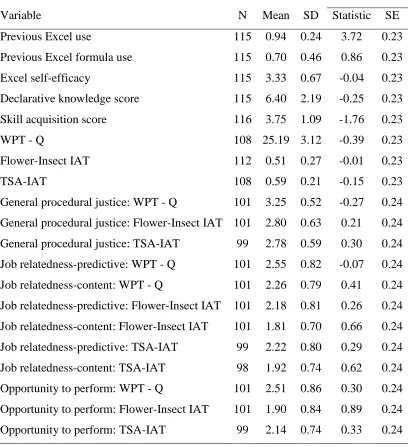
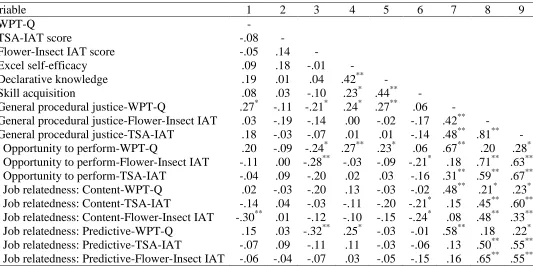
Descriptive statistics, including sample size, mean, standard deviation, and skewness for all study variables can be found in Table 2, and the intercorrelations of the variables can be found in Table 3. IAT scores were calculated using the D scoring algorithm, based upon the recommendations of Greenwald et al. (2003), with one modification. The IATs in this study used only five stages, rather than seven (Meade, 2009). Additionally, as recommended by Greenwald et al. (2003), data for participants with reaction times less than 300ms for more than 10% of the trials were dropped from further analysis (Meade, 2009).
Wonderlic Personnel Test-Quicktest (WPT-Q). Scores on the TSA-IAT were not
significantly related to scores on the WPT-Q, r(104) = -0.08, p = .207. Additionally, scores on the Flower-Insect IAT were not significantly and positively related to scores on the WPT-Q, r(102) = -0.052, p = .301. Hypothesis 1 was not supported. An additional two-tailed Pearson product-moment correlation was used to determine if there was common method variance between the TSA-IAT and the Flower-Insect IAT. There was not a significant correlation between scores on the TSA-IAT and scores on the Flower-Insect IAT, r(102) = 0.14, p = .157, indicating a lack of significant common method variance.
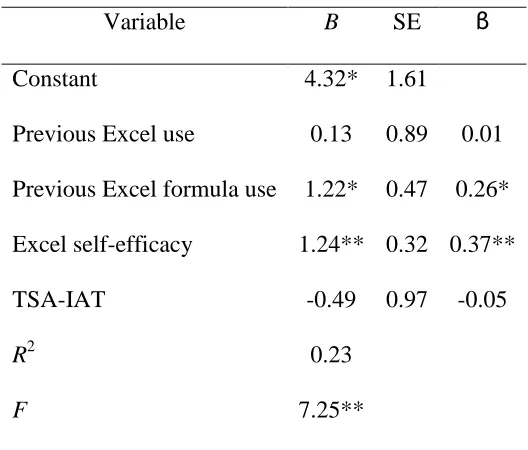
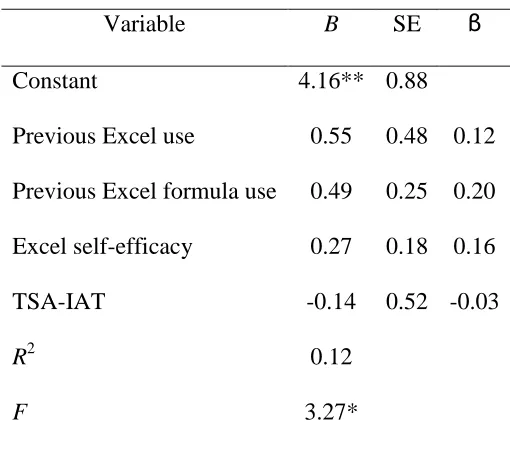
Hypothesis 2a pertained to the TSA-IAT‟s predictive validity in regards to post-training declarative knowledge outcomes. Multiple linear regression was used to determine if scores on the TSA-IAT predicted post-training declarative knowledge. While the overall model was significant,scores on the TSA-IAT did not account for significant variance on the post-training declarative knowledge test after controlling for previous Excel use, previous Excel formula use, and Excel self-efficacy (see Table 4). Thus, Hypothesis 2a was not supported. In regards to post-training skill acquisition, Hypothesis 2b predicted that TSA-IAT scores would predict skill acquisition outcomes. However, scores on the TSA-TSA-IAT did not significantly predict scores on the post-training skill acquisition test when the control variables of previous Excel use, previous Excel formula use, and Excel self-efficacy were accounted for (see Table 5) showing no support for Hypothesis 2b.
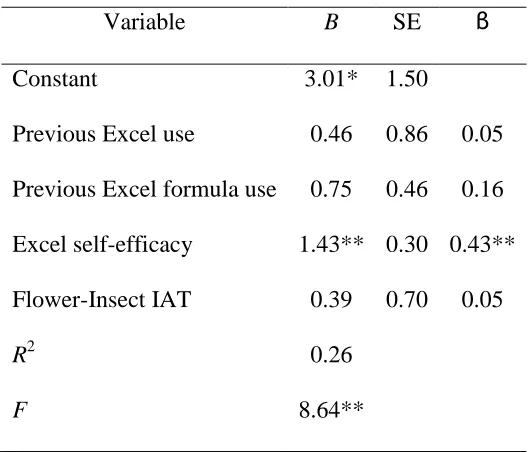
on the Flower-Insect IAT did not significantly predict scores on the post-training declarative knowledge test when the control variables of previous Excel use, previous Excel formula use, and Excel self-efficacy were accounted for (see Table 6). Additionally, as occurred with the TSA-IAT, scores on the Flower-Insect IAT did not significantly predict scores on the post-training skill acquisition test when the control variables of previous Excel use, previous Excel formula use, and Excel self-efficacy were accounted for (see Table 7).
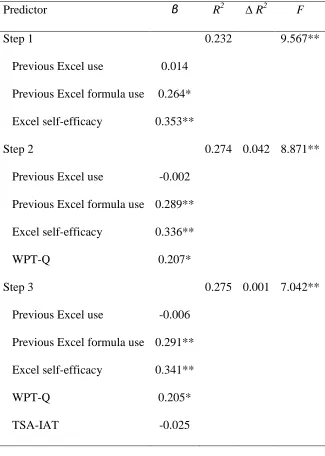
Hierarchical linear regression was used to determine if scores on the TSA-IAT provided incremental validity to a traditional cognitive ability test in predicting post-training declarative knowledge outcomes. The control variables (previous Excel use, previous Excel formula use, and Excel self-efficacy) were entered in the first block, WPT-Q scores were entered in the second block, and IAT scores were entered in the third block. The TSA-IAT scores did not present a measurable change in R2 from the previous model. In this final model, previous Excel formula use, Excel self-efficacy, and WPT-Q scores were unique, significant predictors of scores on the post-training declarative knowledge test. Previous Excel use and TSA-IAT scores were not unique, significant predictors of scores on the post-training declarative knowledge test (see Table 8).
A series of dependent sample t-tests were used to investigate differences in
procedural justice perceptions across the WPT-Q and the TSA-IAT. Participants rated the general procedural justice of the TSA-IAT (M = 2.77) significantly lower than they rated the procedural justice of the WPT-Q (M = 3.26), t(86) = -8.335, p < .001, d = -0.91. Regarding job relatedness, participants rated the predictive job relatedness of the TSA-IAT (M = 2.25) significantly lower than they rated the predictive job relatedness of the WPT-Q (M = 2.58), t(86) = -3.318, p = .001, d = -0.41. Similarly, participants rated the content job relatedness of the TSA-IAT (M = 1.95) significantly lower than they rated the content job relatedness of the WPT-Q (M = 2.28), t(86) = -3.438, p = .001, d = -0.42. Finally, participants rated the
opportunity to perform of the TSA-IAT (M = 2.12) significantly lower than they rated the opportunity to perform of the WPT-Q (M = 2.48), t(86) = -3.858, p < .001, d = -0.46.
A series of dependent sample t-tests were also used to investigate differences in procedural justice perceptions across the TSA-IAT and the Flower-Insect IAT. Participants did not rate the general procedural justice of the TSA-IAT (M = 2.75) significantly different than they rated the procedural justice of the Flower-Insect IAT (M = 2.82), t(88) = 1.583, p = .117, d = -0.12. Concerning job relatedness, participants did not rate the predictive job
opportunity to perform of the Flower-Insect IAT (M = 1.92), t(88) = 3.761, p < .001, d = 0.26.
Discussion
Before using a test for personnel selection purposes, it is important to determine whether the test demonstrates adequate predictive validity, and to ascertain how applicants will react to the test. This study was conducted to determine if the Implicit Association Test (IAT) is positively related to cognitive ability and if the IAT can predict both post-training declarative knowledge and skill acquisition outcomes. If the IAT demonstrated predictive validity in regards to training outcomes, then it might have proved a viable measure for a personnel selection. The IAT‟s future as a cognitive ability proxy was cast into doubt by the results of this study, however. The IAT of interest was not related to cognitive ability, and did not predict post-training declarative knowledge and skill acquisition outcomes.
Moreover, the procedural justice of the IAT was universally poor when compared to a traditional cognitive ability test.
In contrast to findings by McFarland and Crouch (2002), the IAT of interest in this study, the Task-Switching Ability IAT (TSA-IAT), was not positively related to cognitive ability as measured by the Wonderlic Personnel Test-Quicktest (WPT-Q). Additionally, a lack of correlation between the Flower-Insect IAT and the WPT-Q was also observed.
as these studies found that dissimilar IATs correlated strongly with one another. The D scoring algorithm, used to score the IATs in this study, was created to minimize
intraindividual differences that could contaminate IAT scores (Cai et al., 2004; Greenwald et al., 2003). This reduced intraindividual variance should reduce common method variance. Although all psychological measurements are subject to some amount of method-specific variance, the lack of a significant correlation between the TSA-IAT and the Flower-Insect IAT indicates that the improvedscoring algorithm is effectively reducing intraindividual differences that lead to common method variance.
Perhaps more importantly, neither the TSA-IAT nor the Flower-Insect IAT significantly predicted either post-training declarative knowledge or post-training skill acquisition whereas the WPT-Q did predict these outcomes. From this, one can conclude that the IAT methodology is not contaminated to any measurable extent by cognitive ability, and holds little promise as a valid selection measure. One explanation of this finding could be that the task-switching ability and processing speed that contribute to IAT scores (Back et al., 2005; Blanton et al., 2006; Mierke & Klauer, 2001) are lower-level cognitive skills that are not measured by traditional cognitive ability tests (such as the WPT-Q), which measure sophisticated reasoning, mathematical, and verbal abilities. Thus, although the IAT
methodology may be confounded by cognitive skill, this confounding may occur at a lower level than general cognitive ability.
participants rated the procedural justice of the IAT as significantly lower than the procedural justice of the WPT-Q. This indicates that participants viewed the IAT as being less fair than a traditional cognitive ability test. They felt that it did not relate to the job of shift supervisor at a coffee shop in either predictive ability or content, did not provide them with an
opportunity to display their relevant skills, and did not exhibit general characteristics of procedural fairness. Furthermore, there were no significant differences between the TSA-IAT and the Flower-Insect TSA-IAT in regards to general procedural justice and job relatedness (both predictive and content). As the content of the Flower-Insect IAT is clearly not related to the job of shift supervisor, this lack of procedural justice differences between the TSA-IAT and the Flower-Insect TSA-IAT indicates a low estimation of the fairness of the TSA-IAT. Because procedural justice impacts important organizational outcomes, such as
procedural justice because of this. On the other hand, the WPT-Q asks questions related to complex verbal reasoning and mathematical ability, skills which were also relatively unrelated to the shift supervisor‟s position. Despite this, the WPT-Q was generally viewed favorably by participants in terms of procedural justice. It appears that the IAT itself is not viewed as a procedurally just measure in a selection context. Although this is the first study to date examining the IAT in terms of procedural justice, this preliminary evidence suggests that the IAT should not be used for selection by organizations due to its low levels of procedural justice.
Implications for Research and Practice
In general, this study provided a critical view of the use of the IAT in personnel selection contexts. There was little relationship between IAT scores and cognitive ability scores, and IAT scores were unable to predict post-training declarative knowledge and skill acquisition outcomes. Use of the IAT as a measure of cognitive ability does not appear to be warranted, although further research is needed in this area. On a more positive note, a significant common method effect was not observed, which does provide some evidence of discriminant validity of the IATs.
Limitations
This study had several notable limitations. First and foremost, the study was
the potential external validity of this study‟s results. Additionally, participants in this study were not representative of the entire population of working adults in the U.S. Their mean age was 19.84 years, and 81% were Caucasian. This combination of artificial setting and non-representative sample indicates that the results of this study must be interpreted with caution. Note however, there is little reason to expect older persons, persons of other ethnicities, and actual job applicants to view the IAT more favorably.
Another possible limitation of this study was the use of the Wonderlic Personnel Test-Quicktest rather than the full-length Wonderlic Personnel Test. Although the WPT-Q has been found to correlate very highly with the WPT (Wonderlic, 2004), and correlated with learning outcomes in this study, it is possible that participants‟ general cognitive ability was not assessed as accurately with the WPT-Q as it would have been with the WPT. While there is no evidence of this, this could have attenuated correlations between the WPT-Q and the IATs, as well as the relationships between the WPT-Q and post-training outcomes.
A final limitation of this study was the low internal consistency of both the TSA-IAT and the Flower-Insect IAT. Internal consistency is generally considered to be acceptable at .70 and above, a standard which both IATs failed to meet. This may have both attenuated the correlations between the IATs and the WPT-Q, as well as reduced the predictive validity of the IATs in regard to training outcomes.
Future Research
justify using the IAT in an actual selection situation, this study could be replicated in a laboratory setting with a stronger selection manipulation, such as a mock selection procedure in which participants believed that they were being screened for their managerial potential. This study could also be replicated with a more in-depth training procedure, such as a short Excel training course that required participants to complete several hours of classroom instruction
This study provided evidence that the cognitive skill confound on the IAT noted by McFarland and Crouch (2002), if it exists, is not a high-level cognitive skill confound. There was no relationship between cognitive ability and IAT scores. It is possible that this
cognitive skill confound involves a low-level cognitive skill, such as reaction time. Reaction time does relate to cognitive ability (Grudnik & Kranzler, 2001) but, as this correlation is moderate, it is possible that the use of a high-level cognitive ability test caused the effect of the low-level cognitive skill to be missed.
Finally, procedural justice perceptions should be examined for other selection-relevant IATs. IATs measuring job-selection-relevant characteristics such as conscientiousness and integrity have been created, so these would be good candidates for such research. It could be that the unfavorable procedural justice perceptions towards the IAT found in the present study were an artifact of the TSA-IAT rather than the IAT methodology itself.
Conclusion
References
Back, M., Schmulke, S., & Egloff, B. (2005). Measuring task-switching ability in the Implicit Association Test. Experimental Psychology, 52, 167-179. doi:
10.1027/1618-3169.52.3.167
Banse, R., Seise, J., & Zerbes, N. (2001). Implicit attitudes towards homosexuality: Reliability,validity, and controllability of the IAT. Journal for Experimental Psychology, 48, 145-160. doi: 10.1026//0949-3946.48.2.145
Barrick, M. R., Mount, M. K., & Strauss, J. P. (1994). Antecedents of involuntary turnover due to a reduction in force. Personnel Psychology, 47, 515-535. doi: 10.1111/j.1744- 6570.1994.tb01735.x
Bauer, T. N., Maertz, C. P., Dolen, M. R., & Campion, M. A. (1998). Longitudinal
assessment of applicant reactions to employment testing and test outcome feedback. Journal of AppliedPsychology, 83, 892-903. doi: 10.1037/0021-9010.83.6.892 Bauer, T. N., Truxillo, D. M., Sanchez, R. J., Craig, J. M., Ferrara, P., & Campion, M. A.
(2001). Applicant reactions to selection: Development of the Selection Procedural Justice Scale (SPJS). Personnel Psychology, 54, 387-419. doi: 10.1111/j.1744- 6570.2001.tb00097.x
Blanton, H., Jaccard, J., Gonzales, P., & Christie, C. (2006). Decoding the Implicit Association Test: Implications for criterion prediction. Journal of Experimental Social Psychology, 42, 192-212. doi: 10.1016/j.jesp.2005.07.003
Cai, H., Sriram, N., Greenwald, A., & McFarland, S. (2004). The Implicit Association Test‟s D measure can minimize a cognitive skill confound: Comment on McFarland and Crouch (2002). Social Cognition, 22, 673-684. doi: 10.1521/soco.22.6.673.54821 Chen, G., Gully, S., & Eden, D. (2001). Validation of a new general self-efficacy scale.
Organizational Research Methods, 4, 62-83. doi: 10.1177/109442810141004 Chiaburu, D. S., & Lindsay, D. R. (2008). Can do or will do? The importance of
self-efficacy and instrumentality for training transfer. Human Research Development International, 11, 199-206. doi: 10.1080/13678860801933004
Colquitt, J. A. (2001). On the dimensionality of organizational justice: A construct validation of a measure. Journal of Applied Psychology, 86, 386-400. doi:
10.1037/0021-9010.86.3.386
Colquitt, J. A., Conlon, D. E., Wesson, M. J., Porter, C. O., & Ng, K. Y. (2001). Justice at the millennium: A meta-analytic review of 25 years of organizational justice research. Journal of Applied Psychology, 86, 425-445. doi: 10.1037/0021-9010.86.3.425 Colquitt, J. A., LePine, J. A., & Noe, R. A. (2000). Toward an integrated theory of training
motivation: A meta-analytic path analysis of 20 years of research. Journal of Applied Psychology, 85, 678-707. doi: 10.1037/0021-9010.85.5.678
228-239. doi: 10.1037/h0087478
Folger, R., & Konovsky, M. (1989). Effects of procedural and distributive justice on
reactions to pay raise decisions. Academy of Management Journal, 32, 115-130. doi: 10.2307/256422
Gollwitzer, M., Banse, R., Eisenbach, K., & Naumann, A. (2007). Effectiveness of the Vienna Social Competence Training on implicit and explicit aggression: Evidence from an aggressiveness-IAT. European Journal of Psychological Assessment, 23, 150-156. doi: 10.1027/1015-5759.23.3.150
Gilliland, S. W. (1993). The perceived fairness of selection systems: An organizational justice perspective. Academy of Management Review, 18, 694-734. doi:
10.2307/258595
Greenberg, J. (1990). Organizational justice: Yesterday, today, and tomorrow. Journal of Management, 16, 399-432. doi: 10.1177/014920639001600208
Greenwald, A. G., & Farnham, S. D. (2000). Using the Implicit Association Test to measure self-esteem and self-concept. Journal of Personality and Social Psychology, 79, 1022-1038. doi: 10.1037/0022-3514.79.6.1022
Greenwald, A. G., Nosek, B. A., & Banaji, M. R. (2003). Understanding and using the Implicit Association Test: I. An improved scoring algorithm. Journal of Personality and SocialPsychology, 85, 197-216. doi: 10.1037/0022-3514.85.2.197
Grudnik, J. L., & Kranzler, J. H. (2001). Meta-analysis of the relationship between intelligence and inspection time. Intelligence, 29, 523-535. doi: 10.1016/S0160-2896(01)00078-2
Haines, E. L., & Sumner, K. E. (2006). Implicit measurement of attitudes, stereotypes, and self-concept in organizations: Teaching an old dogma new tricks. Organizational ResearchMethods, 9, 536-553. doi: 10.1177/1094428106286540
Harris, L. (2000). Procedural justice and perceptions of fairness in selection practice. International Journal of Selection and Assessment, 8, 148-157. doi: 10.1111/1468-2389.00143
Hausknecht, J. P., Day, D. V., & Thomas, S. C. (2004). Applicant reactions to selection procedures: An updated model and meta-analysis. Personnel Psychology, 57, 639-683.doi: 10.1111/j.1744-6570.2004.00003.x
Holtz, B. C., Ployhart, R. E., & Dominguez, A. (2005). Testing the rules of justice: The effects of frame of reference and pre-test validity information on personality test responses and test perceptions. International Journal of Selection and Assessment, 13, 75-86. doi: 10.1111/j.0965-075X.2005.00301.x
Kraiger, K. (2003). Perspectives on training and development. In Borman, W., Ilgen, D., & Klimoski, R. (Eds.), Handbook of Psychology: Industrial and Organizational Psychology (pp. 171-192). Hoboken, NJ: John Wiley & Sons, Inc.
Kraiger, K., Ford, J., & Salas, E. (1993). Application of cognitive, skill-based, and affective theories of learning outcomes to new methods of training evaluation. Journal of Applied Psychology, 78, 311-328. doi: 10.1037/0021-9010.78.2.311
LaHuis, D. M., MacLande, C. N., & Schlessman, B. R. (2007). Do applicants‟ perceptions matter? Investigating reapplication behavior using fairness theory. International Journal ofSelection and Assessment, 15, 384-393. doi:
10.1111/j.1468-2389.2007.00397.x
Landy, F. J. (2008). Stereotypes, bias, and personnel decisions: Strange and stranger. Industrial and Organizational Psychology, 1, 379-392. doi: 10.1111/j.1754-9434.2008.00071.x
Lane, K. A., Banaji, M. R., Nosek, B. A., & Greenwald, A. G. (2007). Understanding and using the Implicit Association Test: What we know (so far) about the method. In Wittenbrink, B., & Schwarz, N. (Eds.), Implicit Measures of Attitudes (pp. 59-102). New York, NY: The Guilford Press.
Lind, E. A., & Tyler, T. R. (1988). The Social Psychology of Procedural Justice. New York, NY: Plenum Press.
McConnell, A. R., & Leibold, J. M. (2001). Relations among the Implicit Association Test, discriminatory behavior, and explicit measures of racial attitudes. Journal of
McFarland, S., & Crouch, Z. (2002). A cognitive skill confound on the Implicit Association Test. Social Cognition, 20, 483-510. doi: 10.1521/soco.20.6.483.22977
Meade, A. W. (2009). FreeIAT: An open-source program to administer the implicit association test. Applied Psychological Measurement, 33, 643. doi:
10.1177/0146621608327803.
Mierke, J., & Klauer, K. (2001). Implicit association measurement with the IAT: Evidence for effects of executive control processes. Journal for Experimental Psychology, 48, 107-122. doi: 10.1026//0949-3946.48.2.107
Mierke, J., & Klauer, K. (2003). Method-specific variance in the Implicit Association Test. Journal of Personality and Social Psychology, 85, 1180-1192. doi: 10.1037/0022-3514.85.6.1180
Morgeson, F., Delaney-Klinger, K., & Hemingway, M. (2005). The importance of job autonomy, cognitive ability, and job-related skill for predicting role breadth and job performance. Journal of Applied Psychology, 90, 399-406. doi: 10.1037/0021-9010.90.2.399
Mount, M., Oh, I., & Burns, M. (2008). Incremental validity of perceptual speed and accuracy over general mental ability. Personnel Psychology, 61, 113-139. doi: 10.1111/j.1744-6570.2008.00107.x
Murphy, K. R., & Shiarella, A. H. (1997). Implications of the multidimensional nature of job performance for the validity of selection tests: Multivariate frameworks for studying test validity. Personnel Psychology, 50, 823-854. doi:
Perugini, M., O‟Gorman, R., & Prestwich, A. (2007). An ontological test of the IAT: Self- activation can increase predictive validity. Experimental Psychology, 54, 134-147. doi: 10.1027/1618-3169.54.2.134
Ree, M. J., Carretta, T. R., & Teachout, M. S. (1995). Role of ability and prior knowledge in complex training performance. Journal of Applied Psychology, 80, 721-730. doi: 10.1037/0021-9010.80.6.721
Ryan, A. M., & Ployhart, R. E. (2000). Applicants‟ perceptions of selection procedures and decisions: A critical review and agenda for the future. Journal of Management, 26, 565-606. doi: 10.1177/014920630002600308
Salgado, J., Anderson, N., Moscoso, S., Bertua, C., de Fruyt, F., & Rolland, J. (2003). A meta-analytic study of general mental ability validity for different occupations in the European community. Journal of Applied Psychology, 88, 1068-1081. doi:
10.1037/0021-9010.88.6.1068
Schleicher, D. J., Venkataramani, V., Morgeson, F. P., & Campion, M. A. (2006). So you didn‟tget the job…now what do you think? Examining opportunity to perform fairness perceptions. Personnel Psychology, 59, 559-590. doi: 10.1111/j.1744-6570.2006.00047.x
Schnabel, K., Asendorpf, J., & Greenwald, A. (2008). Assessment of individual differences in implicit cognition. European Journal of Psychological Assessment, 24, 210-217. doi:10.1027/1015-5759.24.4.210
Schnabel, K., Banse, R., & Asendorpf, J. (2006). Assessment of implicit personality self- concept using the implicit association test (IAT): Concurrent assessment of
anxiousness and angriness. British Journal of Social Psychology, 45, 373-396. doi: 10.1348/014466605X49159
Smither, J. W., Reilly, R. R., Millsap, R. E., Pearlman, K., & Stoffey, R. W. (1993). Applicant reactions to selection procedures. Personnel Psychology, 46, 49-76. Steffens, M. C. (2004). Is the Implicit Association Test Immune to Faking? Experimental
Psychology, 51, 165-179. doi: 10.1027/1618-3169.51.3.165
Steiner, D. D., & Gilliland, S. W. (1996). Fairness reactions to personnel selection techniques in France and the United States. Journal of Applied Psychology, 81, 134-141. doi: 10.1037/0021-9010.81.2.134
Tziner, A., Fisher, M., Senior, T., & Weisberg, J. (2007). Effects of trainee characteristics on training effectiveness. International Journal of Selection and Assessment, 15, 167-174. doi: 10.1111/j.1468-2389.2007.00378.x
Van Vianen, A., Taris, R., Scholten, E., & Schinkel, S. (2004). Perceived fairness in
Wonderlic, E. F. (2004). The Wonderlic QuickTest series of tests successfully predicts scores on the Wonderlic Personnel Test (WPT). Wonderlic Research Note. Wonderlic Personnel Test, Inc.
Table 1
Fit Indices for Job Relatedness Confirmatory Factor Analyses
Model Reference of Job Relatedness Scale χ2 CFI TLI RMSEA χ2diff One factor Wonderlic Personnel
Test-Quicktest
18.71** 0.90 0.71 0.29
Two factor
Wonderlic Personnel Test-Quicktest
1.39 1.00 0.99 0.06
17.32** One factor Flower-Insect IAT 8.94* 0.96 0.88 0.19
Two factor
Flower-Insect IAT 0.01 1.00 1.04 0.00
8.93* One factor Task-Switching Ability IAT 24.05** 0.89 0.67 0.34
Two factor
Task-Switching Ability IAT 1.00 1.00 1.00 0.00
23.05**
Note. CFI = comparative fit index; TLI = Tucker - Lewis Index; RMSEA = Root Mean Square Error Approximation.
Table 2
Descriptive Statistics for Study Variables
Skewness
Variable N Mean SD Statistic SE
Previous Excel use 115 0.94 0.24 3.72 0.23
Previous Excel formula use 115 0.70 0.46 0.86 0.23
Excel self-efficacy 115 3.33 0.67 -0.04 0.23
Declarative knowledge score 115 6.40 2.19 -0.25 0.23
Skill acquisition score 116 3.75 1.09 -1.76 0.23
WPT - Q 108 25.19 3.12 -0.39 0.23
Flower-Insect IAT 112 0.51 0.27 -0.01 0.23
TSA-IAT 108 0.59 0.21 -0.15 0.23
Table 3
Intercorrelations of study variables
Variable 1 2 3 4 5 6 7 8 9
1. WPT-Q -
2. TSA-IAT score -.08 -
3. Flower-Insect IAT score -.05 .14 -
4. Excel self-efficacy .09 .18 -.01 -
5. Declarative knowledge .19 .01 .04 .42** -
6. Skill acquisition .08 .03 -.10 .23* .44** -
7. General procedural justice-WPT-Q .27* -.11 -.21* .24* .27** .06 - 8. General procedural justice-Flower-Insect IAT .03 -.19 -.14 .00 -.02 -.17 .42** -
Table 3Continued
Variable 10 11 12 13 14 15 16 17 18
10. Opportunity to Perform-WPT-Q -
11. Opportunity to Perform-Flower-Insect IAT .28** -
12. Opportunity to Perform-TSA-IAT .41** .78** -
13. Job relatedness: Content-WPT-Q .50** .26* .31** -
14. Job relatedness: Content-TSA-IAT .13 .55** .60** .37** -
15. Job relatedness: Content-Flower-Insect IAT .16 .63** .50** .30** .59** -
16. Job relatedness: Predictive-WPT-Q .64** .23* .31** .62** .20 .10 -
17. Job relatedness: Predictive-TSA-IAT .15 .54** .58** .21* .63** .44** .35** - 18. Job relatedness: Predictive-Flower-Insect IAT .16 .60** .56** .12 .44** .65** .19 .67** -
Table 4
Predictors of Declarative Knowledge Outcomes: TSA-IAT as Predictor
Variable B SE β
Constant 4.32* 1.61
Previous Excel use 0.13 0.89 0.01 Previous Excel formula use 1.22* 0.47 0.26* Excel self-efficacy 1.24** 0.32 0.37**
TSA-IAT -0.49 0.97 -0.05
R2 0.23
F 7.25**
Table 5
Predictors of Skill Acquisition Outcomes: TSA-IAT as Predictor
Variable B SE β
Constant 4.16** 0.88
Previous Excel use 0.55 0.48 0.12 Previous Excel formula use 0.49 0.25 0.20 Excel self-efficacy 0.27 0.18 0.16
TSA-IAT -0.14 0.52 -0.03
R2 0.12
F 3.27*
Table 6
Predictors of Declarative Knowledge Outcomes: Flower-Insect IAT as Predictor
Variable B SE β
Constant 3.01* 1.50
Previous Excel use 0.46 0.86 0.05 Previous Excel formula use 0.75 0.46 0.16 Excel self-efficacy 1.43** 0.30 0.43** Flower-Insect IAT 0.39 0.70 0.05
R2 0.26
F 8.64**
Table 7
Predictors of Skill Acquisition Outcomes: Flower-Insect IAT as Predictor
Variable B SE β
Constant 4.13** 0.80
Previous Excel use 0.62 0.46 0.14 Previous Excel formula use 0.38 0.24 0.16 Excel self-efficacy 0.29 0.16 0.18 Flower-Insect IAT -0.27 0.38 -0.07
R2 0.13
F 3.63*
Table 8
Hierarchical Regression Analysis: TSA-IAT Predicting Declarative Knowledge Outcomes
Predictor β R2 R2 F
Step 1 0.232 9.567**
Previous Excel use 0.014 Previous Excel formula use 0.264* Excel self-efficacy 0.353**
Step 2 0.274 0.042 8.871**
Previous Excel use -0.002 Previous Excel formula use 0.289** Excel self-efficacy 0.336**
WPT-Q 0.207*
Step 3 0.275 0.001 7.042**
Previous Excel use -0.006 Previous Excel formula use 0.291** Excel self-efficacy 0.341**
WPT-Q 0.205*
TSA-IAT -0.025
Note. n = 100.
Table 9
Hierarchical Linear Regression: TSA-IAT Predicting Skill Acquisition Outcomes
Predictor β R2 R2 F
Step 1 0.116 4.219*
Previous Excel use 0.124 Previous Excel formula use 0.199 Excel self-efficacy 0.147
Step 2 0.125 0.009 3.383*
Previous Excel use 0.117 Previous Excel formula use 0.209* Excel self-efficacy 0.141
WPT-Q 0.091
Step 3 0.125 0 2.678*
Previous Excel use 0.117 Previous Excel formula use 0.209 Excel self-efficacy 0.141
WPT-Q 0.091
TSA-IAT 0.000
Appendix A
TSA-IAT Process and Stimuli
Step Categories Sample Stimuli
Trial 1 Letters
Numbers
N 13
Trial 2 Words
Calculations
Dog 6 + 7
Trial 3 Letter/word
Number/calculation
N/Dog 13/6 + 7
Trial 4 Letters
Numbers
N 13
Trial 5 Letters/calculations
Numbers/words
Appendix B
Flower-Insect IAT Process and Stimuli
Step Categories Sample Stimuli
Trial 1 Flower
Insect
Rose Cockroach
Trial 2 Pleasant
Unpleasant
Love Agony
Trial 3 Flower/Pleasant
Insect/Unpleasant
Rose/Love
Cockroach/Agony
Trial 4 Flower
Insect
Rose Cockroach
Trial 5 Flower/Unpleasant
Insect/Pleasant
Appendix C
General Procedural Justice Scale Items (based on Steiner and Gilliland‟s (1996) procedural justice scale)
Totally disagree=1, Disagree=2, Somewhat disagree=3, Neither agree nor disagree=4, Somewhat agree=5, Agree=6, Totally agree=7
1. This test is based on solid scientific research.
2. This test can identify qualified managerial candidates.
3. This test detected the important qualities that set me apart from others. 4. This test is impersonal and cold.
5. Employers have the right to use this test to obtain information about job candidates. 6. This test invades personal privacy.
Appendix D
Selection Procedural Justice Scale Items (opportunity to perform and job relatedness subscales; from Bauer et al., 2001)
Strongly agree=1, Disagree=2, Neither agree nor disagree=3, Agree=4, Strongly agree=5 Job Relatedness: Predictive
1. Doing well on this test means a person can do a manager‟s job well. 2. A person who scored well on this test will be a good manager. Job Relatedness: Content
3. It would be clear to anyone that this test is related to a manager‟s job. 4. The content of the test was clearly related to a manager‟s job.
Opportunity to Perform
1. I could really show my skills and abilities through this test. 2. This test allowed me to show what my job skills are.
Appendix E
Microsoft Excel Familiarity Scale Responses options are Yes and No
1. Have you used Microsoft Excel before?
Appendix F
Microsoft Excel Self-Efficacy Scale
Strongly disagree=1, Disagree=2, Neither agree nor disagree =3, Agree=4, Strongly agree=5 1. I will be able to achieve most of the tasks that I need to complete in Excel. 2. When facing difficult tasks in Excel, I am certain that I‟ll accomplish them. 3. I will be able to overcome challenges related to using Excel.
4. I am confident that I can perform effectively on many different tasks in Excel. 5. Compared to other people, I can do most tasks in Excel very well.
Appendix G
Microsoft Excel Declarative Knowledge Test 1. What symbol do Excel formulas always begin with? 2. What are the +, -, *, and / symbols called in Excel?
3. What does Excel do if a number in a cell reference changes? 4. What is a prewritten formula in Excel called?
5. Which type of cell reference doesn‟t change as it is copied? 6. What is a mixed cell reference?
7. A2:A6 is an example of what?
8. An error that looks like this: #REF! means what? 9. An error that looks like this: #NAME? means what? 10. The formula =SUM(A1,A3) means what?
Microsoft Excel Skill Acquisition Test 1. Sum across row C.
2. Find the average of column 3. 3. Find the minimum of row A. 4. Multiply cells B2 and D3.