SAFETY & INSTRUCTION
MANUAL
Self loading rifle
G22
Cal. .22l.r.
USA
manual safety front sight sight base
muzzle
rear sight
trigger
cocking lever
upper part of stock butt plate
stock
forend magazine
trigger lock magazine catch
spare magazine ejection port
spacer
Contents
pageComponents...1
General...2
Safety responsibilities...3-5 Operation of safety features...6
Inspection of the rifle...7
Loading the rifle...8
Insertion of the first cartridge...8
Preparation for firing...9
Decocking the hammer...10
Cocking indicator...10
Empty magazine...10
Unloading the rifle...11
Disassembly and reassembly of the rifle...11
Butt extension...12
Disassembly...12-13 Reassembly...13
Conversion from right hand operation to left hand operation...13
Sights...14
Cleaning...14
Safe Storage & Transportation...15-16 Repairs...17
Warranty...17
Technical data...17
Standard accessories...17 2
WARNING Keep your finger away from the trigger unless you intend to fire. Always keep your rifle pointing in a safe direction so that you and others cannot be injured.
Important instructions for the use of firearms
Every rifle is potentially dangerous to you and others when it is not properly handled.
Read and understand the operating instructions and learn how the rifle works and is to be handled.
Always treat a rifle as if it were loaded.
Do not use excessive force when disassembling or assembling your rifle. Incorrect handling and lack of maintenance may lead to malfunctions and reduced safety of the rifle.
Always be aware of possible risks from dropping your rifle or from corrosion or other external influences. In such cases, have your rifle inspected by a competent gunsmith before using it again.
The manufacturer will not be responsible for harm or damages caused by or related to unauthorized modifications to the mechanism, the application of excessive force in handling the rifle or unauthorized modifications effected by third parties.
Only a qualified gunsmith should work on a rifle.
WARNING: Read these instructions and warnings carefully. Be sure you understand these instructions and warnings before using this firearm. Failure to read these instructions and to follow these warnings may result in serious injury or death to you and others.
This SAFETY & INSTRUCTION MANUAL should always accompany this firearm and be transferred with it upon change of ownership or when presented to another person. A copy of the SAFETY & INSTRUCTION MANUAL
is available FREE upon request from:
SMITH & WESSON
CUSTOMER SUPPORT CENTER
2100 ROOSEVELT AVENUE SPRINGFIELD, MA 01104 PHONE: 800-331-0852; EXT. 2905
FAX: 413-747-3682
YOUR SAFETY RESPONSIBILITIES
SAFETY IS YOUR NUMBER ONE RESPONSIBILITY!!!!
At home, in the field, at the range, or anywhere, the first concern of every firearm owner should be safety. Apply the following safety rules in every situation, with any kind of firearm.
If you feel uncertain about any operational aspects of your firearm, please contact Smith & Wesson at 1-800-331-0852, ext. 2905 before proceeding with its operation.
WARNING: You must follow all of these safety rules to ensure the safe use of your firearm. The failure to follow these basic firearm safety rules may result in an unintended discharge which could cause serious personal injury or death to you or others.
YOUR SAFETY RESPONSIBILITIES CONT’D.
• ALWAYS KEEP YOUR FIREARM POINTED IN A SAFE DIRECTION. Never point a firearm at anyone
or anything you do not intend to shoot whether or not it is loaded. This is particularly important when loading, unloading, or fieldstripping the gun. ALWAYS control the direction of the firearm.
• ALWAYS TREAT EVERY FIREARM AS IF IT IS LOADED AND WILL FIRE IF THE TRIGGER IS PULLED. Do not take anyone’s word that the firearm is
unloaded – always check for yourself. Never pass your firearm to another person until the cylinder or action is open and you visually check that it is unloaded. Keep your firearm unloaded and safely stored when not in use. • NEVER PLACE YOUR FINGER INSIDE THE
TRIGGER GUARD OR ON THE TRIGGER UNLESS YOU INTEND TO FIRE. Ensure that other objects do
not touch the trigger.
• ALWAYS BE SURE OF YOUR TARGET AND WHAT IS BEYOND IT. Always be sure of where the bullet
will strike and shoot only where there is a safe back stop free of obstructions, water or other surfaces which can cause ricochets. Do not fire into the sky. • NEVER CROSS OBSTACLES SUCH AS FENCES
OR STREAMS WITH A LOADED FIREARM. • SAFE GUN HANDLING IS YOUR PERSONAL
RESPONSIBILITY at all times. Firearms are dangerous and can cause serious injury or death if they are misused or used inappropriately. Safety must be the prime
consideration of anyone who owns or handles firearms. Accidents are the result of violating the rules of safe gun handling and common sense. Firearm safety training is available. Contact your dealer, law enforcement agency, local sportsman’s club, etc. for availability.
• YOU ARE RESPONSIBLE FOR THE FIREARM AT ALL TIMES. In owning a firearm, you must undertake full-time responsibility for your firearm’s safety and security. You must protect yourself and all others against injury or death from misuse of the firearm 24 hours a day.
• FIREARM SECURITY IS YOUR RESPONSIBILITY. You must secure firearms safely from children and/or
unauthorized users. Your firearm should always be kept unloaded and locked when not in use. A lock has been provided for this purpose. Never assume that the use of this lock is sufficient to safely secure your firearm. You must always evaluate your personal situation and employ the security system(s) that meets your needs and prevents children and unauthorized users from gaining access to your firearm.
• APPROPRIATE USE FOR YOUR FIREARM MEANS USING YOUR FIREARM FOR LEGAL PURPOSES.
For example - target shooting and lawful resistance of deadly criminal force. It is your responsibility to ensure that you are in compliance with all applicable laws and ordinances regarding the use of your firearm.
• NEVER RELY ON MECHANICAL FEATURES
ALONE. Only your safe gun-handling habits will ensure the safe use of your firearm. This is your responsibility. • ALWAYS SAFELY STORE AND SECURE YOUR
FIREARM. Safe and secure storage of your firearm is one of your most important responsibilities. It is a full-time responsibility. You must always secure your firearm and ammunition separately so that they are not accessible to children and/or other unauthorized persons.
• NEVER KEEP AMMUNITION IN THE SAME LOCATION AS THE FIREARM,. Store each in a separate and secure place.
YOUR SAFETY RESPONSIBILITIES CONT’D.
• ALWAYS WEAR EYE AND EAR PROTECTORS THAT ARE SPECIFIED FOR FIREARM USE every time you
discharge your firearm. Make sure others in the vicinity of where you will be shooting do so as well.
• NEVER USE ALCOHOL OR DRUGS BEFORE OR WHILE SHOOTING. Do not use your firearm if you are
on any medication which impairs, even slightly, your mental or physical ability.
• ALWAYS HAVE ADEQUATE VENTILATION.
Discharging firearms in poorly ventilated areas, cleaning firearms, or handling ammunition may result in exposure to lead and other substances known to cause birth efects, reproductive harm, and other serious physical injury. Review the warnings and labels for all ammunition and cleaning products carefully. Wash hands thoroughly after exposure.
• BEFORE HANDLING ANY FIREARM, UNDERSTAND ITS OPERATION. Not all firearms are the same.
Familiarize yourself with the mechanical features of any firearm you intend to use. If you feel uncertain about any operational aspects of your firearm, please contact Smith & Wesson at 1-800-331-0852, ext. 2905 before proceeding with its operation.
• NEVER ALLOW A FIREARM TO BE USED BY
INDIVIDUALS WHO DO NOT UNDERSTAND ITS SAFE OPERATION OR HAVE NOT READ THESE FIREARM SAFETY RULES.
• ALWAYS USE THE CORRECT AMMUNITION FOR YOUR PARTICULAR FIREARM as indicated by the marking on the
barrel. Never use non-standard, reloaded, or “handloaded” ammunition which has not been subjected to internal ballistic pressure testing.
• BE SURE ALL ACCESSORIES ARE COMPATIBLE with the firearm and that the accessories do not interfere with safe operation.
• NEVER DISASSEMBLE YOUR FIREARM beyond the field stripping procedure outlined in this manual. Improper disassembly or reassembly of your firearm may be dangerous and can lead to serious injury or death. • NEVER MANIPULATE, ADJUST OR CHANGE ANY
OF THE INTERNAL COMPONENTS OF YOUR FIREARM unauthorized modification of this firearm may affect its safety and reliability and may cause serious injury or death. • NEVER ALLOW ANY ALTERATION OR REPLACMENT
OF PARTS IN YOUR FIREARM
UNLESS PERFORMED BY A QUALIFIED GUNSMITH using genuine replacement parts. If you do otherwise, improper functioning of your firearm may occur and serious injury or death may result.
WARNING: Safe use of a firearm is your personal responsibility and the failure to follow all of these BASIC SAFETY RULES may result in servere personal injury or death to you or others. You are the most important safety device when it comes to the use of your firearm and WALTHER and SMITH & WESSON will not be responsible for any personal injury, death or property damage that results from:
(1) the criminal or negligent use of this firearm;
(2) a disregard of these safety instructions and warnings; (3) improper or careless handling of this firearm;
(4) the use of non-standard, defective, improper or reloaded ammunition; or
(5) improper or negligent modifications or repairs to the firearm.
CAUTION: Because of its construction as a “Bullpup” rifle, the rifle can be used in its appropriate configuration only. A rifle in left-hand configuration must only be fired from the left shoulder, a rifle in right-hand configuration must only be fired from the right shoulder. Otherwise ejected cartridge cases and the action of the cocking lever might cause injuries to the face.
1. Manual safety
To put the manual safety to "safe", push the safety slide (as shown in fig. 1) to the front position. In the "fire" position, two red markings and a red dot in front of the safety slide (see fig. 2) are visible.
2. Trigger lock
The enclosed key is used to lock the trigger mechanism of the G22. Without the key it is impossi-ble to disengage the safety. Use this feature to prevent unauthorized persons from using your rifle. At the horizontal position of the key, the safety is unlocked. At the vertical position, the rifle is locked. Always keep the trigger locked, when the rifle is not in use and not intended to be fired. Important: The rifle can only be locked when the safety is "safe"-position (forward).
Operation of the safety
features
CAUTION: Leave the manual safety in the safe position until you intend to fire.
6 safe position
fig. 1
fig. 2 fire position
fig. 3
WARNING:
-Never rely on the internal lock mechanism as the sole method to secure your firearm from unauthorized use.
-It is your responsibility to continuously examine your personal situation to provide a sufficient level of secu-rity to keep unauthorized users from firing the firearm. -Never lock a loaded firearm, never load a locked firearm and never lock the firearm with the hammer cocked
-Never attempt to determine whether a firearm is locked or unlocked by pulling the trigger.
-Never assume that the use of this lock is sufficient to safely secure your firearm. It is your personal respon-sibility to select and use whatever measures or prac-tices that will be enable you to be absolutely certain that your firearm is secure at all times.
WARNING: Point the rifle in a safe direction. Make sure that the rifle is unloaded (chamber must be clear) after use, be certain that the magazine is empty and that the safety is in the safe (forward) position. Decock the ham-mer by pulling the trigger.
Inspection after use
7
Inspections before use (read and understand your safety responsibilities on Page 3 - 5)
Make sure that the rifle is unloaded (chamber cleared, magazine empty) for inspection and slide the manual safety forward to the safe position.
Functional inspection
1. Make certain that the safety in the safe (forward) position. Point rifle in a safe direction.
2. Breech action: Remove magazine, retract bolt all the way back by means of the cocking lever. Release the bolt be certain, the main spring has pushed it to its foremost position.
3. Cocking lever: Insert empty magazine, retract bolt all the way back by means of the cocking lever. The bolt must be caught in its rearmost position.
4. Magazine safety: Push the manual safety forward to the safe position, remove magazine, retract bolt slightly by means of the cocking lever. Release bolt and allow it to go fully forward. Push the safety to the fire position and pull the trigger. The hammer must not fall.
5. Decocking: IMPORTANT: Make sure that there is no cartridge left in the chamber! Insert an empty magazine for decocking and pull the trigger. The hammer must fall.
3.Magazine safety
The G 22 will only fire with a magazine fully inserted in the active magazine well.
CAUTION:All safety devices of the weapon are mechanical safeties, and the shooter is the only one who should engage and disengage these safeties. NEVER RELY SOLELY ON MECHANICAL SAFETIES
-Only your safe firearms handling practices can prevent an accident. Never point the rifle at anyone or anything that you do not intend to shoot. Never place your finger in the trigger guard unless you intend to shoot.
WARNING: When removing the magazine always engage the manual safety and make sure the chamber is empty.
Loading the rifle
Slide the manual safety forward to the safe position.
Press the magazine catch and remove the empty magazine (fig. 4). Use the side-mounted button to press the follower down and insert a cartridge under the magazine lips (fig. 5). Do not use force. Damaged magazine lips may cause malfunctions and may render the rifle ino-perable. When a magazine is to be emptied, remove the cartridges one after the other by pushing them to the front of the magazine. Insert the loaded magazine fully into the magazine well until the magazine latches in place (fig. 6).
Loading the chamber with the first cartridge
Keep the manual safety forward in the safe position until you intend to fire.
Pick up the rifle with your hand, hold it at an angle of approx. 45 degrees downward and point the muzzle in a safe direction. Retract the bolt with the cocking lever and then release it. The bolt travels forward and feeds the first round into the chamber; the hammer is now cocked. Slide the manual safety forward to the safe position until you really intend to fire. Do not place your finger in the trigger guard until you intend to fire.
WARNING! Always follow the safety responsibilities outlined in this manual. Your rifle is now ready to fire. Keep finger off the trigger and out of the trigger guard until you intend to fire.
CAUTION: Read and understand the operating instructions thoroughly before you load your rifle. Malfunctions can occur when improper ammunition with a low pro-pellent charge are fired. In order to prevent damage to shooter and rifle, and others, the only ammunition to be used must conform with SAAMI standards or CIP stan-dards respectively.
8 fig. 4
fig. 5
Preparation for firing
WARNING:THE FAILURE TO FOLLOW THESE FIREARM SAFETY REQUIREMENTS WILL CAUSE SERIOUS PERSONAL INJURY OR DEATH TO YOU OR OTHERS.
• ALWAYS TREAT ALL FIREARMS AS IF THEY WERE LOADED.
• ALWAYS KEEP FINGERS AND OTHER PARTS OF YOUR BODY AWAY FROM THE MUZZLE. • ALWAYS WEAR ADEQUATE AND PROPER EAR PROTECTORS SPECIFIED FOR FIREARM USE
to prevent permanent damage to your hearing.
Make sure others who are nearby are wearing ear protection as well.
• ALWAYS WEAR SAFETY GLASSES SPECIFIED FOR FIREARM USE, whether indoors or out. Safety glasses should protect your eyes from the firing flash and particles associated with the discharge of ammunition. Failure to do so creates a risk of personal injury from particle or debris spitting or ricochets.
• ALWAYS BE ALERT AND ALWAYS FOLLOW THE SAFETY INSTRUCTIONS OF THE RANGE OFFICER. Never shoot if you are tired, cold or impaired in any way.
• ALWAYS BE AWARE OF OTHER PEOPLE so that persons cannot accidentally walk into the line of fire.
• THE SHOOTER (AND ALL OTHERS IN THE SHOOTING AREA) MUST ALWAYS BE IN A POSITION THAT IS OUT OF THE LINE OF FIRE and are not within an area where they may be struck by ricochets, particles spitting from a
revolver, or by ejected cases from other types of firearms.
• NEVER SHOOT AT HARD SURFACES,WATER OR UP INTO THE SKY. Always select a place to shoot that has a safe backstop and is free from obstructions and water surfaces which cause ricochets.
• NEVER USE ALCOHOL OR DRUGS BEFORE OR WHILE SHOOTING.
Decocking the hammer.
Slide the manual safety forward to the safe position. Make sure that the rifle is unloaded, retract the bolt with the cocking lever. If a car-tridge were in the chamber, it would be ejected. Disengage the safety and pull the trigger.
WARNING: When decocking the rifle and removing the magazine, always point the rifle in a safe direction so you do not cause harm to other persons. This is important since you will need to pull the trigger to decock the rifle after you have cleared the chamber.
10
Rifle with empty magazine
After the last round was fired, the slide stop holds the slide in its opened position. Engage the safety.
Take the rifle into your shooting hand and point it in a safe direction so that no other persons are endangered.
If you intend to shoot, replace an empty magazine with a full one. Pull the cocking lever fully rearward and release it, this allows the bolt to travel forward and chamber the first cartridge. Keep your rifle in your shooting hand
and keep it pointing in a safe direction so that there is no danger for other persons.
Cocking indicator
The G22 has a cocking indicator.
Look into the window on the cocking lever to find out whether the hammer is cocked.
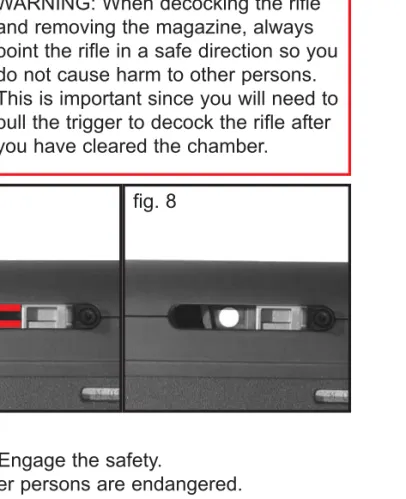
The hammer is cocked when the red marking is visible! (see fig. 7). The hammer is not cocked when the white dot is visible! (see fig. 8).
WARNING! The rifle is ready to fire. Keep your finger off the trigger, and outside the trigger guard, until you intend to fire the rifle. Always follow the safety responsibilities outlined in this manual
Unloading your rifle
Point in safe direction. Remove finger from trigger. Slide the manual safety fully forward. Remove the magazine, retract and hold cocking lever rearward. The round in the chamber is extracted and ejected.
WARNING: Make a visual inspection of the barrel - it must be empty!
Release the bolt to travel forward. Insert an empty magazine and decock the hammer by pulling the trigger.
Disassembly and reassembly of the rifle
It is not necessary to strip the rifle any further than is described in this manual. Further disassembly, improper assembly and disregard of the instructions damage your firearm and may cause injury or damages to yourself or others and will lead to loss of warranty.
WARNING: To begin the feed stripping process engage the safety by pushing the manual safety forward, remove the magazine and inspect the rifle to make certain that it is unloaded.
WARNING: To decock this rifle, you must pull the trigger. Therefore, it is important that you always check to make certain that the chamber is empty before attempting to decock your rifle. Your Failure to follow all of the instructions contained in this manual for unloading and inspecting your rifle prior to decocking may result in severe injury or even Death!
12
Disassembly
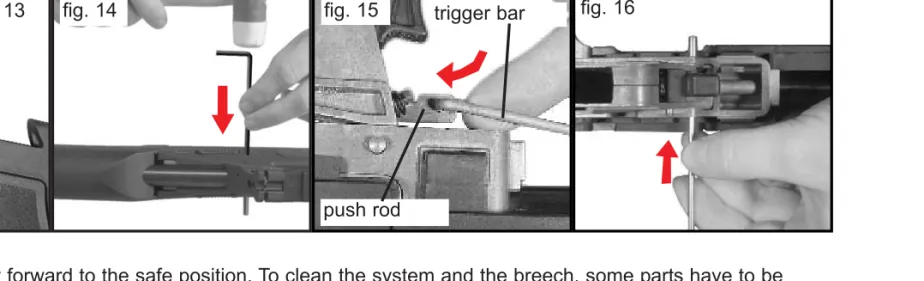
Slide the manual safety forward to the safe position. To clean the system and the breech, some parts have to be disassembled. Loosen the Allen screw at the lower part of the butt (see fig. 13), remove the transversal locking pin above the safety (see fig. 14) and withdraw the butt vertically downwards. Remove the trigger bar from the push rod as shown in fig. 15. Remove the two pins which connect the system with the breech housing (see fig. 16) and remove the system vertically downwards.
Caution: The spring of the magazine safety (fig. 17) and the bolt catch lever with spring (fig. 18) might drop out. Both have to be kept in position (see fig. 19)!
Now the upper part of the butt can be removed upwards.
After this, the frame of the ejection port, the two inserts and the ejector are loose and can be removed. To clean the barrel, you have to pull the cocking lever (see fig. 20).
fig. 13 fig. 14 fig. 15 trigger bar
push rod
fig. 16
fig. 18
slide stop lever with spring
fig. 17 magazine
safety with spring
13
Assembly
The remaining assembly is in reverse order as the disassembly. Make sure the spring is in the correct position on the magazine safety (fig. 17) and the cocking lever with spring (fig. 18). The hammer must be cocked when the system is re-assembled. Make certain that the rifle is unloaded and the safety is engaged.
Conversion from right-hand to left-hand operation
The rifle may be adapted from right-hand to left-hand operation. Only an authorised gunsmith should carry out this adaptation.
A rifle for right-hand operation must never be used as a rifle for left-hand operation!
The ejected cartridge case and the action of the cocking lever may cause injuries to the face.
Butt extension / shortening
Slide the manual safety forward to the safe position.
In order to adapt the length of the butt to the shooter's requirements, different spacers can be mounted on the butt or removed. Loosen the screws on the butt. Now add the desired number of spacers (0, 1 or 2) to the butt end and fix them with the appropriate screws (refer to fig. 9 to 12).
spacer 10
spacer 20
M5x60
M5x50
spacer 20
M5x50
M5x40
spacer 10
without spacer
M5x40
M5x35
M5x35
M5x25
Disassemble the firearm only as instructed in the dissassembly section of this manual. Clean fouled parts of breech, magazine lips, follower and receiver with a brush and a cloth. Clean the barrel with commercially available brushes and wicks. Apply a thin coat of oil to all metal parts. Reassemble rifle in accordance with the Assembly instructions beginning on page 12. Check for proper function, keeping the rifle unloaded and the safety engaged. 14
Sights
The G22 will enable the shooter to compensate for differences in ammunition and range. To do so, the rear sight disk (pinned to the rear sight carrier) (fig. 26) is to be rotated, there are six different elevation settings on the rear sight notch. The current setting can be seen on the disk (stages 1 - 6). To mount a telescopic sight or similar accessories on the Weaver rail, the rear sight can simply be lowered by pushing it down (see fig. 27).
fig. 26 fig. 27
Cleaning
In order to keep the firearm functional and to extend its service life, it should be cleaned and maintained at regular intervals.
WARNING: Engage the safety, remove the magazine.
Safe Storage & Transportation
WARNING: FIREARMS ARE DANGEROUS AND WHEN USED AND STORED IMPROPERLY THEY POSE A RISK OF SERIOUS OR FATAL INJURIES. FIREARMS CAN BE ESPECIALLY DANGEROUS TO CHILDREN WHEN THEY ARE STORED IN AN IRRESPONSIBLE AND UNSAFE MANNER. FOR YOUR SAFETY AND THE SAFETY OF OTHERS, IT IS IMPERATIVE THAT YOU KEEP YOUR FIREARM LOCKED AND UNLOA-DED IN A SECURE PLACE. THE AMMUNITION SHOULD BE STORED IN A SEPARATE, SECURE LOCATION WHEN IT IS NOT IN USE. SAFE AND SECURE STORAGE OF YOUR FIREARM IS ONE OF THE MOST IMPORTANT RULES OF FIREARM SAFETY. YOUR FAILURE TO FOLLOW THESE RULES MAY RESULT IN SERIOUS INJURY OR DEATH TO YOU OR OTHERS.
• ALWAYS SECURE YOUR FIREARM IN A MANNER THAT WILL PREVENT UNAUTHORIZED ACCESS.
Whenever your firearm is not in use, keep it unloaded and locked. Your safety and the safety of others requires that you always secure and store your firearm in a manner that will prevent unauthorized access. Never leave a firearm unattended unless it is locked, unloaded and secured.
• ALWAYS USE THE LOCK PROVIDED TO SECURE YOUR FIREARM. Please read and follow
the instructions packaged separately for the use of this lock. A lock, when properly used, can be an effective tool in preventing unauthorized access to your firearm. There are other alternative locks and safe storage containers available in the marketplace which may also be appropriate for your particular needs. Consult your local gunshop, hardware store, or local police department for guidance on the variety of other safe storage devices or practices which may be appropriate for your particular needs. By purchasing this firearm you have accepted the responsibility of safely securing the firearm at all times and preventing its unauthorized use. Never assume that the use of this lock alone is sufficient to safely secure your firearm. It is your personal responsibility to select and use whatever measures or practices that will enable you to be absolutely certain that your firearm is secure at all times.
WARNING: NEVER LOCK A LOADED FIREARM AND NEVER LOAD A LOCKED FIREARM!!
• ALWAYS STORE YOUR FIREARM AND AMMUNITION SEPARATELY so that they are not accessible to children or other unauthorized persons. Safe and secure storage of your firearm and ammunition are your responsibility. It is a full-time responsibility.
• NEVER ASSUME THAT A “HIDING” PLACE IS A SECURE STORAGE METHOD. Others may be aware of your storage location or come upon it by chance. It is your personal responsibility to use common sense when storing your firearm and ammunition and to always make sure they are not accessible to children or other unauthorized persons.
• NEVER TRANSPORT A LOADED FIREARM. When transporting your firearm, be sure it is unloaded and locked. Safe and secure transportation of your firearm is your responsibility.
• ALWAYS FOLLOW THE LAW! Many jurisdictions have laws that make it a crime to keep a firearm unlocked and in an area accessible to children or others. Keeping a firearm locked and unloaded when not in use is not only common sense safety practice... IT IS THE LAW. You must be familiar with all local, state, and federal laws regarding the safe storage and transportation of your firearm. Failure to know and follow the law may result in unauthorized access or use of your firearm by another. Obey all laws relating to the storage and transportation of firearms. Your local police department or gunshop can furnish you with available information on storing and/or transporting a firearm safely and legally.
• YOUR FIREARM IS YOUR RESPONSIBILITY. You must prevent your firearm from being stolen or from being used by untrained or unqualified individuals. Keep it locked, unloaded and secured when not in use.
Safe Storage & Transportation cont´d.
WARNING: Never leave a loaded firearm unattended!
The firearm should always be stored in an unloaded condition both with the manual safety and lock engaged.
Keep all firearms away from children and unauthorized persons. Firearm and ammunition are to be stored separately.
17
Technical data
caliber... .22 l.r.
action...blowback trigger...single stage trigger trigger pull...approx. 28,2 oz (800g) magazine capacity...10 rounds dimensions (length/height/width)... ...28,3- 29,5/ 8,7/ 2,2
barrel length...~20”
sight length...~11” width of rear sight notch...0,08” front sight width...0,1” weight (without magazine)...91,7oz weight magazine (empty)...1,7 oz
Standard accessories:
- Walther G22 - 2 magazines
- operating instructions - key for trigger lock - spacer 20
- spacer 10 - Allen screw
M5x60; M5x35; M5x25 - Allen key M5
- Allen key M3
- open-end spanner SW13
Repair of Walther firearms
WARNING! A firearm that requires repair should NEVER be used. It should be safely kept in a way that prevents its use until it is repaired. It is difficult to repair a firearm, and improper assembly can lead to dangerous malfunctions.
WARNING:
Only let qualified gunsmith inspect and repair your firearm!
Warranty for Walther firearm
Within the first year after the date of purchase, the Walther company will repair or replace your firearm if defection in material a workmanship free of costs provided the condition or problem was not caused by misuse. Please hand the rifle over to an authorized dealer, describe the problem and enclose a proof of purchase.
WARNING!When transporting a firearm, make sure that it is unloaded and that the safety is engaged.
Smith & Wesson
All technical changes and modifications reserved. 269 62 66.04-04.1,0.18 June 2004 - rev
. A
Smith & Wesson
Sales + Warranty Service 2100 Roosevelt Ave. Springfield, MA 01104 USA