www.ijiset.com
Target Channel Selection Algorithm Based on Multiple
Attribute Decision and Ant Colony Division
Xingbing Cao, Zhongshuai JiaoP
*
P
, Menglu SunP
*
*Chongqing Key Lab of Mobile Communications Technology, Chongqing University of Posts and Telecommunications, Chongqing 400065, P. R. China
E-mai: [email protected],
Abstract
For the existing distributed proactive spectrum handoff strategy, the target channel is usually selected by users only according to the availability and stability of the licensed spectrum, with the QoS of the cognitive user not being taken into account, and thus the cognitive user usually selects the same channel in the case of multi-user, which will lead to the interference between users. Therefore, this paper proposes a target channel selection algorithm based on jointly consideration of the multi-attribute decision and ant colony division of labor. Firstly, considering the influence of the bandwidth, delay, bit error rate, signal-to-noise ratio and channel idle time on the channel selection, the TOPSIS algorithm is used to calculate the proximity between the candidate channel and the ideal solution. The weights are collective determined by the fixed weights assigned by the nine scale method and the dynamic weights of the mutative variance between the channels. Then, the spectrum handoff process is mapped to the ant colony division model, where the stimulus intensity is jointly determined by the normalized proximity and the maximum transmission power allowed by the licensed channel to calculate the selection probability of each users for the candidate channels and choose the target channel with the maximum selection probability. The simulation results show that the proposed algorithm has a great advantage on the performance link retention probability and channel utilization.
Keywords: spectrum handoff, target channel selection, multi-attribute decision, ant colony division of labor
1. Introduction
In the proactive spectrum handoff algorithm, the cognitive user have selected the channel to execute handoff before the return of the authorized user through the local channel history information and periodic spectrum detection. the target channel selection algorithm directly affect the system performance.
In the network of single cognitive users, a probabilistic approach is proposed to select the initial access and handoff channels, and the average dwell time and average extension
service in the two modes of staying and switching are analyzedP
[1]
P
. In the literature [2]. a mechanism to access the target channel in descending order of the average idle time of the channel is proposed. It is proved that the mechanism can guarantee the minimum probability of failure of spectrum switching under the different distribution of authorized user channel idle time. But it don’t consider the availability of authorized channels and ignores the cognitive user's QoS, including channel gain, bandwidth, the maximum allowable transmission power, etc. In order to make an accurate decision, it is necessary to put multiple attributes into the scope of the analysis. In the literature [50], it is proposed to apply the technique for order preference by similarity to ideal solution method to the channel selection considering the power of the authorized user, the bandwidth, the rental price and the probability of the authorized user, and reduce the communication probability of communication. In the literature [51], according to the subjective experience, it uses 1~9 scale to indicate the relative importance degree between the attributes, and the target channel selection mechanism is transformed into the secondary selection mechanism by combining the simple weighting method. But the determination of the weight is based on empirical assignment or subjective judgment. The target channel selection method of fixed weight cannot reflect the dynamic and variability of cognitive radio network, which leads to the algorithm is not accurate enough. Literature [52] proposes a dynamic weight of the spectrum switching decision scheme according to the mean of the parameters and standard deviation. But it is only based on the variable speed of the various parameters, ignoring the actual problem in the determination of the importance of the parameters.
www.ijiset.com chosen by the cognitive user gradually converges to the
local optimum, which avoids the collision problem of the multi-user, so it is very suitable for the distributed model of the cognitive radio network environment. Therefore, this paper proposes a target channel selection algorithm based on multi-attribute decision and ant colony division of labor. Firstly, we consider the objectivity of weight selection in multi-attribute decision, adjust the weight dynamically by using variance of variance between channels, and then establish the mapping from cognitive radio network to ant colony division, and calculate the joint selection probability. This ensure the user's QoS and reduce the channel load.
The rest of this paper is structured as follows: In the second part is the determination of dynamic weight; the third part is the joint target channel selection algorithm. The fourth part is the simulation analysis. Finally, we conclude the paper in Section 5.
2. The determination of dynamic weight
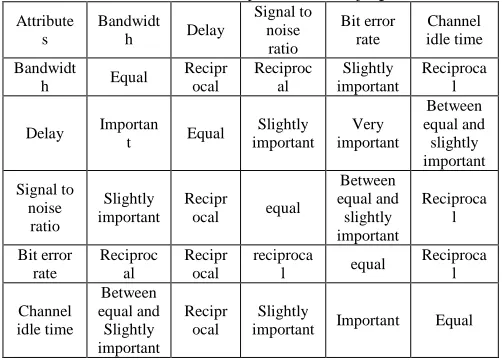
In order to ensure the quality of service of cognitive users, we take into account the channel bandwidth, available time, delay, bit error rate, signal to noise ratio. The n decision factors of m candidate channels are modeled. This article considers cognitive users to transmit real-time fixed-rate services, which have higher latency requirements and need to ensure that the business transmission is within the tolerable latency. According to the actual business characteristics and experience, we compare the judgments of each other.
Table 1 table of relative importance of each judgment factor
Attribute s
Bandwidt
h Delay
Signal to noise
ratio
Bit error rate
Channel idle time
Bandwidt
h Equal
Recipr ocal
Reciproc al
Slightly important
Reciproca l
Delay Important Equal important Slightly important Very
Between equal and slightly important
Signal to noise
ratio
Slightly important
Recipr
ocal equal
Between equal and slightly important
Reciproca l
Bit error rate
Reciproc al
Recipr ocal
reciproca
l equal
Reciproca l
Channel idle time
Between equal and Slightly important
Recipr ocal
Slightly
important Important Equal
According to the table 1, construct a multi-factor judgment matrix, such as (1):
1) According to the formula of
Aw
=
λ
maxw
, get thelargest eigenvalue
λ
max=
5.1404
, and n is the eigenvector.2) According to the order of the matrix
n
, calculate theconsistency index
C I
. . (
=
λ
max−
n
) / (
n
− =
1)
0.0351
。1 2 3 4 5
1
2
3
4
5
1 1 / 5 1 / 3 3 1 / 4
5 1 3 7 2
3 1 / 3 1 4 1 / 2
1 / 3 1 / 7 1 / 4 1 1 / 5
4 1 / 2 2 5 1
=
X X X X X
X
X
A X
X
X
(1)
3) According to the table 4.4, find the average random consistency metrics . .R I 。
Table 2 average random consistency metrics Order of the
matrix(n) 1 2 3 4 5
R.I. 0.00 0.00 0.58 0.90 1.12
4) Calculate the consistency ratio C R. .=C I. . / . .R I
0.0313 0 1.
= < . IfC R. .<0.1, it indicates that the initial established judgment matrix is consistent, else we need to reestablish the judgment matrix or modify the judgment matrix until the consistency meets the conditions。
5) The eigenvector corresponding to the largest eigenvaluew=[0.153,0.791,0.314,0.086,0.495]is the weight
of each parameter。
The above weight is based on the empirical and practical characteristics of the channel to be transmitted to determine the characteristics, although according to the actual problem of the importance of the factors to compare the two factors, but it still cannot reflect the cognitive radio network dynamics and variability.
According to the changes in the network environment, the weight of the decision factor is divided into two parts:
, ,
= +
n c n d n
w w w (2)
Which wc n, is a fixed weight part determined by
empirical information or subjective assignment.wd n, is the
dynamic adjustment part, which should change with the current network status. If the difference between the candidate channels is large, it should be large between the decision factors, that is, the greater change of the decision factors between the channels, the greater the influence of this factor on the target channel. Thus the dynamic weight vector is derived from equation (3):
5
, 5 ,
1 1
var
, 1
var =
=
=
∑
=∑
n
d n d n
n n n
w w
(3)
Which varnis the inter-channel variation variance of
www.ijiset.com
2
, ,
1 1
1
var ( ) ,
= =
=
∑
N − =∑
Nn m n n n m n
m m
x x x x
N (4) The weight of the parameter index that the user needs to consider when performing the spectrum switching and selecting the target channel is shown in equation (5):
2 , 1
5 2
,
1 1
( )
, ( ) , 1
N
m n n
m N
m n n
n m
x x
j c n x x
w a w b = a b
= = −
−
∑
= ⋅ + + =
∑ ∑ (5)
In this paper a= =b 0.5.
3. The joint target channel selection algorithm
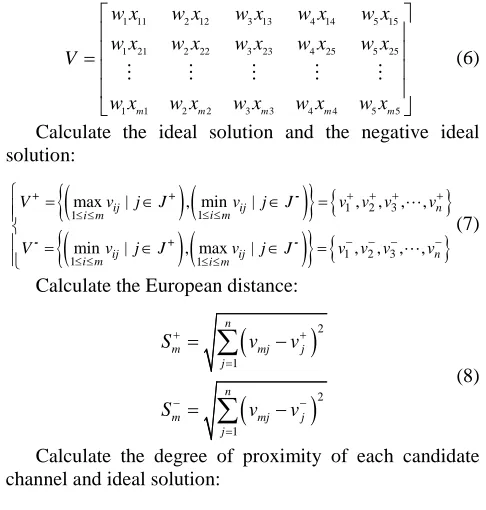
According to the dynamic weight of (5), the weighted decision matrix is calculated:
1 11 2 12 3 13 4 14 5 15
1 21 2 22 3 23 4 25 5 25
1 1 2 2 3 3 4 4 5 5
=
m m m m m
w x w x w x w x w x
w x w x w x w x w x
V
w x w x w x w x w x
(6)
Calculate the ideal solution and the negative ideal solution:
(
) (
)
{
}
{
}
(
)
(
)
{
}
{
}
1 2 3 1
1
1 2 3
1 1
max | , min | , , , ,
min | , max | , , , ,
+ + + +
≤ ≤ ≤ ≤
− − − −
≤ ≤ ≤ ≤
= ∈ ∈ =
= ∈ ∈ =
ij ij n
i m i m
ij ij n
i m i m
V v j J v j J v v v v
V v j J v j J v v v v
+ +
-- +
-(7)
Calculate the European distance:
(
)
(
)
2
1
2
1
+ +
=
− −
=
= −
= −
∑
∑
n
m mj j
j
n
m mj j
j
S v v
S v v
(8)
Calculate the degree of proximity of each candidate channel and ideal solution:
, 0 1
( )
−
− +
= < <
+
m
m m
m m
S
C C
S S (9)
For the same service, the target channel selected by the multi-attribute decision is often the same channel, the probability of collision between the cognitive users increases and the system performance decreases. In the improved ant colony task division algorithm, the spectrum chosen by the cognitive user gradually converges to the local optimal, so it can solve the multi-user conflict problem.
First, we need to establish a mapping relationship between the cognitive radio network switching model and the ant colony task division model. In the cognitive radio network, the cognitive user according to the transmission needs of their own business, select the relative available spectrum for accessing or switching, Similarly, the
individual in the ant colony identify the task-related stimulus intensity, and implement the task with a smaller stimulus intensity. The specific mapping relationship is shown in Table 3:
Table 3 the specific mapping relationship Ant Colony Task Division
Model
Cognitive Radio Network Switching Model
individual in ant colony cognitive user
the task in Ant colony selection of the target channel
stimulus intensitys the maximum permissible power Pm of
channel m
response thresholdθ The power Pnmrequired for the cognitive
user n to transmit on channel m
The stimulus intensity is determined by the maximum permissible power of the channel and the channel quality in the joint target channel selection algorithm. The better the channel quality, the greater the probability of being selected, but for the maximum allowable power of the channel, it only needs to meet the transmission needs for cognitive users, and need not to choose the largest. Therefore, in order to make full use of the spectrum resources, the channel with the least power required for its transmission should be selected, that is, the higher the channel power of the excess power, the higher the probability of being selected.
According to the mapping relationship of Table 3 and the ant colony task division algorithm, the probability of selection of the channel for the cognitive user is introduced:
'
'
0,
( / )
1 ,
( / )
m nm
a
nm m m
m mn
a a
m m nm nm
P P
T P C
P P
P C αP βL
<
= − >
+ +
(10)
'
m
C is the normalization degree of the candidate channel and the ideal solution;
α
andβ
are positiveconstants affecting Pnm and Lnm respectively, Lnm is learning factor. If the cognitive user switches successfully, learns the channel from the successful switchover, and update the learning factor Lnm+ε0.If the switch fails, the channel is forgotten from the failure and the learning factor is updated Lnm−
ε
1, ε0 and ε1 are the learning constant and the forgetting constant respectively.4. Simulation analysis
www.ijiset.com characteristic parameters are shown in Table 4. The
maximum transmission power of the channel is 20 ~ 200mv. The delay index, transmission rate index and error rate of the transmission service are shown in Table 5.
Table 4 the initial value of the channel parameter
Simulation parameters value
distribution of SIN 10~30db random distribution
distribution of delay 50~200ms random distribution
distribution of bit error (2.5~30)*10e-5 random distribution
Table 5 cognitive user service simulation parameter index
Parameter SIN(db) Delay(ms) Bit error (10e-5)
Transmission power
service 13.8 250 25 10~200mv
In this paper, we compare the joint target channel selection algorithm with the multiple attribute decisions, ant colony task division and last idle time target channel selection algorithm.
Fig1. serial number of channel selected
Fig2. The number of access frequency
Figure 1 depicts the channel number selected by the cognitive user in real time. Assuming that there is only one cognitive user in the system, the required transmission power is 68mv, and the cognitive user's traffic to be transmitted is infinite, and the authorized spectrum channel allows the maximum power of transmission to be uniformly distributed from 20 to 200mv. As can be seen from the figure, as time changes, cognitive users switch between channels. The Ant Colony algorithm converges the channel selected by the cognitive user to the channel with the minimum excess power. The MADM algorithm is used to identify the channel with better quality of service without any rules. By the joint target channel selection algorithm, the cognitive user transmits between channel 4,channel 5,channel 6 and channel 7. The cognitive user chooses the channel with the smallest excess transmission power, so the channel selected by cognitive user converge to the channel with the smallest excess transmission power. Compared to the Ant Colony algorithm, it does not always selecte the channel 4 with the smallest excess transmission power, since the improved algorithm takes into account the channel synthesis quality, which occurs when the delay of channel 4 is too large or the remaining free time is short.
In the case of the above figure, the number ofaccess frequency within 100s is counted as shown in Figure 2. The channel selected by the improved algorithm is local convergence. Not only reserve the convergence of Ant Colony algorithm, but also does not simply based on the transmission power to select the channel. Both the MADM algorithm and the Improve algorithm take into account the multiple attribute problems such as the remaining idle time of the channel, so the number of switching is almost the same, and the target channel in the Ant Colony algorithm always has the minimum excess power, althrough save the power resources of the system, the availability and stability of channel can not be guaranteed, so the number of switch is mor frequent.
Figure 3 depicts the effect of the number of users on the link maintain probability. As the number of users increases, the link maintain probability decreases. In the same number of users, the link maintain probability of the proposed algorithm is high, the basic maintained at 90% or more; In the LIP algorithm, the user chooses the channel with the maximum idle time to switch in each time slot, and the probability of multiple users selecting the same channel increases, which causes the communication interruption probability caused by the collision between users to increase, and When the channel with the maximum idle time is poor, the communication is interrupted, so the LIP algorithm has the lowest link-keeping probability. When the number of users is less than 20, the link hold probability of the MADM algorithm is higher than that of the Ant Colony algorithm. But when the number of users is greater than 20, it is opposite. This is because the system can be used more spectrum when the 100 120 140 160 180 200
1 2 3 4 5 6 7 8 9 10
time (s)
C
hannel
num
ber
Improve MADM Ant colony
Improved MADM Ant colony 0
1 2 3 4 5 6 7 8
N
um
ber
of
ac
c
es
s
es
www.ijiset.com cognitive user is small, the impact of the link maintain
probability is the channel quality, MADM algorithm select the channel with better quality to communicate, so higher than the Ant Colony algorithm.
Fig3. the link maintain probability
Fig4. Channel utilizationof the four channel selection schemes
Figure 4 compares the channel utilization of the four channel selection schemes. As can be seen from the figure, MADM algorithm and LIP algorithm channel utilization is low. One is that the MADM algorithm and the LIP algorithm do not take into account the resource savings problem when selecting the target channel, and the selected channel may have a large allowable transmission power. In addition, the MADA algorithm and the LIP algorithm do not solve the multi-user conflict problem. When the conflict occurs between the users, the failure for data transmission requires error retransmission, and causes waste of resources. The channel utilization of Ant Colony algorithm and Improve algorithm is high. This is because the two algorithms use the required transmission power to spread the user to the various channels, on the one hand
they avoid the new users to do not access because of the transmission power, on the other hand reduce the multi-user selecting the same channel and the probability of confliction. So the channel utilization is high.
5. Conclusions
In order to ensure the quality of service of cognitive users and avoid the collision problem in multi-user situations, this paper proposes a target channel selection algorithm based on multi-attribute decision and ant colony division of labor. Firstly, we consider the objectivity of weight selection in multi-attribute decision, adjust the weight dynamically by using variance of variance between channels, and then establish the mapping from cognitive radio network to ant colony division, and calculate the joint selection probability, Finally, the influence of the number of cognitive users on the probability of link retention and channel utilization is analyzed. The simulation results show that compared with the Ant Colony algorithm, the MADM algorithm and the LIP algorithm, the proposed algorithm has a higher probability of link retention and channel utilization, guaranteeing the reliability of cognitive users.
Acknowledgments
This work was supported in part by the Program for Chang jiang Scholars and Innovative Research Team in
University (IRT1299), Project of CSTC
(CSTC2012jjA40044, CSTC2013yykfA40010) and special fund of Chongqing key laboratory (CSTC).
References
[1] Sheikholeslami F, Nasiri-Kenari M, Ashtiani F. Optimal Probabilistic
Initial and Target Channel Selection for Spectrum Handoff in Cognitive Radio Networks[J]. Wireless Communications IEEE Transactions on, 2015, 14(1): 570-584.
[2] Zheng Shilian, Yang Xiaoniu, Chen Shichun, et al. Target Channel Sequence Selection Scheme for Proactive-Decision Spectrum Handoff[J]. IEEE Communications Letters, 2011, 15(12): 1332-1334.
[3] Jiang Jinbo, Wang Keren, Fu Xin, et al.A New Spectrum Switching Scheme Based on TOPSIS Channel Ordering[J]. Telecommunications Technology, 2012, 52 (5): 761-765.
[4] Wu Qiong, Xian Yongju, Xu Changbiao.Objective switching channel
selection based on multi-attribute decision in cognitive radio [J]. Computer Engineering and Applications, 2011, 47 (27): 158-160. [5] Xie Xianzhong, Yang Guang, Ma Bin.Recognition algorithm of dynamic weight spectrum switching in cognitive radio networks [J]. Journal of Chongqing University of Posts and Telecommunications (Natural Science Edition), 2012, 24 (1): 1-7.
[6] Atakan B, Akan O B. Biologically-Inspired Spectrum Sharing in Cognitive Radio Networks[C]// IEEE Wireless Communications and Networking Conference. Hong Kongk, China: IEEE Computer Society, 2007: 43-48.
0 5 10 15 20 25 30 50
60 70 80 90 100
number of users
Li
nk
m
ai
nt
ai
n pr
obabi
lit
y
( %)
Improved MADM Ant Colony LIP
20 25 30 35
50 55 60 65 70 75 80 85 90
number of users
C
hannel
ut
ili
z
at
ion
( %)