www.ijiset.com
Efficient Data Routing Analysis In FANETS To Achieve
QOS
Shilpa K G,Mr.Prakash V Parande
M.Tech, Dept. of CSE Visvesvaraya Institute of Advance Technology, Bengaluru, India.
Asst. Professor M.Tech, Dept. of MCA, Visvesvaraya Institute of Advanced Technology, Bengaluru, India.
Abstract—In recent years the capability and role of Mobile Adhoc Networks have rapidly evolved. Their use in emergency, natural disaster, military battle fields and UAVs is getting very popular as a result of cutting edge technologies in networking and communication. Using the concept of MANET new networking paradigms like VANET and FANET have evolved. FANET is comparably new concept of MANET and it has capabilities to tackle with situations where traditional MANET cannot do so. Due to high mobility and fast topology change in FANET, this is highly challengeable for researcher to implement routing in FANETs. Routing protocols play a dominating role in enhancing the performance of adhoc networks. In this paper, experimental analysis is carried out on AODV, DSDV and AOMDV routing protocol for FANET environment.
Keywords- MANET, VANET, FANET,UAVs,
AODV, AOMDV, DSDV.
I. INTRODUCTION
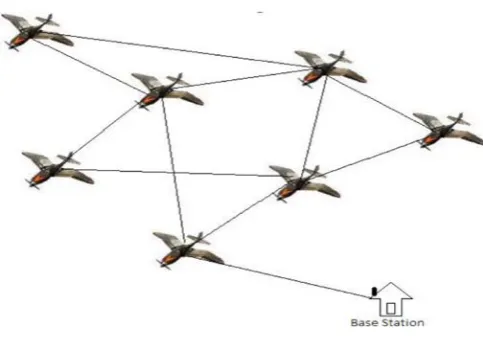
Flying adhoc network (FANET) is a sub category of mobile adhoc network. FANET may consist of homogenous or heterogeneous flying agents that are able to communicate with each other in the vicinity, and alsointeracts with their surroundings to acquire some kind of valuable information. FANET do not use central controlled system [1]. Although mobile adhoc networks have versatileapplication but there is a need of certain technology whichcan overcome from the situation where traditional MANETare not usable such as disaster situations such as drowningor military combat field [2]. It is not imaginable to installmoveable nodes (which move on surface) in such communication area. FANET can provide solution totackle such situations by using flying object called microair-vehicles (MAVs). The swarm of MAVs is used toconverse in a large operational area. MAVs structurethemselves to form wireless communication network. NoGPS, radar or cameras are installed with them and theycommunicate in the neighbourhood only [3, 4].
In FANET,MAVs changes position very
frequently. Due to this thereis a rapid change in topology. So it is very necessarychallenging task to find a suitable routing technique forFANET.
Figure 1. Flying Ad-hoc Network
A. Statement of problem
The problem is to analyse the routing efficiency for different protocols by evaluating network parameters like throughput, end-to-end delay, packet delivery ratio and overhead.
B. Objective
To analyze the routing protocols for different parameters, like node density, node velocity and performance metrics.
II. BACKGROUND
www.ijiset.com III. LITERATURE SURVEY
OzgurKoraySahingoz,[1]:In recent years, the capabilities and roles of Unmanned Aerial Vehicles (UAVs) have rapidly evolved, and their usage in military and civilian areas is extremely popular as a result of the advances in technology of robotic systems such as processors, sensors, communications, and networking technologies. While this technology is progressing, development and maintenance costs of UAVs are decreasing relatively. The focus is changing from use of one large UAV to use of multiple UAVs, which are integrated into teams that can coordinate to achieve high-level goals. This level of coordination requires new networking models that can be set up on highly mobile nodes such as UAVs in the fleet. Such networking models allow any two nodes to communicate directly if they are in the communication range, or indirectly through a number of relay nodes such as UAVs. Setting up an ad-hoc network between flying UAVs is a challenging issue, and requirements can differ from traditional networks, Mobile Ad-hoc Networks (MANETs) and Vehicular Ad-hoc Networks (VANETs) in terms of node mobility, connectivity, message routing, service quality, application areas, etc. This paper identifies the challenges with using UAVs as relay nodes in an ad-hoc manner, introduces network models of UAVs, and depicts open research issues with analyzing opportunities and future work.
SudipMisra and Gopidi Rajesh,[2]:One of the major challenges in the research of mobile ad hoc networks is designing dynamic, scalable, and low cost routing protocols usable in real-world applications. Routing in ad hoc networks has been explored to a large extent over the past decade and different protocols have been proposed. They are based on a two-dimensional view of the ad hoc network geographical region, and are not always realistic. In this article, we propose a bird flight-inspired, highly scalable, dynamic, energy-efficient, and position-based routing protocol called Bird Flight-Inspired Routing Protocol (BFIRP). The proposed protocol is inspired by the navigation of birds over long distances following the great circle arc, the shortest arc connecting two points on the surface of a sphere. This sheds light on how birds save their energy while navigating over thousands of miles. The proposed algorithm can be readily applied in many real-world applications, as it is designed with a realistic three-dimensional view of the network’s geographic region. In the proposed algorithm, each node obtains its location coordinates (X, Y, Z), and speed from the GPS (Global Positioning System); whereas, the destination’s location coordinates (X, Y, Z), and speed are obtained from any other distributed
localized service. Based on the location information, the source and each intermediate node choose their immediate neighbour as the next hop that has the maximum priority. The priority is calculated by taking into consideration the energy of the node, the distance between the node and the destination and the degree of closeness of the node to the trajectory of the great circle arc between the current node and the destination. The proposed algorithm is simulated in J-SIM and compared with the algorithms of Ad Hoc On Demand Distance Vector (AODV), and Most Forward within Distance (MFR) routing protocols. The results of the simulations show that the proposed BFIRP algorithm is highly scalable, and has low end-to-end delay compared to AODV.
Klein-Berndt L[12]: AODV is the on demand(reactive) topology-based routing protocol in which backward learning procedure is utilized in order to record the previous hop (previous sender) in the routing table. In the backward learning procedure, upon receipt of a broadcast query (RREQ) which contains source and destination address, sequence numbers of source and destination address, request ID and message lifespan, the address of the node sending the query will be recorded in the routing table. Recording the specifications of previous sender node into the table enables the destination to send the reply packet (RREP) to the source through the path obtained from backward learning. A full duplex path is established by flooding query and sending of reply packets. As long as the source uses the path, it will be maintained. Source may trigger to establish another query-response procedure in order to find a new path upon receiving a link failure report (RERR) message which is forwarded recursively to the source. Being on-demand to establish a new route from source to destination enables AODV protocol to be utilized in both unicast and multicast routing.
Chintawar A., Chatterjee M. and VidhateA[13]: AOMDV with Accessibility predication and Link breakage prediction (AOMDV-APLP) is proposed to enable AOMDV protocol to predict the relative state of the node using the ordinary and routinerouting information to be utilized for reducing control overhead in future.
www.ijiset.com generated by the destination node. Nodes exchange
their routing tables periodically or when it is required to be exchanged. Due to being aware of the neighbor`s routing table, the shortest path towards the destination could be determined. However, the DSDV mechanism incurs large volume of control traffic in highly dynamic networks such as VANET which results in experiencing a considerable amount of bandwidth consumed. In order to overcome the mentioned shortcoming, two update strategy in proposed; i. full dump strategy which is infrequently broadcasting the whole routing table, and ii. incremental dump which is exchanging the minor changes since the last full dump exchange.
IV. PROPOSED SOLUTION
In the proposed system, routing protocols AODV, DSDV and AOMDV are described briefly and the performance parameters of these protocols are also discussed. This section also define the basic difference of these routing protocols, that how these protocols defines mechanism to their route strategy based classification like reactive or proactive.Advantage of proposed system, as it is UAV, human life can be saved, routing efficiency, Base station control can reduce the communication cost.
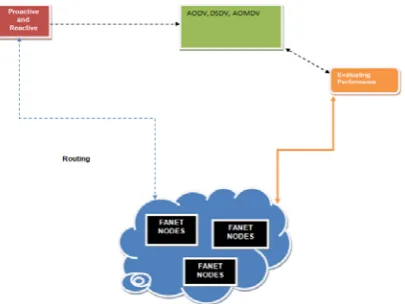
Figure 2: Architecture Diagram
Figure 2 shows the architecture of proposed system. The FANET nodes uses protocols to evaluate the performance of each protocol using different parameters like, PDR, end to end delay, throughput, and overhead. FANETS will choose the efficient protocol to send the packets.
A.Topology Module
This module involves buildingaWireless Network topology, topology consisting of mobile nodes, each node working with multiple channels.
Topology module consistsofafollowing steps:
1. Setting upaWireless Network Topology: This includes environmental settings, node configuration, andatopology creation. 2. Setting the bandwidth andathreshold:
Each and every node in the network topology will be assigned withacertain bandwidth and topology.
3. Identifying theaneighbors: In order to identify the neighbors for aaparticular node Euclidian distance concept is used. 4. Specifying the data transmission
throughasingle and multi hop: From which node the data has to be sent and which nodeamust receive the data will be specified. Also how much amount of data has to be sent along with the time interval of sending the data will beaspecified. 5. Specifying the simulation start time
andaend time:The transaction can be viewed throughathe NAM window at anyatime.For this the simulation start time andaend time will be specified.
B. Node Deployment Algorithm
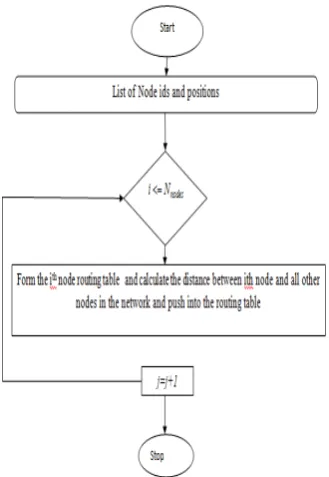
Figure 3: Node Deployment Algorith C. Routing Table Formation Algorithm
This is the algorithm which is used to form routing tables for each of the nodes. The routing table will contain information about other nodes in the network in terms of node id and distance of each node w.r.t other nodes in the network.
www.ijiset.com
Figure4: Routing Table Formation Algorithm.
D. Performance Analysis:
Ad Hoc On Demand Distance Vector Routing (AODV):
AODV isthe on-demand (reactive) topology-based routing protocol inwhich backward learning procedure is utilized in order torecord the previous hop (previous sender) in the routingtable. In the backward learning procedure, upon receipt of abroadcast query (RREQ) which contains source anddestination address, sequence numbers of source anddestination address[11], request ID and message lifespan, theaddress of the node sending the query will be recorded in therouting table. Recording the specifications of previous sendernode into the table enables the destination to send the replypacket (RREP) to the source through the path obtained frombackward learning. A full duplex path is established byflooding query and sending of reply packets. As long as thesource uses the path, it will be maintained. Source maytrigger to establish another query-response procedure inorder to find a new path upon receiving a link failure report(RERR) message which is forwarded recursively to thesource. Being on-demand to establish a new route fromsource to destination enables AODV protocol to be utilizedin both unicast and multicast routing. Figure 5 illustratesthe propagation of RREQ packet and path of RREP replypacket to the source.
Figure-5
(a) Propagation of the RREQ, (b) RREP Path to the Source
Ad Hoc on-demand Multipath Distance Vector (AOMDV):
AOMDV is designed to calculate multiple pathsduring the route discovery in highly dynamic adhocnetworks where the link breakage occurs frequently due tohigh velocity of vehicles. In AODV routing protocol, a routediscovery procedure is needed after each link failure.Performing such procedure results in high overhead andlatency. Thus, this defect is overcome by having multiplepaths available. In AOMDV, performing the route discoveryprocedure will be done after all paths to either source ordestination fail. In AOMDV routing protocol, it isendeavored to utilize the routing information alreadyavailable in the underlying AODV protocol. However, littleadditional modification is required in order to calculate themultiple paths.
AOMDV with Accessibility predication and Link breakageprediction (AOMDV-APLP) [21]is proposed to enableAOMDV protocol to predict the relative state of the nodeusing the ordinary and routine routing information to beutilized for reducing control overhead in future.
www.ijiset.com The aforementioned discussed routing protocols
are all reactiveprotocols in which the routes are established on demands.DSDV [23] is a proactive routing protocol which maintains theroute to the destination before it is required to be established. Therefore, each node maintains a routing table including nexthop, cost metric towards the destination node and thesequence number generated by the destination node. Nodesexchange their routing tables periodically or when it isrequired to be exchanged. Thus each node is able to utilizethe updated list of nodes to communicate with. Due to beingaware of the neighbor`s routing table, the shortest pathtowards the destination could be determined. However, theDSDV mechanism incurs large volume of control traffic in
highly dynamic networks such as VANET which results inexperiencing a considerable amount of bandwidth consumed.In order to overcome the mentioned shortcoming, two updatestrategy in proposed; i. full dump strategy which isinfrequently broadcasting the whole routing table, and ii.incremental dump which is exchanging the minor changessince the last full dump exchange.
V. SIMULATION
A.SimulationPlateform
For evaluating and analyzing the performance of AODV, DSDV and AOMDV. NS2 simulator is used. NS2 isapplication level simulator. NS2 uses c++ libraries asbackend and OTcI interpreter as a front-end. NS2 cansimulate both types of networks wired and wireless andNS2 can simulate various types of communication protocollike UDP, TCP and multicast routing.
B. Performance Parameters
Three Different parameters are used to analyzing the performance of AODV, AOMDV and DSDV protocols areas follow:
• Packet Delivery Ratio (PDR): It defines RatioBetween number of packet sent from source todestination and number of packet actually received at destination.
PDR = (Total number of packet sent by source /number of packet received by destination).
• End to End Delay (E2E Delay): It is the time slice between sending time at source and receiving time atdestination. It includes transmission delay, processqueue delay and propagation delay.
• Throughput: Throughput defines the rate ofsuccessful packet delivery over a communicationchannel.
B. Simulation Parameters
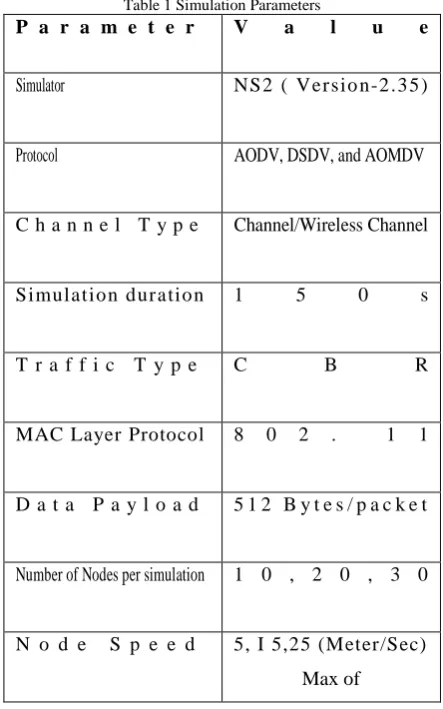
Table 1 Simulation Parameters
P a r a m e t e r V a l u e
Simulator NS2 ( Versio n-2.3 5 )
Protocol AODV, DSDV, and AOMDV
C h a n n e l T y p e Channel/Wireless Channel
Simulatio n d uratio n 1 5 0 s
T r a f f i c T y p e C B R
MAC Layer Protocol 8 0 2 . 1 1
D a t a P a y l o a d 5 1 2 B y t e s / p a c k e t
Number of Nodes per simulation 1 0 , 2 0 , 3 0
N o d e S p e e d 5, I 5,25 (Meter/Sec)
Max of
VI. RESULTS AND ANALYSIS
A.Results Tables
After performing simulation Table 2 shows results ofof speed versus Throughput, Delay, PDR and Overhead for 10 Nodes.Table 3 showsresults of speed versus Throughput, Delay, PDR and Overhead for 20 Nodes.Table 4 shows results of Speed versus Throughput, Delay, PDR and Overhead for 30 Nodes.
The results listed in the tables are used to plot a graph and compare the efficiencies of different protocols like AODV, DSDV, and AOMDV. All protocols like AODV, AOMDV, and DSDVwith different speeds versus Throughput, Delay, PDR and Overhead are plotted in graph using the results of simulation.
www.ijiset.com Table 2: Simulation results of speed versus Throughput, Delay,
PDR and Overhead for 10 Nodes.
10 Nodes Througp-ut D e l a y P D R Overh-ead
AODV ( k b p s ) Micro sec ( % ) (kbps)
5 2 6 . 5 1 11.1662 0.9903 1 . 9 7 7
1 5 2 6 . 1 6 151.949 0.9669 2 . 6 8 9
2 5 2 5 . 9 7 22.4146 0.9740 2 . 8 4 9
DSDV
5 2 2 . 6 4 9.051 1 0.8385 1 . 9 0 8 1 5 1 9 . 7 0 11.4518 0.7357 2 . 2 4 6
2 5 1 7 . 6 9 182.083 0.6609 2 . 5 4 7
AOMDV
5 2 5 . 3 8 9.98411 0.9543 3 . 4 5 8 1 5 2 4 . 2 7 20.7168 0.8994 3 . 9 8 0
2 5 2 3 . 2 0 13.8198 0.8824 4 . 3 2 9
Table 3: Simulation results of speed versus Throughput, Delay, PDR and Overhead for 20 Nodes.
20 Nodes Through-put D e l a y P D R Overh-ead AODV ( k b p s ) Micro sec ( % ) (kbps) 5 4 6 . 8 1 1 6.53 9 0.981 2 . 4 8 4 1 5 4 6 . 1 3 1 1 . 3 8 0.975 2 . 2 9 7 2 5 4 6 . 1 3 1 4.86 6 0.959 2 . 9 3 7
DSDV
5 3 7 . 6 2 1 1.14 9 0.797 2 . 2 4 5 1 5 3 7 . 1 3 9.222 5 0.789 1 . 8 1 9 2 5 3 4 . 1 8 7 8.71 9 0.720 2 . 1 2 8
AOMDV
5 4 4 . 4 1 2 6.43 2 0.930 4 . 0 2 5 1 5 4 3 . 5 0 9.819 3 0.917 3 . 8 7 7 2 5 3 9 . 8 6 1 0.44 8 0.847 4 . 5 2 9
Table 4: Simulation results of Speed versus Throughput, Delay, PDR and Overhead for 30 Nodes.
30 Nodes Throug-hput D e l a y P D R Overhe-ad AODV ( k b p s ) Micro sec ( % ) ( kb p s )
5 5 7 . 0 7 41.910 0.989 2 . 6 3 3 1 5 5 6 . 1 7 14.825 0.964 3 . 2 6 3 2 5 5 5 . 8 3 12.063 0.979 2 . 5 1 4
D S D V
5 5 0 . 4 9 10.625 0.871 2 . 0 2 9 1 5 4 2 . 9 7 9.6850 0.740 2 . 1 5 6 2 5 4 9 . 3 9 62.213 0.854 1 . 6 3 5
AOMDV
5 5 5 . 6 2 11.566 0.965 4 . 3 0 6 1 5 5 0 . 8 4 12.088 0.884 5 . 0 5 0 2 5 5 2 . 7 6 8.2466 0.919 4 . 1 4 5
B. Result Graphs
Figure 6 shows the Comparison of speed versus throughput for AODV, DSDV and AOMDV protocols using 10 nodes. AODV protocol is efficient in throughput when compared to other two protocols AOMDV and DSDV.
Figure 6: Graph plotted against Speed v/s Throughput for 10 Node.
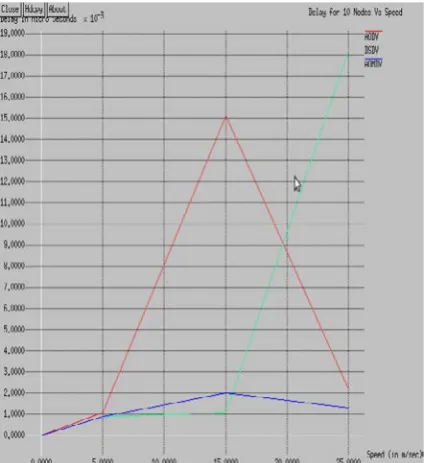
Figure 7 shows the Comparison of speed versus Delay for AODV, DSDV and AOMDV protocols using 10 nodes. AOMDV protocol has less delay when compared to other two protocols AODV and DSDV.
Figure 7: Graph plotted against Speed v/s Delay for 10 Nodes.
www.ijiset.com
Figure 8: Graph plotted against Speed v/s PDR for 10 Nodes.
Figure 9 shows the Comparision of speed versus overhead for AODV, DSDV and AOMDV protocols using 10 nodes.AODV protocol is efficient in overhead when compared to other two protocols AOMDV and DSDV.
Figure 9: Graph plotted against Speed v/s Overhead for 10
Nodes.
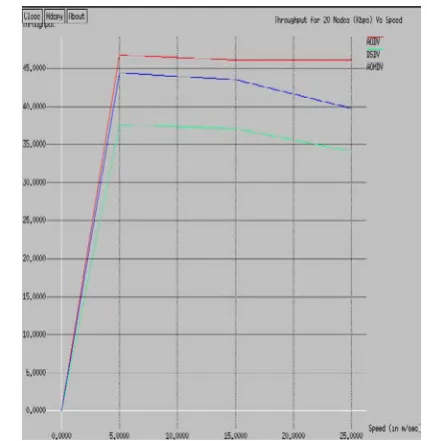
Figure 10 shows the Comparision of speed versus throughput for AODV, DSDV and AOMDV protocols using 20 nodes.AODV protocol is efficient in throughput when compared to other two protocols AOMDV and DSDV.
Figure 10: Graph plotted against Speed v/s Throughput for 20 Nodes.
Figure 11 shows the Comparision of speed versus delay for AODV, DSDV and AOMDV protocols using 20 nodes.AODV protocol has less delay when compared to other two protocols AOMDV and DSDV.
Figure 11: Graph plotted against Speed v/s Delay for 20 Nodes.
www.ijiset.com
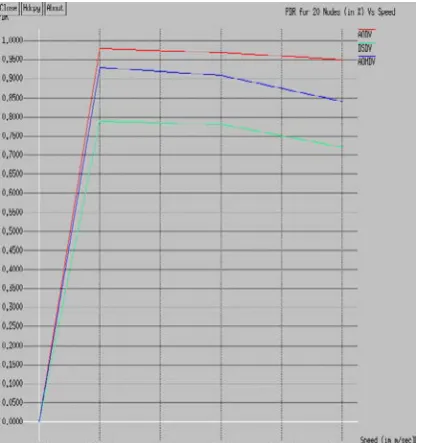
Figure 12: Graph plotted against Speed v/s PDR for 20 Nodes.
Figure 13 shows the Comparision of speed versus overhead for AODV, DSDV and AOMDV protocols using 20 nodes.AODV protocol is efficient in overhead when compared to other two protocols AOMDV and DSDV.
Figure 13: Graph plotted against Speed v/s Overhead for 20
Nodes
.
Figure 14 shows the Comparision of speed versus throughput for AODV, DSDV and AOMDV protocols using 30 nodes.AODV protocol is efficient in throughput when compared to other two protocols AOMDV and DSDV.
Figure 14: Graph plotted against Speed v/s Throughput for 30 Nodes.
Figure 15 shows the Comparision of speed versus delay for AODV, DSDV and AOMDV protocols using 30 nodes.AOMDV protocol has less delay when compared to other two protocols AODV and DSDV.
Figure 15: Graph plotted against Speed v/s Delay for 30 Nodes.
www.ijiset.com
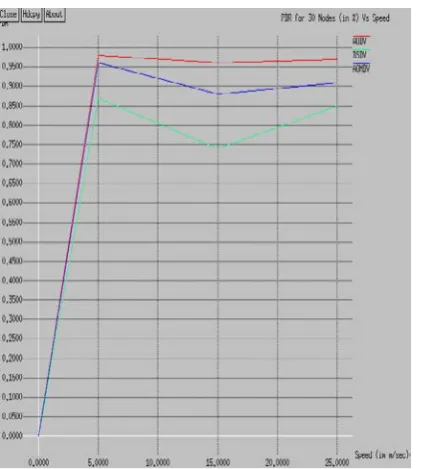
Figure 16: Graph plotted against Speed v/s PDR for 30 Nodes
.
Figure 17 shows the Comparision of speed versus overhead for AODV, DSDV and AOMDV protocols using 30 nodes.AODV protocol is efficient in overhead when compared to other two protocols AOMDV and DSDV.
Figure 17: Graph plotted against Speed v/s Overhead for 30 Nodes.
VII. CONCLUSION
In this research, AODV, DSDV and AOMDV routingprotocols are analyzed under the different parameters i.e.End to End Delay, Average
Throughput, PacketDelivery Ratio and Overhead with respect to speed of mobile node.Through the simulation results it can be clearly seen that, AODV routing protocol perform better than the other tworouting protocol AOMDV and DSDV in terms of End toEnd Delay, Average Throughput, Packet DeliveryRatio and Overhead. So the performance of FANET can be optimized bychoosing AODV as a routing protocol.
ACKNOWLEDGMENT
I thank to my guide Mr.Prakash V Parande,Assistant Professor, Dept. of MCA, VTU-CPGS, Bengaluru Region, VIAT, Muddenahalli, for his valuable guidance throughout this research work.
REFERENCES
[I] Michael Muller, "Flying Adhoc Network" Proceedings of the 4P
th
P
Seminar on"ResearchTrends in Media Informatics", Institute of MediaInformatics, Ulm University, [4th February. 2012].
[2] OzgurKoraySahingoz, "Networking Models in Flying Ad-Hoc Networks (FANETs): Concepts and Challenges", Springer Science, [4P
th
P
September, 2013].
[3] SudipMisra and Gopidi Rajesh," Bird Flight-Inspired Routing Protocol for Mobile Ad Hoc Networks", ACM Transactions on Autonomous and Adaptive Systems, Vol. 6, No. 4, Article 25, October 2011 .
[4] 2001 BixioRimoldi Karol Kru ·zelecki, Louis Traynard, and Stefano Rosati,"Speed Aware Routing for UA V Ad-Hoc Networks", 24 Jul 2013
[5] C.E. Perkins and E.M.Royer, "Ad-hoc On-Demand Distance Vector", in IEEE WMCSA, New Oreans, 1999.
[6] C.E. Parkins and TJ. Watson, "Highly dynamic destination sequenced distance vector routing (DSDV) for mobile computers", in ACM SIGCOMM_94 Conference on Communication Architecture, London, U.K., 1994.
[7] PJacquet, T.Clausen, L. Viennot, "Optimized link state routing [OLSR] protocol for adhoc network", in proceedings of IEEE Multi Topic Conference, INMIC, March 2001.
www.ijiset.com Muhlethaler, A. Qayyum, L. Viennot," The
Optimised Routing Protocol for Mobile Ad-hoc Networks: protocol specifications", INRIA, March 2004.
[9] Zhibin Wu, Rutgres University,[online] Available: http://www.winlab.rutgres.edu/ zhibinwu/htmllnetwork_simulator_2.html
,October,2007.
[10] Issariyakul, Teerawat, Hossain, Ekram, Introduction to Network Simulators[online] Available http://www.springer.comlengineeri ng/signals/book/978-0-3 87 -17 59-3,2009.
[11]FranciscoJ.Ros,Available:http://masimum.inf.u m.es/fjrml September,2013. OLSR, [Online] development/um-olsr.
[12] Klein-Berndt L., A quick guide to AODV routing, National Institute of Standards and Technology, (2001).
[13] Chintawar A., Chatterjee M. and Vidhate A., Performance Analysis of Ad-hoc On Demand Multipath Distance Vector Routing Protocol with Accessibility and Link Breakage
Prediction, Navi Mumbai, India (ICWET), (2011).