Query by Image Content System Based On Colour and
Texture Feature of Image
Vishal Mahajan and Nishant
Arni University, kathgarh (H.P)
Abstract-
The amount of images or the pictorial data is growing day by day with the expansion of internet services. As the network and development of multimedia technologies are becoming more popular, users are not satisfied with the traditional information retrieval techniques. So nowadays the Query by Image Content (QBIC) is becoming a source of exact and fast retrieval. It is very difficult for the users to retrieve the required images using an operative and efficient mechanism. There are many techniques which are used to retrieve the images depending upon the requirement of different applications. Query by Image Content is an important research area in image processing, with a vast domain of applications like recognition systems i.e. finger, face, biometrics, medical sciences etc. In this paper, we review the concept of Query by image content (QBIC). The developed system efficiently retrieved images from large database.Index Terms—QBIC, HSV, Feature Extraction, Similarity Measures.
I.
Introduction
The availability of a variety of sophisticated data acquisition instruments has resulted in large repositories of imagery data in different applications like non-destructive testing, technical drawing, medicine, museums and so on. Effective extraction of visual features and contents is needed to provide a meaningful index of and access to visual data. So nowadays the Query by Image Content (QBIC) is becoming a source of exact and fast retrieval. It is very difficult for the users to retrieve the required images using a operative
and efficient mechanism. There are many techniques which are used to retrieve the images depending upon the requirement of different applications [1]. Query by Image Content is an important research area in image processing, with a vast domain of applications like recognition systems i.e. finger, face, biometrics, medical sciences etc. However, the technology still lacks maturity, and is not yet being used on a significant scale. In the absence of hard evidence on the effectiveness of QBIC techniques in practice, opinion is still sharply divided about their usefulness in handling real-life queries in large and diverse image collections [2].
www.ijiset.com quantization or transforms. The term shape is
the use of gradient operators or morphological operators. The accuracy of the CBIR system can be improved by the iterative refinement process of the queries and the features that are decided by the users’ feedback. An image consists of global and local features. Depending upon the problem we can use the features of our interest to retrieve the images from a database [5]. Some of the major areas of applications of QBIC are: medical diagnosis, Intellectual property, art collections, crime prevention, military and engineering design and geographical information and remote sensing systems. The steps that are to be followed in the system realization are
1. Image acquisition 2. Feature Extraction 3. Similarity Matching
The query images undergo three stages. A large number of images are stored in the database. Image enhancement takes place where various techniques are applied on the image to improve its quality like histogram manipulation. The enhanced image is then subdivided and segmented to get the color, texture and edge density features forming a feature vector. The resultant feature vector can be compared with the feature vector of the query image [6]. The closest image in comparison with the query image from the feature database is returned.
II.
RELATED WORK
Ying Liu et al. [7] provide a comprehensive
survey of the recent technical achievements in high-level semantic-based image retrieval. Major recent publications are included in this survey covering different aspects of the research in this area, including low-level
image feature extraction, similarity measurement, and deriving high-level semantic features.
Hong-Ying Yang [8] proposed a novel
content-based image retrieval using local visual attention feature. The salient image points are extracted by using the fast SURF (Speeded-Up Robust Features) detector. Then, the visually significant image points around salient points can be obtained according to the salient point expansion. Finally, the local visual attention feature of visually significant image points, including the weighted color histogram and spatial distribution entropy, are extracted, and the similarity between color images is computed by using the local visual attention feature.
Henning Muller et al. [9], gives an overview
of available literature in the field of content based access to medical image data and on the technologies used in the field. This article also identifies explanations to some of the outlined problems in the field as it looks like many propositions for systems are made from the medical domain and research prototypes are developed in computer science departments using medical datasets.
III.
MAIN CHALLENGES OF
QBIC SYSTEMS
high dimensionality because of possible size of feature space & images. Hence dimension reduction is required to improve the efficiency of the retrieval task.
IV.
APPLICATIONS
The increasing use of images in miscellaneous application areas has led to vast image archives that require management and retrieval of effective image data. The various applications of QBIC system are given as [10]
Crime prevention
Rule enforcement agencies have maintained large database of visual evidence like past suspects facial photographs, fingerprints and shoeprints. By the use of this system, they can compare evidence from the scene of the crime for its similarity to records in their database.
Military/Defense
Military applications of imaging technology are probably the best-developed. Recognition of enemy aircraft from radar screens, identification of targets from satellite photographs, and provision of guidance systems for cruise missiles are known examples. Many of the surveillance techniques used in crime prevention could also be relevant to the military field.
Fashion and interior design
The designer has to work within externally imposed constraints like choice of materials. The ability to search a collection of fabrics to find a particular combination of colour or texture is increasingly being recognized as a useful aid to the design process. Attempts have been made to use general purpose CBIR tool for specific tasks like colour matching of items from electronic versions of mail order catalogues and identifying textile samples bearing a desired pattern but no commercial use appears to be made of this at present.
Journalism and advertising
Newspapers as well as stock shot agencies maintain database of still photographs to demonstrate articles or advertising copy. This database can often be extremely large and expensive to maintain if detailed keyword indexing is provided. Broadcasting corporations are faced with an even bigger problem having to deal with millions of hours of archive video footage, which are almost impossible to annotate without some degree of automatic assistance.
V. RESULT
www.ijiset.com
173
Fig. 1 - Retrieved Images of Horses (Category 1)
We give image of horse as query image belongs to category 1st and the result is shown in figure 1. The result reveals that the retrieved images contain both relevant and irrelevant images. We retrieve 18 relevant and 2 irrelevant images out of 20 retrieved
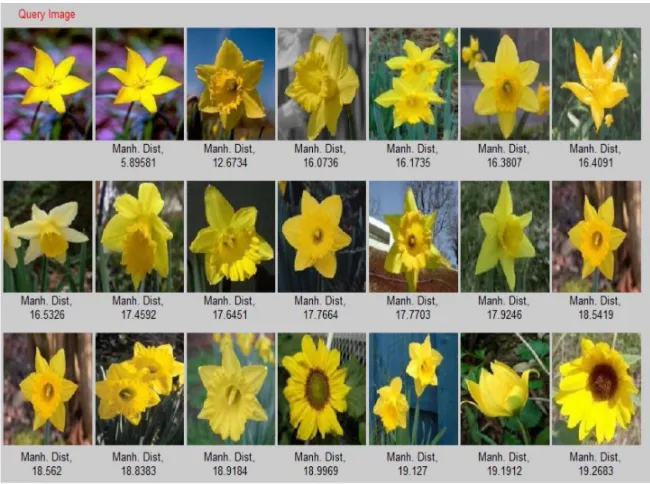
images. The result of the developed QBIC System when input query image is flower belongs to Category 2 is shown in figure 2 with relevant and irrelevant, 20 retrieved images.
174
We give image of flower as query image which belongs to category 2nd and the result is shown in figure 2. The result reveals that the retrieved images contain all relevant images and no irrelevant images. We retrieve 20 relevant and 0 irrelevant images out of 20 retrieved images. The Manhattan Distance of most similar images is calculated and is shown below each retrieved image.
VI. CONCLUSION
In this paper, we give the brief overview of QBIC system. The techniques used for the system and along with similarity measure. The results of the developed system prove the effectiveness of the QBIC system. The overall accuracy of the developed system is 96 %.
REFERENCES
1. M.Eisa, I.Elhenawy, A.E.Elalafi and H. Burkhardt, “Image Retrieval based on Invariant Features and Histogram Refinement”, ICGST Int. Journal on Graphics, Vision and Image Processing (GVIP) , Special Issue on Image Retrievaland Representation, Vol. 6, Year 2006, pp. 7-11.
2. Zachary J M, “An Information Theoretic Approach to Content Based image Retrieval”, Louisiana State University and Agricultural and Mechanical College, Phd, Thesis, pp. 45-62, 2000.
3. S. Sural, G.Qian and S.Pramanik, “A Histogram with Perceptually Smooth
Color Transition for Image Retrieval”, Proc. Fourth Int. Conf. on CVPRIP, Durham, 2002.
4. A. W. M. Smeulders, “Content-based image retrieval at the end of the early years”, IEEE Trans. PAMI. 22(12):1349– 1380, 2000.
5. V. Castelli and L. D. Bergman (Eds.). Image Databases: Search and Retrieval of Digital Imagery. John Wiley & Sons, 2002.
6. H. Muller, “A review of content-based image retrieval systems in medical applications—Clinical benefits and future directions.”, Int. J. Med. Info. 73:1–23, 2004.
7. Ying Liu, Dengsheng Zhang, Guojun Lu,Wei-Ying Ma, “A survey of content-based image retrieval with high-level semantics”, Pattern Recognition 40 (2007) 262 – 282.
8. Hong-Ying Yang, Yong-Wei Li, Wei-Yi Li, Xiang-Yang Wang, Fang-Yu Yang, “Content based image retrieval using local visual attention feature”, J. Vis. Commun. Image (2014) 1308–1323. 9. H. Muller et al. A review of
content-based image retrieval systems in medical applications—Clinical benefits and future directions. Int. J. Med. Info. 73:1–23, 2004.