Research Article
On the Impulsive Synchronization Control for
a Class of Chaotic Systems
Bo Wang,
1,2Peng Shi,
3,4and Xiucheng Dong
11School of Electrical and Information Engineering, Xihua University, Chengdu 610039, China
2School of Mathematics and Computer Science, Yunnan University of Nationalities, Kunming 650031, China 3College of Automation, Harbin Engineering University, Harbin, Heilongjiang 150001, China
4School of Engineering and Science, Victoria University, Melbourne, VIC 8001, Australia
Correspondence should be addressed to Bo Wang; pc [email protected]
Received 30 September 2014; Revised 10 December 2014; Accepted 10 December 2014; Published 28 December 2014
Academic Editor: Hamid R. Karimi
Copyright © 2014 Bo Wang et al. This is an open access article distributed under the Creative Commons Attribution License, which permits unrestricted use, distribution, and reproduction in any medium, provided the original work is properly cited.
The problem on chaos synchronization for a class of chaotic system is addressed. Based on impulsive control theory and by constructing a novel Lyapunov functional, new impulsive synchronization strategies are presented and possess more practical application value. Finally some typical numerical simulation examples are included to demonstrate the effectiveness of the theoretical results.
1. Introduction
Chaos synchronization can be found in many areas, such as laser physics and chemical reactor. Up to now many kinds of methods have been developed to realize chaos
synchronization, such as feedback control method [1–3],
sliding control method [4–6], backstepping control method
[7, 8], fuzzy control method [9–12], and adaptive control
method [13–15].
Recently impulsive control theory and its application in chaos synchronization have become a research hotspot. For instance, based on impulsive control strategies, the reduced-order observer for the synchronization of generalized Lorenz
chaotic systems is built in [16], the adaptive modified
function projective synchronization of multiple time-delayed
chaotic Rossler systems is discussed in [17], the hybrid
synchronization of L¨u hyperchaotic system with disturbances
is investigated in [18], and the robust synchronization of
perturbed Chen’s fractional-order chaotic systems is studied
in [19]. However, these results are just about one kind of
chaotic systems, which limits their applied scope. Hence how to design the impulsive strategy to realize the synchronization suitable for more chaotic systems activates our research.
In this paper, the following class of chaotic system is introduced:
̇𝑧 = 𝑓 (𝑧) ,
𝑧 (𝑡0+) = 𝑧0, (1)
where𝑧(𝑡) ∈ 𝑅𝑛is the system state vector and𝑓(𝑧)is the
non-linear function below second order and can be transformed as follows:
̇𝑧 = 𝐶 + 𝐴𝑧 + 𝐵 (𝑧) 𝑧, 𝑧 (𝑡0+) = 𝑧0,
𝐵𝑖𝑗(𝑧) = 12𝑑 (𝑓𝑑𝑧𝑖(𝑧))
𝑗 ,
(2)
where𝐴and𝐶are linear constant matrices and𝐵(𝑧)is the
linear matrix about𝑧.
System model(2)includes some chaotic systems, such as
Lorenz system, Rossler system, Chen system, and L¨u system.
Hence, the research on system model(2)will possess more
practical application value, compared with those focused on one kind of chaotic system.
The remainder of this paper is organized as follows. The model description and preliminaries are proposed in
Section 2. Based on impulsive control theory and Lyapunov method, we shall try to propose a new and practical impulsive strategy to realize the synchronization for a class of chaotic
systems inSection 3. Finally, some typical examples will be
included to show the correctness of the theoretical results in
Section 4, and the paper will be concluded inSection 5.
2. Model Description and Preliminaries
Consider the following main chaotic system:
̇𝑦 = 𝐶 + 𝐴𝑦 + 𝐵 (𝑦) 𝑦, 𝑦 (𝑡0+) = 𝑦0,
𝐵𝑖𝑗(𝑦) = 1 2
𝑑 (𝑓𝑖(𝑦))
𝑑𝑦𝑗 ,
(3)
where𝑦(𝑡) ∈ 𝑅𝑛is the state variable of the main system.
The slave system is
̇𝑥 = 𝐶 + 𝐴𝑥 + 𝐵 (𝑥) 𝑥, 𝑡 ̸= 𝑡𝑘,
Δ𝑥 = 𝐵𝑘(𝑥 − 𝑦) , 𝑡 = 𝑡𝑘,
𝑥 (𝑡0+) = 𝑥0,
𝐵𝑖𝑗(𝑥) = 1 2
𝑑 (𝑓𝑖(𝑥)) 𝑑𝑥𝑗 .
(4)
Define the error state variable as
𝑒 (𝑡) = 𝑥 (𝑡) − 𝑦 (𝑡) . (5)
We get the following error dynamical system:
̇𝑒 = 𝐴𝑒 + 𝐵 (𝑥) 𝑥 − 𝐵 (𝑦) 𝑦, 𝑡 ̸= 𝑡𝑘,
Δ𝑒 = 𝐵𝑘𝑒, 𝑡 = 𝑡𝑘,
𝑒 (𝑡0+) = 𝑒0.
(6)
Hence, the problem to be addressed in this paper is to design an impulsive control method such that the tracking error variable satisfies
lim
𝑡 → ∞‖𝑒 (𝑡)‖ =𝑡 → ∞lim 𝑥(𝑡) − 𝑦(𝑡) → 0. (7)
3. Main Results
In this section, based on Lyapunov method and impulsive control theory, the following theoretical results are presented.
Theorem 1. For the given class of chaotic systems, based on the following impulsive control strategy
𝑎 = 𝜆max((𝑢𝑘− 1)
Δ𝑘𝑢𝑘 + Π𝑇+ Π) < 0, (8)
where
Π = 1
𝑢𝑘(𝐴 + 𝐵 (𝑥) + 𝐵 (𝑦)) ,
𝑢𝑘= 𝜆max[(𝐼 + 𝐵𝑘)𝑇(𝐼 + 𝐵𝑘)] ,
𝐵𝑘< 0, Δ𝑘= 𝑡𝑘+1− 𝑡𝑘,
(9)
the slave chaotic system(4) with any initial conditions will synchronize the master chaotic system(3).
Proof. Choose the following Lyapunov functional candidate:
𝑉 (𝑡) = 𝑔 (𝑡) 𝑒𝑇(𝑡) 𝑒 (𝑡) (10)
with
𝑔 (𝑡) = (𝑡(𝑢𝑘− 1)
𝑘+1− 𝑡𝑘) 𝑢𝑘 (𝑡𝑘− 𝑡) +
1 𝑢𝑘, 𝑡 ∈ [𝑡𝑘, 𝑡𝑘+1) .
(11)
ConsideringΔ𝑘= 𝑡𝑘+1− 𝑡𝑘, we have
𝑔 (𝑡) = (𝑢Δ𝑘− 1)
𝑘𝑢𝑘 (𝑡𝑘− 𝑡) +
1 𝑢𝑘, 𝑡 ∈ [𝑡𝑘, 𝑡𝑘+1) .
(12)
When𝑡 ∈ (𝑡𝑘, 𝑡𝑘+1), the time derivative of𝑉(𝑡) along the trajectories of the error dynamical system is given by
̇𝑉 (𝑡) = ̇𝑔 (𝑡) 𝑒𝑇(𝑡) 𝑒 (𝑡) + 2𝑔 (𝑡) 𝑒𝑇(𝑡) ̇𝑒(𝑡)
= (𝑢𝑘− 1)
Δ𝑘𝑢𝑘 𝑒𝑇(𝑡) 𝑒 (𝑡) + 2𝑔 (𝑡) 𝑒𝑇(𝑡) ̇𝑒(𝑡) .
(13)
For𝐵(𝑒)𝑥 = 𝐵(𝑥)𝑒, the error dynamical system (6)can be transformed as
̇𝑒(𝑡) = (𝐴 + 𝐵 (𝑥) + 𝐵 (𝑦)) 𝑒 (𝑡) , 𝑡 ̸= 𝑡𝑘,
Δ𝑒 (𝑡) = 𝐵𝑘𝑒 (𝑡) , 𝑡 = 𝑡𝑘,
𝑒 (𝑡0+) = 𝑒0.
(14)
Hence
̇𝑉 (𝑡) ≤ 𝑒𝑇(𝑡) ((𝑢𝑘− 1)
Δ𝑘𝑢𝑘 + 𝑔 (𝑡) (𝐴 + 𝐵 (𝑥) + 𝐵 (𝑦))
𝑇
+ 𝑔 (𝑡) (𝐴 + 𝐵 (𝑥) + 𝐵 (𝑦))) 𝑒 (𝑡) .
(15)
It can be concluded that
̇𝑉 (𝑡) ≤ 𝑒𝑇(𝑡) ((𝑢𝑘− 1)
Δ𝑘𝑢𝑘 + Π𝑇+ Π) 𝑒 (𝑡) ≤ 𝑎𝑉 (𝑡) ,
where
Π = 1
𝑢𝑘(𝐴 + 𝐵 (𝑥) + 𝐵 (𝑦)) . (17)
Hence
(𝑉 (𝑡) 𝑒−𝑎𝑡)= ( ̇𝑉 (𝑡) − 𝑎𝑉 (𝑡)) 𝑒−𝑎𝑡 ≤ 0. (18)
Integrating the above inequality from𝑡𝑘to𝑡, we have
𝑉 (𝑡) 𝑒−𝑎𝑡≤ 𝑉 (𝑡𝑘) 𝑒−𝑎𝑡𝑘. (19)
Then the following inequality can be obtained:
𝑉 (𝑡) ≤ 𝑉 (𝑡𝑘+)exp(𝑎 (𝑡 − 𝑡𝑘)) . (20)
Considering
𝑉(𝑡𝑘+) = 𝑔 (𝑡𝑘+) 𝑒𝑇(𝑡𝑘+) 𝑒 (𝑡𝑘+)
= 𝑔 (𝑡𝑘+) [(𝐼 + 𝐵𝑘) 𝑒 (𝑡𝑘−)]𝑇[(𝐼 + 𝐵𝑘) 𝑒 (𝑡𝑘−)] = 𝑉 (𝑡𝑘−) ,
(21)
we have
𝑉 (𝑡) ≤ 𝑉 (𝑡0+)exp(𝑎 (𝑡 − 𝑡0)) . (22)
One can obtain
‖𝑒 (𝑡)‖ ≤ 𝑒0exp(12𝑎 (𝑡 − 𝑡0)) . (23)
Hence, it can be concluded that the error dynamical system
(6) is stable. That means that the slave system (4) can
synchronize with the master system(3)based on the given
impulsive control strategy and this completes the proof.
Next, let𝐵𝑘 = 𝑏𝐼andΔ𝑘 = Δ, and based onTheorem 1,
we can derive the following theoretical results, and its proof is omitted.
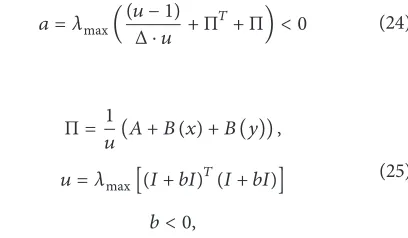
Theorem 2. For the given class of chaotic system, based on the following impulsive control strategy
𝑎 = 𝜆max((𝑢 − 1)
Δ ⋅ 𝑢 + Π𝑇+ Π) < 0 (24)
with
Π = 1𝑢(𝐴 + 𝐵 (𝑥) + 𝐵 (𝑦)) ,
𝑢 = 𝜆max[(𝐼 + 𝑏𝐼)𝑇(𝐼 + 𝑏𝐼)]
𝑏 < 0,
(25)
the slave chaotic system(4) with any initial conditions will synchronize with the master chaotic system(3).
−10 0 10 20
30 40 50
−20 −10 0 10 20 −30 −20
−100
10 20 30
y1
y2
y3
Figure 1: Dynamic behavior of the chaotic system in case 1.
4. Example and Simulation
In this section, we will verify the proposed methodology by giving two illustrative examples. First consider the unified chaotic system as follows:
̇𝑧
1= (25𝑟 + 10) (𝑧2− 𝑧1) ,
̇𝑧
2= (28 − 35𝑟) 𝑧1− 𝑧1𝑧3+ (29𝑟 − 1) 𝑧2,
̇𝑧
3= 𝑧1𝑧2−𝑟 + 83 𝑧3.
(26)
It can be transformed as
̇𝑧 = 𝐶 + 𝐴𝑧 + 𝐵 (𝑧) 𝑧 (27)
with
𝐴 = [[ [
−25𝑟 − 10 25𝑟 + 10 0 28 − 35𝑟 29𝑟 − 1 0
0 0 −𝑟 + 8
3 ] ] ] ,
𝐵 (𝑧) = 12[ [
0 0 0 −𝑧3 0 −𝑧1
𝑧2 𝑧1 0 ] ]
, 𝐶 = [ [ 0 0 0 ] ] .
(28)
Unified chaotic system has different dynamic behavior with
different parameter𝑟. For instance, the unified chaotic system
represents L¨u system when𝑟 = 0.8, Lorenz system when0 ≤
𝑟 < 0.8, and Chen system when0.8 < 𝑟 ≤ 1.
The numerical simulation is with initial condition𝑥0 =
[7, 9, 2]𝑇, 𝑦
0 = [−1, 3, 5]𝑇, and the simulation step 0.001
second. Based onTheorem 2, we choose the impulsive control
parametersΔ = 0.02,𝑏 = −0.8.
Remark 3. Figure 1 depicts the dynamic behavior of the chaotic system in case 1. It can be seen that the state variable moves in a scope and will never converge to a constant with
the lapse of time.Figure 2depicts the time response of the
−5 0 5 10
−10 −5 0 5
0 0.2 0.4 0.6 0.8 1 1.2 1.4 1.6 1.8 2
−5 0 5 10
t (s)
0 0.2 0.4 0.6 0.8 1 1.2 1.4 1.6 1.8 2
t (s)
0 0.2 0.4 0.6 0.8 1 1.2 1.4 1.6 1.8 2
t (s)
e3
e2
e1
Figure 2: Time response of the error variable in case 1.
Next, consider the following Rossler system
̇𝑧
1= − 𝑧2− 𝑧3,
̇𝑧
2= 𝑧1+ 0.15𝑧2,
̇𝑧
3= 0.2 + 𝑧3(𝑧1− 10) .
(29)
It can be transformed as follows:
̇𝑧 = 𝐶 + 𝐴𝑧 + 𝐵 (𝑧) 𝑧 (30)
with
𝐴 = [ [
0 −1 −1 1 0.15 0 0 0 −10
] ]
, 𝐵 (𝑧) = 12[ [
0 0 0 0 0 0 𝑧3 0 𝑧1
] ] ,
𝐶 = [ [ 0 0 0.2
] ] .
(31)
The numerical simulation is with initial condition 𝑥0 =
[−1, 5, −4]𝑇,𝑦
0 = [7, −6, 2]𝑇and the simulation step 0.001
second. Based onTheorem 2, we choose the impulsive control
parametersΔ = 0.02and𝑏 = −0.8.
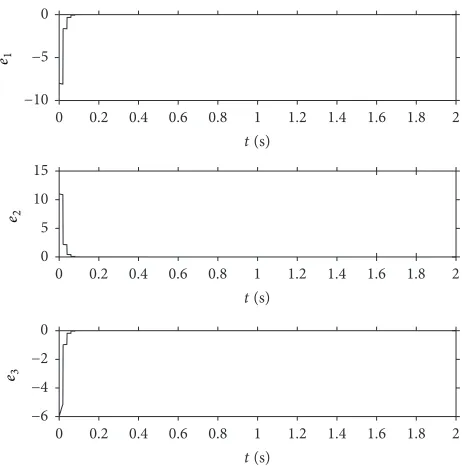
Remark 4. Figure 3 depicts the dynamics of the chaotic
system in case 2.Figure 4 depicts the time response of the
error variable of master-salve system in case 2. It can be seen that the error variable converges to zero quickly based on the proposed impulse control method.
From the above numerical simulations, it can be con-cluded that our impulsive synchronization strategy has more practical application value compared with those specific to one kind of chaotic system.
−15 −10−5 0
5 10 15 20
−20 −10 0 10 20 0 5 10 15 20 25 30 35 40
y1
y2
y3
Figure 3: Dynamical behavior of the chaotic system in case 2.
−10 −5 0
0 5 10 15
0 0.2 0.4 0.6 0.8 1 1.2 1.4 1.6 1.8 2
−6 −4 −2 0
t (s)
0 0.2 0.4 0.6 0.8 1 1.2 1.4 1.6 1.8 2
t (s)
0 0.2 0.4 0.6 0.8 1 1.2 1.4 1.6 1.8 2
t (s)
e3 e2 e1
Figure 4: Time response of the error state variable in case 2.
5. Conclusions
This paper focuses on the chaos synchronization problem and tries to figure out the strategies suitable for more chaotic systems. Based on the impulsive control technique and Lya-punov stability theory, we have presented the new impulsive synchronization strategies for a class of chaotic systems. Finally some numerical simulations have been carried out to demonstrate the effectiveness of our theoretical results.
Conflict of Interests
The authors declare that there is no conflict of interests regarding the publication of this paper.
Acknowledgments
of Education (SZjj2011-006), the Chunhui Plan Project of Ministry of Education (Z2011089, Z2014055), Xihua University Young Scholars Training Program (01201419), the Open Research Subject of Key Laboratory of Signal and Information Processing of Sichuan Province (szjj2014-018), and the National Natural Science Foundation of China (61174058, 61134001, and 11461062).
References
[1] A. E. Matouk, “Chaos, feedback control and synchronization of a fractional-order modified autonomous Van der Pol-Duffing
circuit,”Communications in Nonlinear Science and Numerical
Simulation, vol. 16, no. 2, pp. 975–986, 2011.
[2] D. Chen, P. Shi, and X. Ma, “Control and synchronization of
chaos in an induction motor system,”International Journal of
Innovative Computing, Information and Control, vol. 8, no. 10, pp. 7237–7248, 2012.
[3] H. R. Karimi and H. Gao, “New delay-dependent exponential
𝐻∞synchronization for uncertain neural networks with mixed
time delays,”IEEE Transactions on Systems, Man, and
Cybernet-ics Part B, vol. 40, no. 1, pp. 173–185, 2010.
[4] M. Heydari, H. Salarieh, and M. Behzad, “Stochastic chaos syn-chronization using unscented Kalman-Bucy filter and sliding
mode control,”Mathematics and Computers in Simulation, vol.
81, no. 9, pp. 1770–1784, 2011.
[5] A. Razminia and D. Baleanu, “Complete synchronization of commensurate fractional order chaotic systems using sliding
mode control,”Mechatronics, vol. 23, no. 7, pp. 873–879, 2013.
[6] H. R. Karimi, “A sliding mode approach to𝐻∞synchronization
of master-slave time-delay systems with Markovian jumping
parameters and nonlinear uncertainties,”Journal of the Franklin
Institute, vol. 349, no. 4, pp. 1480–1496, 2012.
[7] Y. Yu and H.-X. Li, “Adaptive hybrid projective synchronization of uncertain chaotic systems based on backstepping design,”
Nonlinear Analysis: Real World Applications, vol. 12, no. 1, pp. 388–393, 2011.
[8] N. Chen, F. Song, G. Li, X. Sun, and C. Ai, “An adaptive sliding mode backstepping control for the mobile manipulator
with nonholonomic constraints,”Communications in Nonlinear
Science and Numerical Simulation, vol. 18, no. 10, pp. 2885–2899, 2013.
[9] M. Chadli, H. R. Karimi, and P. Shi, “On stability and stabi-lization of singular uncertain Takagi-Sugeno fuzzy systems,”
Journal of the Franklin Institute, vol. 351, no. 3, pp. 1453–1463, 2014.
[10] A. I. Al-Odienat, “The PID controller based on genetic
algo-rithm for voltage stability of the synchronous machine,”
Inter-national Journal of Innovative Computing, Information and Control, vol. 10, pp. 2263–2276, 2014.
[11] M. Chadli, I. Zelinka, and T. Youssef, “Unknown inputs observer design for fuzzy systems with application to chaotic
system reconstruction,”Computers & Mathematics with
Appli-cations, vol. 66, no. 2, pp. 147–154, 2013.
[12] H. R. Karimi, M. Zapateiro, and N. Luo, “Stability analysis and control synthesis of neutral systems with time-varying delays
and nonlinear uncertainties,”Chaos, Solitons and Fractals, vol.
42, no. 1, pp. 595–603, 2009.
[13] I. Zelinka, M. Chadli, D. Davendra, R. Senkerik, and R. Jasek, “An investigation on evolutionary reconstruction of continuous
chaotic systems,”Mathematical and Computer Modelling, vol. 57,
no. 1-2, pp. 2–15, 2013.
[14] U. E. Vincent and R. Guo, “Finite-time synchronization for a class of chaotic and hyperchaotic systems via adaptive feedback
controller,”Physics Letters, Section A: General, Atomic and Solid
State Physics, vol. 375, no. 24, pp. 2322–2326, 2011.
[15] H. R. Karimi, M. Zapateiro, and N. Luo, “Adaptive synchroniza-tion of master-slave systems with mixed neutral and discrete
time-delays and nonlinear perturbations,” Asian Journal of
Control, vol. 14, no. 1, pp. 251–257, 2012.
[16] Z. Zhang, H. Shao, Z. Wang, and H. Shen, “Reduced-order observer design for the synchronization of the generalized
Lorenz chaotic systems,”Applied Mathematics and
Computa-tion, vol. 218, no. 14, pp. 7614–7621, 2012.
[17] K. S. Sudheer and M. Sabir, “Adaptive modified function projective synchronization of multiple time-delayed chaotic
Rossler system,”Physics Letters A, vol. 375, no. 8, pp. 1176–1178,
2011.
[18] Q. Li, R. Dong, and B. Lu, “Hybrid synchronization of L¨u hyperchaotic system with disturbances by sliding mode
con-trol,”Procedia Engineering, vol. 15, pp. 23–27, 2011.
[19] M. Asheghan, M. Beheshti, and M. Tavazoei, “Robust synchro-nization of perturbed Chen's fractional-order chaotic systems,”
Communications in Nonlinear Science and Numerical
Submit your manuscripts at
http://www.hindawi.com
Hindawi Publishing Corporation
http://www.hindawi.com Volume 2014
Mathematics
Journal ofHindawi Publishing Corporation
http://www.hindawi.com Volume 2014
Mathematical Problems in Engineering
Hindawi Publishing Corporation http://www.hindawi.com
Differential Equations
International Journal of
Volume 2014
Hindawi Publishing Corporation
http://www.hindawi.com Volume 2014 Hindawi Publishing Corporationhttp://www.hindawi.com Volume 2014
Hindawi Publishing Corporation
http://www.hindawi.com Volume 2014
Mathematical PhysicsAdvances in
Complex Analysis
Journal ofHindawi Publishing Corporation
http://www.hindawi.com Volume 2014
Optimization
Journal ofHindawi Publishing Corporation
http://www.hindawi.com Volume 2014
Combinatorics
Hindawi Publishing Corporation
http://www.hindawi.com Volume 2014
International Journal of
Hindawi Publishing Corporation
http://www.hindawi.com Volume 2014
Journal of
Hindawi Publishing Corporation
http://www.hindawi.com Volume 2014
Function Spaces
Abstract and Applied Analysis
Hindawi Publishing Corporation
http://www.hindawi.com Volume 2014
International Journal of Mathematics and Mathematical Sciences
Hindawi Publishing Corporation http://www.hindawi.com Volume 2014
The Scientific
World Journal
Hindawi Publishing Corporation
http://www.hindawi.com Volume 2014
Hindawi Publishing Corporation
http://www.hindawi.com Volume 2014
Discrete Dynamics in Nature and Society
Hindawi Publishing Corporation
http://www.hindawi.com Volume 2014
Hindawi Publishing Corporation
http://www.hindawi.com Volume 2014
Discrete Mathematics
Journal ofHindawi Publishing Corporation
http://www.hindawi.com Volume 2014 Hindawi Publishing Corporationhttp://www.hindawi.com Volume 2014